15 Xeriscape Outdoor Lighting Ideas for Fall

Gravel, stone, and spiky plants look great at noon, then vanish the minute the sun drops. These xeriscape outdoor lighting ideas fix that, and fall is the season that makes it urgent. Clocks fall back on Sunday, November 1, 2026, and the yard you planted with blue grama and yucca goes dark before dinner.
Here’s the good news. A dry garden needs less light than a lawn-and-shrub yard, not more.
Pale gravel bounces a soft glow. Spiky leaves throw sharp shadows. Grass seedheads catch a backlight like they were built for it.
Below are 15 ideas, each tied to a real plant, a fixture type, and a price tier you can plan around. You’ll find the trick that makes little bluestem glow copper, and the setback distance that keeps a tall cactus from looking like a crime scene. You’ll also get the honest math on solar path lights once October days get short. First, though, a quick test that sorts every spot in your yard into solar, low-voltage, or plug-in before you buy a single fixture.
The Sun-or-Socket Test
Walk your yard around 3 p.m. on a clear October day and run each spot you want to light through these four questions. It takes about ten minutes. It also stops the most common fall mistake: parking solar fixtures where the low autumn sun never reaches. Every spot lands on solar, low-voltage, or plug-in, and several ideas below point back to this test by name.
🌞 The Sun-or-Socket Test
Does the spot get the hours of direct October sun the box asks for (often 6 to 8)? Yes: solar can work here. No: go to question 2.
Is there a GFCI outdoor outlet within about 75 feet? Yes: a low-voltage kit with a plug-in transformer. No: go to question 3.
Will the light hang overhead on posts, a fence, or the eaves? Yes: plug-in café string lights on an outdoor-rated cord. No: go to question 4.
Still stuck in the shade? Pick a solar fixture with a separate panel on its own cord, and stake the panel where the sun does reach.
1. Backlit Little Bluestem That Glows Copper After Sunset
Fall is when little bluestem earns its spot. The blades turn copper and rust, and fluffy silver seedheads show up right as the evenings stretch out. It’s hardy across Zones 3 to 9 and barely needs water once it settles in.
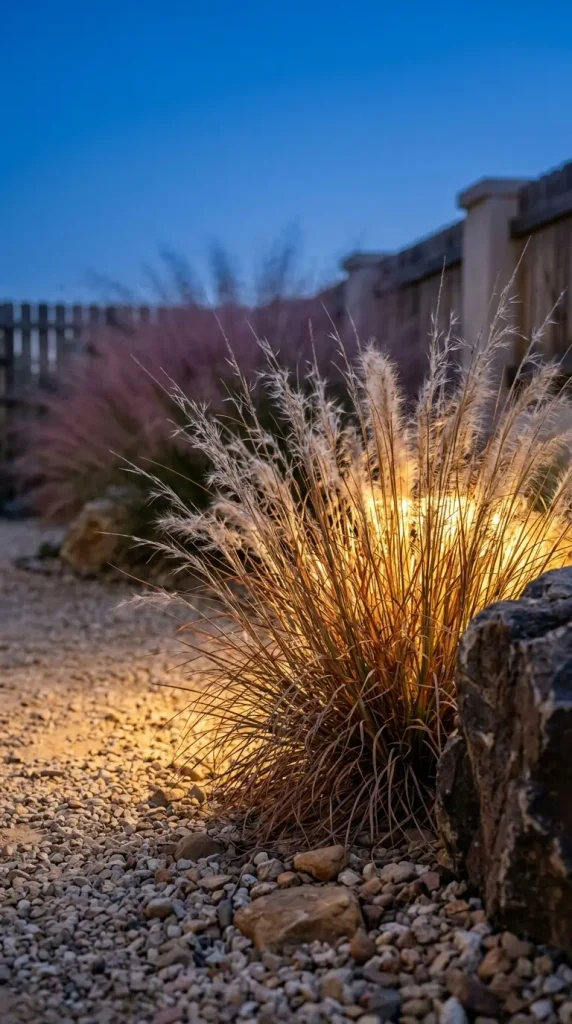
The fix is simple: put the light behind the grass, not in front of it. A small LED spot set 2 to 3 feet behind the clump, aimed back toward where you sit, turns each seedhead into a tiny filament. Pink muhly grass pulls off the same trick in Zone 6 and warmer.
Keep that spot low and hidden. If you can see the bulb from your patio chair, drop it a few inches or tuck it behind a boulder.
Front lighting flattens grass. Backlighting makes it glow.
Fine seedheads scatter light the way frost does on a window. Light them from behind, level with the plumes, and the whole clump outlines itself against the dark.
2. Yucca Shadow Art on a Stucco Wall or Cedar Fence
Lighting pros call this silhouette lighting: you light the wall behind a plant, not the plant itself. Spiky xeric plants are the best candidates in the whole yard. An Adam’s needle yucca or a Parry’s agave throws a shadow far sharper than any leafy shrub ever could.
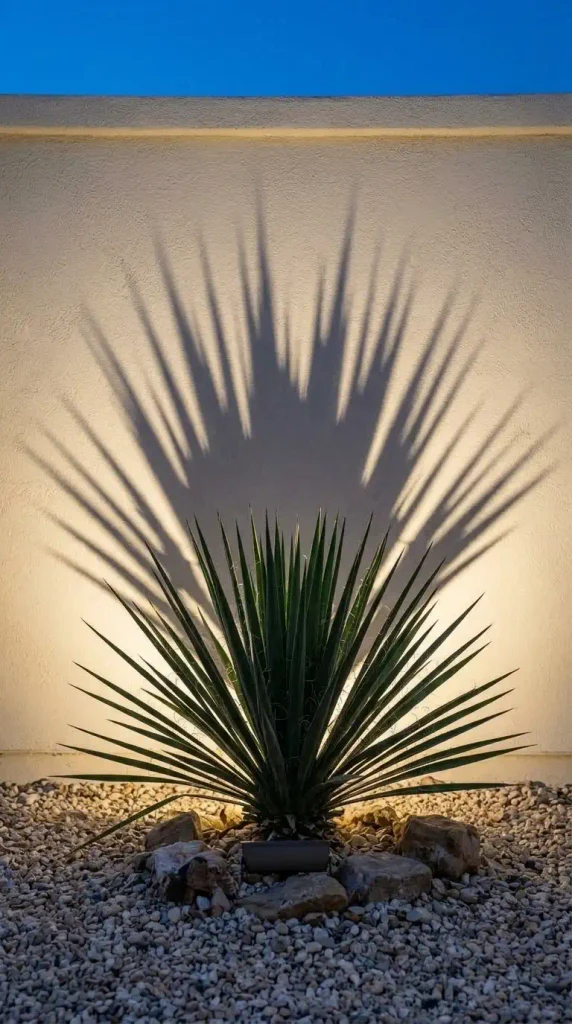
Adam’s needle is hardy across Zones 5 to 9. Parry’s agave is the pick for Zone 7 and warmer. Here’s the full setup:
🪴 Recreate the silhouette
Lock the angle from your seat, not from the flower bed. The shadow should look sharpest where you actually sit.
3. Solar Path Lights on Decomposed Granite That Still Work in November
Solar path lights that glowed until midnight in July often fade by 8 p.m. in late October. According to the Department of Energy, the winter run time for outdoor solar lighting can drop 30 to 50 percent unless the fixture was built for winter use.
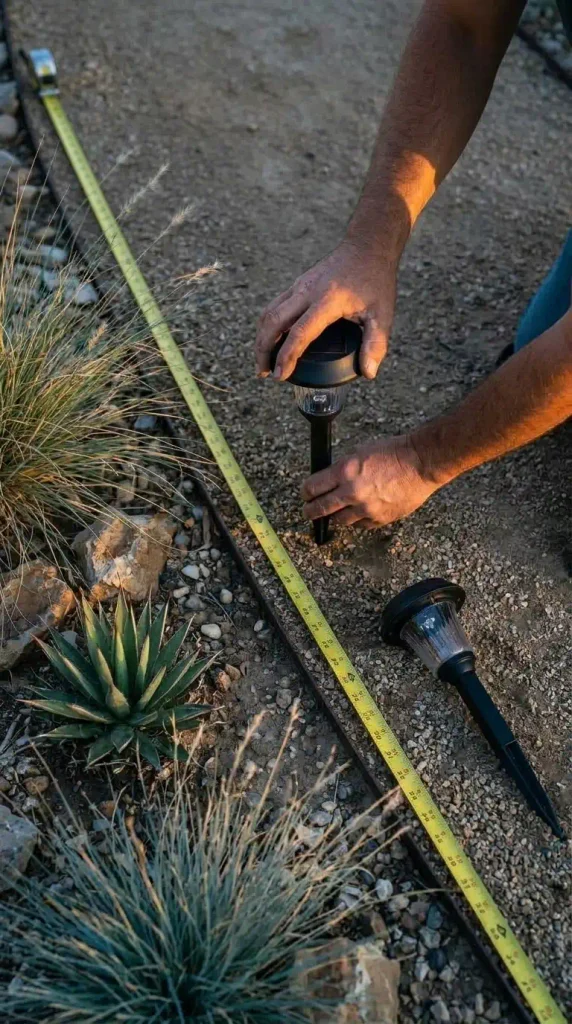
Three moves keep a decomposed granite path lit through fall:
- Run the Sun-or-Socket Test first. A path along a north fence fails question one, every time.
- Turn each panel toward the south, where the low fall sun sits.
- Wipe the panels every few weeks. Fine dust off a DG path settles on them fast.
Hampton Bay solar path lights and spotlights usually run under $15 each at Home Depot. Buy two, test them for a week, then buy the rest.
| 💡 Solar path lights | 🌞 July | 🌙 Late October |
|---|---|---|
| Sun angle | High overhead | Low in the southern sky |
| Fence and wall shade | Short shadows | Long shadows across the path |
| Run time | Often late into the night | Can drop 30 to 50 percent (DOE) |
| Your move | Set and forget | Face panels south, clean them, move shaded ones |
4. Grazed Boulders That Show Off Every Crack and Ridge
Smooth light hides texture. Raking light reveals it.
Grazing means setting a fixture almost against the base of a boulder or a dry-stack wall and aiming it nearly straight up the face. Every ridge throws a tiny shadow, so a plain moss rock suddenly reads as sculpture.
- Set a narrow-beam LED spot 6 to 12 inches from the stone.
- Aim it so the beam skims the face instead of hitting it head on.
- Choose rough stone: granite, sandstone, or dry-stacked flagstone.
Polished river rock is the exception. It just bounces a hot spot back at you.
5. The 30 to 48 Inch Rule for Uplighting a Tall Cactus
Jam a spotlight right at the base of a tree cholla and you get a blinding hot spot at the bottom and darkness up top. Lighting designer Randall Whitehead recommends mounting fixtures 30 to 48 inches away from the base of tall cacti instead, so the light climbs the whole column evenly. It’s the most dramatic desert landscape lighting idea on this list, and the easiest to get wrong.
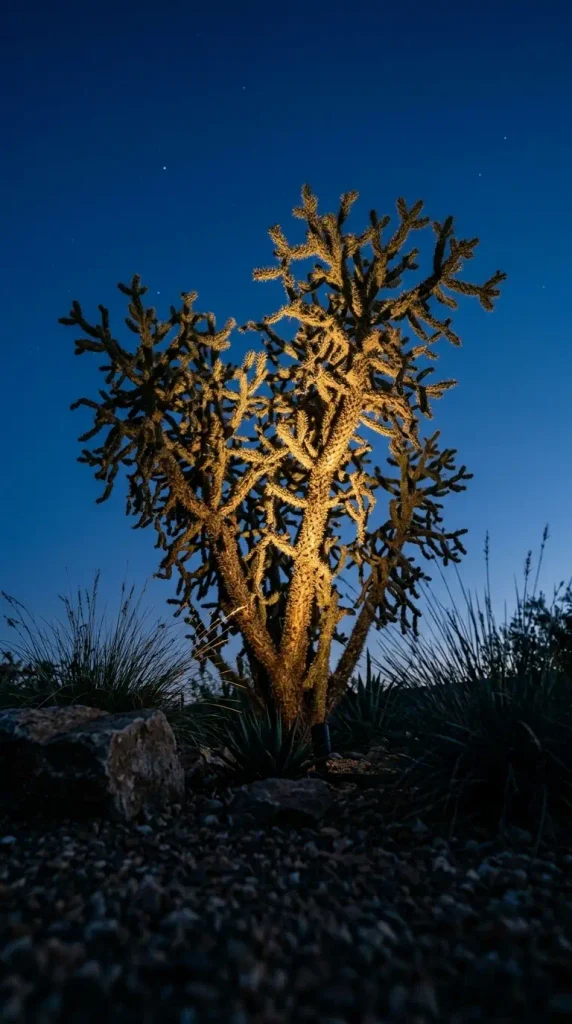
Tree cholla is hardy into Zone 5. Yucca rostrata, with its tall trunk and blue-gray pompom of leaves, suits Zone 6 and warmer with sharp drainage.
📏 Measure 30 to 48 inches out from the base, on the side facing your main view.
💡 Angle a narrow-beam spot so the center of the beam lands about two-thirds of the way up the plant.
🌙 Check it from the house and the street, then nudge the angle until no bare bulb shows.
Taller than 8 feet? Add a second, dimmer spot from the opposite side.
6. Solar Rock Lights Tucked Into a Dry Creek Bed
A dry creek bed is mostly river rock and shadow after dark, which makes it one of the easiest rock garden lighting ideas to pull off. Solar rock lights look like a plain stone by day and glow softly at night, so they disappear into the cobbles.
Place them where water would actually gather. Three to five per run is plenty, and more than that starts to look like an airport runway.
One fall warning: most solar rock lights hide the panel on top. A scatter of October leaves can block it for days, so sweep the creek bed once a week.
7. A Low-Voltage Kit for a No-Grass Front Yard
Curb appeal lives or dies on the front walk. If you’ve swapped turf for gravel and flagstone, every look in our roundup of front yard landscaping with no grass gets sharper once the path is lit.
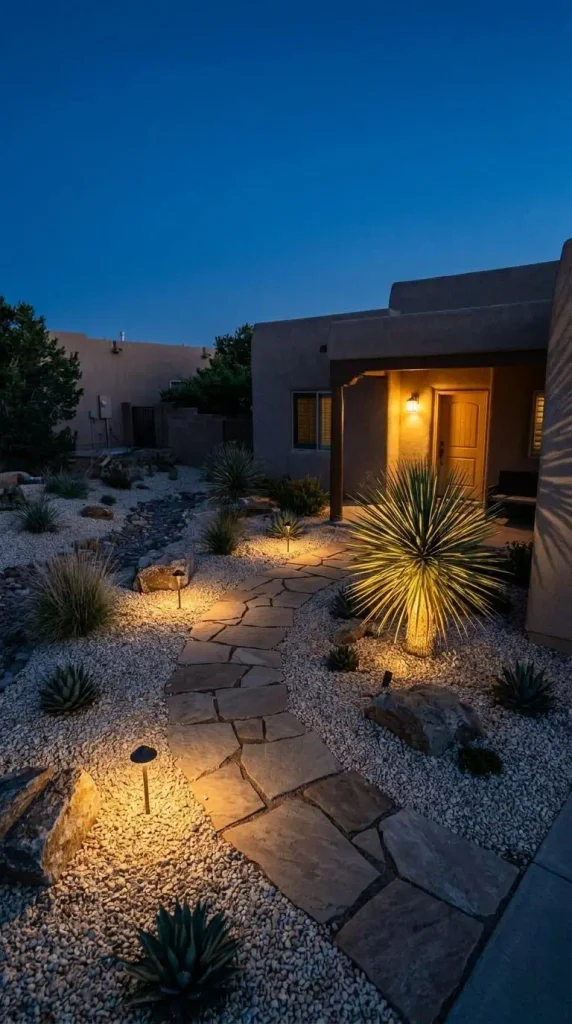
Solar or low-voltage? For a front walk, low voltage landscape lighting usually wins. It runs every night at the same brightness no matter how cloudy October gets, and most transformers include a timer or dusk sensor.
The Malibu Equinox 6-piece LED kit runs around $160 at Walmart. It includes four path lights, two spotlights, a 45-watt power pack, and 75 feet of cable, enough for a typical walk plus one spot on a specimen yucca.
Follow the kit’s burial depth for the cable. In a rock-mulched yard, lay it on top of the landscape fabric and under the gravel, so you can move it later without cutting the fabric.
⚠️ Watch Out
Use outdoor-rated, UL-listed lights and cords on a GFCI outlet. Anything beyond plugging into an existing outlet is a job for a licensed electrician.
8. Café String Lights Over a Gravel Patio, No Trees Required
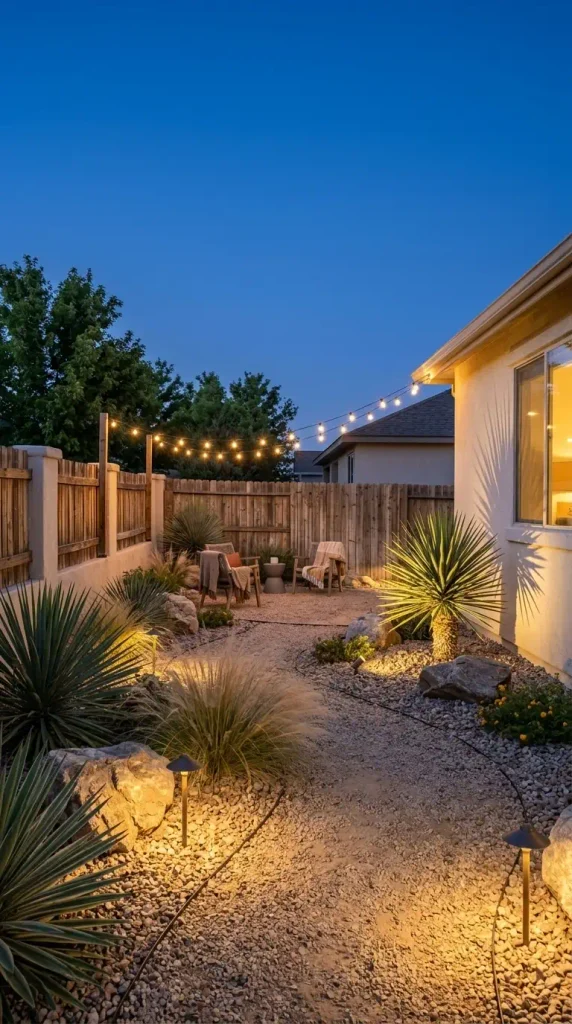
Xeriscapes rarely come with big shade trees, which leaves café string lights with nothing to hang from. The workaround: 10-foot steel or 4×4 cedar posts set in concrete inside large corten or fiberglass planters, then topped with gravel and a few clumps of blue fescue.
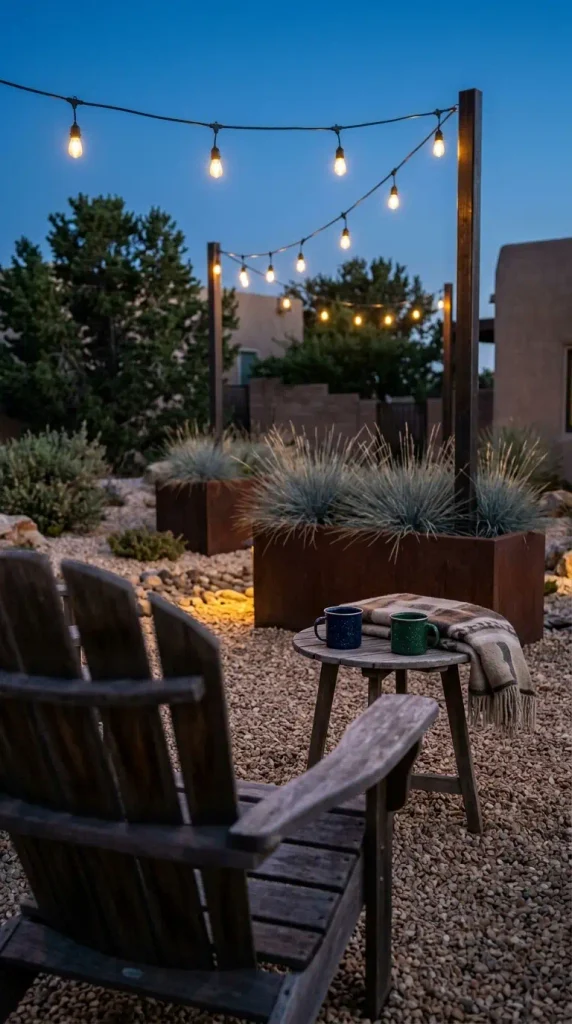
Two strands fit most gravel patios, and the right one depends on your answer to question two of the Sun-or-Socket Test.
| 🔌 Feit 48 ft LED set (Costco) | 🌞 Brightech Ambience Pro Solar 27 ft (Amazon) |
|---|---|
| Plugs into a GFCI outdoor outlet | Charges from a small staked panel |
| Price tier: about $50 to $80 | Price tier: about $20 to $30 |
| Best for: nightly dinners and long spans | Best for: a short span with no outlet |
| Fall catch: needs an outlet nearby | Fall catch: shorter run times as days shrink |
Run the strand in a shallow zigzag, not a tight web, so the night sky still shows between bulbs. Pair the canopy with one of our backyard patio ideas and a plain gravel pad starts to feel like a real outdoor room.
9. Moonlight Pouring Through a Honey Locust
Some of the best lighting in a dry garden never points at a plant.
Moonlighting tucks a downlight high in a tree and lets the branches break the beam into a lace of shadows on the gravel below. Honey locust is ideal for it. Its tiny leaflets turn gold in fall and cast a fine pattern, and the tree handles Zones 3 to 9 on very little water.
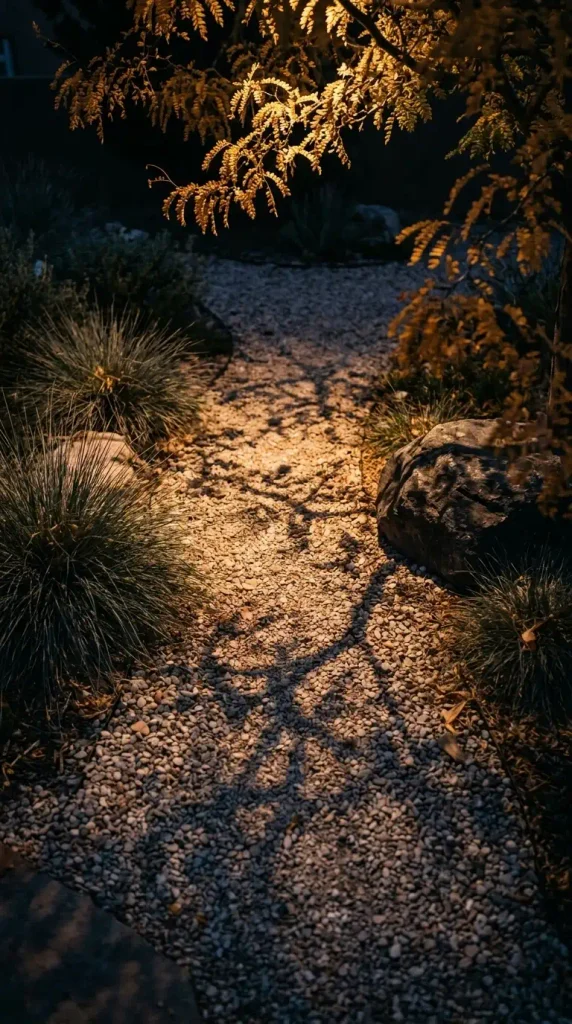
- ▸Mount the fixture on a sturdy limb, aimed down through the canopy so the leaves break the beam.
- ▸Choose a fixture with a glare shield, so nobody on the patio looks straight into it.
- ▸Keep the output low. Moonlight should feel faint, never like a security floodlight.
- ▸Hire out any mounting job above stepladder height.
Once the leaves drop in November, the bare branches throw an even sharper pattern.
10. A Lantern Cluster on Flagstone Steps With Fall Squash
Three heights, one finish, zero open flame.
A cluster of black metal lanterns on the bottom step of a flagstone stair does more for a fall evening than a dozen stake lights. Fill each one with a battery LED pillar candle that has a 6-hour timer. Switch them on once at dusk and they’ll repeat it every evening. Flameless matters here, since dry grass and pine-needle mulch catch fast on a windy October night.
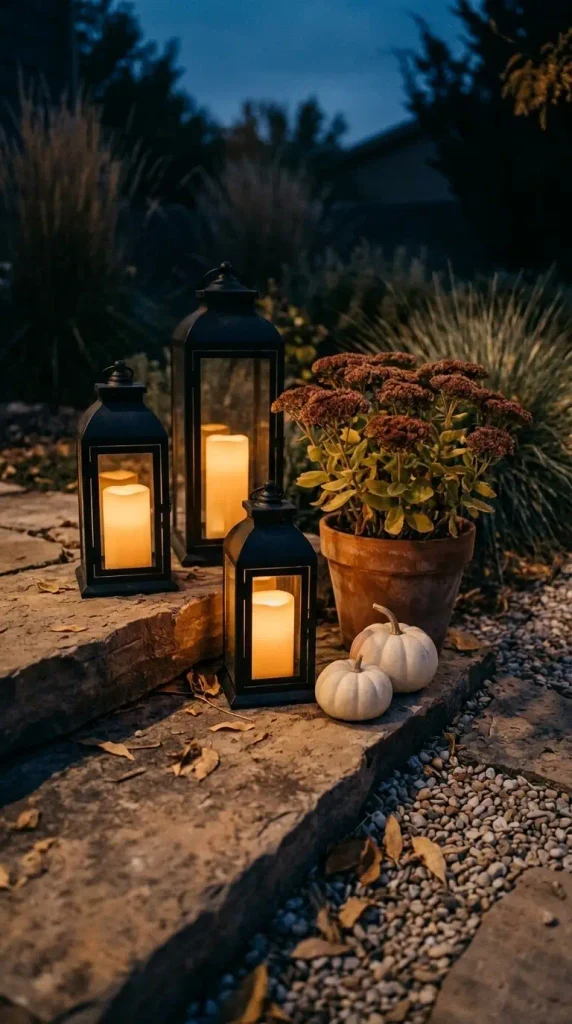
🕯️ Build the step cluster
Swap the squash for small potted evergreens in December, and the cluster carries straight through winter.
11. Low Step Lights for Sloped Gravel Paths and Timber Steps
Slopes are where xeriscapes turn risky after dark. Loose gravel on a grade and timber-edged steps with uneven risers catch toes, and wet fall leaves make it worse.
Step lights solve that by lighting the tread, not the air above it. Mount them low on the riser or on a short post beside each step, aimed down and across.
Light every step, or at least the top and bottom ones.
Pick hooded step lights so the beam stays on the tread.
Tall, bright path lights at eye level on a slope. They blind you on the way down.
Lighting only the middle steps, which hides the first and last edge.
The goal fits in one line: see your footing without ever seeing the bulb.
12. Warm, Shielded, and on a Timer: The Dark-Sky Xeriscape
Here’s the unpopular opinion: most xeriscapes look better with less light. Pale gravel and stone reflect so much that a fixture sized for a lawn-and-shrub bed washes everything flat. Kichler’s own xeriscape lighting guidance says cacti, grasses, and stone call for lower lumen output than a traditional landscape.
Dimmer is also kinder to the night sky. DarkSky’s five principles for responsible lighting come down to useful, targeted, low level, controlled, and warm-colored. In a backyard, that means hooded fixtures, a timer that shuts everything off at 11 p.m., and warm bulbs.
One nuance. Randall Whitehead suggests 3000K over 2700K for cacti and succulents, because it keeps blue-gray leaves from turning muddy. It’s still a warm light, just a shade cleaner.
If you notice the fixture before you notice the plant, it’s too bright. Dim it, hood it, or move it.
13. One Smart Spotlight That Shifts Color With the Season
Problem: A fall yard and a December yard want different moods, and re-aiming fixtures every season gets old fast.
Fix: Put one smart color spot on your best specimen plant. A Philips Hue Lily outdoor spot light base kit runs around $300, plus a Hue Bridge if you don’t already own one. Set warm amber for October, a deeper orange for Halloween week, and soft white the rest of the year. App schedules handle on and off, which also checks the dark-sky timer box.
Payoff: One fixture covers three seasonal looks. Save saturated colors for a holiday night or two, though. Full-time purple on an agave looks like a nightclub.
14. Dollar Tree Solar Stakes, Grouped in Odd Numbers
At about $1.25 each, Dollar Tree solar stake lights won’t last a decade. Grouped well, they still look intentional.
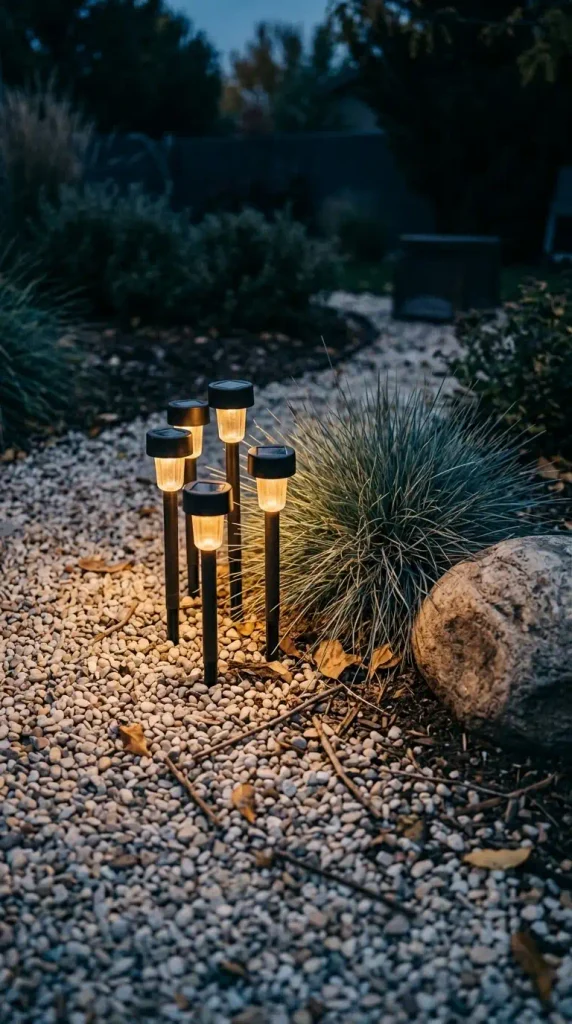
Scattered single stakes read as clutter. Tight groups of three or five read as a design choice. Push each stake into the gravel at a slightly different height, and set the group beside a clump of blue fescue or a small boulder so the glow has something to land on.
Cheap panels feel short fall days fast, so put these through the Sun-or-Socket Test before you buy a bagful. For more low-cost wins, our list of backyard makeover projects under $100 pairs well with this one.
📌 Good To Know
If the plastic spikes wobble in deep gravel, push them down until they hit the landscape fabric, then pile two or three palm-size stones around each base.
15. The Frost-Proof Light Match: Light the Plants That Stand Up to Winter
First fall frost typically arrives around late September to mid-October in Zone 5. Across much of Zone 9 it comes late November or later, and some winters skip it entirely. Your county extension office can give you the typical date for your yard.
Once frost hits, some xeric plants keep their shape all winter and others slump into tan mush. Wiring a permanent fixture to a plant that collapses is wasted effort.
So aim permanent fixtures at plants with winter bones. Save the seasonal tricks, like the lantern cluster from idea 10, for the ones that fade.
❄️ The Frost-Proof Light Match
After frost: stays evergreen
Light it: silhouette on a wall
After frost: copper stems stand tall
Light it: backlight, low
After frost: holds its full shape
Light it: uplight from 30 to 48 inches
After frost: dried rust heads stay upright
Light it: low wide spot
After frost: plumes fade to tan
Light it: fall only, with a movable spot
Xeriscape Outdoor Lighting Ideas Frequently Asked Questions
Do solar lights work in fall and winter?
They work, just for fewer hours. The U.S. Department of Energy says run times can drop 30 to 50 percent in winter unless a fixture was designed for it. Shorter days and a low sun angle mean less charge, especially behind fences. Face the panels south, wipe them every few weeks, and save solar for spots that still get full sun in October.
Do solar lights work in the shade?
Not well. Most solar fixtures need several hours of direct sun to charge, and fall shade from fences, walls, and evergreens stretches longer every week. For a shady spot, pick a solar light with a separate panel on a cord you can stake in the sun. A low-voltage fixture wired back to a transformer is the other option.
What color temperature is best for landscape lighting?
Warm white, roughly 2700K to 3000K, suits most yards. For xeriscapes heavy on blue-gray agave, yucca, and succulents, 3000K keeps the foliage color cleaner without feeling cold. Skip bulbs labeled daylight or 5000K in a garden. They read harsh, flatten texture, and add more of the blue light that dark-sky groups ask homeowners to limit.
How do you light a cactus at night?
Uplight it from a distance. Set a narrow-beam spot about 30 to 48 inches from the base, aimed so the beam lands about two-thirds of the way up the plant. That spreads light evenly and avoids a hot spot at ground level. For wide, spiky plants like agave, try a silhouette instead by lighting the wall behind them.
How bright should xeriscape lighting be?
Dimmer than you’d guess. Gravel, stone, and pale mulch bounce light around, so xeriscape plantings need lower lumen output than lawn-and-shrub beds. Start with the lowest setting or the smallest fixture, and view the yard from your patio and the street. Add brightness only where you still can’t see. If the fixture catches your eye first, it’s too bright.
Can you put landscape lights in gravel or rock?
Yes, and gravel makes it easier than turf. Push stake fixtures straight down into the gravel, then pile a few larger stones around each base to steady it. For low-voltage cable, follow your kit’s burial depth. Lay the cable on top of the landscape fabric, under the rock, so you can adjust it later without cutting the fabric.
Light Less, See More
A dry garden after dark is mostly about restraint. One backlit clump of little bluestem, one silhouetted yucca, and a path you can walk without squinting will beat a yard full of bright stakes.
Start with the Sun-or-Socket Test this weekend, while October still gives you a few good hours of afternoon sun. Then pick two ideas, not ten. Live with them for a week, and add a third only if a corner still feels dark.
Save these xeriscape outdoor lighting ideas to your fall garden board, so they’re right there when the clocks fall back and you’re ready to plan the next layer.