How to Build a Paver Fire Pit (Beginner-Friendly) + 5 Paver Fire Pit Ideas to Copy

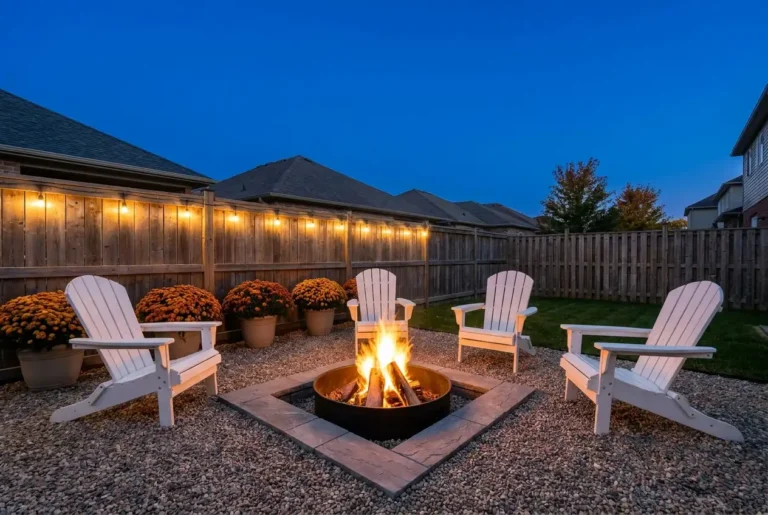
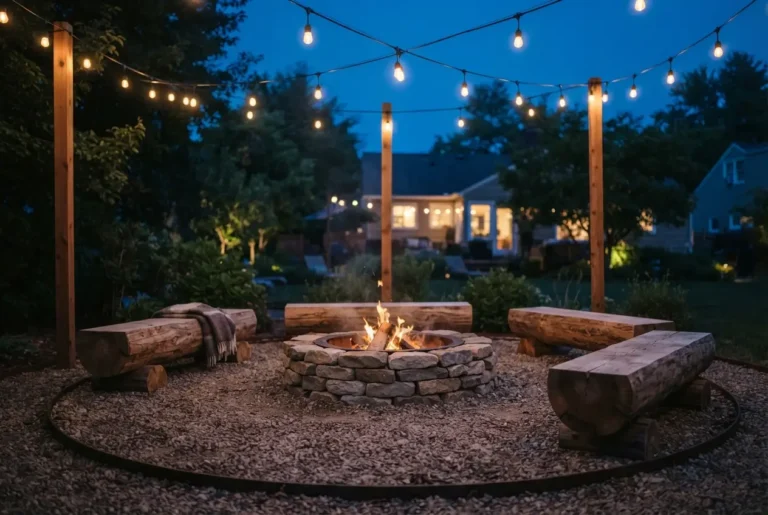
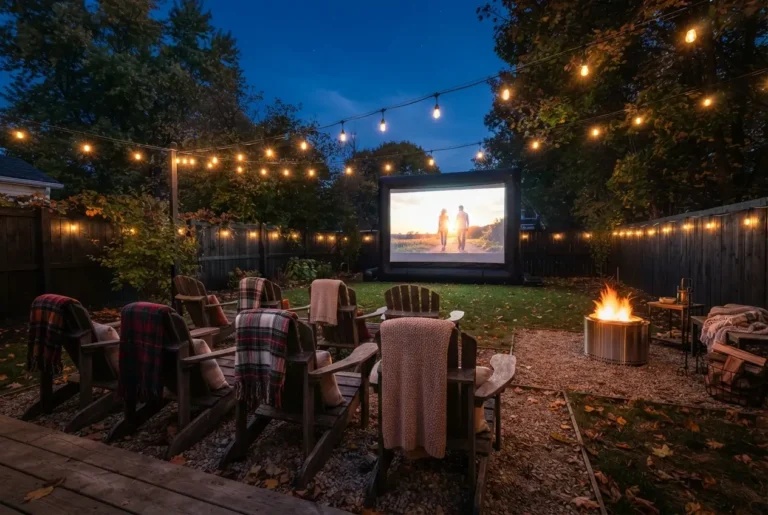
Every one of these paver fire pit ideas can be built by a first-timer in a single weekend. You need a shovel, a level, a rubber mallet, a steel fire ring, and a few dozen concrete wall blocks. No mortar. No contractor. No wet saw.
We’ll start with five styles worth copying, then go through the full build in eight steps.
Most fire pit tutorials skip two things, and we cover both. The first is heat. Regular concrete pavers can crack or even pop when flames hit them directly, so a good build keeps the fire off the blocks. The second is placement, because the safe distance from your house isn’t one national number. It depends on where you live.
You’ll also get the Fire Pit Budget Ladder, three price tiers built from retailer prices we checked on October 6, 2026.
Fall is a smart time to build. In most of Zones 5 to 9 the ground still digs easily, and your pit will be ready for chilly nights well before winter.
Paver Fire Pit Ideas: Pick Your Style Before You Buy a Block
Shape decides almost everything else. It sets which blocks you buy, which ring fits, and how the patio around it gets laid out. Pick first, shop second.
1. Round block pit on a gravel pad
The classic. Tapered wall blocks curve around a round steel ring with no cutting, which is why this is the easiest first build. A 36-inch ring fits most yards.
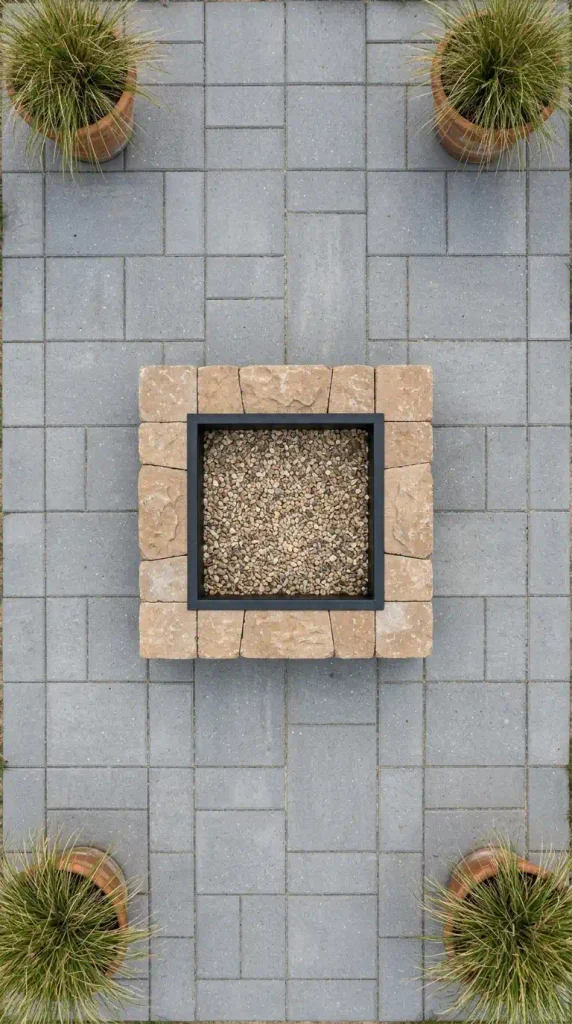
2. Square fire pit on a square patio
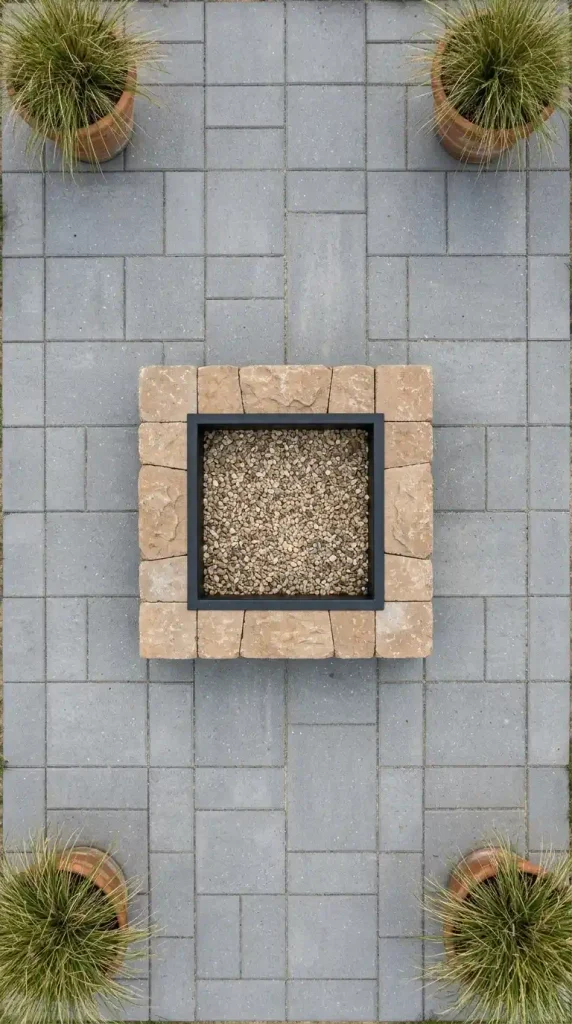
Straight-faced blocks stack into a square around a square steel insert, like the 36-inch square rings Sunnydaze and VEVOR sell at Lowe’s. The corners line up with the patio joints, so the whole area looks planned.
3. Sunken (in-ground) pit
The blocks sit mostly below grade, so the fire stays out of the wind and the profile stays low. Expect more digging. Home Depot’s in-ground guide goes about 18 inches down and adds a gravel-filled drainage hole so rain doesn’t pool in the pit.
4. Pavers around a fire pit you already own
Already have a steel ring or bowl? Leave it where it is and build a paver or gravel apron around it. It’s the fastest upgrade on this list, and it ends the muddy ring where the chairs sit.
5. Round pit with a curved seat wall
A low curved block wall a few steps back from the fire gives everyone a built-in perch. Treat it as phase two, once the pit is done and you know where people actually like to sit.
Match the pit’s shape to the patio’s shape: round on round, square on square. Mixing the two is where DIY layouts start to look accidental.
Go Smaller Than You Think
Big fire pits look great on Pinterest. In real life, an oversized pit pushes the chairs so far back that nobody can warm their hands, and it burns through firewood fast.
A 36-inch ring is plenty for most backyards. Standard 16-inch split firewood fits with room to spare, and This Old House’s rule of keeping logs under three-quarters of the pit’s width lets you go up to about 27 inches.
Size limits are real, too. Lehi, Utah, caps recreational fire pits at 3 feet across with flames under 2 feet. Even Pavestone’s big RumbleStone No. 2 kit, 46 inches across the outside, has only a 31-inch fire bowl inside.
A smaller pit also fits small yards better. It can sit in the open part of a narrow lot while a fence or screen frames the space from well outside the clearance zone. Our roundup of simple backyard privacy ideas has screens that work for that.
Even Yardzen’s 2026 design forecast leans away from one giant feature and toward planting that wraps the whole space. A modest fire pit fits that direction.
Size the fire to the people sitting around it, not to the size of your yard. A 36-inch ring keeps everyone close enough to talk and warm their hands.
Which Pavers Can Touch the Fire (and Which Can’t)
This is the part most tutorials skip. Standard concrete pavers and wall blocks soak up rain. When a fire heats them, that moisture turns to steam, and the pressure can crack a block or make it pop. Hardscape supplier Western Interlock also warns against using red clay brick, limestone, or sandstone inside the firebox.
So when you build a fire pit out of pavers, the blocks are only the shell. The heat goes to materials rated for it:
- A steel fire ring. The Sunnydaze 36-inch heavy-duty ring cost $199 at Home Depot when we checked. It’s 2mm steel, 10 inches tall, and 42 inches across the outside, and it ships in four pieces with no bottom.
- Fire brick on the floor. Rutland’s 9 x 4.5 x 1.25-inch fire brick is rated to 2,700°F and costs $34.49 for a 6-pack at Home Depot.
- Loose fill. Pea gravel or lava rock in the bottom drains water and keeps coals off the soil.
The ring has no bottom, so what’s under it matters as much as what surrounds it.
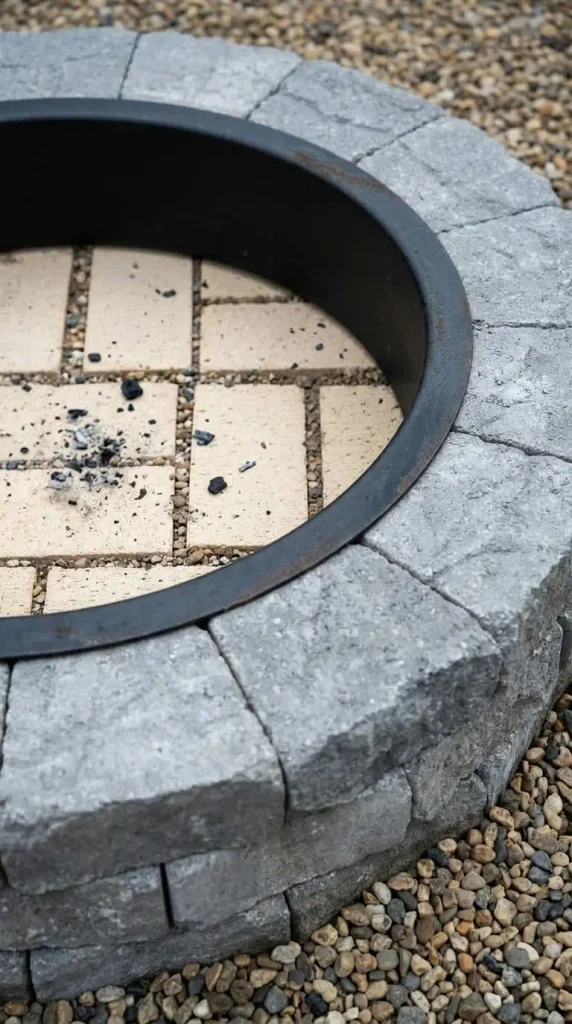
Set a steel fire ring inside the blocks so flames never touch the concrete.
Floor the pit with fire brick, pea gravel, or lava rock.
Use concrete wall blocks as the outer shell only.
Regular pavers as the floor right under hot coals.
Red clay brick, limestone, or sandstone inside the firebox.
An inner wall of bare block with no ring between it and the flames.
Where to Put Your Fire Pit (The Distance Rule Is Local)
Ask three sources how far a fire pit should sit from your house and you’ll get three answers. This Old House’s fire pit kit walkthrough says at least 10 feet from structures, trees, and branches. Home Depot’s and HGTV’s build guides both say 15 feet. Lehi, Utah, requires 25 feet from structures and anything combustible.
None of them is wrong. Each one is answering for a different place. Your city or county fire department sets the number that counts, and an HOA can add its own rules on top.
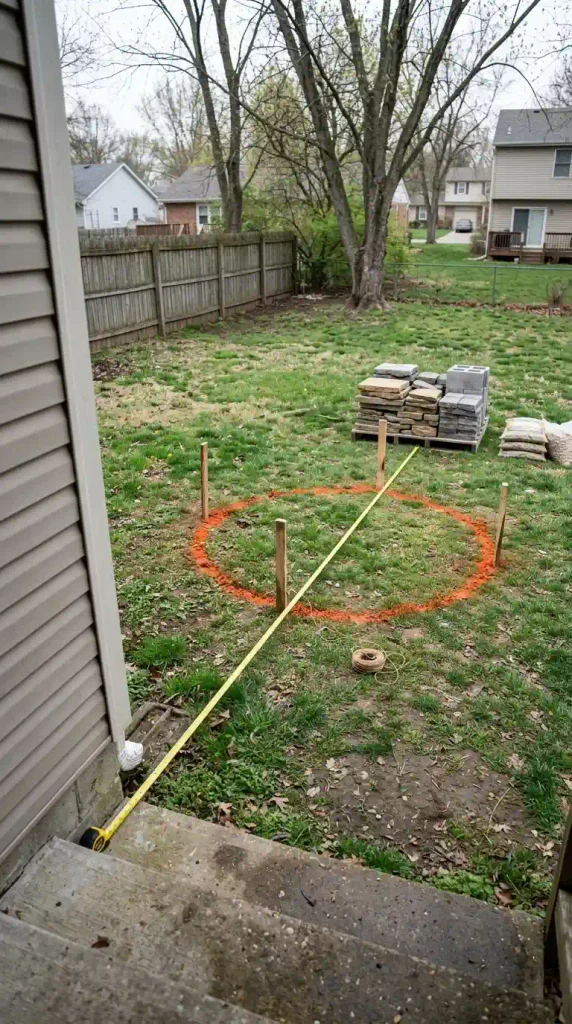
Before you mark the spot, check these:
- Call 811 a few days before you dig so buried utility lines get marked for free.
- Look up. No branches should hang over the pit.
- Pick level ground so the first course isn’t fighting a slope.
- Watch the evening wind for a few nights and keep smoke away from open windows.
⚠️ Watch Out
Check your city’s burn rules before you light anything, keep the clearance from structures and branches that your fire pit’s manual and local code call for, and never leave a fire unattended.
The Fire Pit Budget Ladder: Three Real Price Tiers
The Fire Pit Budget Ladder prices the same 36-inch-ish pit three ways, using prices we checked on October 6, 2026. Prices move often, so treat these as ballparks and check your local store before you buy.
Rung 1, ring-and-block DIY. About 36 Pavestone 4 x 11.75 x 6.75-inch wall blocks at $2.88 each (roughly $105), the $199 Sunnydaze ring, and four 0.5 cu ft bags of Pavestone paver base. Home Depot’s 64-bag pallet works out to about $13 a bag, so that’s around $52. You’re near $356 before crushed stone and pea gravel, and those two vary a lot by region.
Rung 2, mid-range kit build. This Old House estimates about $600 for a kit build, with crushed stone, paver base, and lava rock included.
Rung 3, premium kit. The Pavestone RumbleStone No. 2 kit was $1,038.45 at Home Depot. You get 96 pieces, a stainless octagonal insert, and no-cut instructions. Base materials are extra.
| Rung | What you buy | Ballpark (Oct 2026) | Good fit if |
|---|---|---|---|
| 💲 Ring and block DIY | 36 wall blocks, steel ring, paver base | around $356 plus stone and gravel | you want to pick your own block color |
| 💲💲 Kit build | boxed kit, crushed stone, base, lava rock | about $600 | you want matched parts with less planning |
| 💲💲💲 Premium kit | RumbleStone No. 2 with stainless insert | about $1,038 plus base | you want a tall, finished look with no cutting |
Plan for the haul. Each Pavestone wall block weighs about 22 pounds, so 36 of them come to roughly 800 pounds. That’s more than you want in one trunk load. Make two trips or pay for delivery.
If the ladder leaves money on the table, spend it on the walk out to the pit. A row of solar path stakes does more for night use than a bigger ring, and our list of dollar store backyard decor ideas has cheap ones.
How to Build a Paver Fire Pit, Part 1: Prep the Ground
Any DIY fire pit with pavers lives or dies on what’s under the first course. Give the base your patience and the rest goes quickly.
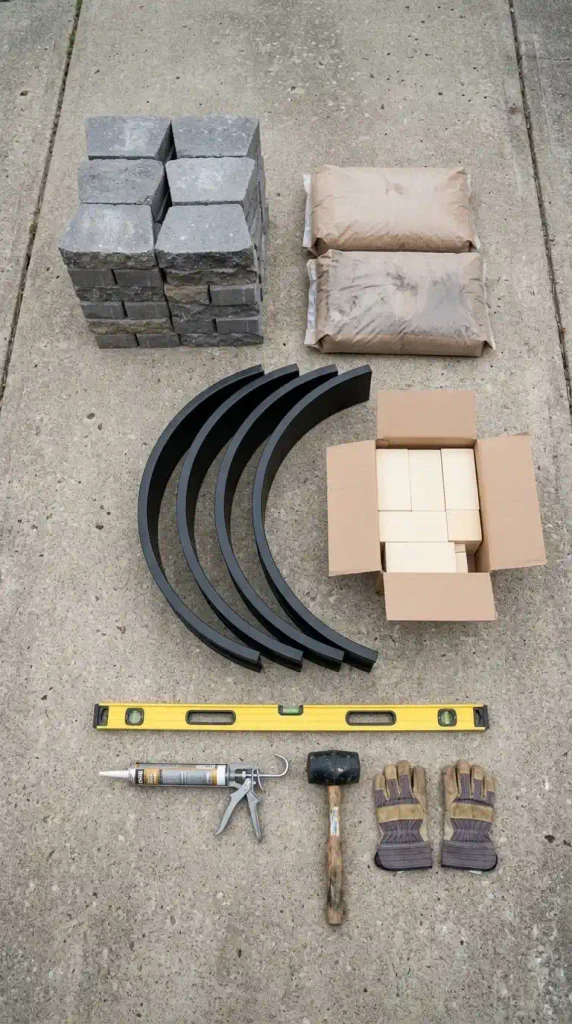
- Use the ring as your template. Set the steel ring where the pit will go and dry-lay the first course of blocks around it. Spray marking paint around the outside of the blocks, about 6 inches out.
- Dig. Strip the sod and dig the circle about 7 to 8 inches deep with a flat bottom. Tamp the soil firm.
- Build the base. Add crushed stone in 2-inch layers and compact each layer with a hand tamper. Finish with paver base or about 1 inch of sand, then check it with a long level.
- Lay course one. Center the ring again and set the first row of blocks around it. Level every block front to back and side to side, tapping with a rubber mallet.
Course one decides everything. Every course above it copies its mistakes.
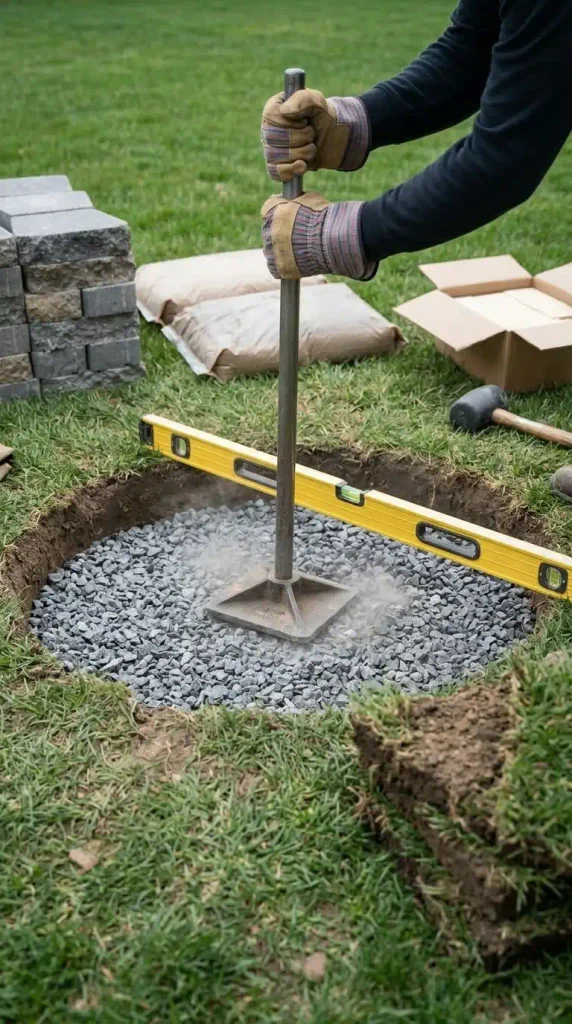
The most common first-build mistake is skipping compaction. Loose soil settles after the first hard rain, and by the end of the season one block starts to rock. Ten more minutes with the tamper prevents it.
If you’re in Zone 5 or 6, finish the base before the ground freezes. Frozen soil won’t compact properly.
How to Build a Paver Fire Pit, Part 2: Stack, Glue, and Fill
Before you stack anything, count the blocks in course one. Multiply by the number of courses you want (usually three or four) and add two spares. For reference, HGTV’s budget build uses about 36 blocks for three courses.
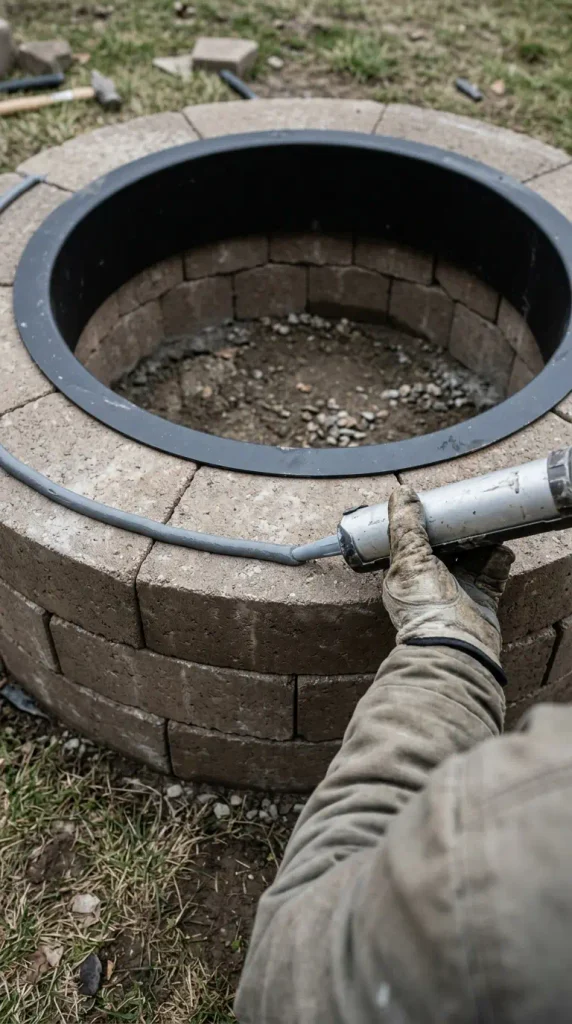
Courses two and up get glued with a landscape block adhesive like Loctite PL 500. Glue keeps blocks from shifting when someone props a boot on the edge.
Dry-fit course two. Stagger it so every seam sits over the middle of a block below.
Glue it down. Lift each block, run a bead of block adhesive on the course below, and press it back. Repeat for course three.
Fill the floor. Lay fire brick or pour pea gravel or lava rock inside the ring.
Let it cure. Wait the full cure time printed on the adhesive tube before the first fire.
Pavers Around the Fire Pit: Build the Apron
Without a hard surface, the ring where chairs sit turns to mud in spring and scorched grass by August. Pavers fix both, and stray embers land on stone instead of turf.
Home Depot’s guide lays a 12-foot circle of pavers around the pit on a 4-inch compacted gravel base. The pavers slope 1 inch for every 8 feet away from the fire so rain runs off instead of pooling at the blocks. Circular paver patio kits make the curves easy. For a cheaper version, set square pavers and fill the ragged outer edge with pea gravel.
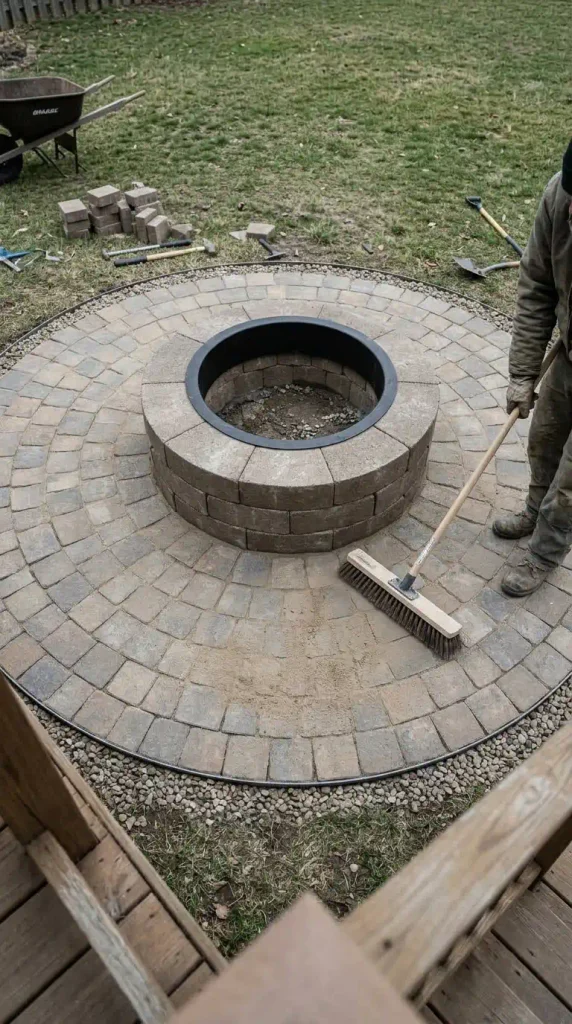
A gravel-only apron is the budget route. It drains well and costs less, though chair legs sink a little. If you want ideas for tying the apron into the rest of the yard, our budget backyard patio ideas cover paver and gravel layouts that connect to a fire pit area.
Fire pit sitting in the lawn. A worn ring of mud and scorched grass where the chairs go, and puddles against the blocks after rain.
A 12-foot paver circle on compacted gravel, sloped away from the pit. Chairs sit flat, rain runs off, and embers land on stone.
Your First Fire Checklist
The adhesive has cured and the ring is in. Before the first match, run through this list.
🔥 First fire checklist
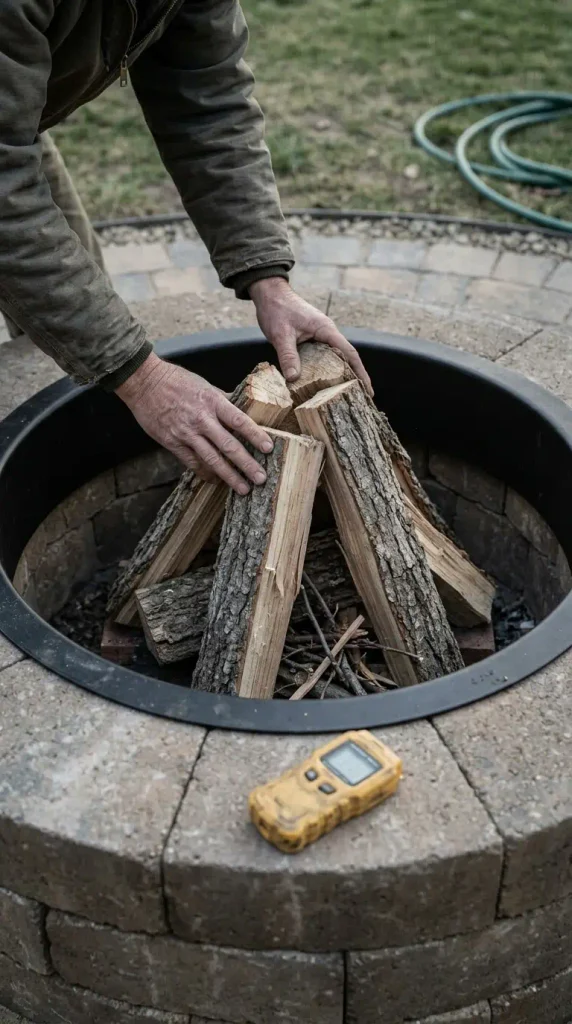
Wood matters more than most people think. EPA’s tips for burning dry, seasoned wood say wood burns best below 20 percent moisture and should season for at least six months. A cheap handheld moisture meter tells you in seconds. EPA also says never to burn painted or treated wood, plywood, or trash.
Paver Fire Pit FAQs
Can you use regular pavers for a fire pit?
For the outer walls, yes. Standard concrete wall blocks work fine as the shell around a steel ring. They shouldn’t take direct flame, though, because moisture trapped inside can turn to steam and crack or pop a block. Put a steel fire ring inside, and use fire brick, pea gravel, or lava rock on the floor where the coals sit.
What do you put in the bottom of a paver fire pit?
Start with compacted crushed stone, then a layer of paver base or sand. Inside the ring, add pea gravel, lava rock, or a layer of fire brick. Gravel drains rain and keeps hot coals off bare soil. For a sunken pit, also dig a gravel-filled drainage hole so water doesn’t pool after storms.
How many pavers do I need for a fire pit?
It depends on the ring size and the block shape, so dry-fit one course around your ring and count. Multiply by the number of courses, usually three or four, and add two spares for chips. HGTV’s budget build used about 36 wall blocks for a three-course pit around a metal ring.
How far should a fire pit be from the house?
There’s no single national number. This Old House says at least 10 feet, Home Depot and HGTV say 15 feet, and some cities, like Lehi, Utah, require 25 feet from structures. Check your city code or call the local fire department before you dig, and follow your fire ring’s manual as well.
Do you need a metal ring in a paver fire pit?
We’d always use one. A steel ring keeps flames off the concrete blocks, which helps prevent cracking, and it holds the circle true while you stack. The 36-inch Sunnydaze ring made of 2mm steel cost $199 at Home Depot when we checked in October 2026.
How much does it cost to build a paver fire pit?
A ring-and-block DIY build comes to roughly $356 in blocks, ring, and paver base, plus crushed stone and gravel. This Old House estimates about $600 for a kit build. A premium kit like the Pavestone RumbleStone No. 2 was about $1,038 at Home Depot. These are October 2026 prices and they change often.
Do you need to glue fire pit blocks?
Glue the courses above the first one with landscape block adhesive so the blocks don’t shift when someone bumps them. The first course sits on the leveled base without glue. Let the adhesive cure for the full time printed on the tube before you light your first fire.
Start With the Ring
Start with the ring. Once it’s sitting in your yard, everything else falls into place: the block count, the dig line, and the size of the apron around it.
Keep the fire smaller than you think you need. Keep the flames off the concrete. Check your local distance rule before the first shovelful of sod comes up.
Do those three things and this becomes a weekend build you’ll use every fall night for years.
Save these paver fire pit ideas to your backyard projects board so the Budget Ladder and the first fire checklist are on your phone when you’re standing in the hardscape aisle.