
15 Tropical Front Yard Ideas (Including Hardy Picks for Cold Zones)
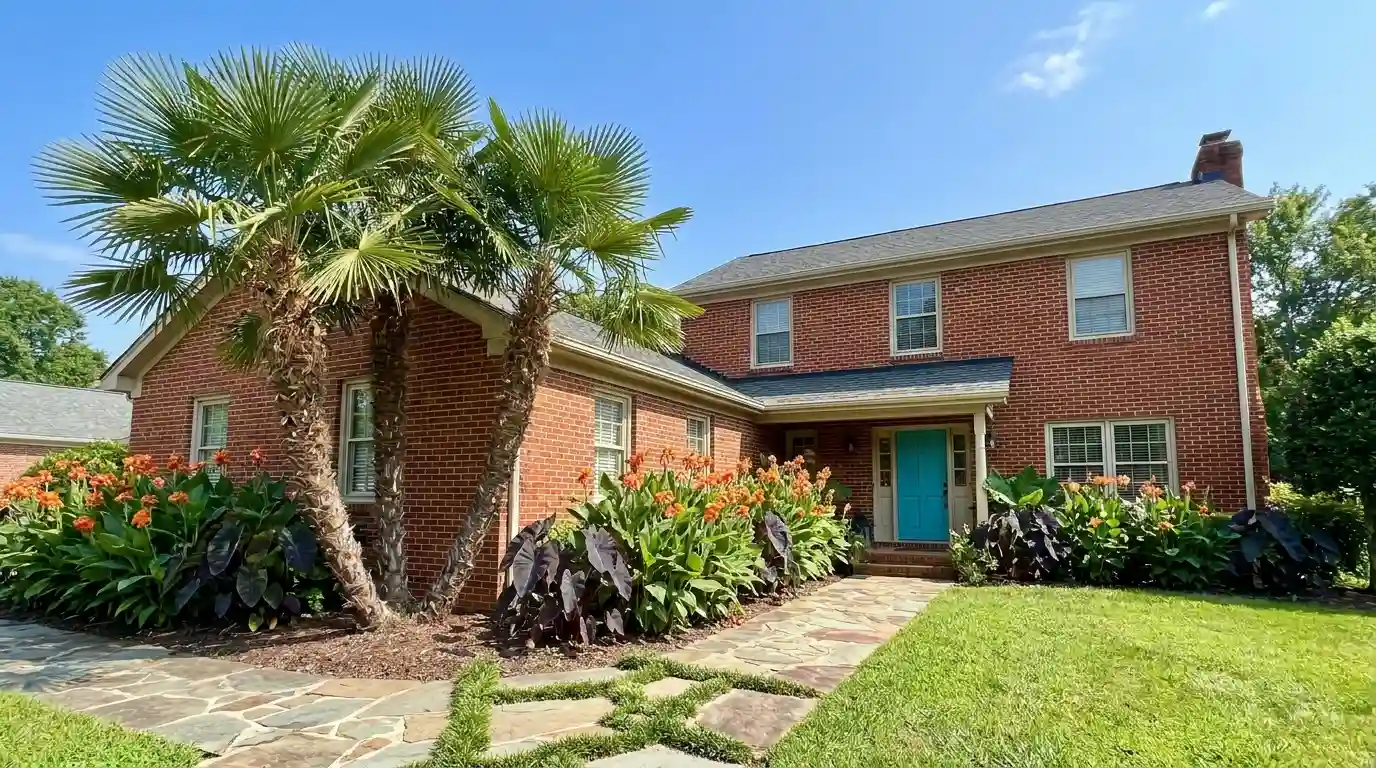
Most tropical front yard ideas online quietly assume you live in Miami. Queen palms, tropical hibiscus hedges, elephant ears left in the ground all year. Plant that list in Zone 6 and the first hard freeze in October turns your curb appeal into brown mush by Thanksgiving.
We built this list for the rest of the country too.
Every idea below gives you big leaves, hot colors, and that layered jungle look. Each one also names the plant to use in a warm zone and the tough stand-in that survives a cold one. The shortcut is the Zone Swap Chart right under the main photo: find the look you want, then pick the plant that actually lives where you do.
You’ll get palm groupings that look planned, a banana that shrugs off -10°F, a lava rock strip that replaces a tired curb lawn, and pots that spend winter indoors. The prices are real ranges we checked at Home Depot, Lowe’s, and plant nurseries this November, so you can budget before your first trip to the garden center.

The Zone Swap Chart
Big-leaf tropicals aren’t all tender, and a tropical front yard in Ohio can borrow the very same shapes as one in Tampa. Most of the classic tropical looks have a cold-hardy twin that gives you the same shape from the street. Read across the row for the look you want, then plant the column that matches your USDA zone. Zones 9 to 11 can use the true tropicals in the ground. Zones 5 to 8 get the stand-in, or grow the tender version in a pot that comes inside for winter. Several ideas below point back to this chart, so it’s worth a screenshot.
1. Skip the Lone Palm, Plant Windmill Palms in a Group of Three
A single palm dropped in the middle of the lawn looks like a lollipop somebody forgot. It’s the most common tropical front yard move, and it almost never reads as designed.

Grouping fixes it. University of Georgia horticulturists suggest planting windmill palms in clusters of three to five at a building corner or entrance. Their notes on cold-hardy palms that grow throughout Georgia also report windmill palms surviving temperatures as low as -10°F.
Stagger the three so the crowns sit at different heights instead of lining up like fence posts. Lowe’s stocks a 3-gallon windmill palm rated for Zones 7 to 11, and a specialty palm nursery we checked listed the same size around $30 for local pickup. A trio starts near $90.
Plant 3 or 5 palms in a staggered cluster at the house corner or beside the front steps.
Buy mixed sizes so the crowns land at different heights.
One palm alone in the open lawn with nothing around its trunk.
Planting right under the gutter line, where fronds rub the roof as they grow.
Group them once, and the corner looks planned for decades.
2. A Hardy Banana on the South Wall That Survives -10°F
Big paddle leaves are the fastest way to say “tropical” to anyone driving by. Musa basjoo is the banana that makes it possible north of Florida. Its underground rhizomes handle roughly -10°F under a thick mulch blanket, which puts much of Zone 6 in play. Look up your number on the USDA plant hardiness zone map before you order, then check it against the Zone Swap Chart above.

Plant it against a south-facing wall. The wall soaks up heat and blocks the wind that shreds banana leaves into ribbons by August. PlantingTree listed a 6-inch starter around $40 and a 3-gallon plant around $66 when we checked this November, and it can reach 10 to 15 feet once established.
The leaves die back every winter. That’s normal, and the fall routine takes about 20 minutes:
Wait for the first frost to blacken the leaves, then cut the stems back to about 2 feet.
Circle the stumps with a chicken-wire cage and stuff it with dry shredded leaves.
Pile straw or more leaves over the base and cap the cage with a scrap of plastic to shed rain.
Pull the cage after your last frost, usually around mid-April in Zone 7, and new leaves follow within weeks.
3. The Three-Height Bed: Cannas, Elephant Ears, Then Coleus
Three heights. That’s the whole trick behind the jungle look, because tropical beds read as dense when leaves stack up tall in back and short in front with no bare ground showing between the rows.

- Back row: cannas like ‘Tropicanna’, for striped leaves and orange blooms that show over everything else.
- Middle row: elephant ears (Colocasia), whose heart-shaped leaves hide the bare lower canna stems.
- Front row: sun coleus in full sun or caladiums in shade, so color covers the mulch.
Space the front row a little tighter than the plant tag suggests so it knits together by July.
4. Elephant Ears Right Where the Downspout Drains
Every front yard has one soggy spot, and it’s usually below a downspout. Most plants sulk there. Elephant ears love it.
Garden State Bulb sells a bag of five 7 to 9 inch Colocasia bulbs at Home Depot for just under $20. That’s enough to fill the wet corner with leaves the size of a cafeteria tray. Add a downspout extension so the water lands in the bed a few feet out instead of against your foundation.
The classic first-winter mistake is leaving those bulbs in the ground in Zone 6 or colder. They look fine until the first hard freeze, then rot by spring. Dig them after frost kills the leaves, let them dry for a week, and store them in a paper bag in a cool basement.
5. Red Lava Rock Instead of That Patchy Curb Strip
Grass hates the hot strip between the sidewalk and the street. Two fixes fit a tropical look, and they behave very differently.

Red lava rock is the classic tropical answer. Home Depot’s pallet price on Vigoro’s 0.5 cubic foot bags works out to about $13 a bag, and one bag covers roughly 3 square feet at 2 inches deep. A 3 by 20 foot strip needs about 20 bags, or around $260. It lasts for years.
Pine bark mulch costs less and feeds the ground as it breaks down, but you’ll top it up every spring. We’d use lava rock in full-sun strips and bark anywhere you plant a lot of annuals. For more lawn-free layouts, our roundup of front yard landscaping with no grass has 15 more.
| Red lava rock | Pine bark mulch | |
|---|---|---|
| Lasts | Years, it doesn’t break down | Needs a fresh layer each spring |
| Feeds the ground | No | Yes, as it rots |
| Leaf cleanup | Fiddly, leaves catch in the rock | Easy, leaves rake right off |
| Best spot | Full-sun curb strips | Beds full of annuals and bulbs |
One warning: skip lava rock under trees, because picking oak leaves out of it every November gets old fast.
6. A Flagstone Walk With Dwarf Mondo Grass in Every Joint
Flagstone with green in the joints looks like it’s been there for decades. Dwarf mondo grass (Ophiopogon japonicus ‘Nana’) stays about 2 to 3 inches tall, takes light foot traffic, and is hardy in roughly Zones 6 to 10. Make the walk at least 4 feet wide so two people can reach the door side by side. In a tropical front yard, edge it with big-leaf hostas in shade or cannas in sun so leaves brush your legs on the way in.
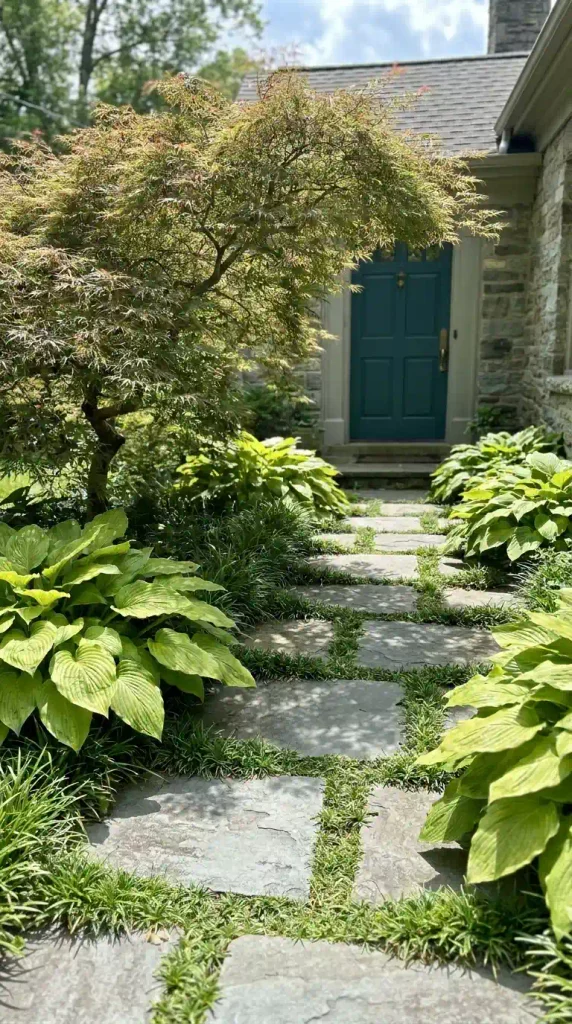
Recreate this walk
Dwarf mondo spreads slowly. Give it two summers to fill.
7. Tropical Hibiscus and Mandevilla Pots That Spend Winter Indoors
Most people buy a front step pot they can’t lift. Heavy glazed ceramic looks great in May, but by October a 20-inch pot full of wet potting mix is too heavy for one person to carry inside.

Lightweight resin solves it. Bloem’s Ariana 20-inch planter holds 11 gallons, comes with a self-watering disk, and was listed around $25 when we checked. Set it on a rolling plant caddy and the whole pot glides indoors when nights drop toward 50°F.
Tropical hibiscus and mandevilla both handle this routine. That means real tropicals on the steps all summer, even in Zone 5.
📌 Good To Know
A dormant mandevilla can rest in an attached garage that stays above 40°F. Tropical hibiscus keeps blooming longer in your sunniest window, so give it the spot by the glass.
Real tropicals, zero winter risk.
8. A Hot-Color Border of Cannas, Lantana, and Hardy Hibiscus
Hot colors read best at a distance. Orange, red, and hot pink still pop when someone sees your yard at 25 miles per hour, while soft pastels melt into the green.
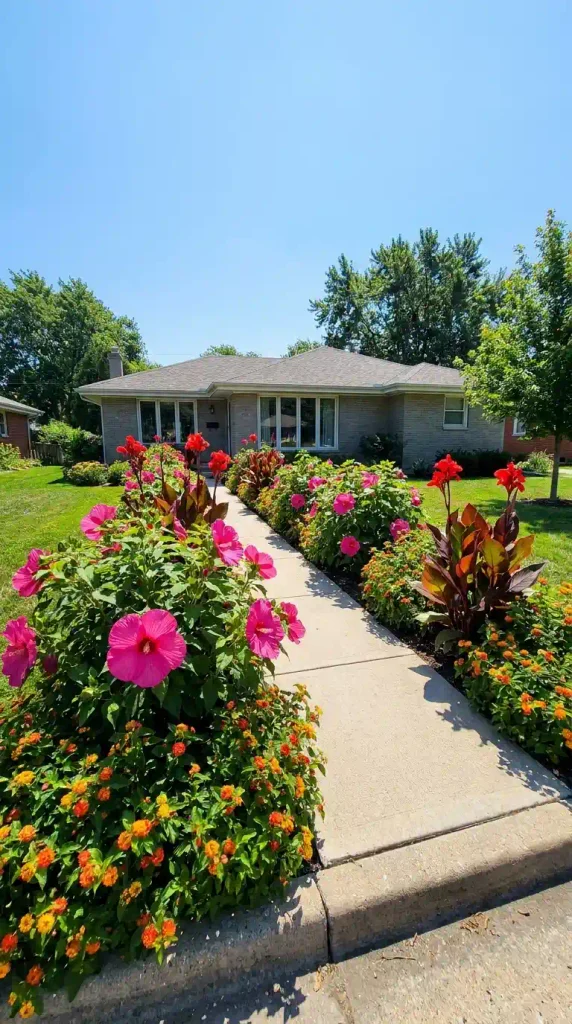
Edge the front walk with a band about 3 feet deep. If you want to plan the whole bed around sight lines, our guide to front yard ideas for curb appeal walks through what looks right from the street.
- ▸Hardy hibiscus: dinner-plate blooms July through September, Zones 5 to 9.
- ▸Cannas: red or orange spikes midsummer until frost; dig the rhizomes north of Zone 8.
- ▸Lantana: orange and yellow clusters until frost, grown as an annual in most zones.
Hardy hibiscus is the Zone Swap Chart’s cold-zone stand-in for the tropical kind, and it fools almost everyone the first spring. The stems stay bare well into May while every other shrub leafs out, and new shoots may not show until late May or even June in Zone 6. Don’t dig it up. It’s just late.
9. Low Maintenance Tropical Front Yard: Seven Yuccas in Pale Gravel
Low maintenance usually means fewer kinds of plants, not fewer plants. Line up seven Yucca filamentosa ‘Color Guard’ about 30 inches apart in pale pea gravel, edge the bed with black steel, and stop there.
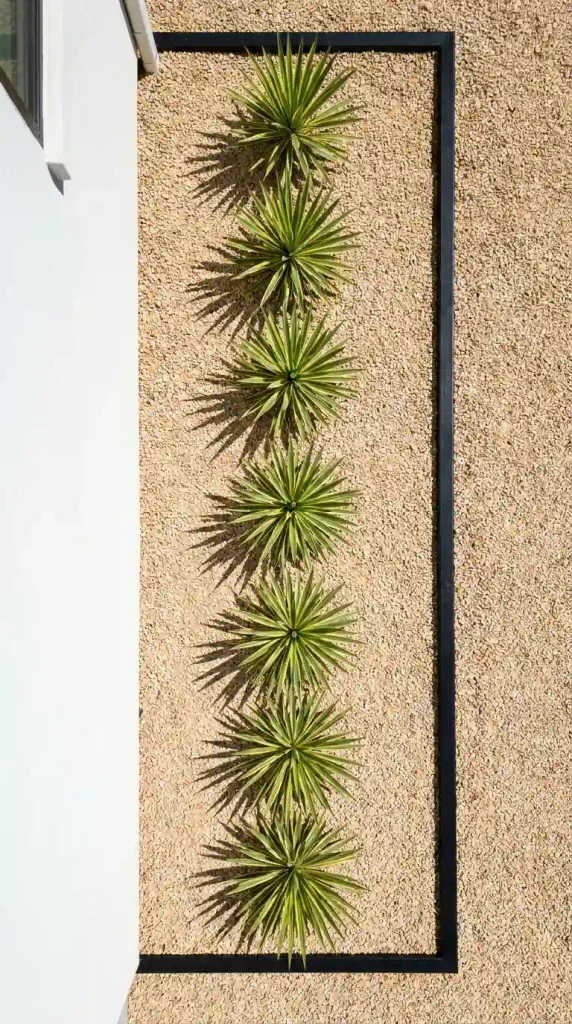
The gold-striped spikes stay evergreen in Zones 4 to 10, so the bed looks the same in January as it does in July. Repetition does the design work for you. An odd number keeps the row from looking like a fence.
One tough plant repeated five or seven times reads as a design choice. Ten different plants read as a garden center sale.
Your whole yearly to-do list: cut the tall flower stalk after it fades in summer. Wear gloves, since the leaf tips are sharp.
10. Small Tropical Front Yard in a 6 by 10 Foot Bed
Tiny beds need one star. Skip the twelve extras. Start with a needle palm, the toughest palm on the Zone Swap Chart. University of Georgia horticulturists put it at about -5°F, and it stays a slow, shrubby 3 to 6 feet.
Tuck three Japanese painted ferns at its feet for silver texture, add one 20-inch pot of sun coleus by the steps, and leave the rest in dark shredded mulch. Here’s how that 60 square feet changes:
A 6 by 10 foot strip of thin lawn, one lonely boxwood, and bare siding behind it.
One needle palm, three Japanese painted ferns, a 20-inch pot of coleus, and 2 inches of dark shredded mulch.
Keep the needle palm at least 3 feet off the walk. The spines at its base live up to the name.
11. A Bubbling Urn Fountain Instead of a Pond
Ponds are a lot of work for a front yard: liners, filters, algae, and a big hole you’ll regret by August. An urn is easier. A self-contained urn fountain gives you the sound with almost none of the digging.
Water bubbles over the rim, drains into a hidden basin under a bed of river rock, and recirculates, so the trickle softens street noise right beside the front walk. Moving water also keeps mosquitoes from laying eggs in it, which a still birdbath can’t promise. In a small tropical front yard, ring it with elephant ears or Japanese forest grass so it looks planted, not parked.
⚠️ Watch Out
Use an outdoor-rated, UL-listed pump and cord on a GFCI outlet. Anything beyond plugging into an existing outlet is a job for a licensed electrician.
Top off the basin weekly in July and August, when evaporation runs fastest.
12. Clumping Bamboo for Privacy That Stays Put
Running bamboo is the plant neighbors write letters about. It spreads by underground rhizomes, pops up yards away, and some towns now restrict planting it near property lines.
Clumping bamboo grows in a tight circle instead. Fargesia rufa reaches about 8 to 10 feet, handles Zones 5 to 9, and prefers afternoon shade. In hot Zone 9 and 10 yards, ‘Alphonse Karr’ (Bambusa multiplex) is the clumper that takes the heat and still gives you a striped green screen.
| Clumping (Fargesia rufa) | Running (Phyllostachys) |
|---|---|
| Widens slowly in one tight clump | Sends rhizomes out several feet a year |
| About 8 to 10 feet tall | Often 15 to 30 feet tall |
| No root barrier needed | Needs a 24 to 30 inch deep root barrier |
| Low risk for the neighbors | High risk, and sometimes restricted |
Same privacy, minus the angry letters.
13. Coastal Tropical With Dwarf Palmetto and Crushed Shell
Beach towns do tropical a little drier. Swap black mulch for pale crushed shell or tan pea gravel, then layer in three plants that handle sun and salty air better than banana leaves do:
- Dwarf palmetto (Sabal minor): a shrubby fan palm for Zones 7 to 10, planted in a clump of three.
- Northern sea oats (Chasmanthium latifolium): dangling seed heads that rattle in the breeze, Zones 5 to 8.
- Dusty miller: silver edging along the walk, grown as an annual.
Snip the sea oat seed heads in late fall, or you’ll be pulling seedlings out of the gravel for years.
14. Uplight the Palms So the Yard Still Shows After Dark
After dark, palms turn into the best shadow puppets on the block. A few low-voltage 12-volt LED spotlights aimed up through the trunks throw frond shadows across the siding. Feit Electric sells 12-volt spotlight four-packs at Home Depot, and warm white between 2700K and 3000K keeps leaves looking natural instead of icy. Our post on outdoor lighting landscaping ideas for fall covers timers and path lights too.
Stake each spotlight 12 to 18 inches from the trunk, tilted up into the crown.
Plug the transformer into a GFCI outlet, the same rule as the fountain above.
Set the photocell timer to switch on at dusk and off by 11 p.m.
Two spotlights per palm cluster is plenty. More starts to look like a car dealership.
15. The Whole Look on a $50, $150, or $300 Budget
Every price in this list adds up to three honest budgets. Bulbs and pots cost the least. Palms and bananas cost more up front, but they come back every year, so they’re the better long-term money.

Buy palms and bananas in spring, when nurseries restock and roots get a full season to settle before winter. Spend the first $50 on the spot people see from the driveway, then grow the bed next spring once you know what made it through winter.
Tropical Front Yard Ideas FAQs
What plants make a front yard look tropical?
Big leaves and bold shapes do most of the work in a tropical front yard. Windmill palms, hardy bananas like Musa basjoo, elephant ears, and cannas give you the jungle silhouette, while hardy hibiscus and lantana add hot color. Fill the front edge with coleus or caladiums so no bare ground shows. In Zones 9 to 11 you can add true tropicals like queen palms and tropical hibiscus right in the ground.
Can you have a tropical front yard in a cold climate?
Yes, if you choose cold-hardy look-alikes. Windmill palms have survived about -10°F, needle palms about -5°F, and Musa basjoo rhizomes come back after roughly -10°F under heavy mulch. Hardy hibiscus and Japanese painted ferns are reliable down to Zone 5 or 4. Grow tender plants like mandevilla in lightweight pots and bring them indoors before nights drop below 50°F.
What is the most low-maintenance tropical plant for a front yard?
Yucca filamentosa ‘Color Guard’ is hard to beat. It stays evergreen in Zones 4 to 10, shrugs off drought once established, and needs only one job a year: cutting the faded flower stalk in summer. Needle palm is a close second for shady spots, since it grows slowly and rarely needs pruning. Wear gloves around both, because the leaf tips and trunk spines are sharp.
Which palm trees survive cold winters?
The windmill palm (Trachycarpus fortunei) is the most widely planted cold-hardy palm and has survived temperatures near -10°F. The needle palm (Rhapidophyllum hystrix) is shrubbier and handles about -5°F. Dwarf palmetto (Sabal minor) suits Zones 7 to 10 and looks best in clumps of three to five. Plant all of them in spring so roots settle before their first winter.
When should I plant tropical bulbs like cannas and elephant ears?
Plant them after your last spring frost, once the ground feels warm to the touch. That’s usually around mid-April in Zone 7 and early to mid-May in Zone 5, though local dates vary. Cold, wet ground can rot the bulbs before they sprout. In Zones 7 and colder, dig them up after the first fall frost and store them somewhere cool and dry.
How much does a tropical front yard cost?
A starter bed can come in under $50 with a bag of elephant ear bulbs and one resin pot. Adding a 3-gallon windmill palm and a few bags of lava rock brings it to roughly $150 to $175. A fuller corner with two palms and a hardy banana lands around $300. Hardscape like flagstone walks or fountains adds more, so phase those in over a few seasons.
Start With One Corner
You don’t need a Florida address to pull off the look. Pick one spot people see from the street, check your zone, and pull your plants from the matching column of the Zone Swap Chart. A trio of windmill palms, a band of cannas, or a single hardy banana against a warm wall is enough to change how the whole house reads from the curb.
Then let it grow for a season before you add more. Tropical front yard ideas work best in layers, and each summer fills in the next row.
Save this list to your front yard Pinterest board so the Zone Swap Chart is ready when spring planting starts.