Front Yard Landscaping With No Grass: 15 Ideas That Look Better Than a Lawn

The lawn in front of my house lasted exactly one summer before I gave up on it. Brown in July, soggy in March, and thirsty the entire time in between. Most front yard landscaping no grass ideas you find online hand you a gorgeous finished photo and quietly skip the part where somebody has to remove 600 square feet of turf first. This guide does the opposite. You’ll get the removal methods ranked by effort, real 2026 costs, plant picks sorted by USDA zone, and the three regrets that show up around year two.
Visual treatment locked for this article: Better Homes & Gardens May Cover. Bright midday light, soft top-front diffusion, saturated greens with bloom accents, no recognizable faces, no text burned into any image.
Why So Many Front Lawns Are Coming Out Right Now
Water is the short answer. The EPA reports that outdoor use accounts for more than 30 percent of household water use, climbing toward 60 percent in arid regions. Worse, as much as half of what we spray outdoors never reaches a root. Wind takes it. Evaporation and runoff take the rest. That’s real money vanishing over a strip of turf nobody sits on.
Then there’s the labor math. Mowing, edging, fertilizing, aerating, overseeding, and irrigating a front lawn eats roughly 25 to 40 hours a year for an average suburban lot. Grass-free yards ask for a weekend of weeding in spring and a mulch top-up in fall.
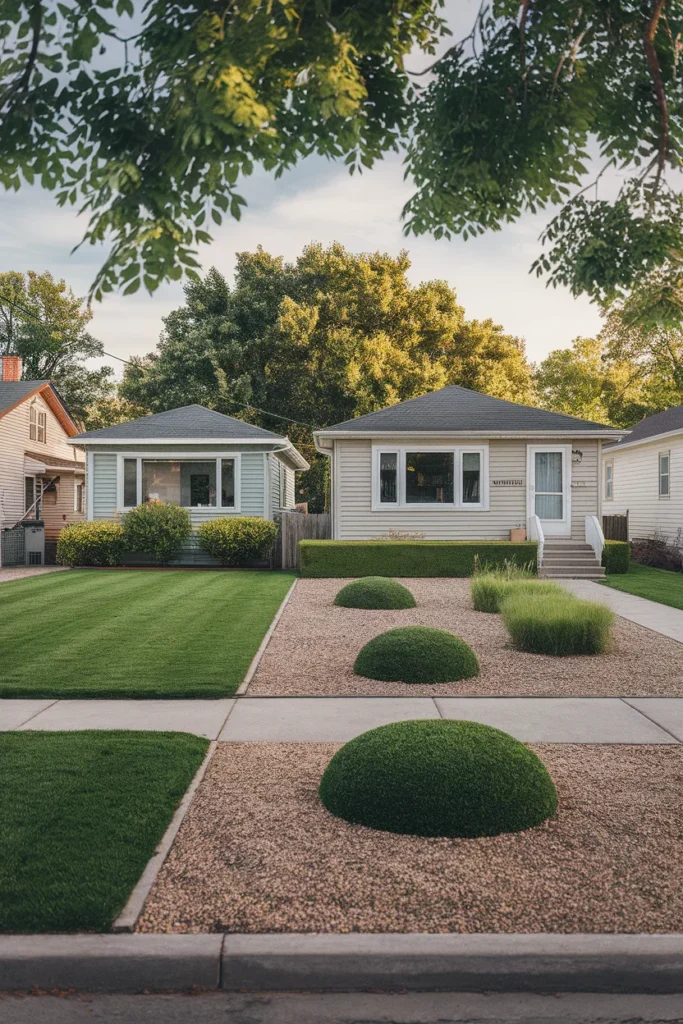
Curb appeal shifted too. A flat green rectangle reads as builder-default now, while a layered gravel-and-grasses front yard reads as intentional. Buyers notice. So do neighbors, which is why half the people reading this got here after seeing one house on their street do it first.
There’s a payback argument too, and it’s more convincing than the water savings alone. A front lawn costs something every single year: fertilizer, seed, gas or electricity, irrigation, and either your Saturdays or a mowing service at roughly $35 to $60 a visit. Run that out over ten years and a grass-free conversion often pays for itself somewhere between year four and year seven. Most front yard landscaping no grass ideas get pitched as an aesthetic choice. They’re closer to a maintenance decision with a nice side effect.
Kill the Grass First: 4 Removal Methods Ranked by Effort
Skip this step and the turf comes back through your gravel by June. Every method below actually works. They just cost you differently.
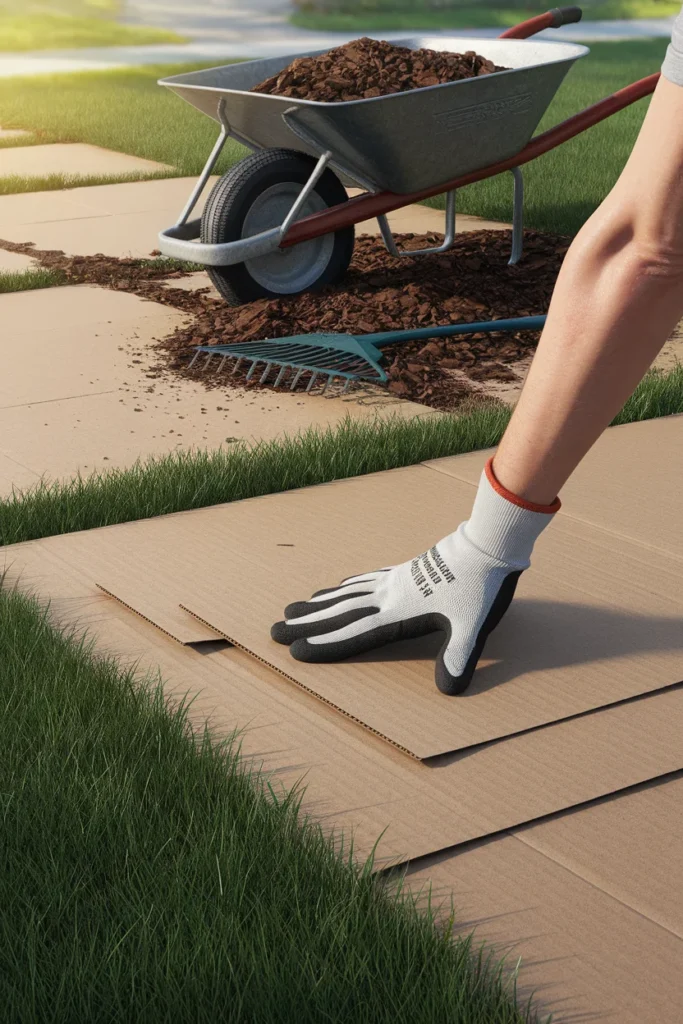
1. Sheet mulching (cheapest, slowest). Lay flattened cardboard over the grass with a 6 inch overlap at every seam, soak it, then pile 4 to 6 inches of mulch on top. The turf composts in place. Give it two to three months in warm weather. Cost runs close to zero if you save Amazon and Costco boxes, plus $25 to $100 per cubic yard for bark mulch.
2. Solarization (free, seasonal). Clear plastic sheeting pinned tight over damp soil cooks the turf in four to six weeks of real summer heat. Works beautifully in Zones 8 through 10. Nearly useless in a cloudy Zone 5 June.
3. Sod cutter (fastest, sweatiest). A rental machine slices turf into rollable strips. Home Depot and most local rental yards run around $80 to $110 for a four hour block. Honestly, this is the option I’d pick again for anything over 400 square feet on flat ground.
4. Hire it out. Professional sod removal runs about $0.50 to $2.00 per square foot, so a 500 square foot front lawn lands somewhere near $250 to $1,000 hauled away.
The first time I pulled turf out of a front strip I rented a cutter on a Saturday, spent about $90, and then fought the thing sideways across a slope for four hours. The second yard I sheet mulched with cardboard from the garage. Twenty minutes of actual labor and it looked better by fall.
The 60-30-10 Curb Formula
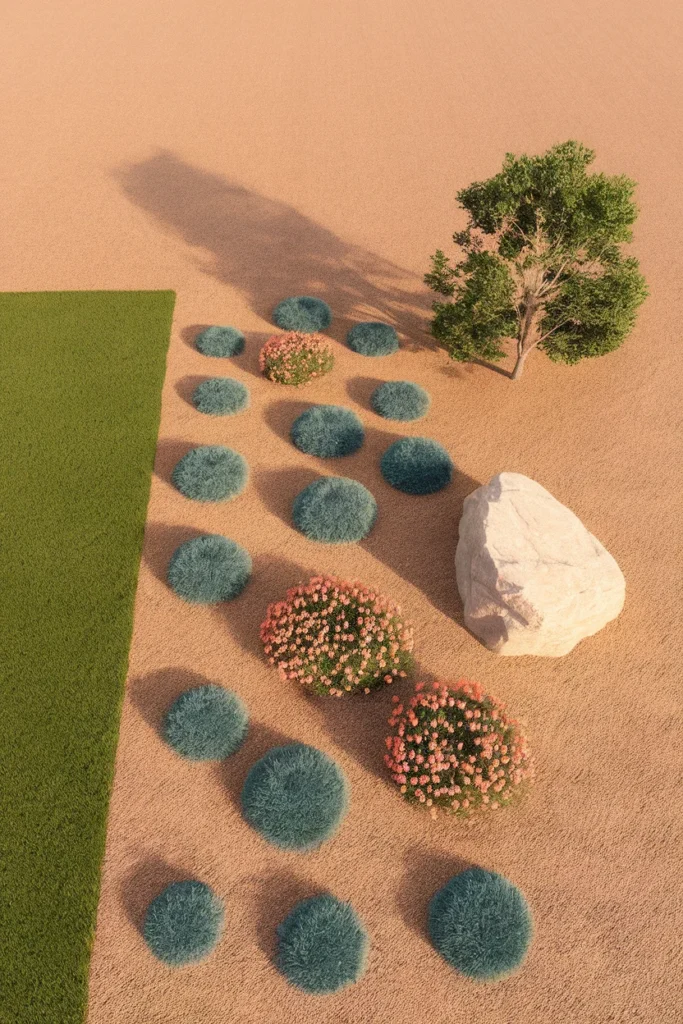
Here’s the design rule I use on every grass-free front yard, and it’s the reason some no-lawn yards look designed while others look like a parking lot with plants. Split the visible area into three shares: 60 percent quiet ground plane, 30 percent living mass at three different heights, 10 percent one deliberate focal point. Miss the 30 and you get a gravel pit. Miss the 10 and the whole thing reads flat from the street.
| Share | What fills it | Common mistake |
|---|---|---|
| 60% ground plane | Decomposed granite, pea gravel, bark mulch, or a walkable groundcover | Going 90 percent gravel because it’s cheap |
| 30% living mass | Groups of 3 or 5 plants at low, mid, and tall heights | Single plants dotted evenly like polka dots |
| 10% focal point | One specimen tree, boulder cluster, bench, or water bowl | Three competing focal points, so none of them win |
Plant in odd-numbered groups. Repeat the same three species across the yard instead of collecting fifteen different ones. That repetition is what your eye reads as professional.
15 No Grass Front Yard Ideas Worth Copying
Run each of these through the 60-30-10 split before you fall in love with it. Some are complete yards on their own. Others are a ground plane or a focal point that needs two more layers around it to read finished from the sidewalk.
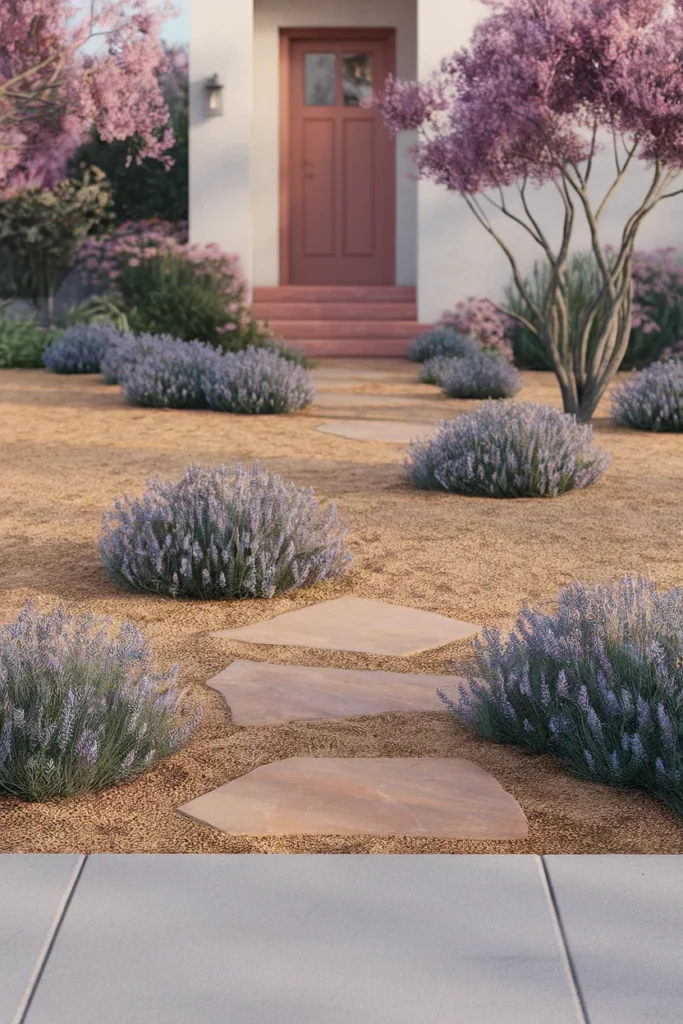
1. Decomposed granite carpet with specimen plants
Tan or gold DG compacts into a firm walkable surface and costs roughly $40 to $100 per cubic yard loose. Stabilized DG runs closer to $100 to $225 and resists washing out on a slope.
2. Pea gravel with steel edging
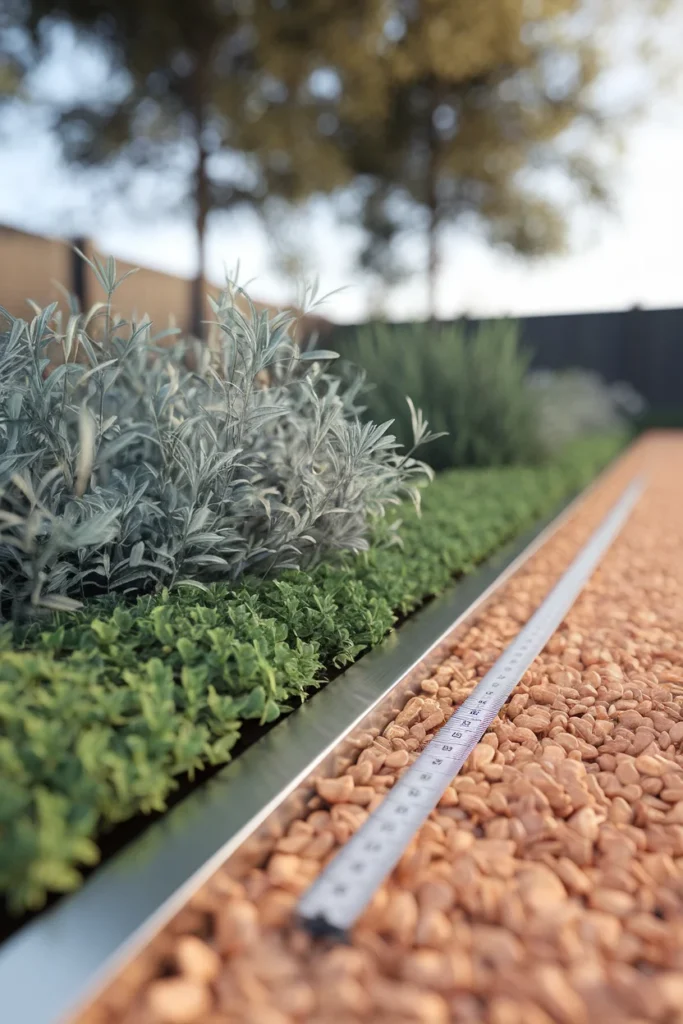
Pea gravel sits around $4 to $7 per half cubic foot bag at Lowe’s, or about $29 to $86 per cubic yard delivered. Steel or aluminum edging at $2 to $6 per linear foot keeps it from migrating into the sidewalk.
3. A full native pollinator meadow
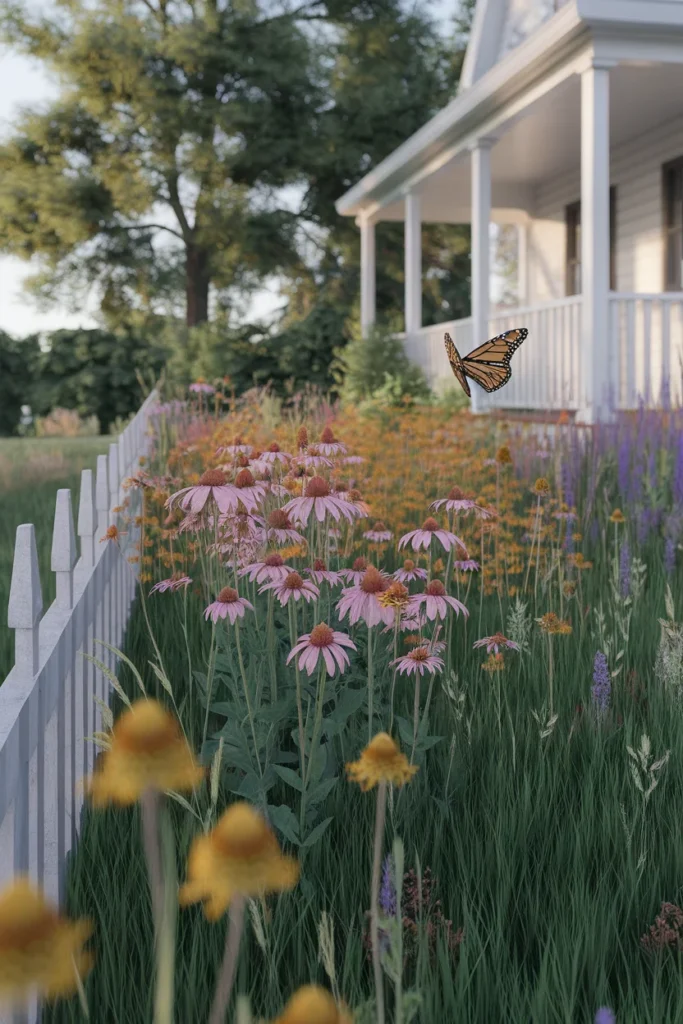
Yarrow, coneflower, little bluestem, and milkweed. No mowing, no irrigation after year one, and monarchs by August. Keep a mowed or gravel border strip about 18 inches wide along the sidewalk so the whole thing reads as a garden rather than neglect. That single detail is what keeps code enforcement off your porch.
4. Mulch beds with a mass-planted shrub layer
The lowest-cost real makeover. Bark mulch at $2 to $8 per bag, and one cubic yard covers about 108 square feet at 3 inches deep.
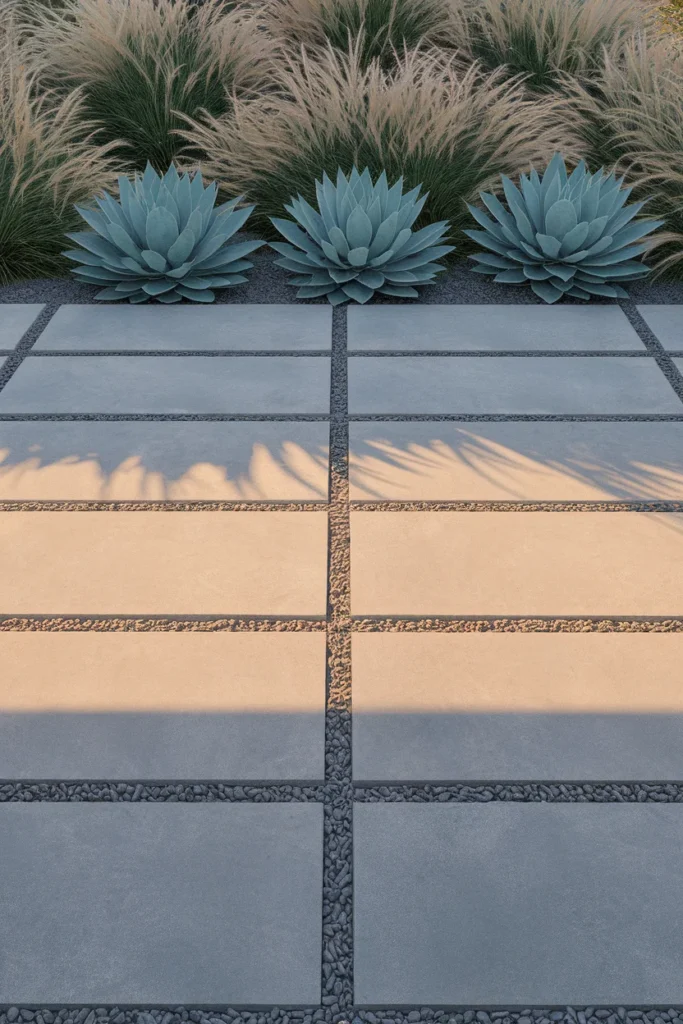
5. Modern paver grid with gravel joints
Concrete pavers run roughly $10 to $17 per square foot installed. Leave a 2 inch gravel gap between them for that architectural grid look.
6. Flagstone path through low groundcover
Flagstone lands near $15 to $32 per square foot installed. Underplant with creeping thyme so it releases scent when stepped on.
7. Rock garden with succulents and boulders
Our full walkthrough on front yard landscaping with rocks covers boulder placement and how to keep the palette from turning gray and cold.
8. Dry creek bed for drainage plus drama
Solves a real runoff problem and looks intentional doing it. River rock costs about $50 to $160 per cubic yard.
9. Front yard patio or sitting garden
Move your morning coffee to the front. Two Polywood Adirondack chairs at roughly $200 to $350 each and a small gravel pad completely change how you use the house.
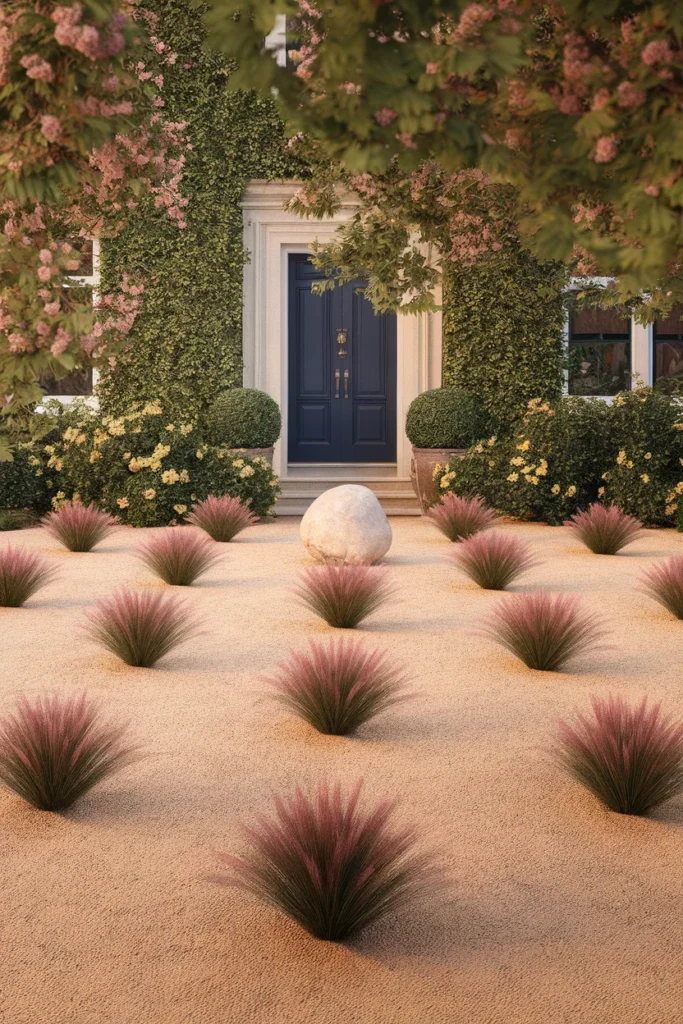
10. Ornamental grasses only
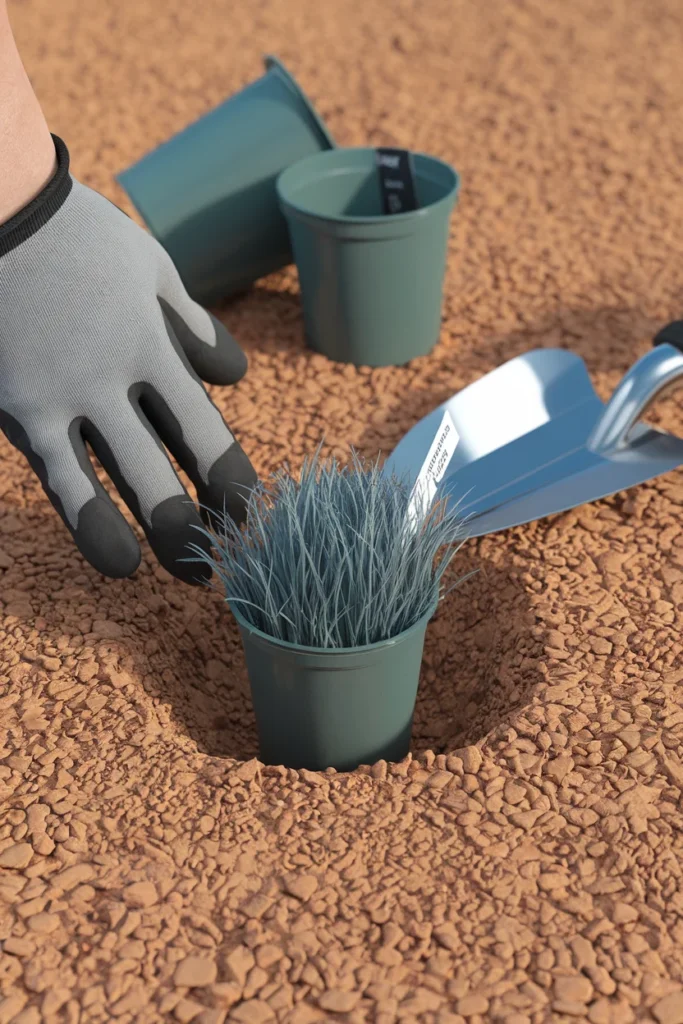
Muhly grass, feather reed grass, and blue fescue. Movement all summer, gold structure all winter, one cutback in February. Plant them in drifts of five or seven, never in a straight soldier line, and let the seed heads stand through winter for the low sun to catch.
11. Raised planters along the walkway
Corten steel or cedar boxes filled with Kellogg or Miracle-Gro garden soil at about $10 to $18 per 1.5 cubic foot bag, planted with herbs and dwarf shrubs. Feed once each spring with Espoma Plant-tone, around $12 for a 4 pound bag.
12. Desert palette with agave and gravel
The desert front yard ideas approach works far outside Arizona if your drainage is sharp enough.
13. Clover or microclover lawn substitute
Still soft underfoot, stays green with about a third of the water, and fixes its own nitrogen. Seed runs roughly $25 to $45 per pound, and a pound covers close to 1,000 square feet. Good middle ground for dog owners who aren’t ready to give up something walkable.
14. Evergreen structure with seasonal containers
Boxwood and dwarf conifers hold the bones. Swap Bloem containers, about $15 to $40 depending on size, for seasonal color without replanting beds every spring.
15. Artificial turf panel with a planted border
Costs about $6 to $22 per square foot installed. Use it as a small green rectangle inside a planted frame, never as the whole yard.
Pick Plants by Your USDA Zone, Not by the Photo
Half the failed no-grass yards I’ve seen failed because somebody copied a California pin in Ohio. The 2023 USDA Plant Hardiness Zone Map splits the country into 10 degree bands based on average annual extreme winter lows. It also bumped a lot of neighborhoods up half a zone from the old 2012 edition. Check yours before you buy anything.
| Zone | Ground plane | Reliable mid layer | Focal point |
|---|---|---|---|
| 5 to 6 | Hardwood mulch, pea gravel | Little bluestem, catmint, sedum | Serviceberry, river birch |
| 7 to 8 | Decomposed granite, bark | Muhly grass, salvia, dwarf yaupon | Crape myrtle, redbud |
| 9 to 10 | DG, crushed rock | Agave, lantana, red yucca | Desert willow, palo verde |
Colorado State Extension makes a point most homeowners never hear. Turf strips narrower than 8 feet cannot be irrigated efficiently with spray heads. That’s why parking strips and side yards are the smartest first squares to convert. They also recommend a 3 to 4 inch mulch layer, well above the thin 1 inch scatter most people apply.
Frost dates move around by year and micro-location, so treat any planting date as a range. Zone 5 usually clears last frost around mid-April. Zone 8 often clears by mid-March. Confirm yours against your county extension office before you put tender plants in the ground.
What if your front yard faces north?
Almost every grass-free yard you’ve saved was photographed in blazing sun, which is unhelpful if your house faces north or sits under a mature oak. Shade changes the plant list completely. Skip the agave, lavender, and muhly grass, because they’ll stretch and flop by midsummer.
Reach for hosta, heuchera, Japanese forest grass, ferns, hellebore, and epimedium instead. Swap gravel for bark mulch as your ground plane, since organic mulch suits woodland roots better and light rock looks strange under a canopy. Sweet woodruff and creeping Jenny will knit across bare soil within two seasons. Shade is the single most common reason front yard landscaping no grass ideas fail after the first year, and it has nothing to do with the design and everything to do with the plant list.
What a No Grass Front Yard Actually Costs in 2026
Nobody ranking for this keyword publishes numbers, which is strange, because cost is the whole decision. Here’s the real spread.
| Item | Typical 2026 US cost |
|---|---|
| Sod removal, DIY rental | About $80 to $110 per half day |
| Sod removal, professional | About $0.50 to $2.00 per sq ft |
| Bark mulch | About $25 to $100 per cubic yard |
| Pea gravel | About $29 to $86 per cubic yard |
| Decomposed granite | About $40 to $100 per cubic yard |
| River rock | About $50 to $160 per cubic yard |
| Metal edging | About $2 to $6 per linear foot |
| Shrubs, plant only | About $5 to $35 each |
| Concrete pavers, installed | About $10 to $17 per sq ft |
| Flagstone, installed | About $15 to $32 per sq ft |
| Artificial turf, installed | About $6 to $22 per sq ft |
| Full professional xeriscape | About $5 to $20 per sq ft |
A 500 square foot front yard done as a DIY mulch-and-shrub conversion lands near $600 to $1,200. The same yard done professionally with pavers, boulders, and drip irrigation lands closer to $2,500 to $10,000. Prices shift by region and season, so price your own materials locally before committing.
Where does the money actually go? Not the plants, which usually come in under 20 percent of a DIY budget. Hardscape eats it. A square foot of paver, flagstone, or synthetic turf costs five to twenty times what the same square foot of mulch costs. That’s exactly why the 60-30-10 split saves you money as well as making the yard look better. Keep the expensive materials for the 10 percent people actually walk on. The cheapest front yard landscaping no grass ideas on this page are also the ones that photograph best, which surprised me the first time I priced a project out properly.
One more line item people forget: drip irrigation. Budget about $100 to $300 in tubing, emitters, and a Rain Bird or Orbit hose-end timer for a typical front yard. New plants need consistent water for two full summers even if the finished design needs almost none.
HOA Rules, Rebates, and the Paperwork Nobody Mentions
Two things can change your budget by thousands before you buy a single bag of gravel.
Rebates first. Several US water agencies pay homeowners per square foot to remove turf. Southern Nevada Water Authority pays 5 per square foot for the first 10,000 square feet. LADWP customers in Los Angeles can stack to $5 per square foot with a 250 square foot minimum. Broader Southern California through SoCal Water mart sits at $2 per square foot. Utah runs a statewide program up to $3 per square foot, though it requires 50 percent perennial plant coverage and drip irrigation. Colorado’s statewide program closed to new applications in March 2025, so ignore the older roundups still listing it. Rates change constantly. Apply before you demolish, because almost every program requires pre-approval photos of the living lawn.
Then the HOA. Many associations still have turf mandates on the books. Several states, including California, Nevada, Arizona, Texas, Colorado, and Florida, have passed laws limiting an HOA’s power to prohibit drought-tolerant or water-efficient landscaping. Those laws vary in strength and none of them override a design review requirement. Submit a plan with plant names, a materials list, and a drawing. Approvals go through far more often than people expect.
Check your city separately for impervious-surface caps. Some municipalities limit how much of a front yard can be hard paving for stormwater reasons, which quietly rules out the all-concrete look.
The Downsides: Heat, Glare, Gravel Migration, and Weeds
Here’s the part the pretty pins leave out, and it’s the reason people redo these yards in year three.
Heat is real. Dark gravel and artificial turf absorb sun and radiate it back. Standing on my charcoal gravel barefoot one July afternoon lasted about four seconds. Artificial turf can run 30 to 60 degrees hotter than air temperature in full sun. Pick light tan or gold rock over dark gray if your yard faces south, and keep at least 30 percent planted so something is casting shade.
Landscape fabric under gravel is mostly a mistake. This is my least popular opinion and I’ll defend it anyway. Fabric costs about $0.20 to $0.24 per square foot, blocks water and air from reaching soil, and degrades in three to five years. It also does nothing about the weeds that germinate in the organic dust settling into your gravel from above. Weeds arrive from the top. Skip the fabric, go 3 to 4 inches deep on your rock, and pull the handful that show up.
Gravel migrates. Without edging it ends up in your lawn strip, your gutter, and your mower. Budget for the edging on day one.
I laid pea gravel two inches deep on my first bed and could see straight through to the soil in three spots by August. Depth is not the place to save $40.
Your Four Weekend Timeline
Most people picture this as a season-long project. It isn’t, if you sequence it right.
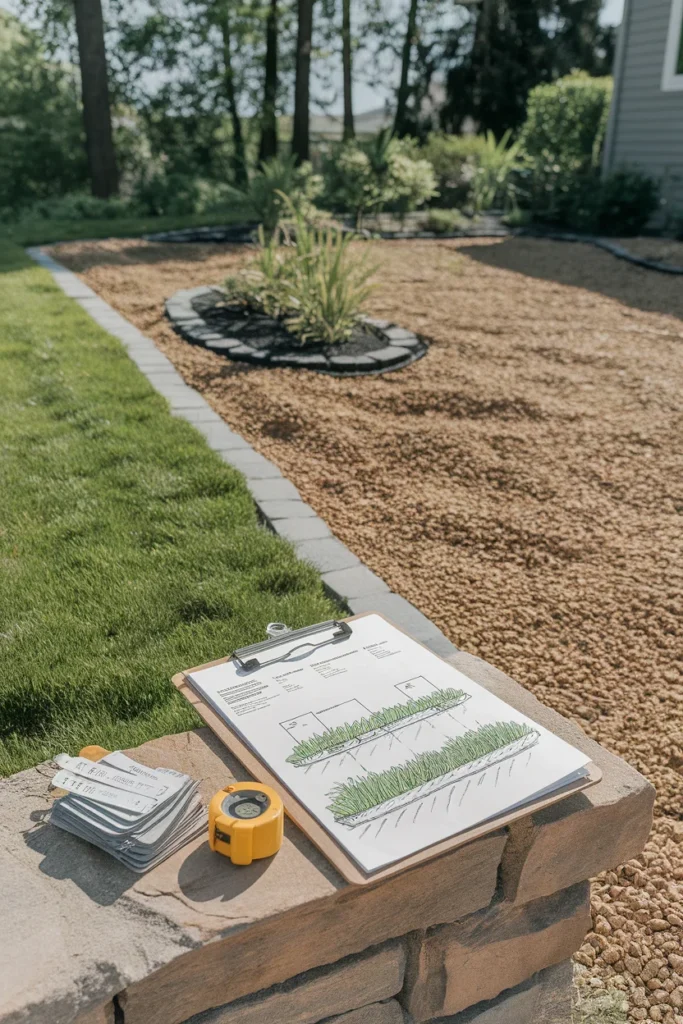
Weekend 1. Measure, sketch your 60-30-10 split, photograph the living lawn for rebate paperwork, and submit your HOA plan. Order materials.
Weekend 2. Remove or smother the turf. Set your edging while the ground is bare, because it’s twice as hard later.
Weekend 3. Spread and rake the ground plane to full depth. Walk it. Adjust.
Weekend 4. Plant in odd-numbered groups, water everything in deeply, and set your focal point last so you can position it by eye from the street.
Fall planting beats spring in most zones. Roots establish through cool months without the plant fighting summer heat at the same time. Anyone building a broader plan for the whole property will find our low maintenance front yard landscaping guide useful for what happens after year one.
Frequently Asked Questions
What are the best alternatives to grass in the front yard? Decomposed granite, bark mulch, pea gravel, native perennial beds, ornamental grasses, and clover all work well. The strongest results combine two or three rather than picking one. A gravel ground plane with mass-planted grasses and a single specimen tree handles almost any climate.
What is the cheapest grass alternative? Sheet mulching over the existing lawn, then planting into the mulch. Cardboard is free and bark mulch runs about $2 to $8 per bag, so a 500 square foot conversion can come in under $400 if you plant small nursery stock and let it fill in.
What grass alternatives are safe for dogs and kids? Clover and microclover stay soft and tolerate traffic. Creeping thyme handles light foot traffic and smells wonderful. Avoid sharp crushed rock and dark gravel in play areas because of paw burns, and skip cocoa mulch entirely since it’s toxic to dogs.
How do grass alternatives affect property values? A well-designed grass-free yard generally holds or improves value, especially in drought-prone markets where buyers price in water bills. A yard that’s mostly bare rock with a few scattered plants tends to hurt it. Design quality drives the outcome more than the material choice.
Do grass alternatives work in areas with HOA restrictions? Usually yes, with a submitted plan. Several states now limit an HOA’s ability to ban drought-tolerant landscaping, though design review requirements still apply. Bring a drawing, a plant list, and photos of comparable yards in your neighborhood.
What grass alternative looks most like real grass? Microclover from a distance, and quality artificial turf up close. If you want the green rectangle look without irrigation, a small turf panel framed by real planting beds reads far better than wall-to-wall synthetic.
How do I maintain a no-grass yard with minimal effort? Expect about two hours a month. Pull weeds while they’re small, top up gravel or mulch every two to three years, and cut ornamental grasses back once in late winter. Run drip irrigation on a timer through the first two summers while roots establish. After that, most of these yards want almost nothing.
The Yard You Stop Fighting
The best thing about going grass-free isn’t the water bill, though that helps. It’s walking out on a Saturday morning in June and having nothing you’re obligated to do. No mower to start. No brown patch to feel guilty about.
Start with the smallest, most annoying piece of your yard. That parking strip, or the dry patch under the tree where grass has never once grown properly. Convert 100 square feet, live with it through a full season, and you’ll know exactly how you want to handle the rest. Nobody who has done this has ever told me they wished they’d started bigger. Plenty have told me they wished they’d started sooner.
The front yard landscaping no grass ideas that last are the ones matched to your actual zone, your actual light, and the amount of upkeep you’ll realistically do in year three. Get those three right and the design almost takes care of itself.
Which idea are you starting with? Save the one that fits your zone and come back to it when the weather turns.