
Deck Dining Ideas: Table Sizes, Grill Placement, Shade and Lighting That Work on a Real Deck

Most deck dining ideas start with a pretty table and stop right there. Then the first real dinner happens. Chairs knock the railing, the low sun lands in everyone’s eyes at 6:30, and somebody walks the whole length of the deck four times for the salt.
A deck isn’t a patio. It has edges, a railing, a door that swings out, and boards that can scuff or fade under the wrong rug. That changes the plan.
So here’s the full playbook we use for eating outside on a deck of any size. You’ll get the Deck Dining Fit Chart, our table-size math for common deck footprints, plus where the table and grill should sit in relation to the kitchen door. After that comes shade based on the direction your deck faces, lighting for after sunset, a quick bug check before guests arrive, and the rug detail that can leave marks on composite boards.
Grab a tape measure. You’ll want it by the second section.

Put the Table by the Kitchen Door, Not the View
Here’s the take that saves more dinners than any centerpiece. On most decks, the best spot for the deck dining table is the one closest to the kitchen door.
Count the trips on your next dinner outside. Plates out. Drinks out. The serving spoon you forgot, the dressing, dessert, then every dish back in. Each extra foot between the door and the table gets walked on every one of those runs.
The view still counts. Turn the chairs toward it instead of hauling the whole table out to the far railing. A rectangular table set parallel to the house, long side facing the yard, gives most seats a good look outward and keeps the door a few steps away.
Then protect the path. Outdoor furniture planning guides call for 42 to 48 inches of clear space near doors, stairs, and grills, because that’s where people carry plates and squeeze past chairs. Treat the stretch between your door and your table as that kind of lane.
Keep chairs out of the door swing and away from the top stair. That one chair tucked by the threshold always becomes the chair everyone trips over.
Last move: a landing spot. A narrow bar cart or a shallow console set just outside the door lets you carry everything out in one trip, then serve from there.
Set the table a few steps from the kitchen door.
Keep a clear 42 to 48 inch lane between the door and the table.
Park a bar cart by the door as your landing spot.
Hauling the whole table to the far railing for the view.
Tucking a chair into the door swing or by the top stair.
Serving every dish straight off the kitchen counter.

The Deck Dining Fit Chart: How Much Table Your Deck Can Hold
Table shopping goes sideways when you measure the table instead of the space it needs. Plan on about 36 inches of clearance on every side where a chair slides out, and 42 to 48 inches on any side that doubles as a walkway.
That makes the real footprint the table plus 6 feet in each direction. A 48-inch round table doesn’t need 4 feet of deck. It needs a circle about 10 feet across.
We ran that math for the table sizes outdoor furniture makers list by seat count, then matched each one to the smallest common deck that holds it with a little room to spare. Screenshot this one.
📏 The Deck Dining Fit Chart
| Seats | Table size | Space it needs | Smallest deck that works |
|---|---|---|---|
| 2 | 24 to 30 in round bistro | 8 ft to 8 ft 6 in across | 8 x 10 ft |
| 4 | 42 to 48 in round | 9 ft 6 in to 10 ft across | 10 x 10 ft (dining only) |
| 4 | 48 x 36 in rectangle | 10 x 9 ft | 10 x 12 ft |
| 6 | 72 to 84 x 36 in rectangle | 12 to 13 ft x 9 ft | 12 x 16 ft |
| 8 | 84 to 96 x 40 in rectangle | 13 to 14 ft x 9 ft 4 in | 16 x 20 ft |
Space it needs = the table plus 36 inches of clearance on every side. Add 6 to 12 more inches on any side that is also the path to the door, stairs, or grill.
Two honest ways to beat the chart:
- Put a bench against the railing. Nobody pulls a bench out, so that side needs no clearance strip at all. You win back about 3 feet.
- Choose armless or swivel chairs. Armless chairs tuck all the way under the table between meals. Swivel chairs need only a short push back before you turn and stand, which is why furniture retailers suggest them for tight decks.
Before you buy anything, fold a drop cloth or flat sheet to the size of the table you want and lay it on the deck. Set real chairs around it and pull each one out like you’re sitting down. If a chair hits the railing or blocks the door lane, size down.

Deck Dining Sets, Benches, and Bar Tables That Earn the Space
Shape comes first. A round table suits a square deck and keeps conversation easy, since nobody sits at a far end. A rectangle follows a long, narrow deck along the house and seats more people for the same width.
An extendable table is the quiet hero of small deck dining. It sits at four-seat size most nights and stretches for holidays, so the deck isn’t stuck holding a table for eight on a Tuesday.
Benches pull double duty. Run one along the railing and you get the clearance savings from the Fit Chart, plus a spot to stash cushions if you pick a storage bench. On a deck with a dining and seating area side by side, a bench can even face either way.
A bar-height table for two along the rail works harder than it looks, too. On a normal night it holds coffee. On a party night it becomes the serving station next to your landing spot.
For material, HDPE poly lumber earns its price on an uncovered deck because it doesn’t need sealing. Polywood’s five-piece dining sets ran roughly $1,100 to $1,900 at Walmart and furniture dealers when we checked in early November 2026, and prices move often. If you’re still deciding between lounge pieces and dining pieces, our deck furniture ideas built around the One-Room Rule help you pick what the deck needs first.
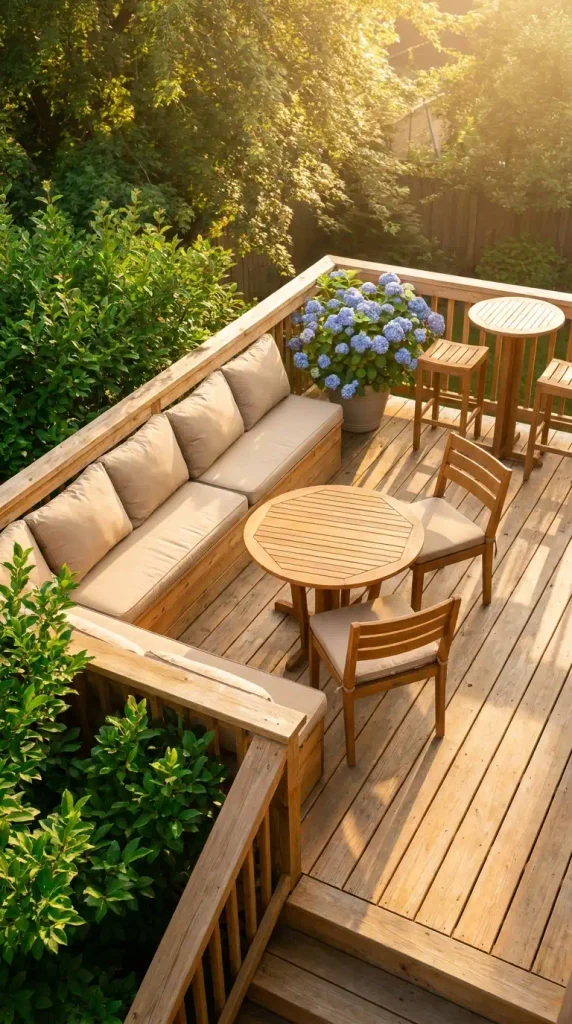
The Door, Table, Grill Triangle
Think of the kitchen door, the table, and the grill as three corners of a triangle. Each corner needs its own breathing room, and the walking paths between them shouldn’t cut through anyone’s chair.
Here’s how we set it:
- Door to table is the short side. Keep that 42-inch lane from the first section clear.
- Table to grill is the middle side. Close enough to pass a platter, far enough that smoke doesn’t drift over the plates. Notice which way your evening breeze usually blows and keep the grill downwind of the table.
- Grill to house is the long side. The National Fire Protection Association’s grilling safety guidance on decks and railings says to keep grills well away from the home and deck railings, and out from under eaves and overhanging branches. NFPA also suggests keeping kids and pets at least 3 feet from the grill area.
Under the grill, add a mat. It catches grease drips and stray sparks before they reach the boards. A GrillTex 30 x 48 inch mat ran under $25 at Home Depot, and bigger mats sized for 36-inch grills, like Camp Chef’s, cost around $70.
Renting or living in a condo? Read the building rules before the first cookout. Some local fire codes ban open-flame cooking on the decks of multifamily buildings.
⚠️ Watch Out
Check your city’s burn rules before you light anything, keep the clearance from structures and branches that your grill’s manual and local code call for, and never leave a fire unattended.
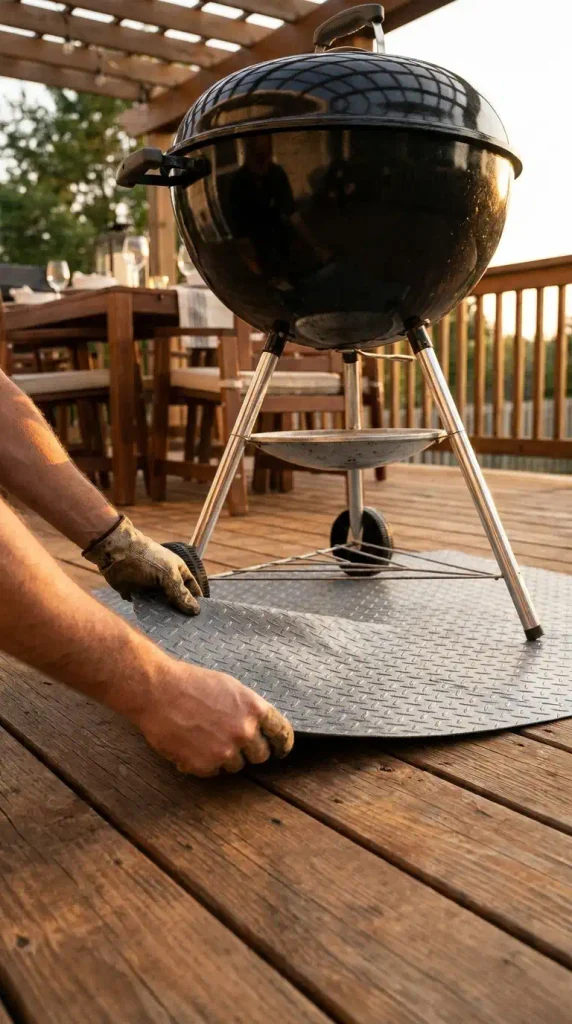
Shade for Lunch, Warmth for Dinner
The direction your deck faces decides what kind of shade you need. Most people buy an umbrella first and figure that out later.
A west-facing deck gets its hardest sun right at dinnertime in summer. The sun is low by then, so it slides in under an umbrella and lands in people’s eyes. Vertical shade fixes it: an outdoor curtain panel on a pergola post, a roll-up shade, or a row of tall potted ornamental grasses on the sunny side.
An east-facing deck is the easy one. The house shades it by evening, so a simple umbrella covers weekend lunches.
South-facing decks need overhead shade at midday. That’s where a cantilever umbrella shines, because the pole stands off to the side instead of poking through the middle of your outdoor dining area. Ten-foot cantilever umbrellas at Home Depot ran about $100 to $165 for budget models in early November, with heavier-duty ones near $300. Use the base weight the manufacturer calls for. Decks get gusty.
North-facing decks rarely need shade. They need warmth. In fall, that means fleece or wool throws in a basket by the door, warm drinks, and moving dinner an hour earlier to catch the last daylight.
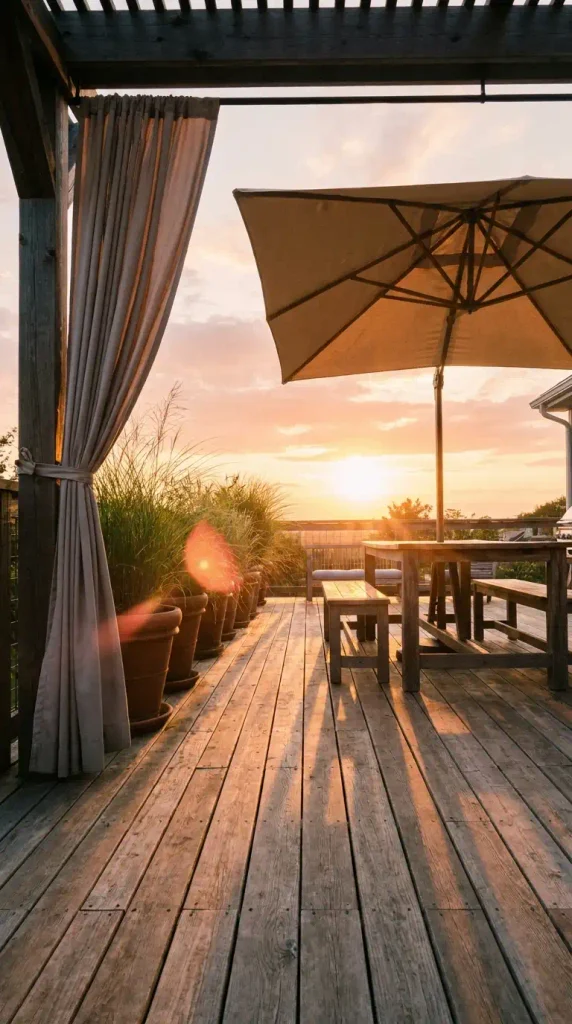
Lighting the Table After Sunset
Light the table in three layers and the deck keeps working long after the sun drops.
Start overhead. Zigzag café string lights across the dining zone rather than tracing the railing, so the brightest part of the run sits over the plates. Hang them about 8 feet up so tall guests and the umbrella both clear the bulbs. Warm white at 2700K or lower keeps faces looking like faces. A 48-foot Brightech Ambience Pro LED strand ran about $55 to $65 at Walmart, and the 24-foot version was around $40.
Next comes the table layer. Flameless pillar candles inside hurricane glass give you candle glow without a flame near the runner or a breeze snuffing it out.
Finish low. Step lights or solar path stakes at the deck stairs matter more than they look, since the walk down to the yard is the darkest part of the night.
Use outdoor-rated, UL-listed lights and cords on a GFCI outlet. Anything beyond plugging into an existing outlet is a job for a licensed electrician.
We go deeper on this in how to plan party lighting in layers, which builds the same three layers for a bigger crowd.
Overhead: warm white café bulbs zigzagged over the table, about 8 feet up.
Table: flameless pillars in hurricane glass, low enough to see across.
Low: step lights or solar stakes along the deck stairs.
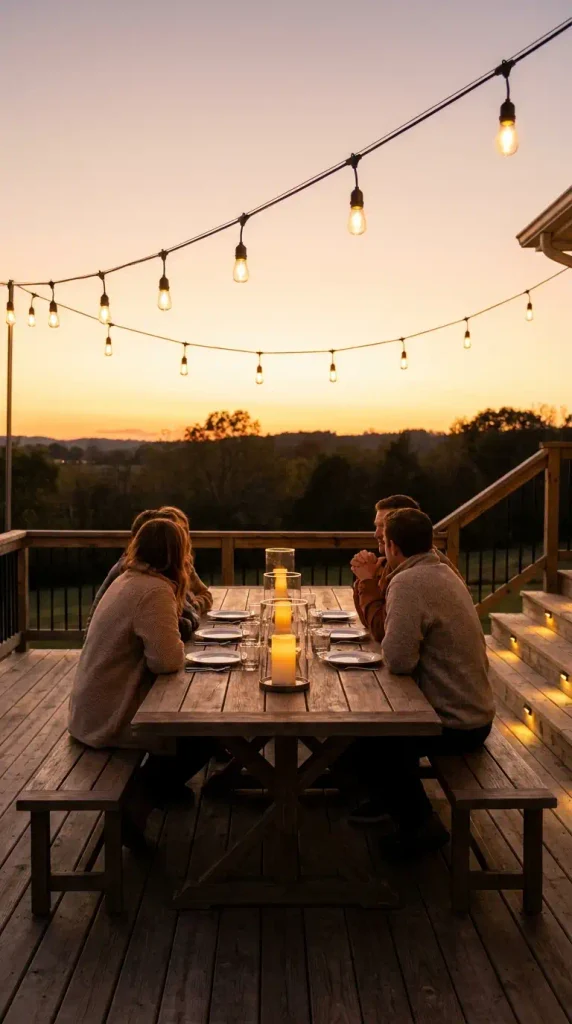
Keep Bugs From Crashing Dinner
A deck full of potted plants is also a deck full of saucers, and standing water is where mosquitoes breed. The EPA’s list of simple ways to prevent mosquito bites includes emptying potted plant trays, birdbaths, and other small water holders at least once a week. On a deck, that’s a quick sweep before the weekend.
Swap the porch fixture by the door for a yellow bug bulb. The EPA notes yellow bulbs tend to attract fewer mosquitoes than ordinary ones, though they don’t repel anything.
For the table itself, a Thermacell Patio Shield ran about $27 at Target and is sold as creating a 15-foot protection zone, enough to cover a typical deck dining table. Set it on the table edge or a side table and switch it on before people sit down.
A box fan on low near the chairs helps too. Mosquitoes are weak fliers, and a steady breeze makes landing hard work.
Herb pots and citronella candles look great on a table. Treat them as extras. Keep an EPA-registered repellent on the bar cart for anyone who wants it.
Bug check, 30 minutes before guests

Protect the Boards Under the Table
The dining zone takes more wear than any other part of the deck. Chairs scrape, drinks spill, grease travels, and a rug sits in the same spot for months. A little planning keeps the boards looking even.
Start with the rug. Polypropylene outdoor rugs handle rain and rinse clean, but the backing matters as much as the weave. Some composite decking makers warn that rubber- or latex-backed mats can leave marks, so check your decking brand’s care guide before you lay one down. Budget rugs often use latex: Target’s Threshold 5 x 7 outdoor rugs, which ran about $60 to $70, list a spray latex backing on several product pages. Read the spec line before you buy.
Then think about sun. New wood and new composite both weather in daylight, and a rug parked in one spot all season can leave a rectangle that doesn’t match the rest of the deck. Shift the rug and the table a few inches every few weeks during the first year.
Chair feet are the last piece. Add rubber caps or outdoor glides, especially on capped composite, which bare metal feet can scratch. After dinner, sweep crumbs out of the board gaps before the ants find them.
| Usually fine on deck boards | Check your care guide first |
|---|---|
| Woven polypropylene rug with no rubber or latex back | Rubber- or latex-backed rugs and mats on composite |
| Rubber caps or outdoor glides on chair feet | Bare metal chair feet on capped composite |
| Heat-rated mat under the grill | A grill sitting straight on the boards |
| Rug and table shifted every few weeks in year one | One rug parked in the same spot all season |

Style a Deck Table That Stands Up to Wind
A deck a few feet off the ground catches more breeze than a patio at ground level, and a light table setting is the first thing it takes. Style from the bottom up.
Weight goes on first. A heavy linen-cotton runner or an outdoor-fabric tablecloth with corner clips or hanging weights stays put where a thin cloth won’t. Melamine plates and acrylic glasses won’t shatter if a gust tips something onto the boards.
Keep the centerpiece low. Short pots of herbs, small hurricanes with flameless candles, and a bowl of lemons read as styled without catching wind like a tall arrangement. If you use potted rosemary, know that most varieties only overwinter outside in about Zone 7 and warmer. In Zones 5 and 6, that pot comes inside for the cold months.
Napkins need weight too. Tuck each one under its plate, or tie it with twine and a rosemary sprig, so it doesn’t sail off the railing during a toast.
For fuller table looks, our outdoor tablescape ideas built on a base kit cover the pieces worth buying once.
Heavy pieces go down first. Light pieces get clipped or tucked. A deck table styled from the bottom up still looks set after the first gust.

Deck Dining Ideas Questions, Answered
How much space do you need around an outdoor dining table?
Plan on at least 36 inches between the table edge and the railing, a wall, or anything else on every side where chairs pull out. Near doors, stairs, or a grill, aim for 42 to 48 inches so people can pass with plates. A quick formula: add 6 feet to the table’s length and width to get the full dining footprint.
Can you leave an outdoor rug on a deck all year?
You can, but the boards do better if you don’t. A rug left down through winter holds snowmelt and wet leaves against the deck and slows drying. Lift it in late fall, let it dry fully, and store it rolled. During the season, shift it now and then so the boards weather evenly underneath.
Can you put a grill on a composite deck?
Usually, yes, with some care. Check your decking brand’s care guide first, since some limit heat sources on the boards. Set the grill on a heat-rated grill mat, keep it well away from the house and railings, and never leave it unattended. Renters and condo owners should check building rules, because some fire codes ban grills on multifamily decks.
How do you keep a tablecloth from blowing away outside?
Start with heavier fabric, like a linen-cotton blend or outdoor canvas. Add clips that grip the table edge or small weights that hang from each corner. Set heavier items, such as a water pitcher or a pot of herbs, near the middle. On very windy evenings, skip the cloth and use a weighted runner instead.
What’s the best table shape for a narrow deck?
A rectangle set parallel to the house. It follows the long side of the deck and leaves a walkway open on the other side. Push one long side against the railing with a bench and you save about 3 feet of clearance. A table around 30 to 36 inches wide helps even more on a tight deck.
How high should string lights hang over a deck table?
Aim for about 8 feet above the deck so tall guests and umbrella tops clear the bulbs. Center the zigzag over the table, not the whole deck, so light lands on the food and faces. Leave a small drip loop of cord below each plug connection so rain runs off before it reaches the joint.
Dinner’s on the Deck
The best deck dining ideas come down to a few decisions made in the right order. Put the table near the door. Size it with the Fit Chart, not the store tag. Make the grill the far corner of the triangle, shade the side the evening sun hits, and light the table in three layers. Then protect the boards, so next summer’s dinners start on a deck that still looks good.
Save this to your deck or outdoor dining board so the Fit Chart is handy the next time you’re in a furniture aisle with a tape measure. Planning for spring? Start with the table spot this weekend. Everything else follows it.