9 Fall Deck Ideas You Can Build Even If You Rent

Fall deck ideas fall apart fast when you rent, because almost every one of them starts with a drill. Hang the garland here. Screw the hook there. Stain the boards, plant the mums, mount the bracket. That advice assumes you own the wood you are standing on, and most of us are standing on wood we have to hand back in good shape.
So this list flips the assumption. Nine ideas, all of them built with clamps, weight, tension, and pots instead of hardware. Every one clears what we call the Landlord Test below, which means it leaves no holes, no stains, and no argument at move-out.
They also have to survive October. Wind ruins more fall decks than rain does, and the styled photos you scroll past were almost all shot on a still afternoon. Half of what follows is about keeping the pretty stuff where you put it.
Start at the floor and work up.
The Landlord Test
Before anything goes out there, run it through four questions. If a piece fails one, it stays in the cart. This is the whole filter, and it is why the fall deck ideas below look different from the usual roundup.
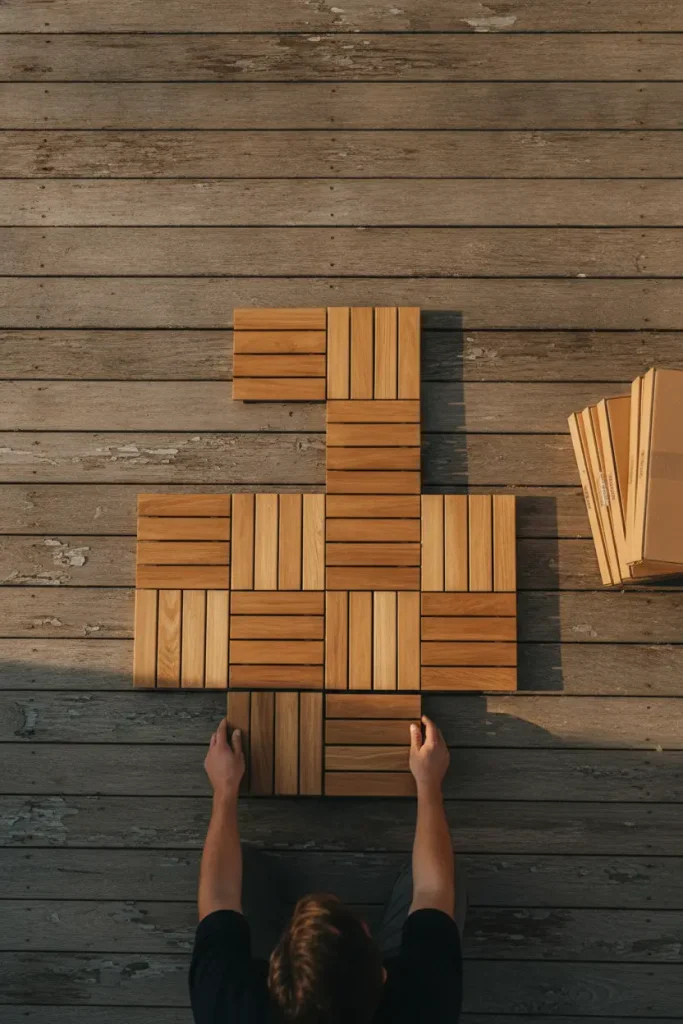
1. Snap-together deck tiles cover boards you are not allowed to touch
Renters inherit the ugliest part of the deck and get no say in it. Gray, splintery, half-weathered boards read as neglect in every photo you take, and staining them is usually a lease violation anyway. Interlocking tiles clip over the top and lift right back off in spring.
IKEA’s RUNNEN decking runs about 9 square feet per pack and sits under $25, and the UTLÄNGAN line gives you the same trick in a warmer brown. A 6 by 8 landing takes five or six packs. Lay them loose, leave a finger gap at the edges so water drains, and do not seal the perimeter. The same logic runs through most good budget backyard patio ideas: cover, do not commit.
Sweep hard, then hose the boards and let them dry fully. Grit under tiles grinds the finish.
Start in the corner you see first from the door and clip outward in one direction.
Stop one tile short of the railing. That gap is your drainage channel and your airflow.
Pull a corner section every few weeks through fall and check underneath for trapped damp.
2. A shallow V of café bulbs beats a straight line every time
Run a single taut line of bulbs across a deck and you get a job site, not a dinner. The light sits too high, it glares straight into everyone’s eyes, and the whole thing looks temporary because it is.
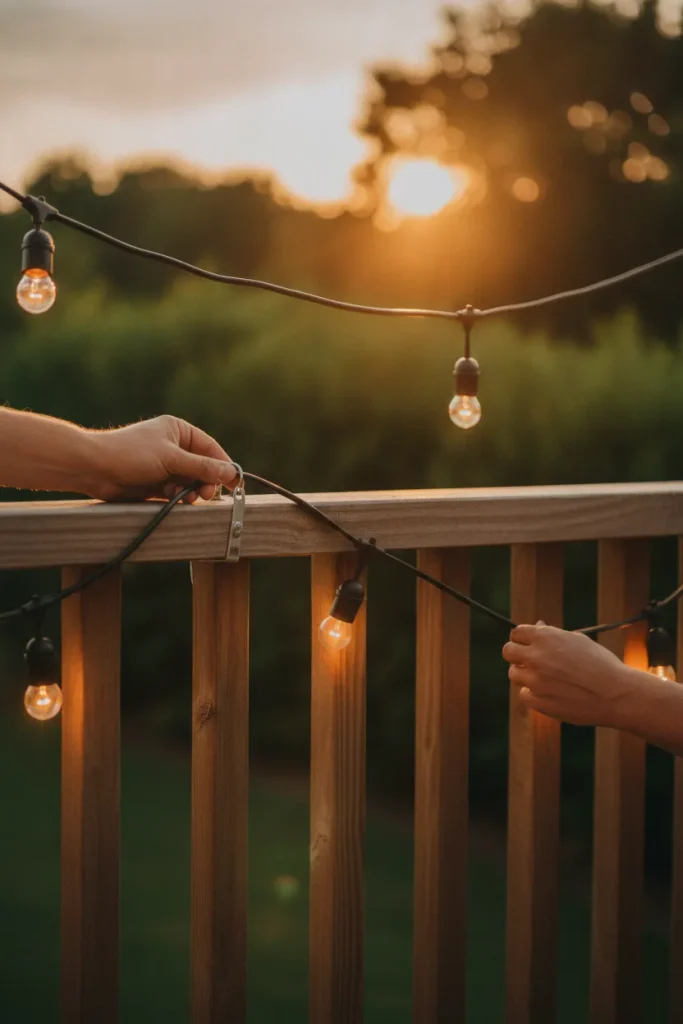
Drape changes the read completely. Two anchor points, one shallow V dipping toward the middle of the seating area, and the bulbs land at about head height where they actually flatter faces and tables.
⚠️ Watch Out
Use outdoor-rated, UL-listed lights and cords on a GFCI outlet. Anything beyond plugging into an existing outlet is a job for a licensed electrician.
Brightech’s Ambience Pro in the 48 foot length sits in the $40 to $70 range and takes real S14 Edison bulbs, which is the difference between warm and cheap. For anchors that clear the Landlord Test, use slide-on deck rail hooks or spring clamps from the hardware aisle, plus a length of guide wire if your span runs past 15 feet. Zip ties do the rest. Nothing goes into the wood.
3. Mums are fall decor, not a planting project
Garden centers stack mums like furniture in September, and every roundup tells you to plant them after. Skip that. The plants sold in full bloom are built to peak in the pot, and Virginia Cooperative Extension is blunt about why: garden mums need to go in the ground in late August or early September for root development, and, in their words, the later they are planted the lower the survival rate.
Their guidance on overwintering garden mums also notes that garden mums are typically hardy in zones 5 to 9 while florist types are not bred for hardiness at all.
Which is freeing, honestly. Buy them as seasonal color, spend $8 to $15 on a 9 inch pot at Home Depot or Lowe’s, group three of them in odd numbers, and let them do their six weeks.
A pot on a deck dries out far faster than the same plant in a bed, so the real failure mode is thirst, not cold. Check the top inch every morning.

4. The ten pound rule for anything that stands up
Most fall deck ideas were photographed on a still afternoon. Then the first front rolls through and your lantern is in the neighbor’s yard, the garland is hanging by one clip, and a pumpkin has rolled off the steps.
Here is the working rule: anything standing taller than a foot on an open deck needs roughly ten pounds holding it down, and anything hanging needs two anchor points rather than one. Pea gravel in the bottom third of a lightweight resin planter does it. So does a bag of play sand under the soil line.
Gravel or sand in the base of every tall pot, under the potting soil.
Two clip points on any garland, at the ends, never one in the middle.
Group pumpkins against a wall or a step riser so they have something to fail into.
Hollow foam pumpkins on an open rail. They are the first thing to go.
Tall empty lanterns with nothing weighting the base.
Corn stalks tied to a post with twine and hope.
Wind is the most under-covered problem in this whole category. Solve it once in September and you stop restaging the deck every Monday.
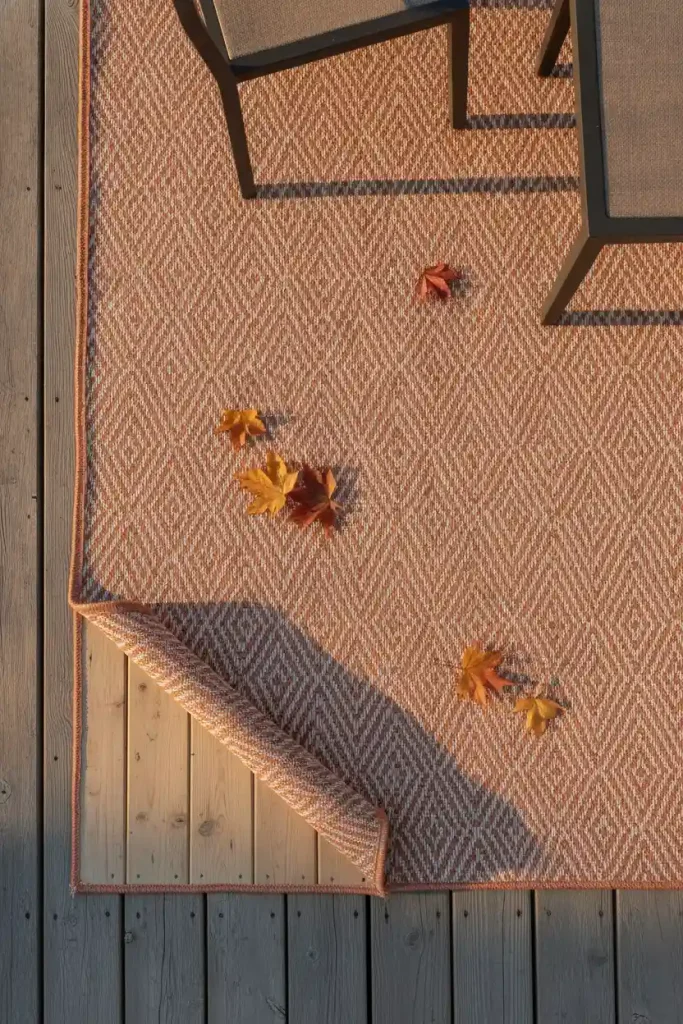
5. Flat weave beats plush on wood boards
Every fall roundup pushes a thick shaggy outdoor rug, and on a wood deck that is the one piece most likely to cost you your deposit. A plush pile holds water against the boards after every rain, shade keeps it there, and by November you have a rectangle of darker wood that does not sand out easily.
Flat weave polypropylene dries in hours instead of days. It also sheds leaves when you shake it, which matters more in October than any pattern does.
| Plush pile rug | Flat weave rug | Deck tiles |
|---|---|---|
| Holds damp against the boards | Dries in a few hours | Drains through the gaps |
| Traps wet leaves in the pile | Shakes clean over the rail | Sweeps clean |
| Cost tier: mid | Cost tier: low to mid | Cost tier: mid |
Most fall deck ideas gloss over this part, which is a shame, because it is the one that costs money later. On a small deck, a 5 by 7 in a rust and cream pattern from Target or Wayfair reads bigger than a 4 by 6 because it touches more furniture legs. Lift whichever you choose after heavy rain and let the boards breathe. That single habit is what keeps a rug inside the Landlord Test.
6. A blanket basket by the door is the whole trick
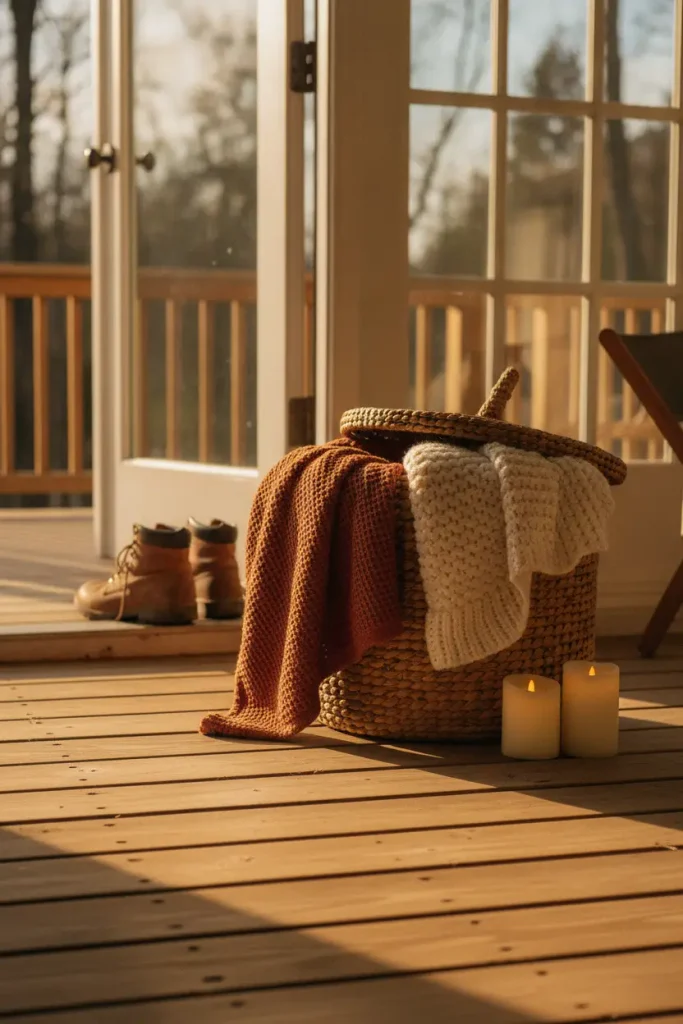
Deck season ends when sitting outside stops being comfortable, and that happens about three weeks earlier than it needs to. A basket of throws parked where you walk out fixes it, because the friction of going back inside for a blanket is what actually sends people in.
What goes in the basket
HomeGoods and TJ Maxx carry seasonal throws under $20 all autumn, and the candle and faux stem aisle at Dollar Tree fills the gaps for a couple of dollars a piece, the same way it does across these dollar store backyard decor finds. Buy the basket once. Refill it every October.
7. Tabletop fire gives you the glow without the clearance problem
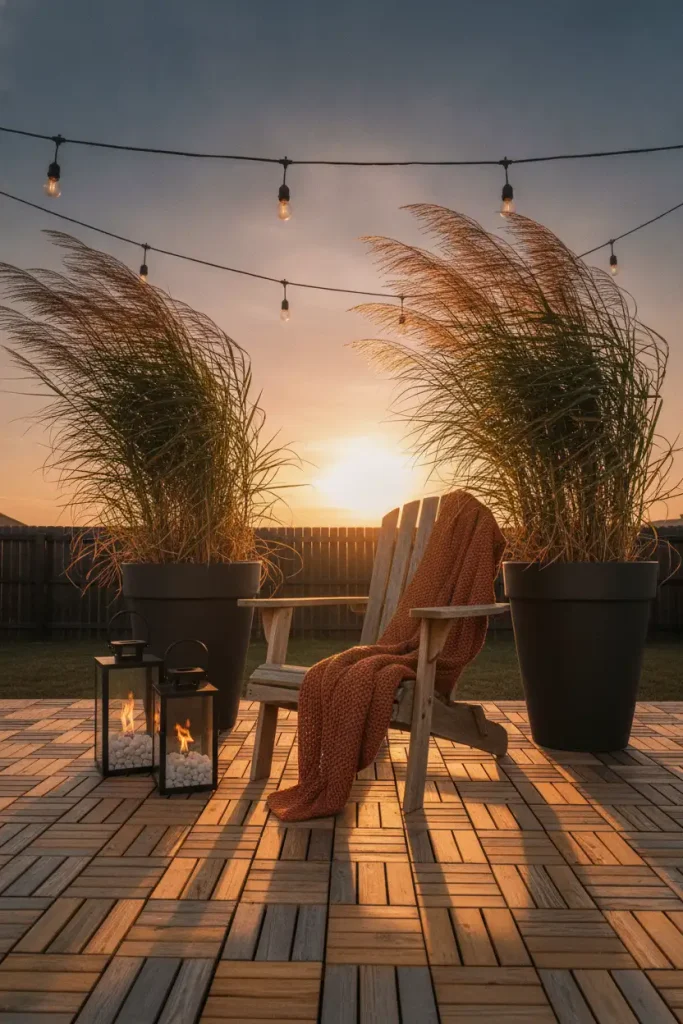
Full size fire pits and wood decks are a bad pairing, and on a rental they are usually a flat no in the lease. A tabletop unit changes the math. Solo Stove’s Mesa sits about 5 inches across, runs under $100, and throws enough light to make a table feel like an evening rather than a dinner that ended.
⚠️ Watch Out
Check your city’s burn rules before you light anything, keep the clearance from structures and branches that your fire pit’s manual and local code call for, and never leave a fire unattended.
If flame is off the table entirely, and in a lot of apartment leases it is, a cluster of battery pillar candles inside hurricane glass reads almost identically in photos and costs a fraction of the Bonfire 2.0, which sits in the $200 to $400 range. Put the light low. Firelight from below is the entire mood, and a smokeless unit on a heat-safe trivet gets you there without a single hole in anything.

8. Railing planters turn four feet of rail into a second garden
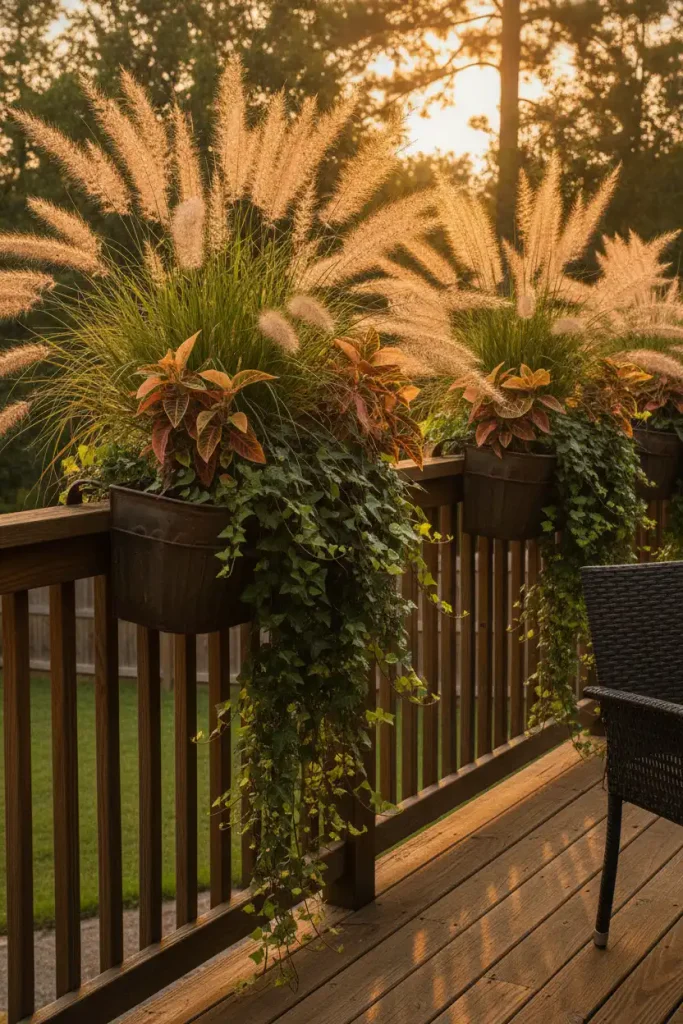
Small decks run out of floor before they run out of interest. The rail is the unused acre, and saddle-style railing planters straddle the top board without a single fastener, which is exactly the kind of renter friendly deck decor that survives an inspection.
Fill them with ornamental grasses, trailing ivy, and croton for color that lasts past the mums. Check what will actually hold through your autumn on the 2023 USDA Plant Hardiness Zone Map, which is based on average annual extreme minimum winter temperature and has a zip code search built into the map. Your county extension office is the better call for local first frost timing, since hardiness zones describe winter lows rather than frost dates.
Measure the top rail width first. Saddle planters are sized to 2×4 or 2×6, and the wrong one wobbles.
Set them on the inside edge of the rail, never overhanging a walkway or a neighbor’s space.
Put a saucer or liner underneath. Runoff stains a rail faster than anything else on this list.
Alternate tall and trailing plants so the rail reads as a planted edge, not a row of boxes.
Bloem and Gardener’s Supply both make saddle styles in the $20 to $40 range, and the same containers carry straight into spring herbs, which is roughly the logic behind most good small space container garden setups. Two planters per rail section is plenty. Four looks like a nursery display.
9. One bin, one label, and teardown takes twenty minutes
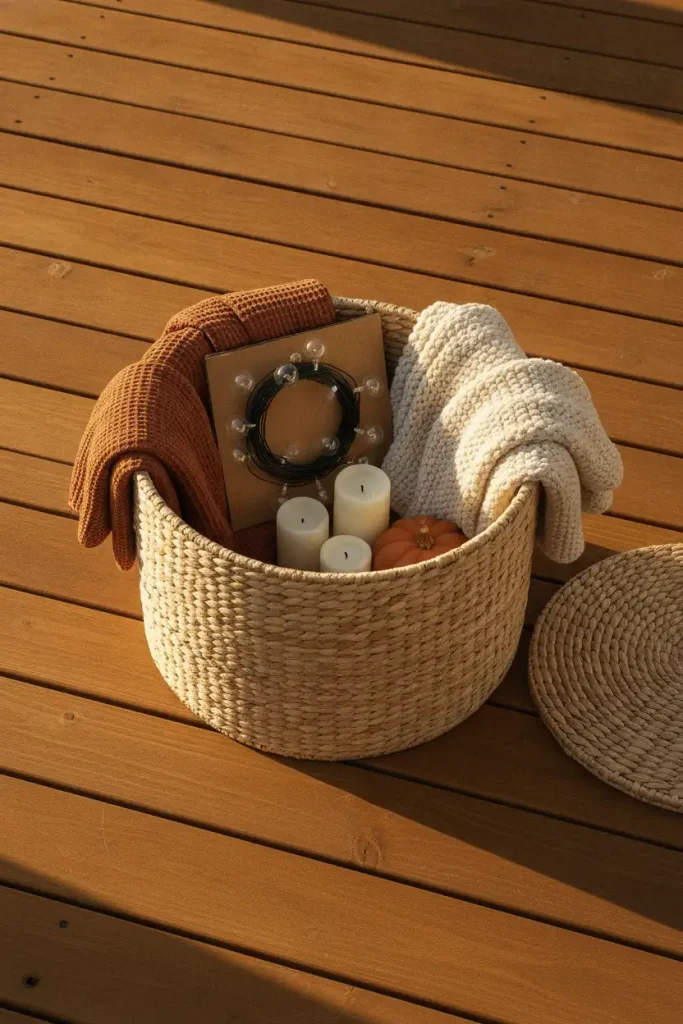
Nobody plans the ending, which is why fall decor sits out until it is soaked and faded and genuinely depressing in December. Decide the date now instead: the week of your first hard frost, everything soft comes in.
Textiles go in first, fully dry, or they mildew in storage. Battery candles get their batteries pulled so they do not corrode. String lights get coiled around a scrap of cardboard rather than stuffed in a ball, which is the difference between five working strands next year and two. Pumpkins go to compost, not the bin.
If the whole season fits in one labeled bin, you will actually put it up again next year. That is the real test, and it is the last line of the Landlord Test for a reason.
Write the month and the contents on the lid in marker. Future you will not remember.
FAQ
How do I decorate a deck for fall on a budget?
Spend on light and textiles, save on everything else. A 48 foot strand of outdoor rated café bulbs in the $40 to $70 range plus two throws under $20 each changes the whole space. Pumpkins, faux stems, and battery candles come from Dollar Tree for a couple of dollars a piece. The fall deck ideas that cost the most rarely photograph the best, so skip furniture entirely in year one.
How can I make my deck more inviting in the fall?
Lower the light and shorten the distance to comfort. Bulbs at head height instead of overhead glare, a blanket basket within arm’s reach of the door, and one small heat or flame source at table level. Those three moves do more than any amount of seasonal decor, because they change how long people actually stay outside.
What can renters use instead of drilling into a deck railing?
Slide-on deck rail hooks, spring clamps, saddle-style railing planters, and guide wire with zip ties cover almost everything. All four grip the rail by shape or tension rather than fasteners. For floors, interlocking deck tiles clip over existing boards. Check your lease language on exterior changes before you start, since some leases cover the deck separately.
Do mums survive the winter in pots on a deck?
Usually not. Virginia Cooperative Extension notes that garden mums are typically hardy in zones 5 to 9 but need to go in the ground by late August or early September to root before the ground freezes, and that the later they are planted the lower the survival rate. Florist types are not bred for hardiness. Treat fall mums as seasonal color.
How do I keep fall decorations from blowing off my deck?
Weight and anchor points. Anything over a foot tall wants roughly ten pounds in its base, which pea gravel or play sand under the potting soil handles cheaply. Garlands get clipped at both ends, never in the middle. Hollow foam pumpkins and empty lanterns are the usual runaways, so group them against a wall or a step riser.
When should I take fall decor off the deck?
Target the week of your first hard frost in your area. Textiles come in fully dry so they do not mildew, battery candles get their batteries pulled, and string lights get coiled around cardboard instead of balled up. Your county extension office has local frost timing, since hardiness zones describe winter lows rather than frost dates.
Is it worth putting a rug on a wood deck in fall?
Yes, with one condition. Choose a flat weave polypropylene rug that dries in hours rather than a plush pile that holds damp against the boards through every rain and shady afternoon. Lift it after heavy weather and let the wood breathe. On a rental, that habit is the difference between a styled deck and a deposit conversation.
Conclusion
The best fall deck ideas are the ones you can undo. Tiles that lift, hooks that slide off, planters that straddle a rail, and a season that packs into one bin when the frost comes. Nothing here asks permission from a landlord, and nothing here punishes you in April.
Pick two this weekend. The floor and the lights carry the most visual weight, so start there and let the mums and the throws follow.
Save this to your fall porch and deck board so it is waiting for you next September, when the garden center stacks the mums out front again.