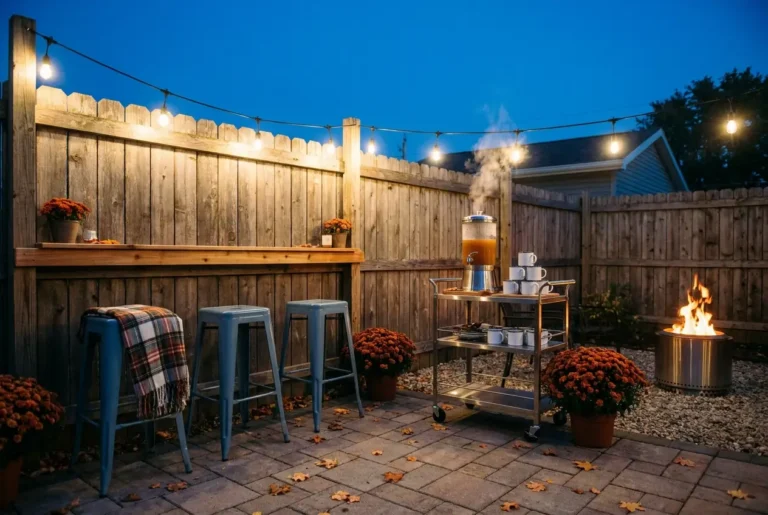
25 Stone Cozy Backyard Ideas That Make Fall Nights Worth Sitting Outside For

Cold air does something strange to a backyard. The furniture stops getting used, the grass goes flat, and the whole space quietly closes for the season. Stone is the one material that ignores all of that. These stone cozy backyard ideas work because rock holds the day’s warmth, shrugs off wet leaves, and gives a chair somewhere solid to sit when the lawn turns to mush.
Here is what most idea lists will not tell you: the difference between the cheapest warm stone surface and the most expensive one is roughly ten times the money per square foot. Same photo energy, wildly different receipt. So before the ideas, you get a cost ladder. Pick your rung, then pick your look.
Twenty five ideas below, most of them with a real number attached, and a few built specifically for what October does to a yard.
First, the $3-to-$32 Stone Ladder
Every idea below sits on one of three rungs, priced by the square foot from current 2026 installed cost data. Loose stone is the bottom rung and it is not a compromise, it is just a different texture. Concrete and brick pavers are the middle. Natural flagstone is the top, and it costs what it costs because the labor alone runs most of the bill. Decide the rung first and the rest of your choices get easy.
1. A dry-laid flagstone landing sized for exactly two chairs
Forget the full patio. A 6 by 8 foot landing is 48 square feet, and at the going dry-laid rate of $15 to $32 per square foot installed that lands somewhere between $720 and $1,536. Small enough to finish, big enough to hold two chairs and a side table without anyone’s legs in the dirt.
Irregular flagstone reads warmer than a grid because no two joints match. Keep the pieces at least 1.5 inches thick, ideally 2 to 3, or furniture legs will crack them over a couple of winters.
This is the highest rung of the ladder, and it is the one idea here worth spending on, because it is the piece you will look at every single day.
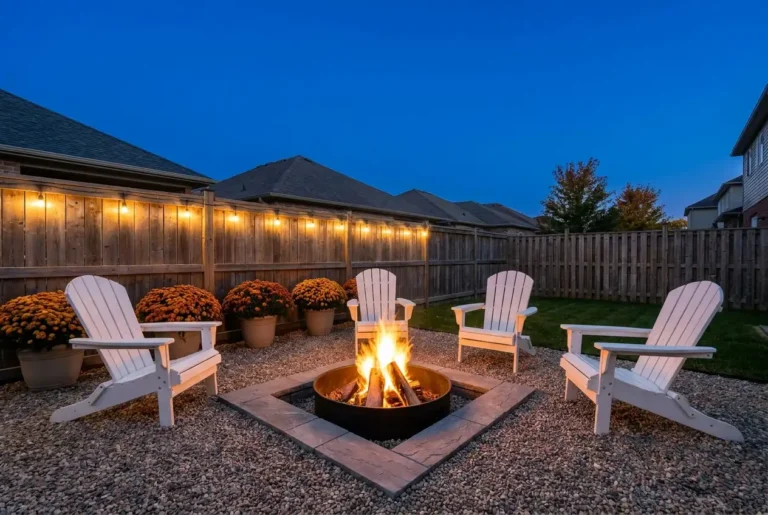
2. Pea gravel seating circle, three inches deep, under two hundred dollars
Bottom rung, best value on the whole list. Pea gravel runs about $1 to $3.15 per square foot, and a 10 foot circle is roughly 79 square feet, so the stone itself is a couple of hundred dollars at most. Bagged at Lowe’s or Home Depot you are looking at around $5 for a half cubic foot bag.
Three things make the difference between a gravel circle that feels finished and one that feels like a construction site:
- Landscape fabric first, at $0.05 to $0.25 per square foot
- A hard edge all the way around so the stone cannot wander
- Three inches of depth, not two
Our first gravel circle went down at two inches and kept scuffing into bare patches by the second week. Three inches fixed it.” Replace with your real depth and what went wrong.
Two inches looks fine on day one and shows dirt by the end of the month. If you are working the whole yard on this rung, our other budget backyard patio ideas stack well with it.
| Pea gravel circle | Flagstone landing |
|---|---|
| About $1 to $3 per sq ft | $15 to $32 per sq ft installed |
| One afternoon, no compactor | A weekend, tamper or plate compactor |
| Rake it level again any time | Lift and reset single stones as needed |
| Chair legs sink a little | Chair legs stay put |
3. Stepping stones set flush into the gravel so slippers survive
Walking across loose gravel in socks is nobody’s idea of a good evening. Drop four or five large flat stones into the gravel on the line people actually walk, set flush with the surface, and the crunch zone becomes a path.
Space them by stride, not by ruler. Stand where you normally enter the space, walk it at a normal pace, and mark where your feet land.
Get the stepping line right
4. Pick a dense stone if wet leaves are going to sit on it
Here is the autumn problem nobody in the idea lists mentions. Leaves pile up, they get rained on, and the tannin in them leaves shadows on porous stone. Sandstone and limestone drink it in. Denser picks like bluestone and granite shrug most of it off.
Limestone also scratches easily, and slate, despite lasting 50 to 100 years or more, reacts badly to acidic cleaners, which rules out half the shortcuts you would reach for on a stained patio.
If your seating spot sits under a maple, that choice matters more than the pattern you lay it in.
Under a deciduous tree, stone density beats stone beauty. Dense stone stays the color you bought it in.
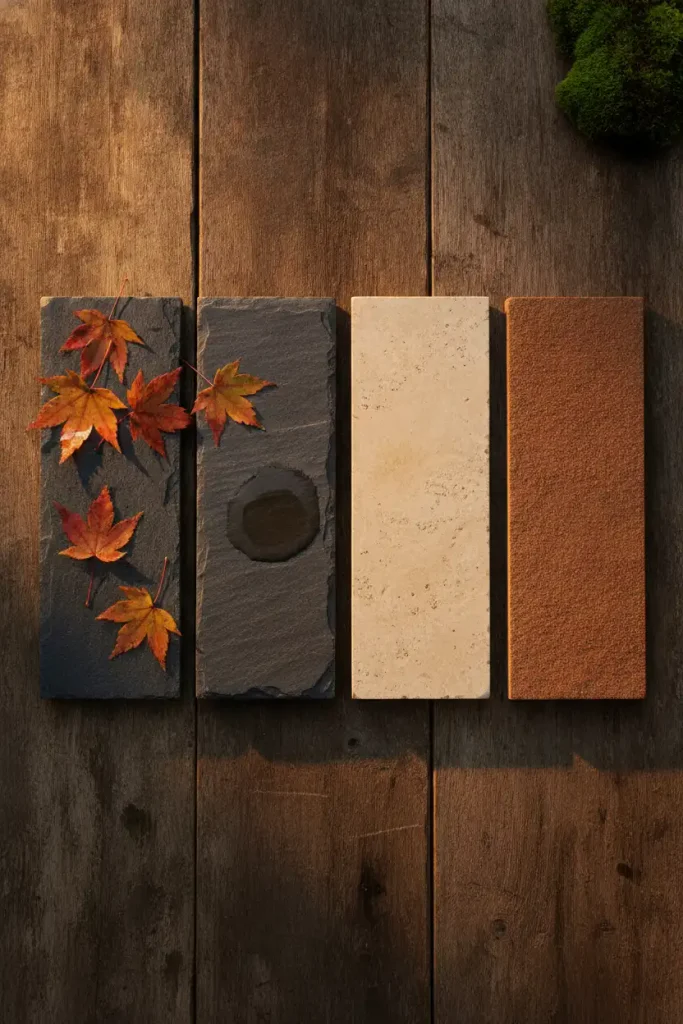
5. Creeping thyme or moss in two-inch joints instead of sand
Wide joints planted green are the single cheapest way to make new stone look like it has been there a decade. Leave the gaps generous, fill them with soil rather than polymeric sand, and tuck in plugs.
Moss wants shade and steady moisture. Creeping thyme wants sun and takes a light footstep. Check your zone before you commit, because a plant that dies in January leaves you with a muddy joint.
Leave joints around two inches wide as you lay the stone, wider than you think looks right.
Fill with a sandy soil mix, not polymeric sand, which sets hard and kills anything planted in it.
Press plugs in firmly, water lightly every few days for the first month, then leave them alone.
Expect real coverage the following season, not this one. Green joints are a patient project.
6. A smokeless fire pit with the clearance measured before the stone goes down
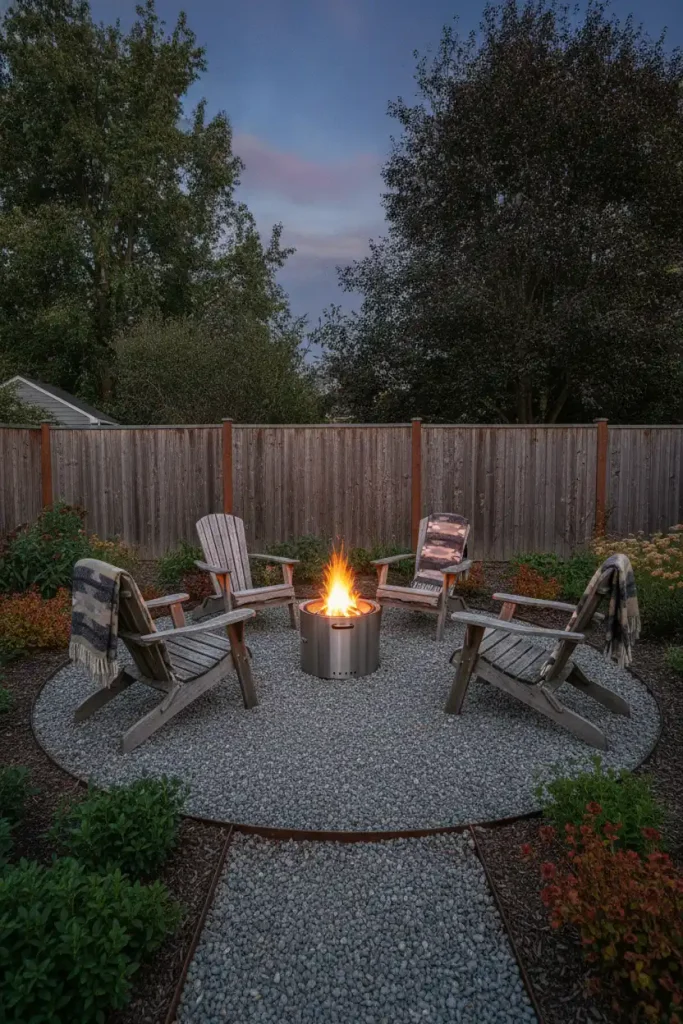
The pea gravel fire pit area is the most saved idea in this entire category on Pinterest, and there is a reason: gravel does not burn, does not stain, and rakes flat again after a season of sparks.
Before you lay a single stone, measure. Federal outdoor fire safety guidance puts fire pits, chimneys, and outdoor fireplaces at least 10 feet away from the house or anything else that can burn, and campfires at 25 feet from tents and shrubs. Ten feet is a bigger circle than it sounds like in a small yard, which is exactly why you measure first and design second.
A Solo Stove Bonfire 2.0 runs about $250 at Home Depot, throws heat across a 4 to 6 foot radius, and seats four to six people, which sizes the gravel circle for you.
⚠️ Watch Out
Check your city’s burn rules before you light anything, keep the clearance from structures and branches that your fire pit’s manual and local code call for, and never leave a fire unattended. A metal screen over a wood fire keeps sparks from floating out, and cooled ash belongs in a lidded metal can, not a trash bag.
7. Build the bench out of wall block instead of buying more chairs
Chairs blow over, fade, and need storing. A low stone bench does not. Stack wall block two or three courses to land around 18 inches of seat height, cap it with a wide flat stone, and throw a cushion on top when you sit.
Aim for roughly 18 inches from grade to the top of the cap, the height of a dining chair.
Give the seat 15 to 18 inches of depth so a person can actually lean back.
Set the first course on tamped gravel, not bare soil.
Running the bench in a long straight line, which reads like a retaining wall, not seating.
Stacking above about three courses without proper wall design behind it.
Skipping the cap stone. The cap is what makes it read as furniture.
8. Use gravel’s heat storage on purpose, now that it finally helps
All summer, rock mulch is a liability. The EPA’s own water smart landscaping tips warn that rocks, pebbles, and gravel radiate heat and dry out nearby plants, and specifically say to avoid rock mulches in sunny spots around plants that are not adapted to arid conditions.
In October that same behavior becomes the feature. A gravel or stone seating area facing the afternoon sun soaks up heat all day and gives it back for the first hour or two after sundown, which is exactly when you are out there with a mug.
- South or west facing, if you get the choice
- Darker stone stores more than pale stone
- Keep thirsty plants back from the edge, where the heat is worst
- Three to four inches of organic mulch in the beds instead, per the same EPA guidance
Same physics, opposite season, opposite verdict.
- ▸Warmest seat in the yard from about 4pm onward
- ▸No cushions needed on the stone itself, it is already warm
- ▸Move the fire pit here and you double the effect
9. Tuck the whole thing into a fence corner
Open-field seating never feels settled. Two fence lines already give you a back and a side, so a small stone pad in the corner does the work of a much bigger patio. Add a screen or a tall planter on the open diagonal and the space closes around the chairs.
Corners also cut the wind, which in November is the difference between sitting outside and going in. If you want to close that third side properly, our backyard privacy ideas for small yards cover the cheap versions.
10. Broken concrete, laid as urbanite
Someone in your zip code is paying to haul away a broken driveway right now. Busted slab, laid pattern-side down with the rough break facing up, looks remarkably like fieldstone once the joints are gravel-filled. Cost of stone: zero. Cost of your back: real
💡 Quick Tip
Contractors pay by the ton to dump concrete, so free pickup is a favor to both of you. Take only pieces you can lift with two hands, and wear real gloves. Broken slab edges are sharper than they look.
11. Stone slabs with cedar deck tiles between them
Straight stone can feel cold in October. Breaking the field with squares of wood warms the whole surface up visually and costs less per square foot than filling the same area in flagstone.
The two materials age differently, which is the point. Stone stays put, wood silvers.
| Stone field | Stone plus wood tiles |
|---|---|
| Full flagstone rate across every square foot | Stone rate on part of it, tiles on the rest |
| Cool underfoot in fall | Warmer where the wood is |
| Nothing to replace | Tiles get swapped out eventually |
12. Renting? Lay slabs loose on the concrete slab you already have
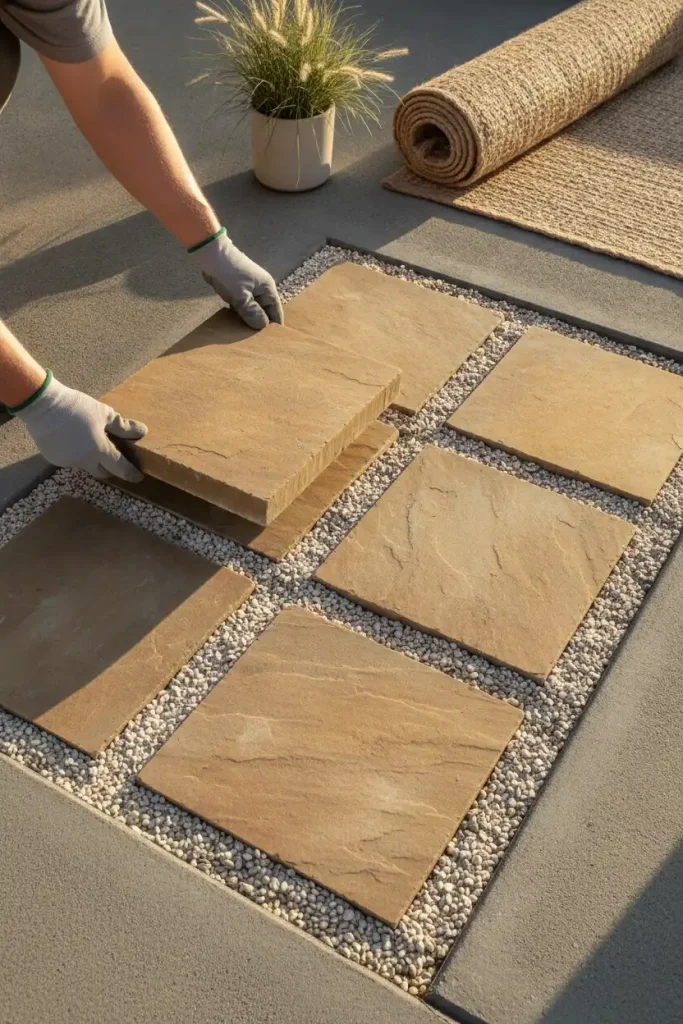
Nothing below this idea gets dug, drilled, or mortared. Large flat pavers set directly onto an existing concrete pad, with gravel swept into the gaps, cover ugly concrete completely and lift out in an afternoon when the lease ends.
It is the bottom rung of the stone ladder in spirit and the middle rung in looks, which is a rare combination.
A gray concrete pad with a hairline crack across it, two plastic chairs, nothing you would photograph.
Wide pavers laid loose over the same pad, gravel in the joints, a rug at one end. All of it reversible.
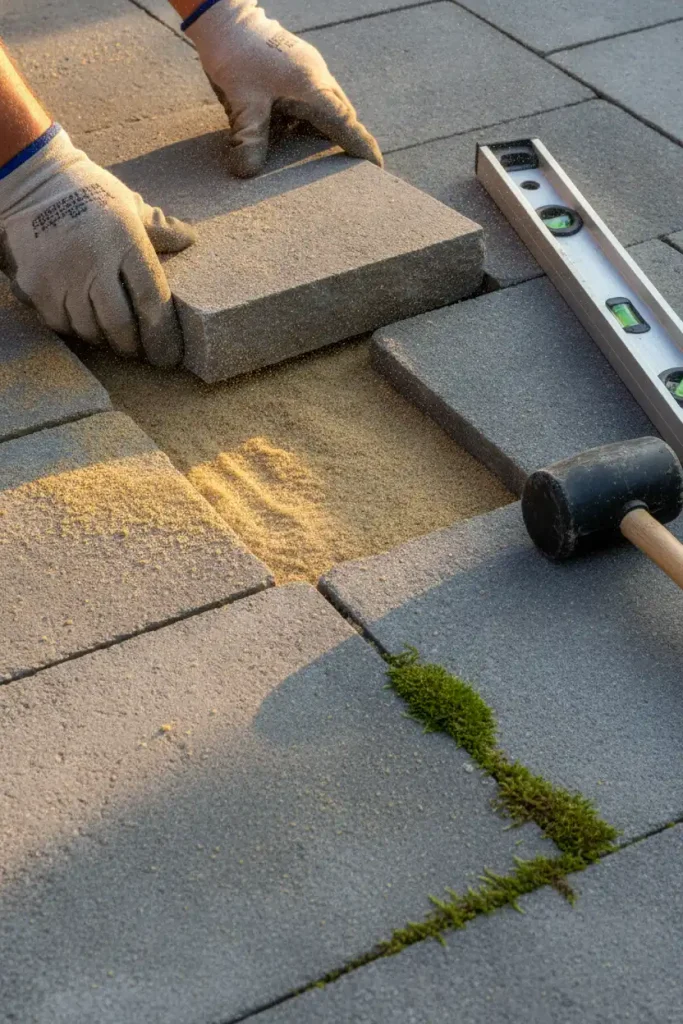
13. Four inches of gravel base, tamped in two-inch lifts
Almost every failed stone surface failed down here, below the part anyone sees. A compacted gravel base runs about $2 to $5 per square foot installed and typically goes 4 to 10 inches deep depending on your ground.
We rented a plate compactor for $83 for the day rather than buying a $68 hand tamper, and on anything over about 50 square feet it was the better call.” Replace with the tool you actually used and what it cost you.
Compact in lifts. Dumping four inches of gravel and hitting it once leaves the bottom half loose, and loose base is what makes a stone rock under a chair leg two winters later.
Excavate deep enough for base plus stone thickness, so the finished surface sits where you want it.
Add gravel two inches at a time and compact each lift before the next one goes in.
Pitch the whole surface slightly away from the house so water leaves instead of pooling.
Top with leveling sand for dry-laid stone, then set your pieces and sweep the joints.
14. Choosing between bluestone, slate, and limestone
All three show up in flagstone patio ideas constantly, and they behave nothing alike. Bluestone materials run roughly $6 to $14 per square foot, hold up 35 to 50 years or more, and resist fading, though some sources note color softening over time. Slate costs more, $9 to $25, and can last a century, but acidic cleaners damage it. Limestone sits in the middle at $7 to $15 and scratches easily.
15. Warm bulbs over the stone, not cool ones
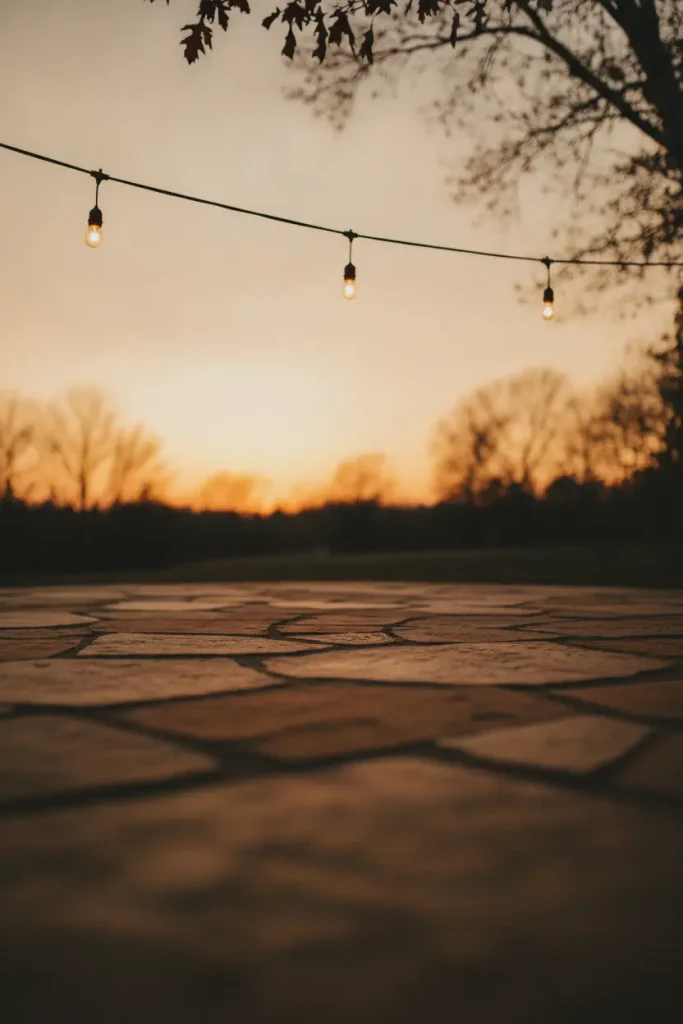
Lighting is where a good stone surface gets ruined. Bulbs above about 3000K turn warm tan flagstone a flat, clinical gray after dark. Stay at 2700K or below and the same stone glows.
Run the line low, roughly eight feet up, so the light lands on the stone and on faces rather than spilling over the fence into a neighbor’s window.
⚠️ Watch Out
Use outdoor-rated, UL-listed lights and cords on a GFCI outlet. Anything beyond plugging into an existing outlet is a job for a licensed electrician.
16. A cluster of lanterns on one wide slab
Not every light needs wiring. Three lanterns of different heights grouped on a single broad stone read as intentional, while the same three spread around the space read as leftovers.
Group them like this
17. A dry creek bed that earns its keep when the gutters overflow
Beautiful in photos, useful in a downpour. A shallow channel of river rock running from a downspout or a low spot toward the edge of the property moves water away from the seating area instead of letting it sit under your chairs.
Autumn is when you find out whether your yard drains, so autumn is when this idea pays for itself.
A dry creek bed is the only decorative feature in your yard that also does a job on the worst day of the month.
18. Gravel-filled joints instead of mortar, so the ground can breathe
Sealed surfaces send every drop of rain somewhere else. The EPA’s permeable pavement guidance describes how interlocking pavers and grid systems let rain and snowmelt pass through to the soil and gravel below rather than running off.
Practically, that means open joints swept with small aggregate instead of mortar. Slightly more maintenance, considerably less standing water, and no cracking when a fully sealed surface freezes with water trapped under it.
| Open gravel joints | Mortared joints |
|---|---|
| Water soaks through to the soil below | Water runs off and pools at the low point |
| Lift and reset one stone in an hour | Repairs mean breaking out the mortar |
| Top the joints up every year or two | Nothing to sweep, more to crack |
19. Edge it, or spend every weekend raking stone off the lawn
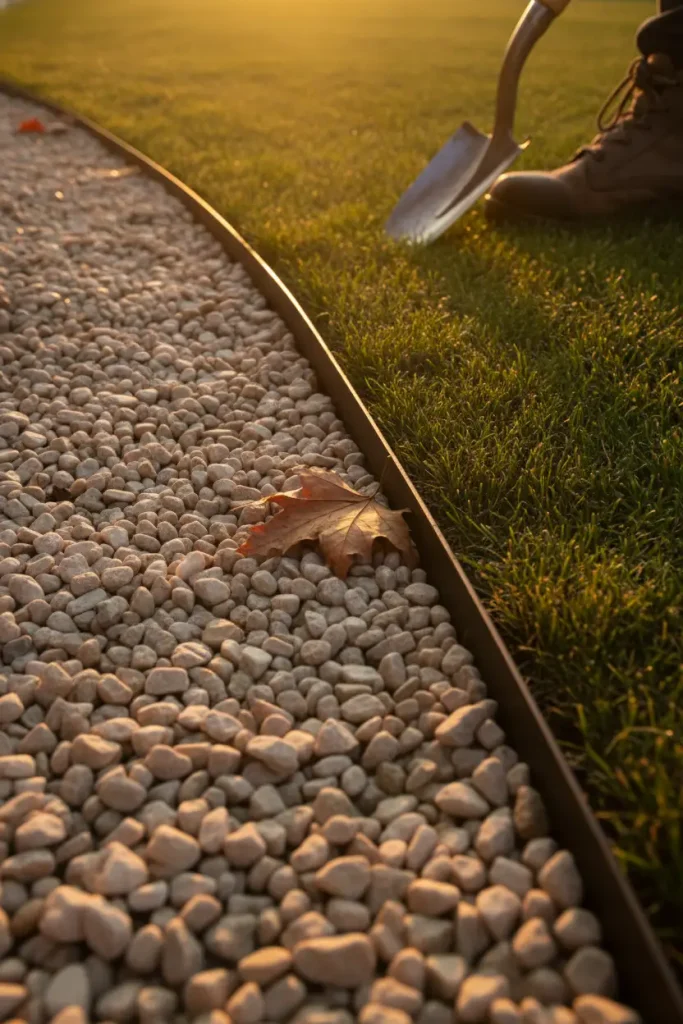
Gravel migrates. Without a hard edge it ends up in the grass, in the flower beds, and in the lawn mower. Landscape edging runs roughly $5 to $18 per linear foot installed, and on a 10 foot circle that is about 31 feet of perimeter.
Steel disappears visually. A soldier course of stone on edge becomes part of the design. Plastic edging is the cheapest and looks like plastic edging.
Set the edge slightly proud of the gravel so it actually holds stone back.
Use steel where you want the edge invisible, stone where you want it seen.
Stake it properly. Frost lifts a lazy edge first.
Thin plastic edging on a curve, which ripples within one season.
Leaving a gap where the gravel meets the lawn, which turns into a mud channel.
Edging three sides and calling it done.
20. A stone-bordered planter of grasses that still look good in November
Annuals quit. Ornamental grasses keep their shape through frost and catch low afternoon light in a way nothing else does at this time of year. Ring a low bed with the same stone as your surface and the planting reads as part of the build.
Look up your USDA hardiness zone on the 2023 map before you buy anything perennial.
Border the bed with leftover stone from the main surface so nothing looks bought separately.
Plant grasses on the side that gets low afternoon sun, where the seed heads will backlight.
Mulch three to four inches deep in the bed, and keep rock mulch out of it.
21. One outdoor rug, and a rule about when it comes up
A flatweave rug over stone softens the whole space instantly for well under a hundred dollars. It also traps moisture against the surface, and in a wet fall that means a rug-shaped discoloration you will be scrubbing in spring.
So: rug down for the season, up after any soaking rain, dried before it goes back. Treat it like a cushion, not like flooring.
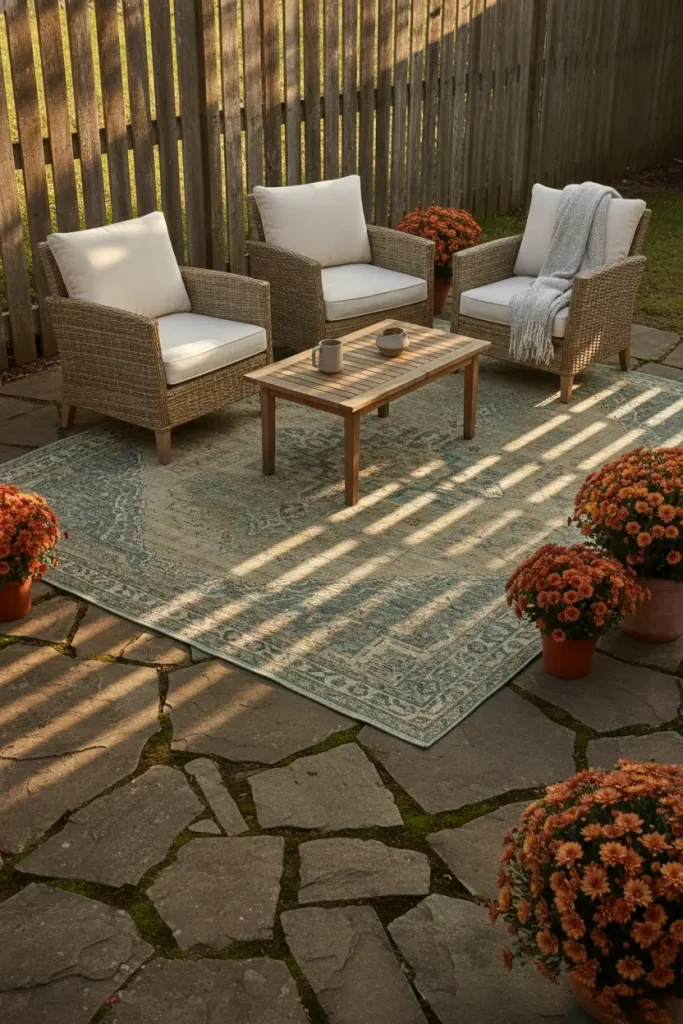
22. A riverstone strip along the base of the fence
That eighteen-inch dead zone where the mower will not reach and nothing grows? Fill it with rounded riverstone. Weeds slow down, the fence line reads finished, and you never string-trim it again.
💡 Quick Tip
Fabric under the stone, and a hard edge on the lawn side. Skip either one and you are pulling grass out of rock by June.
23. Two small pads beat one big one on a sloped yard
Small stone patio ideas usually assume flat ground. On a slope, cutting one large level pad means retaining walls and real money. Two smaller pads at different heights, joined by a couple of stone steps, follow the grade instead of fighting it.
Worth knowing before you plan: a dry-laid flagstone or paver patio usually needs no permit because it is not a permanent structure, while adding stone steps can push you into permit territory. That single distinction can decide which version you build.
24. Wash and seal before the freeze window shuts
The last honest job of the season. Stone gets sealed while the surface can still dry fully, which in most of the country means now, not December. Professional cleaning runs about $0.35 to $0.77 per square foot, sealing about $0.80 to $2.50, and most sealed surfaces want redoing every 18 to 36 months.
We sealed ours in early October one year and in late November the next, and only the October coat cured properly.” Replace with your own timing and what you noticed.
- Sweep every joint clear of leaves first, because trapped organic matter holds water
- Wash at low pressure with a wide fan tip, not a concentrated jet
- Let the stone dry completely, a full dry day at minimum
- Skip acidic cleaners entirely on slate
- Top up joint material before sealing, not after
Water that sits in a joint and freezes is the thing that moves your stone. Everything above is aimed at that one problem.
- ▸Clean: about $0.35 to $0.77 per sq ft professionally
- ▸Seal: about $0.80 to $2.50 per sq ft
- ▸Repeat: every 18 to 36 months, not every fall
25. Finish it with the cheap stuff, last
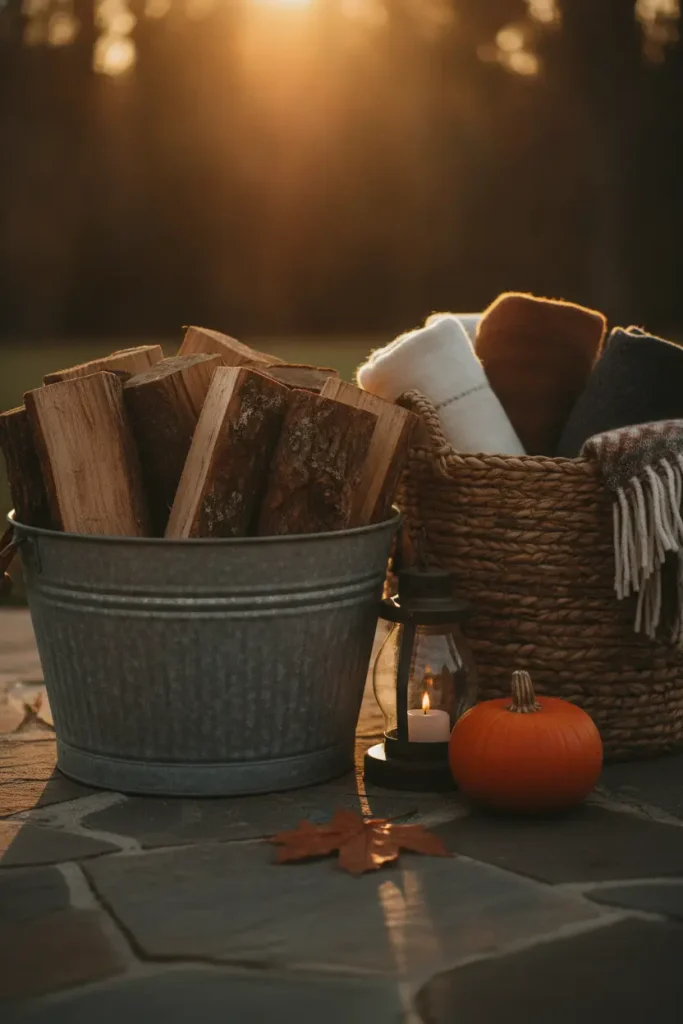
Once the stone is down, the rest is small money. A few hurricane lanterns, a stack of firewood in a galvanized tub, two throws in a basket by the door, one pumpkin that is not a decoration so much as a color. Our dollar tree backyard decor finds cover most of this for the price of one restaurant meal.
Do it in this order and the cheap things look deliberate. Do it first, before the surface exists, and they look like a substitute for one.
Finished stone, two chairs, and nothing else. Correct, and slightly unfriendly.
Lanterns on the wide slab, wood in a tub, throws in a basket, one pumpkin. Now it invites you out.
Suggested reorder (your call)
Entries stand as numbered above. If you want more value front-loaded, this order puts the cheapest win and the cost framework first:
- Current entry 2 (pea gravel circle, under $200)
- Current entry 6 (fire pit with clearance)
- Current entry 1 (flagstone landing)
- Current entry 12 (renter version)
- Then 3, 4, 5, and the rest in existing order
Do not renumber if any of these are already pasted into WordPress.
Frequently Asked Questions
What is the cheapest stone for a cozy backyard?
Loose gravel, by a wide margin. A pea gravel surface runs roughly $1 to $3 per square foot, against about $10 to $17 for concrete or brick pavers and $15 to $32 for dry-laid flagstone. Bagged pea gravel is around $5 for a half cubic foot bag at big-box stores. Buying loose by the yard costs less per square foot than bagged on anything larger than a small path.
How thick should flagstone be for a patio?
At least 1.5 inches for a patio, and 2 to 3 inches if furniture and regular foot traffic will sit on it. Thinner pieces crack under chair legs and freeze-thaw movement. For walkways, 2 inches is the sensible floor. Wider, thicker pieces cost more per square foot but they are far less likely to need replacing.
How deep should pea gravel be for a seating area?
Three inches over landscape fabric, with a hard edge around the whole perimeter. Two inches looks acceptable when it is fresh and starts showing bare patches within weeks of real use. Laid deeper than about four inches, gravel gets soft underfoot and chair legs sink. Three is the number that holds up.
Can I put a fire pit on a stone patio?
Yes, with clearance. U.S. Fire Administration guidance puts fire pits, chimneys, and outdoor fireplaces at least 10 feet from the house or anything else that can burn. Use a metal screen over a wood fire, keep the fire supervised the entire time it is lit, and put cooled ash in a lidded metal can. Check your city’s burn rules first, since some ban open fires outright.
Do I need a permit for a stone patio?
Usually not. A ground-level dry-laid flagstone or paver patio typically does not count as a permanent structure, so most jurisdictions do not require a permit. Adding stone steps, a retaining wall, or anything attached to the house often does, and permit costs commonly land around $200 to $300. One phone call to your city building department settles it.
How do I keep leaves and dirt out of stone joints in fall?
Sweep before it rains, not after. Dry leaves lift out of open joints with a stiff broom in minutes, while wet ones pack down and stain porous stone with tannin. Blow or sweep weekly during leaf drop, top up joint material once at the end of the season, and keep acidic cleaners away from slate entirely.
How much does a small stone patio cost?
A 100 square foot flagstone patio installed generally runs about $1,500 to $3,200, and the same footprint in concrete pavers lands closer to $1,000 to $1,700. In pea gravel it can be a few hundred dollars. Doing it yourself saves less than expected once tools are counted: one published breakdown put a DIY 144 square foot flagstone patio at roughly $2,200 to $2,400 including tool purchases.
Before you go back inside
Fall is the honest season for stone. The plants have stopped doing the heavy lifting, so whatever structure your yard actually has is what you are looking at, and stone is the part that still looks good in November. Start on the rung you can afford, not the one in the photo. A $200 gravel circle with a fire pit and one warm bulb string gets used far more than a flagstone patio you keep meaning to start.
Save the ideas you want for spring, and take the cheap one on now while the ground is still workable.
📌 Good To Know
Pin the ideas you want to try, then look up your own first frost date by zip code before you plan a build weekend. Frost dates are averages with real variation, and a published fall date still carries about a 30 percent chance frost arrives earlier.