Small Backyard Pool Ideas: How to Fit Real Water in a Tiny Yard

Most small backyard pool ideas online skip the only question that decides anything: will it actually fit? Not “does it photograph well.” Fit. As in, can a machine get down your side yard, and will the code-required fence swallow the patio you were planning to lounge on.
So that is the gap this guide closes. You get real 2026 numbers, the three yard measurements that rule out most options in about ninety seconds, and the design moves that make a small pool read as deliberate instead of squeezed.
Grab a tape measure. Seriously, go get it.
If you are still shaping the whole yard and the pool is one piece of a bigger plan, start with our guide to small backyard ideas that make a tiny yard feel bigger, then come back here for the water.
Start With the 8-10-12 Fit Test
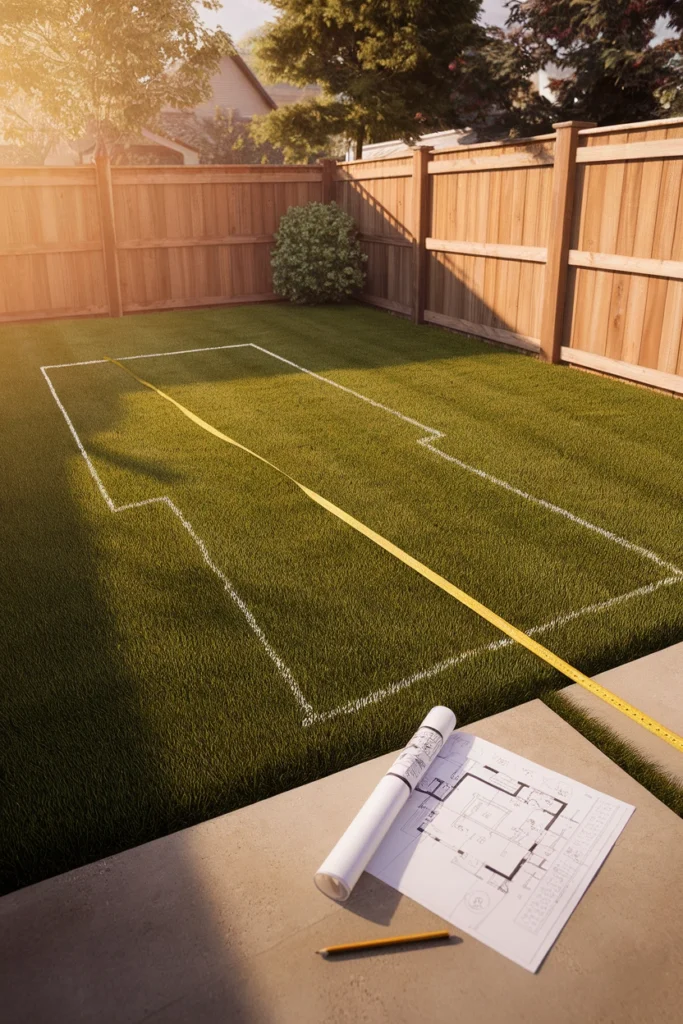
Every small pool decision collapses into one number: the widest unbroken span of open ground you actually have. Not the yard’s full width. The span that survives after you subtract the house, the required setback from the property line, and the walking path you still need to reach the shed.
I call it the 8-10-12 Fit Test, and it sorts that single measurement into three buckets. Each bucket opens up a different family of pool and quietly rules out the rest. Measure once, and most of what you saved on Pinterest disqualifies itself before you ever call an installer.
| Usable span | What actually fits | Typical footprint | Ballpark 2026 installed cost |
|---|---|---|---|
| About 8 feet | Stock tank, spool, cocktail pool | 6 x 8 up to 8 x 12 feet | $600 to $40,000 |
| About 10 feet | Plunge pool, swim spa | 7 x 10 up to 10 x 21 feet | $10,000 to $50,000 |
| About 12 feet | Compact swim pool | 12 x 15 up to 12 x 24 feet | $35,000 to $85,000 |
Here is why the test works. Industry sizing data puts plunge pools at roughly 6 to 12 feet wide and 12 to 21 feet long, cocktail pools around 8 x 12 to 12 x 14, and the classic small inground rectangle at 12 x 24. Those numbers barely move between manufacturers. So your span is the gate, and everything downstream follows from it.
One caution that catches people. The span has to include the walkable margin around the water, not just the shell. Coping plus a body’s width means adding about 3 feet on any side you plan to walk. An 8-foot pool in an 8-foot span technically fits and functionally does not.
The Measurements That Kill Small Pool Plans
Budget gets blamed for most abandoned pool projects. Access is the real culprit, and it is measurable in an afternoon.
Setbacks. No federal standard governs residential pool placement, so this is local. Rear-yard setbacks commonly land between 3 and 10 feet, with some municipalities pushing 15 feet or more, and most codes want 5 to 10 feet of clearance between the pool or its deck and the house itself. Spas and hot tubs sometimes get a friendlier 3-foot allowance. Call your building department before you sketch anything.
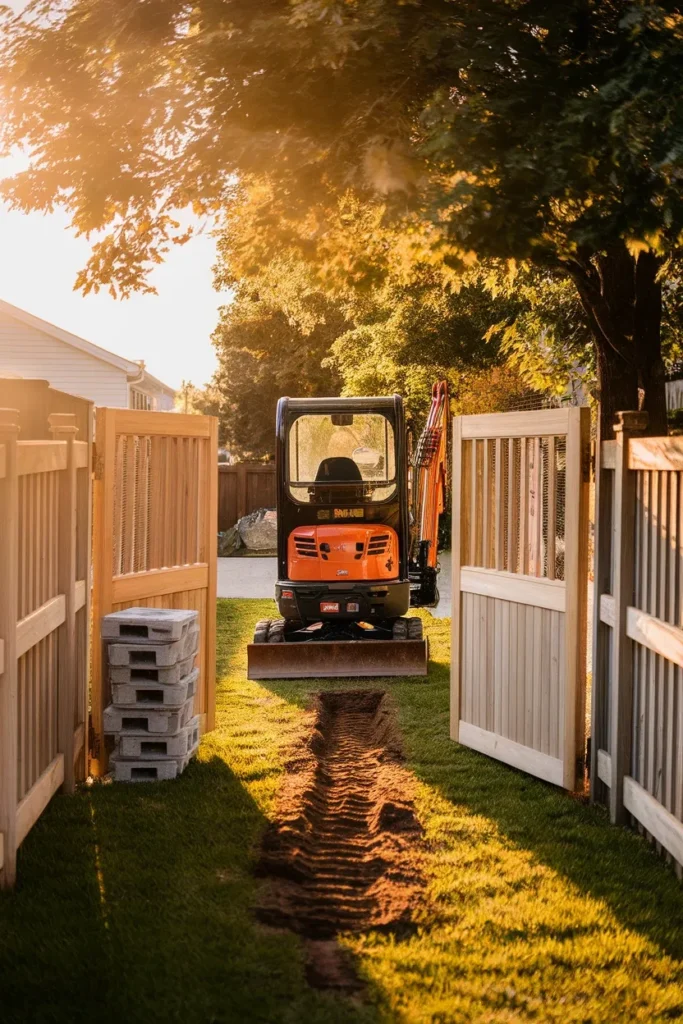
Side yard access. A fiberglass shell arrives whole and usually gets craned over the roof, which needs a staging spot for the truck and clear airspace. Gunite and vinyl need an excavator to physically walk into your yard. Compact machines are narrow, but “narrow” still means a gate and a path wide enough for the specific machine your contractor owns. Ask for the exact width in inches before you sign anything, then go measure your gate.
What is under the grass. Call 811 first. It is free, it is national, and utility locators will mark buried gas, electric, water, and telecom lines. Septic tanks and leach fields are separate homework, and mature tree roots on a small lot are almost always in the way of the one spot you wanted.
Slope. A yard that drops even a foot across the pool footprint adds retaining work, and retaining work on a tight lot gets expensive fast because there is nowhere to stage material.
Honestly, that last one surprises people the most. A yard reads flat to the eye and reads like a hillside to a laser level.
Small Backyard Pool Ideas by Budget
Three tiers, three completely different conversations. Pick your tier before you pick your shape.
Under $5,000: Stock Tank and Above Ground
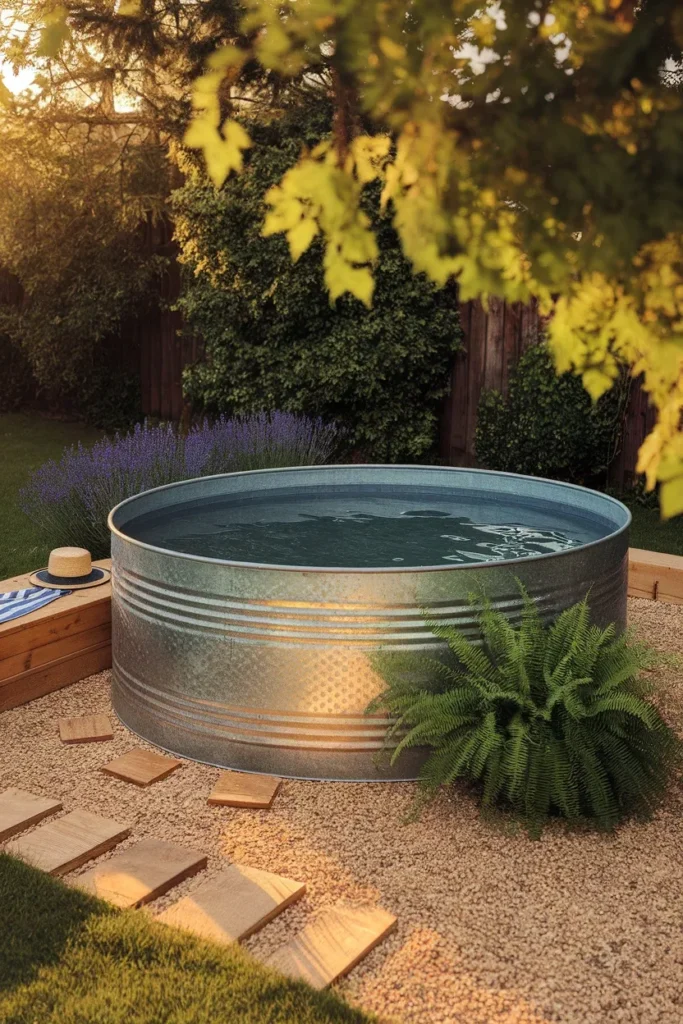
The cheapest real water you can put in a yard. A galvanized stock tank from Tractor Supply runs roughly $300 for a 6-foot to about $600 for a 10-foot at the low end of 2026 pricing, and premium finishes climb well past that. Add a pump with filter for about $100 to $300, plus fittings in the $50 to $125 range. Fully installed, most stock tank builds land between $600 and $4,300 depending on diameter and how much site prep you buy.
Capacity is modest and that is fine. A 6-foot tank holds around 390 gallons, a 10-foot holds around 850, and standard depth is 24 inches with some tanks reaching 30. Two adults, a cold drink, an August afternoon. That is the assignment.
Conventional above ground pools sit in the same neighborhood, generally $1,800 to $5,000 with installation, and they give you real swimming length that a tank never will.
The thing nobody warns you about: a metal tank in full sun turns to soup. By mid-August the water sits close to bathtub warm in most of the country, and the fixes are shade, a partial evening drain and refill, or accepting that your pool is now a warm bath with a view.
$10,000 to $30,000: Vinyl Plunge Pools and Swim Spas
This is the sweet spot for a genuinely small yard. Vinyl-lined plunge pools start around $10,000 and run to roughly $25,000, and vinyl remains the cheapest inground route overall, with full vinyl builds often landing under $30,000.
Swim spas belong in this tier too, and they are underrated for tight lots. Average installed cost sits between $20,000 and $40,000, with budget units from about $10,000. Dimensions are compact by design: 5 to 10 feet wide, 10 to 21 feet long, 3.5 to 5 feet deep, holding 1,300 to 2,500 gallons. You get a current to swim against, a heated soak in November, and no excavation crew.
The tradeoff is lifespan. A swim spa averages 8 to 15 years, where a well-built inground shell is a multi-decade asset.
$35,000 and Up: Fiberglass, Precast, and Gunite
Now you are buying permanence. Fiberglass small pools generally start in the $30,000 to $40,000 range and climb, with small fiberglass installs commonly quoted between $45,000 and $85,000. Precast concrete units land around $40,000 to $75,000, and custom gunite for a small footprint runs $60,000 and well past $120,000 once you add the good stuff.
Then the extras nobody quotes upfront: decking at $7,000 to $25,000 or more, permits at roughly $450 to $1,800, electrical at $1,500 to $4,000 and up, heating at $3,000 to $6,000.
Timeline matters as much as money here. Fiberglass typically installs in 2 to 4 weeks, vinyl liner in 4 to 8 weeks, and concrete in 3 to 6 months. On a small lot with one access point, a 6-month concrete build means half a year with no usable backyard.
What It Costs to Run Each Month
Small pools are genuinely cheaper to keep. Less water means fewer chemicals, shorter filter runtime, and faster heating. Typical pool maintenance across sizes runs about $80 to $150 per month, and a small pool sits at the friendly end of that.
Your pump is the single biggest lever. A standard pool pump can burn as much as $310 in electricity a year. Swap it for one of the ENERGY STAR certified pool pumps and inground models use about 20 percent less energy, above ground models about 11 percent less. That works out to roughly $50 and $20 saved per year, and up to $290 across the pump’s life.
The physics behind variable speed is the fun part: halving pump speed drops energy use to about one eighth. Hayward’s EcoStar and similar certified variable-speed units pay for themselves in under two years by ENERGY STAR’s own math.
Plunge Pools, Spools, and Swim Spas: Choosing a Shape for a Narrow Yard
Shape is where small yards get won or lost, and it is less about style than about which dimension you are short on. Sort the small backyard pool ideas you have saved by the dimension each one solves and the shortlist writes itself.
Plunge pools are the default answer for a yard that is short front to back. Common sizes run 7 x 10 up to 15 x 8 feet at 4 to 5 feet deep, and because you are standing and cooling rather than swimming laps, the length you give up costs you nothing you actually use.
Spools and cocktail pools are the answer when you are short in every direction. Cocktail pools sit around 8 x 12 to 12 x 14 feet at 3 to 4.5 feet deep, spools around 8 x 10 to 12 x 12 at 3.5 to 5 feet. Many come with jets and heat, so the thing works in October, which is the argument that usually closes the deal. The smallest inground footprints get down near 6 x 8 feet, about 48 square feet of water.
Compact swim pools at 15 x 8 up to 20 x 10 feet give you something closer to a traditional pool. For actual lap swimming or pool games, industry guidance says anything under roughly 12 x 14 feet stops working, and a 12 x 24 rectangle at a little over 5 feet deep is the classic small inground standard.
Two things a small pool will not do, so plan around them. A diving board needs about 8 feet of depth, which no small pool has. A slide is fine at 3 feet of depth or more, so that one stays on the table.
For a long, skinny yard, run the pool parallel to the longest fence line and push it to one side rather than centering it. Centering splits your remaining space into two useless strips. Offsetting gives you one generous deck instead.
Stock Tank and Above Ground Pool Ideas That Do Not Look Temporary
The knock on above ground water is that it reads like a rental. Fixable, and cheaply. These are the small backyard pool ideas with the best return per dollar spent, because five finishing moves do almost all the work.
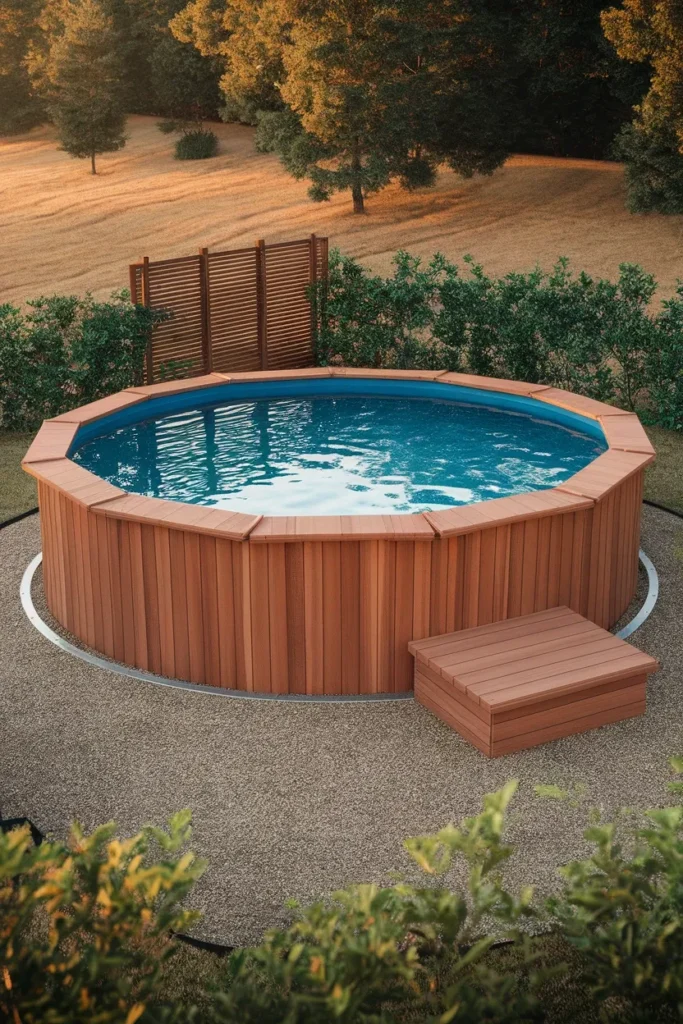
Sink it partway. Dropping a stock tank or above ground shell 12 to 18 inches into the grade instantly changes the proportions. The rim stops looming, the whole thing settles into the yard, and step-in height becomes comfortable rather than gymnastic. Confirm with your installer that the wall is rated for backfill pressure before you commit.
Skirt and cap it. A cedar or composite skirt wrapping the visible wall, capped with a 2-inch top rail wide enough to set a drink on, is the single highest-return move in this whole category. It costs a weekend and makes a $500 tank look built-in. Our full breakdown of above ground pool deck ideas walks through the skirting and wrap options in detail.
Give it a deliberate floor. A tank sitting on lawn looks parked. The same tank sitting on a crisp pea gravel or paver pad with a clean edge looks specified.
Repeat one material. If the skirt is cedar, make the bench cedar. If the pad is gravel, run that gravel to the fence line. Small yards punish variety.
Screen the equipment. The pump and filter are the tell. A simple slatted box or a pair of tall planters ends the conversation.
Add a shade structure while you are at it. A simple 8 x 8 pergola or a triangle sail over one end drops the water temperature noticeably in the afternoon and gives the setup an architectural anchor, which small yards badly need.
Design Moves That Make a Small Pool Look Twice as Big
Perception does most of the work in a tight yard. These five moves cost far less than buying more square footage.
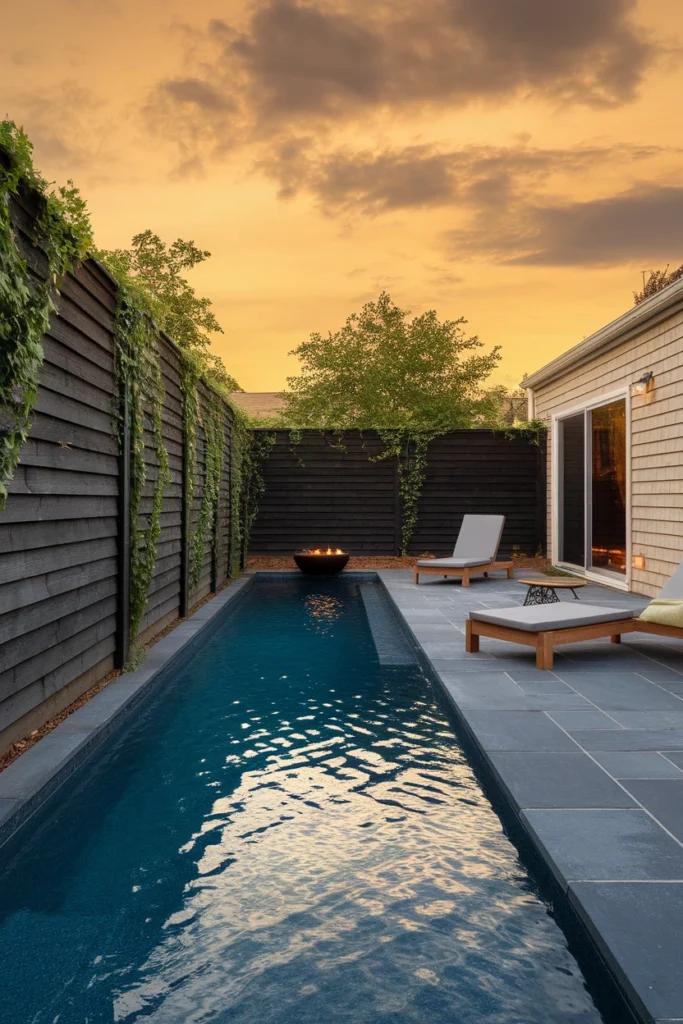
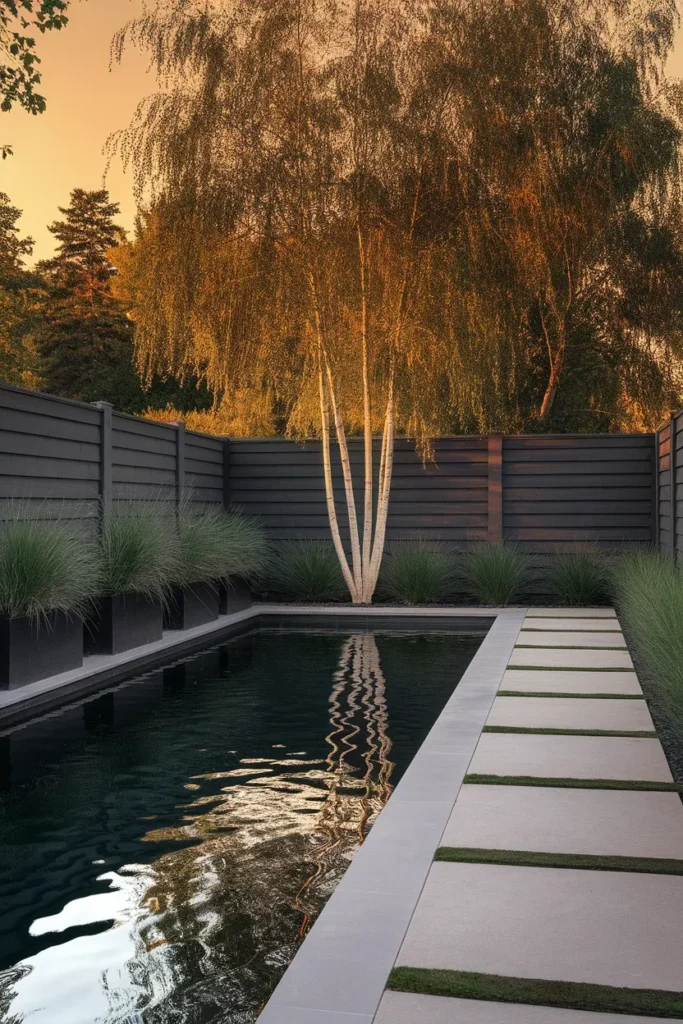
- Darken the fence. A charcoal or black stained fence recedes visually and stops the eye from measuring the boundary. It also makes water and greenery pop. Best value change you can make in a weekend, so do this one first.
- Run one continuous decking material. Break the ground plane into three materials and the yard shrinks. One paver, one direction, right to the edges.
- Use dark waterline tile and a dark interior finish. Dark water reads deeper and reflects the sky and planting like a mirror. Pale plaster in a small pool reads like a bathtub.
- Keep the coping thin and flush. Chunky raised coping eats visual space. A slim, flush edge lets the deck read as one continuous surface with water set into it.
- Go vertical with planting. Climbers on the fence, one tall multi-stem tree, and tall narrow planters. Wide shrubs steal floor area you cannot spare.
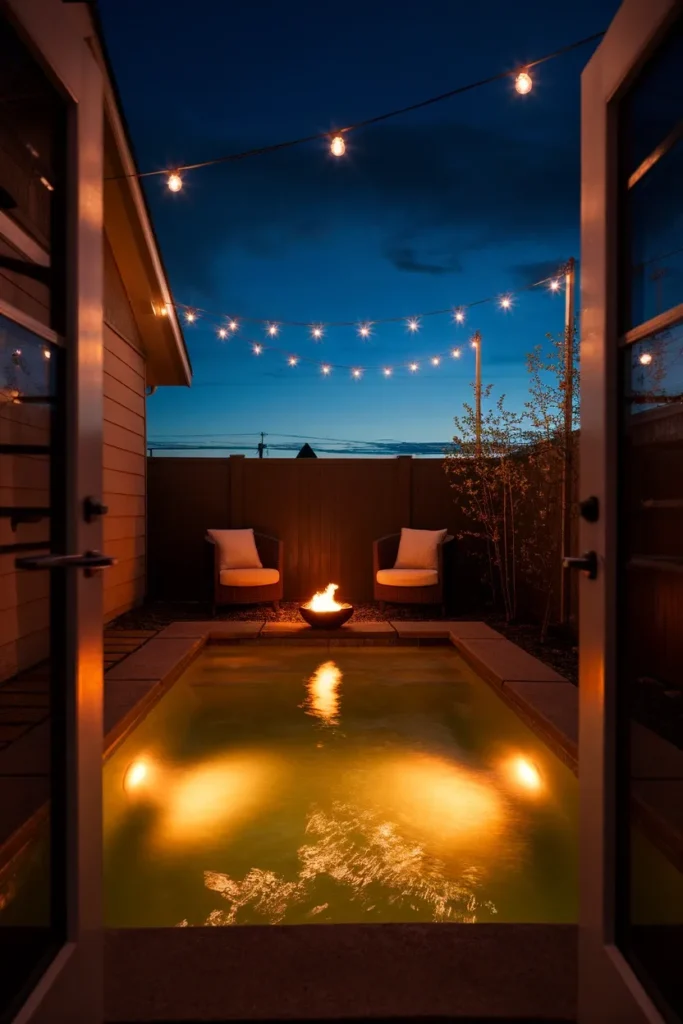
Lighting is the sixth move and the one that pays after dark. Two or three warm submerged lights, a string of bulbs overhead, and low path lights at the deck edge turn a modest pool into the best room in the house at 9pm. Our guide to pool patio ideas covers the layered lighting zones in more depth.
One contrarian take, and I will defend it: skip the tanning ledge in a truly small pool. It is the most-requested feature and, in a footprint under about 12 feet wide, it eats 20 to 30 percent of your water for a shelf you will use twice a season. Spend that money on heating instead and get two extra months of use every single year.
Fence First: The Safety Rules That Set Your Whole Layout
Here is the part every inspiration listicle leaves out, and the reason so many small-yard plans get redrawn after the deposit clears.
Your barrier is a layout decision. In a large yard, a pool fence disappears into the property line. In a 25-foot-deep yard, the barrier line determines where your deck ends, where the grill goes, and whether the back door still opens onto usable space. Draw it in step one.
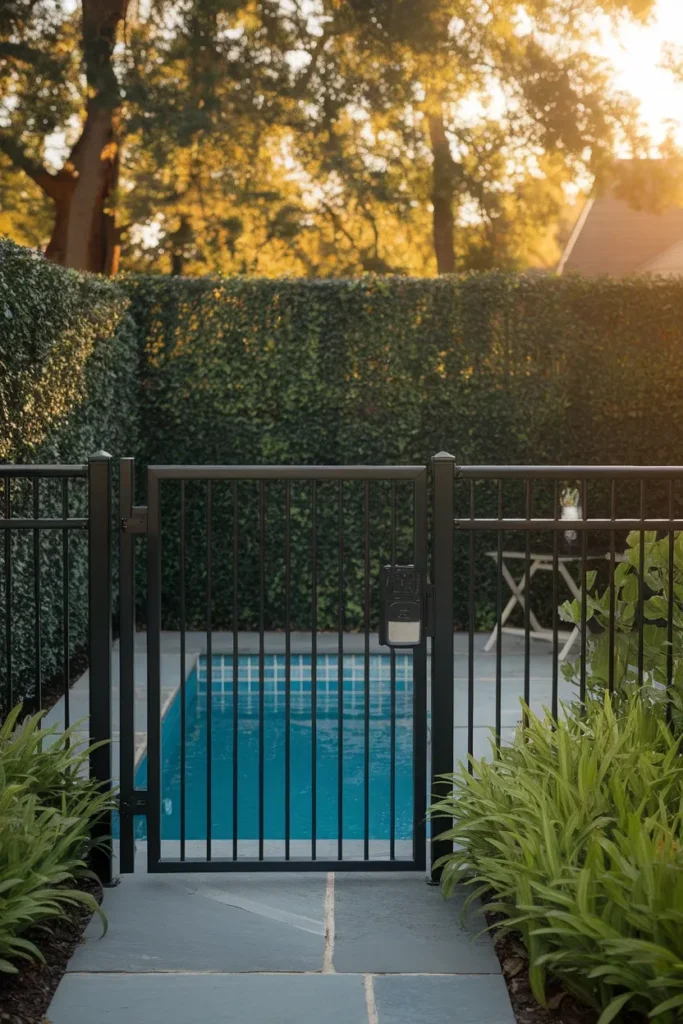
The core requirements are consistent nationally even though the fine print is local. The CPSC’s residential pool barrier checklist calls for a 4-foot fence around the full perimeter of the pool or spa. Gates must be self-closing and self-latching, and they swing outward, away from the water. For above ground pools, the ladder gets secured, locked, or removed whenever the pool is not in use. Many jurisdictions add rules for door alarms and for gaps beneath and between fence members, so check locally.
Design-wise, this is easier than it sounds. Frameless glass panels keep sight lines open and make a small yard feel unbroken, though they are the priciest option. Slim black aluminum vanishes against dark planting and costs a fraction of glass. Sinking the fence line into planting on the far side softens it further.
Three genuinely useful add-ons: a door alarm on any house door that opens toward the pool, a fine-mesh removable safety fence if you have toddlers, and a hard cover for the off-season that carries weight.
Anything involving bonding, grounding, or wiring near water is licensed-professional territory. This article is general information, not code guidance, so bring in a licensed electrician and your local building department before you commit to a layout.
Putting It Together: A Small Yard Pool Plan in Five Steps
- Measure your usable span and run the 8-10-12 Fit Test. Write the number down.
- Call your building department for setbacks, then call 811 for utility locates.
- Draw the barrier line before you draw the pool. Whatever deck is left is your real deck.
- Match the pool type to your tier and your timeline, remembering that concrete can mean 3 to 6 months without a backyard.
- Spend leftover budget on heat and lighting rather than on more water. Both extend your season and neither takes floor space.
Print that, tape it inside a cabinet, and you have skipped about three rounds of expensive rework. Most small backyard pool ideas fail at step two or three, never at step five.
Small Backyard Pool Ideas: Quick Answers
What is the smallest pool you can put in a backyard? Inground shells get down to roughly 6 x 8 feet, about 48 square feet of water. Stock tanks start smaller still at 6 feet across, holding around 390 gallons. For anything resembling actual swimming or pool games, most builders consider under about 12 x 14 feet too small.
How much does a small backyard pool cost in 2026? It spans three orders of magnitude, so pick your tier. Stock tank builds run roughly $600 to $4,300 installed. Above ground pools land at $1,800 to $5,000. Vinyl plunge pools start near $10,000, swim spas average $20,000 to $40,000, and small fiberglass or precast inground pools commonly run $40,000 to $85,000. Mini inground pools are often quoted in the $7,000 to $25,000 range before decking and extras.
What type of pool is best for a small yard? A plunge pool for a yard that is short front to back, a spool or cocktail pool when you are tight in both directions, and a swim spa when you want a current plus year-round heat without excavation. Fiberglass is the fastest inground option at 2 to 4 weeks, which matters when your only access is one narrow gate.
Is a small pool worth it? For cooling off, entertaining, and property appeal, yes. For lap swimming or diving, no. A diving board needs about 8 feet of depth that no small pool has, though a slide works at 3 feet or more.
Are small pools cheaper to maintain? Yes, and meaningfully so. Less volume means fewer chemicals, shorter filter runtime, faster heating, and cheaper refills and refinishing. Budget roughly $80 to $150 per month across the year, and put a variable-speed pump in from day one.
How long does a small pool take to install? Fiberglass typically 2 to 4 weeks, vinyl liner 4 to 8 weeks, and concrete or gunite 3 to 6 months. Stock tank and above ground setups are a weekend once the pad is prepped.
Do I need a permit for a small backyard pool? Almost certainly for anything inground, and often for above ground pools past a certain depth. Permit fees commonly run about $450 to $1,800. Setbacks, barrier rules, and electrical inspection are all handled locally, so your building department is the first call, not the last.
One Last Thing Before You Dig
The best small backyard pool ideas are not the prettiest ones. They are the ones that survive contact with a tape measure, a setback rule, and a gate that is narrower than you remembered.
Measure your usable span this weekend. Run the 8-10-12 Fit Test, sketch the barrier line before the water, and you will know in an afternoon whether you are shopping for a stock tank or booking a fiberglass crane lift.
Which tier did your yard land in? Have a look at our pool patio ideas next and start planning the deck that goes around it, because in a small yard the space beside the water gets used more hours than the water itself.