Narrow Backyard Makeover Ideas That Make a Long Lot Feel Twice as Wide

A narrow backyard makeover almost never fails because of the plants. It fails because of the sight line.
Long, skinny lots put everything in one straight view. Your eye leaves the back door, runs down the fence, and lands in the far corner in about a second flat. So the yard reads as a hallway. Drop a patio set and a few pots into that hallway and you still have a hallway, only now it cost you nine hundred dollars.
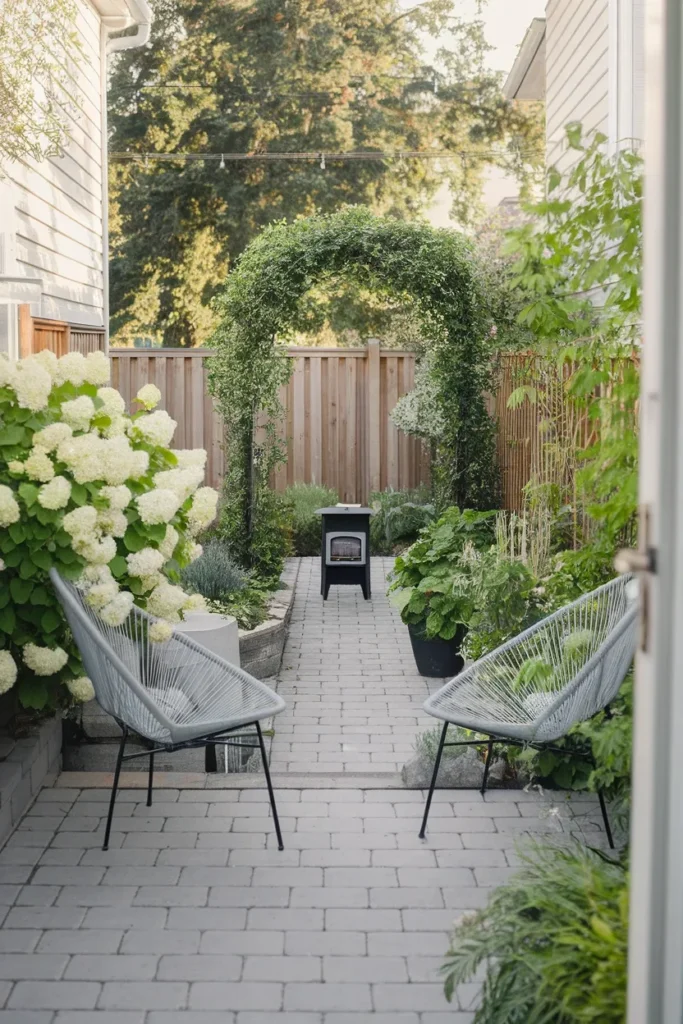
Break the view into stops and the whole thing changes. An eleven foot wide strip can hold a dining zone, a green pause, and a fire pit corner that feels like its own room. The shift happens before a single plant goes in the ground.
Below are the moves that actually work, in the order I would do them, along with rough costs and the same budget backyard garden ideas sequencing that keeps you from spending in the wrong place first.
Why a Long Narrow Backyard Feels Like a Hallway
Blame the corridor effect. When two parallel fences run the full length of a lot with nothing interrupting them, your brain measures the space by its narrowest dimension and stops looking. Every narrow backyard makeover has to solve that before anything else.
Three things make it worse, and most people do all three.
They push furniture flat against one fence. They run a straight path down the center. They plant low, tidy shrubs in a single line, which just underlines how straight everything is.
The fix is not more square footage. It is interruption. Anything that stops the eye partway down the yard (a tall grass clump, an arch, a change in paving direction, a bench turned sideways) forces your brain to read the space in segments, and segments feel wider than a tunnel.
Here is the counterintuitive part. Spend your first dollars at the far end, not near the house. A finished far corner gives the eye a reason to travel and a place to land, which makes the whole run feel intentional. A finished patio by the back door with a weedy void behind it does the opposite: it frames the mess.
The Three Stop Rule: A Layout Framework for Long, Skinny Lots
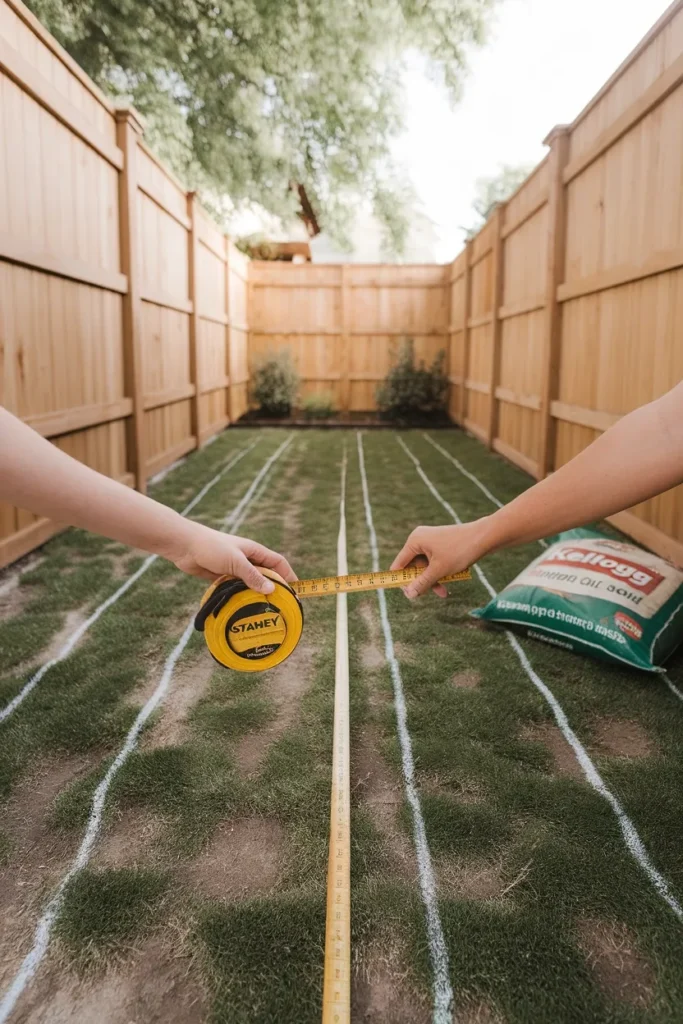
This is the rule I fall back on for every narrow backyard makeover, and it takes one afternoon and a bag of chalk to test.
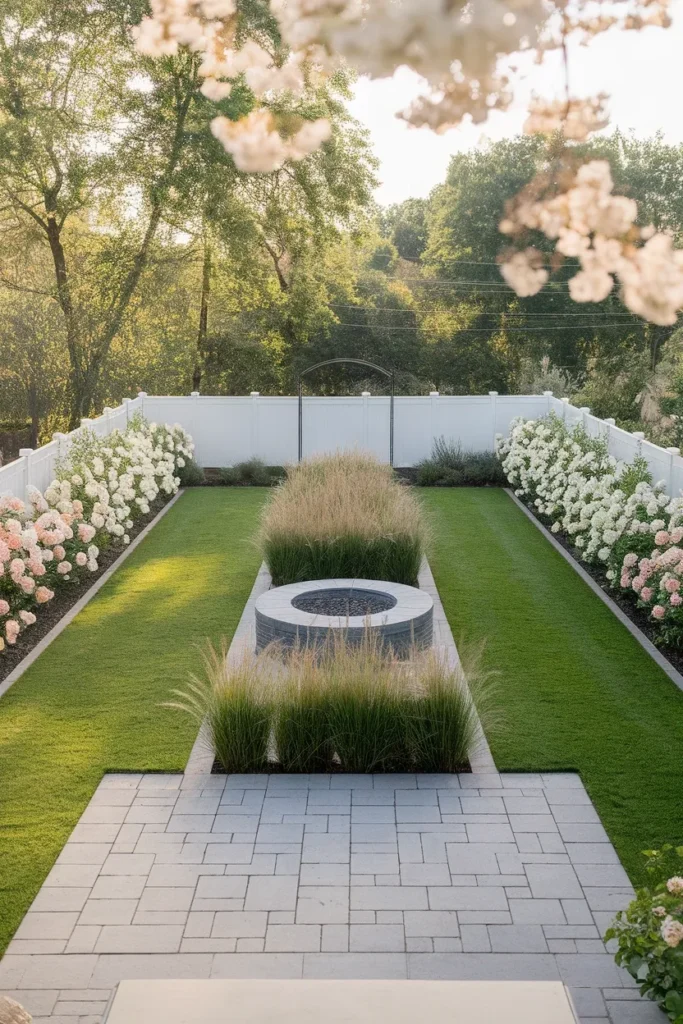
The Three Stop Rule: divide the length of a narrow yard into three destinations, and put a deliberate visual pause between each one. Stop 1 is daily use and sits closest to the house. Stop 2 is the pause, a planted or structural break that hides part of what comes next. Stop 3 is the payoff at the far end, and it must be worth walking to.
Three stops is the sweet spot. Two feels like a hallway with a bench at the end. Four gets choppy in anything under fifty feet of yard depth.
| Stop | What goes here | Rough length of yard used | Budget tier |
|---|---|---|---|
| Stop 1, nearest the house | Dining or lounge, hard surface, the zone you use daily | 10 to 12 feet | $$ |
| Stop 2, the pause | Arch, tall grasses, planter cluster, or a narrowed path | 3 to 5 feet | $ |
| Stop 3, the far end | Fire pit, garden bed, bench, or a single specimen tree | 8 to 12 feet | $$$ |
How to mark your three stops in an afternoon
Grab marking chalk or a can of turf paint from Home Depot, usually under ten dollars.
- Stand at the back door and note exactly where your eye stops without trying. That is your natural focal point, and Stop 3 belongs there or just past it.
- Measure the width at the narrowest point. Write it down. Everything else scales off that number.
- Chalk Stop 1 as a rectangle, then rotate it forty five degrees and chalk it again. Look at both from the door.
- Mark the pause. Just two chalk arcs pinching the walking route in from the fences.
- Leave the lines for two days and live with them. Walk out with coffee. Take the trash out. See what annoys you.
That two day wait has saved me twice. The first time I laid out a narrow yard, I chalked a ten by twelve dining zone right off the back step, loved it on paper, and then discovered on day two that it sat directly under the neighbor’s second story window. I shifted the whole zone six feet down the yard, and it cost me nothing but chalk.
What each stop actually costs
Rough 2026 US ballparks, materials only, for a yard in the ten to fourteen foot wide range.
- Stop 1, DIY paver patio: around $8 to $14 per square foot installed yourself with Pavestone or Home Depot pavers plus paver base and polymeric sand. A ten by twelve zone lands somewhere near $1,000 to $1,600.
- Stop 1, budget version: decomposed granite or pea gravel over landscape fabric, closer to $2 to $4 per square foot.
- Stop 2, the pause: a cedar or metal arch runs roughly $80 to $200, or build the pause with three tall Bloem or Vego Garden planters for under $150 total.
- Stop 3, fire pit: a Solo Stove Bonfire sits in the $200 to $300 range, a Sunnydaze steel bowl is often under $150, and a DIY cinder block or brick ring can come in under $100 from Lowe’s.
- Edging and mulch to tie it together: budget about $150 to $300 for a yard this size.
Run the Patio on a Diagonal for the Fastest Visual Win
Turn your main hard surface forty five degrees to the fence line. That is it. That is the whole trick, and it is the highest return move in a narrow backyard makeover.
Why it works: a square patio squared up to a straight fence repeats the fence line and reinforces the corridor. Rotate it and the longest dimension of the patio becomes the diagonal across the yard, which is always wider than the yard itself. Your eye follows that diagonal corner to corner instead of running straight to the back.
An eleven foot wide yard has a diagonal of roughly fifteen and a half feet across a standard zone. You just found four feet of visual width without moving a fence.
A few things that make the diagonal work harder:
- Run the paver joints on the diagonal too, not squared to the house.
- Let one corner of the patio tuck into a planted bed so the shape reads deliberate.
- Skip the border course in a contrasting color. On a small diagonal it chops the shape up.
- Angle the furniture with the patio. A dining table squared to the house on a diagonal patio undoes the effect completely.
Decking behaves the same way. Lay boards diagonally or perpendicular to the sight line and a narrow deck stops reading like a bowling lane. For more on squeezing a real seating zone out of a small footprint, the small backyard patio ideas breakdown covers surface options and the one third floor rule in detail.
Push Every Plant Toward the Fence Line
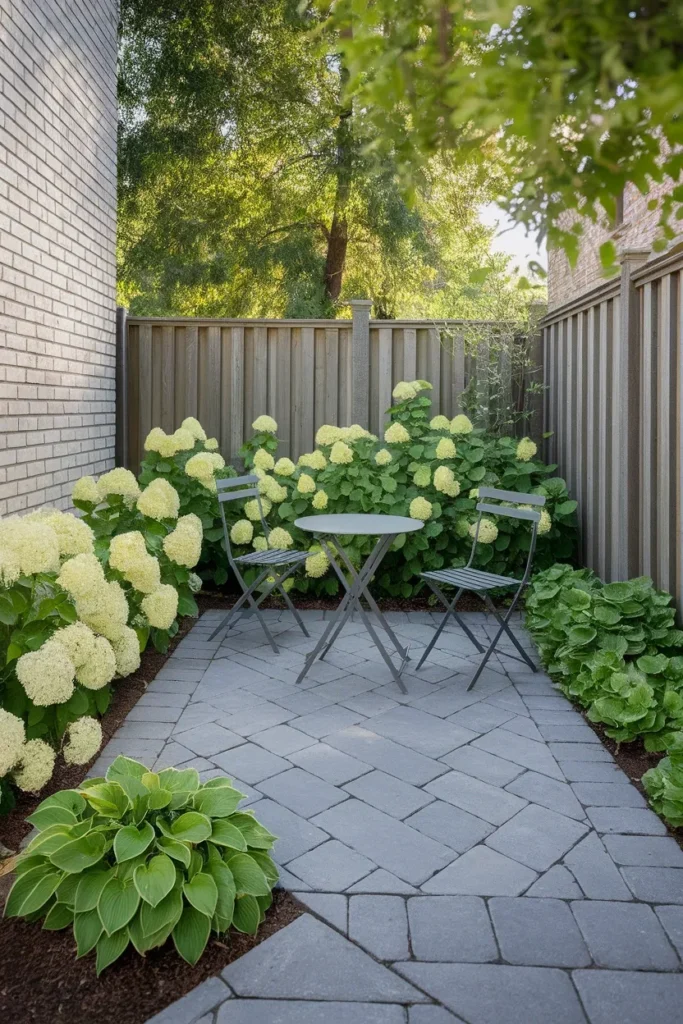
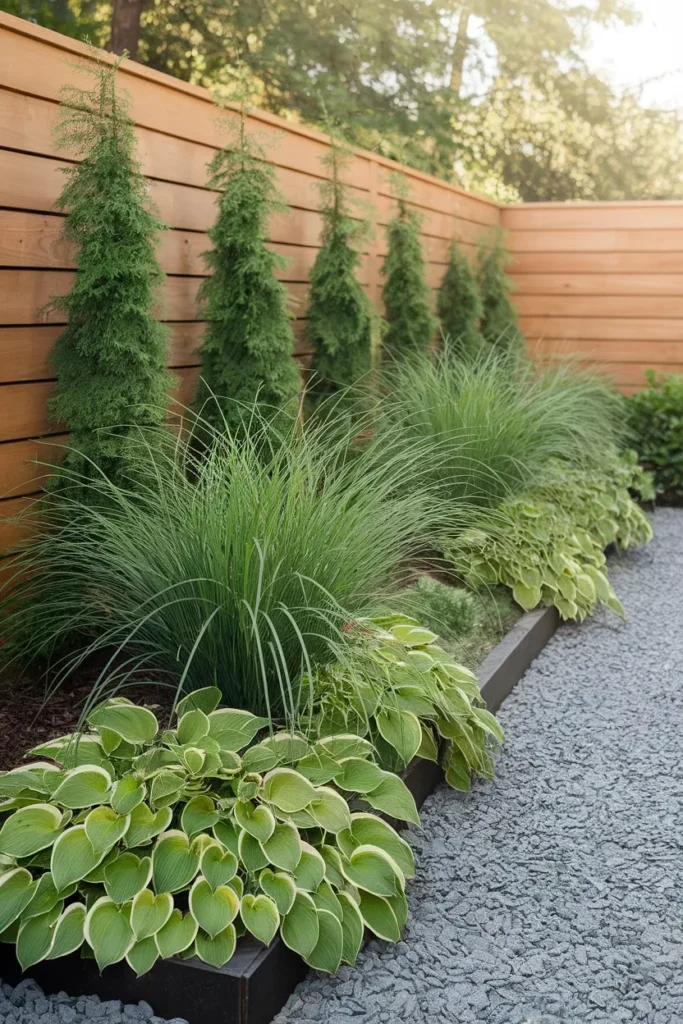
A narrow backyard makeover lives or dies on the fence line. Keep the middle open, plant the edges, and stagger that planting in depth rather than a straight row.
A single line of identical shrubs marching down a fence is the planting equivalent of a corridor. Stagger the same plants forward and back by even eighteen inches and the fence disappears behind layers. Vary the heights too. Tall at the back, mid layer in front, low spillers at the bed edge.
Bed depth matters more than most people expect. Eighteen inches is not enough to screen anything. Thirty inches is workable. Three to four feet is where a narrow yard bed starts feeling lush instead of apologetic, and yes, that means giving up width you feel protective of. Give it up anyway.
Before buying a single shrub, check your USDA plant hardiness zone on the official 2023 map. Screening plants are a multi year investment and the wrong zone pick fails slowly, which is the worst way to fail.
Screening picks that behave in a tight bed
For Zones 5 through 9, these stay narrow enough not to swallow the yard:
- Emerald Green arborvitae. Holds about three to four feet wide, evergreen, the default for a reason. Bonnie Plants and most Lowe’s garden centers stock them in the $40 to $70 range for a five to six footer.
- Sky Pencil holly. Genuinely columnar, roughly two feet wide, good for Zones 6 to 9.
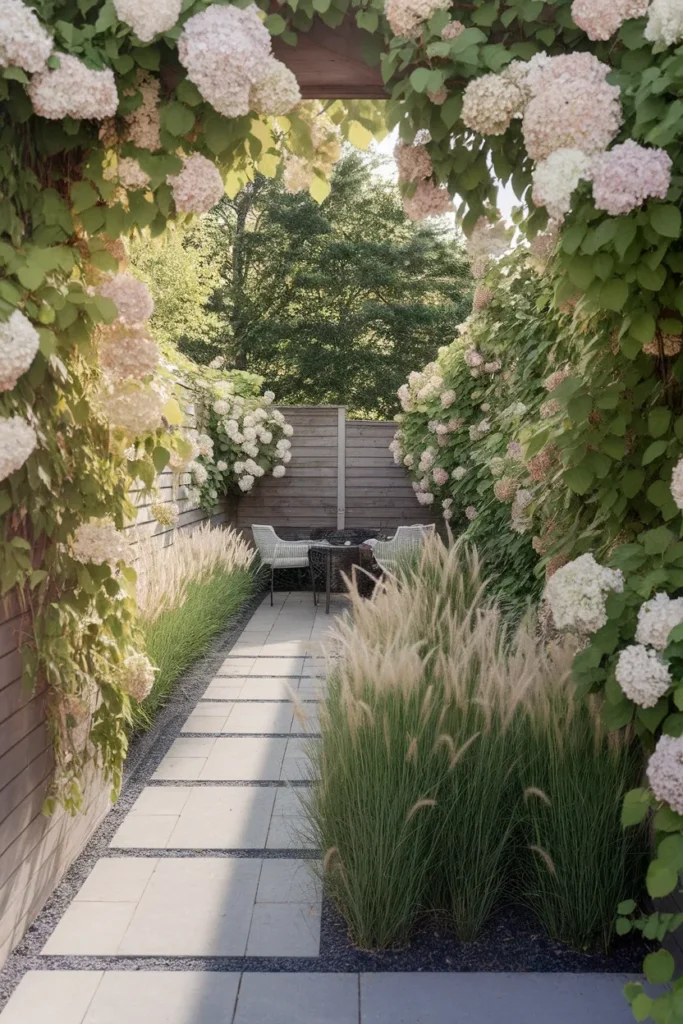
- Feather reed grass, Karl Foerster. Vertical, moves in wind, cuts back to nothing in late winter. Perfect Stop 2 pause material.
- Espaliered fruit trees or climbing hydrangea on the fence. Nearly zero bed depth used.
Timing: in Zone 6 the last frost typically lands mid April, and in Zone 5 it usually runs late April into early May, so shrub planting windows open around then and again in early fall. Frost dates shift year to year and by microclimate, so confirm yours against the USDA map or your county extension before you commit a delivery date.
I lost a season learning this one. I set a row of arborvitae eighteen inches off a fence in a twelve foot yard, felt clever about saving space, and by the second summer they had pushed into the walking route badly enough that we were turning sideways to get past with the recycling bin. Moving nine established shrubs in August is not a mistake you make twice.
Solve the Utility Strip Nobody Plans For
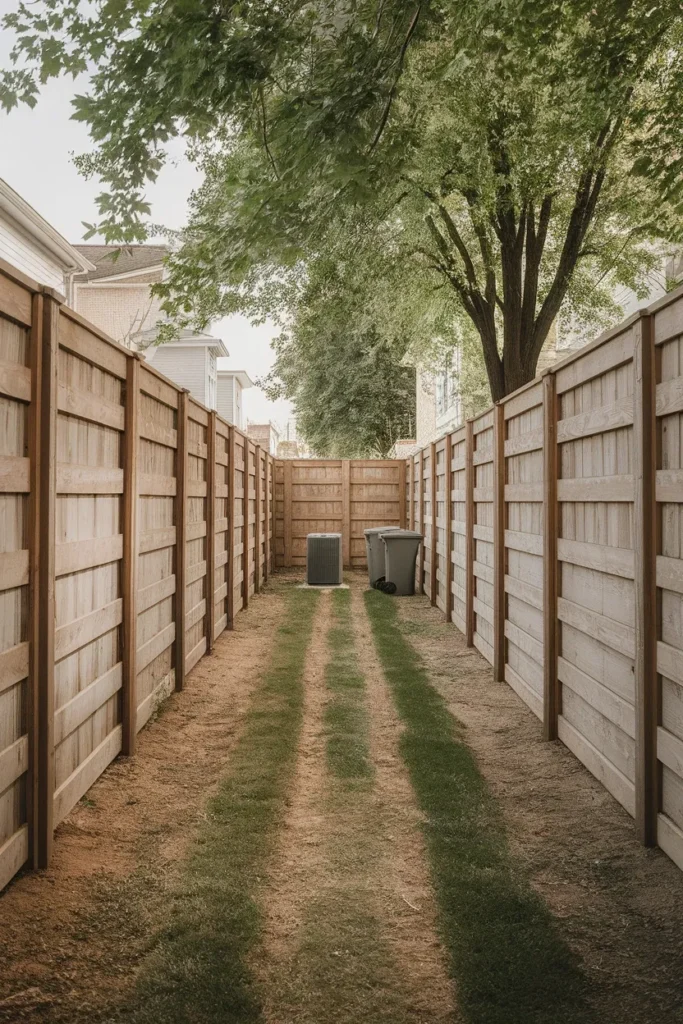
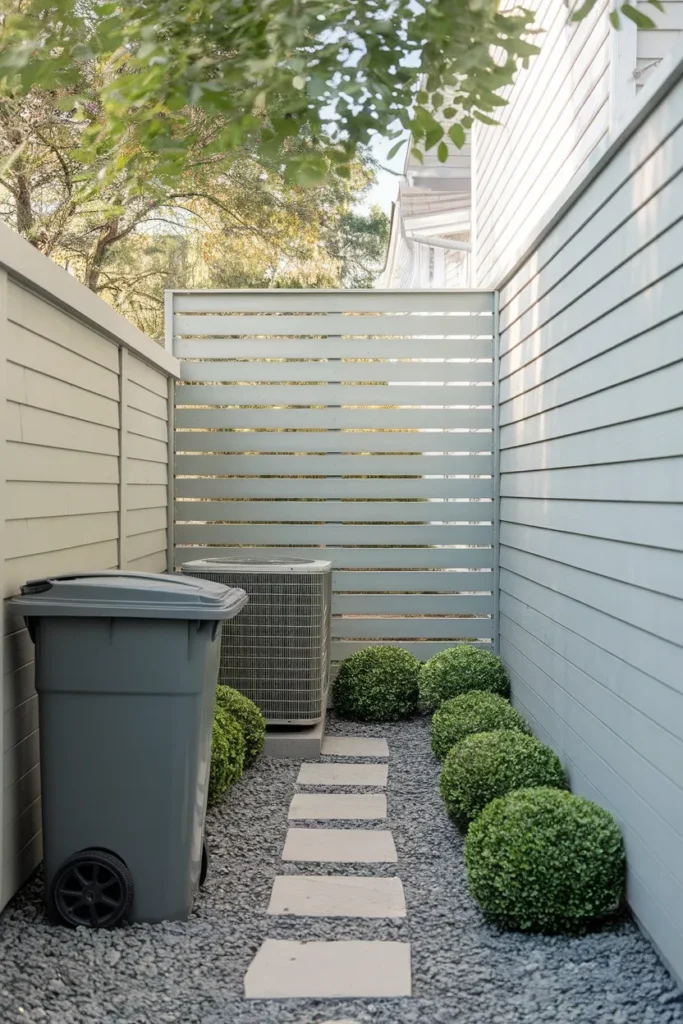
Here is the section every inspiration post skips. In a narrow lot, your backyard is also the only hallway to the trash cans, the AC condenser, the hose bib, the gas meter, and whatever the last owner left behind the shed.
Most narrow backyard makeover plans ignore that traffic, and the design loses because of it.
Start by writing down what has to stay reachable. The university extension guidance on site analysis from the University of Maryland puts this at the front of the process for good reason: inventory sun, drainage, and utilities before you draw anything. Techs need clearance at the condenser. Meter readers need a clear approach. Trash cans need a straight roll, not a route that threads between planters.
Then apply three rules:
- Give the utility route its own lane along one fence, ideally the shadier, uglier side. Thirty six inches of hard surface handles a wheeled bin comfortably. Thirty inches is the tight minimum.
- Screen at eye level only. A four to five foot cedar slat panel or a pair of tall planters blocks the view from seating height without boxing anything in or blocking airflow to the condenser.
- Do not fully enclose mechanical equipment. Leave the clearance the manufacturer calls for on the label, usually a couple of feet on the service side.
A horizontal slat screen from cedar fence pickets runs roughly $60 to $120 in lumber from Lowe’s or Menards for a two panel run. Painting it the same color as the fence makes it vanish. Painting it a contrast color turns your trash cans into a feature wall, which is a choice.
Quick note on the dark fence debate, since two of the biggest sites flatly contradict each other on it. Dark boundary color does recede visually, and in a wide yard that reads as depth. In a narrow yard with tall fences on both sides, painting all three planes charcoal can close the space in and turn it cave-like, especially on a north facing lot. My middle ground: darken the far end plane only, keep the two long side fences light or natural, and let the dark back wall pull the eye down the length.
Light It in Layers So the Yard Does Not End at Dark
Lighting is the cheapest part of a narrow backyard makeover and the part that pays back nightly. Darkness erases the far end and shrinks the space back to whatever the porch bulb reaches.
Layer three heights and the yard keeps its full length after sunset.
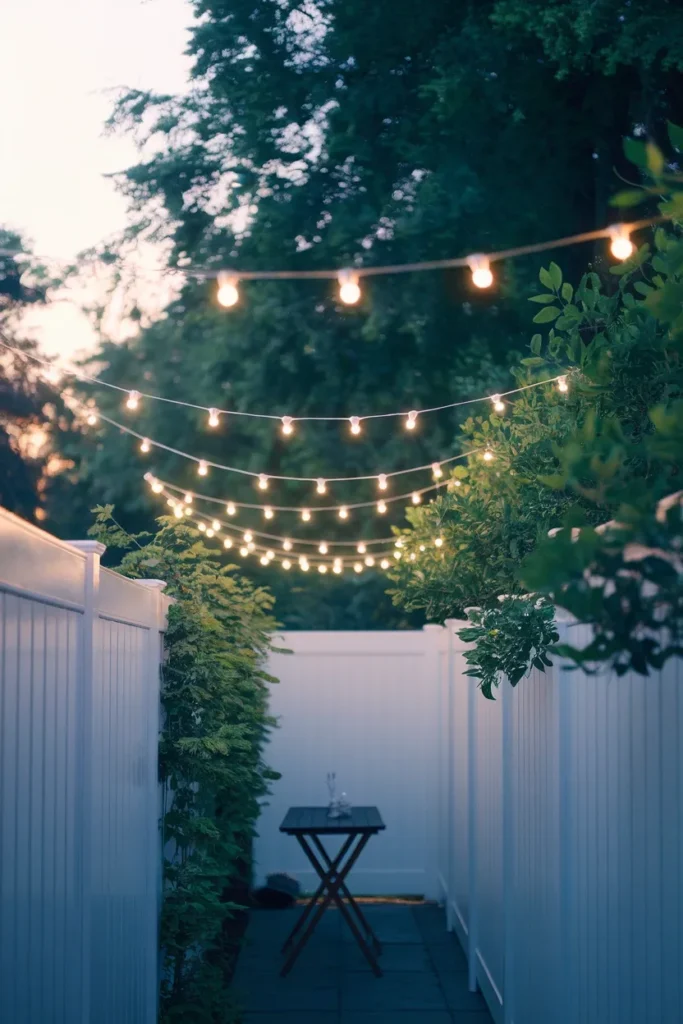
- Overhead. String lights are the workhorse. Brightech Ambience Pro in a forty eight foot run lands around $40 to $60, and Feit Electric sets from Costco or Home Depot often come in cheaper per foot.
- Mid level. A lantern on the table, a sconce on the slat screen, a solar post light at the pause.
- Ground. Two or three low path lights washing the fence line plants, not aimed down the walkway like a runway.
One placement note that matters more than the fixtures. Do not run string lights straight down the center of a long yard. I did exactly that in my first setup, one clean line from the house to the back fence, and it looked like an airport approach. Zigzagging the same strand between the two fences fixed it in twenty minutes, because the crossings cut the length into segments the same way the Three Stop Rule does on the ground.
Hang the lowest point around seven and a half to eight feet so nobody ducks. Warm white, 2200K to 2700K. Cool white makes a small yard look like a parking lot.
Renter Friendly Ideas, Plus the Mistakes That Backfire
The no dig version of the Three Stop Rule
Everything above assumes you can dig. Plenty of people cannot, so here is the narrow backyard makeover that leaves no trace.
The Three Stop Rule still applies. You are just building the stops out of movable parts.
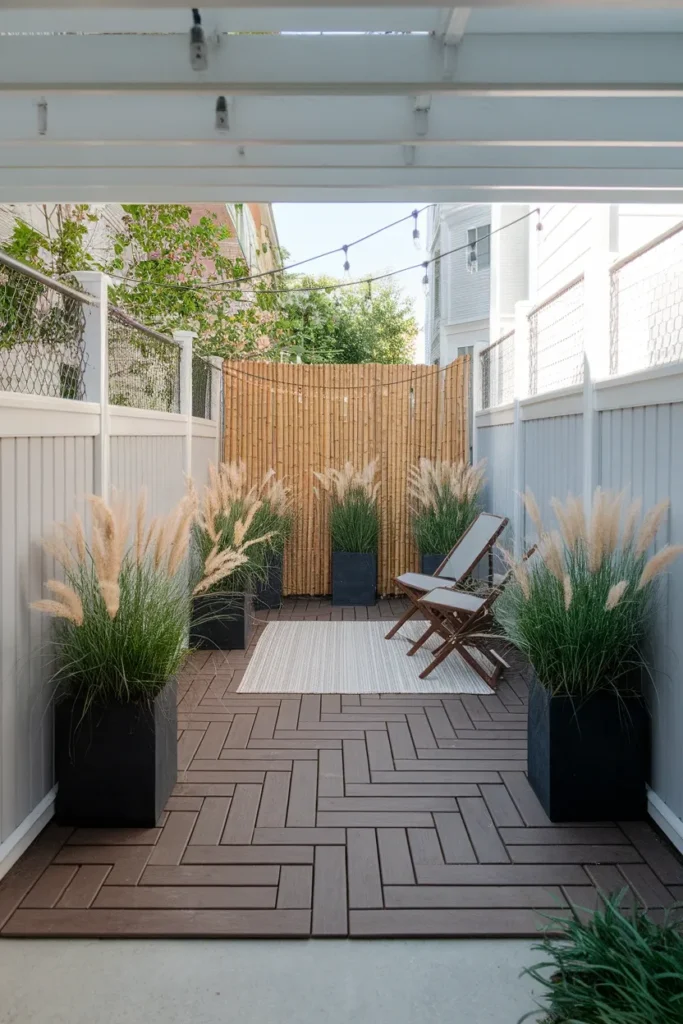
- Stop 1 surface: interlocking deck tiles over existing concrete or packed dirt. Home Depot and IKEA both carry them, generally $3 to $6 per square foot, and they pop apart into a stack when you move.
- Stop 2 pause: three tall planters in a loose triangle across the walking route. Bloem planters run under $20 each, and a Vego Garden or Birdies metal bed makes a heavier, better looking anchor if you want to spend more.
- Stop 3 payoff: a portable fire pit on a gravel-in-a-frame pad, or an outdoor rug plus two chairs and a lantern.
- Privacy without building: a rolled reed or bamboo screen zip tied to the existing fence, roughly $30 to $50 per roll at Home Depot. Tall grasses in fifteen gallon pots do the same job and move with you.
- Path: a no dig route of pea gravel over landscape fabric, held with plastic edging staked in. It lifts out.
Honestly, some of the best narrow yards I have seen were rentals, because the constraint forces everything to be light, movable, and layered instead of poured in place.
Five moves that quietly make a narrow yard look narrower
Worth checking your plan against these before you buy anything.
- A straight path down the middle. It is the fastest way to draw an arrow at your back fence. Offset it, curve it, or let it disappear behind the pause.
- A strip of lawn you cannot really use. Under about eight feet of usable width, turf becomes a maintenance chore that reads as leftover space. Gravel, groundcover, or planting beds do more.
- Small pots, lots of them. Five little containers scattered around look like clutter. Three big ones look like design.
- Furniture flat against both fences. It exaggerates the width you are trying to hide. Angle it, or float one piece.
- Matching everything. Same paver, same fence stain, same shrub, end to end. Repetition ties a design together, but total sameness in a long space just measures the length for the viewer.
Frequently Asked Questions
How do you make a narrow backyard look wider? Interrupt the sight line. Rotate your patio forty five degrees to the fence, break the length into three zones with a planted pause between them, and stagger fence line planting instead of running a single straight row. Those three moves change the read of a narrow yard more than any amount of new furniture.
What is the best layout for a long narrow backyard? Three zones with pauses between them, and the most-used zone nearest the house. Keep the middle of the yard open, push planting to the edges, and give the far end a real destination so the eye has somewhere to travel. Avoid a straight center path.
How much does a narrow backyard makeover cost? A DIY refresh with gravel, planters, string lights, and a portable fire pit generally lands in the $600 to $1,200 range for a ten to fourteen foot wide yard. Add a DIY paver patio and you are usually looking at $2,000 to $3,500 in materials. Hiring out the hardscape typically doubles it. Prices vary a lot by region and by delivery costs on bulk material.
What can I plant along a narrow fence line for privacy? Emerald Green arborvitae for evergreen screening, Sky Pencil holly where you have under three feet of bed depth, Karl Foerster feather reed grass for movement and height that cuts back each winter, and climbing hydrangea or an espaliered fruit tree when the bed is genuinely tiny. Confirm each pick against your hardiness zone first.
How wide does a backyard path need to be? Thirty six inches is comfortable for one person plus a wheeled trash bin. Thirty inches works as a tight minimum. Anything under twenty four inches will feel like an obstacle course once plants fill in on both sides.
Can you fit a patio and a garden in a narrow backyard? Yes, and a narrow lot is actually well suited to it. Put the patio in Stop 1 near the house, and run raised beds along the sunniest fence line in Stop 3. A pair of two by eight foot Vego Garden or Birdies beds fits a twelve foot wide yard with room to walk between them.
Should I paint my fence a dark color in a narrow yard? Only the far end. A dark back plane recedes and pulls the eye down the length of the lot. Painting both long side fences dark in a narrow space tends to close it in, particularly on a shaded or north facing yard.
Your Weekend Starting Point
A narrow backyard makeover does not start with a shopping list. It starts with chalk.
Mark your three stops, live with the lines for two days, and pay attention to where you actually walk with a coffee in one hand and a trash bag in the other. The layout will tell you what to buy, and it will usually be less than you thought.
If Stop 1 is the piece you want to get right first, the outdoor furniture layout guide walks through spacing and arrangement so your diagonal patio does not end up with everything squared back to the house.
Then tell me what you are working with. How wide is your narrowest point, and where does your eye stop when you walk out the back door?