Small Backyard Kitchen and Grill Setup Ideas for Tight Yards

A small backyard kitchen doesn’t need a 12 foot island, a built-in fridge, or a contractor on retainer. It needs about eight linear feet, a grill you actually like, and 24 inches of counter you can set a hot pan on without shuffling sideways. That’s the whole secret, and most of the articles ranking above this one skip it entirely.
So here’s what you’re getting: real dimensions, real 2026 numbers, the layouts that work in a narrow yard, and the clearance rules worth checking before you pour a single paver. If your patio surface still needs work first, start with these inexpensive patio ideas you can build in a weekend and come back.
Why a Small Backyard Kitchen Often Cooks Better Than a Big One
Here’s the take nobody selling outdoor cabinetry wants to lead with. Big outdoor kitchens cook worse.
The first cook line I built ran twelve feet along the fence, because I assumed more counter meant more usable space. Wrong assumption. I ended up walking that run twice per burger, and the far four feet turned into a graveyard for empty seltzer cans and a bag of charcoal I never opened. The tongs were always at the other end.
Indoor kitchen designers have known this for seventy years. The work triangle exists because steps cost you, and a cook who takes fewer steps produces better food with less stress. A tight run keeps your grill, your prep surface, and your trash within one pivot.
Small has a second advantage that matters more in August than in a showroom. Less counter means less surface baking in direct sun, which means fewer scorched forearms when you lean in to flip something.
The 8-Foot Cook Line: A Sizing Rule for Tight Yards
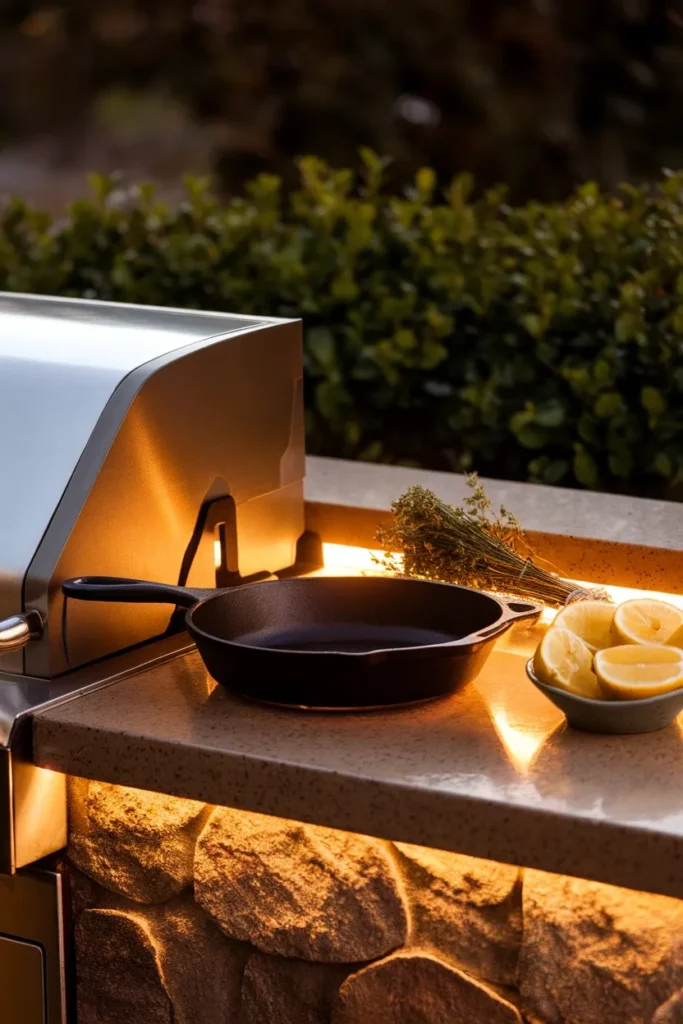
I call this the 8-Foot Cook Line. It’s the shortest continuous run that holds a full-size grill plus enough working counter to cook a real dinner, split into three fixed zones so you buy the right pieces in the right order. Every competitor tells you to go small. None of them tell you how small.
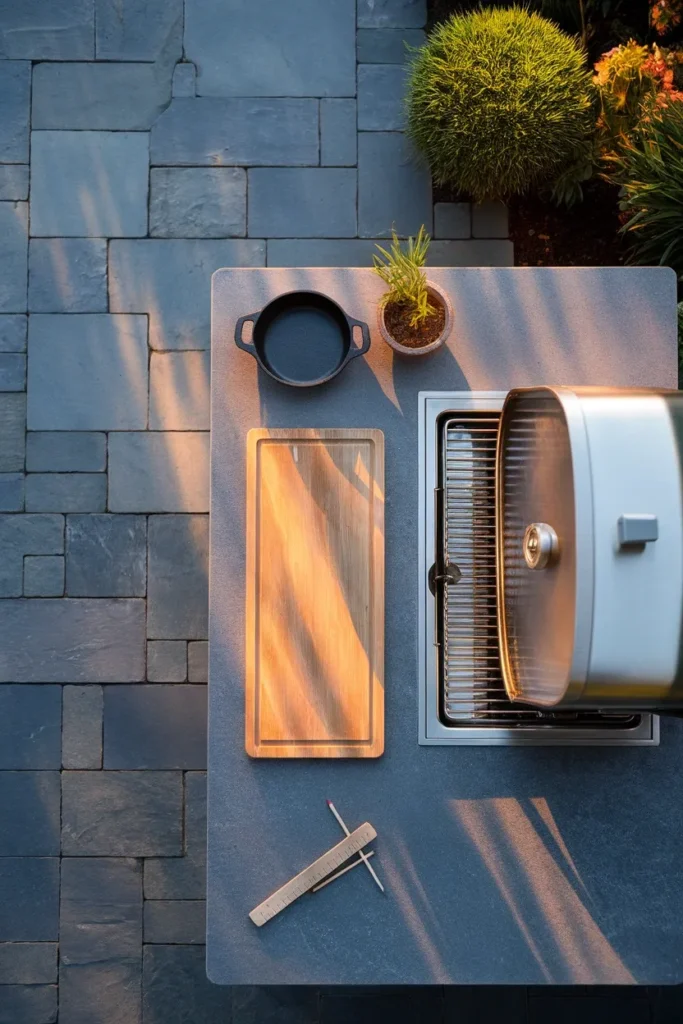
The math comes from published outdoor kitchen dimension standards: 12 inches of landing counter on each side of a grill, and 24 inches of uninterrupted prep space. Add a 30 to 36 inch grill and you land at 96 inches. Eight feet.
| Zone | Width | What lives here | Counter height |
|---|---|---|---|
| Cold zone | 24 in | Prep, cutting board, raw platter, drinks | 36 in |
| Hot zone | 30 to 36 in | Grill or griddle, tool hooks | 36 in |
| Landing zone | 12 in each side | Hot pans coming off, spice tray, thermometer | 36 in |
| Optional bar lip | adds 12 to 18 in overhang | Two stools, plates, glasses | 40 to 42 in |
Build the cold zone first if your budget is tight. A grill on a stand next to 24 inches of solid counter beats a beautiful island with nowhere to set the tray. Honestly, that’s the mistake I see in about half the small yards I walk into.
Two more numbers to write on your tape measure. Leave 5 feet of walkway behind the cook so people can pass without a shoulder check, and at least 3 feet between two facing runs if you go galley or U-shaped.
If you only have six feet
Six feet still works. Drop one landing zone. Keep the 24 inches of prep, a 30 inch grill, and a single 12 inch landing on your dominant hand side. You lose the spice tray spot. You keep everything that matters.
Under six feet, stop building counter. Buy a rolling cart instead. Wheels beat a cramped permanent run every single time.
Pick Your Layout Before You Pick Your Grill
Most people shop backwards. They fall for a grill at Home Depot in April, get it home, and then find out the only wall it fits against is the one with the dryer vent.
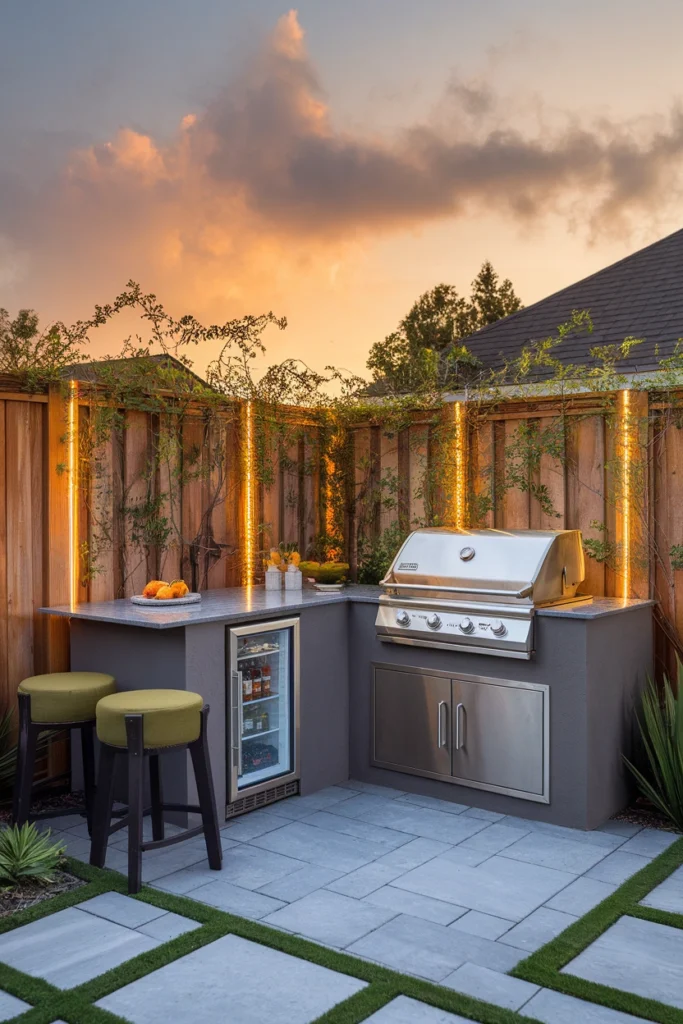
Straight run. One line against a fence or house wall. Cheapest to build, easiest to plumb and wire later, works in yards under 400 square feet. This is the default for a small backyard kitchen and there’s no shame in it.
L-shape. Turns a corner and gives you a natural spot for a small fridge or a trash pullout in the short leg. Needs roughly 8 by 5 feet of footprint. Family Handyman calls this out as a small-yard favorite for good reason.
Galley. Two short parallel runs with the cook in the middle. Rare in small yards, but it works beautifully on a long narrow side yard where you’d otherwise waste the space. Keep that 3 foot aisle.
Peninsula off a deck rail. If your cooking happens on a deck, the rail is free structure. Cantilever a 12 inch bar top off it and you’ve added seating without adding footprint. There’s more on squeezing function out of a raised, tight footprint in these deck ideas for small yards.
One placement rule beats all four layouts: keep the cook line within about 25 feet of your back door. Longer than that and you’ll stop using it on weeknights, which is when an outdoor kitchen actually earns its keep.
Grill and Griddle Setups for a Narrow Run
You’ve got three honest paths here, and the right one depends less on budget than on how you cook.
Freestanding cart grill. A Weber Spirit or similar three burner runs around $550 and rolls. If you rent, or if you might rearrange the yard next spring, this is the correct answer. Park it at the end of your 8 foot run and treat the counter as the permanent part.
Built-in drop-in head. No cart, no wheels, just the cooking head set into your counter. Cleaner look, better use of the 8 feet, and the counter continues right up to the firebox. Expect to spend more on the head than a comparable freestanding unit.
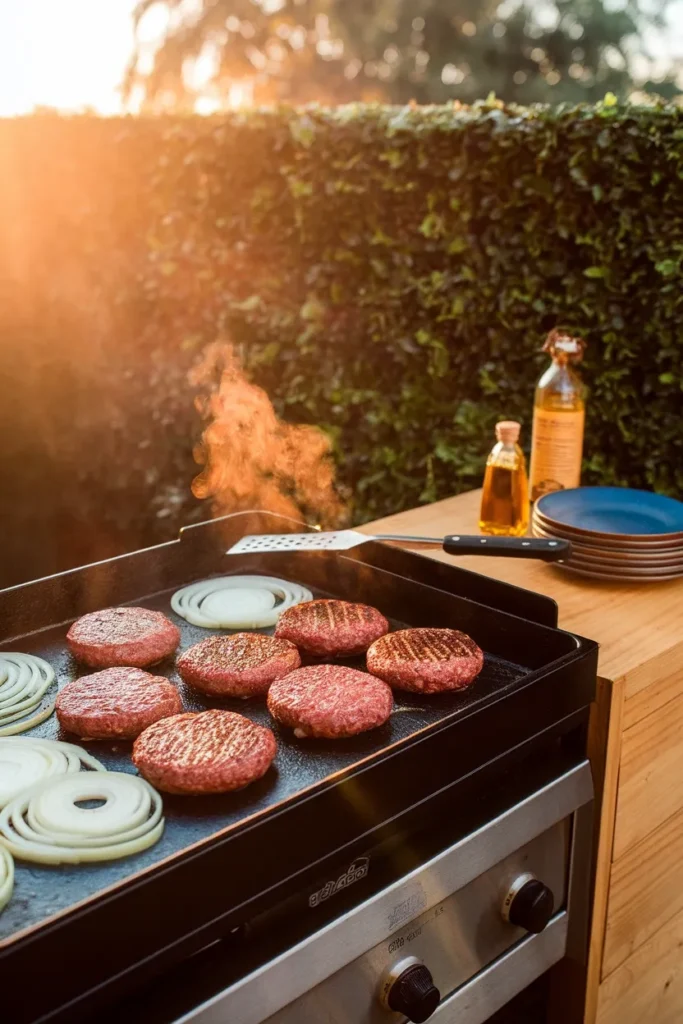
Flat top griddle. A Blackstone 28 inch sits around $300 and changes what a small backyard kitchen can produce. Smash burgers, fried rice, breakfast for six. If you already own a grill, the griddle is the higher-value second appliance, not a fridge.
A pellet grill is the outlier worth naming. It needs a covered spot and an outlet, and pellets turn to mush in a damp hopper. Great cooker, higher setup cost in a small space.
Charcoal deserves a line too. A 22 inch kettle runs around $120. It takes almost no footprint. It also needs a fireproof spot to dump ash, which nobody thinks about until the first cook ends at 10pm.
Whatever you pick, buy the cover the same day. Sun and sideways rain are what kill outdoor appliances, and a $40 cover is the cheapest insurance in the yard.
Clearance and Safety Rules to Check Before You Build
Every article ranking for this keyword buries safety at the bottom. That ordering is backwards for small yards specifically, because a small yard puts your firebox close to siding, close to a fence, and close to a deck rail by definition. You want to know the rules before you commit to a wall.
Start with placement. Grills belong outside in a well ventilated spot, never in a garage, carport, breezeway, porch, or under any surface that will burn, which rules out most low pergola roofs and every vinyl soffit. That guidance comes straight from federal consumer safety regulators and it’s the one rule people break most often when rain shows up.
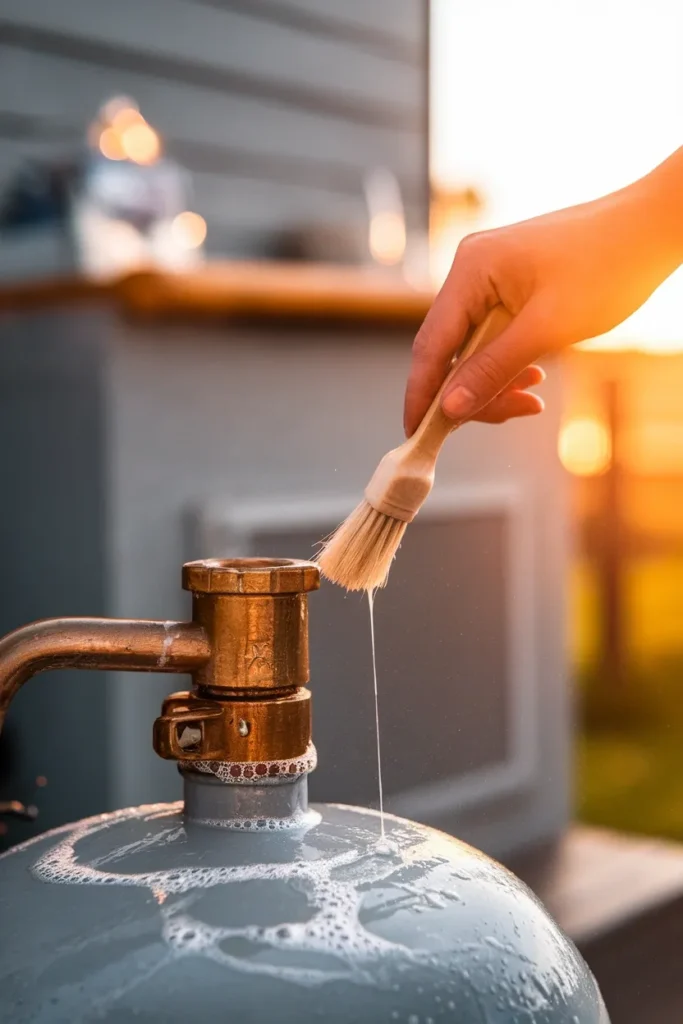
Then the annual check. Before your first cook of the season, brush a soapy solution across every propane connection point and watch for bubbles, which is the soapy water leak test the CPSC recommends. Bubbles mean a leak. While you’re down there, run your fingers along the hose looking for cracking, brittleness, or holes.
Local fire codes vary, and multifamily rules are stricter than single family rules in most places. Read the current grilling safety guidance from fire protection experts, then call your municipal building department before you set a permanent gas appliance against an exterior wall. Ten minutes on the phone beats a failed inspection.
The three things people actually get wrong
Deck boards under a charcoal grill with no fireproof pad. Combustible fence pickets within arm’s reach of an open lid. Propane tanks stored in a sealed deck box in July. Fix those three and you’ve handled most of the real risk.
Counters, Cabinets, and Storage That Handle Weather
My first counter was untreated pine topped with leftover bathroom tile. Two winters later the grout had cracked in six places and the whole run wobbled if you leaned on it. I rebuilt it in a weekend the following April and I’m still annoyed about the first attempt.
Learn from that. Outdoor counters fail at the substrate, not the surface.
Best value surface: honed granite remnant. Stone yards sell offcuts at a steep discount, and an 8 foot run often comes out of one remnant. Sealed, it shrugs off freeze cycles.
Best budget surface: exterior grade tile over cement board over a treated frame. Under $200 in materials for a short run if you shop the clearance rack. Use epoxy grout, not sanded.
Skip: butcher block outdoors, laminate anything, and untreated softwood framing.
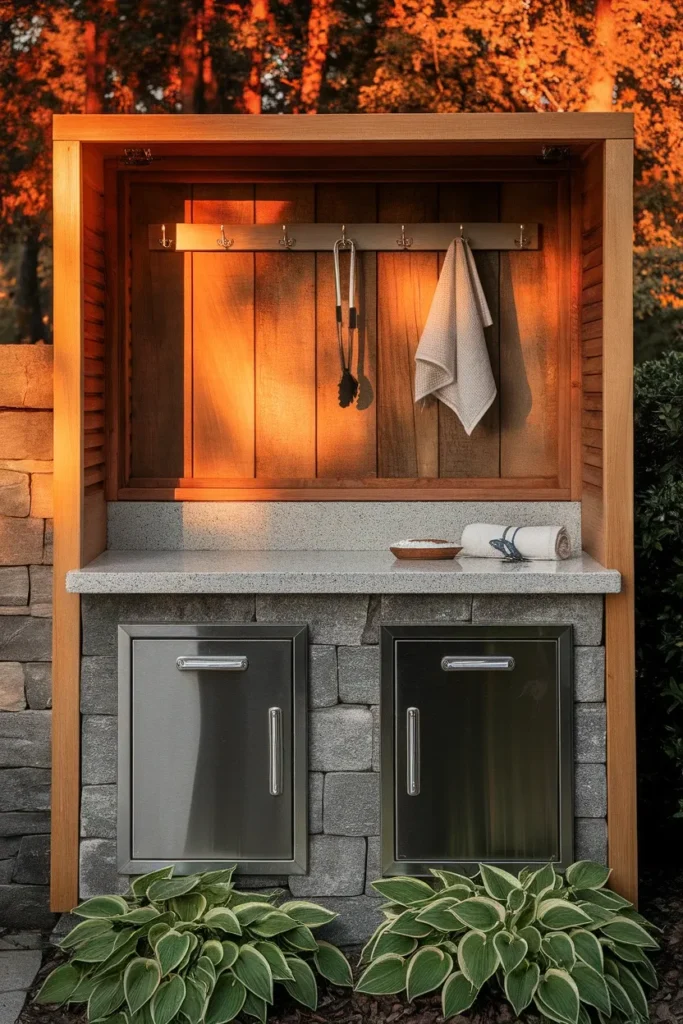
For cabinets, stainless doors in a masonry or treated frame outlast everything else, and powder coated aluminum runs a close second. If you want the cheap version that still looks intentional, an IKEA outdoor storage unit or a marine grade plastic cabinet under the counter keeps tools dry for around $150.
Storage rule for a small backyard kitchen: everything you touch more than twice per cook lives within one arm’s length of the grill. Tongs, spatula, thermometer, salt, oil, a towel. Everything else can live inside and make the trip.
What a Small Backyard Kitchen Costs in 2026
Numbers first, opinions after. These reflect current national installed pricing, and your region will swing them.
| Setup | 2026 installed range | Who it’s for |
|---|---|---|
| DIY BBQ island kit | $1,500 to $6,000 | Weekend builders with a level slab |
| Built-in BBQ island, grill up to 3 ft | $3,000 to $10,000 | One permanent run, no utilities moved |
| Modular or prefab kitchen | $7,000 to $16,000 | Turnkey, includes shipping and hookups |
| Gas line run | $12 to $25 per linear foot | Anyone tired of swapping tanks |
| Outdoor sink install | $330 to $1,300 | Plus $450 to $800 per fixture for the water line |
I priced a gas line to my patio one March and the quote came back near $900 for a forty foot run. I kept the 20 pound propane tank and put that money into a better cooking surface instead, which I’d do again. A tank swap costs around $25 and takes ten minutes.
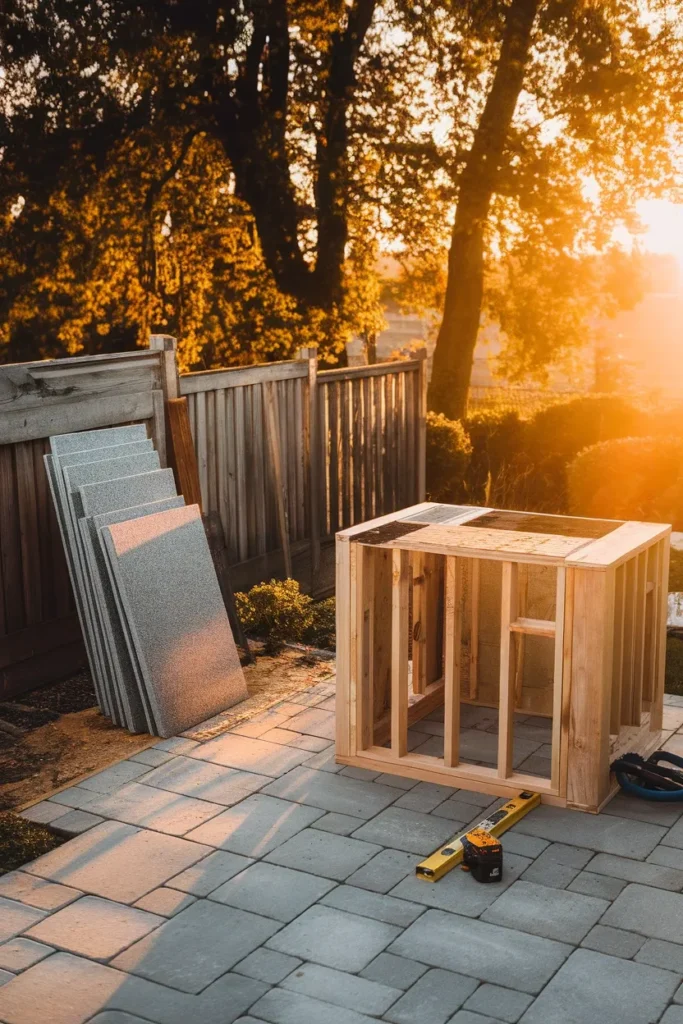
The honest budget build looks like this: a level paver base you laid yourself, a treated frame with a granite remnant top, a $550 freestanding grill, and about $150 in weatherproof storage. That’s a complete small backyard kitchen for roughly $1,200 to $1,800 in materials, spread across two weekends.
Where the money quietly goes: utilities. Water and gas are what separate a $2,000 project from an $8,000 one. Skip both on version one.
One more line item people miss. Power. A single outdoor GFCI outlet near the cook line is affordable if you’re tapping an existing circuit, and much less so if an electrician has to run a new one. You need it for a fridge, a pellet grill, or hardwired task lighting. Skip all three and you skip the electrician entirely.
Seating That Turns the Cook Line Into a Hangout
A cook line without seating is a chore station. Add two stools and it becomes the place everyone stands around, which is the actual point.
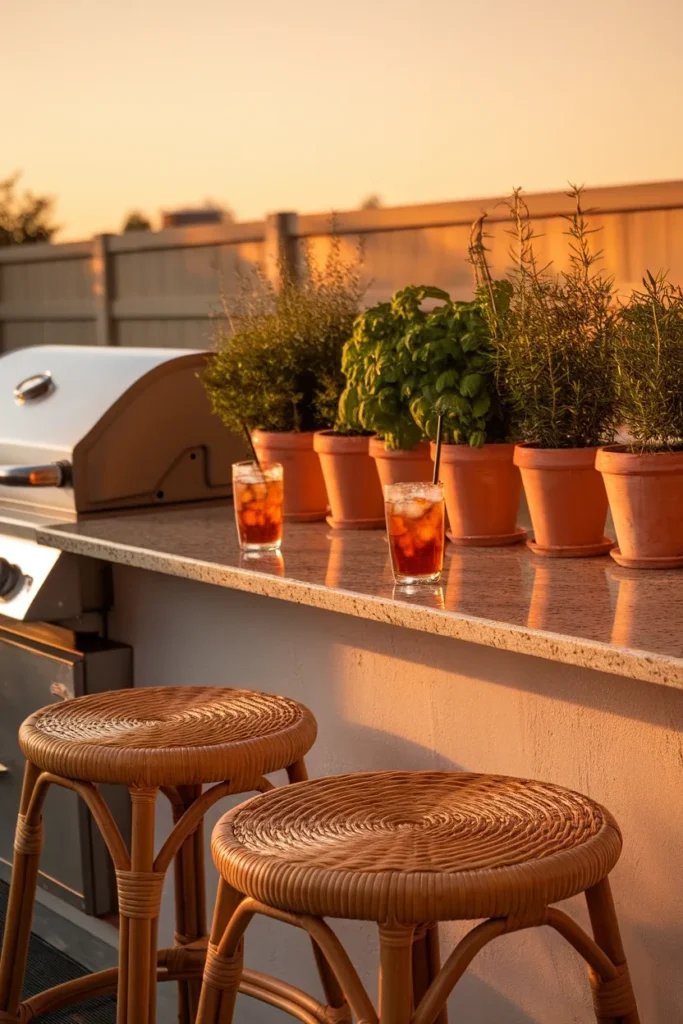
The cheapest way in is a bar lip. Extend your counter top 12 to 18 inches past the cabinet face, raise that section to 40 or 42 inches, and slide two stools under. No extra footprint, no extra furniture to store in November.
If your yard can spare the room, a small round table beats a rectangle in tight spaces because there’s no bad seat and no sharp corner to walk into after dark. Keep 3 feet of chair pull-back behind each seat. For the full spacing logic across different patio shapes, this guide to outdoor furniture layout walks through it.
Herbs earn their spot here too. A row of terracotta pots along the counter edge with rosemary, thyme, and basil gives you something to snip mid cook. In Zones 5 to 6, last frost usually lands somewhere between mid April and mid May, so that’s your realistic planting window for tender basil outdoors. Check your specific zone against the USDA hardiness map or your county extension office, since micro-location shifts those dates more than people expect.
Lighting, Shade, and the Small Stuff That Sells the Whole Thing
Task light and mood light are two different jobs, and small yards need both from separate fixtures.
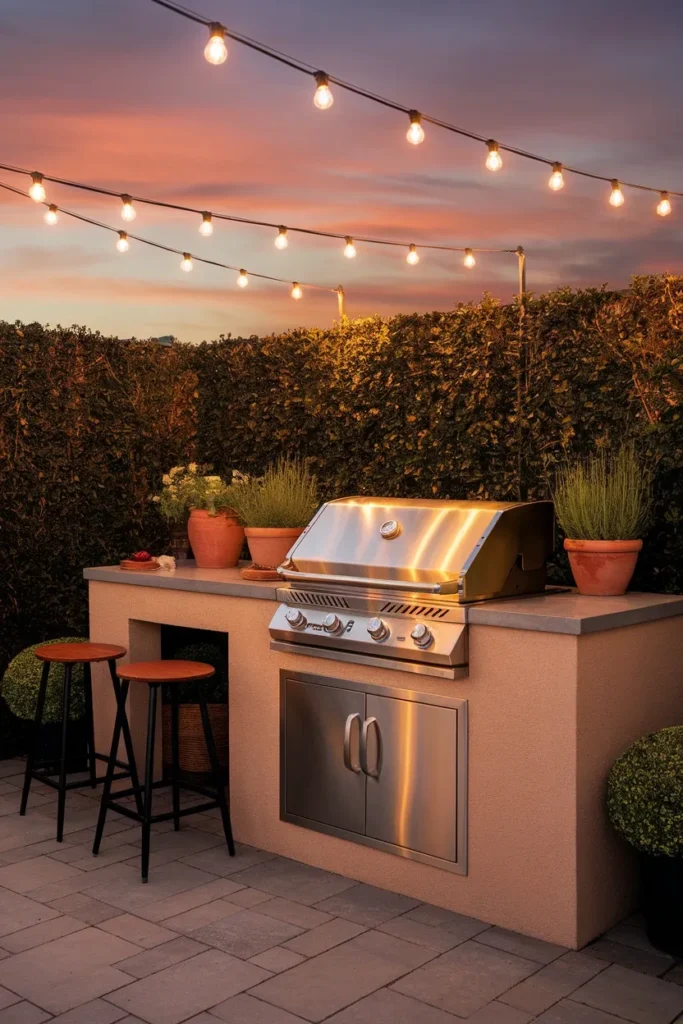
For task light, you want something aimed at the cooking surface that doesn’t blind you. A grill-mounted LED or a small under-counter strip does it. For mood, a single run of Brightech or Feit weatherproof string lights zigzagged overhead makes an eight foot counter feel like a restaurant patio for under $50.
Shade matters more than people plan for. A west facing cook line in July is brutal at exactly dinner time. A cantilever umbrella that clears the grill by a wide margin, or a shade sail anchored to the fence, solves it. Never put fabric directly above an open flame.
Now the finishing details that punch above their cost. A magnetic knife strip screwed to the cabinet side. A hook rail for tongs. A small trash pullout so nobody carries scraps inside. A rolled towel that lives outdoors year round.
Four cheap moves. Together they’re the difference between a setup you use twice a summer and one you use on a Tuesday.
Two more small wins while you’re at it. Put the trash on the side you plate from. Keep the towel on a hook, never flat on the counter.
Frequently Asked Questions
How much does a small backyard kitchen cost?
A DIY BBQ island kit runs $1,500 to $6,000 installed in 2026. A built-in island for a grill up to 3 feet lands between $3,000 and $10,000, and a modular prefab kitchen with hookups included runs $7,000 to $16,000. A pure DIY build with a freestanding grill, a treated frame, and a granite remnant top comes in far lower, roughly $1,200 to $1,800 in materials.
How much space do you need for a small outdoor kitchen?
Eight linear feet is the working minimum for a complete cook line: 24 inches of prep, a 30 to 36 inch grill, and 12 inches of landing counter on each side. You also want 5 feet of walkway clearance behind the cook, and 3 feet between two facing runs if you go galley or U-shaped.
How do you design the layout of a small outdoor kitchen?
Pick the layout before the appliances. A straight run against a fence or wall is cheapest and fits most yards under 400 square feet. An L-shape needs roughly 8 by 5 feet and gives you a spot for a fridge or trash pullout. Keep the whole thing within about 25 feet of your back door so you actually use it on weeknights.
Can you make a small U shaped outdoor kitchen?
Yes, though it’s the most space hungry option. You need at least 3 feet of clearance between the facing runs, plus room for the cook to turn without hitting a corner. In yards under about 500 square feet, an L-shape usually delivers the same counter footage with a friendlier footprint.
Can you build a small outdoor kitchen on a deck?
You can, with two conditions. The deck has to carry the load, which matters most with masonry construction, so check span and footing capacity before framing anything permanent. And a charcoal grill needs a fireproof pad underneath, since embers and composite decking are a bad pairing.
Do you need a gas line for an outdoor kitchen?
No. A 20 pound propane tank runs a standard grill for roughly 18 to 20 hours of cooking and a swap costs around $25. A permanent gas line costs $12 to $25 per linear foot installed, which adds up fast on a long run. Most small backyard kitchen builds are better off skipping it on version one.
What is the cheapest way to build an outdoor kitchen?
Level pavers you set yourself, a pressure treated frame, and a discounted granite remnant top from a stone yard. Add a freestanding grill you already own or buy around $550, plus a marine grade plastic cabinet for storage. Skip water, skip gas, and put the savings into the cooking surface.
Start With Eight Feet and See How It Feels
You don’t need to solve the whole yard this month. Measure eight feet along the wall or fence you’d realistically cook against, mark the three zones with painter’s tape, and stand there for a minute holding a spatula. That five minute test tells you more than any Pinterest board will, including this one’s.
Build the cold zone first, add the grill you actually want, and let the bar lip and the string lights come next spring. A small backyard kitchen gets better in layers, and the layers are the fun part.
What’s the first thing you’d cook out there? That’s usually the detail that tells you which zone to build first.