Small Backyard Play Area Ideas for Kids That Actually Fit

Most articles about building a small backyard play area for kids start by showing you a photo of a yard that is not small. You scroll, you like it, you go outside with a tape measure, and the math falls apart in about four minutes. So let’s start with the number nobody leads with: a swing set with a seven-foot pivot beam needs roughly fourteen feet of clear ground in front of it and fourteen feet behind. That is a twenty-eight-foot run for one piece of equipment.
Here is the good news. Once you know that number, you stop shopping for the wrong things, and a genuinely small yard opens up fast. This guide covers the footprint math, the surfacing depths that actually matter, and eight play zones that fit in tight corners. It also covers the part almost nobody plans for: what a small backyard play area for kids becomes once they outgrow it. If a raised deck is already eating half your yard, our deck ideas for small yards covers how to claim back usable ground.
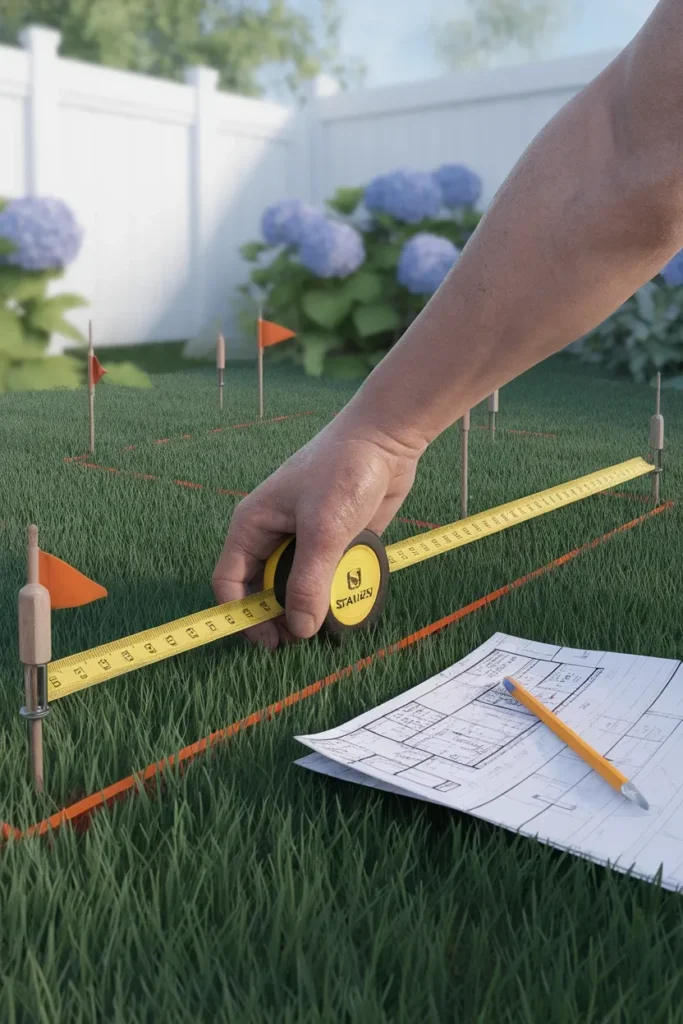
Start With the Footprint, Not the Playset
Almost everyone does this backwards. They fall for a cedar playset at Home Depot, get it home, and then try to make the yard accommodate it. Then the fun part begins, which is discovering that the swing arc clips the fence.
Work the other direction. Measure the flattest usable rectangle you have, subtract three feet of walking clearance on every side you need to get past, and whatever is left is your real play footprint. Write that number down. For a lot of suburban lots, it lands somewhere between 10 by 12 feet and 15 by 20 feet.
That rectangle is the entire brief for a small backyard play area for kids. Everything else is shopping.
Now compare it to what equipment actually requires. The public playground safety handbook from the Consumer Product Safety Commission calls the buffer around equipment a use zone, and it recommends a minimum of six feet in all directions around a standalone climber. Six feet. In every direction. A modest five-foot climber that measures 5 by 5 on the box needs a 17 by 17 foot clear area to sit inside its own safety buffer.
That is bigger than most small yards can give up.
I learned this one the hard way. I measured our swing beam and completely forgot about the arc, so I bolted the frame together three feet off the back fence in early June and only did the pivot math afterward. We moved the whole thing in October with two neighbors and a lot of complaining. Measure the arc first.
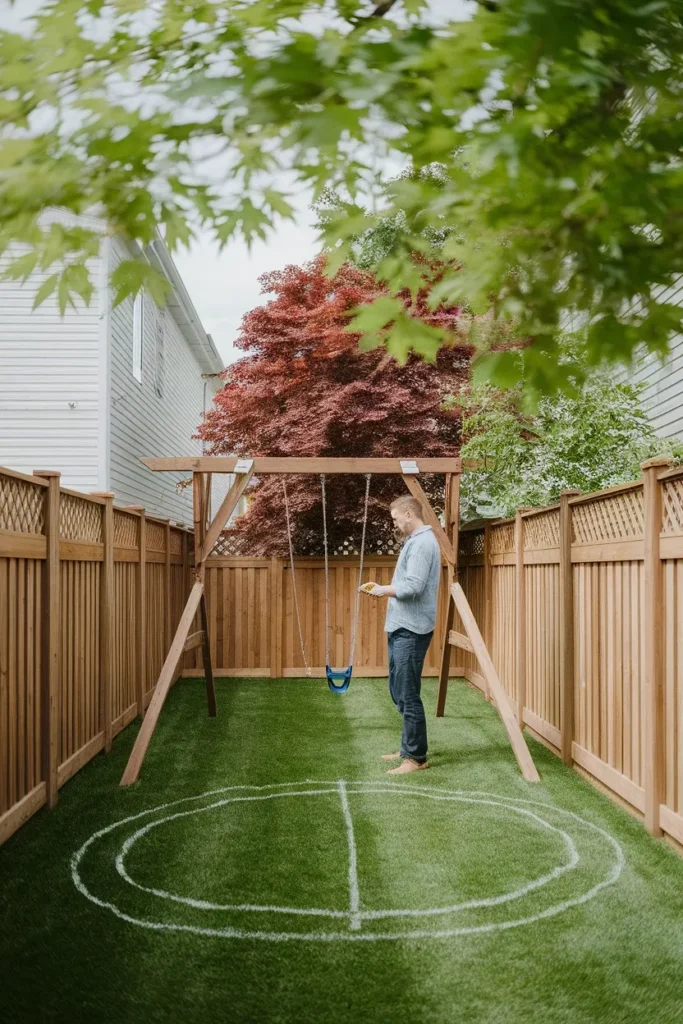
The 6-Foot Footprint Test
This is the framework I wish someone had handed me before I spent a weekend assembling something that did not fit. Call it the 6-Foot Footprint Test. Before anything enters your cart, take the equipment’s listed dimensions, add the required use zone on every side, and check whether that total rectangle fits inside your measured play footprint with three feet to spare. If it does not fit, the piece is wrong for your yard, no matter how good the sale price is.
Screenshot this table. It is the whole article in one block.
| What you want | Equipment size | Use zone to add | True footprint needed |
|---|---|---|---|
| Swing set, 7 ft pivot | 8 x 4 ft | 14 ft front, 14 ft back, 6 ft sides | about 20 x 32 ft |
| Standalone climber, 5 ft tall | 5 x 5 ft | 6 ft all sides | about 17 x 17 ft |
| Playhouse, floor under 30 in | 4 x 4 ft | walking room only | about 6 x 6 ft |
| Sandbox, ground level | 4 x 4 ft | no fall-height zone | about 5 x 5 ft |
| Mud kitchen against a fence | 3 x 2 ft | no fall-height zone | about 3 x 4 ft |
| Stepping-log course, 8 in high | 8 x 2 ft | no fall-height zone | about 8 x 4 ft |
Look at the bottom four rows. Everything in that group is ground-level, which means no fall height, which means no six-foot buffer. Five of them together fit in the space one climber demands.
That is the contrarian part of this whole guide, and I stand behind it. In a small yard, the big playset is usually the wrong first purchase. Ground-level, open-ended play gets more hours per week from most kids under eight, and it costs a fraction of both the money and the square footage. Buy the climber later, if you still want it, when you have watched what your kids actually gravitate toward.
The other advantage is reversibility. A ground-level small backyard play area for kids can be picked up, moved four feet left, or removed entirely in a single afternoon. A post-set climber cannot.
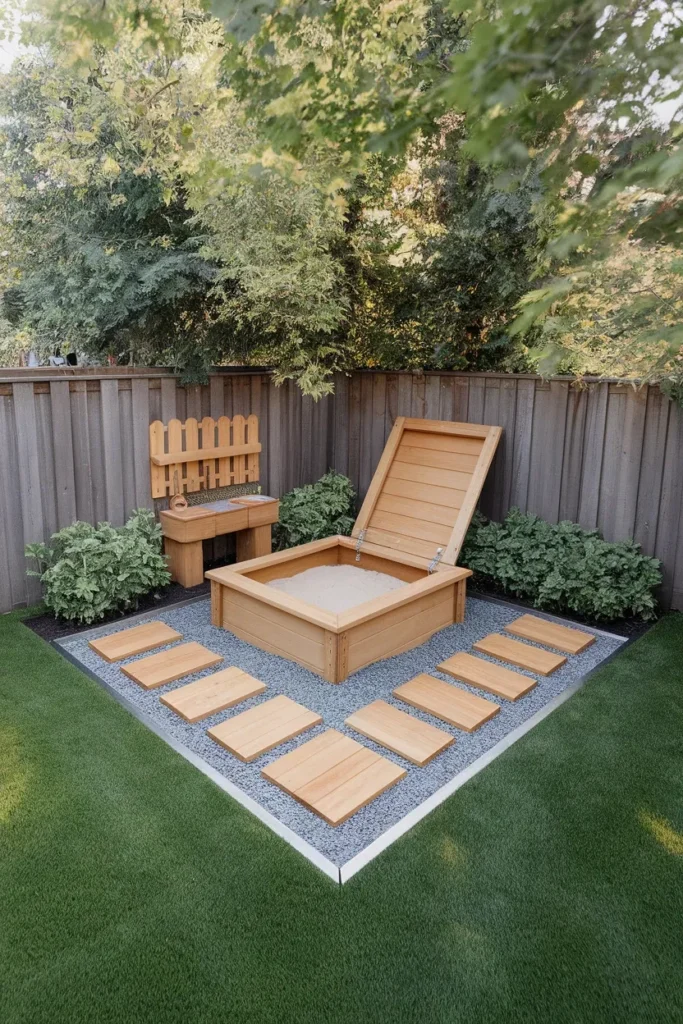
Ground-Level Play Ideas That Fit a Small Yard
These are the pieces that earn their square footage. Start at the top of this list, because the first one has the best return per foot I have seen in any yard.
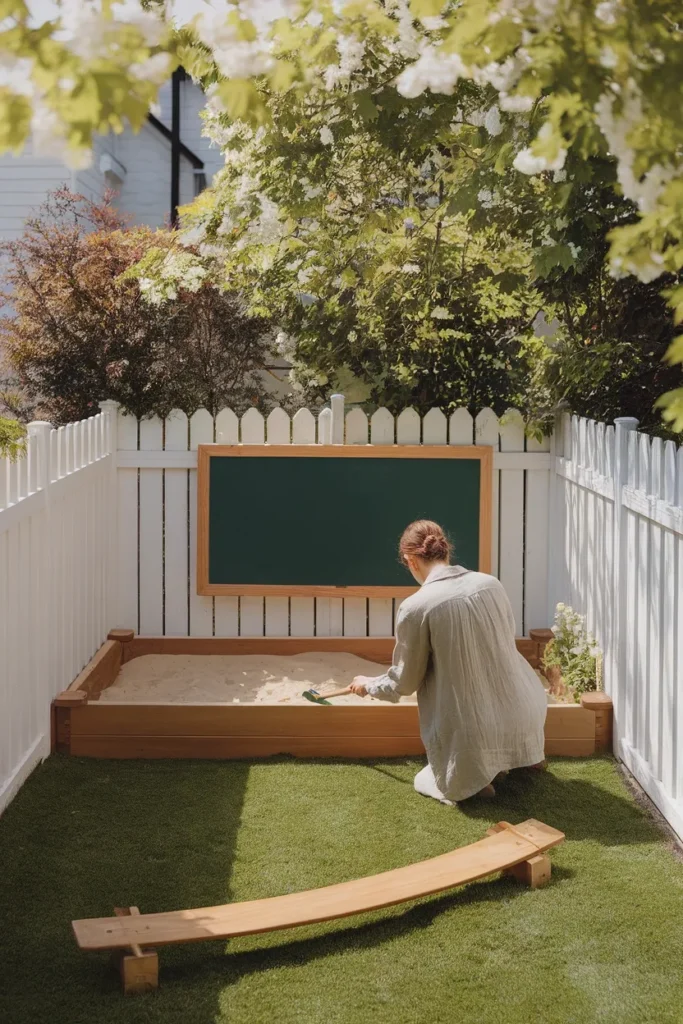
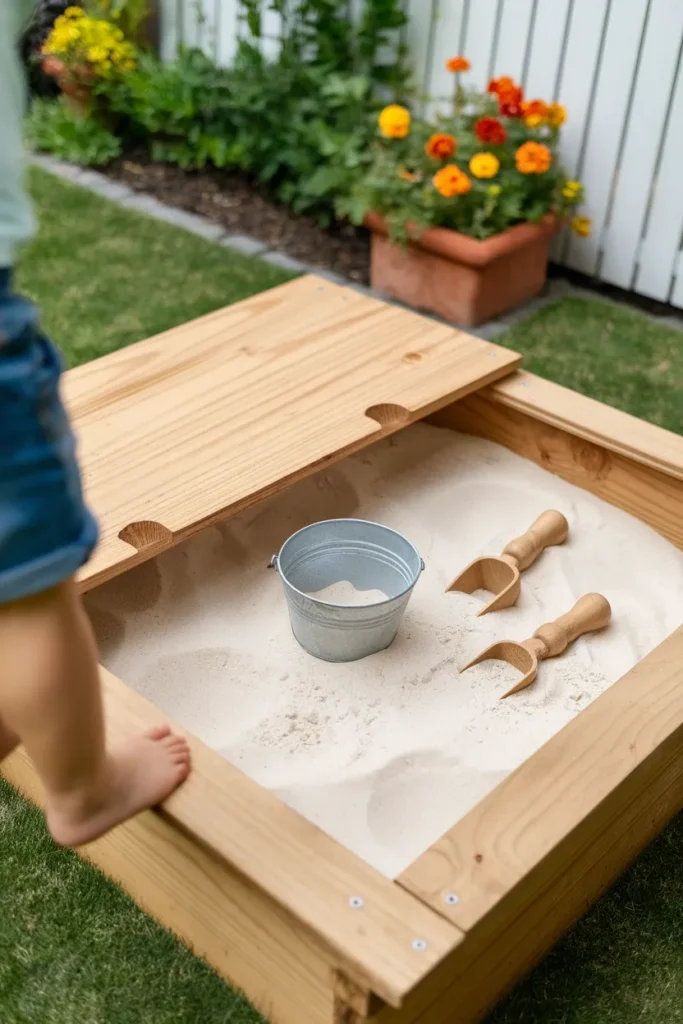
1. A lidded sandbox, four feet square
Sand is the highest-hours, lowest-footprint play surface there is. A Greenes Fence cedar frame runs around $60 to $90 depending on size. Play sand from Lowe’s or Home Depot costs roughly $6 to $10 a bag, and a 4 by 4 box takes about eight bags at six inches deep.
The lid is not optional. Our first sandbox went straight onto bare dirt in early May with no cover at all, and by mid-July it was half mud and full of earwigs. Landscape fabric underneath and a plywood lid on top fixed it the following spring, and the lid cost less than the sand did.
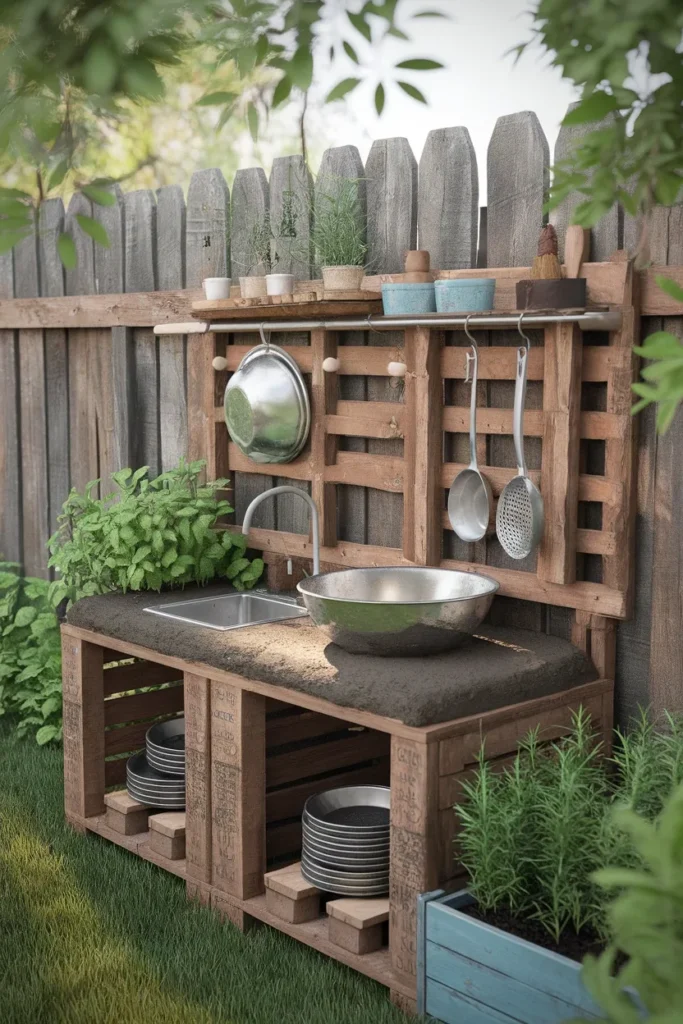
2. A fence-mounted mud kitchen
Two feet of counter screwed to a fence rail. That is the entire build. Add a thrifted stainless bowl dropped into a cut hole for a sink, and stock it with a run of Dollar Tree pans, muffin tins, and wooden spoons for around $12 total.
Here is the part that still surprises me: the mud kitchen got more hours across an entire summer than anything else in our yard, and it cost less than one bag of engineered wood fiber. Kids do not need the equipment to do the playing for them.
3. A loose parts bin
One galvanized tub, around $30 at Tractor Supply, filled with pinecones, smooth stones, short lengths of PVC, wooden rounds, and scrap fabric. Loose parts play is the cheapest sustained-engagement upgrade in the entire yard. It takes up two square feet.
Rotate the contents every few weeks. Same bin, new game, no new spending.
4. A stepping-log course
Six log rounds, cut eight to twelve inches tall, sunk two inches into the ground in a curve. Balance practice, zero fall height, and it doubles as informal seating when adults are out there. Free if a neighbor is taking down a tree.
Set them close together for toddlers and spread them out as the kids get steadier. It is one of the few pieces in a small play area that grows with them instead of aging out.
5. Go vertical when the floor is full
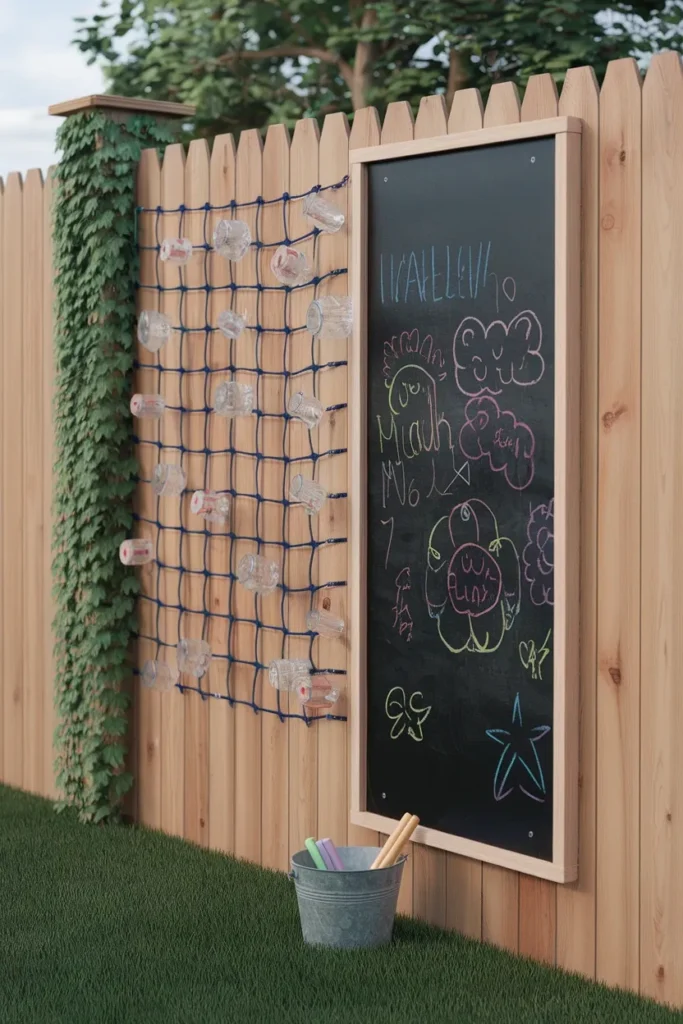
When the ground is spoken for, the fence is still empty. A chalkboard panel painted with exterior chalkboard paint costs about $25 and gives you six feet of drawing surface at zero footprint. A water wall built from funnels and cut bottles screwed to a plywood backer runs under $20. Cargo netting stretched between two posts adds climbing without a use zone, as long as the climb height stays low.
Surfacing That Is Actually Safe Underfoot
This is where small-yard builds most often cut the wrong corner. If you have anything with fall height, the ground under it matters more than the equipment on top of it.
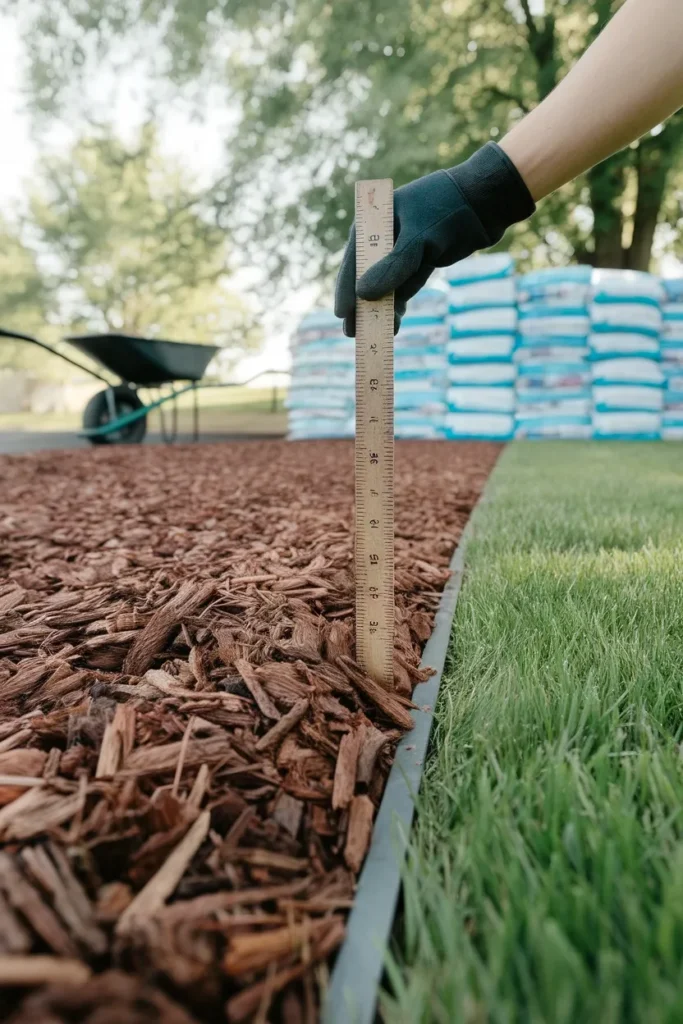
The CPSC numbers are specific. At a nine-inch compressed depth, wood mulch and pea gravel protect to a five-foot fall height, engineered wood fiber protects to six feet, and sand protects to nine feet. Nine inches compressed, which means you order closer to twelve and let it settle. Most backyard installs I have seen run three or four inches, which protects to almost nothing.
Researchers at the National Program for Playground Safety put it plainly in their fall surfacing research from playground safety specialists: equipment taller than five feet more than doubles the probability of injury. That single line is a strong argument for keeping a small yard low.
Quick comparison for a small footprint:
- Engineered wood fiber. Best protection per dollar, roughly $4 to $8 a cubic foot bagged. Needs topping up every year or two.
- Pea gravel. Cheap and drains well, but it migrates, and it is a genuine choking risk under age three.
- Play sand. Great protection, doubles as play material, tracks into the house relentlessly.
- Artificial turf. Clean and low maintenance, but only rated for falls if you install a shock pad underneath. The turf alone is not safety surfacing.
- Grass. Not fall surfacing at any depth. Fine under ground-level play, insufficient under anything raised off the ground.
Skip surfacing entirely for ground-level zones. That is the whole point of staying low.
Shade, Sun Hours, and the Kitchen Window Test
A play area in full afternoon sun does not get used in July. Not in Zone 7, not anywhere. Before you commit to a corner, stand in the yard at 10 a.m., 2 p.m., and 5 p.m. on a clear day and note what is shaded. Three readings, one day, and you will know more about that corner than any plan drawing will tell you.
Then run the window test. Stand at your kitchen sink and look out. If you cannot see the play zone from wherever you spend your weekday afternoons, you will not let the kids out there alone. That means the whole thing only gets used when you are outside supervising, which cuts its real hours by more than half. Sightline beats aesthetics on a small lot every time.
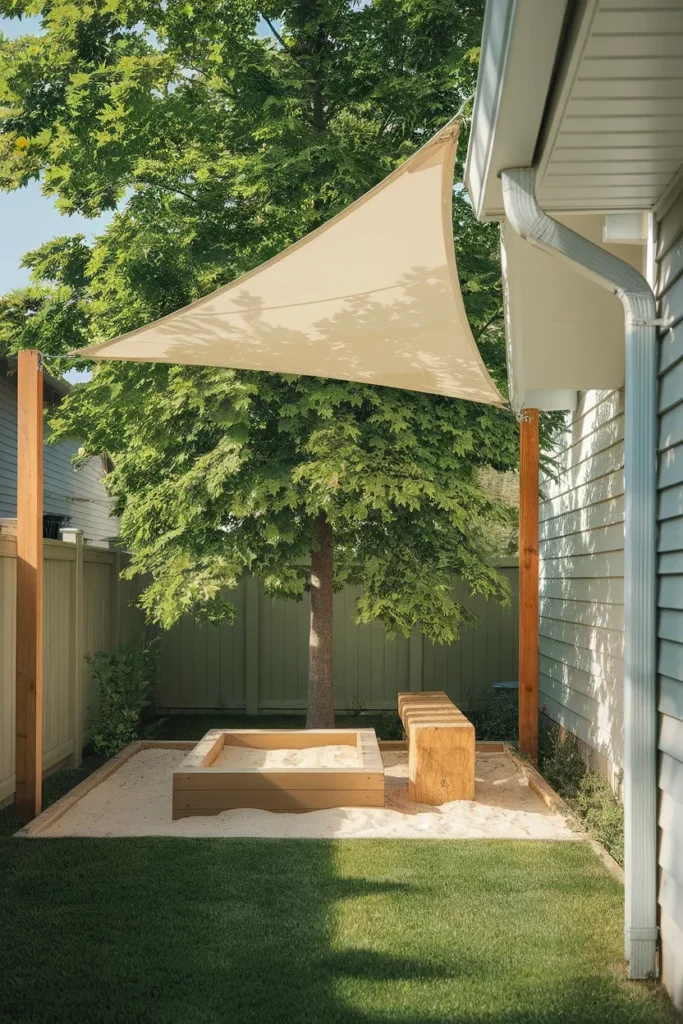
For fast shade, a triangular shade sail runs in the $40 to $90 range and installs in an afternoon between the fence and the house. A young tree is the better long-term answer. In Zone 6, last frost usually lands somewhere around mid-April, so sod, clover seed, or a new tree goes in late April at the earliest. Confirm your own dates against the USDA Plant Hardiness Zone Map or your county extension office, because micro-location shifts those windows by a week or two either direction.
If your best-shaded corner turns out to be the darkest one, our shade garden ideas for low-light yards covers what will actually grow around the edges of it.
Zoning So the Adults Still Get a Seat
A yard that belongs entirely to the kids stops being a yard you want to sit in. On a small lot, the fix is a hard border rather than more space.
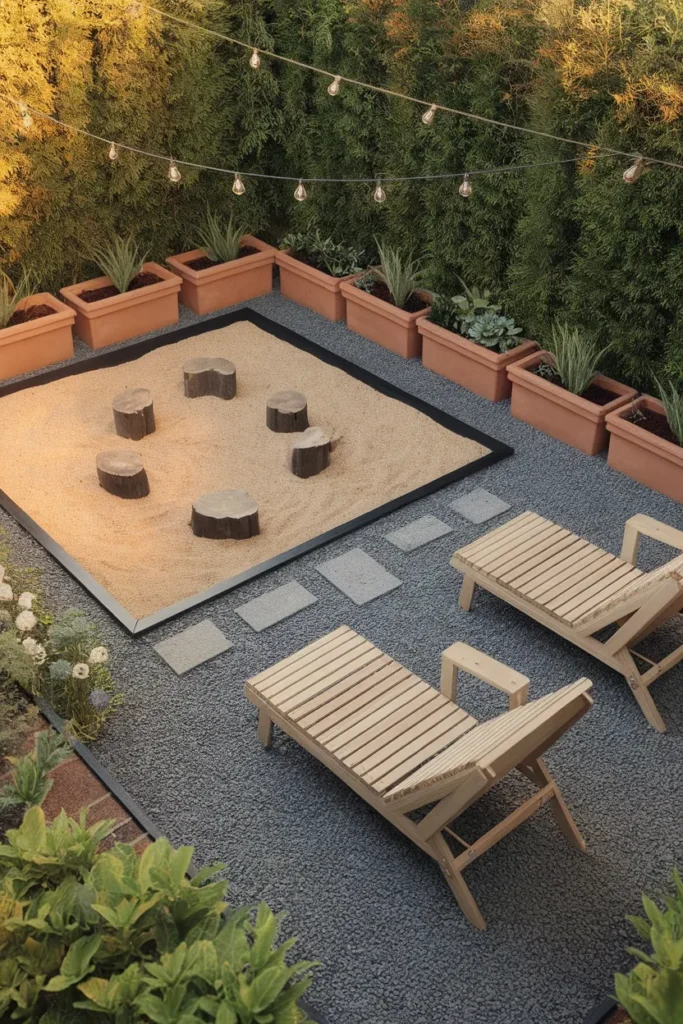
Steel or aluminum edging, roughly $2 to $4 a linear foot at Lowe’s, draws a visible line between the play surface and the sitting surface. Bloem or terracotta planters along that line soften it and reinforce it at the same time. Ten feet of separation reads as two rooms even when the whole yard is thirty feet across.
Keep the adult side simple: two chairs, one small table, and something overhead. A run of Brightech string lights across the seating corner (usually in the $30 to $60 range for a 48-foot set) turns that side into an evening space once the kids go in. IKEA Bondholmen or a couple of Polywood chairs handle weather without a cover.
Honestly, this is the part people skip and then regret by August.
Plan the Exit Before You Build
Here is the section no competitor writes, and it is the one that will save you the most money.
Your kids will outgrow this. A four-year-old who lives in the sandbox is nine in five years, and nine-year-olds do not use sandboxes. If you bolt a permanent structure into the only flat corner of a small yard, you have committed that corner for a decade, and removing a concrete-footed playset is a genuinely miserable weekend.
So design the conversion now:
- The sandbox becomes a raised bed. A 4 by 4 cedar frame or a Vego Garden metal bed swaps sand for soil in one afternoon. Same footprint, new purpose.
- The pea gravel zone becomes a patio base. Gravel is already the sub-base for pavers. You are halfway to a seating area without knowing it.
- The mud kitchen becomes a potting bench. It already has a counter, a sink, and shelves.
- The fence chalkboard becomes a vertical herb rack. Unscrew one panel, screw on rail planters.
Nothing on that list requires demolition. That is the test: if removing a piece takes more than an afternoon and a drill, think harder before installing it in a small yard.
There is a resale angle here too. Buyers walking a compact lot want to see flexible outdoor space, not a fixed play structure they will have to pay someone to pull out. A small backyard play area for kids built from movable pieces reads as an easy yard. A concrete-footed frame reads as a project.
Small Backyard Play Area Questions, Answered
How much space do you need for a backyard play area? Less than you think, if you stay at ground level. A useful small backyard play area for kids starts around 8 by 10 feet for sand, loose parts, and a balance course. Raised equipment is what drives that requirement up. CPSC guidance adds a six-foot use zone in all directions around a standalone climber, which turns a 5 by 5 structure into a 17 by 17 demand on your yard.
What is the cheapest ground cover for a backyard play area? Pea gravel is usually the lowest cost per square foot, running roughly $1 to $3 installed depending on your region. It drains well and it does not rot. Two catches: it migrates out of the zone and needs raking back a few times a season, and it is a choking hazard for children under three.
How deep should mulch be under a swing set? Nine inches compressed, per CPSC guidance, which means installing around twelve inches and letting it settle. At nine inches, wood mulch protects to a five-foot fall height and engineered wood fiber protects to six feet. Three or four inches, which is what most backyard installs actually have, protects to very little.
What can I put in a backyard play area for toddlers? Stay entirely at ground level for under-threes. A lidded sandbox, a shallow water table, a soft grass or turf surface, a low tunnel, and a loose parts bin without small stones covers it. Skip pea gravel at this age, and skip anything with a platform over 30 inches.
Do I need a fence around a backyard play area? Local codes vary, and there is usually no requirement for a play zone by itself. Water is the exception. If a pool or a spa is anywhere on the property, fencing and self-latching gates are typically required by local ordinance, so check with your city or county building department before you plan the layout.
How do I make a small backyard fun for kids without a playset? Open-ended beats fixed-function, and it is not close. Sand, water, mud, loose parts, and a chalk surface generate more hours of play per square foot than a climber does, because the kids supply the game. Add a shade sail so the zone stays usable in July, and it will get used most days.
What age is a backyard playset good for? Most residential playsets are designed for roughly ages 3 to 10, with the sweet spot from 4 to 8. That is a shorter window than most people expect, which is exactly why the exit plan above matters so much on a small lot.
Start With One Zone This Weekend
You do not need the whole plan finished to start. Pick the flattest corner you can see from a window, mark it out with flags, and put one thing in it. A sandbox, a mud kitchen, a tub of loose parts. Watch what your kids actually do with it for a month before you buy anything with a use zone attached.
Small yards reward that kind of patience, mostly because they punish the alternative so quickly. If the rest of the yard needs help too, our budget backyard garden ideas walks through the same spend-in-order thinking for the space around the play zone.
What is the first zone going in your yard? Measure the corner this weekend and see what the 6-Foot Footprint Test tells you.