How to Plant a Fall Container Garden (No Contractor Needed)

Most fall container garden ideas fall apart the same way. You buy three fat mums on a Saturday, press them into a pot, and by the third week of October the whole thing looks like wet paper bags. The plants were not the problem. The plan was.
A fall pot has to survive three different kinds of cold, and almost nobody builds for that. The tender stuff quits the first night it hits 32°F. The middle layer shrugs off light frost and actually gets prettier. A third group keeps its shape long after everything else has gone to mush.
Sort your plants that way and one pot carries you from Labor Day through Thanksgiving. Sort them wrong and you are back at the garden center in four weeks, buying the same mums again.
Below is the plan we use: what to buy, what to skip, what it costs, and three porch recipes that hold up in Zones 5 through 9. No contractor, no raised bed, no digging. One pot, one afternoon.
What actually survives a fall pot, and what quits in week two
Garden centers stack everything together in September, which makes it look like it all has the same lifespan. It does not.
Coleus, sweet potato vine, celosia and most tender annuals are done the first night the thermometer touches freezing. They look great in the photos on the display table. They will not make it to Halloween in Zone 5 or 6.
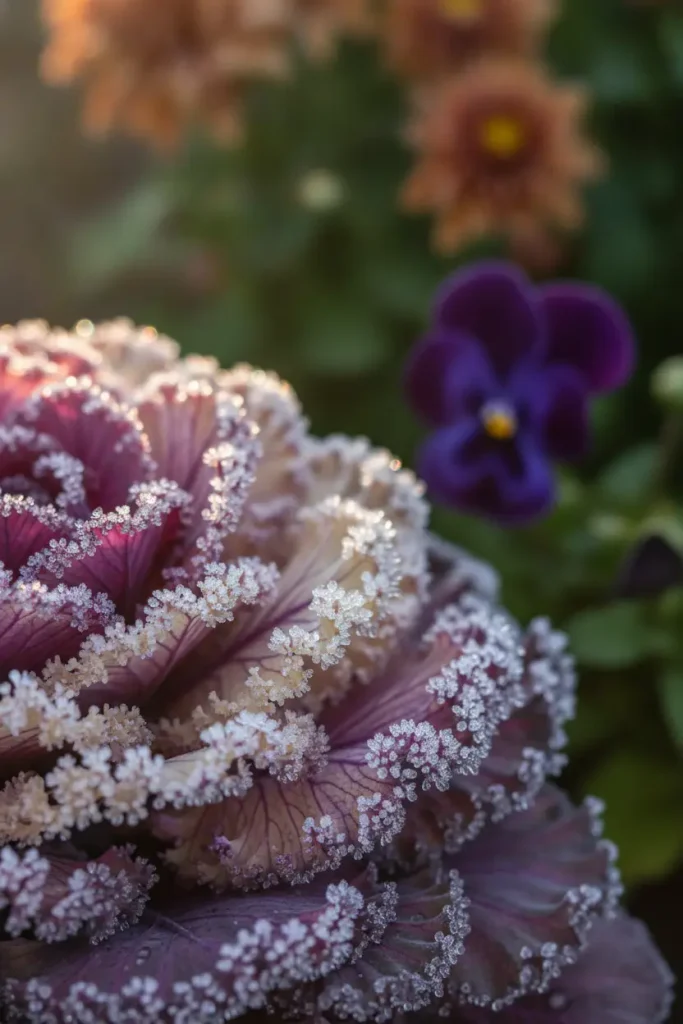
Pansies and violas go the other direction. Clemson’s extension factsheet puts it plainly: pansies grow and flower best when temperatures stay below 75°F, which is exactly why fall is their season and why a summer pansy always looks sad. Ornamental kale and flowering cabbage do something even better. Their color deepens after a few frosty nights, so the pot you plant in September looks richer in November.
Then there is the group that never really changes: feather reed grass, purple fountain grass, heuchera, dusty miller. They keep their shape through hard frost and hold the pot together after the flowers give up.
If you are new to pots in general, our container gardening basics for beginners covers soil, drainage and pot sizing before you get to seasonal swaps.
| Quits at first frost | Gets better after frost |
|---|---|
| Coleus | Ornamental kale |
| Sweet potato vine | Flowering cabbage |
| Celosia | Pansies and violas |
| Peppers and basil | Swiss chard |
| Most summer petunias | Ornamental grasses and heuchera |
The Three-Frost Fall Pot Plan
Here is the whole framework, and it is the thing the big gallery posts leave out.
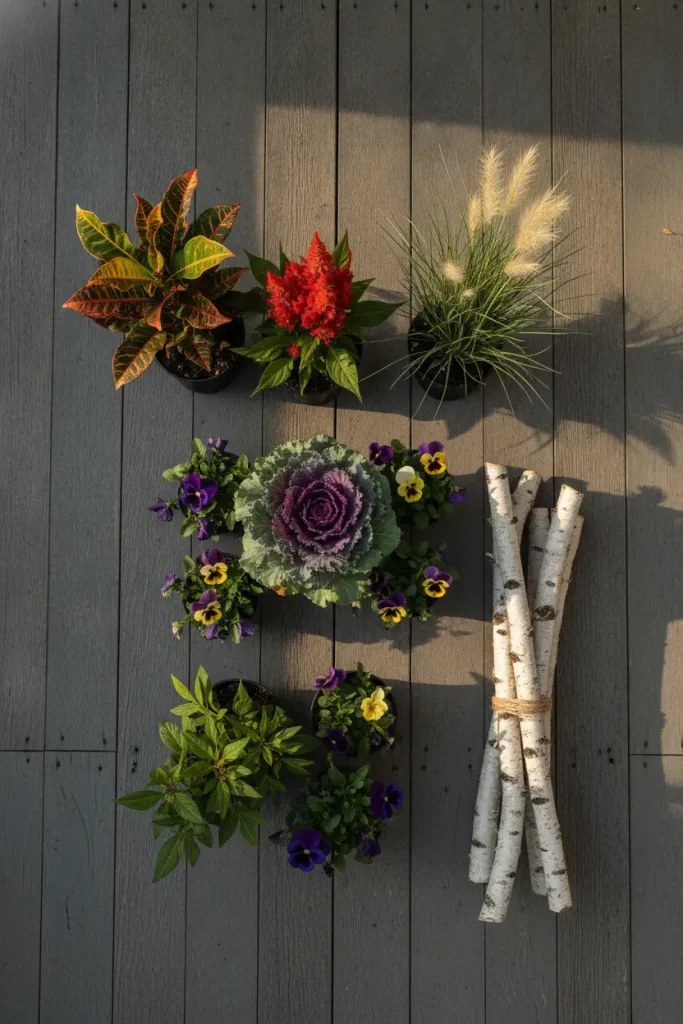
Build every fall pot in three layers, sorted by the cold each layer can take. Layer one carries September and early October while it is still warm. Layer two takes over when light frost arrives and holds the middle of the season. Layer three is structure, and it is still standing when everything else has browned out.
Buy all three at once. Plant all three at once. You are not replanting later, you are just letting the pot hand off from one layer to the next.
Your first frost date decides how much Layer 1 is worth buying. Zone 5 usually sees it from late September into mid October. Zone 6 lands early to late October, Zone 7 mid October into early November, Zone 8 early November into December, and Zone 9 often skips it entirely. Those are typical ranges, not promises, so check your own band on the 2023 USDA plant hardiness zone map, which sorts the country by average annual extreme minimum winter temperature in 10-degree bands.
Short version. Zone 8 or 9, load up on Layer 1. Zone 5, spend that money on Layer 2 instead.
Pick the pot before you pick the plants
This is backwards from how most people shop, and it is the reason so many fall pots crack in January.
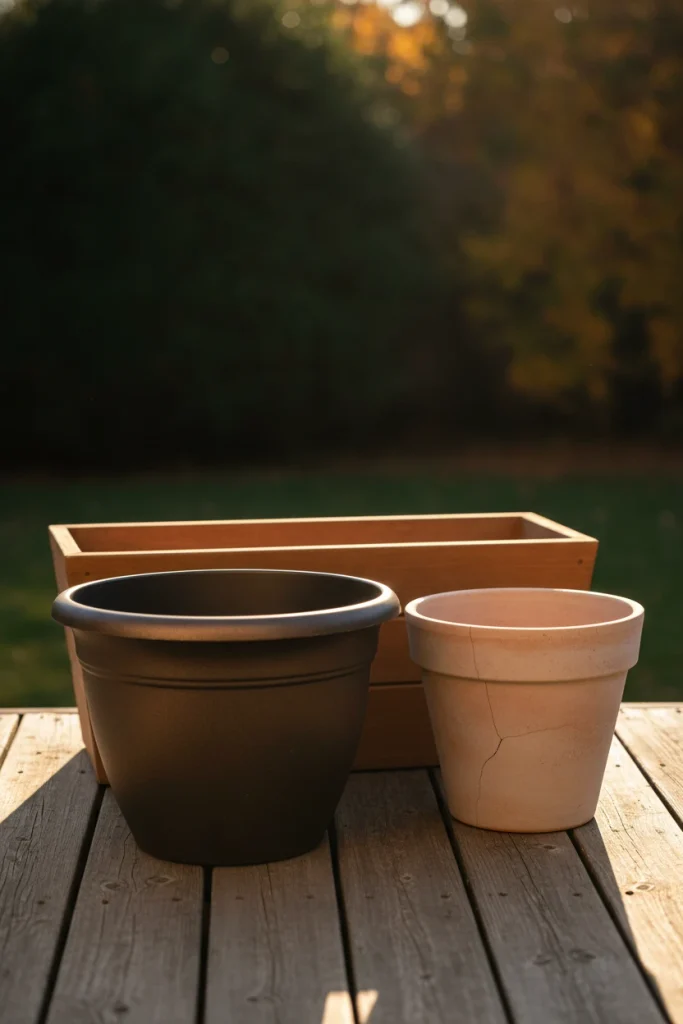
NC State’s Extension Gardener Handbook is blunt about material. Unglazed ceramic pots should not be used for plants that stay outside through winter, because they drink up water that then freezes and splits them. Wood and plastic containers can safely stay out year round. That one sentence should decide your purchase if you live anywhere north of Zone 7.
Size matters just as much. The handbook notes that larger containers do not dry out as quickly, and that shallow-rooted annuals need a minimum potting mix depth of 6 to 8 inches. A 14 to 16 inch pot is the sweet spot for a full three-layer fall arrangement. Anything under 12 inches and you are watering every day in October for no good reason.
One more detail worth knowing: the growing medium in an outdoor pot can swing as much as 30°F between day and night, and dark containers absorb more heat than light ones. In cold weather that heat is an asset, which is why a deep bronze or near-black resin planter outperforms a pale one once November arrives. Lowe’s carries an allen + roth 15-inch round resin planter that hits the size and material target, and comparable resin pots at Home Depot and Target usually land in the $25 to $50 range. Check the details in chapter 18 of the NC State Extension Gardener Handbook if you want the full container rundown.
Build it in six steps
Set aside about forty minutes. You need the pot, one bag of mix, your three layers, and a pair of scissors.
Check the drainage holes. If there is only one, drill two or three more. Skip the gravel layer at the bottom, it does not help drainage and it steals root room.
Fill with fresh potting mix, not garden soil. A 25-quart bag of Miracle-Gro all purpose potting mix runs about $11 at Lowe’s and fills one 16-inch pot with a little left over.
Set your Layer 3 structure first, toward the back or the center. Grass plume, tall heuchera, or a bundle of birch stems pushed straight down into the mix.
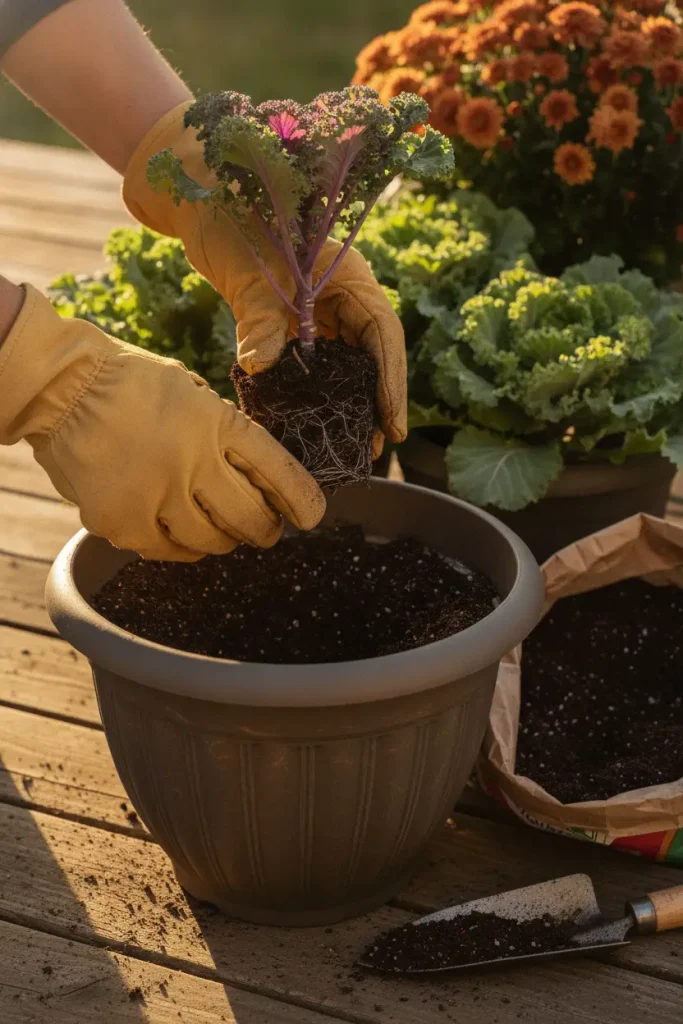
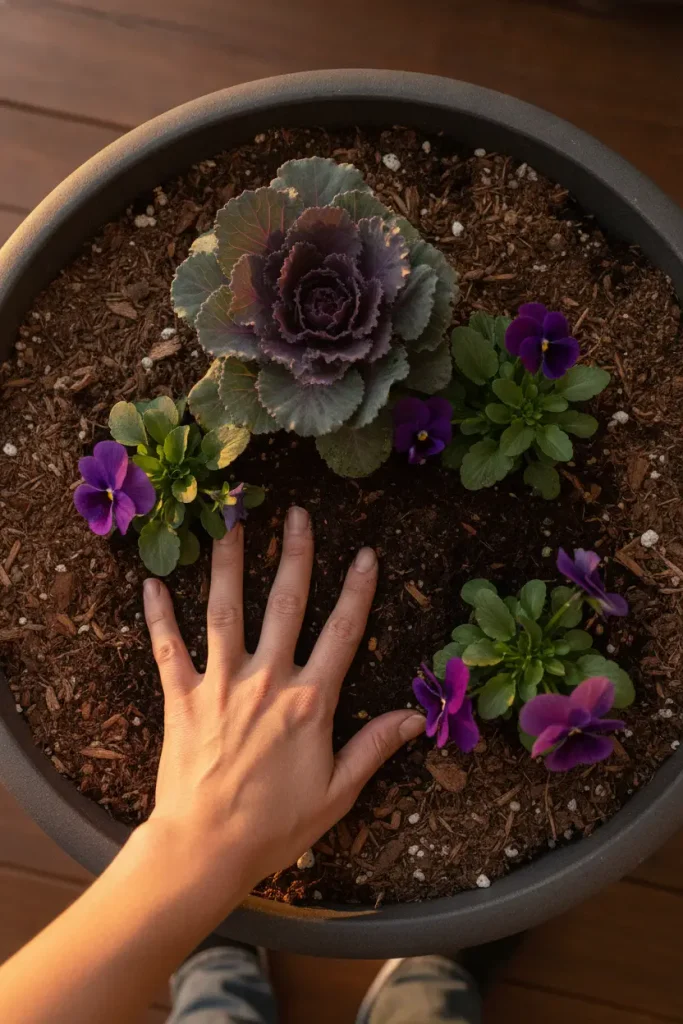
Add Layer 2 around it. Tease the roots loose on every kale and pansy before it goes in; nursery six-packs are almost always root bound by September.
Tuck Layer 1 along the front rim where it will spill over the edge. Plant this layer tighter than you would in spring, because nothing is going to grow much from here.
Water until it runs out the bottom, then top with a half inch of shredded bark. Nothing else. Fall pots do not need fertilizer.
That last point surprises people. You are not growing these plants, you are displaying them for ten weeks. Feeding them pushes soft new growth that frost will burn.
Skip the big mum, buy the tight one
Time for the unpopular opinion.
The mum is the worst value in your fall pot, and it is the thing everybody spends the most on. A 1.5 gallon garden mum in a decorative pot runs close to $29 at Walmart. Smaller nursery mums land in the $10 to $20 range at Home Depot and Lowe’s. Whatever you pay, a mum covered in fully open blooms is already at the end of its show. You are buying the last two weeks of a plant’s life.
A six-pack of pansies costs a few dollars and keeps flowering into December in Zone 7. An ornamental kale is a couple of dollars more and looks better every time it frosts.
So do this instead. Buy mums with tight, mostly closed buds and a little green still showing, even though they look boring on the shelf. That plant has three to four weeks ahead of it instead of ten days. Or leave mums out entirely, run kale plus pansies plus grass, and put the saved $25 toward a bigger pot that you will use for the next five autumns.
Buy mums in tight bud with green showing.
Spend the savings on a bigger pot you keep.
Let kale and pansies carry the color.
Three fully open mums jammed in one pot.
Paying premium for a decorative sleeve pot.
Replacing the whole thing in mid October.
Three fall porch pot recipes for Zones 5 to 9
Each one fits a single 16-inch container and follows the Three-Frost Fall Pot Plan. Ballpark cost runs $35 to $60 per pot if you already own the container.
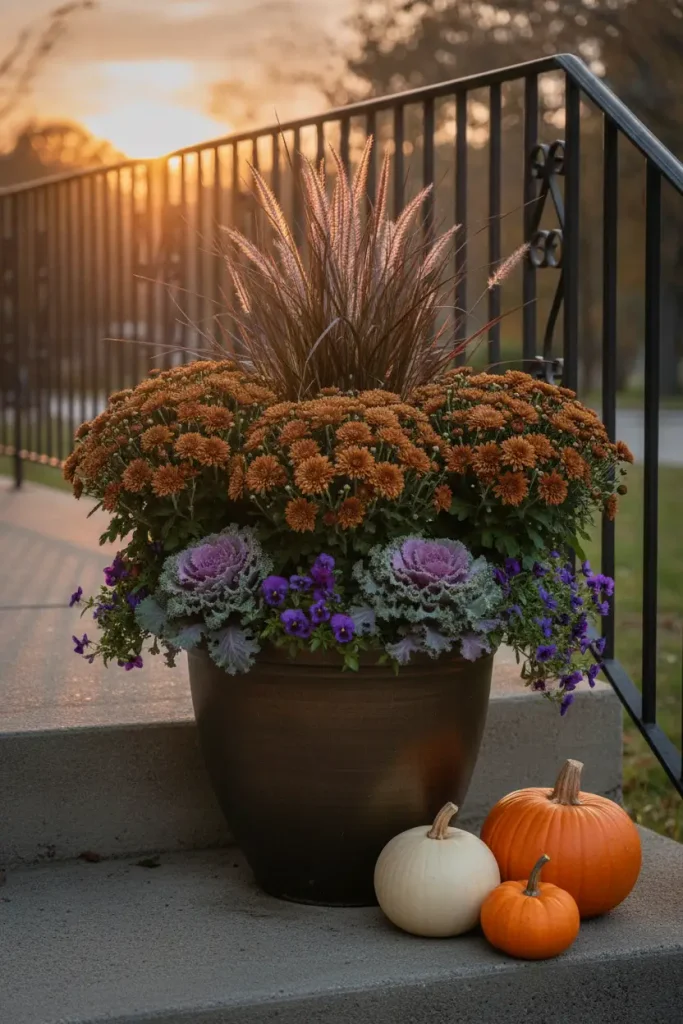
The classic front step
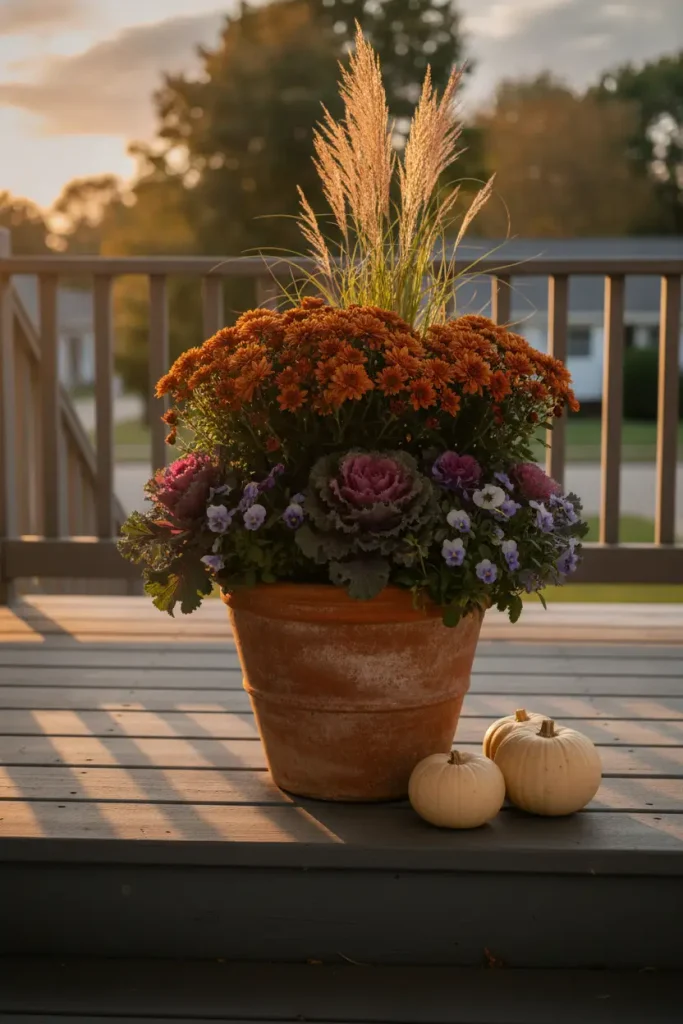
Purple fountain grass as the structure, three rust or bronze mums in tight bud around it, purple ornamental kale filling the gaps, and deep purple pansies spilling over the front rim. This is the arrangement most of the front porch fall planters on Pinterest are copying, and it works because the grass keeps a silhouette long after the mums brown.
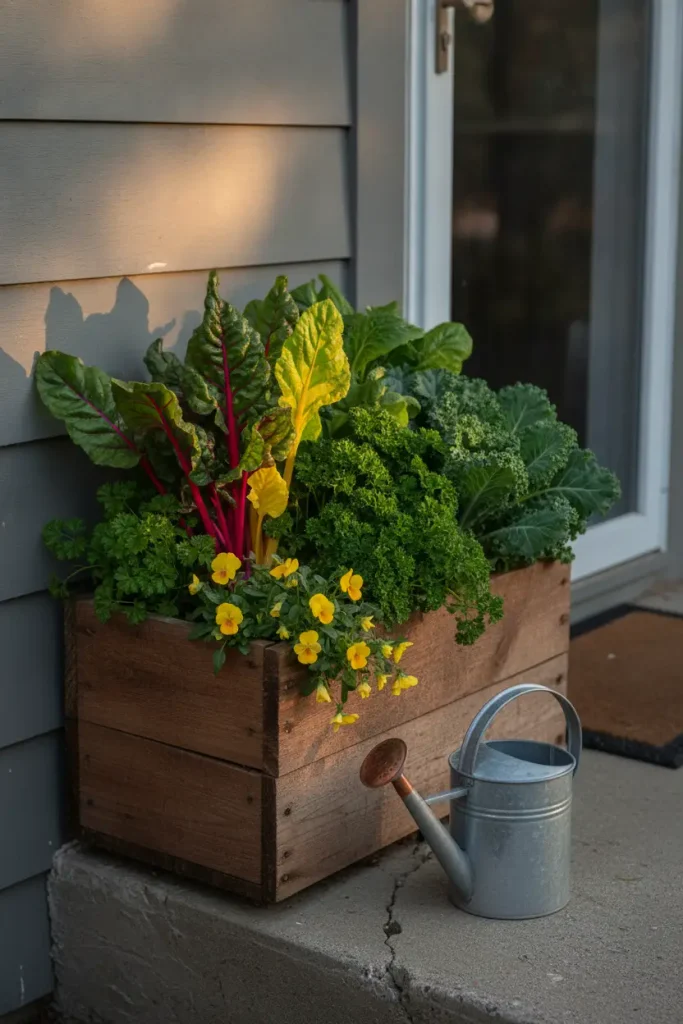
The edible one
Rainbow Swiss chard as the tall layer, curly parsley and a compact Bonnie Plants kale start filling the middle, and violas along the edge because the flowers are edible. Everything in this pot is harvestable, and chard holds its color down to the low 20s°F. Set it near the kitchen door so you actually cut from it.
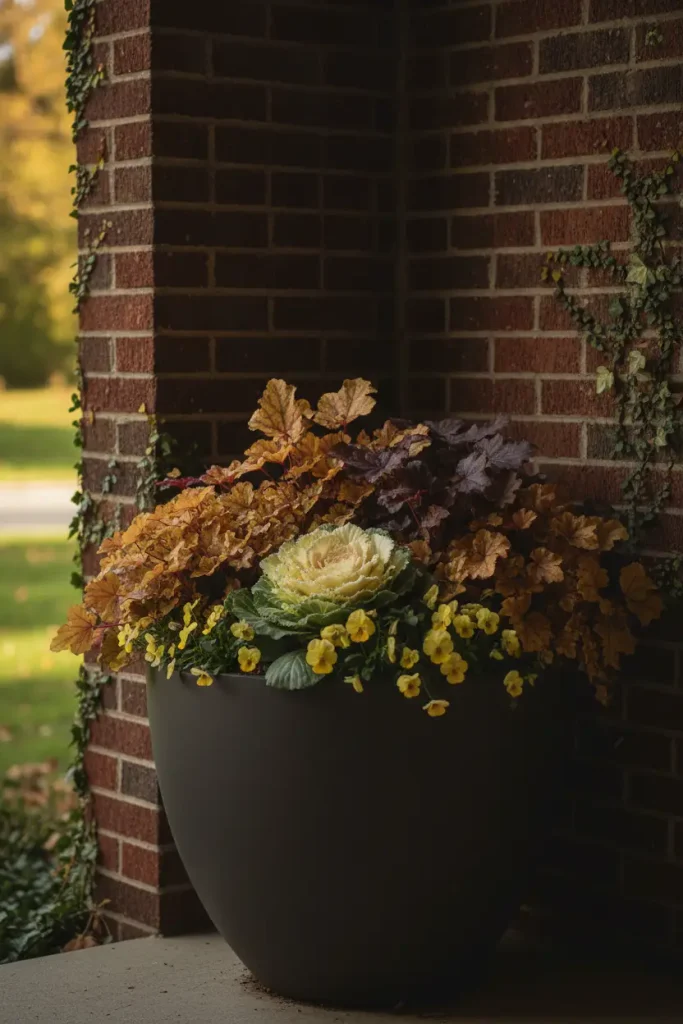
The shady side door
North-facing entries get maybe three hours of direct sun, which rules out mums. Use heuchera in caramel or plum as the anchor, add white flowering cabbage for brightness, and edge it with pale yellow violas that read well in low light. Our guide to shade-tolerant container combinations has more pairings if your whole porch sits in shadow.
Shopping list for one 16-inch pot
Water and light: the two things that actually kill fall pots
Overwatering takes out more fall containers than frost does.
Cool air, shorter days and slower growth mean your pot dries out far less often than it did in July. Push your finger two inches into the mix. If it feels damp, walk away. Most fall pots want water every three to five days, not daily, and a big planter stretches that further because larger containers hold moisture longer.
Light is the other half. Mums, pansies and kale all want at least six hours of direct sun to keep flowering and coloring up. A north-facing porch will not deliver that, which is why the shade recipe above swaps in foliage instead of blooms. Read the sun on your actual step for one Saturday before you buy anything.
One more thing to watch as the season turns. Pots against a south-facing wall dry out fastest, because that wall radiates stored heat back at the soil all evening.
💡 Quick Tip
Water in the morning, not at dusk. Wet foliage sitting overnight in 40°F air is how fall containers pick up leaf spot, which shows up on pansies in cool weather.
Styling the step without buying more stuff
The pot is done. The porch around it is what makes people stop scrolling.
Three pumpkins in staggered sizes beside the planter does more than another $30 of plants. Dollar Tree sells small craft pumpkins for a dollar each and they photograph fine next to real ones. Cut stems are the other cheap win: birch, red twig dogwood, or bare branches from your own yard, pushed deep into the mix behind the grass.
Keep the color story tight. Two colors plus green is the rule. Rust and cream reads warm, plum and chartreuse reads modern, and both beat a pot with five competing shades.
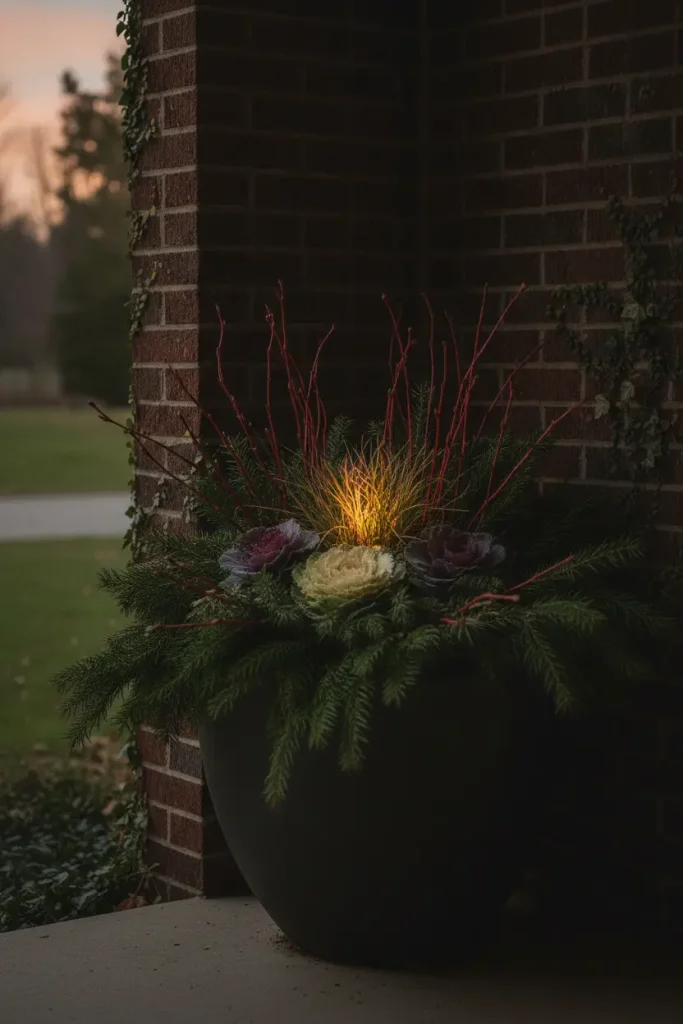
Lighting is the last layer, and it is what carries the porch into the evening once sunset moves to 5 p.m. A single warm-white spotlight aimed up through the grass changes the whole entry after dark, and our outdoor lighting ideas for fall nights covers what holds up outside all season. Use outdoor-rated, UL-listed lights and cords on a GFCI outlet. Anything beyond plugging into an existing outlet is a job for a licensed electrician.
What to do when the first hard freeze hits
Nothing, for about a week. Let it ride.
Kale, cabbage and pansies all come back after a hard frost knocks them flat, and they often look better afterward. Give them a few days before you decide anything is dead.
Once the mums finish, pull just those and leave the rest. That gap is where you push in evergreen cuttings, a few pine boughs, or red twig dogwood, and the same pot becomes a winter arrangement without a second trip to the store.
If you want the container itself to survive until spring, move it against the house and out of the wind. NC State’s handbook describes double-potting for this: set the planter inside a slightly larger one and fill the gap with mulch or foam. Root insulation is the whole point, because roots in a pot have none of the protection ground soil gives them.
One pot, three cold-tolerance layers, zero replanting. You buy once in September and the arrangement hands itself off twice before winter.
Frequently asked questions
When should I plant a fall container garden?
Plant four to six weeks before your typical first frost so roots settle in while the mix is still warm. For most of Zone 5 and 6 that means late August through mid September. Zone 7 and 8 can plant through early October. Planting later still works, the display just will not fill in as much.
What plants last longest in fall containers?
Ornamental kale, flowering cabbage, pansies, violas and Swiss chard outlast everything else, and several of them deepen in color after frost. Ornamental grasses and heuchera hold their shape even longer, well past a hard freeze. Mums have the shortest run of the group despite being the most common purchase.
How long do mums last in pots?
Four to six weeks if you buy them in tight bud, and closer to ten days if you buy them in full bloom. The plant is spending its whole flowering budget at once. Choosing a mum with closed buds and visible green stem is the single biggest factor in how long your pot looks good.
Do fall containers need full sun?
Mums, pansies and kale color up best with six or more hours of direct sun. Under that, flowering slows and kale stays pale. Shaded entries are not a lost cause, they just need a foliage-led arrangement built around heuchera, flowering cabbage and violas rather than a bloom-led one.
How often should I water fall containers?
Every three to five days for most pots, not daily. Cool air and short days slow evaporation dramatically. Test with your finger two inches down and water only when it reads dry. Containers against a south-facing wall dry faster, and any pot still in full afternoon sun in September needs checking more often.
Can I leave my planter outside all winter?
Resin, plastic and wood containers handle it. Unglazed ceramic and terracotta should come inside, because absorbed water freezes and cracks them. If a pot stays out, move it against the house, out of wind, and insulate the root zone by setting it inside a larger container with mulch packed in the gap.
What can I plant in fall containers instead of mums?
Build around ornamental kale and flowering cabbage for structure and color, pansies or violas for flowers that keep going into December in mild zones, and an ornamental grass for height. Croton and celosia add warm tones while it is still mild. The result costs less and runs weeks longer.
Your pot is the easy part
Fall containers reward planning far more than spending. Sort your plants by the cold each one can take, buy the pot before the plants, and resist the fully bloomed mum no matter how good it looks in the cart. That is the whole method.
Build one this weekend and photograph it in the last hour of daylight, when the low sun catches the kale edges. Then check back in November, when your neighbors are on their third round of mums and yours is still holding.
Save this to your fall porch board so the plant list is there when you are standing in the garden center aisle.