9 DIY Outdoor Lighting Ideas for Fall, and Exactly When to Do Each One

Most DIY outdoor lighting ideas tell you what to hang. Almost none tell you when, and in fall that is the part that decides whether the whole thing works. Dig your post holes in November and you are fighting half-frozen clay. Set your timer in September and it is still switching on at 8:15 when the sun went down at 6:40.
Here is what actually happens between Labor Day and Thanksgiving. The sun drops lower, so solar panels that drank up eight hours in July start coming up short. The ground stiffens. Leaves fill every fixture lens you own. And on November 1, 2026, the clocks fall back and your yard goes dark an hour earlier than it did the night before.
So this list is sorted by calendar, not by category. Nine projects, each one tied to the window where it is easiest and cheapest to pull off. Start at the top if it is early September. Skip to entry five if you are reading this in late October and the light is already gone by dinner.
The 5 O’Clock Dark Plan
Everything below fits into three windows. Do the digging work first, the looks work second, and the switching work last, because the first one gets harder every week and the last one does not matter until the clocks change.
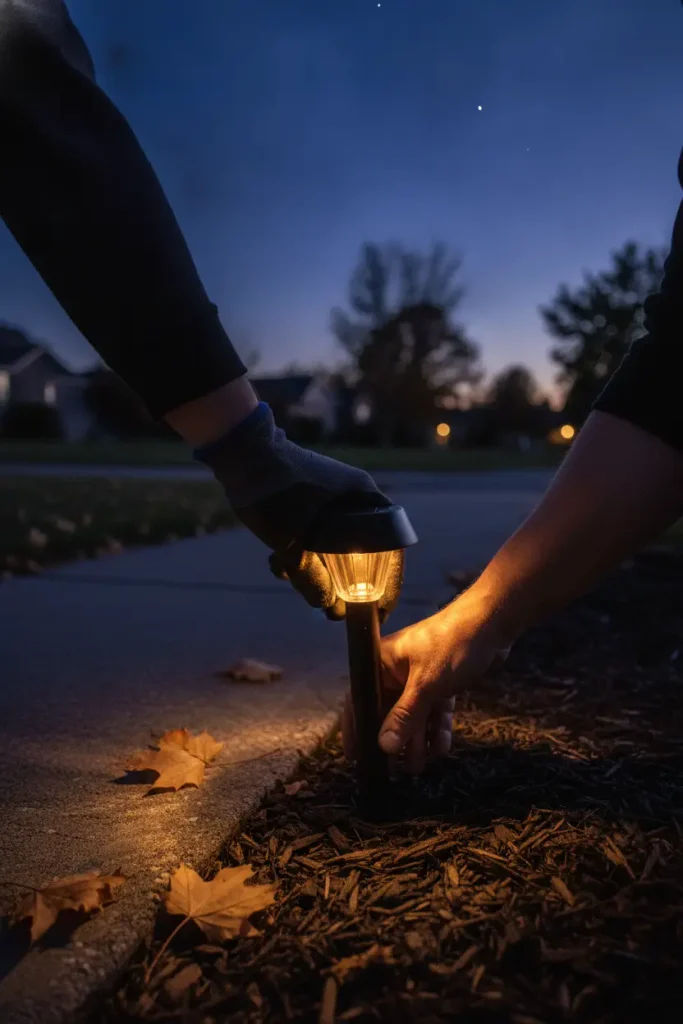
1. Move your solar path lights in early September, before the sun angle drops
Solar stakes fail in fall for a reason nobody puts on the box. The panel did not break. The sun moved.
By late September the sun tracks lower and shorter across the sky, and a spot that delivered a full charge in July now sits in tree shadow by two in the afternoon. Most solar garden lights want roughly six to eight hours of direct sun to fill their battery.
Watch the yard on one clear Saturday and mark where sun still lands at 9am, 1pm, and 4pm.
Pull every stake and move it to the spot that stayed sunny at all three checks, usually the south facing edge of the path.
Wipe each panel with a damp cloth. A summer of pollen film costs you real runtime.
If a light still dies by 9pm after all that, the battery is the problem, not the placement. A pack of replacement AA rechargeables runs under $15 at Ace Hardware and buys you two more seasons.
I left six solar stakes along the north side of my walk all summer and by the first week of October they were dying before 8pm. Moving four of them to the south edge of the path, about 30 inches out, fixed every one except the two under the maple.
2. Drive your string light poles while the ground is still soft
Window 1 work, and the one people put off until it is genuinely miserable.
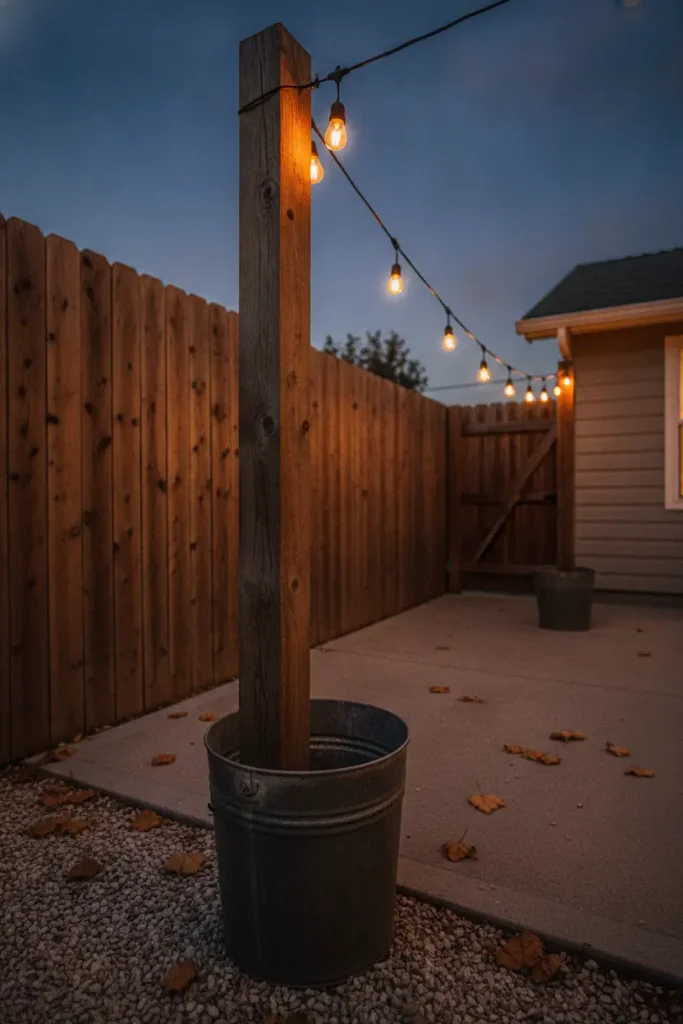
A 4×4 cedar post set in a five gallon bucket of fast setting concrete costs somewhere in the $25 to $40 range at Home Depot or Lowe’s and gives you an anchor point anywhere you want one. Two of those plus one house wall is enough to float lights over a whole patio.
The catch is timing. Cedar sinks easily into September soil. In a Zone 5 or 6 yard in mid November, after the first hard freezes, that same hole takes a digging bar and a bad mood.
Anchors are the only part of a lighting setup that fights the calendar. Hang the bulbs whenever. Set the posts while the shovel still goes in.
If you have no trees to work with, our guide on how to hang string lights without trees walks through the pole and tension setup in full.
3. Swap cool white bulbs for 2200K warm white before the first cold snap
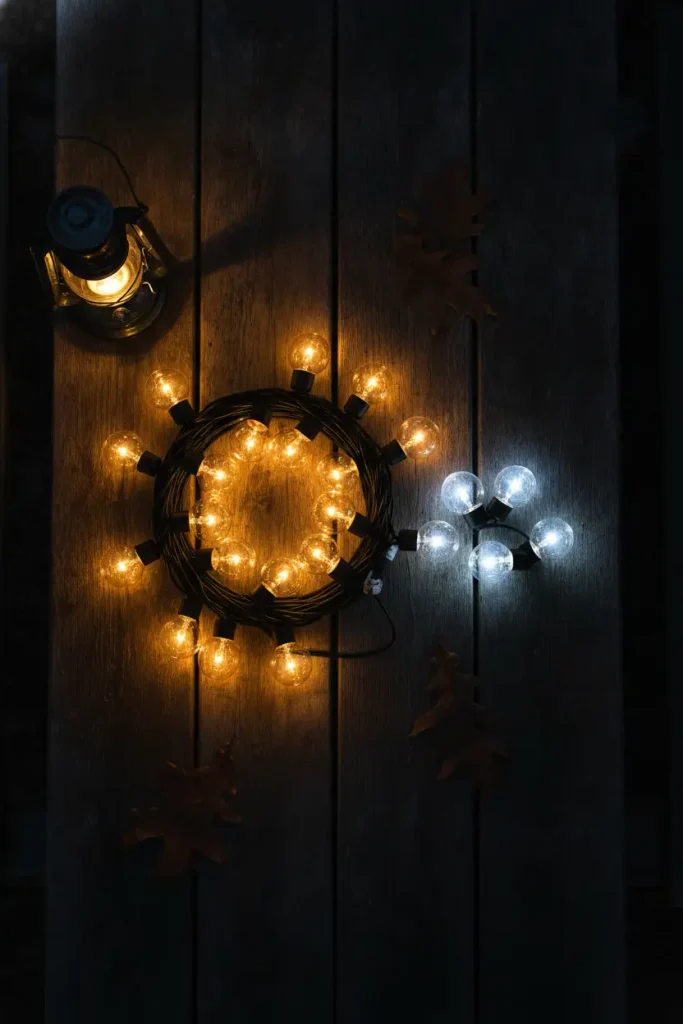
Cold air, bare branches, and a 5000K bulb make a yard look like a parking lot. That is the single fastest fall fix there is, and it costs less than dinner.
Bulb color is measured in Kelvin. Lower number, warmer light.
| 2200K to 2700K warm white | 4000K and up cool white |
|---|---|
| Reads as candlelight and firelight, which is what fall evenings already look like | Reads as security lighting, which is what you are trying to avoid |
| Flatters brick, cedar, rust, and dried grasses | Turns warm fall color gray and blue |
| Pairs with a fire pit without clashing | Fights every warm light source near it |
Shatterproof warm white replacement bulbs from Feit or Brightech run around $2 to $4 each, so a 24 foot strand is a $30 upgrade at most. Buy four extra. You will drop one.
I ran Brightech Ambience Pro at 2700K over the patio and Feit shatterproof bulbs on the fence line the same fall, and the Feit bulbs read noticeably cooler side by side until I swapped the whole fence run to 2200K.
4. Run one outdoor rated cord to one GFCI outlet, then branch from there
Plan the power before you buy another strand. Every fall the same thing happens: three extension cords daisy chained across wet grass, one of them the orange indoor cord from the garage.
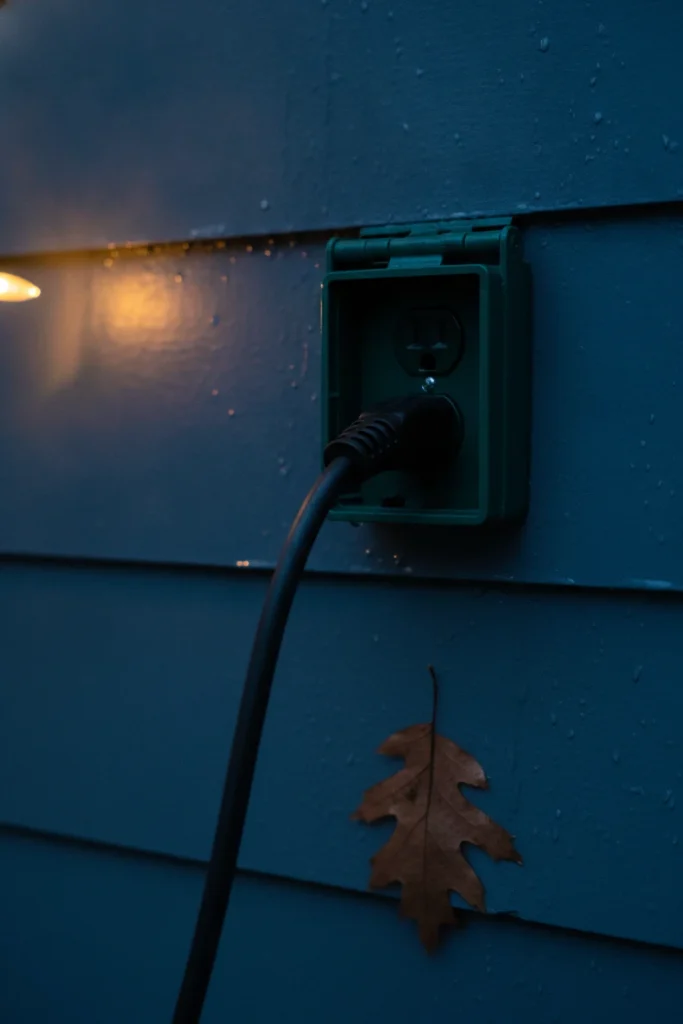
Pick the single exterior outlet closest to where the lights will live. Run one heavy outdoor rated cord from it to a covered spot, then branch your strands from that one point. Fewer connections, fewer failures, and everything drops back to one switch later.
Worth knowing: US code has required ground fault protection on outdoor receptacles since 1973, and a GFCI cuts power when it senses a leak as small as 0.006 amperes. If you are unsure whether yours is protected, the CPSC explains what a GFCI actually does in two plain pages.
Use outdoor rated, UL listed lights and cords on a GFCI outlet. Anything beyond plugging into an existing outlet is a job for a licensed electrician.
⚠️ Watch Out
Indoor extension cords are not rated for rain, frost, or wet leaves, and the label is the only way to tell them apart once they are both dirty and orange. Check every cord for an outdoor rating before it goes in the yard, and press the test button on your GFCI once a month.
5. Put every light on a timer the week before November 1
Window 3, and the highest payoff hour in this whole list.
Daylight saving time ends on November 1 in 2026 at 2 a.m. local time. Your evening does not get shorter, it gets darker earlier, which means the yard you barely used in August suddenly needs light at 5:15 on a Tuesday.
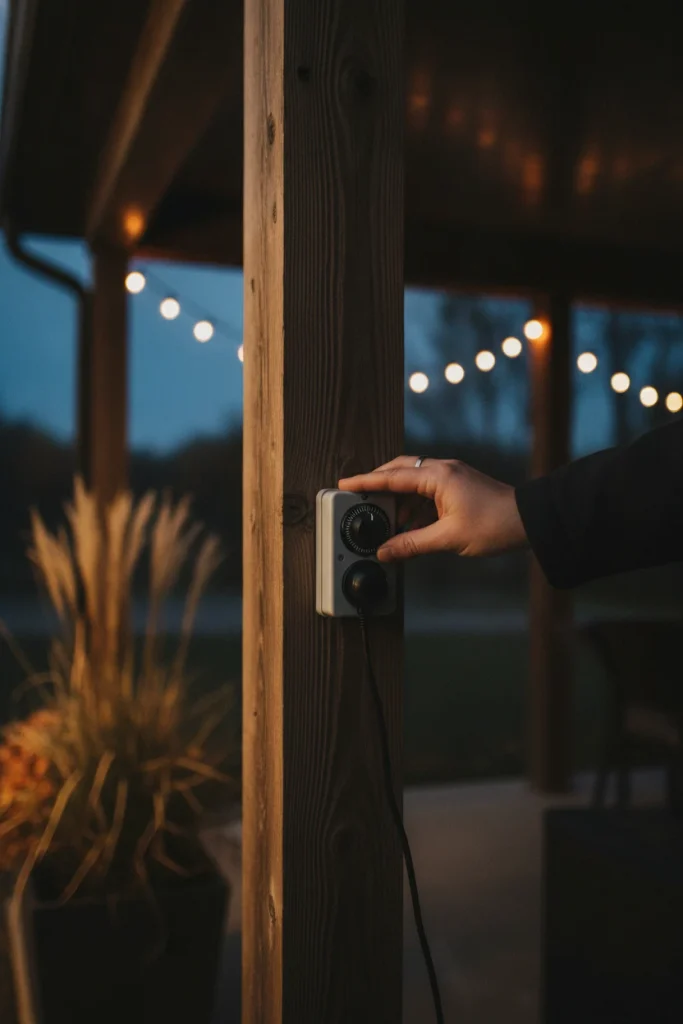
A dusk to dawn photocell plug or a simple outdoor timer runs in the $15 to $30 range and removes the only reason people stop using their lights: nobody wants to walk out in the cold to flip a switch.
Photocells beat clock timers here, because a clock timer needs resetting every few weeks as sunset keeps sliding. That is the whole reason the 5 O’Clock Dark Plan puts this job last.
6. Light the fire pit corner at knee height, not overhead
Overhead light kills a fire pit. The flame stops being the brightest thing in the circle and the whole corner goes flat.
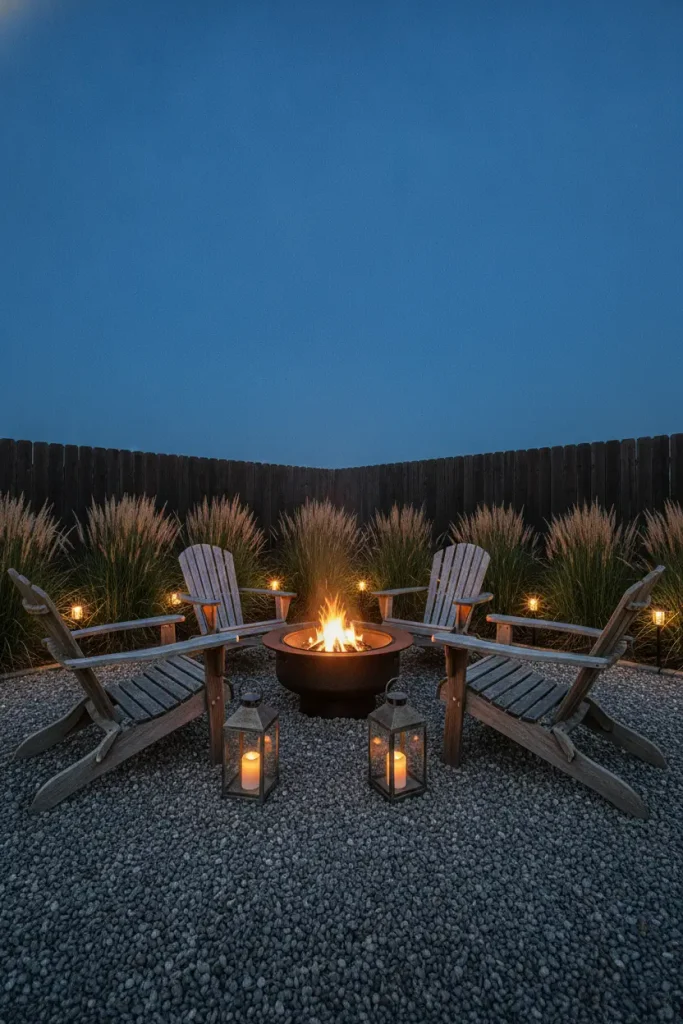
Keep every light source in that zone below seating height. Lanterns on the ground, a few solar stakes in the bed behind the chairs, battery candles in glass hurricanes on a side table. A Solo Stove or Sunnydaze pit throws plenty on its own once nothing is competing with it.
Knee height fire pit corner
Check your city’s burn rules before you light anything, keep the clearance from structures and branches that your fire pit’s manual and local code call for, and never leave a fire unattended.
If the corner itself still needs building, we laid out a budget fire pit seating area with the layout math already done.
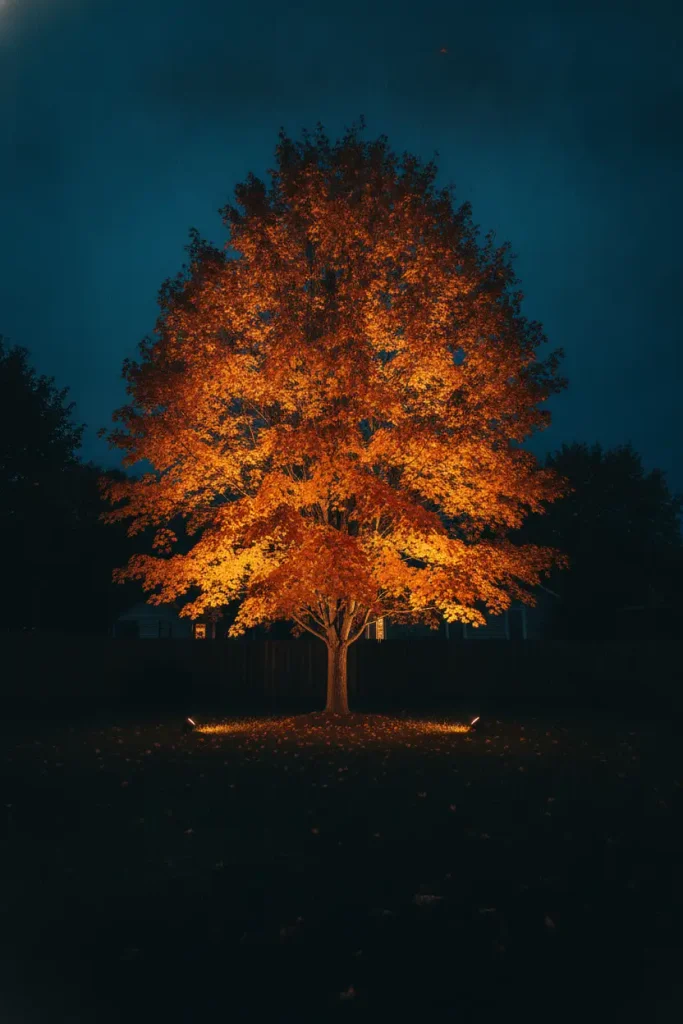
7. Uplight the one tree still holding its leaves, and leave the rest dark
Here is the contrarian part. The common advice is to light your best features, plural. In October that is exactly wrong, because half your yard is going bare and lighting a bare branch structure at close range just looks skeletal.
Pick one. A maple still turning, a river birch, a tall ornamental grass clump. Two spotlights at the base, angled up at roughly 45 degrees and set eighteen to twenty four inches out from the trunk so the beam skims the bark instead of blasting it.
One subject, two lights, aimed up through the canopy that still has color.
Set fixtures back from the trunk so the light grazes rather than floods.
Lighting four trees at once, which flattens depth and doubles your run time.
Uplighting a tree that has already dropped, unless you actively want a bare silhouette.
Darkness is a design element in fall. One glowing canopy against a black yard reads as intentional. Six half lit trees read as a hardware store display.
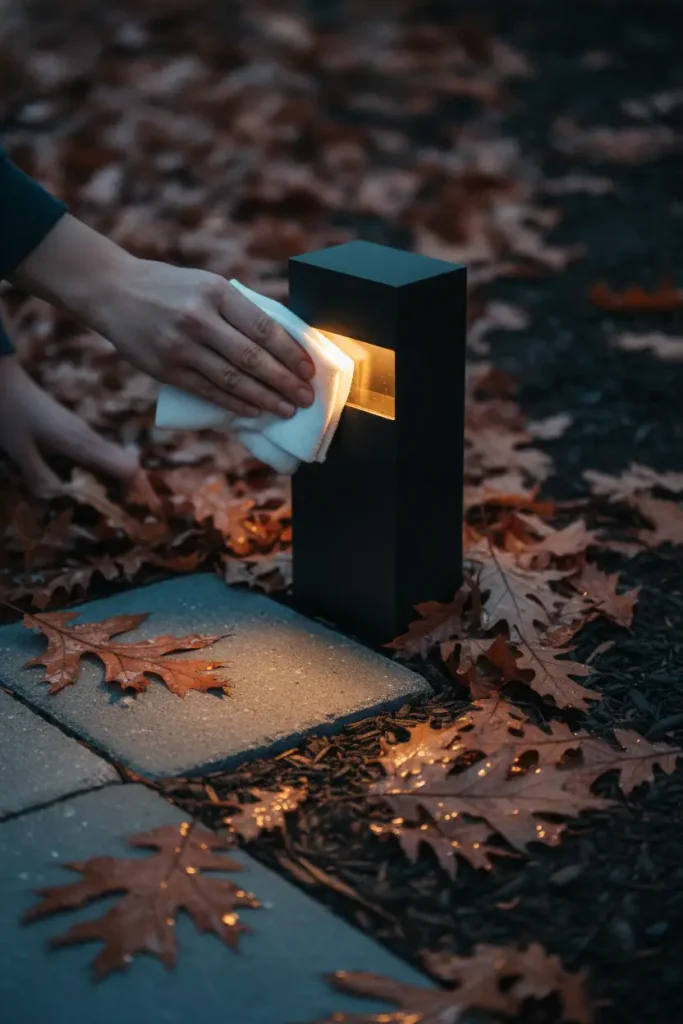
8. Leaf proof your fixtures before the first real windstorm
Nobody plans for this one and everybody deals with it.
- ▸Wipe every lens and solar panel. A film of wet leaf grime cuts output fast.
- ▸Raise low path fixtures two or three inches on a paver so leaf litter cannot bury them.
- ▸Wrap every cord to cord connection in electrical tape, then tuck the joint under a stone.
- ▸Pull cords up out of the low spot where water always collects.
That last one matters more than it sounds. A connection sitting in a puddle under six inches of soaked oak leaves is the single most common way a working setup dies in November.
The October we had back to back windstorms, I lost two path lights that turned out to be completely buried under leaf litter, and a third that had a cord joint sitting in standing water. Setting all of them on pavers in early October the next year meant I lost none.
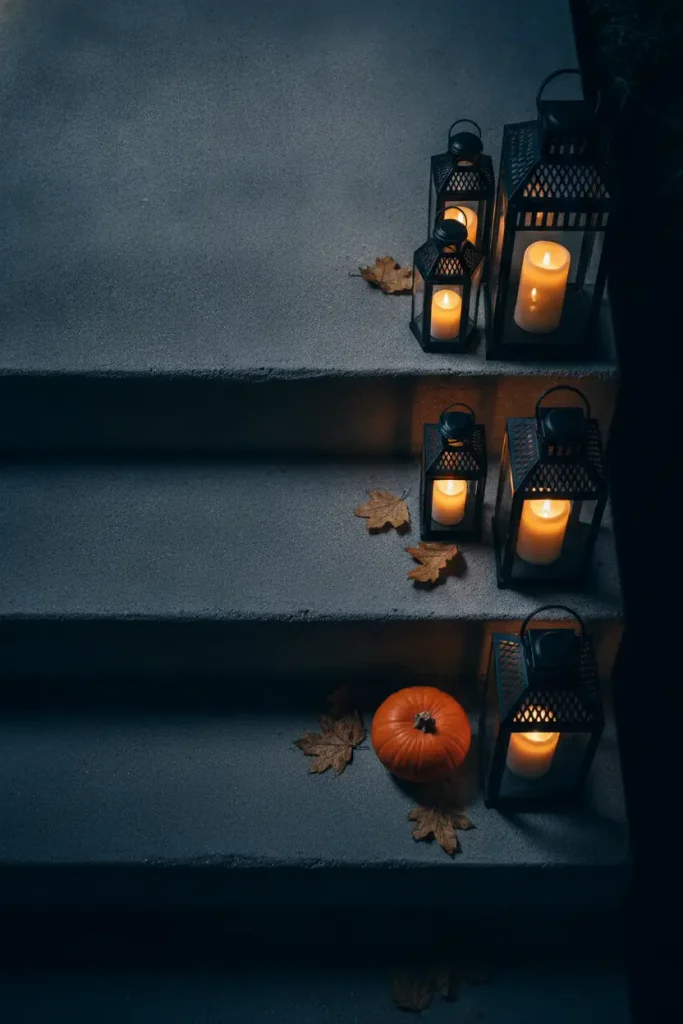
9. Cluster thrifted lanterns on the steps for nights you do not want to plug anything in
Some evenings you want light for two hours and nothing else.
Three to five lanterns at mixed heights, grouped on one side of a step run or along a porch edge, does more for a fall entry than any wired fixture. Glass hurricanes from HomeGoods or TJ Maxx, metal lanterns from World Market, plain jars from Dollar Tree with a battery tea light dropped in. Odd numbers, varied heights, all one metal finish so the group reads as deliberate.
A bare concrete step run that disappears completely after 5:15, with nothing marking the edge or the door.
Five lanterns at three heights along one edge, each step read clearly, the whole entry warm for about six dollars of batteries.
Budget note: a full cluster like this lands under $40 if you shop the mix rather than buying a matched set, and our dollar tree backyard decor roundup covers the jar and candle side of it in detail.
DIY Outdoor Lighting Ideas Frequently asked questions
What is the cheapest way to light a backyard?
Battery and solar, in that order. A cluster of thrifted lanterns with battery tea lights costs under $40 and needs no wiring at all. Solar path stakes run about $5 to $10 each and cost nothing to operate, as long as you place them where fall sun actually reaches. Plug in string lights cost more upfront but give the most light per dollar over a full season.
How high should you hang outdoor string lights?
Aim for about 8 to 10 feet above the walking surface at the lowest point of the sag. That clears an adult comfortably and still keeps the bulbs low enough to feel like a ceiling rather than a streetlight. Over a dining table you can drop to around 7 feet, since nobody stands there. Always check the sag after tensioning, not before.
Do solar lights still work in fall and winter?
They work, but they run shorter. Shorter days and a lower sun angle mean less charge time, and most solar garden lights want roughly six to eight hours of direct sun to fill their battery. The usual fix is relocation rather than replacement. Move the panel to the sunniest open spot you have, clean it, and swap tired rechargeable batteries before blaming the fixture.
Can you leave outdoor string lights up all year?
If they are outdoor rated and UL listed, yes, and most people do. What shortens their life is not weather so much as unprotected connections. Tape and shelter every cord to cord joint, keep plugs up out of standing water and leaf litter, and take down any strand rated for temporary or indoor use before the first freeze.
How do you light a backyard without electricity?
Solar and battery cover almost everything. Solar path stakes and solar string lights handle the permanent glow, battery candles inside glass hurricanes handle tables and steps, and a fire pit handles the gathering spot. The one thing they will not give you is reliable brightness on a run of overcast days, so keep a couple of rechargeable lanterns on hand as backup.
What color light is best for a backyard at night?
Warm white in the 2200K to 2700K range. It reads as candlelight, flatters brick, cedar, and fall foliage, and does not fight a fire pit. Anything at 4000K and above starts looking like security lighting, which drains the warmth out of a yard fast. Keep every fixture in the same range so the space reads as one setting.
Do outdoor string lights need a GFCI outlet?
Yes. Ground fault protection has been required on outdoor receptacles in the US since 1973, and a GFCI cuts power the instant it senses current leaking, at levels as small as 0.006 amperes. If your exterior outlet has no test and reset buttons, have an electrician confirm whether the circuit is protected before you run anything out there for the season.
One evening is really all this takes
Pick your window and start there. Early September means posts and anchors. Mid October means bulbs and aim. The week of November 1 means timers, and honestly that is the hour that changes how much you actually use the yard once it gets dark at five.
None of these nine projects need a contractor, and most of them cost less than a takeout dinner. The plan is just knowing which one belongs to which week.
Save this to your fall backyard board so the timing is right there when the clocks change.