Fire Pit Bench Ideas for Built-In Seating
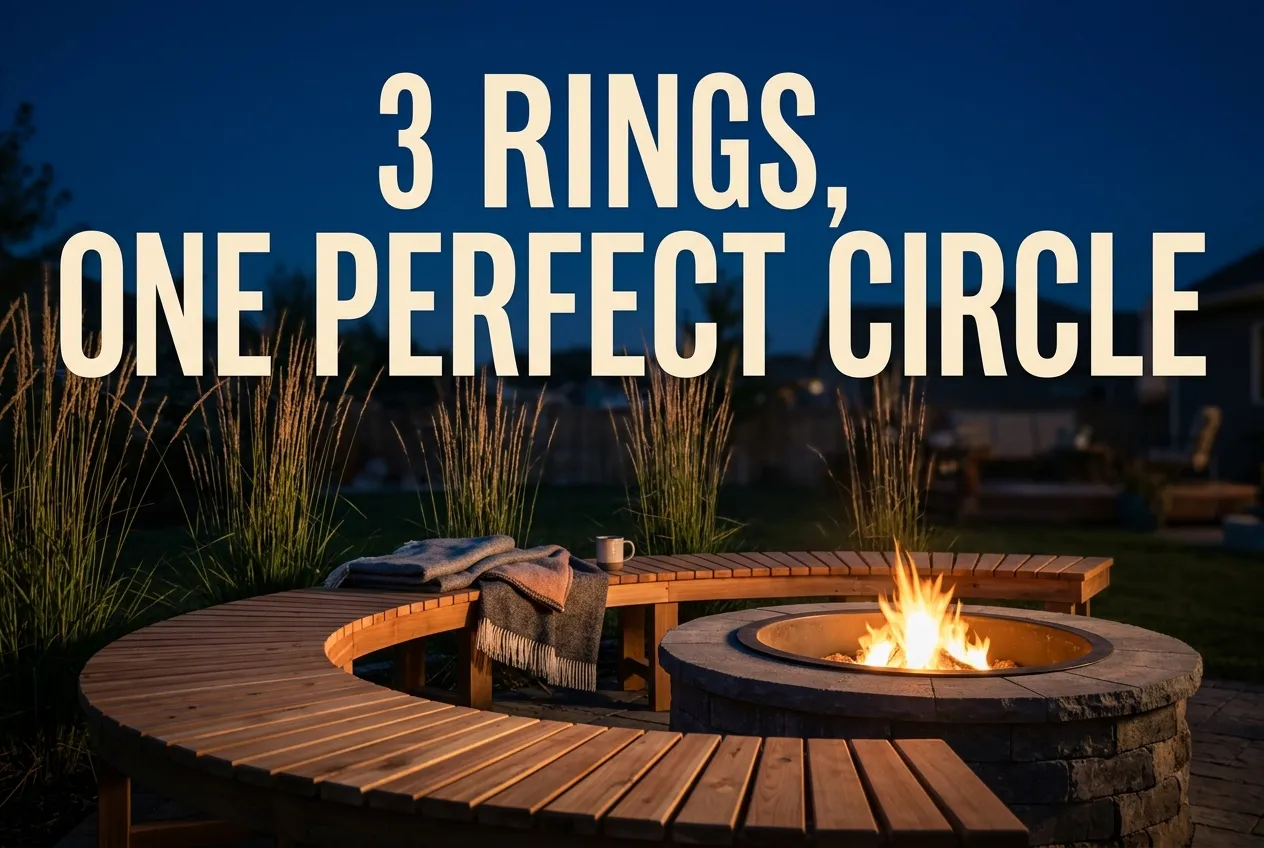
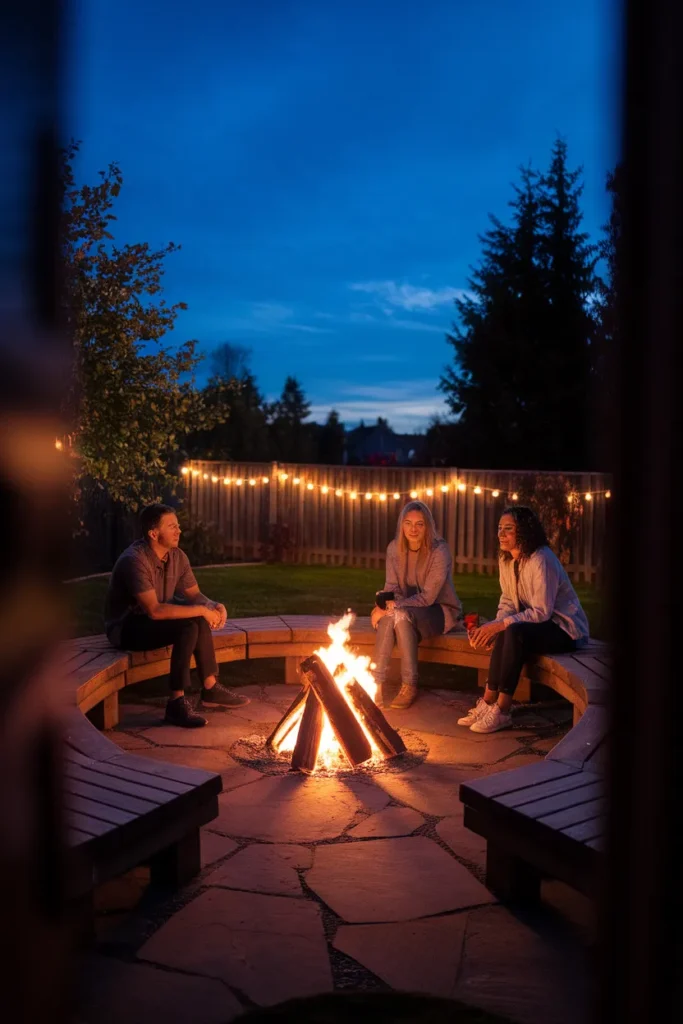
Four plastic chairs dragged into a rough circle. That is what most backyard fire pits are surrounded by, and it works right up until the moment you want the space to feel finished. A good fire pit bench fixes that in one move, because built-in seating turns a fire ring into an actual outdoor room with a shape and a center.
Here is what almost nobody tells you upfront, though. The number that decides whether your bench feels right is not the length or the wood species. It is the setback, the distance between the flame and the front edge of the seat, and the ranking guides on this topic disagree with each other by a factor of three.
So this guide gives you the layouts, the materials, and the spacing math in one place. You will also get the one material warning that every popular fire pit bench tutorial skips.
What Makes a Fire Pit Bench Different From a Regular Bench
A garden bench faces something. A fire pit bench faces everyone, which changes the geometry completely.
Regular benches sit at 18 inches or so and get pushed against a wall. Fire pit benches sit lower, usually 16 to 18 inches with a 16 to 20 inch seat depth, and they get placed so the whole ring can hear each other over a crackling fire. Sightline matters more than lumbar support here.
Three practical differences drive every decision below:
- The seat runs low. Designers often set the pit coping a few inches below seat height so you look slightly down into the flame instead of up through it.
- Backless usually beats backed. A back rest blocks the view out and traps smoke around the shoulders. Most curved commercial units skip it entirely.
- Everything is combustible. Your bench is furniture sitting near an open flame, which puts it in a different safety category than a bench by the tomatoes.
That last point is where the numbers get interesting.
The Three-Ring Setback Method
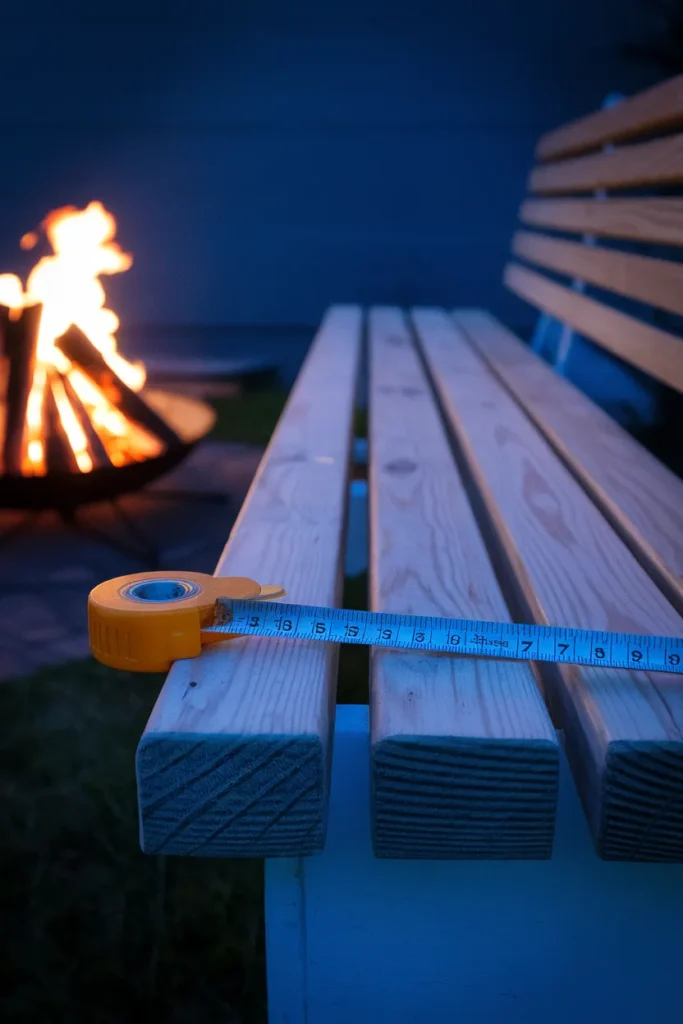
Every ranking article on this topic gives a different seating distance. I found 2 feet, 3 feet, 4 to 6 feet, 5 to 7 feet, and 7 feet, all stated confidently on pages currently sitting on page one. They are not contradicting each other by accident. They are answering two different questions and blurring them into one.
Split them apart and it gets simple. Three rings, working outward.
| Ring | What it controls | Working number |
|---|---|---|
| Ring 1: the code ring | Distance from flame to anything that can burn | Start at 10 ft, then check your local rule |
| Ring 2: the comfort ring | Flame edge to the front of the seat | 3 to 6 ft depending on fuel and wind |
| Ring 3: the walk ring | Behind the bench, so people can pass | 3 to 4 ft minimum |
Ring 1 is the one people skip. Both the federal outdoor fire safety guidance from the U.S. Fire Administration and NFPA’s clearance guidance for fire pits land on the same headline figure: keep a fire pit at least 10 feet from your home or anything else that can burn.
Now, obviously, nobody builds a seating circle 10 feet deep on every side. That guidance is aimed at structures, fences, and sustained fuel loads more than at a single low bench you are actively sitting on and watching. The honest read is this: the 10 foot figure is your outer discipline, your local fire code and your fire pit manufacturer’s manual set the actual requirement, and Ring 2 is a comfort call you make inside whatever that allows.
Practical version. Gas or propane produces no flying embers, so 3 feet often feels right. Wood burning throws sparks unpredictably, so push to 5 or 6 feet and go further on a breezy night. Then confirm against your city’s rule before you pour a footing, because a permanent bench is a lot harder to move than a chair.
Curved Fire Pit Bench Ideas
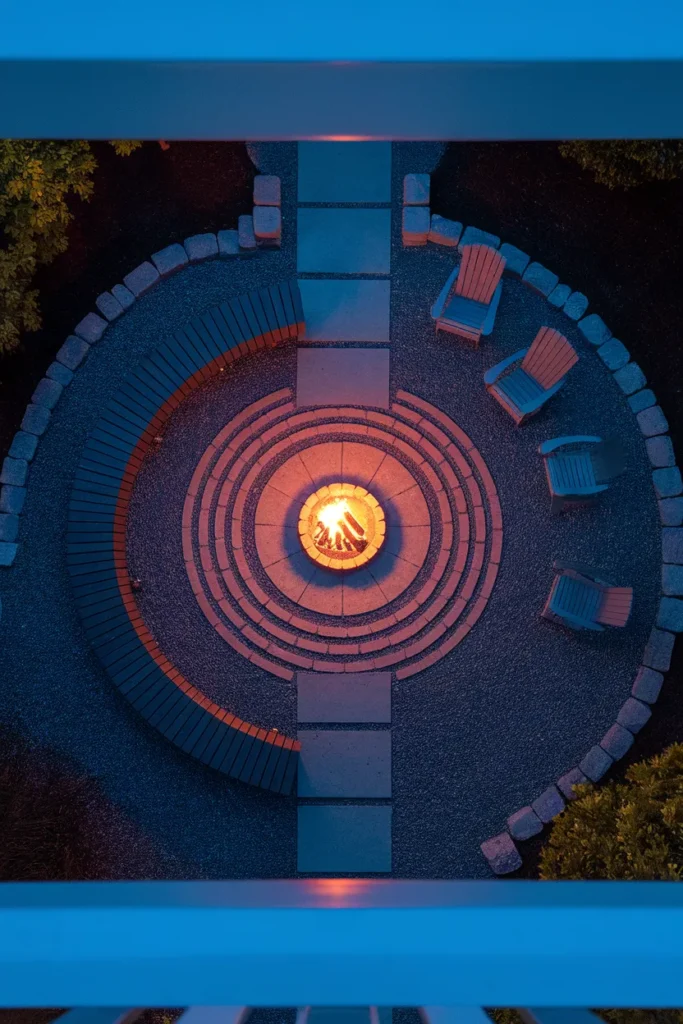
Curved is the shape people picture, and it earns the reputation. An arc keeps everyone facing the same fire at roughly the same angle, so conversation carries instead of splitting into two ends of a rectangle.
Buying one is easy. Single acacia curved sections run roughly $110 to $175 at Walmart and Lowe’s, and four-piece powder-coated steel sets land in the $145 to $175 range for the whole set. Solid teak sets are the other end of the market entirely, often well into four figures.
Building one is where people get intimidated, usually for no reason.
The half-hexagon trick. A true curve needs curved joinery, which is genuinely hard. Instead, build the bench as half of a hexagon so every miter is a straight 30 degree cut. From six feet away it reads as a smooth arc.
The nesting-seat trick. Build square seat boxes, then angle-cut the sides so they nest together on a radius. Each seat is simple right-angle joinery, and you can pull them apart into individual chairs whenever you want a different layout.
The segmented-arc trick. Three straight bench sections set at a slight angle to each other, joined by short spacer blocks. It is the fastest of the three and the easiest to level on imperfect ground.
Any of these gets you a curve without a single bent board. If your yard drops away on one side, sort getting a sloped yard level first before you cut anything, because a bench that rocks will annoy you every single evening.
Straight and L-Shaped Layouts for Square Pits
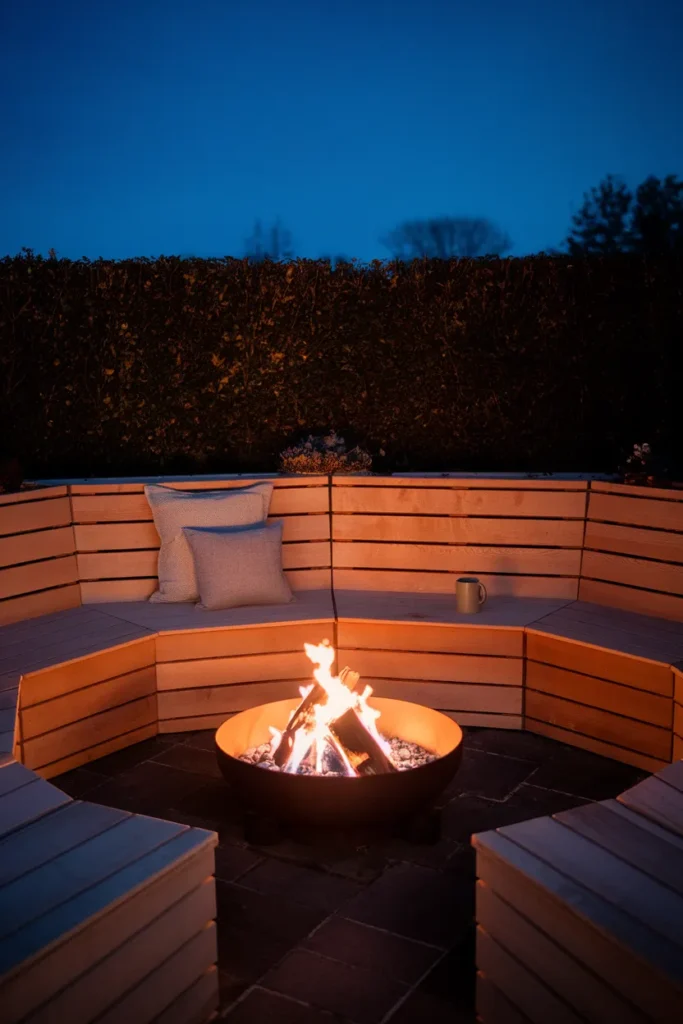
Round pit, curved bench. Square or rectangular pit, straight bench. Matching the seating geometry to the fire geometry is the single fastest way to make a backyard look designed rather than assembled.
For a rectangular fire table, run a long bench down each of the two long sides and put a pair of chairs on the short ends. You get the same seat count as a full circle with about half the build.
An L-shape does something a circle cannot: it uses a corner. If your pit sits where two fence lines meet, an L tucks into that corner, gives you a wind block on two sides, and leaves the open quadrant facing the house. Small yards benefit enormously from this, since a full ring eats the whole slab.
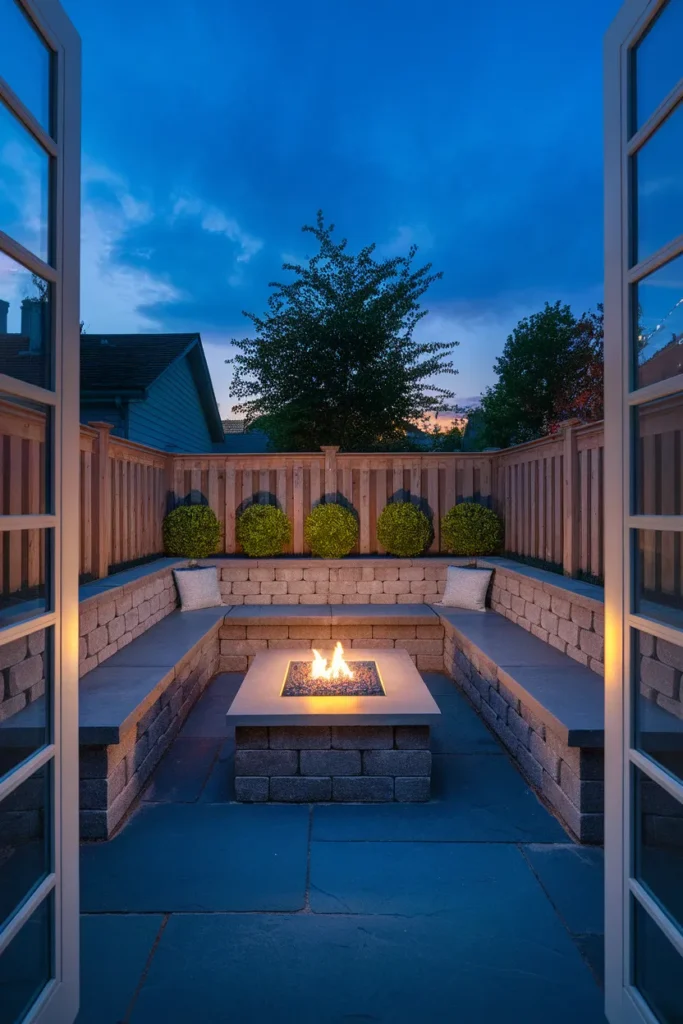
Seat-wall benches are the permanent version. A low block or stone wall, capped flat, doubles as seating and as the edge that defines the whole area. It never blows over, never needs storing, and never gets dragged out of position. If you want that effect taken further, sunken fire pit seating drops the whole circle below grade so the benches become part of the ground plane.
Budget Bench Bases That Do Not Look Cheap
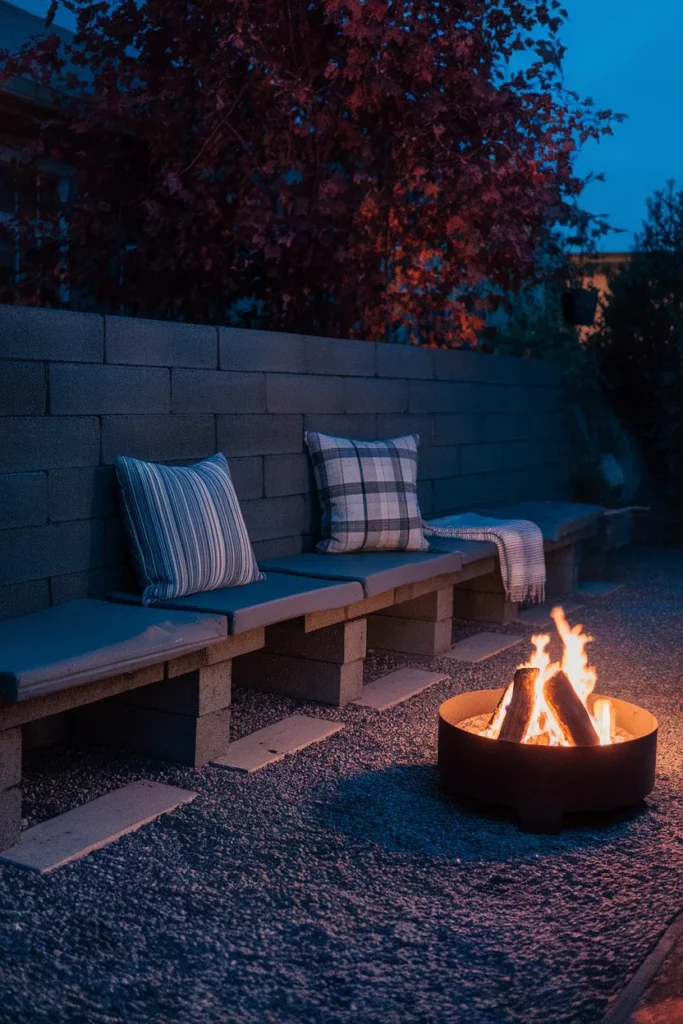
Two concrete blocks and a 4×4 will hold a person. That is the entire engineering behind the most-pinned budget bench on the internet, and it works.
The version that looks intentional rather than improvised comes down to three moves. Paint the block a flat dark charcoal so it reads as a plinth instead of a construction leftover. Use 4x4s rather than 2x4s for the seat, since the extra thickness reads as furniture. Then run the bench long, six to eight feet, because short block benches look temporary and long ones look built.
Materials for a basic version land under $60 at most home centers. Standard blocks run a couple of dollars each, and the timber is the bulk of the spend.
Other bases worth stealing:
- Salvaged stone or reclaimed granite curbing as the legs, with a thick timber cap. Heavy enough that it never shifts.
- Tree rounds cut flat, set in a shallow gravel bed for drainage, timber spanning between them.
- Gabion baskets filled with local stone. Expensive-looking, cheap to fill, and they weather beautifully.
- Hollow block bases with a lift-up lid, which gives you dry-ish storage for firewood right where you burn it.
The block approach pairs naturally with a matching cinder block fire pit build, since the same material in the pit and the seating makes the whole area look deliberate.
Choosing the Material
Wood species arguments get heated online. The short version is that there is no wrong answer, only different maintenance bills.
| Material | Roughly what it costs | Upkeep | Best for |
|---|---|---|---|
| Pressure treated pine | Cheapest lumber option | Seal every year or two | Frames, legs, ground contact |
| Cedar | Around double PT | Clean and reseal every 1 to 2 years to keep color | Seat surfaces, visible faces |
| Redwood | Similar to cedar or higher | Same as cedar | Warm color, western yards |
| Acacia (prebuilt) | Roughly $110 to $175 per curved section | Oil occasionally | Buying rather than building |
| Powder-coated steel | Roughly $145 to $175 for a four-piece set | Touch up rust spots | Zero combustible seat surface |
| Block, stone, poured cap | Varies widely by material | Almost none | Permanent seat walls |
Cedar heartwood carries its own oils and tannins, which is why it resists rot without chemical treatment and why it is the usual pick for anything your hands and legs actually touch. Pressure treated pine is stronger where it counts structurally and much cheaper, which is why it dominates the frames. Plenty of good benches use both: treated legs and framing, cedar on top.
The Pressure Treated Problem Nobody Mentions
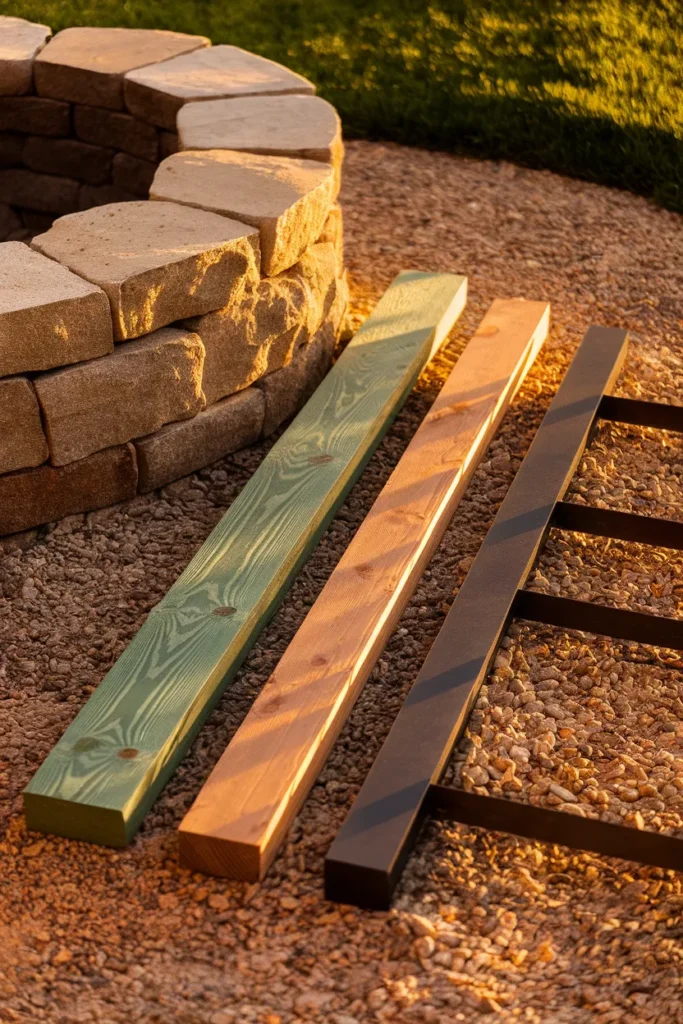
Here is the gap in almost every popular fire pit bench tutorial, including two of the three currently ranking highest for this topic. They specify pressure treated lumber, sometimes for the seat surface itself, and then say nothing at all about what that means next to an open fire.
Treated lumber is infused with chemical preservatives. Burning it releases those chemicals into the smoke, and the ash left behind stays hazardous. A California State Parks fact sheet citing EPA guidance puts it plainly: treated wood should never go into an open fire, and the contaminated ash is a disposal problem, not just a smoke problem.
So three rules follow, and none of them are complicated.
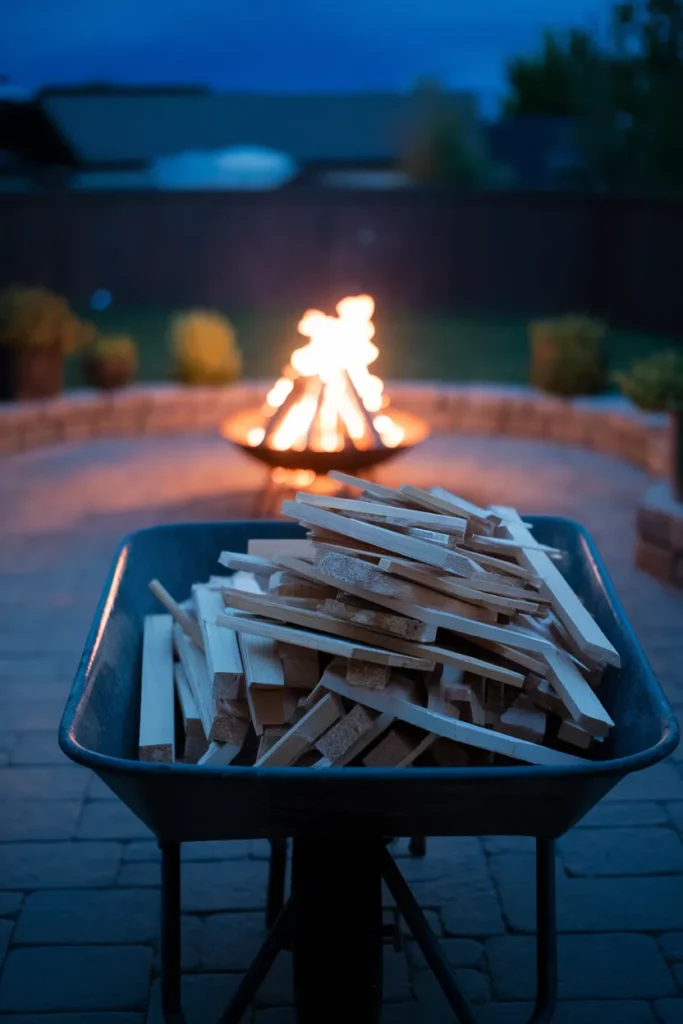
- Never burn the offcuts. You will finish the build with a pile of short treated scraps sitting three feet from a fire pit, on an evening when the fire is running low. Bag them. Do not feed them in.
- Never burn the bench. Ten years from now when it finally gives out, it goes to disposal, not into the pit.
- Cap the seat in something untreated. Cedar, redwood, or a stone cap over a treated frame gives you skin contact with clean material and keeps the treated wood structural.
None of this makes treated lumber a bad choice for a fire pit bench. It makes it a material with a rule attached, and the rule is easy once somebody tells you.
Build Details That Decide If It Lasts Ten Years
Most fire pit benches do not fail at the joints. They fail at the ground.
Get it off the dirt. Wood in direct soil contact wicks moisture upward and rots from the bottom, even cedar. Set legs on gravel, pavers, or concrete pucks and the bench outlives its own hardware.
Use the right fasteners. The preservatives in modern treated lumber corrode standard screws. Exterior-rated or coated hardware is a small upcharge that saves the entire build.
Leave gaps between slats. A quarter inch is plenty. Water drains, air moves, and the seat dries out after rain instead of holding a puddle in the grain.
Check for square before you commit. A base that is out of square by a quarter inch at the bottom is out by an inch by the time you reach the seat, and every board after that fights you.
Plan for frost if you garden in Zone 6 or colder. Ground that heaves in winter will lift and tilt a bench that sits directly on soil. A compacted gravel bed under each leg gives the movement somewhere to go.
Seal the whole thing before the first fire, and let it cure fully before anyone sits down. Fresh sealer plus body heat plus a warm evening equals fingerprints in the finish forever.
Fire Pit Bench FAQ
How far should a bench be from a fire pit? Start with 3 feet for a gas or propane pit and 5 to 6 feet for wood burning, then check two things: your fire pit manufacturer’s manual and your local fire code. Federal guidance recommends keeping fire pits at least 10 feet from your home or anything that can burn, and your city may set its own minimum on top of that.
How high should a fire pit bench be? Around 16 to 18 inches, with a seat depth of 16 to 20 inches. Slightly lower than an indoor chair, which puts your eyeline just above the flame rather than looking up through it.
What is the best wood for a fire pit bench? Cedar for anything you sit on, because its natural oils resist rot without chemical treatment. Pressure treated pine for legs, framing, and anything touching the ground. Many good benches combine both.
Is pressure treated wood safe to use around a fire pit? As furniture, yes, and it is the most common choice. As fuel, never. Burning treated lumber releases preservative chemicals into the smoke and leaves hazardous ash behind, so keep offcuts out of the fire and cap seat surfaces in untreated wood where your skin makes contact.
How much does a fire pit bench cost? Block-and-timber builds come in under $60 in materials. A prebuilt curved acacia section runs roughly $110 to $175, and a four-piece powder-coated steel set lands around $145 to $175. Custom teak goes well past $1,000.
How many benches do I need around a fire pit? Allow about 24 inches of bench per adult. Two or three curved sections usually seat six comfortably while leaving an open gap for access, which you want, since a fully enclosed ring makes people climb over the seating to get in.
Can I put a fire pit bench on a deck? Wooden benches on a wood deck near an open flame need real caution. Gas or propane units, a proper heat barrier under the pit, and confirmation from both your deck material manufacturer and your local code should come before anything gets built.
Start With the Circle, Not the Bench
The instinct is to pick a bench you like and squeeze it in. Reverse that. Mark your three rings on the ground first with a can of marking paint and a string tied to a stake at the pit center, then sit in the space for an evening before you cut a single board.
You will learn more in that one evening than in a week of scrolling. Where the smoke actually drifts. Which side catches the wind. Whether six seats is generous or two short.
Then build the bench that fits the circle you already know works.
General information only. Fire pit placement, permanent seating, and any gas line work are governed by local fire code, permit rules, and HOA restrictions that vary by city. Check with your local building or fire department before building a permanent structure.