Small Front Yard Landscaping Ideas That Make a Tiny Lot Look Twice Its Size

Most small front yard landscaping ideas fail for one reason: they were designed for a yard three times bigger. You copy the photo, you buy the plants, and eight months later your 320 square feet looks crowded instead of finished. The fix is not more stuff. It’s knowing the actual numbers, the bed depths, the mature widths, the setback distances, so every dollar lands where someone can see it. If you’re working the money angle too, our budget front yard landscaping ideas that look expensive covers the spending side. This one covers the space.
Here’s what you get below: nine fixes, real measurements, a cost snapshot from 2026 pricing data, and three things nobody else writing about small yards will tell you.
Start With a Tape Measure, Not a Plant List
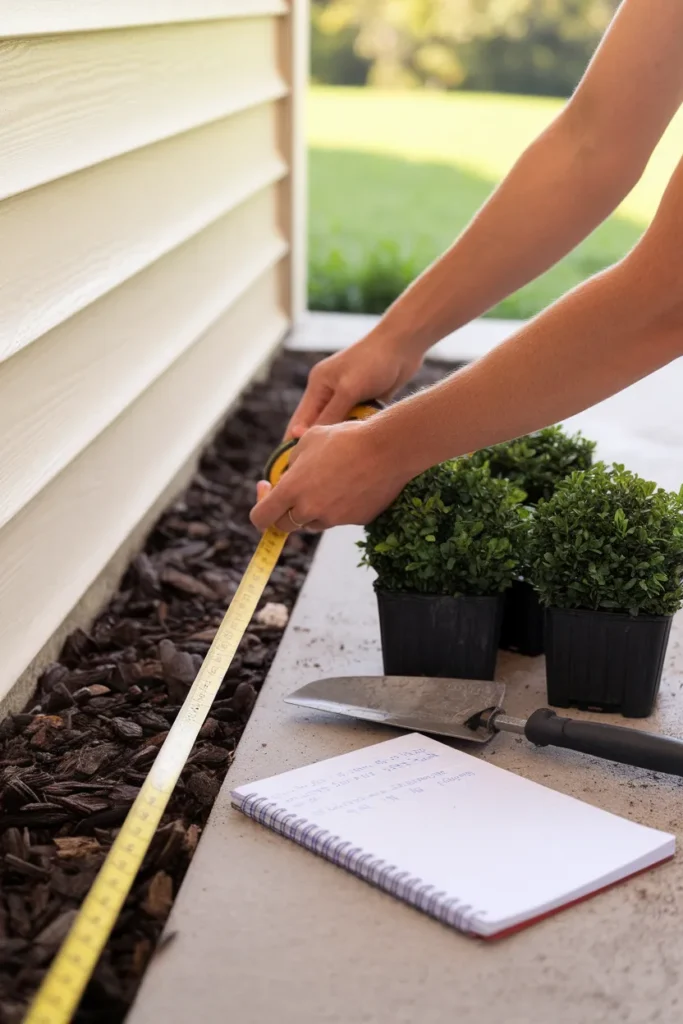
Go outside. Measure the frontage of your house wall, then measure from the wall out to the sidewalk. Write both numbers down.
That’s it. That’s the whole exercise, and skipping it is why half of small front yards end up looking stuffed.
A typical American tract lot gives you somewhere between 250 and 450 square feet out front. At the 2026 rate of $4.50 to $12 per square foot for professional landscaping, a 200 square foot front runs roughly $900 to $2,400 installed, and a full professional front yard lands between $1,500 and $5,000. Labor eats 40 to 65 percent of that at $50 to $100 an hour. So every square foot you handle yourself is real money back in your pocket. Sweat equity pays well out here.
Once you know your two numbers, this table tells you what your yard can actually hold.
| Front yard depth (wall to sidewalk) | Max bed depth | Tallest plant that works | What to skip |
|---|---|---|---|
| Under 8 ft | 30 to 36 in | 3 ft mature shrub | Any tree, any seating |
| 8 to 12 ft | 3 to 4 ft | 6 ft mature shrub | Full-size trees, wide beds |
| 12 to 18 ft | 4 to 5 ft | 15 to 20 ft ornamental tree | Hedging along the walk |
| 18 to 25 ft | 5 to 6 ft | 25 ft tree, off-center | Symmetry on both sides |
Screenshot that. It’ll save you a return trip to the garden center.
One more measurement almost nobody takes: the view from inside. Stand at your living room window and look out. That’s the angle you’ll see four hundred times a year, and it’s the one every list of small front yard landscaping ideas quietly ignores. If your one flowering shrub sits where a porch post blocks it from the couch, move it two feet. Costs nothing. Changes everything about how the yard feels to live with.
Write down a third number while you’re at it: the width of your driveway apron. On lots under 40 feet wide, the driveway usually eats a third of the frontage, which means your usable planting area is smaller than the plat suggests.
The Three-Stop Curb Test
This is the framework I use on every small lot, and it’s the reason some tiny yards read as designed while others read as decorated.
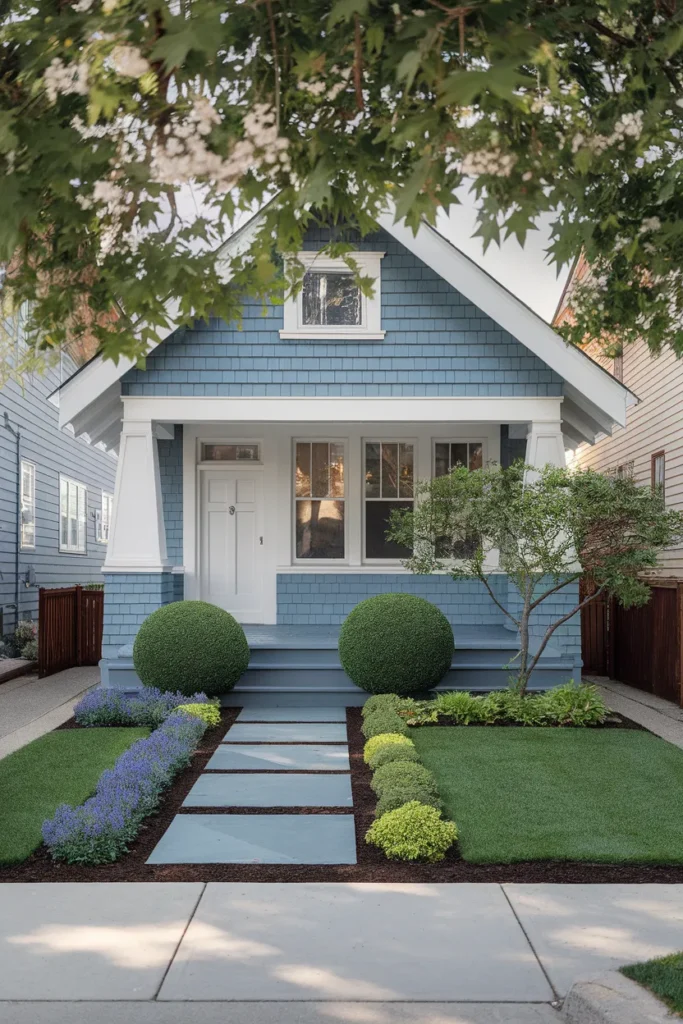
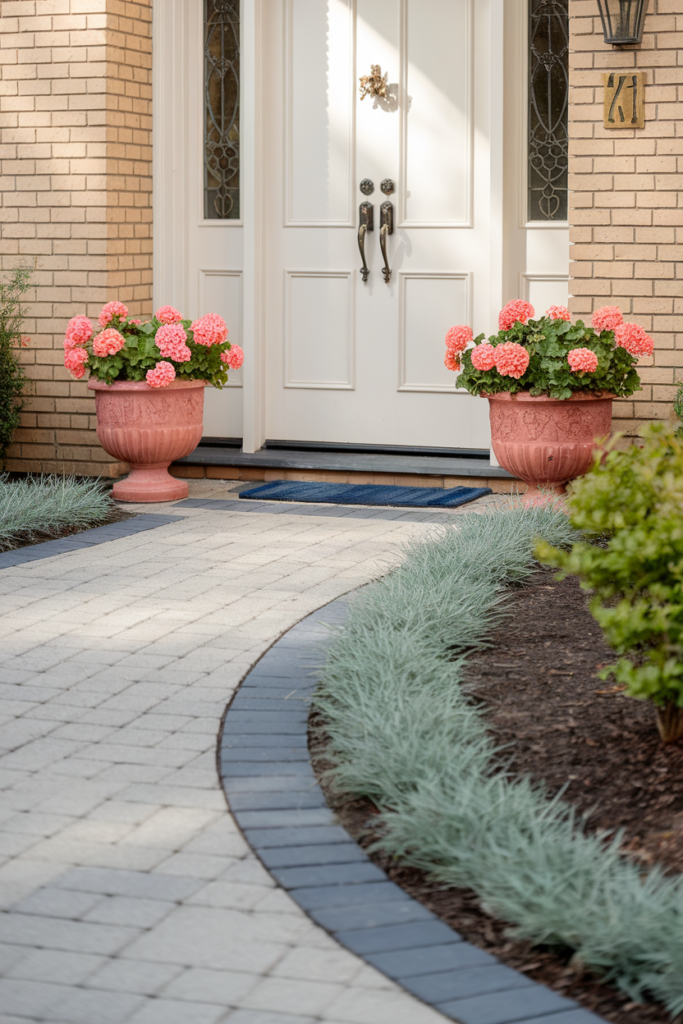
The Three-Stop Curb Test works like this: your front yard is seen from exactly three positions, the curb, the middle of the walkway, and the front step. Each stop needs one thing worth looking at. Miss a stop and the eye slides right past your whole yard.
Big yards can absorb a dead zone. Yours can’t. Not one of them.
| Stop | Where you stand | What the eye needs there | Budget share |
|---|---|---|---|
| Stop 1 | Curb or driver’s seat | One tall element that breaks the roofline: a tree, a trellis, a tall planter | 20% |
| Stop 2 | Halfway up the walk | Color and texture change at ankle-to-knee height | 30% |
| Stop 3 | Front step | Detail worth touching: planters, house numbers, a door mat, a light fixture | 50% |
Notice the split. Half your money goes to the eight feet nearest your door, because that’s where guests stand still. Most people reverse this and blow the budget on the curb, where nobody stops for more than two seconds.
Walk your own yard right now and stand at each stop. If a stop is blank, that’s your first project.
There’s a fourth vantage point worth testing, and it takes ten seconds. Drive past your own house at 15 miles an hour. Most neighbors and delivery drivers never see your yard any other way. At that speed, detail vanishes and only three things register: the shape of the bed line, the mass of the tallest plant, and the color of your front door. Small front yard landscaping ideas that survive the drive-by test are the ones built on shape and mass, not on tiny plant collections that read as visual static from the street.
That’s also why repetition beats variety on a small lot. Three of the same shrub outperform six different ones every time.
Foundation Beds: The Depth Everyone Gets Wrong
Here’s the mistake I made on my own first front bed, and it cost me two seasons.
I bought three 3-gallon boxwoods from Lowe’s (around $25 each), dug them in about 12 inches off the siding, spaced them a foot apart, and stood back feeling pretty good. By the second summer they’d fused into one lumpy green mass pressed flat against the wall, and the ones catching afternoon sun off the light siding scorched brown on one side. I had to pull all three and start over.
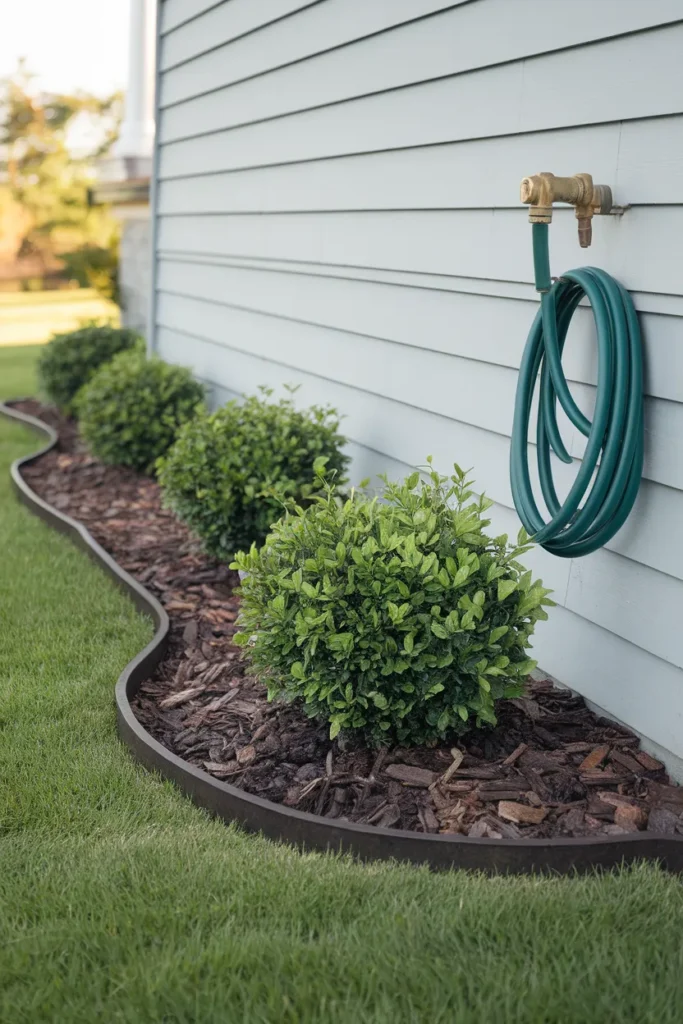
The rule I should have followed: plant to mature width, not nursery pot width. A dwarf boxwood tagged at 3 feet wide needs its center set 18 inches from the wall and 3 feet from its neighbor. Feels absurdly empty the day you plant it. Looks correct in year three. Be patient.
Two more numbers worth memorizing:
- Bed depth should be roughly half the height of the wall behind it. An 8 foot single-story wall wants a 4 foot bed. Anything shallower makes the house look like it’s standing on a shelf.
- Leave 12 to 18 inches of clearance between mature foliage and siding, always. Air moves, paint lasts, and you can still reach the hose bib.
Pull the bed line forward in a gentle curve instead of running it straight across. On a narrow lot a curve buys you visual depth for free, and free is a good price.
Plant in odd numbers. Threes and fives, never pairs except flanking a door. Odd groupings read as natural drifts while even ones read as a fence, and on 300 square feet that difference is obvious. Trust me on this one. Then repeat one plant at least twice across the frontage so the eye connects the two ends of the yard. Designers call it rhythm. You’ll just notice the yard suddenly looks finished.
The last piece is the edge itself. A spade-cut trench edge costs nothing but an hour, steel edging runs a few dollars a foot at Home Depot or Ace Hardware, and either one makes fresh mulch look deliberate. Skip the scalloped concrete blocks. They’re the fastest way to make good small front yard landscaping ideas read as a 1998 rental.
One Small Tree, Sized to Your House
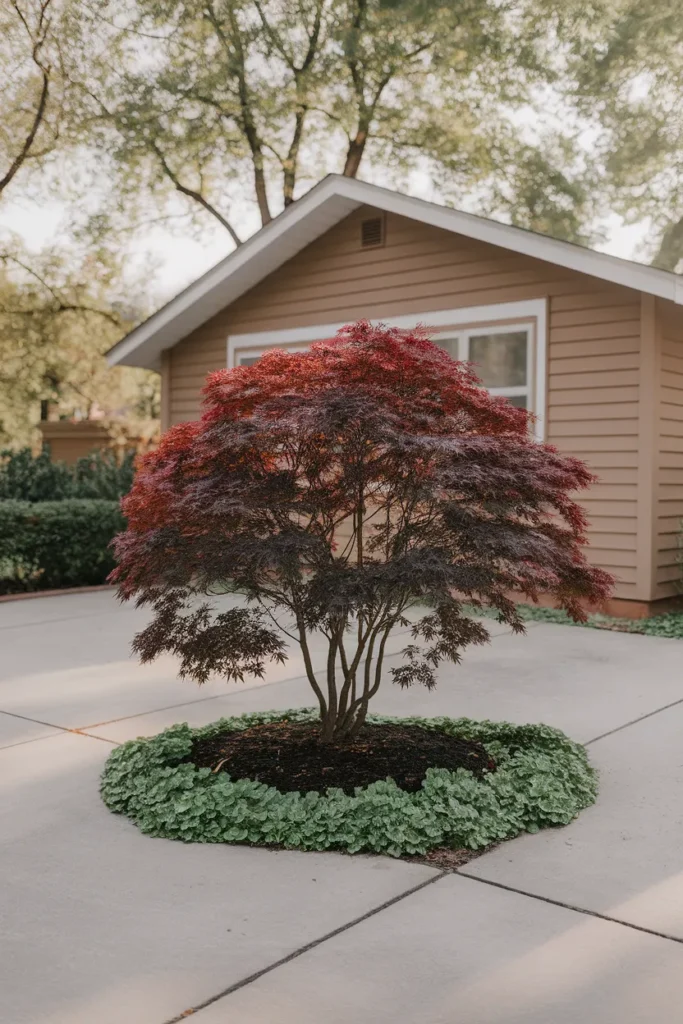
You get one tree. Just one. On a small lot, two is a thicket and three is a mistake you’ll pay an arborist to fix.
Size it against your house, not against the yard. A useful ratio: at maturity, the tree should reach somewhere between half and two-thirds the height of your roofline. For a standard single-story ranch at roughly 15 feet to the peak, that means a 10 to 12 foot mature tree. Dwarf Japanese maple, serviceberry, crape myrtle in warmer zones, redbud, or a columnar hornbeam if you want height without spread.
Before you buy anything, check your USDA plant hardiness zone. The 2023 map shifted a lot of the country half a zone warmer than the version people had memorized, and a tree rated for Zone 7 planted in a genuine Zone 5 pocket is a dead tree with a receipt. Most of the ideas here suit Zones 5 through 9.
Placement matters as much as species. Set the tree off-center, roughly one-third of the way across your frontage, never dead middle. Centered trees split a narrow yard into two smaller yards, which is the opposite of what you want. Keep the trunk at least 8 feet off the foundation and well clear of any utility line marked on your locate.
Fall planting beats spring in most of the country. Roots keep working in warm soil after the leaves drop, and you skip a summer of daily watering. Aim for six weeks before your typical first hard frost, mid-October in Zone 6, later as you go south.
Swap Lawn for Something That Earns Its Square Footage
A 200 square foot patch of turf gives you nothing. You don’t picnic on it, kids don’t play on it, and you still buy fertilizer, run a mower, and drag a hose for it. On a small front yard that grass is the least productive square footage you own.
Better uses of the same space:
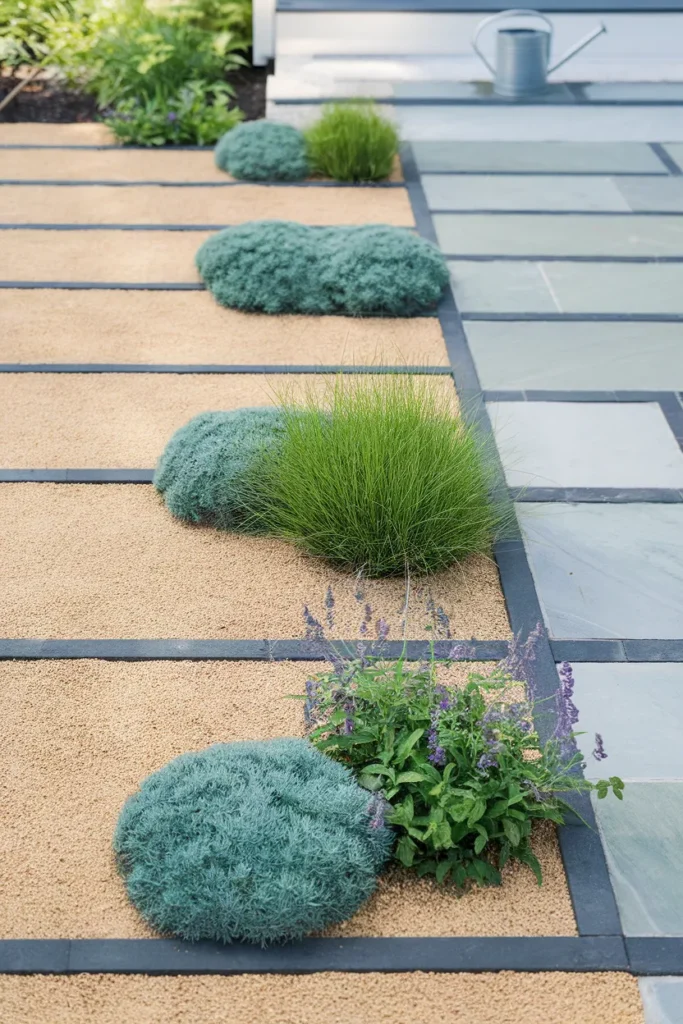
- Gravel or decomposed granite ground plane. Cheapest full-coverage swap, and it reads as intentional the moment you edge it properly. Our full guide to front yard landscaping with rocks walks through sizing and color matching.
- Steppable groundcover. Creeping thyme, blue star creeper, dwarf mondo grass. No mowing, soft underfoot, flowers in spring.
- Paver expansion. Widen the walkway to 4 feet or add a small landing. Suddenly two people can walk side by side.
- A gravel-and-perennial mix. Islands of ornamental grass and salvia set into gravel. Highest visual payoff per dollar in my experience.
One warning, learned the hard way. My first gravel run was two tons of pea gravel from Home Depot (bagged, roughly $5 to $8 a bag, and yes I should have ordered bulk) spread straight onto scraped dirt in April because I convinced myself landscape fabric was optional. By early August I had crabgrass coming through in a dozen places and spent a Saturday pulling it out of loose stone, which is exactly as fun as it sounds. Fabric or a pre-emergent goes down first. Every time. No exceptions.
Budget roughly $0.20 to $0.60 per square foot for mulch, or $30 to $120 per cubic yard delivered. Gravel runs a bit higher but lasts years longer.
Don’t forget the driveway edge and the mailbox post, which are usually the two most neglected feet of any small lot. A 12 inch ribbon of creeping sedum or dwarf mondo along the driveway softens all that concrete for under $40. A single clematis or climbing rose on the mailbox post does the same job vertically, and vertical is the one direction a tiny yard has in unlimited supply.
Keep the palette tight while you’re at it. Two or three plant species repeated, one mulch color, one hardscape material. Restraint is what separates expensive-looking small front yard landscaping ideas from a yard that just has a lot going on in it.
Screen the Meter, the Cans, and the AC Unit
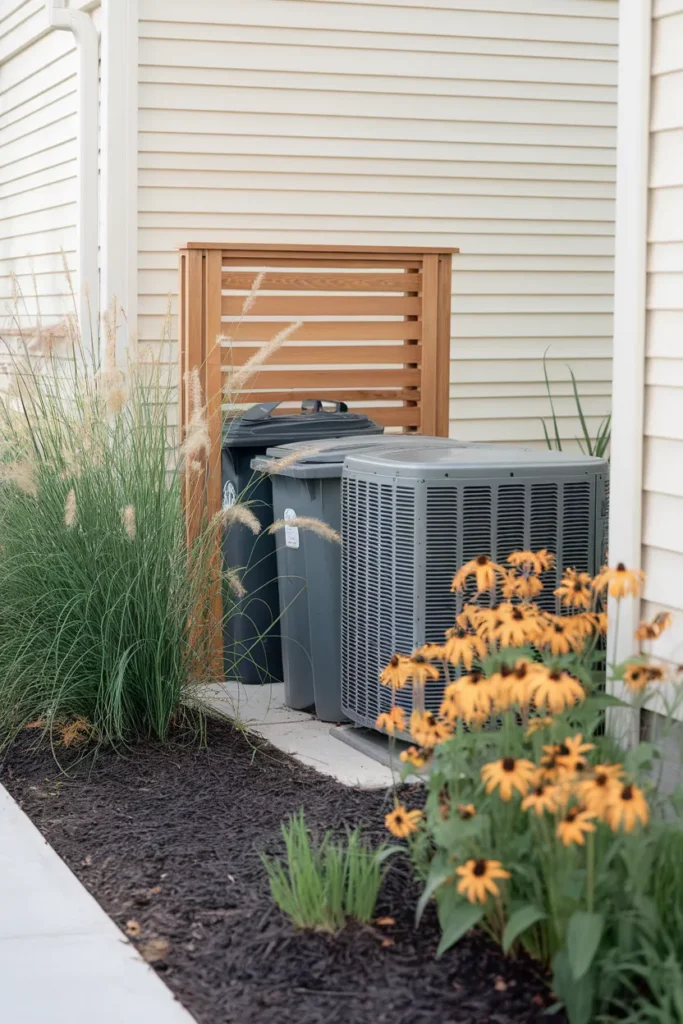
Nobody writing about small front yards mentions this, which is strange, because on a tiny lot the utilities are unavoidable. Your gas meter, electrical panel, hose bib, AC condenser, and two rolling trash cans all live inside the same 300 square feet you’re trying to make pretty.
Screening rules that actually keep things working:
- AC condenser: 24 to 36 inches of clearance on all sides, 5 feet of open air above. A loose screen of ornamental grass on three sides works. A tight boxwood hedge kills your compressor’s efficiency and voids some warranties.
- Gas and electric meters: leave them fully visible and reachable. Meter readers will cut through whatever you plant. Screen the approach with a planter or a low shrub set to the side instead of covering the face.
- Trash cans: a three-panel cedar screen or a simple horizontal slat fence, 42 to 48 inches tall, set two feet off the house so the lid clears. Home Depot and Lowe’s both stock flat-pack versions in the $120 to $250 range, or you can build one from six cedar fence pickets for well under $80.
- Hose bib: keep it in front of the plants, never behind them. You will regret this in July otherwise. Ask me how I know.
Here’s the contrarian bit: stop trying to hide utilities and start trying to out-compete them. Give the eye something better nearby, a bold planter, a flowering shrub, a light fixture, and the gray box genuinely stops registering. Full concealment on a small lot usually just draws a rectangle around the thing you’re hiding.
Find Out Where Your Yard Legally Ends
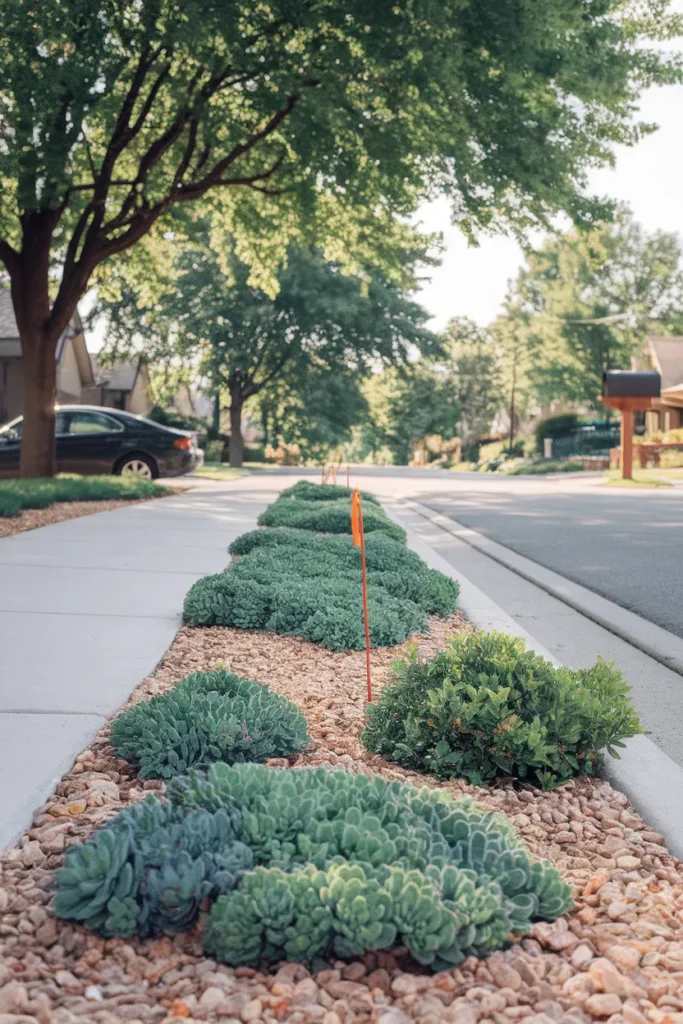
That strip of grass between your sidewalk and the street? There’s a good chance you don’t own it.
It’s called the right-of-way, the parkway, or the hell strip depending on where you live, and in most American municipalities the city holds an easement over it even though you’re the one mowing it. Cities routinely restrict what goes there: height limits (often 24 to 30 inches for sightline safety at intersections), bans on permanent hardscape, and the standing right to dig the whole thing up for a water main without paying to restore your plantings.
Three quick checks before you spend a dollar out there:
- Pull your plat or survey. Usually free on your county assessor’s website. The property line is often at the sidewalk, not the curb.
- Search your city name plus “right of way planting permit.” Many cities publish an approved plant list. Some require a no-fee permit.
- Call 811 before any digging. Free, federally mandated, and utility locates take a few business days. Hitting a fiber line is a bill you’ll remember.
If the strip turns out to be yours, treat it as an extension of the yard. If it isn’t, plant it with cheap, replaceable, low-growing perennials and keep your real money inside your own line.
Same logic applies to HOA setbacks and any recorded easement running along the side of your lot. Ten minutes of reading beats a violation letter. Go read.
Light the Walkway, Skip the Runway
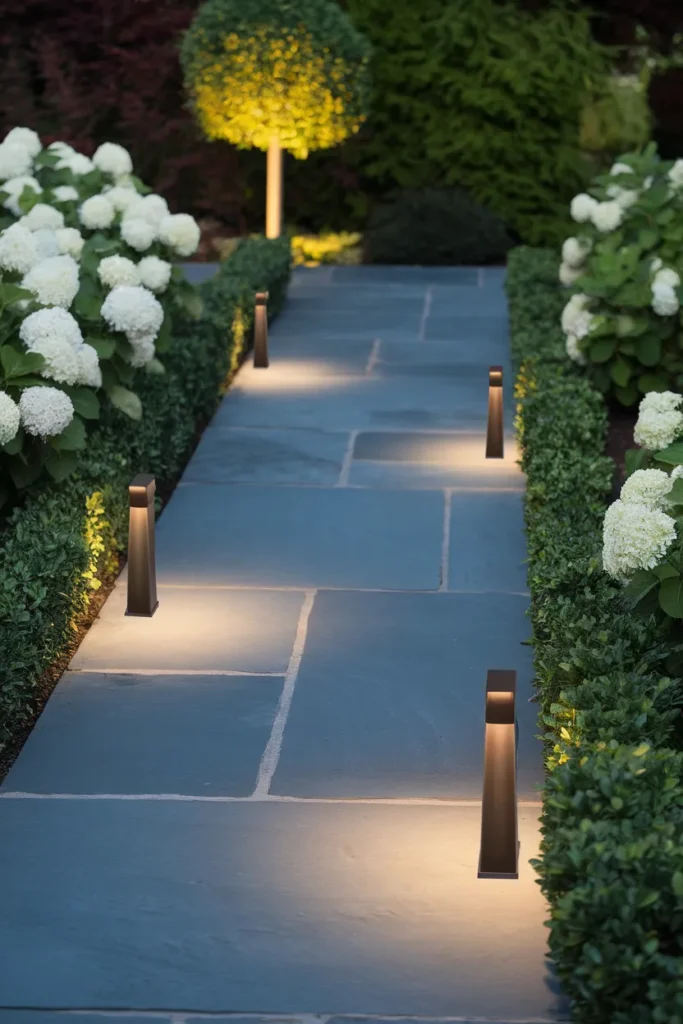
Path lighting is the single highest-return upgrade on a small front yard, and almost everyone installs it wrong.
The wrong way is a matched pair of stakes every three feet down both sides of the walk, which lands somewhere between airport taxiway and haunted mini golf. The right way on a tiny lot is three to five fixtures total, staggered, never opposite each other. Light the edges of the path and one plant. That’s the whole job. Really.
My own version of this lesson: I bought an 8-pack of cheap solar stakes at Walmart one spring for about $30, loved them for six weeks, watched them fade to a dim amber by August, and by December four of them wouldn’t light at all. Solar in a shaded front yard is a renewable disappointment. I replaced them with a low-voltage Malibu kit (transformer plus six fixtures, in the $60 to $120 range depending on the set) and those have run through three winters with one bulb swap.
Two more lighting notes:
- Warm white, 2700K, always. Cool white makes green foliage look gray and your siding look blue.
- Add one uplight at the base of your tree or against a textured wall. Uplighting is what makes a $200 yard photograph like a $2,000 yard.
Plant It Once and Let It Water Itself
The best small front yard landscaping ideas are the ones still looking good in year four without a standing weekend commitment. That comes down to two decisions: right plant for your zone, and a planting scheme that doesn’t depend on you standing there with a hose.
Group plants by water need instead of by color. It sounds obvious. Almost nobody does it, and it’s the core of water-smart landscape design from the EPA’s WaterSense program. Thirsty things together near the hose bib, drought-tolerant things together out by the sidewalk where you’ll never drag a hose anyway.
Reliable low-water performers across Zones 5 through 9:
- Sedum (‘Autumn Joy’ and the low creeping types) for full sun and total neglect
- Russian sage for height, silver texture, and months of purple
- Little Bluestem or Blue Fescue for movement and winter structure
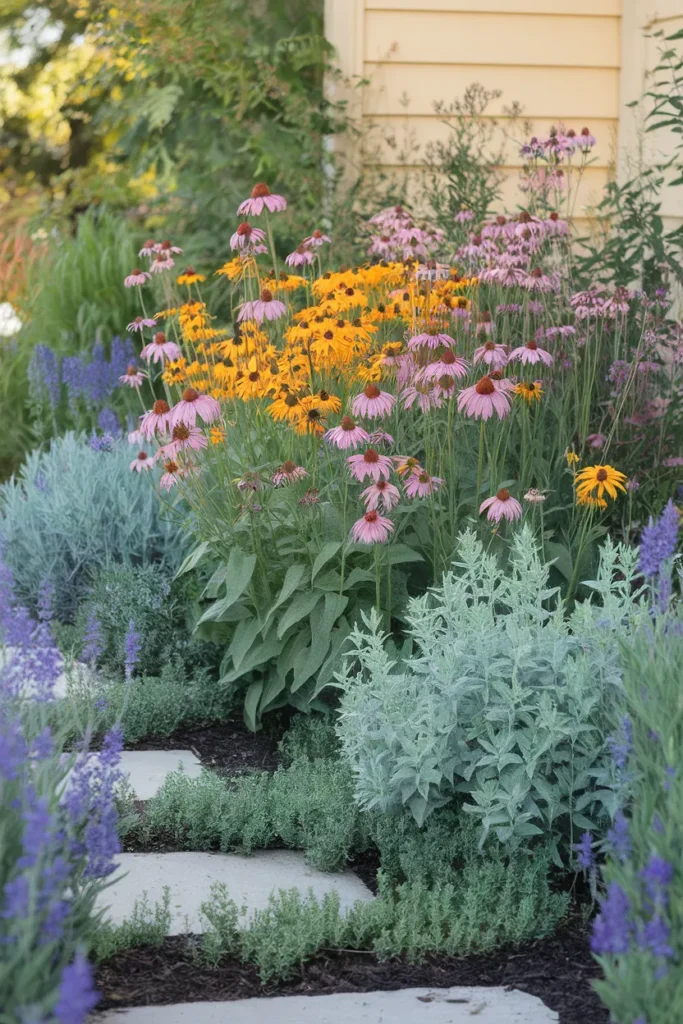
- Coneflower and Black-eyed Susan for long bloom and pollinators
- Creeping thyme between pavers, which smells wonderful when stepped on
If you’re in the Southwest or anywhere with real water restrictions, the gravel-and-succulent approach in our desert front yard ideas goes deeper on plant selection for arid zones.
Mulch 2 to 3 inches deep, never more, and keep it pulled back an inch or two from every stem. Piling mulch against a trunk is the most common way homeowners quietly kill an expensive tree. A bag of Scotts or Kellogg mulch runs a few dollars, bulk delivery runs $30 to $120 per cubic yard, and either way it’s the cheapest insurance you’ll buy all season.
Timing matters more than most people expect. In Zones 5 through 7, plant perennials and shrubs in early fall (roughly six weeks before your typical first hard frost) or in spring once soil temperatures hold above 50 degrees. Zones 8 and 9 can plant through fall and into mild winter, which is a real advantage. Skip midsummer installs entirely unless you enjoy watering daily. Water deeply twice a week for the first month, then back off and let roots chase moisture downward.
A final honest note on maintenance. Even the lowest-maintenance small front yard landscaping ideas need about two hours in spring and two in fall: cut back the grasses, refresh the mulch, re-cut the edge, deadhead what’s spent. Four hours a year. Not four a month. That’s the actual price of a yard that looks intentional in year five.
Frequently Asked Questions
What’s the cheapest way to landscape a small front yard?
Mulch and edging, hands down. A crisp spade-cut or steel edge plus 2 inches of fresh dark hardwood mulch runs $0.20 to $0.60 per square foot and changes how the whole front reads in an afternoon. Add three matching planters at the door and you’re under $200 total. Do that before you buy a single shrub.
How much does it cost to landscape a small front yard?
Professionally, expect $4.50 to $12 per square foot, which puts a 200 square foot front at roughly $900 to $2,400 and a full front yard between $1,500 and $5,000. Labor is 40 to 65 percent of that at $50 to $100 an hour, so DIY on the planting and mulching while hiring out only the hardscape is where most people find their savings.
How do I create a low-maintenance small front yard?
Shrink the lawn to zero or near it, group plants by water need, mulch 2 to 3 inches deep, and choose species rated for your zone rather than the ones that looked prettiest at the garden center. Sedum, ornamental grasses, and creeping thyme ask almost nothing after year one.
What are the best ground cover plants for a small front yard?
Creeping thyme for sunny paths you’ll walk on, dwarf mondo grass for shade and clean edges, blue star creeper for a soft flowering mat, and creeping juniper for slopes and hot strips. All four stay under 6 inches, which keeps sightlines open on a narrow lot.
Are there any plants I should avoid in a small front yard?
Yes. Skip anything that matures wider than about 4 feet unless it’s your single feature plant. Avoid arborvitae (they get enormous), running bamboo (it will find your neighbor’s yard), and full-size maples or oaks whose roots will lift your walkway. Also skip fast-growing privacy hedges, which need constant shearing in a space this tight.
What is the best hardscaping option for a small front yard?
Widening the walkway. Going from a standard 3 foot path to 4 feet, or adding a small landing at the door, does more for how a tiny front reads than any other hard surface. Pavers or bluestone over a compacted base beat poured concrete for both looks and repairability.
Can I grow vegetables or herbs in a small front yard?
Absolutely, and herbs especially earn their spot. Rosemary, sage, lavender, and thyme all read as ornamental foliage while being fully edible. Check your HOA covenants first if you have one, since a few restrict raised beds in the front setback.
Where to Start This Weekend
Pick one stop from the Three-Stop Curb Test and fix it. Just one. That’s the whole assignment.
If your front step is bare, buy three planters and a bag of good potting soil. If your beds are shapeless, spend Saturday cutting a clean curved edge and laying fresh mulch. If the curb view is flat, that’s your one tree, sized to your roofline and set off-center.
Small front yards reward restraint in a way big yards never do. Fewer plants, better spacing, sharper edges, and one thing worth looking at from each of the three stops. Do that and 300 square feet will out-photograph your neighbor’s half acre.
The best small front yard landscaping ideas aren’t the most elaborate ones. They’re the ones sized correctly, placed where someone actually stands, and planted for the zone you really live in. Get those three right and the rest is just mulch.
Which stop is weakest at your house? Go stand at the curb and be honest about it. Then come back and tell us what you’re fixing first.