Secret Garden Ideas for a Hidden Backyard Escape

Most secret garden ideas fail for one boring reason: you can see the whole thing from the back door. A real hidden garden withholds itself. You catch a glimpse of something green through a gap, you take a few steps, the path bends, and only then does the space open up. That delay is the entire product. Get it right and even a scrappy 8×8 corner reads as a discovery. Get it wrong and you’ve built a nice bench nobody sits on.
This guide covers the mechanics behind that reveal, the corner you should actually build in (hint: it’s the one you’ve been ignoring), plants that survive the low light these spots always have, and honest cost tiers so you know what you’re signing up for.
What Actually Makes a Garden Feel Secret
Enclosure alone doesn’t do it. Plenty of fully fenced yards feel like storage lots.
The feeling comes from three things working together: something blocks your view, something forces you to change direction, and something marks the moment you arrive. Miss any one of those and the space reads as a corner rather than a room. I see people spend a whole weekend on a gorgeous arch and then set it flat against an open lawn where you can see straight through it from thirty feet away. The arch is fine. The staging is what failed.
Scale matters less than most people assume. A secret garden can be 6 feet by 8 feet. What it cannot be is visible in full from the place you usually stand.
There’s a second layer too, and it’s sensory. Sound softens when you’re surrounded by foliage. Temperature drops a few degrees under a canopy. Your footing changes from turf to gravel or flagstone. Those small shifts tell your body you’ve gone somewhere, and they cost almost nothing to build in.
The 3-Second Reveal Rule
Here’s the framework I use to test secret garden ideas before a single plant goes in the ground.
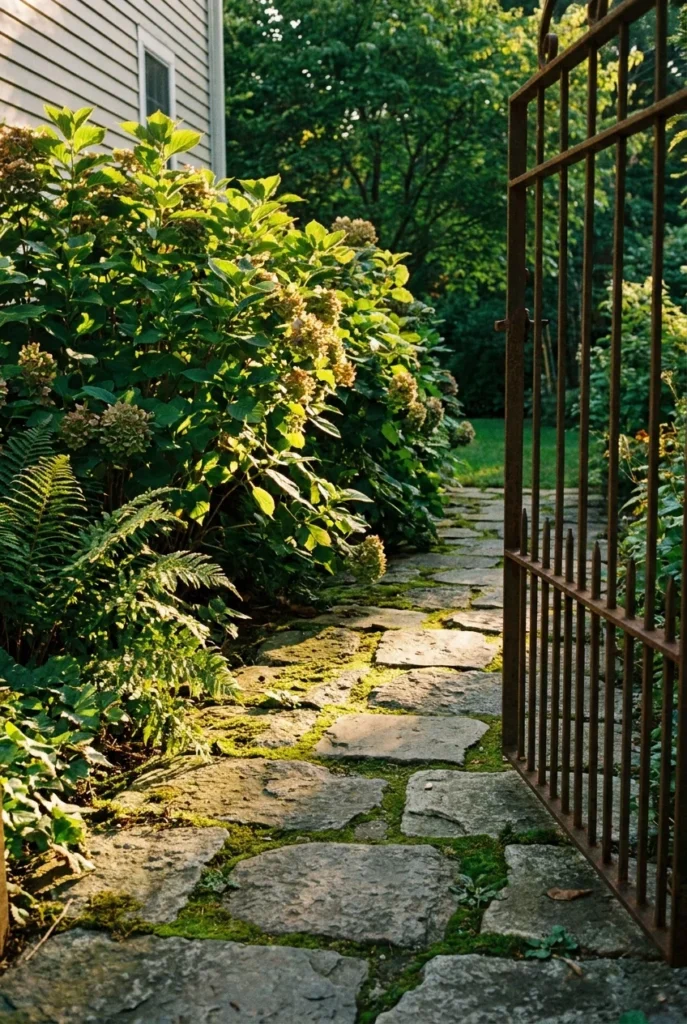
The 3-Second Reveal Rule: walk from your back door toward the space at a normal pace. For the first three seconds, you should not be able to see the seating. If you can, the design is doing decorative work rather than structural work, and no amount of fairy lights will fix it.
It breaks into three moves, and you need all three:
| Move | What it does | Cheapest version |
|---|---|---|
| Block | Stops the sightline from your main vantage point | A pair of 6-foot arborvitae, around $60 each at Lowe’s |
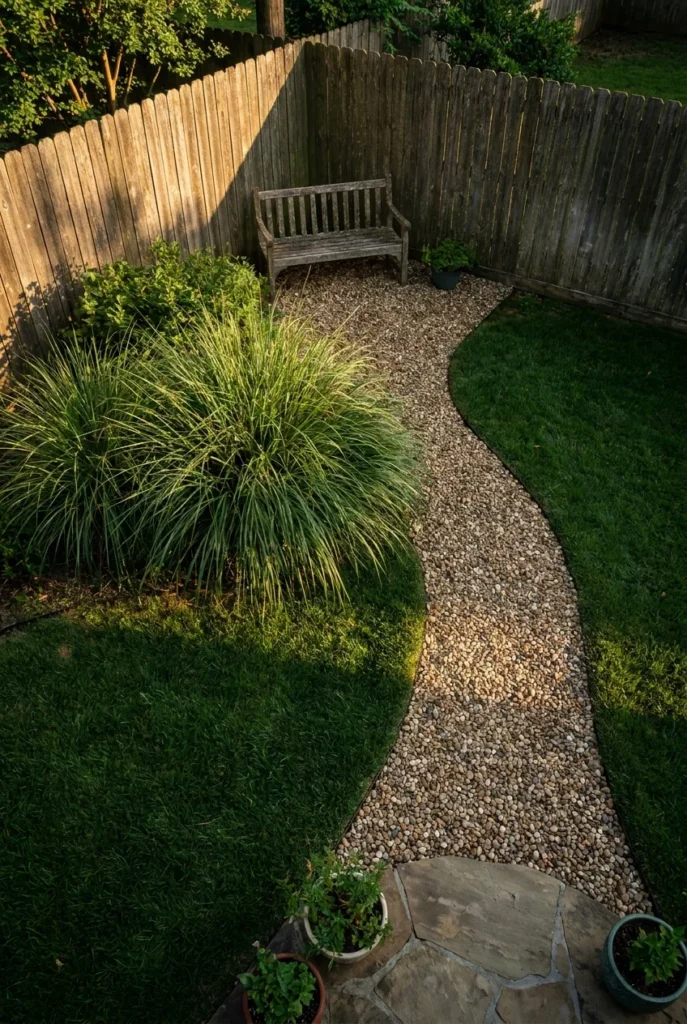
| Bend | Makes you change direction on the way in | Curve a gravel path around an existing shrub, roughly $40 of pea gravel |
| Threshold | Marks the moment of arrival | A salvaged gate leaned against two posts, often free |
Run the walk before you buy anything. Stand at the door, count to three, and note exactly where your eye lands. That spot is where the Block goes. Everything else follows.
The rule also tells you when to stop. Once you can’t see the bench at three seconds, quit adding screens. Overbuilt enclosure turns a hideaway into a closet, and that’s a much harder mistake to undo than an underbuilt one.
Start With the Worst Corner in Your Yard
The instinct is to build your secret garden somewhere pleasant. That’s backwards.
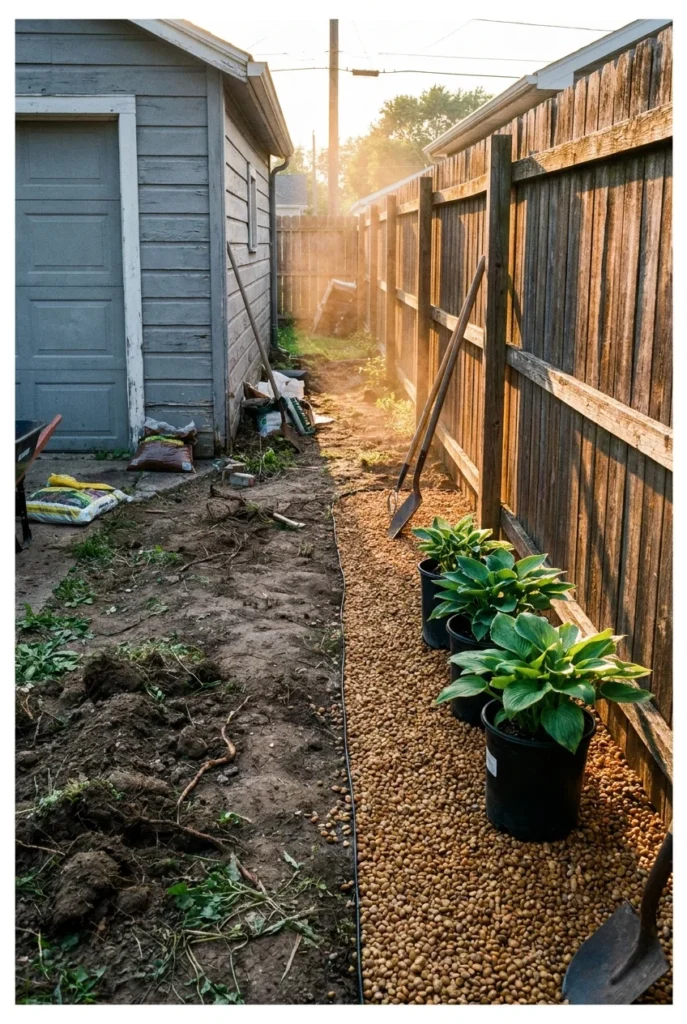
Look for the spot you’ve written off. The strip behind the garage. The dead patch under the maple where grass gave up years ago. The awkward wedge between the shed and the property line. These corners are already half enclosed, already shaded, and already invisible from the house, which means the expensive part of the job is done for you.
They’re also the areas where you’ve got nothing to lose. Nobody mourns a dead lawn corner.
One caution on the under-a-tree option, and it’s a real one: don’t pile soil or build a raised bed over established tree roots. Trees take on water and air through fine feeder roots in the top several inches of soil, and burying them slowly suffocates the tree. Use containers on top of the existing grade instead, or lay a permeable gravel or flagstone floor without excavating. If you want the full breakdown of working under a canopy, our guide to shade garden ideas for low-light yards covers the light assessment and the plant palette in detail.
Check your drainage before committing. Dig a 12-inch hole, fill it with water, and see if it drains within a few hours. If it’s still standing water the next morning, you’ve found a bog, and a bog needs a different plan than a bench.
Walls That Do the Hiding
Most secret garden ideas live or die on this step. You’ve got three routes, and the right one depends mostly on whether you own the place.
Living walls. Evergreen shrubs give you year-round screening, which matters if you want the space usable in March. Emerald Green arborvitae, boxwood, and Skip laurel are the reliable workhorses. Buy them at 5 to 6 feet rather than as 2-foot starts. Yes, the mature sizes cost more, often two or three times as much, but a hedge that screens in year one instead of year five is worth the premium. Space them tighter than the tag says if you want a solid wall fast.
Built walls. Stone, brick, timber, and gabion cages all read as permanent and add real structure. They also come with permit questions once you pass about four feet in most municipalities, and they need proper drainage and a compacted base or they’ll heave. Our garden wall ideas guide walks through which styles are DIY friendly and which need an engineer.
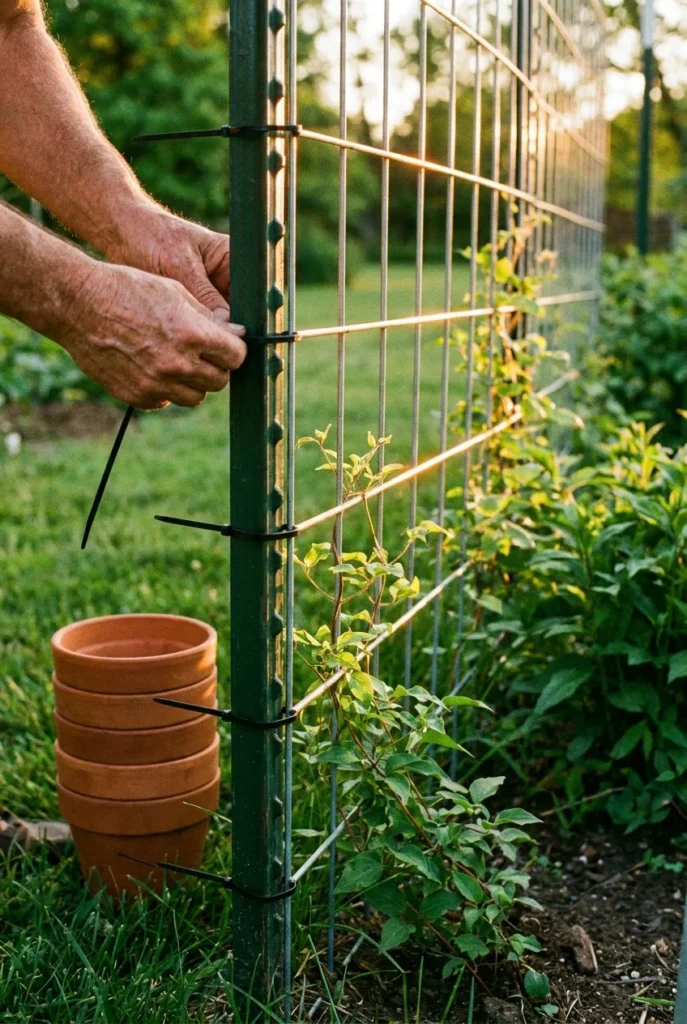
Renter friendly walls. Nothing here goes into the ground. Cattle panel from Tractor Supply (usually in the $30 to $40 range per panel) zip-tied to T-posts driven into the soil makes an instant trellis you can pull out on move-out day. Drop cloth curtains on a tension rod, freestanding lattice screens, and tall containers of clumping bamboo or ornamental grass all work. Roll-up reed fencing from Home Depot runs well under $40 for a 6×16 roll and hides a chain link fence in an afternoon.
Mix routes if the budget’s tight. Two arborvitae to block the main sightline plus a cheap reed panel on the ugly side costs a fraction of a full hedge and looks intentional.
The Threshold Is the Whole Trick
If you only build one element well, build the doorway.
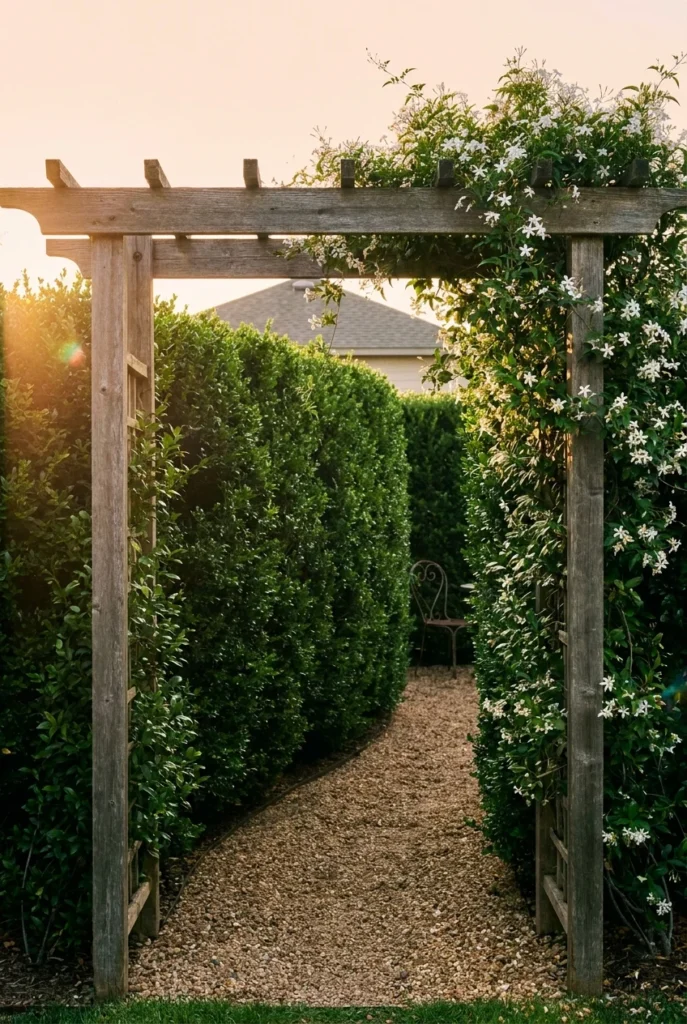
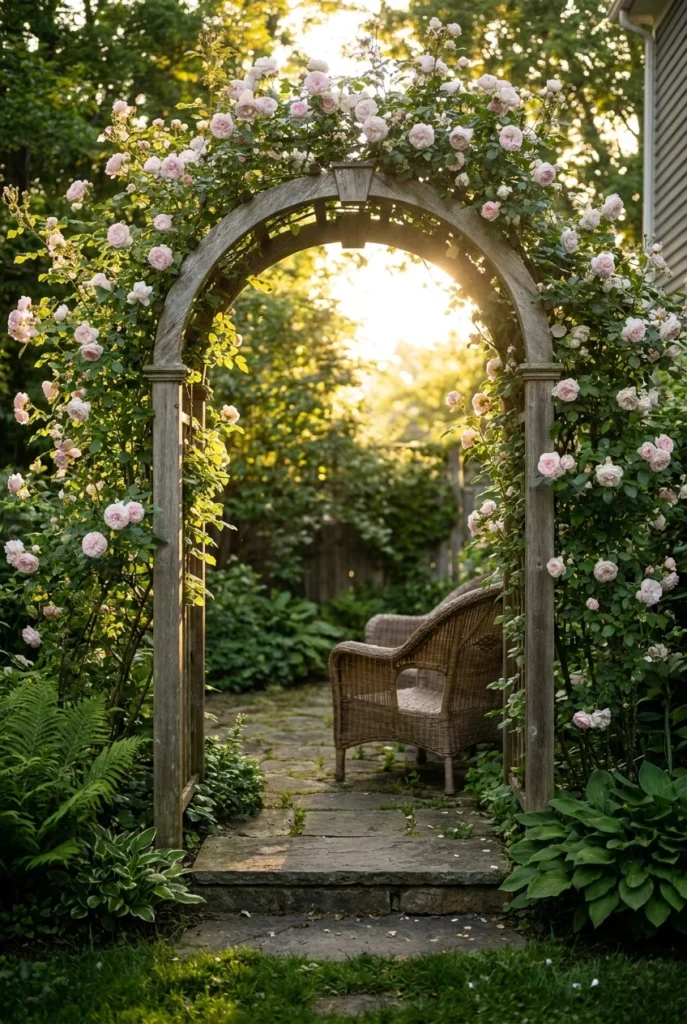
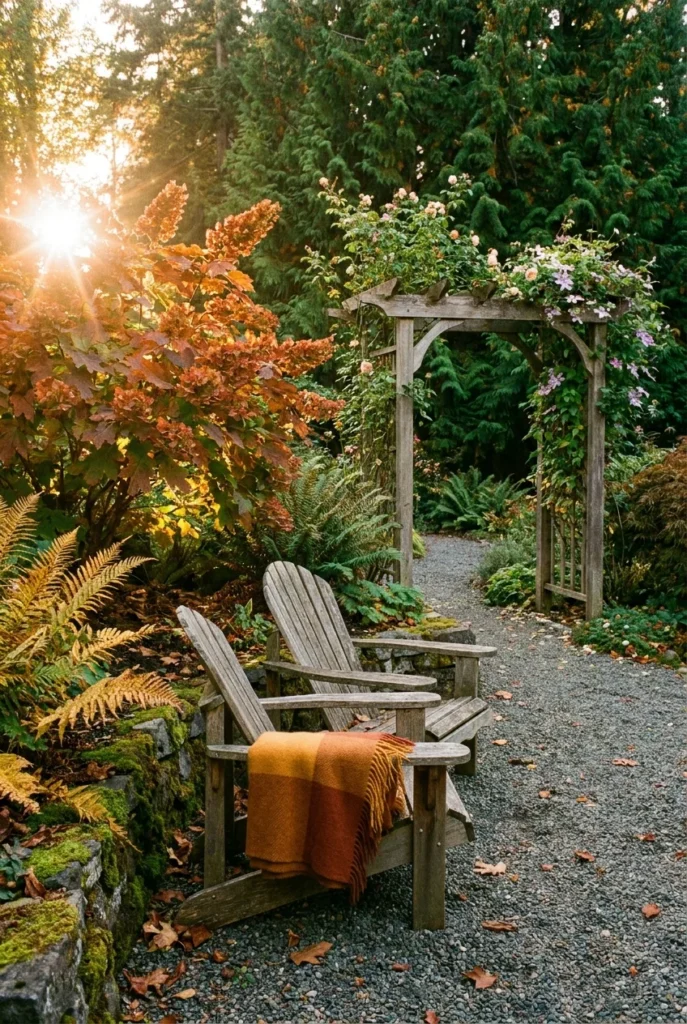
A threshold is the thing you pass through, and passing through is what converts a corner into a room. An arbor works. So does a gate that opens onto nothing, a gap cut deliberately into a hedge, two matched planters flanking the path, or a change in flooring underfoot. Cheap and effective: sink two 4×4 cedar posts, run a top beam across, and let a climbing hydrangea or a New Dawn rose do the rest over two seasons.
Narrow it more than feels comfortable. Thirty inches is plenty for one person and reads far more like a passage than a 5-foot opening does. You want a slight squeeze.
Make it lower too. A threshold at 6.5 feet forces a small head duck on the way in, and that tiny physical acknowledgment does more psychological work than another $200 of plants ever will. Honestly, it’s my favorite cheap trick in the whole niche.
One thing to avoid: don’t center the threshold on the seating. Offset it so the bench sits at an angle to the opening. You’ll get one more beat of concealment for free.
Secret Garden Plants That Handle Low Light
Here’s the part most secret garden ideas skip entirely. The corners that make good hideaways are almost always shady, and the plant lists floating around Pinterest are written for full sun.
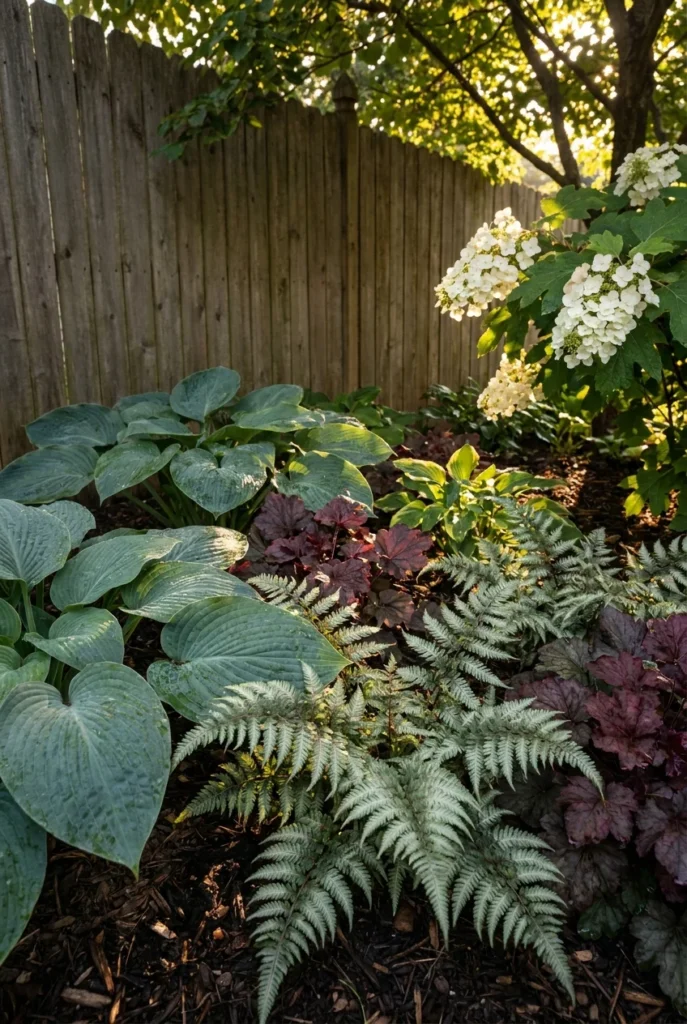
Before you buy, figure out what kind of shade you actually have. The University of Minnesota Extension’s guide to gardening in the shade sorts it into four useful buckets: dappled shade (light filtering through a canopy), part shade (roughly 3 to 6 hours of sun), full shade (under 3 hours), and deep shade (almost none). Those categories change everything about what will live.
Reliable performers for part to full shade:
- Hostas. Blue-leaved varieties like Halcyon hold color best in deeper shade. Slugs are the tradeoff.
- Ferns. Ostrich fern spreads fast and fills space cheaply. Japanese painted fern brings silver.
- Hydrangea (oakleaf or smooth). Structure, blooms, and fall color in one plant.
- Heuchera. Burgundy and lime foliage that holds all season.
- Astilbe. Feathery blooms, but it wants consistent moisture.
- Solomon’s seal and brunnera. Both light up a dark corner with variegation.
Layer in fragrance where you’ll be sitting. Sweet woodruff at ground level, a potted gardenia or star jasmine near the seat if your winters allow it.
Check your zone before you buy anything perennial. The USDA Plant Hardiness Zone Map is the standard reference, and your zone determines which of these survive winter versus which are one-season purchases. Zone 5 gardeners planting star jasmine are buying an annual whether they know it or not.
Add climbers on the vertical surfaces. Climbing hydrangea tolerates real shade, takes a few years to establish, then covers a wall for decades.
Furnish It Like a Small Room
Two chairs. That’s usually the right answer.
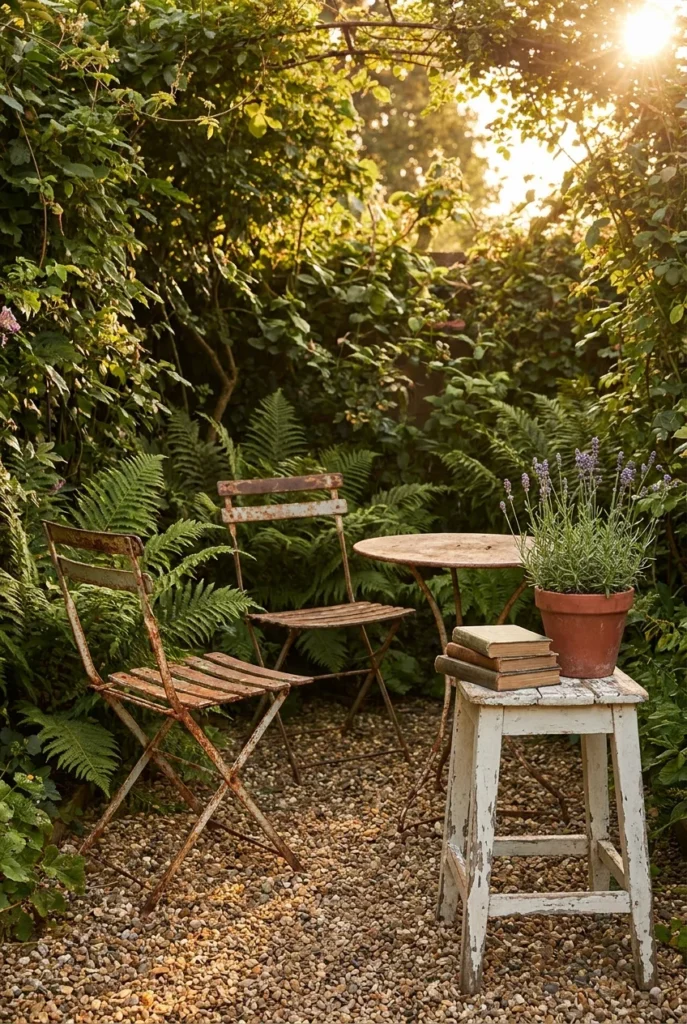
The instinct is a full dining set, and it’s almost always wrong for a hidden garden. A secret space works because it’s intimate, and a six-seater table announces itself. Go with a bistro set (IKEA and Target both carry decent ones in the $80 to $200 range), a single wide bench, or a hanging egg chair if you’ve got a beam to take the load.
Give it a floor. This is the step people skip, and it’s the one that makes the difference between “corner of the yard” and “outdoor room.” Pea gravel is the budget champion at roughly $6 to $8 a bag, and about 15 bags covers an 8×8 area at 2 inches deep. Flagstone set on sand costs more and lasts longer. Even a weatherproof outdoor rug over existing patio slabs changes the read instantly.
Add one piece with some age on it. A chippy painted stool, a stone urn from a salvage yard, a rusted watering can left where it fell. New-looking outdoor furniture reads suburban. One weathered object reads like the space has been there a while, which is exactly the story a secret garden is telling.
Storage helps more than it sounds. A small deck box for cushions means the cushions actually come out, and a garden that’s comfortable in two minutes gets used ten times more than one that takes fifteen.
Water, Warm Light, and the Evening Version
Sound is the most underrated tool in this whole category.
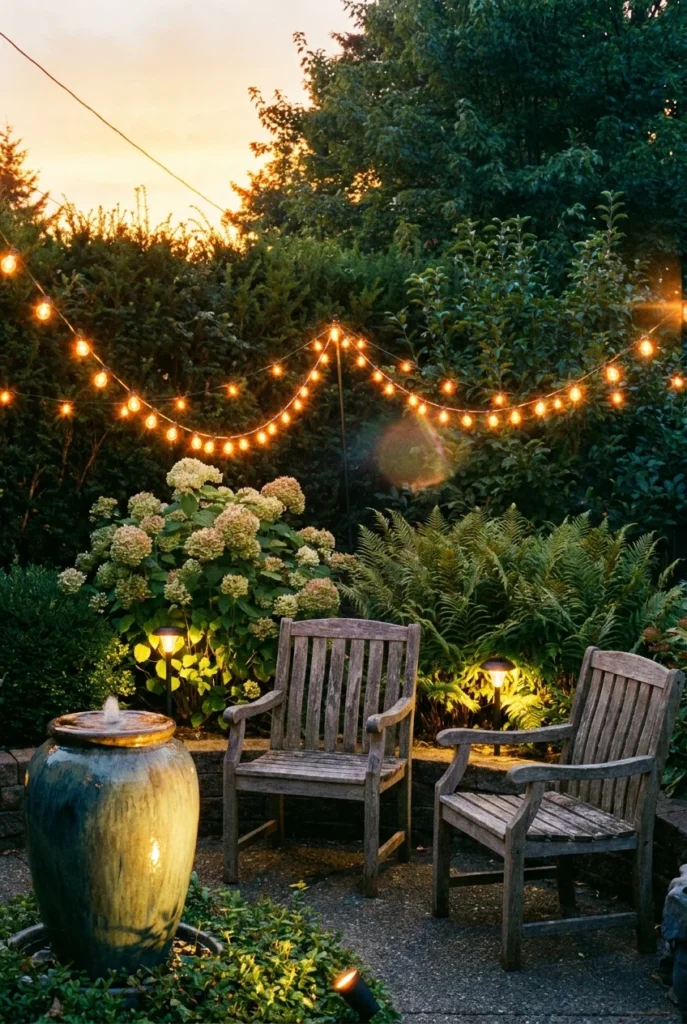
A small recirculating fountain masks traffic, neighbors, and HVAC units, and it gives your brain something to follow. Solar bubblers start under $40. A plug-in pump with a glazed ceramic bowl gives you steadier flow and typically lands somewhere in the $80 to $150 range. Even a simple birdbath brings movement and birds, which is its own kind of sound.
Now the lighting, because this is where a secret garden earns its keep. Daytime it’s a nice corner. At dusk it’s the best place on the property.
Keep the color temperature warm, around 2200K to 2700K. Cool white light makes any outdoor space read like a parking lot. Brightech and Feit both make warm-toned commercial-grade string lights that survive real winters, usually in the $30 to $60 range for a 48-foot run. Run them low and loose rather than taut overhead, so the light sits at head height where it feels like a room.
Then add two or three solar uplights aimed into the shrubs. Uplighting foliage from below is the single highest-impact lighting move in a garden and it costs about $15 a fixture. Skip the path lights lining the walk like a runway. Light the plants, not the pavement.
A small fire element extends the season by a couple of months. Keep any flame well clear of overhanging branches and fabric, and check local rules before you install anything permanent. For a full walkthrough of layering floor, screening, lighting, and seating on a budget, our small backyard oasis guide breaks it down layer by layer with costs.
What a Secret Garden Actually Costs
Almost nobody publishing secret garden ideas will give you a number, so here are three honest tiers. Treat these as 2026 ballparks and check current pricing before you shop, since plant and material costs move a lot by season and region.
The $200 weekend. Reed fencing or a cattle panel screen, 15 bags of pea gravel, a thrifted bench, one string light run, and three or four shade perennials from the clearance rack in late summer. Genuinely doable in two days. It will look young for a year.
The $600 to $900 build. Five or six 5-foot evergreens for real screening, a cedar arbor kit, flagstone or a larger gravel area, a bistro set, a solar fountain, and layered lighting. This is the tier where most people land, and it’s the one that looks finished in season one.
The $2,500 and up version. A masonry or timber wall, mature specimen plants, a professionally installed water feature, low-voltage wired lighting, and possibly a permit. Worth it if you’re staying put for a decade.
Where to save: plants (buy small on anything that grows fast, buy big only on the screening evergreens), and furniture (secondhand metal chairs are better than new plastic and often cheaper). Where not to save: drainage prep and the screening plants themselves. Those two determine whether the whole thing works.
Buy perennials in fall if you can wait. Nurseries discount heavily in September and October across most of the country, often 40 to 60 percent, and fall planting gives roots a head start before summer stress hits.
Secret Garden Ideas: Frequently Asked Questions
Can you create a secret garden in a small yard? Yes, and small yards often do it better. You need roughly 6×8 feet of usable space plus room for a screen and a short approach path. The constraint that actually matters is the sightline from your house, not the square footage. If you can hide the seating from your back door, you have enough room.
Where should a secret garden be placed in a yard? Pick the spot that’s already partly enclosed and already out of view: behind a garage, alongside a shed, under a mature tree, or in a side yard corridor. Those locations do half the screening work for free. Avoid low spots that hold water and any area where you’d need to build over established tree roots.
How do you separate a secret garden from the rest of the yard? Use a blocking element (evergreen shrubs, a screen, a wall), a directional change (curve the path so you can’t see straight in), and a threshold you physically pass through. All three together, not just one. Change the flooring material at the boundary and the separation reads even more strongly.
What design elements create a sense of mystery? Partial views are the main one: a path that disappears around a corner, a gap in a hedge that shows a fragment of what’s beyond, a gate standing slightly open. Fragrance you notice before you see the source works too, as does the sound of moving water. Mystery comes from incomplete information, so resist showing the whole space at once.
What plants work best in a shady secret garden? Hostas, ferns, heuchera, astilbe, brunnera, and oakleaf or smooth hydrangea handle part to full shade reliably. Climbing hydrangea covers vertical surfaces in real shade. Check your USDA zone and your specific shade level first, since a plant rated for dappled light will struggle in deep shade under a dense canopy.
How much does it cost to build a secret garden? A basic version with a screen, gravel floor, thrifted seating, and a few perennials runs around $200 to $300. A finished-looking build with mature evergreen screening, an arbor, and layered lighting typically lands in the $600 to $900 range. Masonry walls and professional installation push past $2,500.
Can renters make a secret garden? Absolutely, and it’s easier than most people expect. Freestanding cattle panel or lattice screens on T-posts, tall containers of clumping bamboo or ornamental grasses, roll-up reed fencing zip-tied to an existing fence, outdoor rugs over concrete, and battery or solar lighting all come out clean when you leave. Nothing on that list needs a posthole.
Your Turn
The secret garden ideas that actually work aren’t the ones with the biggest budget. They start with you walking out the back door, counting to three, and noticing exactly where your eye landed. That spot is your whole project.
Start there this weekend. Block one sightline, curve one path, and set two chairs where you can’t see them from the house. Everything else can wait until next season.
Which corner of your yard has been sitting unused? That’s the one.