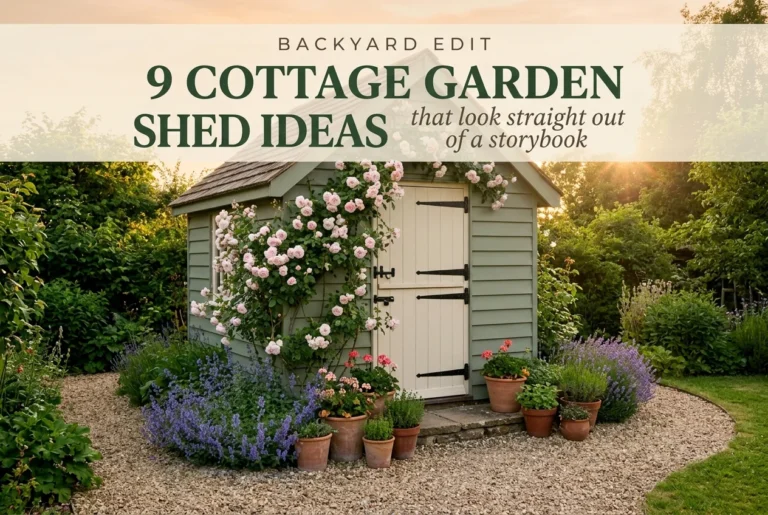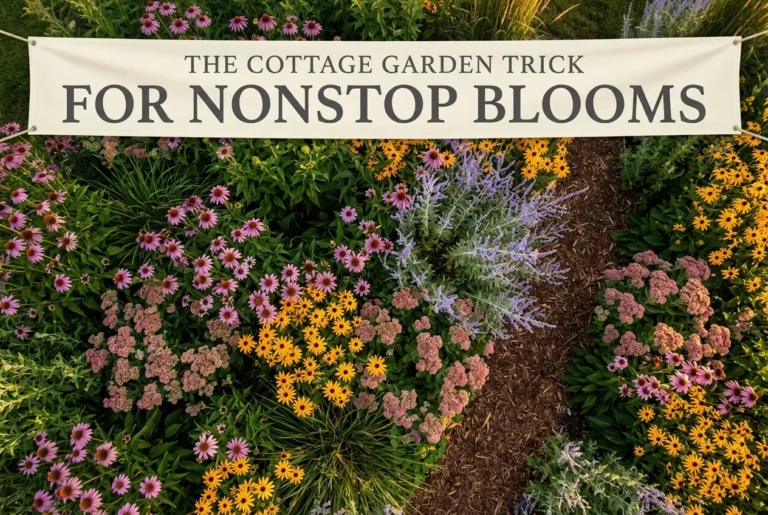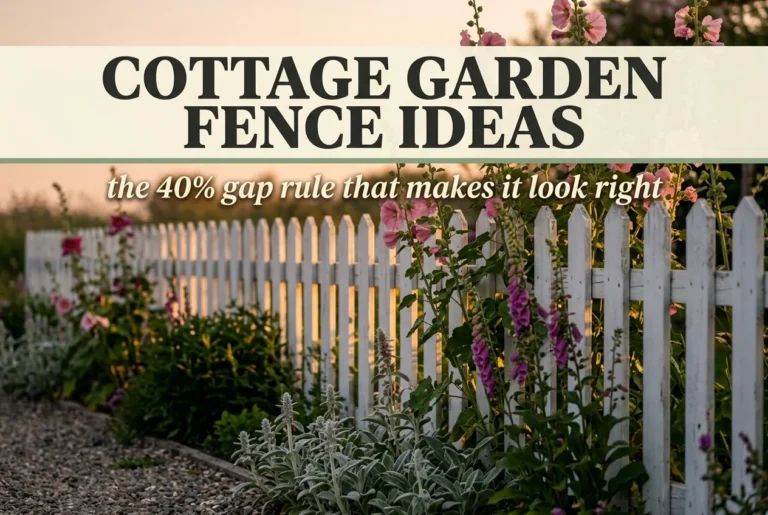
English Cottage Garden Design That Fits Whatever Yard You Actually Have

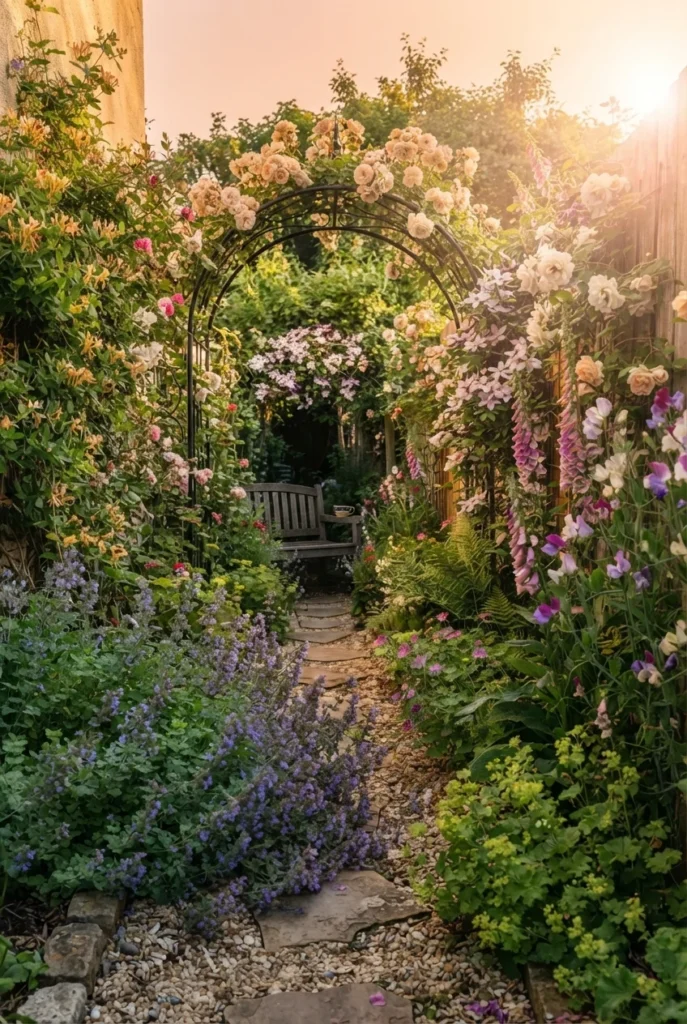
You have seen the picture. Foxgloves shoulder to shoulder with roses, a gravel path disappearing under catmint, everything spilling and nothing in a straight line. Then you walk outside, look at your actual yard, and the math stops working. The English cottage garden in your saved folder was photographed in a half-acre English village plot. Yours is a 5-foot strip between a driveway and a fence.
Here is the promise: an English cottage garden scales down much further than anyone tells you. It survives a narrow side yard, a 30-inch front bed, even a balcony rail. Two conditions. You keep the layers in the right order, and you give up the one thing most beginners refuse to give up.
That thing is plant variety. More on that in a minute.
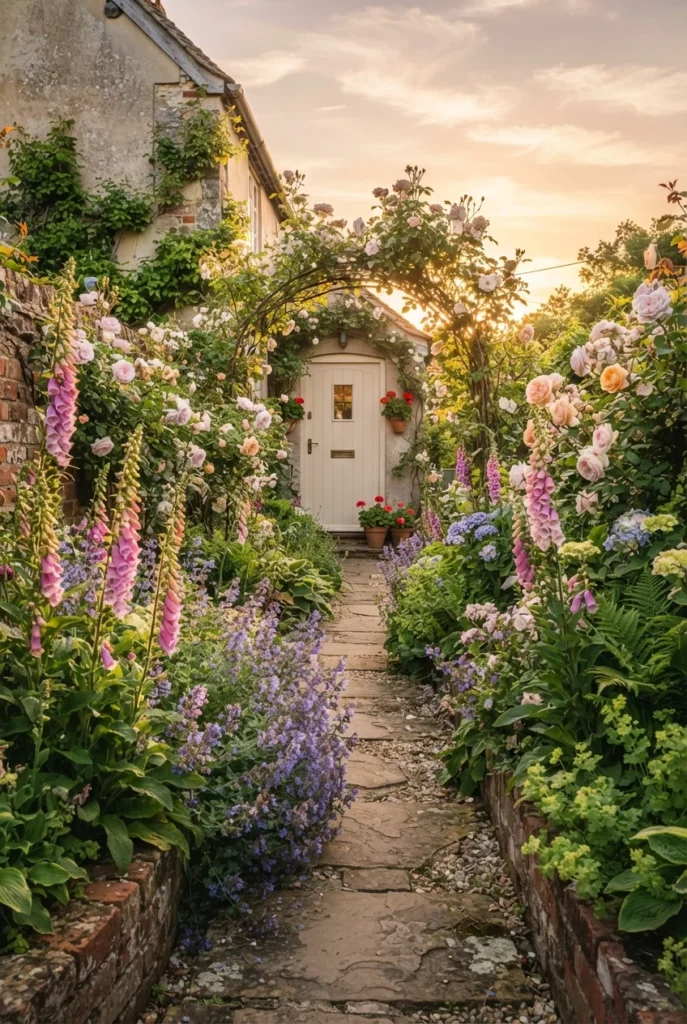
What Actually Makes a Garden Read as an English Cottage Garden
Strip away the romance and an English cottage garden is doing three unglamorous jobs at once.
It hides its edges. It repeats itself. It goes vertical.
Miss any one of those and you get a mixed perennial bed, which is a fine thing to own but photographs like a mess. The original cottage gardens were working plots. Food first, flowers packed in around the vegetables to pull in pollinators, every square foot earning something. That crowding is the whole aesthetic, and it is why a sparse, tidy, well-spaced planting never quite lands.
Gertrude Jekyll gets the credit for turning that accident into a design language in the late 1800s. Her contribution was drifts: instead of one of everything, plant seven of one thing in a long lozenge shape, then let the next drift overlap it. Your eye reads flow instead of confetti.
Most people plant confetti. They come home from the nursery with fourteen different plants, one of each, and wonder why the bed looks busy rather than lush.
The other half of the look is what the planting sits against. An English cottage garden with no wall, fence, arch, or hedge behind it has nothing to lean on. That is why the style often works harder in a front yard than in a wide open back one. If you are planting the street-facing side of the house, the same rules that drive good front yard landscaping ideas for curb appeal apply here: read the bed from 20 feet away first, from 2 feet second.
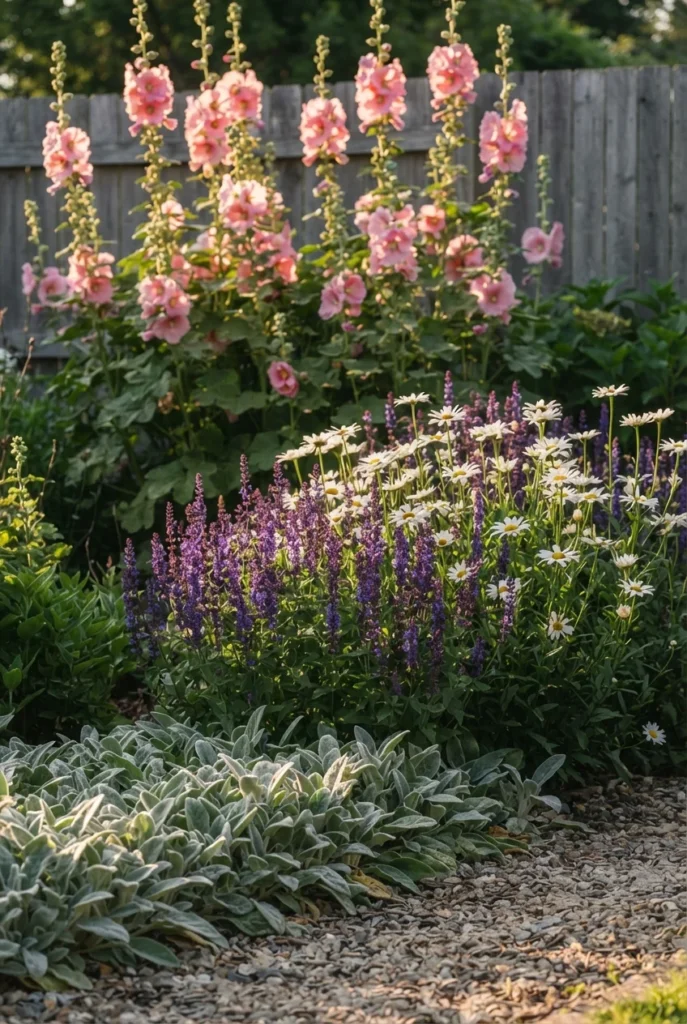
The 4-Layer Cottage Stack, or English Cottage Garden Design at Any Size
Here is the framework I keep coming back to. The 4-Layer Cottage Stack treats an English cottage garden border as four stacked bands rather than a plant list, and each band has a minimum depth it needs to look right. Once you know the depths, you can measure your bed and know instantly which layers you can afford to keep. The stack is also the reason a 5-foot strip can look better than a 12-foot one that was planted at random.
| Layer | Height | What goes in it | Minimum depth it needs |
|---|---|---|---|
| 1. Backbone | 6 ft and up | Climbing rose on an arch, obelisk, hedge, fence, trellis | 12 in. |
| 2. Spires | 3 to 5 ft | Foxglove, hollyhock, delphinium, larkspur | 18 in. |
| 3. Mounds | 18 to 30 in. | Catmint, coneflower, phlox, yarrow, peony, salvia | 24 in. |
| 4. Spillers | Under 12 in. | Lady’s mantle, lamb’s ear, creeping thyme, dianthus | 12 in. |
Add it up and a full four-layer stack wants about 66 inches of depth, call it 5.5 feet. That is the number nobody prints.
Now the scaling rule, which is the useful half:
- 6 ft or deeper: run all four layers. This is the postcard.
- 4 ft deep: keep layers 1, 3 and 4, and move the backbone flat against the fence so it costs you no floor depth.
- 30 in. deep: layers 3 and 4 only, with the backbone climbing the wall behind. Skip the spires or grow them in a pot you can rotate out.
- 18 in. or containers: layer 3 and layer 4, plus exactly one vertical element. That is the whole plan.
Notice what never gets cut. The backbone survives every reduction, because verticality is what your eye reads as English from across the street. Layer 4 survives too, because a hard visible edge between soil and path is the single loudest tell that a garden is young.
Here is my contrarian position, and it costs people money the first year: buy the arch before you buy the plants. A $238 metal arch at Home Depot with one climbing rose on it will read as an English cottage garden from the sidewalk by year two. Four hundred dollars of assorted perennials with nothing vertical behind them will read as a flower bed for the next decade.
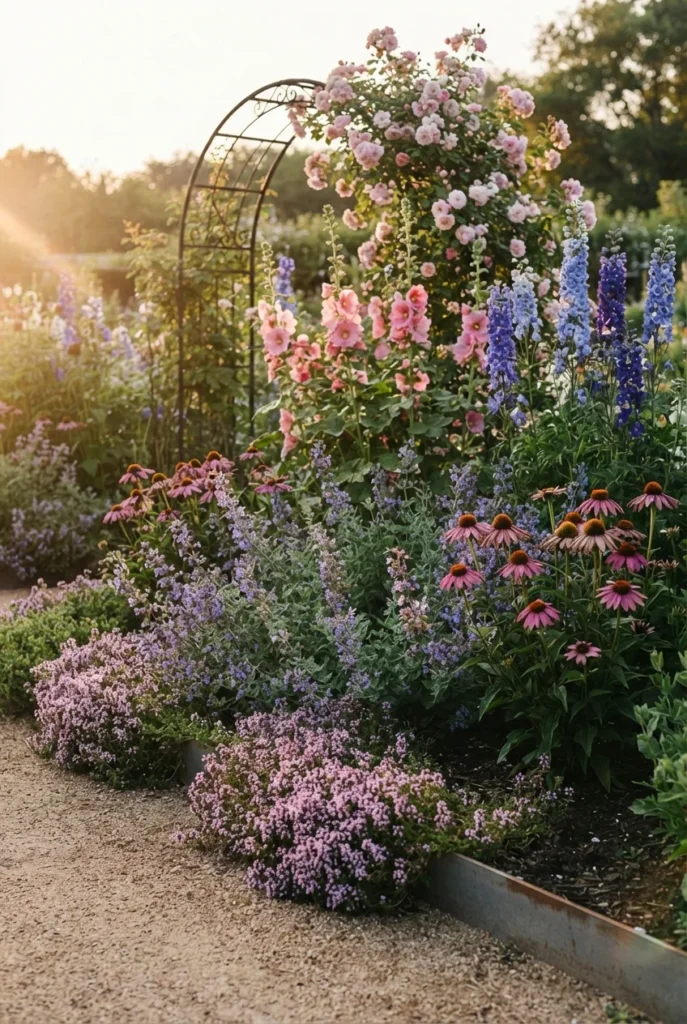
English Cottage Garden Plants That Do the Heavy Lifting in Your Zone
Before you buy anything, look up your USDA plant hardiness zone. The current map is the 2023 edition, which replaced the 2012 version and moved a lot of the country half a zone warmer. If you are planting from a list written before 2023, some of it is stale.
These are the English cottage garden workhorses, with zone data pulled from NC State Extension rather than from nursery tags.
Catmint, Nepeta x faassenii. Zones 5a to 9b, 18 inches to 2 feet tall and 2 to 3 feet wide, full sun to partial shade. Drought tolerant once it settles in, and it deters deer. This is the most forgiving plant in the whole stack. A 1-gallon Walker’s Low runs around $27 at Home Depot, and one plant covers close to 3 feet of frontage by its second summer.
Foxglove, Digitalis purpurea. Zones 4a to 9b, 2 to 5 feet, full sun to partial shade. Read this next part carefully: foxglove is a biennial, so a seedling planted this spring makes leaves this year and flowers next year. That timing trap gets its own section below.
Also, foxglove is genuinely poisonous. Every part of it, flowers through roots, carries cardiac glycosides, and NC State Extension rates it high-severity for dogs, cats, horses and children. It is still worth growing. It is not worth growing along a path where a toddler grazes, and that is a sentence no competing article on page one bothers to write.
Roses. The David Austin English roses are the shortcut to the look, and they price from $40 to $70 each on the US site. That is real money for one plant. My honest advice is to buy exactly one, put it on the arch, and fill everything else with cheaper perennials until you see how the bed performs.
Sweet peas. A packet of Burpee High Scent sweet pea seed is $6.95 and will cover a 6-foot obelisk. Nothing else in the garden gives you that much vertical for under seven dollars.
The rest of the mound layer. Coneflower (zones 4 to 8), peony (3 to 8), yarrow (3 to 8), hollyhock (3 to 8), columbine (3 to 8), bee balm (4 to 9). Buy them in threes or fives. Never one.
One thing to skip, and I say this having wasted a spring on it: the wildflower seed mix. It gives you a meadow. A meadow has no repetition and no structure, so it reads as neglect rather than as an English cottage garden. By August it is mostly stems.
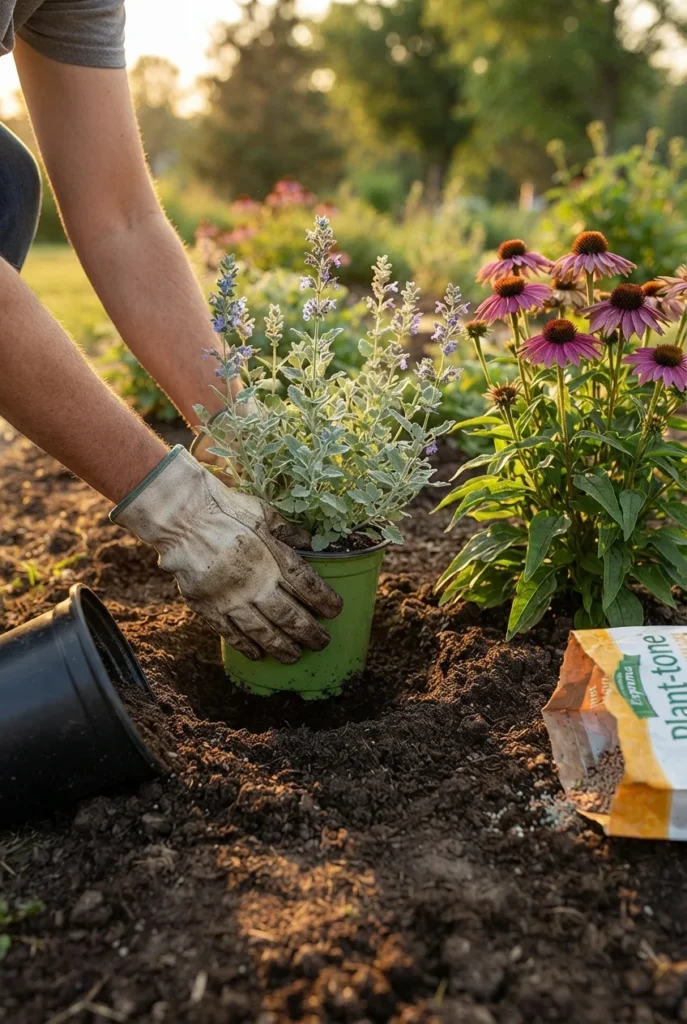
English Cottage Garden Ideas for Small Yards, Narrow Strips, and Balconies
This is where most guides quietly stop being useful, so let me be specific about three real footprints.
The 5-foot side yard. Run a single line of stepping stones down the middle, not along one edge, and plant both sides. Layer 3 and 4 on the near side, layer 1 climbing the fence on the far side. The corridor effect actually helps you: a narrow space packed to the walls reads as abundance, while the same plants in a wide bed read as gaps.
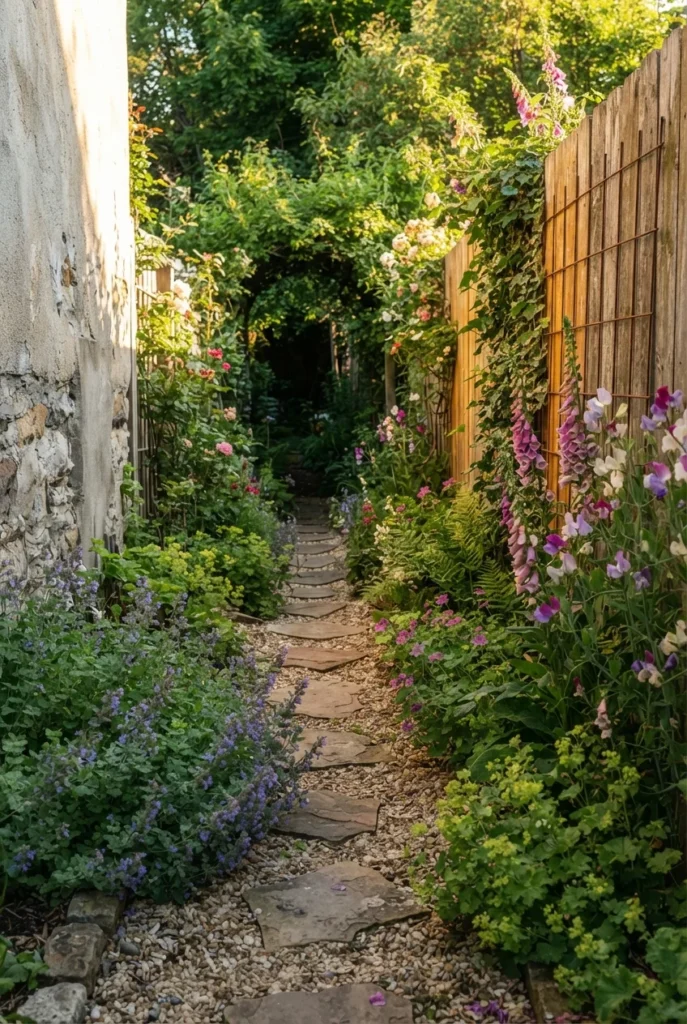
The 30-inch front strip along the house. Trellis on the wall, catmint and lady’s mantle at the base, and one seasonal pot doing the spire job. Rotate the pot: tulips in April, foxglove in June, dahlias in September. Three swaps a year and the strip never looks finished-and-forgotten.
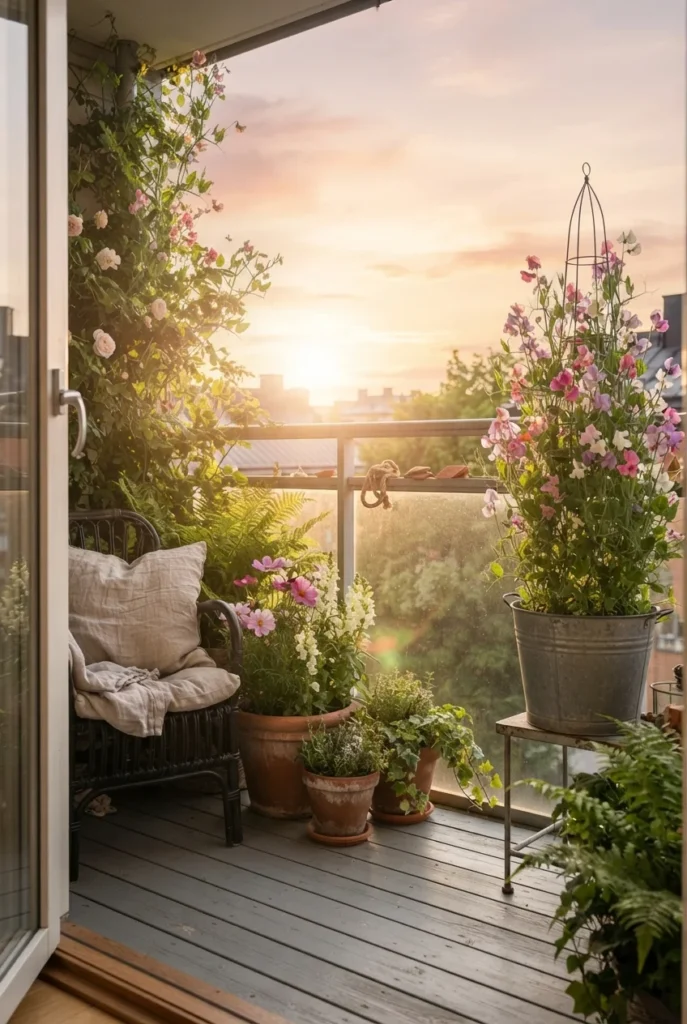
The balcony. Terracotta, a wire obelisk, sweet peas, and two mounding annuals. Cosmos and snapdragons will do more for you in a container than any perennial, because you are optimizing for one long season rather than five years of return.
Sun is the constraint that overrides all of this. If your small space gets under four hours of direct light, the plant list changes completely, and it is worth measuring before you spend anything. The sunlight-mapping approach in this guide to small backyard garden design works exactly the same for flowers as it does for vegetables.
Worth knowing: the original cottage gardens were half edible. Mixing dill, chives, and a few dwarf raspberries into the mound layer is historically correct, not a compromise, and it keeps a small garden earning its footprint.
Paths, Edging, and the Structure That Stops It Looking Messy
An English cottage garden is informal planting inside formal bones. Take away the bones and you have a weed patch with good intentions.
The bones are three things: a path with a defined width, an edge that holds a line, and at least one repeated hard material. Extension horticulturists say the same thing in plainer language. In its guide on how extension horticulturists lay out a cottage garden, NC Cooperative Extension puts borders, paths and hardscape first in the build order, ahead of buying a single plant. The planting sequence it gives is short in front, tall in back, then mulch.
Path width matters more than path material. Under 24 inches and it feels like a chore. At 36 inches two people pass, and the planting can flop over both sides by 6 inches without closing it off. Decomposed granite, pea gravel and reclaimed brick all work. Poured concrete fights the style.
The edge is where cottage gardens live or die, because you are deliberately letting plants sprawl and something has to say this sprawl is on purpose. A cut trench edge costs nothing but a spade and 40 minutes. Steel edging holds a crisper line for years. Either way you want a visible break, and this breakdown of garden edging ideas covers which option holds up in which zone.
Then repeat one material. The same brick in the path, the edging, and a low wall. Repetition is what your brain reads as intent.

The Shade English Cottage Garden Almost Nobody Attempts
Every article on page one plants this garden in full sun. Real yards have a maple.
A shaded English cottage garden works, it just swaps the cast. Foxglove is the bridge plant here, because NC State Extension lists it as happy in partial shade at 2 to 6 hours of direct sun, so it holds the spire layer where delphinium would sulk. Around it: astilbe for plumes, hosta for the blue and cream foliage weight, ferns for texture, lady’s mantle spilling at the front, and hellebores carrying the bed through late winter.
The rule that changes in shade is contrast. Sun gardens can lean on flower color. Shade gardens have to lean on leaf shape and leaf color, so you want a broad hosta leaf next to a fine fern frond next to the scalloped disc of lady’s mantle. Get the foliage contrast right and the bed reads as full even in July when almost nothing is blooming.
Watering catches people out. Dry shade under a mature tree is a root competition problem, not a light problem, and no amount of mulch fixes it in year one. Water deeply twice a week through the first summer, then back off.

What an English Cottage Garden Actually Costs, in Three Honest Tiers
Prices below are what these items list at right now in the US. Garden pricing moves with the season, so treat them as tiers rather than quotes.
Tier 1, under $200. Seeds and patience. A packet of Burpee High Scent sweet pea at $6.95, a wire obelisk, three 1-gallon catmint at roughly $27 each, and a bag of Espoma Plant-tone (the 27-pound bag runs about $38 at Home Depot). You get a real bed, thin the first year, convincing the second.
Tier 2, $400 to $800. Add the vertical. A metal garden arch at Home Depot sits around $238 for a piece roughly 8 feet tall and 5 feet wide. Add one David Austin rose at $40 to $70, nine to twelve perennials bought in threes, and the soil to plant them. Miracle-Gro Garden Soil comes in 0.75 cubic foot bags and takes 6 to 8 bags to cover about 24 square feet, so budget the bags honestly before you fill a cart.
Tier 3, $1,500 and up. Hardscape enters. Path material, steel edging along the full run, a bench, a small tree, and larger container-grown shrubs instead of quarts.
The tier that gets skipped is the one that matters most. Soil prep is invisible in photographs and it is the reason two identical plant lists look nothing alike in year three.
The Year Two Dip, and What English Cottage Garden Upkeep Really Takes
Why year one looks thin
Plant an English cottage garden in May and by August you will feel cheated. This is not a mistake you made. It is the biennial math.
Foxglove and hollyhock, the two plants doing most of the spire work, are biennials. Year one they build a rosette of leaves. Year two they throw the flower spike, set seed, and often die. Meanwhile the perennials you planted are spending their first season on roots rather than top growth, which is where the old saying comes from: first year sleep, second year creep, third year leap.
So the first summer looks thin, the second looks good, and the third looks like the photograph.
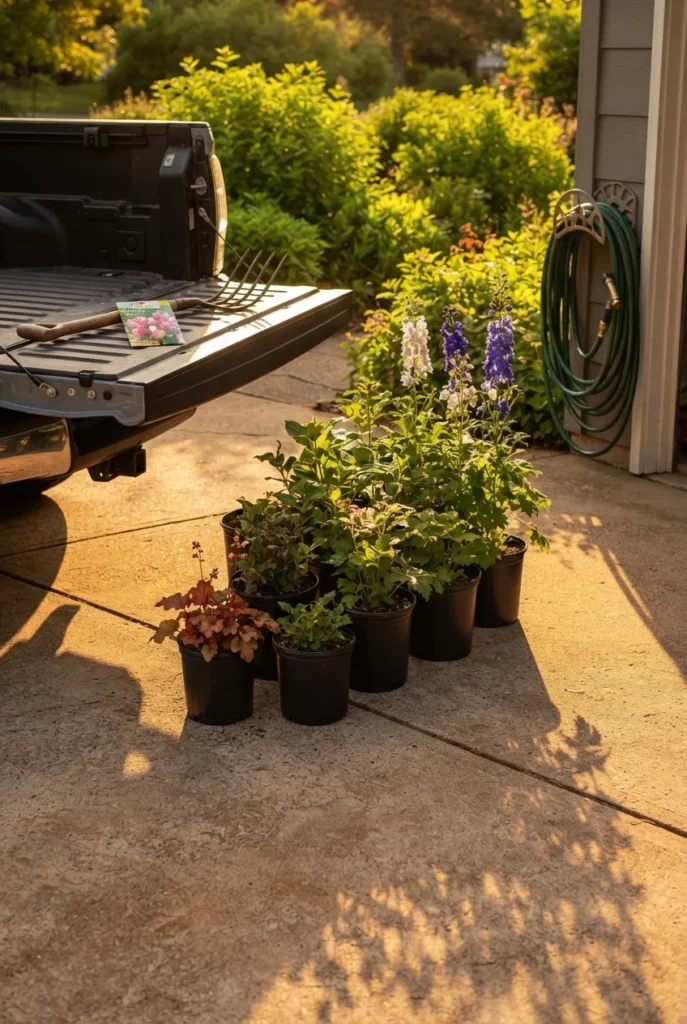
There are two ways to shorten that. Buy second-year foxglove plants already in bud rather than seed or plugs, which costs more per plant and buys you a whole season. And overplant the gaps with annuals for year one: cosmos, larkspur, nigella, snapdragons. They fill the holes cheaply and pull out clean.
Then let the foxglove self sow. Once it seeds itself into your bed it will keep the cycle running on its own, and the slightly random placement of self sown seedlings is exactly the informality this style depends on. Leave the seed heads on until they rattle.
Keeping it alive without becoming a full-time gardener
The maintenance reputation is overstated, though not by much. Budget about 30 minutes a week from April through September on a 100 square foot bed.
Deadhead the repeat bloomers, catmint and salvia especially, and cut catmint back hard by half after the first flush. It will rebloom in about three weeks. Mulch 2 to 3 inches deep in spring and stay an inch off the plant crowns. Divide the mound layer every three or four years, in fall, and use the divisions to extend the bed instead of buying more.
Water deeply and infrequently. Daily sprinkling grows shallow roots, which is what kills cottage plantings in their first hot August.
Skip staking if you can. Plants packed tightly enough hold each other up, and that mutual leaning is half the charm.
English Cottage Garden FAQ
What is the difference between a cottage garden and an English cottage garden? A cottage garden is any informal, densely planted flower garden. The English version adds specific conventions: a strong vertical backbone such as a rose arch or hedge, plants grouped in drifts rather than singly, a defined path, and a plant palette leaning on roses, foxglove, delphinium, hollyhock and catmint. The English style is also structured underneath the sprawl, which is the part people miss.
What are the key elements of an English cottage garden? Four: a vertical backbone, a spire layer at 3 to 5 feet, a mound layer at 18 to 30 inches, and a spiller layer under 12 inches that hides the edge. Add a path with a defined width and one repeated hard material such as brick or gravel. Those six things produce the look regardless of which flowers you pick.
Can you have an English cottage garden in a small yard? Yes, down to about 18 inches of bed depth. Below 5.5 feet you start dropping layers rather than shrinking all of them, and the backbone moves flat against a wall or fence so it uses no floor space. Narrow spaces actually flatter this style, because packing plants wall to wall reads as abundance instead of as gaps.
What plants are essential for an English cottage garden? Catmint (zones 5a to 9b) for the front, foxglove (4a to 9b) for the spires, one climbing or shrub rose for the backbone, plus coneflower, peony, yarrow, hollyhock and lady’s mantle. Buy in threes or fives. A single specimen of fourteen different plants is the most common beginner mistake in this style.
Are English cottage gardens high maintenance? Moderate. Roughly 30 minutes a week on a 100 square foot bed through the growing season, mostly deadheading and cutting catmint back after its first flush. Dividing perennials every three or four years and mulching each spring covers nearly everything else. Dense planting suppresses weeds, so year three is easier than year one.
How do I create an English cottage garden on a budget? Start with seeds and one vertical element. Sweet pea seed at about $7 covers a 6-foot obelisk. Annuals such as cosmos and larkspur fill first-year gaps for a few dollars a packet, and perennials bought as quarts instead of gallons cost roughly half. Spend on structure first and let the plants catch up.
When is the best time to plant an English cottage garden? Fall is the better window in most of the US, because roots establish through cool soil before the first hot summer. Spring works if you commit to watering deeply through August. Sow foxglove and hollyhock seed in late summer so they are established rosettes going into winter and flower the following June.
Start With One Border
You do not need the whole yard, and you do not need it this season. Pick one bed, measure its depth, and run it through the 4-Layer Cottage Stack to see what fits. If it is 5.5 feet or more, plant all four layers. If it is 30 inches, plant two and put the backbone on the wall.
Buy the vertical first, plant in drifts of three or five, let the foxglove seed itself, and give it until the third summer.
Then send yourself a photo of that bed today so you have the before shot. The comparison in two years is the best part, and most people forget to take it.