19 Cozy Backyard Ideas This Fall

By the second week of October, most backyards go quiet. Not because anyone stopped liking them. Because sitting outside stops being comfortable, and comfort is the entire job. Most cozy backyard ideas you find online open with pumpkins and close with a photo of a blanket, which is fine for a pin and useless at 7 p.m. when your feet are cold and there is nowhere to set your coffee.
We went at it from the other end. Nineteen ideas below, ordered by what actually keeps a person in a chair after sunset. Heat placement first. Then wind. Then the color of your light. Then somewhere to put a mug. The soft stuff comes last, because it only works once the rest is handled.
You will find the fix for cold concrete, the bulb spec that makes a yard feel warmer without one extra watt, and the reason your café lights keep snapping in November. Some of these cost around $40. One costs nothing at all. Save the ones that match your yard and skip the rest. That is the point of a list this long.
The Go-Inside Test
When people leave a backyard early, it is almost never the decor. It is one of three things: cold feet, light that makes them squint, or nowhere to set a mug down. Fix those three and a plain yard fills up. Skip them and a beautiful one sits empty with nine pumpkins on it. Before you buy anything this fall, walk out at 7 p.m., sit down in the chair you actually own, and notice which of the three gets you first. That is your starting point, and it is probably not the one you were planning to spend money on. Every one of the cozy backyard ideas below aims at one of those three.
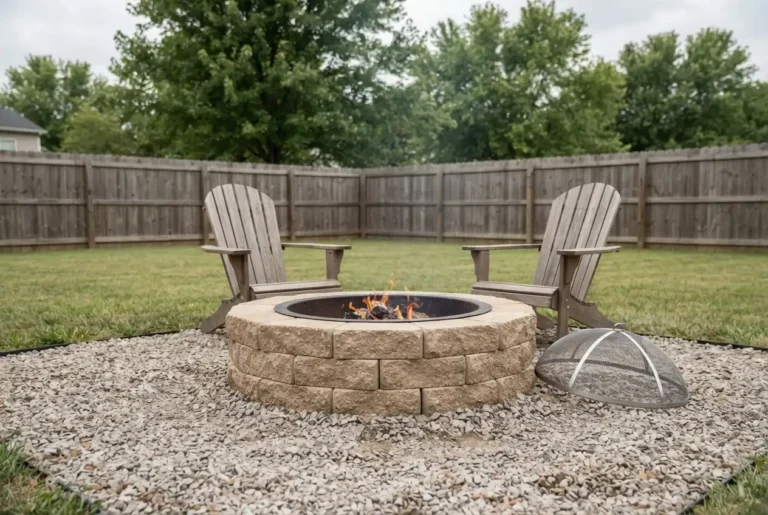
1. Move the fire pit 10 feet off the house before you spend another dollar
Most backyard fire pits end up too close to the siding, and it happens for a boring reason: the patio is near the house, so that is where the pit lands. The U.S. Fire Administration’s outdoor fire safety guidance puts fire pits and outdoor fireplaces at least 10 feet from your home or anything that can burn, and asks for a metal screen over wood fires to catch sparks.
Ten feet fixes something nobody mentions, too. Smoke. Pushed up against a wall, smoke rolls back over the seats and everyone spends the evening turning their head. Out in the open it lifts and goes. A Solo Stove Bonfire 2.0 runs in the $300 to $400 range and burns cleaner than an open ring, but even a smokeless pit needs the distance.
⚠️ Watch Out
Check your city’s burn rules before you light anything, keep the clearance from structures and branches that your fire pit’s manual and local code call for, and never leave a fire unattended.
2. Block the wind first, because a heater cannot outrun a breeze
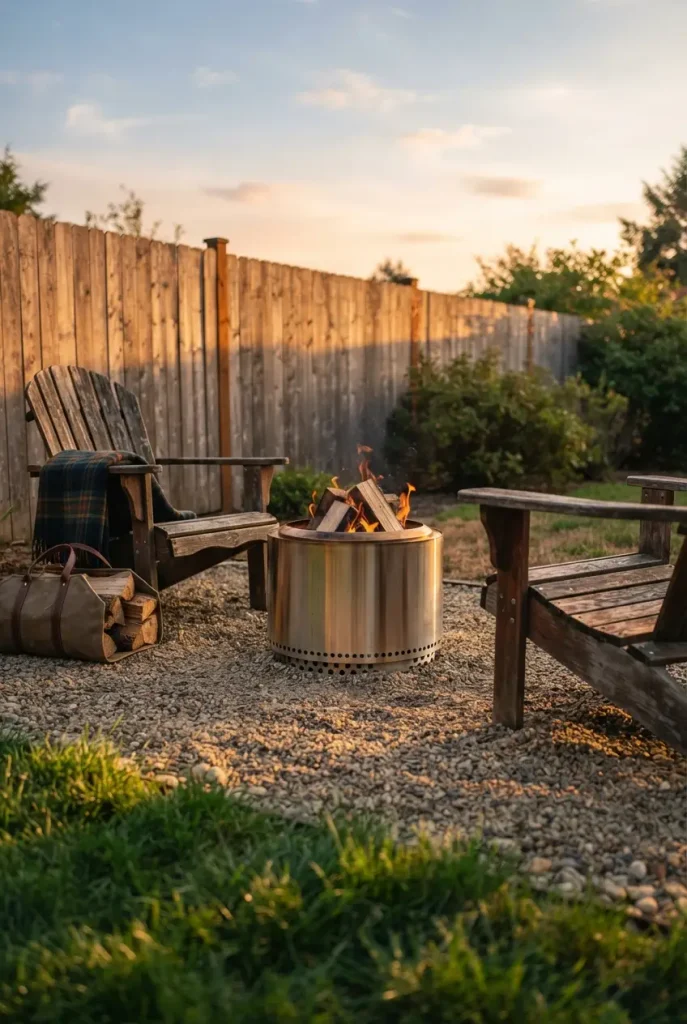
Wind is the reason fall yards fail, and not one of the top-ranking guides on this topic mentions it. A 10 mph breeze at 58 degrees feels closer to 50 on bare skin. Candles blow out. Smoke chases people around the circle. Blankets flap instead of holding heat.
Stand outside on the next cold evening and find the direction it comes from. Then put something solid on that side: an existing fence panel you move the seats behind, a row of potted arborvitae, a firewood stack, a rolled bamboo screen zip-tied to the fence for around $30. Solid beats decorative here. Once the wind stops, every other thing on this list starts working better.
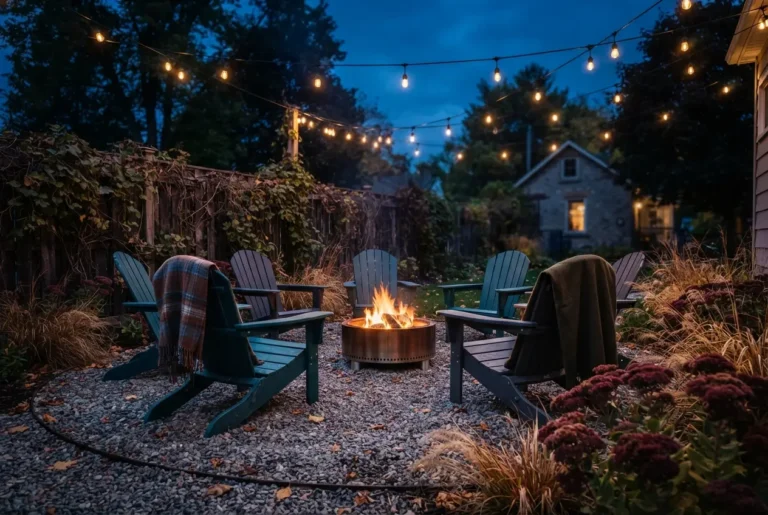
3. Switch every bulb to 2200K and the yard feels ten degrees warmer
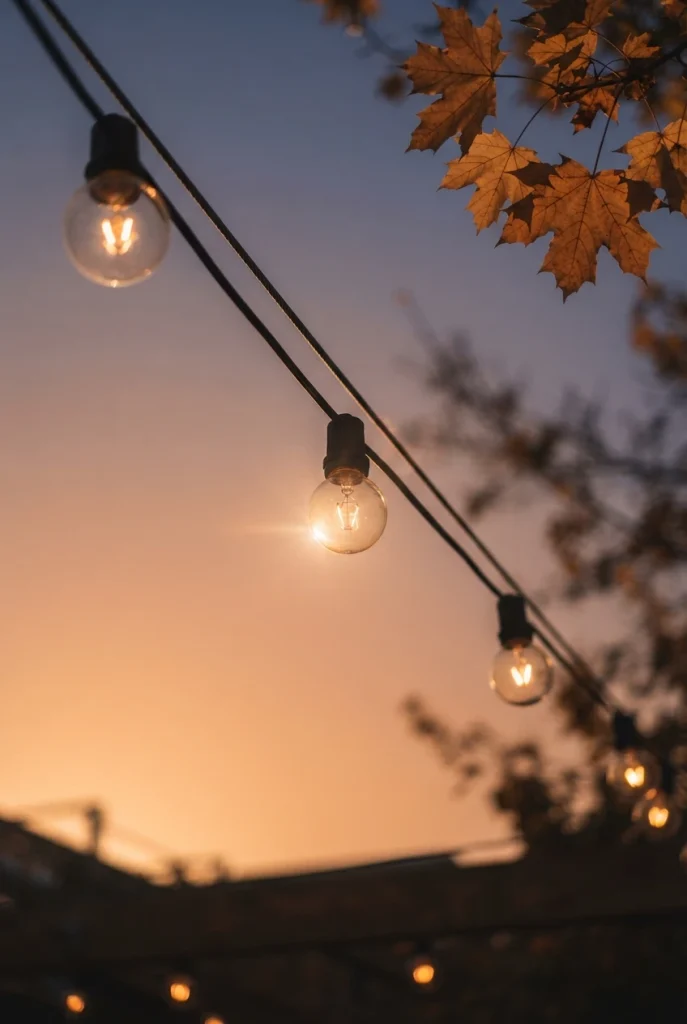
Color temperature does more for warmth than wattage ever will. A 4000K bulb is the color of a parking lot. A 2200K bulb is the color of a candle flame, and your eye reads it as heat even though nothing moved on the thermometer.
Feit and Brightech both sell warm outdoor strings in that range, and a 48-foot commercial-grade run costs around $40 to $60. Read the box for the actual Kelvin number rather than the word warm, because warm gets printed on plenty of bulbs that are not.
| 2200K to 2700K | 3000K and up |
|---|---|
| Reads as candlelight and firelight | Reads as security lighting |
| Skin tones look warm, faces look soft | Skin tones go gray, everyone looks tired |
| Fire glow still reads as the brightest thing | Fire glow disappears against it |
| Sold as “amber,” “ultra warm,” “vintage” | Sold as “bright white,” “daylight” |
Use outdoor-rated, UL-listed lights and cords on a GFCI outlet. Anything beyond plugging into an existing outlet is a job for a licensed electrician.
4. Give every chair a surface within arm’s reach
The third failure in The Go-Inside Test is the quiet one, and it is the one people never diagnose. Someone stands up to set a mug somewhere. Standing up is how an evening ends.
Every seat needs something within arm’s reach, and none of it has to match. Count your chairs, count your surfaces, and make the two numbers equal. That is the whole idea.
Surfaces that cost almost nothing
5. Put a rug over cold concrete, and a pad under the rug
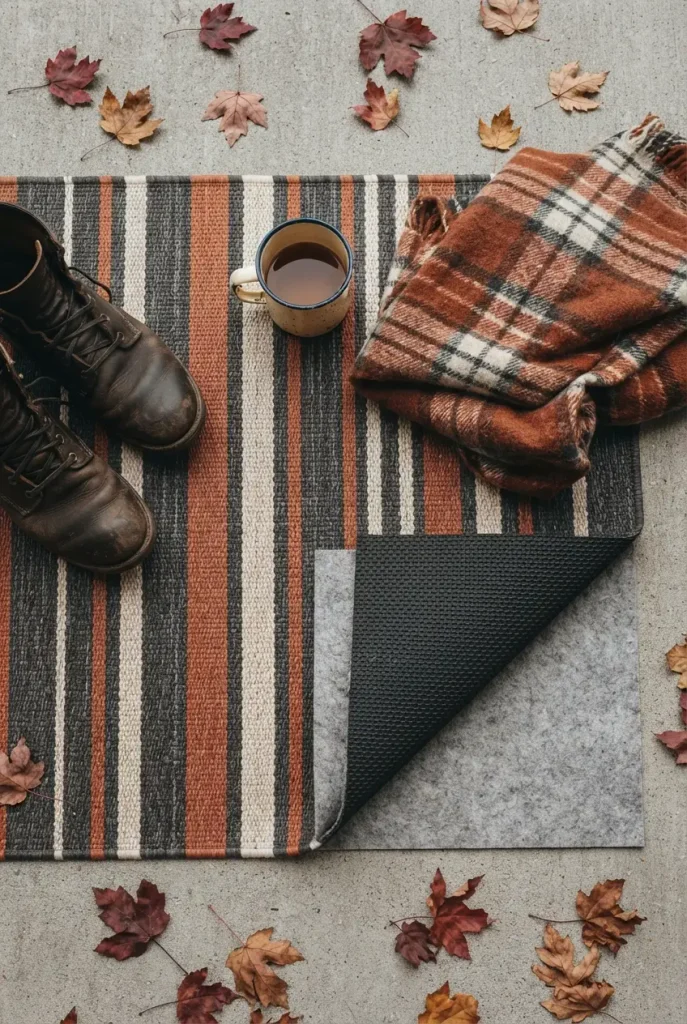
Concrete and pavers pull heat straight out of your feet, which is failure number one on the test and the cheapest of the three to solve.
An indoor-outdoor polypropylene rug from Target or IKEA runs under $60 for a 5×7 and dries fast after rain. The part almost everyone skips is the pad. Laid flat on cold stone, a thin rug just conducts the cold right through itself. A felt-and-rubber outdoor pad breaks that contact, adds a little give underfoot, and stops the whole thing sliding when someone pushes a chair back.
Warmth is mostly about what touches you. Air you can fix with a fire. The ground you can only fix with a layer between it and your feet.
6. Run café lights on a steel guide wire so wind stops snapping bulbs
Bulbs break in November because the cord swings. String lights directly between two posts and every gust turns the whole run into a whip, with all that force landing on the glass.
The fix is to give the load somewhere else to go.
Anchor an eye hook at each end, into a post, a fence rail, or the house band board. Not into siding.
Run stainless aircraft cable between them and pull it tight with a turnbuckle. A kit runs around $25.
Zip-tie the light cord to the wire every 18 inches, leaving a small loop of slack at each tie so the cord is never the thing under tension.
7. Park a lidded bin of wool throws three steps from the back door
Blankets stored inside do not get used. Nobody walks back through the kitchen, down the hall, and into the linen closet because their arms are a little cold. They just go in and stay in.
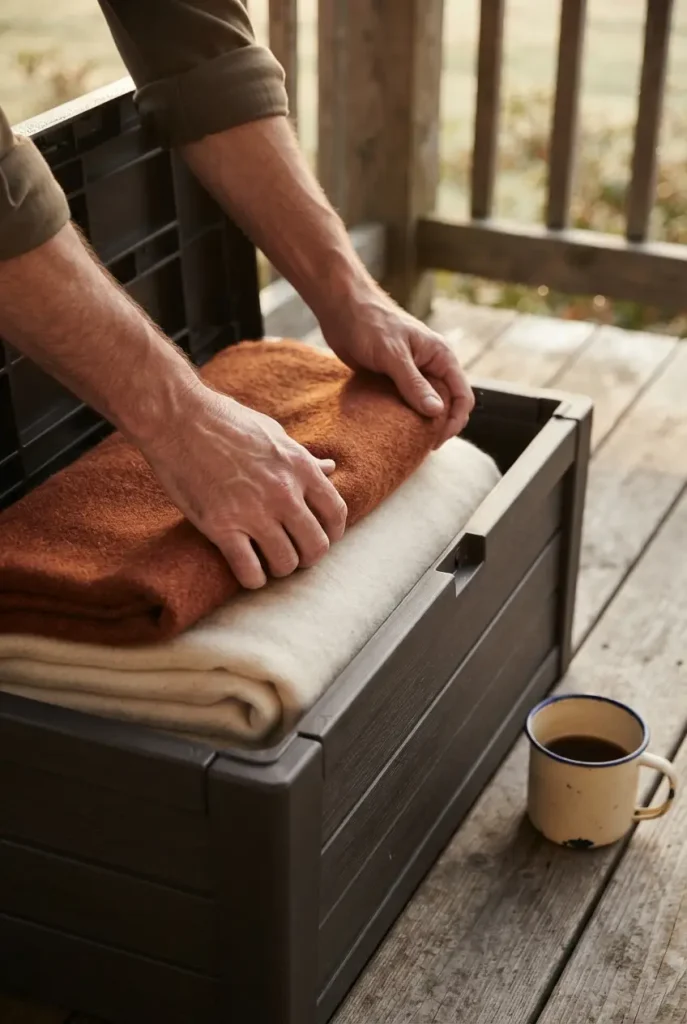
A weatherproof deck box near the door, around $50 at most home stores, changes that math entirely. What you put in it matters as much as where it sits.
Wool and fleece. Both stay warm damp and shed dew instead of holding it.
A hard lid with a gasket, not a fabric cover.
A cedar block or two inside to keep the smell honest.
Cotton throws. They soak up dew and stay clammy until noon.
A woven basket left out. It wicks water and grows mildew by week three.
Draping them over chairs “for the look.” That is how they get ruined.
8. Turn the porch floodlight off and light everything below shoulder height
One bright fixture overhead is failure number two on The Go-Inside Test. It flattens every face, erases the fire glow, and quietly tells everyone they are standing in a driveway.
Kill it. Then rebuild the light from several small sources, all of them low.
- ▸A lantern or two on the table, at elbow height.
- ▸One string run at the top of the fence, not overhead.
- ▸A candle inside each glass hurricane, where wind cannot reach it.
- ▸Solar path lights at ankle height, spaced wide enough to feel deliberate.
- ▸The fire itself, which only gets to be the brightest thing once the floodlight is off.
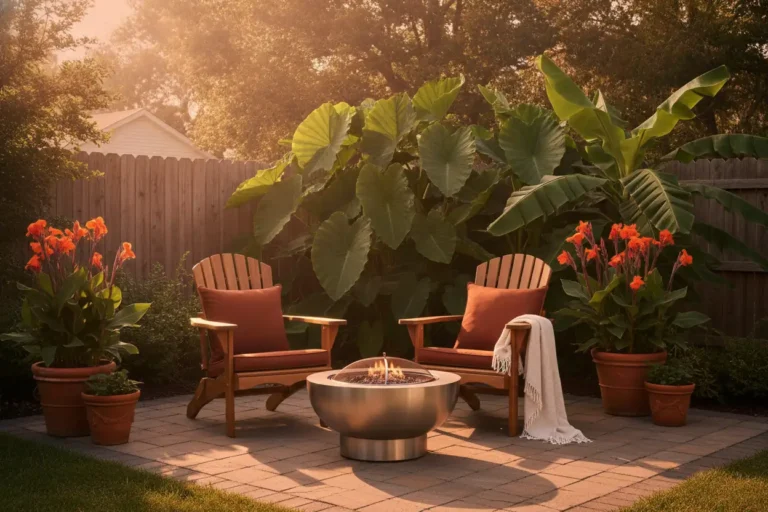
9. Cluster mums in three terracotta pots instead of scattering nine
Nine pots spread evenly around a patio read as clutter. Three grouped tight at one corner read as a decision somebody made.
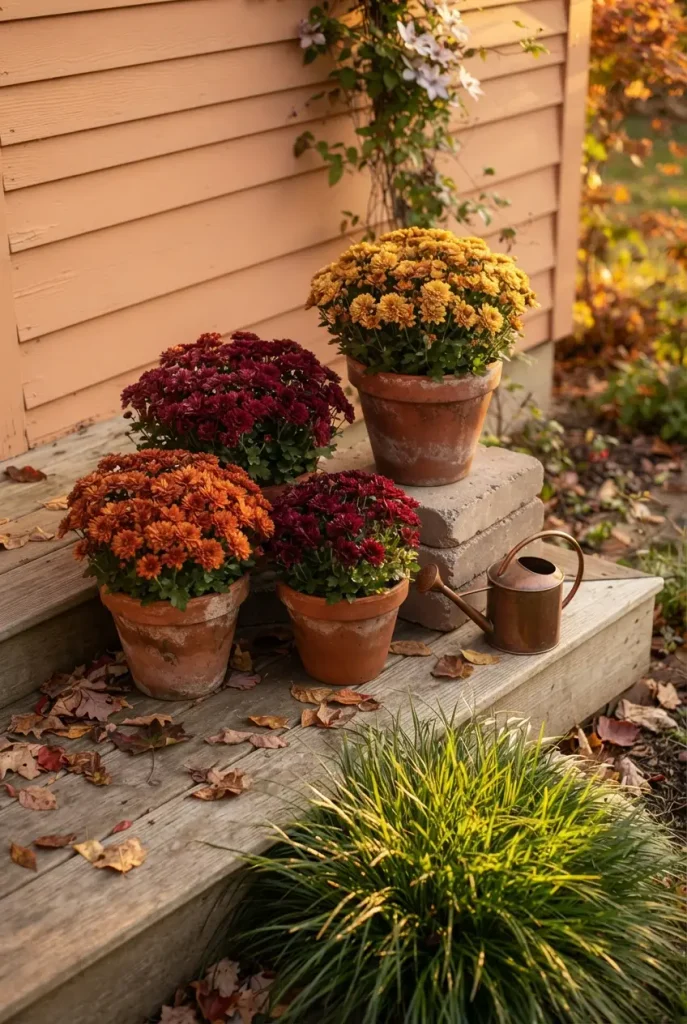
Garden-center mums run roughly $8 to $15 a pot across most US markets, and they are sold as annuals for a reason. The florist types rarely make it through a hard winter. If you want them back next year, buy hardy garden mums and look up your zone on the USDA Plant Hardiness Zone Map before you commit, since it takes a ZIP code and gives you the answer in one click. In Zones 5 and 6 a first frost typically lands somewhere between late September and late October, so pots bought in early September have a good run ahead of them.
10. Build the cozy outdoor seating area seven feet across, not twelve
Conversation falls apart past about eight feet. Most people ring a fire pit too wide because the patio is wide, and then everyone ends up talking sideways to the person next to them instead of across the fire.
Seven feet knee to knee is close enough to hear a normal speaking voice and far enough to sit comfortably beside flame. Four chairs pulled tight beats six spread loose, every time. If you are starting from bare ground, a DIY fire pit seating area on a budget is mostly gravel, edging, and one weekend of work.
| Tight circle, about 7 feet | Wide circle, 12 feet or more |
|---|---|
| One conversation, everyone in it | Splits into two, then three |
| Everyone feels the heat | Outer seats get nothing |
| Four good chairs are enough | You keep buying chairs to fill it |
| Less gravel, smaller pad, lower cost | More of everything, used less |
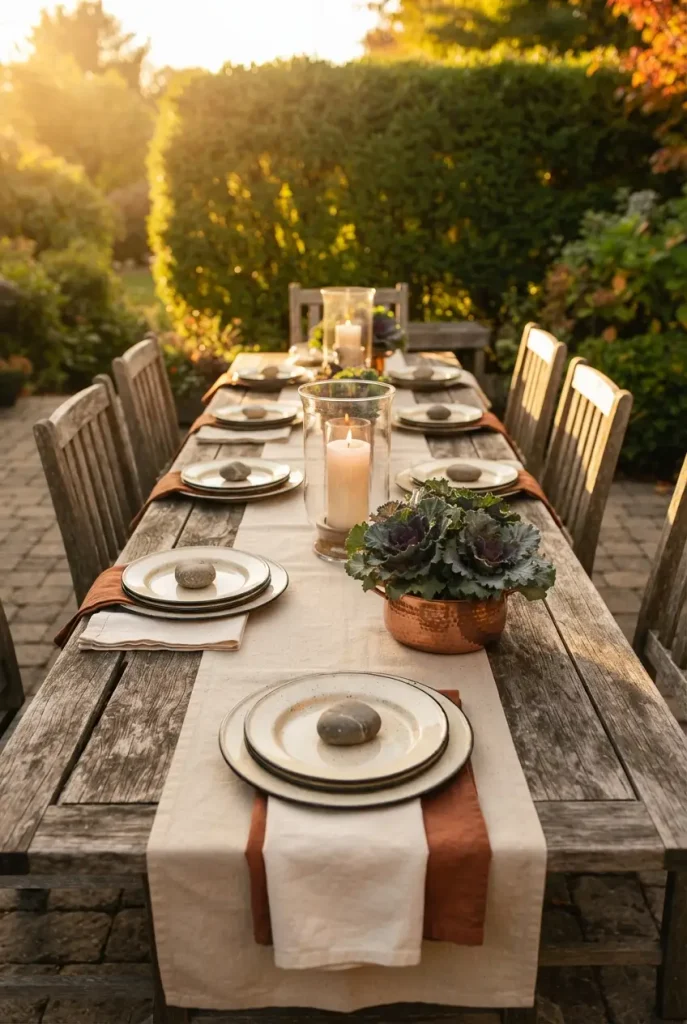
11. Set the table once in September and leave it set
A table that is already set gets used. A bare table asks for a decision first, and a decision is exactly what stops somebody carrying their dinner outside on a Tuesday in October.
Everything on it has to be weatherproof and none of it should be precious.
Lay a runner that can get rained on. Outdoor canvas or a cheap flat-weave, not linen.
Centerpiece is one glass hurricane with a pillar candle. It survives wind and it is the only light the table needs.
Stack enamel plates upside down so they shed water, with a smooth stone on top as the weight.
Leave it. Reset it once a week. That is the entire maintenance.
12. Lay a gravel pad so chair legs stop sinking into wet fall lawn
Fall lawn holds water in a way summer lawn does not. Metal and wood chair legs sink into it, tip when somebody leans back, and leave a set of holes that stay there all winter.
Four inches of compacted crushed stone over landscape fabric solves it for roughly a hundred dollars in bagged gravel on a small pad, and it drains instead of puddling. Gravel does one more thing that is hard to argue for on paper and obvious the first evening: it makes a sound when people walk on it.
A seating area stops feeling temporary the moment it has a floor. The gravel is doing more for the room than the furniture on top of it.
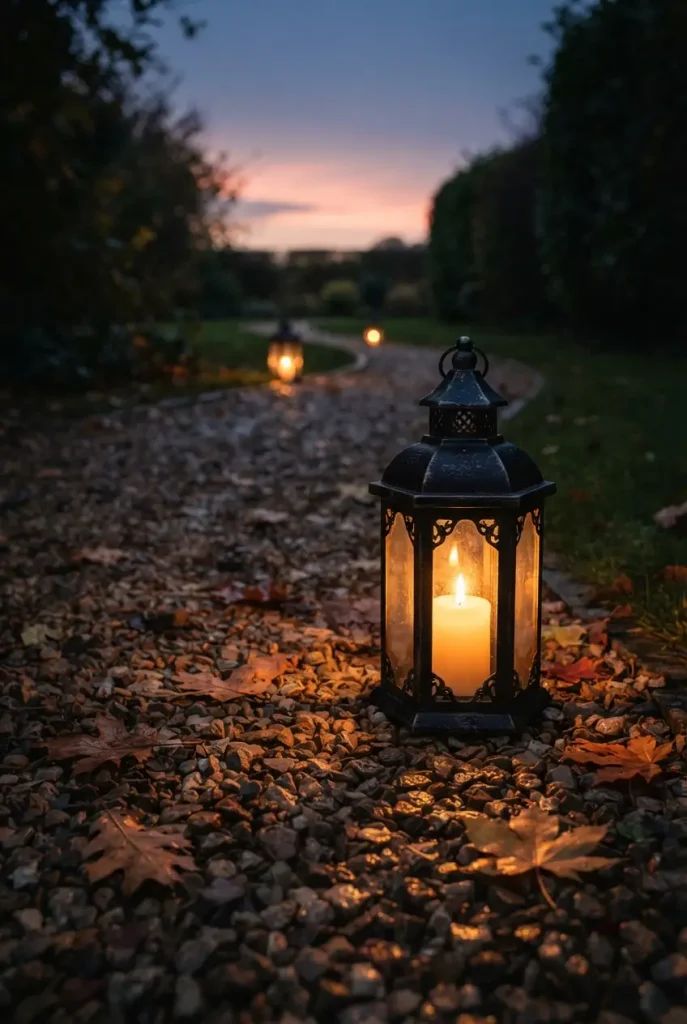
13. Light one path with lanterns and leave the rest of the yard dark
Lighting everything is the same mistake as lighting nothing. Contrast is what gives a yard depth after dark, and a fully lit yard is just a flat, bright rectangle.
Choose one route, the one from the back door to the seats, and mark only that. Everything else stays black on purpose. Our cozy outdoor lighting ideas for fall post goes further on layering if you want to push it.
Get the path right
14. Add the propane heater last, and put it behind you
Patio heaters get bought first, and they are close to the last thing you should buy. Here is the case against the popular move: a heater throws warmth in a narrow cone, it drains a 20-pound tank fast on high, and pointed into a breeze it does almost nothing at all. Spend that money on a wind block and a rug and you will feel more difference for less.
If you do buy one, place it behind the seating instead of in the middle of it.
Set it behind and slightly above the seats. Heat on your back, fire in your eyes.
Put the wind block in first so the heat has somewhere to sit.
Keep a spare tank. Running out at 8 p.m. ends the evening.
Standing it in the middle of the circle. It blocks sightlines and cooks one person.
Buying it before you have solved wind. That is money burned twice.
Anything tall and top-heavy on gravel without a wide base.
15. Stack firewood into a half wall you can actually sit against
Firewood usually gets shoved against the house, which is both the worst place for it and a waste of a perfectly good wall.
Stack it about four feet high in a straight run along the windward side instead. It blocks wind, it gives the seating circle an edge, and the wood ends up exactly where you need it at 8 p.m. Keep the bottom row off the ground on a rack or two pressure-treated runners so it does not wick moisture and rot from underneath.
📌 Good To Know
Green wood is the reason a fire smokes people out of their own yard. Buy seasoned wood, or stack this year’s for next year and burn last year’s. Split ends should look gray and cracked, not fresh.
16. Pick two heavy chairs over four light ones
Light resin chairs blow over in the first real gust, slide around on gravel, and feel cheap the second you sit in one. Two chairs that stay where you put them will get used far more than four that do not.
Polywood Adirondacks run in the $200 to $350 range each and never need sanding or a stain. Resin versions from most home stores start around $70 and give you a few seasons. Either way, sit in one before you commit, and check that the arm is wide enough to hold a mug, because that quietly solves the third failure on the test. If you are pacing the spend across a whole yard, our cozy backyard ideas on a budget roundup keeps the total under $200.
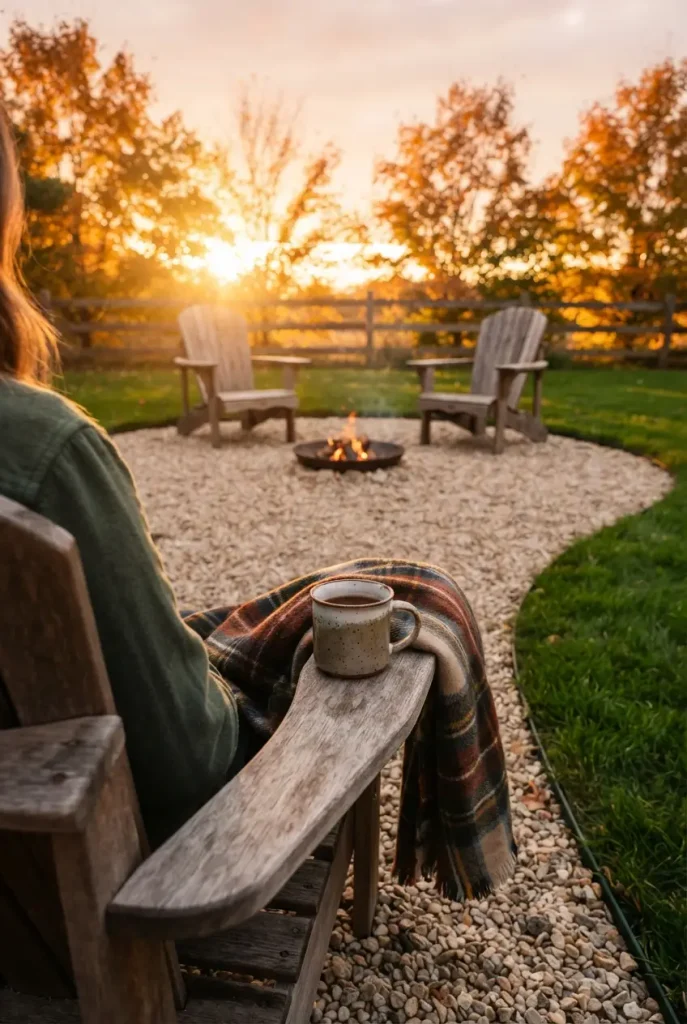
17. Line the fence rail with $1.25 hurricanes for fall backyard decor that survives wind
Dollar Tree glass hurricanes cost $1.25 each and they are the one genuinely cheap buy that holds up outdoors. Glass does not fade in sun, and wind cannot reach a flame sitting down inside one.
Spacing is what separates this from looking like leftovers.
- ▸Five or more in an even run reads deliberate. Two reads like an accident.
- ▸Same glass, same candle, same height. The repetition is the whole effect.
- ▸A handful of sand or dry rice in the base stops them tipping and holds the candle upright.
- ▸Flameless tea lights on a timer if the rail sits near anything dry.
- ▸Skip the seasonal print ones. Plain glass carries from September through February.
18. Turn the dead corner into the s’mores station
Every yard has a corner that collects nothing but leaves, a coiled hose, and one forgotten pot. It is usually the corner nobody has assigned a job to.
Give it one. A small table, a covered tin, long forks, and the chocolate already there. What it really does is create a second place to stand, which is the cheapest way to make a small yard feel bigger than it is.
Hose reel, a bag of something, leaves piled in the angle of the fence. Everyone walks past it and nobody stops.
A small table, a lidded tin of graham crackers and chocolate, roasting forks in a jar, one lantern. People get up and go to it, which is the point.
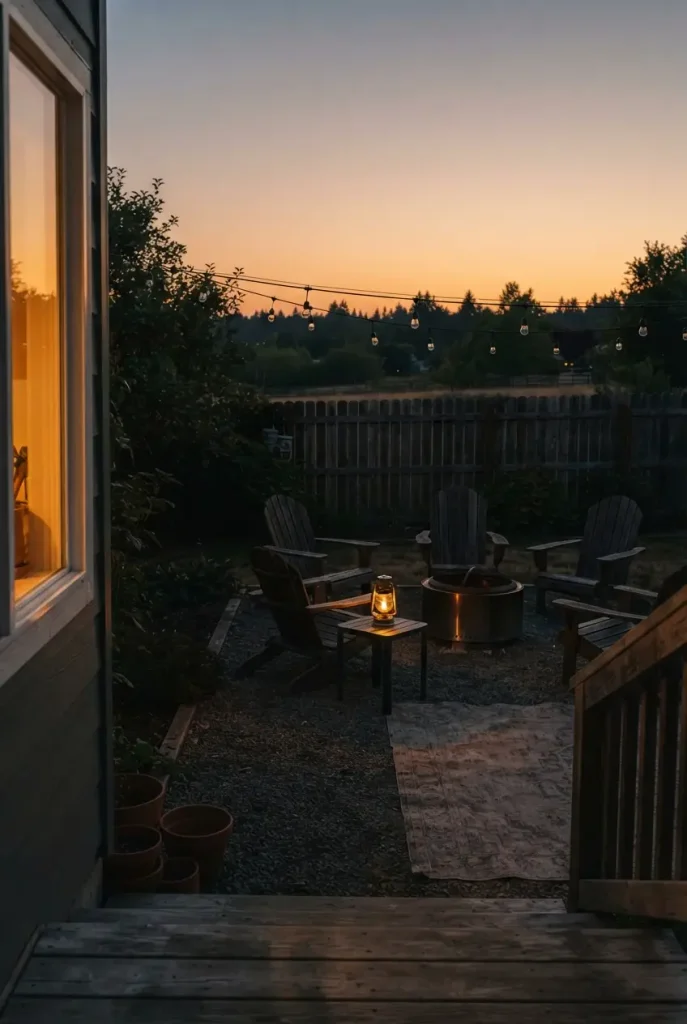
19. Leave one lamp burning when everyone goes in
This is the free one, and it is the reason people come back out the next night.
When the last person heads inside, leave a single low light on outside. A solar lantern on the table, or a low-wattage warm bulb by the door. From the kitchen window the yard reads as a room that is still there, instead of a black rectangle you stop looking at in October. It costs nothing, and it quietly keeps the space in circulation for another six weeks.
Put the fire fully out before anyone goes in. Not glowing, out.
Throws back in the box, lid down. Ten seconds now saves a damp blanket tomorrow.
Leave the one lamp on. Everything else off.
Frequently Asked Questions
What are the cheapest cozy backyard ideas for fall?
Start with the free moves. Pull the fire pit away from the house, find the wind direction and put something solid on that side, and switch off the porch floodlight. Then spend in this order: a rug and pad for under $60, warm 2200K string lights for around $40 to $60, and a surface beside every chair. Decor comes last, not first.
What works best in a small backyard?
Tighten everything. A seating circle around seven feet across, one lit path instead of a lit yard, and two heavy chairs rather than four light ones. Small yards fail when they get filled evenly, so leave the far corner dark and cluster your pots in one spot. A second small station, like a s’mores table in the dead corner, makes the space read bigger than it measures.
How much does a cozy fall backyard setup cost?
It splits into tiers. Under $100 covers a rug, a pad, and a few glass hurricanes. Around $200 to $400 adds warm café lights on a guide wire and a decent fire pit. Past that you are into chairs, gravel pads, and heaters. Most of the difference people actually feel comes from the first tier, which is the part nobody wants to hear.
Can I do any of this if I rent?
Most of it. Rugs, throws in a deck box, lanterns, clustered pots, hurricanes on a rail, and a freestanding fire pit all leave with you. Skip anything that needs drilling into the building. Use freestanding light poles in weighted planters instead of eye hooks in siding, and check your lease before you put anything permanent on a patio slab.
What is the most common fall backyard lighting mistake?
Leaving one bright overhead fixture on and calling it lighting. It flattens faces, erases the fire glow, and makes a yard feel like a parking area. The second most common is buying bulbs labeled warm without checking the Kelvin number. Aim for 2200K to 2700K, put the light low, and use several small sources instead of one big one.
What do I do with blankets and cushions when it rains?
Get them into something with a hard lid, not a fabric cover and not a basket. A weatherproof deck box near the door for around $50 is enough. Wool and fleece handle damp and dry out; cotton holds it and stays clammy. Cushions with quick-dry foam cores can stay out through a shower, but they still need somewhere to go before a long wet stretch.
Do I need a permit for a backyard fire pit?
It depends entirely on where you live, and it is worth ten minutes of checking. Many cities regulate open burning, set clearance distances, or ban wood fires during dry spells. Call your city building or fire department before you build anything permanent. A portable propane or smokeless pit is usually the simpler path where wood is restricted.
Before you close the tab
Most cozy backyard ideas get judged on how the photo looks. The yards that actually get used in November are almost never the prettiest ones. They are the ones where somebody fixed cold feet, harsh light, and nowhere to set a mug, then stopped worrying about the rest. Pick the two ideas above that match the failure you actually have, do those this weekend, and leave the pumpkins for later.
Save this list to your fall backyard board so it is there when the first cold evening catches you off guard.
Do these three this weekend