23 Cottage Cozy Backyard Ideas for Fall That Get Your Yard Used Again

Fall is the only season that does the hard work for you. The light turns gold by five, the air smells like woodsmoke from somebody else’s chimney, and a plain concrete slab suddenly has atmosphere it never earned in July. These cottage cozy backyard ideas lean into that instead of fighting it.
We pulled 23 together for real yards. Small ones. Rentals. The kind with a chain link fence and one tired hydrangea in the corner.
Here is what almost every fall roundup gets backwards: they open with pumpkins. Pumpkins are the last five percent. If your patio is cold and breezy at seven in the evening, no quantity of gourds will keep a single person sitting in it. So the order below runs warmth first, light second, pretty third.
Everything is scaled for USDA Zones 5 to 9, priced in honest tiers, and sorted so the cheap wins come first. Grab a coffee. Your backyard is about to get a lot more use this October.
Start with the Stay Outside Ladder
Before you buy anything, know which rung you are on. The Stay Outside Ladder splits a fall backyard into three spend levels and, more importantly, three priorities in order: get warm, get lit, then get pretty. Most people run it in reverse, spend $200 on decor in week one, and still end up indoors by 7:30 because the wind comes straight across the yard. Pick your rung, work top to bottom, and stop when the space feels good. Nobody has to finish the whole ladder.
1. Block the wind before you buy a single pumpkin
Cold air moving across your skin is what sends people indoors, not the temperature on your phone. A still 52 degrees feels fine with a sweater. A breezy 52 feels like November.
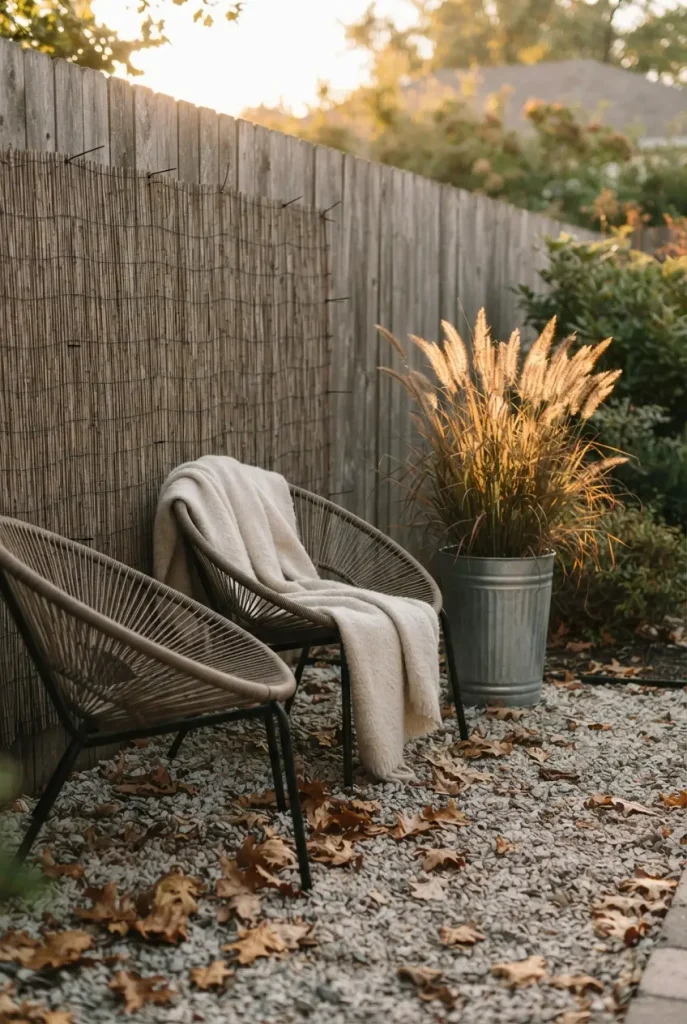
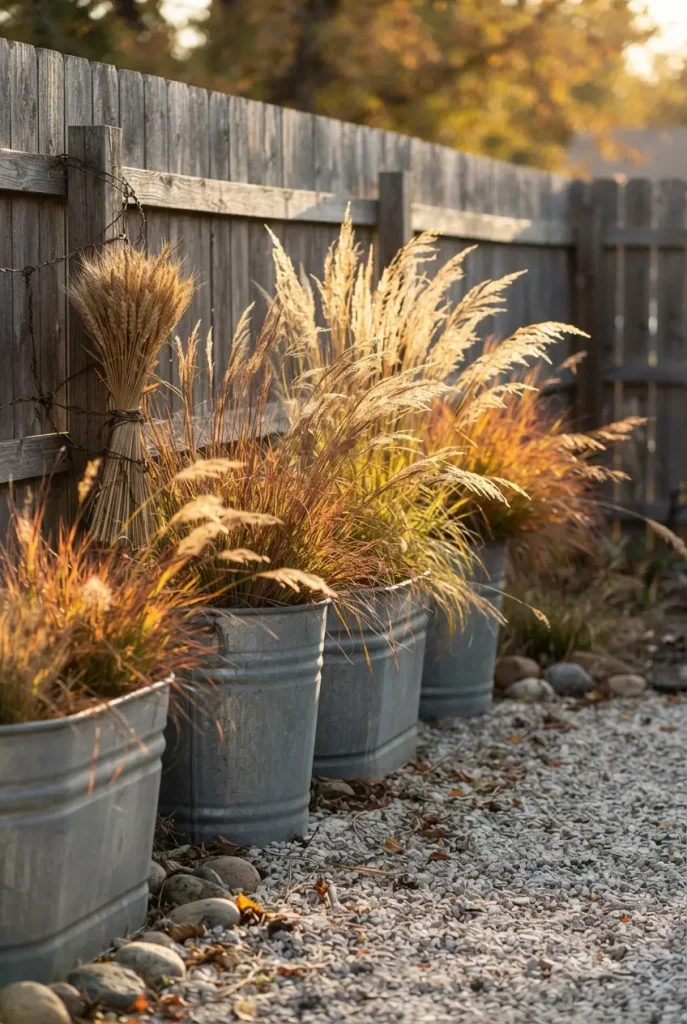
Find the direction your wind comes from, then put something solid in its path at seating height. A pair of 6-foot reed or bamboo roll screens zip-tied to the fence runs under $30 at most garden centers and takes twenty minutes. Two tall galvanized planters filled with switchgrass do the same job and look better. On a balcony, a fitted privacy screen along the rail works.
This is rung one of The Stay Outside Ladder, and it is the single highest-return thing on this whole page.
Block wind at seating height, roughly 3 to 5 feet, right where people sit.
Use something you can move, so you can chase the wind as the season shifts.
A solid 8-foot wall. It creates a downdraft that dumps cold air right behind it.
Outdoor curtains as your only windbreak. Pretty, but they billow and give up.
2. A cedar bench that hides every blanket you own
Every throw you drag outside has to go somewhere at 10pm, and “somewhere” usually means the back of a chair, where it soaks up dew overnight and smells like a wet dog by Thursday.
Build or buy a bench with a lidded box under the seat. Cedar handles the damp without sealing, and a 4-foot bench holds roughly six rolled throws plus a folded picnic blanket.
Measure the wall or fence run first. A bench deeper than 18 inches eats a small patio.
Use cedar fence pickets, not deck boards. Lighter, cheaper, and the lid stays liftable.
Add drain holes and a strip of scrap wood as a lid stop so it never slams on fingers.
Roll the throws instead of folding. You fit about a third more in the same box.
Cheapest version: a $25 galvanized trash can with a lid, lined with a contractor bag. Not charming, completely effective.
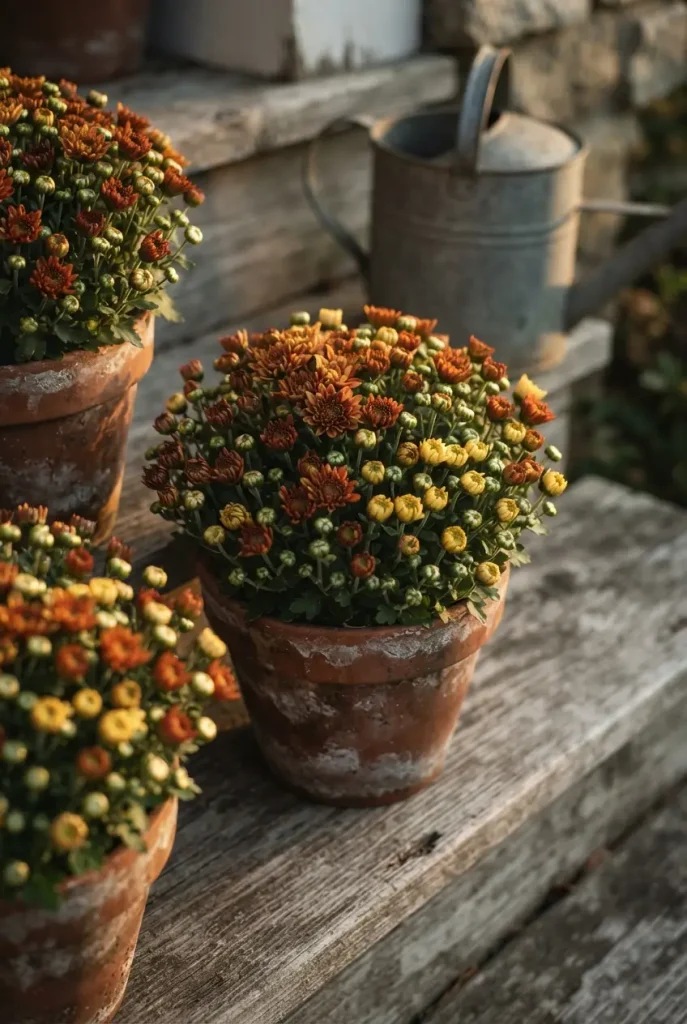
3. Buy mums in tight bud, never in full bloom
Garden centers stack the showiest mums at the front because they sell. Those are also the ones that will be brown confetti in twelve days.
Look past them. You want a plant where roughly a third of the buds are still closed and green at the tip. It looks stingy on the shelf and then blooms for a month on your steps.
The first fall we did this we bought six fully open plants from a grocery store display in late September because they looked incredible in the cart, and by the second week of October every one of them had gone crisp and we replaced the whole grouping. Six wasted plants taught the lesson faster than any article would have.
If you want them to come back, timing beats everything. Virginia Cooperative Extension notes that garden mums are typically hardy in zones 5 to 9 but need to go in the ground by late August or early September for real root development, so a plant bought in October is a seasonal decoration, not a perennial. Their guidance on how to overwinter garden mums also calls for 3 to 4 inches of light mulch like pine needles or clean straw over the crown, pulled back by early to mid April.
| Bought in tight bud | Bought in full bloom |
|---|---|
| Looks plain for about a week | Looks incredible on day one |
| Holds color roughly four to five weeks | Holds color roughly ten to fourteen days |
| Still good at Halloween | Usually replaced before Halloween |
| Same shelf price, about $8 to $15 a pot | Same shelf price, half the run time |
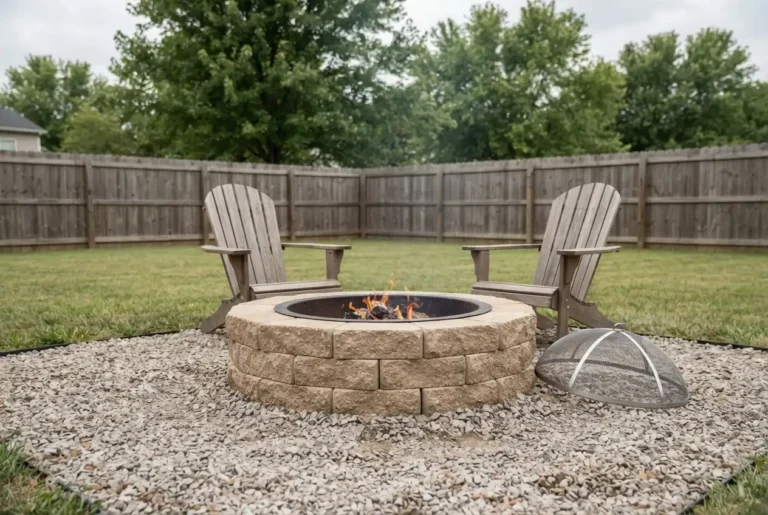
4. Give the fire pit a gravel corner instead of the middle of the lawn
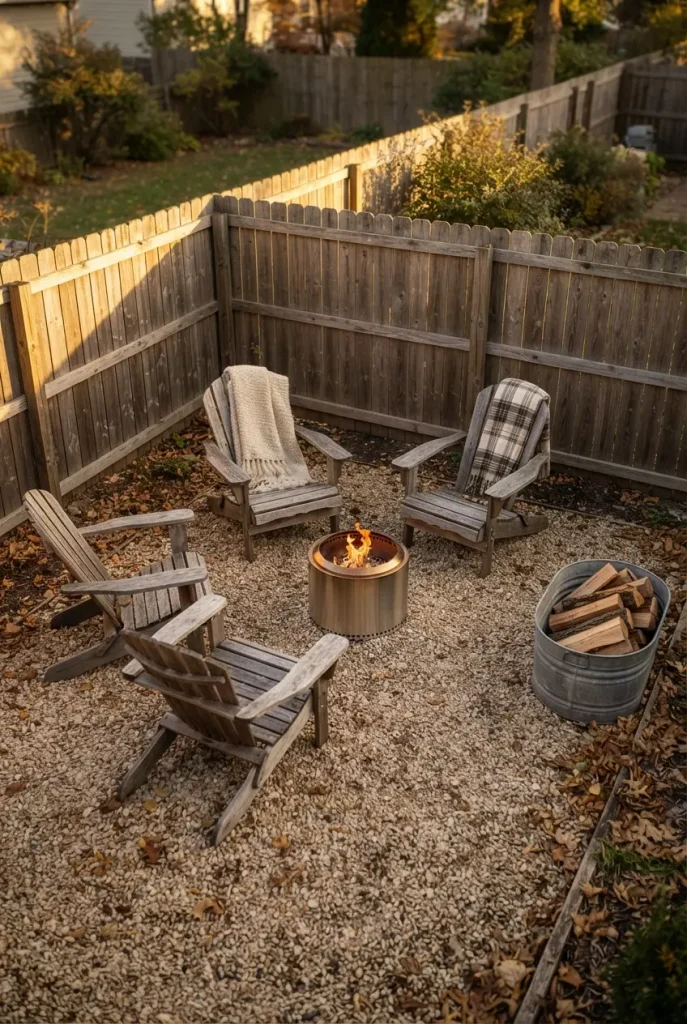
Grass under a fire pit turns into a scorched yellow ring by November, and you will look at that ring until May.
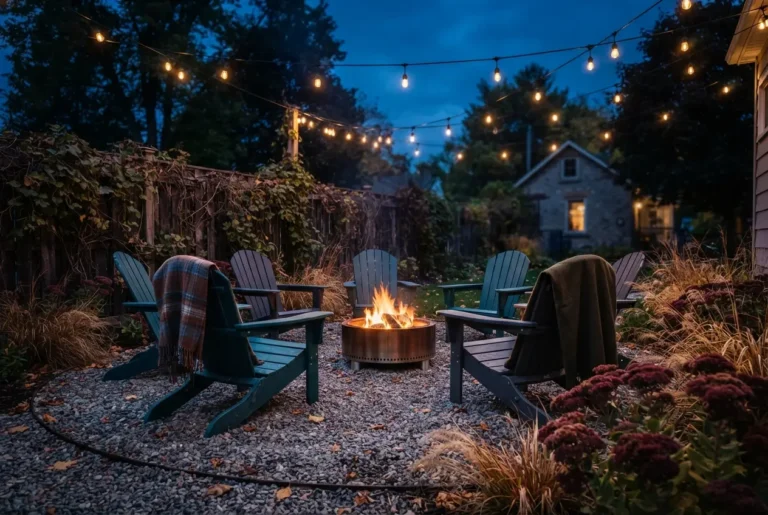
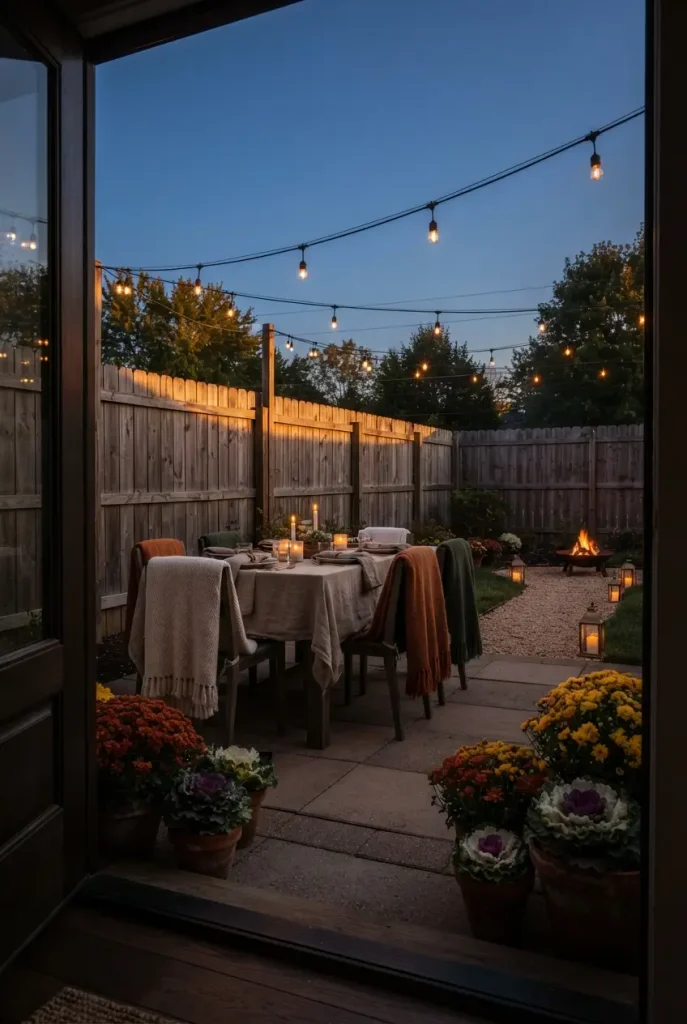
Pull the pit into a corner and put a 6 to 8 foot circle of pea gravel under it, roughly 2 inches deep over landscape fabric. Three or four bags from a home center covers a small circle and runs well under $60. Gravel drains, it does not burn, and it makes the corner read as a deliberate room rather than a fire pit parked on grass.
Ring it with four chairs, not six. Four pulls people close enough to talk over the crackle.
⚠️ Watch Out
Check your city’s burn rules before you light anything, keep the clearance from structures and branches that your fire pit’s manual and local code call for, and never leave a fire unattended.
If you want the full layout, seating math, and materials list, we walked through a budget fire pit seating area build start to finish.
5. Hang the cafe bulbs lower than feels correct
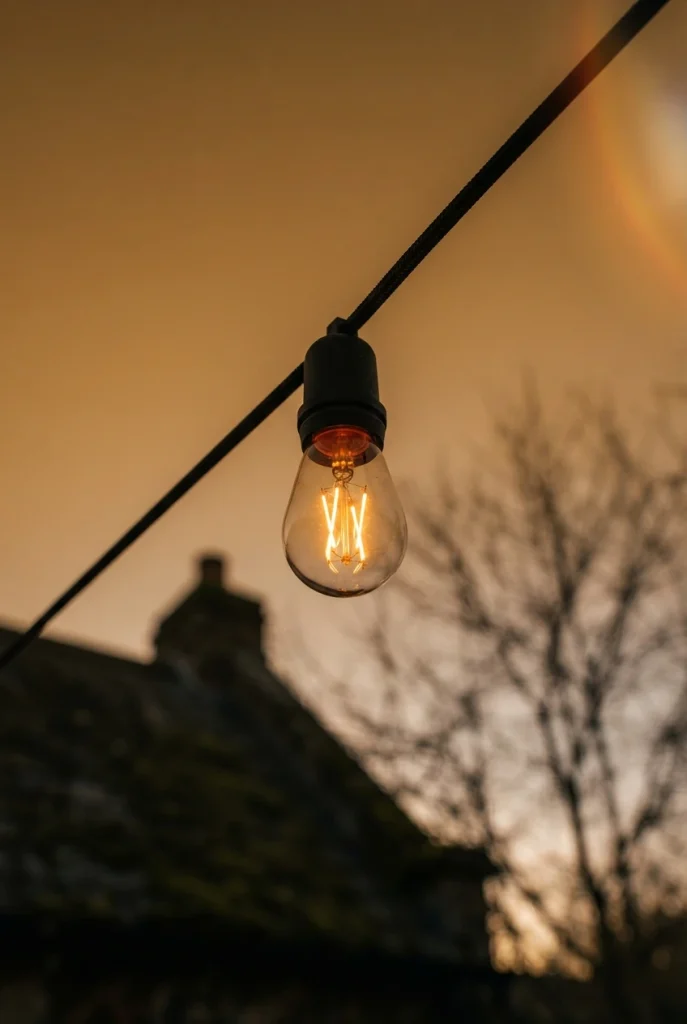
Most people string lights at gutter height because that is where the hooks are. Then they wonder why the yard still feels like a parking lot.
Drop them. A guide wire about 7.5 to 8 feet over the table brings the glow down into the space where faces are, and the whole area shrinks around it in the best way. Warm white only, in the 2200K to 2700K range, which is the difference between candlelight and a dentist’s office.
Two 24-foot Brightech or Feit strands run the length of most small patios and sit in the $30 to $70 range each. If you have no trees, a pair of 4×4 posts set in buckets of concrete will hold the run.
📌 Good To Know
Use outdoor-rated, UL-listed lights and cords on a GFCI outlet. Anything beyond plugging into an existing outlet is a job for a licensed electrician.
Twenty-seven more ways to work the glow are in our roundup of cozy outdoor lighting ideas for fall.
6. Group pumpkins in threes at three different heights
Odd numbers read as intentional. Even numbers read as a display at a garden center.
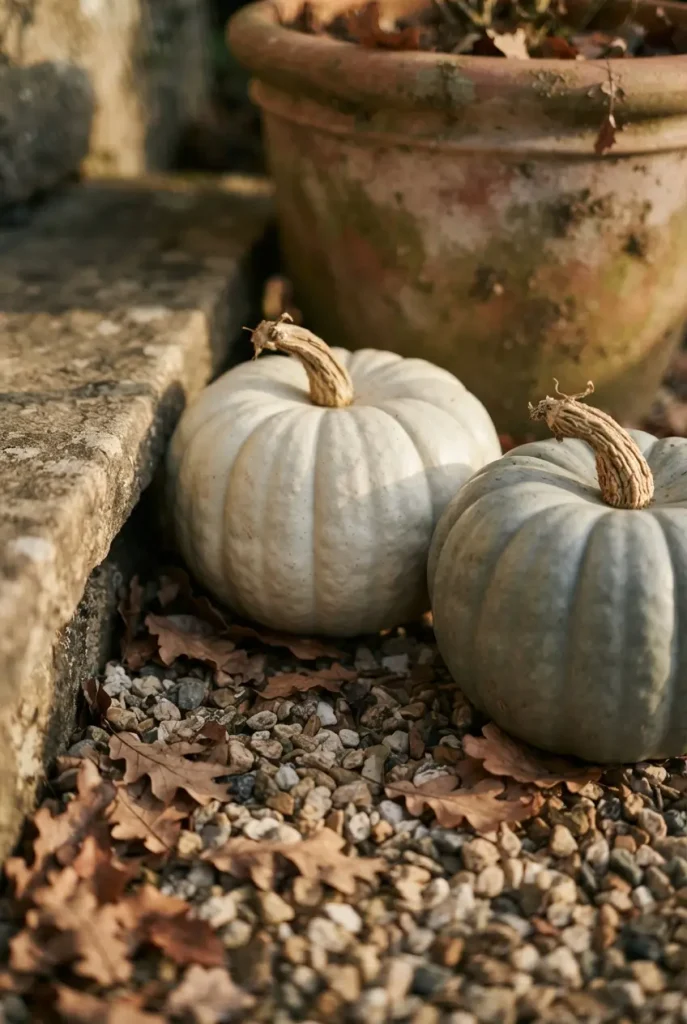
Pick three pumpkins of clearly different sizes, then stage them at three different heights: one on the ground, one on an overturned crate, one on the step above. Same trick works with two pumpkins and a squat pot of ornamental kale.
Colors that hold up on a cottage-style step: the pale ghost white ones, the flat blue-gray Jarrahdale, and one classic orange for contrast. Skip the glossy sprayed ones, which look plastic in daylight and worse in a photo.
The three-height grouping
7. Swap the summer rug for one you can hose down
Summer rugs hold water. By mid October a woven jute or a thick synthetic pile stays damp for days, grows a mildew smell, and quietly ruins the corner it was supposed to make cozy.
Flatweave polypropylene is the fall answer. It dries in about an hour of sun, it sheds leaves with a shake, and a 5×7 in a faded rust or muted olive runs in the $50 to $90 range at most big-box stores. Roll it out over concrete and the slab stops reading as a slab.
Faded summer stripe, heavy pile, wet for three days after every rain, curling at two corners.
Rust flatweave, dries in an hour, hoses clean in two minutes, weighted flat with the pots you already own.
Weight the corners with your terracotta pots instead of buying rug grippers. Free, and it looks arranged.
8. Let the hydrangeas dry on the plant and leave them there
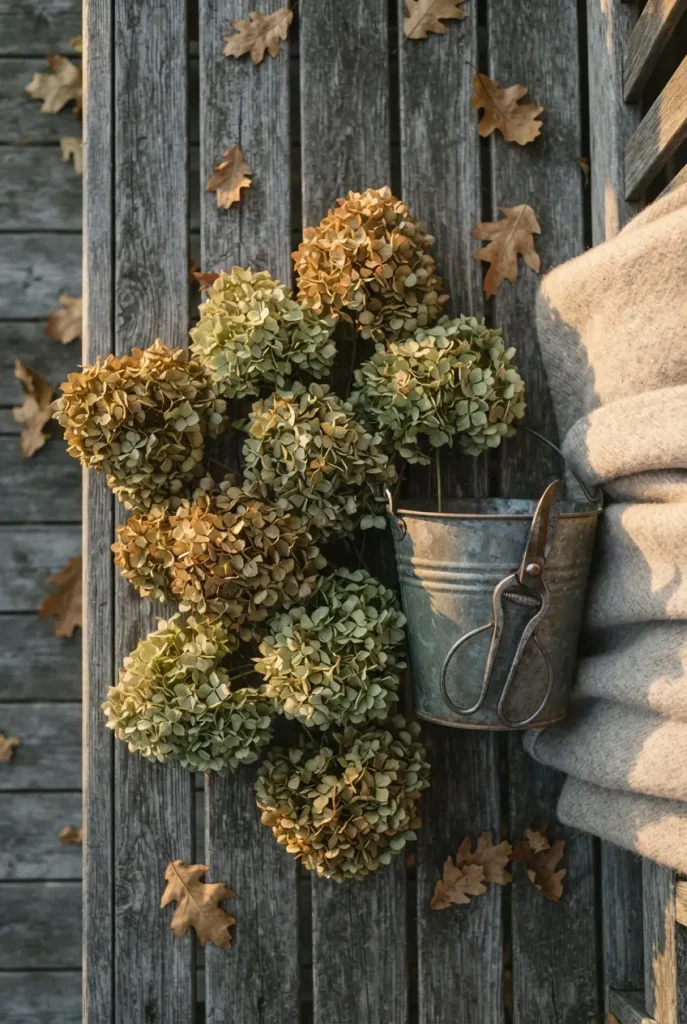
Hydrangea heads that fade to papery bronze and green on the shrub are the most cottage thing in any fall yard, and they cost nothing because you already grew them.
Stop deadheading in late August. Let them go. By early October they turn that dusty antique color, they hold through frost, and they catch low sun better than anything you can buy.
- ▸Cut a few for a galvanized bucket by the door and skip the water entirely.
- ▸Leave the rest standing. They give the winter bed structure once everything else collapses.
- ▸Same treatment works on sedum heads, alliums, and any seed head with a strong silhouette.
- ▸Coneflower centers left standing feed goldfinches into November.
More of this build-it-from-what-you-grow approach lives in our cottage garden yard ideas.
9. Keep the firewood where you will actually reach for it
Nobody walks to the side yard in the dark for one more log. The fire dies, everybody goes in, and the evening ends forty minutes early.
Park a galvanized tub or a wire log basket within arm’s reach of the chairs, loaded with enough split wood for one night plus kindling. A bundle from a grocery store runs a few dollars and burns fast; a rack of seasoned hardwood from a local supplier costs more up front and burns twice as long. Keep the tub on gravel or pavers, never on grass or a wood deck, and tip it after rain.
📌 Good To Know
Buy firewood close to where you burn it. Moving wood long distances is how tree pests travel, and many states ask you to source within about 50 miles. A local roadside rack is usually the right call anyway.
Rung three of The Stay Outside Ladder assumes you have this sorted, because a fire pit with no wood next to it is furniture.
10. Put real flame in glass lanterns along the steps
Battery tealights read as fake from about six feet away. The flicker is too even and the color is too blue.
Beeswax or soy pillars in clear glass hurricanes do something no LED manages: they move. A row of three lanterns down one side of the steps is enough. Four is generous. Nine is a fire hazard and a lot of matches.
Pick hurricanes tall enough that the flame sits at least 2 inches below the rim, so wind cannot reach it.
Drop an inch of sand or dried beans in the base. It steadies the pillar and catches drips.
Set them on the outside edge of each tread, never the middle, so nobody’s foot finds one.
Bring them in when you go in. Glass plus a hard freeze plus rainwater equals a cracked lantern.
Thrift stores are full of glass hurricanes in October for a couple of dollars each. They do not need to match.
11. Decide now what comes in when it rains
Rain will find your throw pillows. It always does, usually on the one night you left everything out because the forecast said forty percent.
Sort your fall setup into two piles before you need to, and keep a plastic tote by the back door for the first pile. Two minutes of sorting in September saves you replacing cushions in November.
| Comes in every time | Lives outside all season |
|---|---|
| Wool and cotton throws | Flatweave polypropylene rug |
| Paper lanterns, dried wheat bundles, books | Terracotta, galvanized metal, cedar |
| Seat cushions without a drainable core | Mums, kale, grasses, pumpkins on gravel |
| Glass hurricanes with candles in them | Metal lanterns, stone, the fire pit itself |
Pumpkins are the exception worth naming: they last far longer on gravel or a stone step than on grass or a wet wood deck, because the bottom stays dry.
12. Choose wheat, millet, and grasses over corn stalks
Corn stalks say roadside farm stand. Fine if that is the look, but they also flop, they hold water at the base, and they blow over in the first real gust.
Ornamental grasses do the same vertical job with more grace and they catch light in a way corn never will. Feather reed grass stands upright through wind. Little bluestem turns copper. Switchgrass goes gold and rattles in a way that is quietly great at night. All three are reliable across Zones 5 to 9.
For instant height without planting, a bundle of dried wheat or broom millet wired to a fence post costs a few dollars at a craft store and lasts to Thanksgiving.
13. Hang a cotton flat sheet and run a movie at 7pm
White cotton flat sheets make a better projection surface than most of the portable screens sold for the job, and dark comes early enough in October that you can start a film at seven and still get everyone home at a reasonable hour.
Clip a queen flat sheet to a fence, a pergola beam, or two shepherd’s hooks with spring clamps. Pull it tight. Wrinkles are the only thing that ruins it.
html
Fall movie night kit
Point the projector so the beam runs away from your neighbor’s bedroom window. Small courtesy, big difference.
14. Set the table with enamel, linen, and a runner you foraged
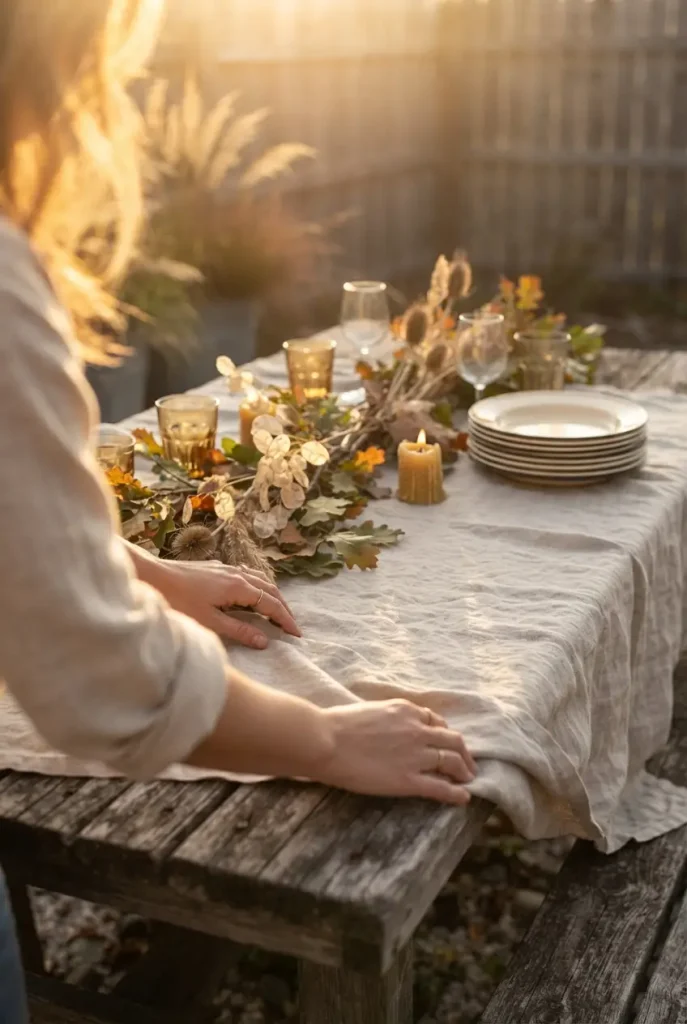
Enamel plates do not blow off the table, they do not shatter on a paver, and the chipped ones look better than the new ones. That is the whole cottage argument in one object.
Layer it: a washed linen cloth in oatmeal or clay, enamel plates, mismatched glassware, and a runner made from whatever the yard gave you. Cut branches, seed heads, a few small gourds rolled down the center. It takes six minutes and it photographs beautifully at golden hour.
15. Cluster terracotta in odd numbers where the paving ends
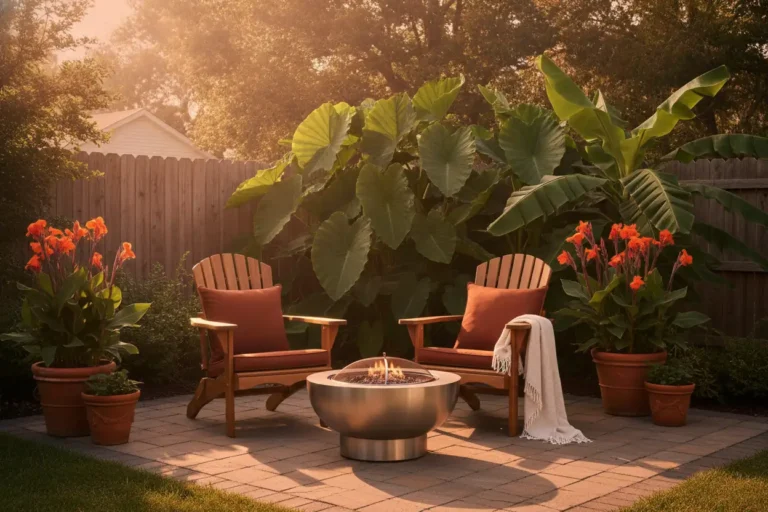
Terracotta darkens when it rains, and that is exactly the point. It goes from pale clay to deep rust and back again all season, which is more color movement than any painted planter will give you.
Where paving meets grass or gravel is the ugliest line in most yards. Soften it with a cluster of pots rather than a row.
- ▸Use three or five pots, in three clearly different sizes, pushed close enough to touch.
- ▸Fill with what still looks good in October: ornamental kale, heuchera, trailing ivy, a small dwarf conifer.
- ▸Leave one pot empty and tipped on its side with leaves spilling out. It reads as a garden, not a display.
- ▸Raise the tallest on two bricks hidden behind the others.
- ▸Bring glazed pots in before a hard freeze. Unglazed terracotta cracks too, so keep it off wet ground on pot feet or scrap tile.
16. Build the whole thing without drilling a single hole
Renting changes what you can install, not how good the space looks. Every idea above has a version that leaves no mark and moves with you.
The no-drill, no-dig fall set
One caution on the buckets: fill them with concrete, not sand. Sand shifts, the post leans, and your lights sag by the second windy night.
17. Claim the dead fence corner with a hanging chair
Fence corners collect leaves and nothing else. In most small yards that triangle is the only unclaimed square footage left, and it is usually the most sheltered spot you own.
Hang an egg chair or a rope swing from a sturdy branch or a freestanding stand, drop a sheepskin or a wool throw in it, and put a small side table within reach. That is the entire project. It becomes the seat everybody fights over.
💡 Quick Tip
Face the chair back into the yard, not out at the fence. You want the view of your own lit patio, and the fence at your back is what makes the corner feel sheltered.
18. Solve the ten-day pumpkin problem before it starts
Grocery store pumpkins are already old when you buy them. Most were cut weeks earlier, trucked, and sat in a bin under a heat lamp. Then they go on a warm patio and the clock runs fast.
Two Octobers back we tested this with four pumpkins out of the same bin: two went onto the gravel by the fire corner and two onto the wood deck by the back door. The deck pair were soft underneath inside eleven days. The gravel pair made it to Thanksgiving.
Moisture underneath is the whole game. Air below, dry surface, stem intact.
| What you do | Roughly how long it holds |
|---|---|
| Carved, sitting on a wet wood deck | 3 to 6 days |
| Uncarved on grass or damp soil | around 2 weeks |
| Uncarved on dry gravel or a stone step | 4 to 8 weeks in cool weather |
| Uncarved, stem on, wiped dry, raised on a brick | often past Thanksgiving |
Never carry one by the stem. Break the stem and you have opened the door for rot.
19. Roll out a hot drink cart and watch people stay
Warm drinks buy you an extra hour outside. Reliably. A thermos in someone’s hands does more for October comfort than another blanket does.
Any rolling cart works, including a $30 metal one from a discount store. Load it before people arrive so nobody goes back inside, because the person who goes inside for the kettle does not come back out.
Two large thermoses, filled indoors: one coffee or cider, one plain hot water for tea and cocoa.
Enamel or stoneware mugs on the lower shelf. They hold heat far longer than paper cups.
A small bowl of cinnamon sticks and orange slices. It smells like the season before anyone drinks anything.
One lantern on the top shelf so the cart is findable after dark.
20. Run one color temperature across the entire yard
Mixed color temperature is why some patios look cheap after dark. A cool white porch fixture next to warm string lights next to a blue-white security floodlight reads as chaos, no matter how good the furniture is.
Pick one number and make everything match. Somewhere between 2200K and 2700K is candlelight range and it flatters skin, brick, wood, and every fall color you own.
Swap the porch bulb. Put the floodlight on a motion sensor so it only fires when something moves. Then the only light people see is the light you chose.
One color temperature everywhere reads as designed. Three temperatures read as an accident, and no amount of decor fixes it.
Rung two of the Stay Outside Ladder is really this, more than it is buying more lights.
21. Use straw bales as seating, but get them off the pavers
Straw bales sitting flat on pavers will stain them, and the stain does not scrub out easily. They wick water, they hold it against the stone, and they leave a dark rectangle you notice every spring.
Put a scrap pallet, two lengths of 2×4, or even four bricks under each bale. Air underneath solves it. Then throw a plaid wool blanket over the top, which keeps the poke off the back of anyone’s legs and instantly makes it look intentional rather than agricultural.
We have run both a smokeless Solo Stove and a cheap open steel bowl in the same corner, and the real difference is smoke rather than heat: with the smokeless design nobody drags a chair every ten minutes. The bales we set too close that first fall scorched along one face and we lost most of the front of one bale.
Ask for straw, not hay. Hay is full of seed and it will sprout in your gravel by spring.
Raise every bale on pallets, 2x4s, or bricks so air moves underneath.
Buy straw, cover the top with a wool blanket, and keep bales well back from the fire.
Bales straight on pavers, on a deck, or anywhere near an open flame.
Hay instead of straw, unless you want a lawn growing out of your patio.
The U.S. Fire Administration’s outdoor fire safety guidance puts fire pits, chimineas, and outdoor fireplaces at least 10 feet from your home or anything that can burn. A straw bale is very much a thing that can burn, so measure that gap before you set the bales.
22. Plan the November pivot before you buy anything
November arrives faster than the decorating budget expects. Most people build a beautiful October patio and then throw all of it away in three weeks because none of it carries.
Buy for the long window instead. Roughly seventy percent of what you put out should still work at Thanksgiving with nothing more than a swap of two or three small things.
| Buys you September through December | Swap it out in early November |
|---|---|
| Grasses, dried hydrangea, seed heads | Spent mums, replace with dwarf conifers |
| Cafe bulbs, lanterns, the fire pit | Orange pumpkins, replace with white and gray ones |
| Terracotta, galvanized, cedar, gravel | Anything printed with a leaf or a word |
| Wool throws, ornamental kale, evergreen boughs | Straw bales, once they start to slump |
Ornamental kale is the quiet hero here. It shrugs off frost, the color deepens as the temperature drops, and it still looks alive in December.
23. Walk the space once, ten minutes before anyone arrives
Ten minutes before people arrive, walk the whole yard slowly, the way a guest would. You will spot four things you stopped seeing weeks ago.
The hose still coiled by the steps. A trash can visible from the chairs. One dead plant. A cord running across a walkway.
The ten minute walkthrough
That last one matters more than it sounds. A folded throw on a chair is an invitation to stay another hour, and staying another hour is the entire point of all twenty-three of these.
Cottage Cozy Backyard Ideas Frequently asked questions
When can you start decorating outside for fall?
Late August or the first week of September works for anything neutral: grasses, dried wheat, wool throws, lanterns, and terracotta. Hold the orange pumpkins and anything Halloween-leaning until the last week of September, or they read as early and they age out before the season ends. Mums are the exception worth rushing, since planting them by early September gives the roots time to establish.
How do you decorate for fall outdoors without being tacky?
Cut the printed novelty items and lean on real plant material. Grasses, seed heads, dried hydrangea, undyed pumpkins, and bare branches never look cheap because they are not pretending to be anything. Hold to three colors maximum, keep every light the same warm temperature, and choose two or three larger pieces over a dozen small ones. Restraint is the whole difference.
How long do mums last outside?
A mum bought in tight bud usually holds color for four to five weeks. One bought in full bloom often fades in ten to fourteen days, because it was already most of the way through its cycle on the shelf. Keeping the potting mix evenly moist and the pot out of hot afternoon sun stretches both numbers. Cool nights help more than anything you can do.
How do I make my backyard cozy for fall on a budget?
Spend in this order: block the wind, then add warm light, then decorate. Under $75 gets you two wool throws, a reed screen panel, split firewood, and three mums, which is enough to change how the space feels at seven in the evening. Decor before warmth is the common mistake, and it is why so many pretty patios sit empty in October.
How do I add some fall color to my garden?
Plant for foliage rather than flowers, since foliage lasts. Little bluestem turns copper, switchgrass goes gold, and heuchera holds burgundy or amber through frost. Ornamental kale deepens in color as nights get colder and often looks best in December. Add oakleaf hydrangea if you have room, because its leaves turn deep wine red and hang on for weeks.
How do I keep real pumpkins from rotting on my patio?
Keep the bottom dry. A pumpkin on wet grass or a damp wood deck can go soft in under two weeks, while the same pumpkin on dry gravel or a stone step often lasts a month or more in cool weather. Leave it uncarved, leave the stem attached, wipe it dry after rain, and raise it on a brick if the ground stays damp.
What temperature is too cold to sit outside?
Most people stay comfortable down to the low 50s with a sweater and a throw, and into the 40s once there is a fire and no wind. Wind matters more than the number on the thermometer, which is why blocking it is the first move. Warm hands help disproportionately, so a hot drink genuinely extends how long anyone lingers.
Your yard is already most of the way there
Fall does the heavy lifting. The light is better, the air smells right, and the plants you stopped fussing over in August have gone the exact colors you would have paid for. Your job is smaller than it looks: block the wind, get one warm light source going, and let the garden hand you the rest.
Start with two ideas from this list. Not twelve. The corner that gets used every night beats the whole yard that gets photographed once.
Save this one to your fall board so it is there when the first cold evening shows up, and come back to it in November when the pivot list earns its keep.