21 Corner Fire Pit Ideas for Cozy Fall Nights

Corners are the most ignored square footage in most backyards, and they’re also where everyone wants a fire. The catch? Most corner fire pit ideas you’ll scroll past show flames tucked tight against two fences, which is the exact spot safety guidance tells you to avoid.
So we flipped the plan.
These 21 ideas use the corner for what it does best: holding benches, lights, planters, and firewood. The fire itself sits out on the diagonal, where it has room to breathe and your fence stays a fence.
First comes the 10-Foot Corner Test, a two-minute tape measure check that shows where the pit belongs in your yard. After that you’ll find gravel pads, paver patios, propane tables, renter setups, and a shut-down station, with prices we pulled from Home Depot, Wayfair, and brand sites this September. Prices shift, so use them as a starting point.
One ground rule before you shop. Check your city’s burn rules before you light anything, keep the clearance from structures and branches that your fire pit’s manual and local code call for, and never leave a fire unattended.
The 10-Foot Corner Test
The U.S. Fire Administration, This Old House, and HGTV all land on the same starting number: keep a fire pit at least 10 feet from your house or anything that can burn. HGTV counts fences in that list.
In a corner, you have two fences. That’s why the rule applies twice.
Add half your pit’s width to 10 feet, and that’s how far the pit’s center sits from each fence. Then stretch your tape diagonally out from the corner post. The diagonal number below is where the center of the pit goes, and everything between it and the post becomes room for seats, lights, and planters. If your local code asks for more, the code wins. Every one of the corner fire pit ideas below starts with this measurement.
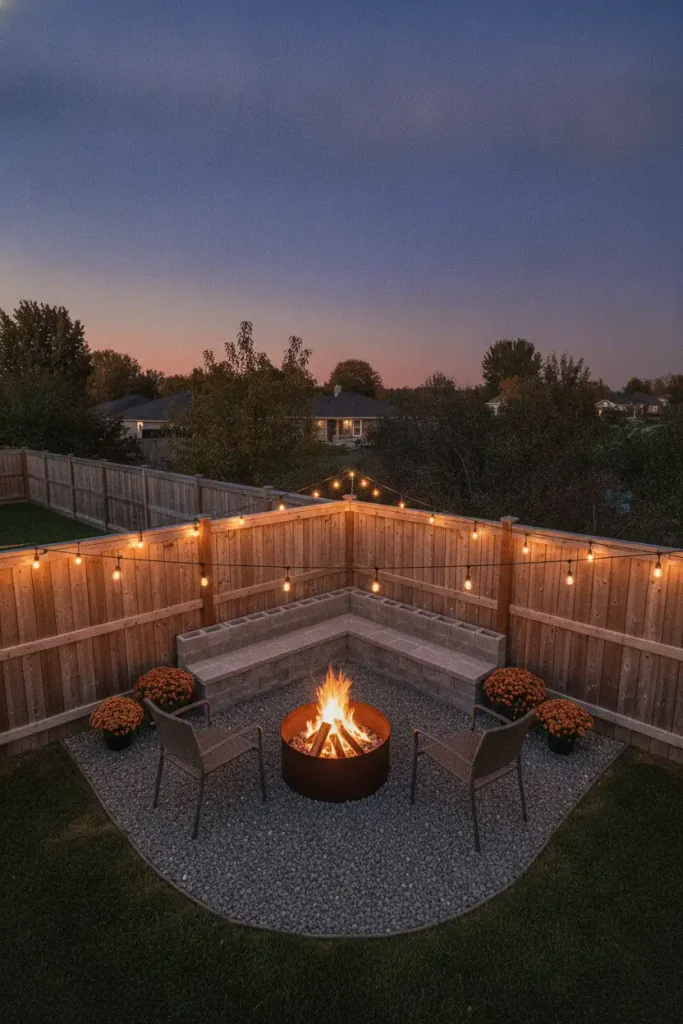
1. The Corner Flip: L-Shaped Block Bench in the Corner, Backyard Fire Pit Out in the Open
Most corner photos online show the fire jammed into the angle where two fences meet. It looks tidy. It’s also the spot with the least clearance in the whole yard.
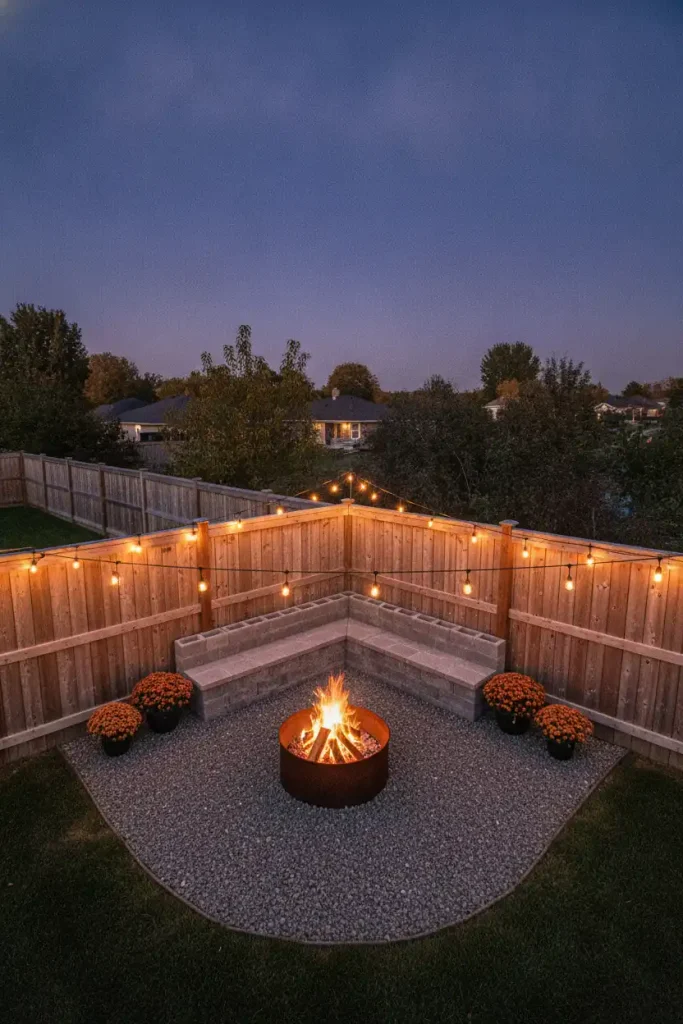
Flip it. Build or buy an L-shaped bench that hugs both fence lines, then set the pit on the diagonal using the 10-Foot Corner Test. The guidance in the U.S. Fire Administration’s outdoor fire safety tips is plain: use fire pits at least 10 feet away from your home or anything that can burn.
Your guests still get that tucked-in corner feeling, because they’re the ones sitting in it. Since the bench ends up a little farther from the flames than a campfire circle, pull two low chairs onto the open side for anyone who runs cold.
The corner holds the people. The open yard holds the flame.
2. Pea Gravel Corner Pad Sized With Real Bag Math
Forty-eight bags. That’s what a 12 by 12 foot pad of pea gravel takes at 2 inches deep, because one 0.5 cubic foot bag covers about 3 square feet at that depth.
Vigoro bagged pea gravel worked out to roughly $12 a bag at Home Depot when we checked, based on its pallet price. That puts a bagged pad near $600. The same 24 cubic feet is just under one cubic yard, so a quick call to a local landscape supply yard for bulk pricing is worth it.
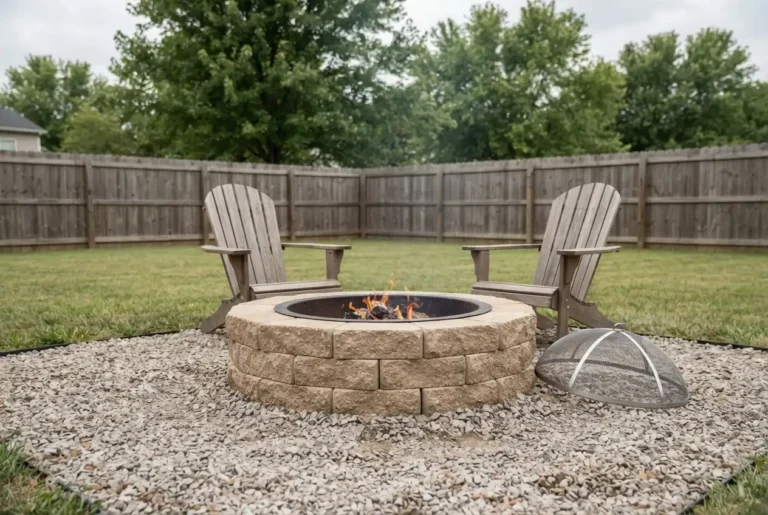
HGTV recommends surrounding a fire pit with non-combustible materials like crushed stone, brick, or sand, and removing lawn underneath. Gravel checks both boxes.
| Ground cover | Underfoot | Best corner use |
|---|---|---|
| 🪨 Pea gravel | Soft, shifts under chair legs | Casual pads and renter corners |
| ⛰️ Crushed stone | Firm once tamped | Seating that stays level |
| 🧱 Brick or pavers | Flat and solid | Dining chairs and side tables |
| 🏖️ Sand | Loose, tracks indoors | A ring right around the pit |
Lay landscape fabric first, or weeds will find every gap by spring.
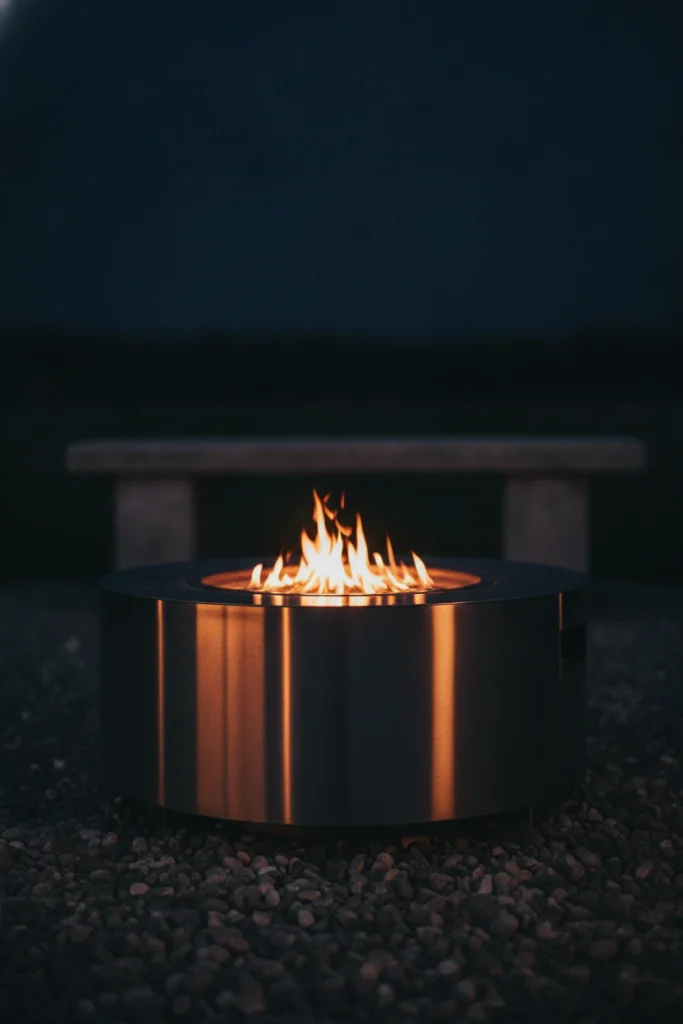
3. Small Backyard Corner Fire Pit Idea: A 19.5-Inch Smokeless Steel Bowl
Smaller yards need a smaller flame footprint.
A 19.5-inch bowl like the Solo Stove Bonfire 2.0 ($249.99 at Home Depot when we checked) pulls the pit center about 13 inches closer to each fence than a 46-inch block ring, and saves roughly a foot and a half on the diagonal. Its double-wall design is built to cut down on smoke once the fire is burning hot, which matters when the corner backs up to a neighbor’s yard.
It’s also light enough to move. The stand and shelter bundle ran $399.99 at the same store, and it lifts the base off gravel or pavers.
🔥 Before you buy a small steel bowl
4. Corner Patio Fire Pit on Big Square Pavers
Got a patio that already fills a corner of the yard? You’re halfway there.
A patio corner that opens to lawn on two sides usually clears the 10-foot rule far more easily than a corner boxed in by fences. Set the pit on the outer edge of the slab and keep dining chairs on the house side. This Old House advises a level stone, concrete, or brick surface for any pit, so a paver patio is already the right base.
If you’re still planning the slab itself, our roundup of backyard patio ideas for small yards covers layouts that leave room for a fire zone.
Big 16-inch step stones like Pavestone’s gray squares mean fewer joints for embers to settle into.
5. Propane Fire Table for Neighbors Who Hate Wood Smoke
Corners sit right on the property line. Wood smoke drifts over it.
A propane fire table skips the smoke problem entirely. The Hampton Bay Crossridge 30-inch table was $179 at Home Depot when we checked, and 43-inch models from eVita and R.W.FLAME sat right around $200. The flat rim doubles as a spot for mugs, which a wood bowl can’t offer.
Gas isn’t a free pass on placement, though.
⚠️ Watch Out
Gas tables still need clearance. Follow the manual for distance from fences and walls, test hose connections with soapy water before the first light, and shut the tank valve when you’re done. To put out a gas fire, turn off the supply first.
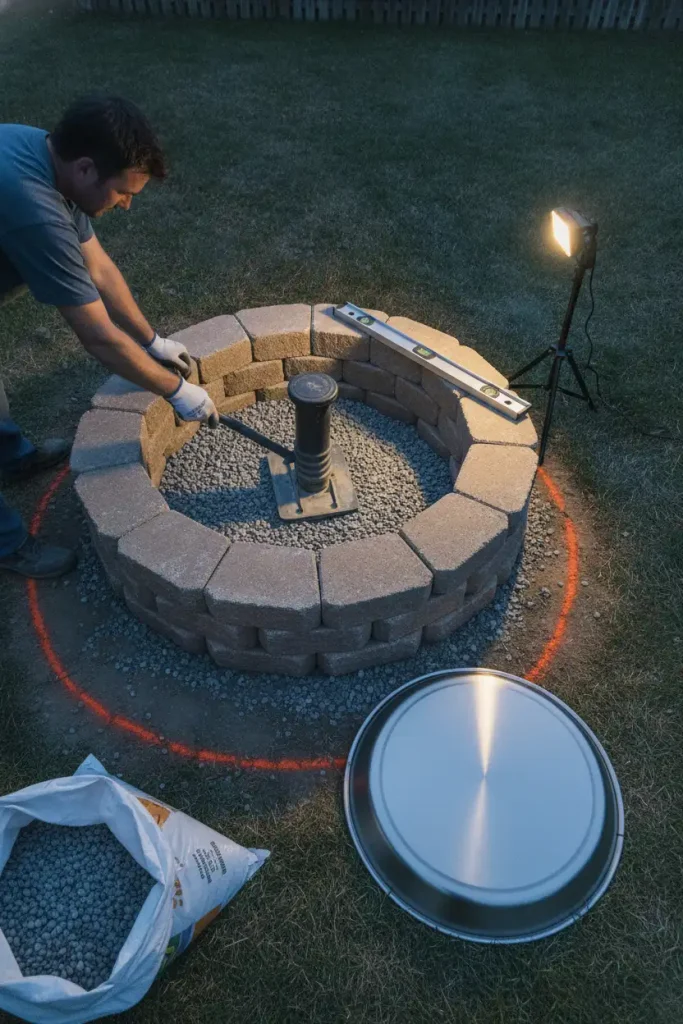
6. Stacked Block Fire Ring You Can Build in a Weekend
About $712. That’s what the Pavestone RumbleStone 46-inch Kit No. 1 cost in Sierra Blend at Home Depot when we checked, with the Greystone color closer to $789. The kit includes a round steel insert, which protects the blocks from direct heat.
A 46-inch ring is the widest option in the corner table, so its center lands almost 17 feet out on the diagonal. Measure before you order.
Some communities require a permit for a permanent fire pit, so call your city before you dig.
Find the center with the 10-Foot Corner Test and spray-paint a circle a little wider than the kit.
Strip the sod, then add and tamp a gravel base to the depth the kit instructions list.
Dry-fit the first course around the steel insert and check level in two directions.
Stack the remaining courses, glue them as the kit directs, and let the adhesive cure before a first fire.
7. Slatted Privacy Screen Along the Fence, Clear of the Fire Line
A slatted screen makes a corner feel like its own room. It’s also more wood near a fire.
Here’s the good news. If you’ve placed the pit with the 10-Foot Corner Test, a screen mounted flat against the fence behind your bench already sits outside the clearance zone. You get the enclosed look without moving fuel closer.
Horizontal cedar slats read warm and modern. Corrugated metal panels read rustic and won’t burn, which makes them the better pick if your corner is tight. For more ways to block a neighbor’s view, see our backyard privacy ideas for every fence line.
8. Café Lights Zigzagged Over the Seats, Not the Flames
Hang the bulbs where people sit.
This Old House says a fire pit needs at least 21 feet of open clearance above it, so the strands belong over the bench zone near the fence, stopping short of the pit. Brightech Ambience Pro 48-foot LED strands were $44 on sale at Brightech when we checked, down from a regular $79. One strand covers a single zigzag across a modest corner.
Use outdoor-rated, UL-listed lights and cords on a GFCI outlet. Anything beyond plugging into an existing outlet is a job for a licensed electrician.
- ▸Anchor each run to a fence post or a steel pole set in a planter.
- ▸Run a guide wire first so the strand never carries its own weight.
- ▸Keep the lowest dip well above head height over the bench.
- ▸Stop the last bulb short of the open sky above the pit.
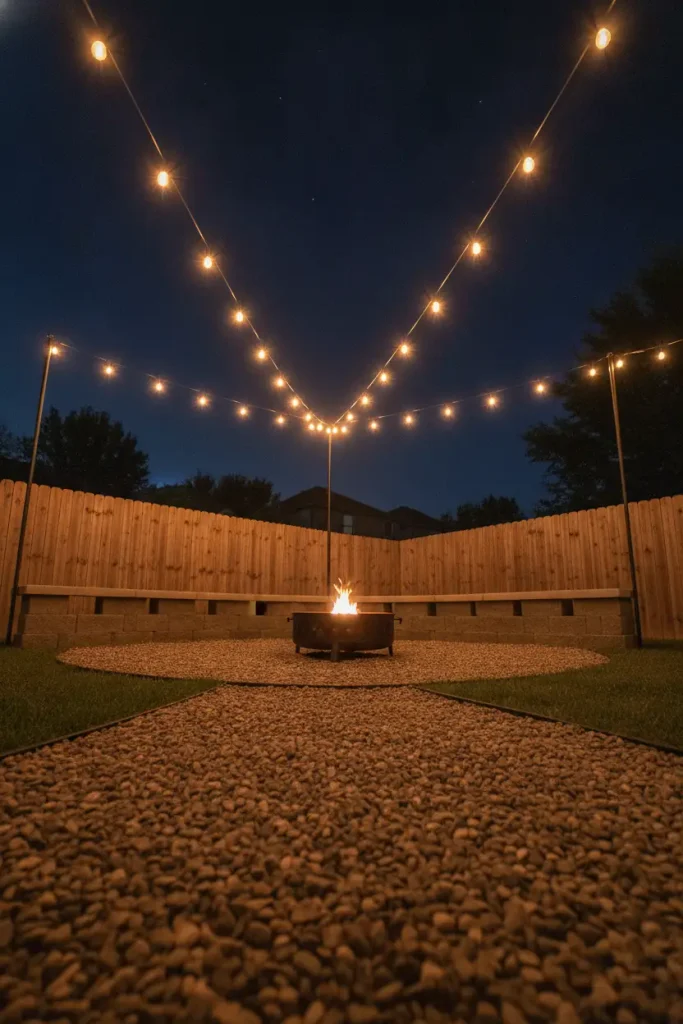
9. Built-In Block Bench That Doubles as a Wind Break
Wind is the quiet deal breaker for fall fires.
Per the fire pit safety rules from This Old House, skip the fire when winds pass 10 to 15 miles per hour and pick a spot shielded from strong gusts. A low wall of stacked concrete retaining blocks, capped with flat stone, does two jobs at once. It blocks the breeze on the windward side and gives you seating that can’t catch a spark.
Check your yard’s usual wind direction on a breezy evening before you stack the first course.
Build the bench on the side the wind usually comes from.
Cap it with smooth stone so it’s comfortable without cushions.
Walls tall enough to trap smoke around the seats.
Lighting up on a gusty night because the wall is there.
Walls block wind. They don’t cancel it.
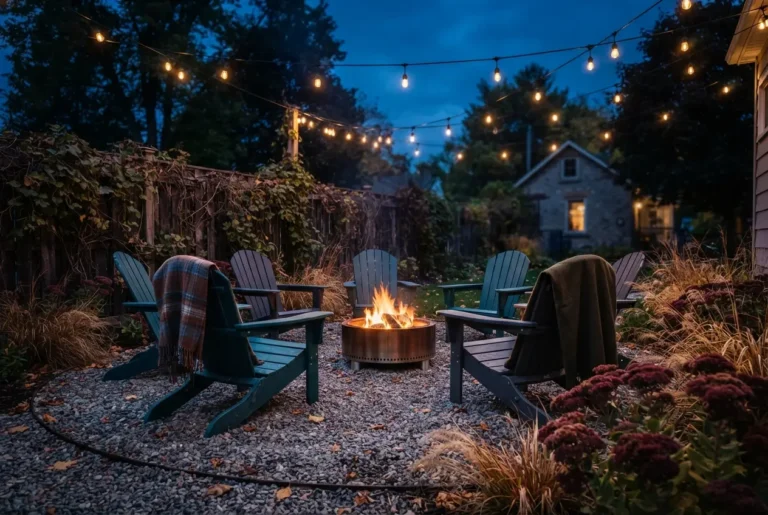
10. Low Adirondack Chairs Angled Toward the Flame
Cedar and recycled plastic both work for fire-side Adirondacks. They just age very differently.
Cedar looks warm and costs less up front, then asks for sealing every so often. HDPE lumber like the POLYWOOD Classic Folding Adirondack ($289 per chair at Wayfair when we checked) skips the staining and folds flat for winter.
Neither one belongs at the rim. HDPE is still plastic, and it can warp from radiant heat, so keep chairs back the distance your pit’s manual suggests.
💡 Quick Tip
Angle each chair toward the fire instead of lining them up with the fence. Four chairs set at a slight curve feel like a circle even when the corner forces an L.
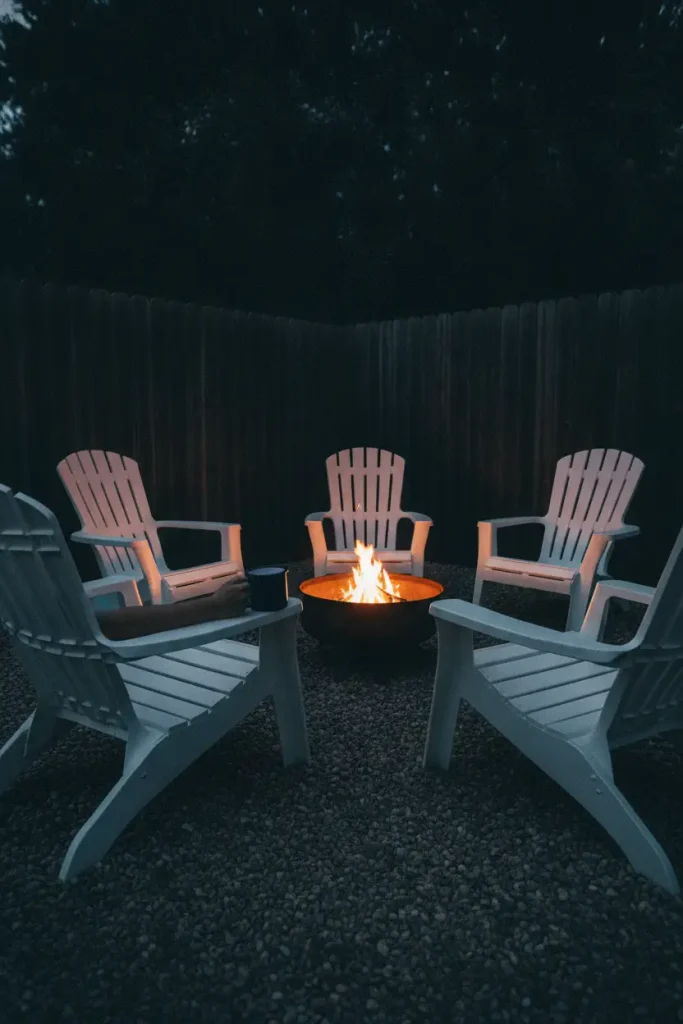
11. Fall Mums in Galvanized Troughs Along the Back Fence
Planters make the corner look finished, and fall is when they earn their spot.
HGTV suggests keeping plants at least 10 feet from the fire pit area. That lines up with the corner test, so the fence line behind your bench is the right place for galvanized stock tank troughs full of color.
Bell Nursery mums in 8-inch pots sold as a two-pack for $29.24 at Home Depot when we checked. Read the tag, though. That listing is labeled an annual. If you want mums back next year in Zones 5 to 9, buy plants tagged hardy and get them in the ground a few weeks ahead of your area’s first frost.
12. Sunken Gravel Corner, Two Steps Down
Sunken fire circles look fantastic in photos. They also collect rain like a bowl.
That’s why this one starts with drainage, not digging. Pick a corner that doesn’t puddle after a storm, and plan a gravel base plus a way for water to leave. Before a single shovel goes in, call 811, the free national call-before-you-dig line, so buried utility lines get marked.
Watch the corner through one heavy rain and skip it if water sits there.
Call 811 and wait for the utility marks before digging.
Ask a local landscaper about a drain line or dry well if your soil is heavy clay.
Build block retaining steps, then fill the floor with tamped crushed stone.
Retaining walls that hold back real soil may need a permit too. Ask when you call the city.
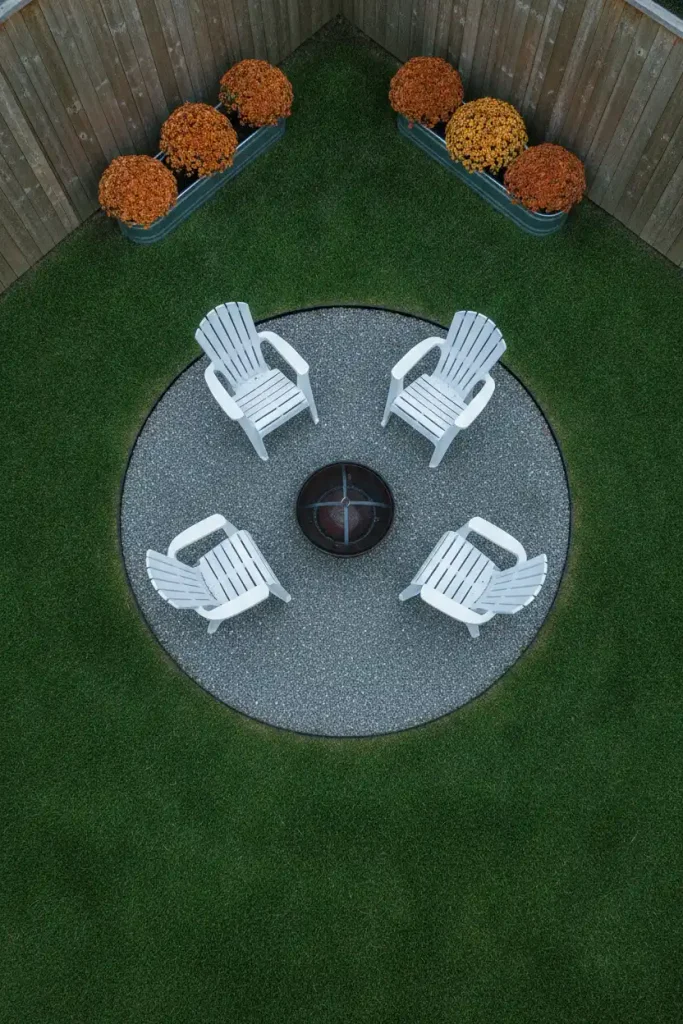
13. Before and After: Bare Lawn Corner to a Gravel Corner Fire Pit Area
Grass under a fire pit is a slow-motion problem. Heat browns it, embers scorch it, and a dry fall lawn can catch.
HGTV’s advice is to remove vegetation, even lawn, around the pit. So this idea is mostly subtraction: cut out a clean circle of sod, edge it with steel landscape edging, and fill it with pea gravel or crushed stone. The corner reads as a planned space the day you finish, even before any furniture shows up.
Patchy grass, a portable pit dragged onto the lawn, chairs sinking into soft ground, and scorch marks after every fire.
A crisp gravel circle with steel edging, the pit centered by the 10-Foot Corner Test, and level footing for every chair.
14. Dollar Tree Glow: Battery Lanterns and Solar Stakes on the Bench Line
Real candles and a real fire in one small corner is a lot of open flame. Swap the candles.
Battery LED tea lights inside glass jars give the same flicker along a stone bench, and solar path stakes mark the gravel edge so nobody trips on the way to the pit. Budget stores are the easy place to stock up, and our list of Dollar Tree backyard decor finds has more ideas that don’t look cheap.
🕯️ Budget glow shopping list
Set timers on the tea lights, and they’ll switch on before your guests arrive.
15. Renter Corner Kit: A 30-Inch Bowl on Stepping Stones
No digging, no permanent pad, and everything leaves with you on moving day.
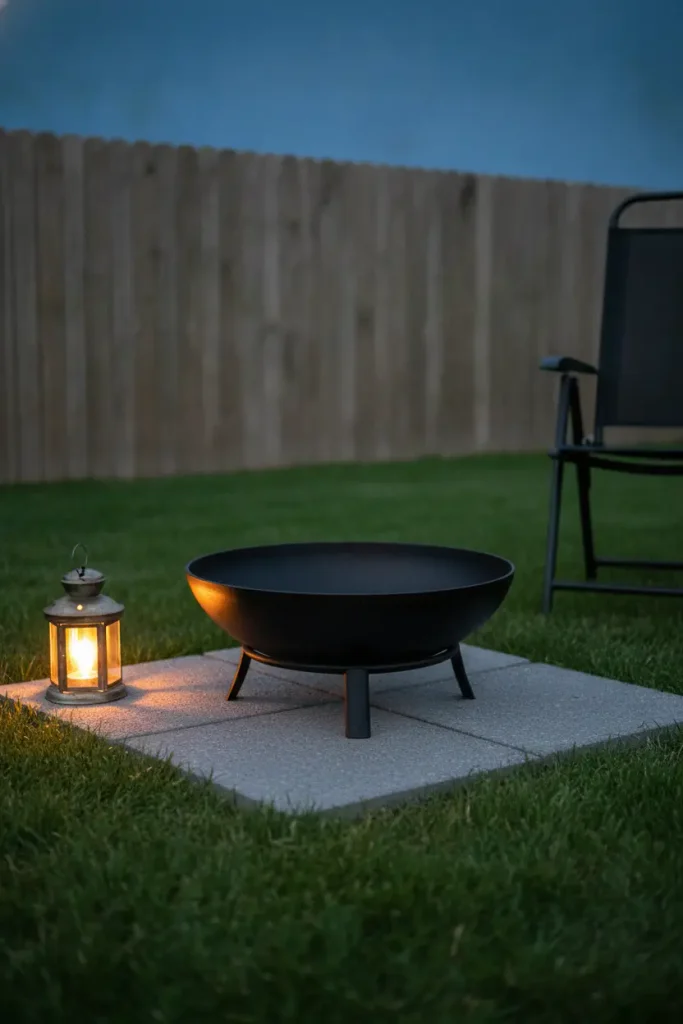
Start with a portable bowl, like the Sunnydaze 30-inch cast iron fire pit bowl ($199 at Home Depot when we checked) or its bronze steel cousin with a spark screen included ($195). Set it on a small square of concrete step stones so the lawn underneath stays protected, then add folding metal chairs.
Read your lease before the first fire. Plenty of rentals limit or ban open flames, and your landlord’s insurance may care even when the city doesn’t.
16. Firewood Rack in the Far Corner, Not Beside the Pit
A neat stack of split logs right next to the fire looks great. It’s also a pile of fuel sitting in the danger zone.
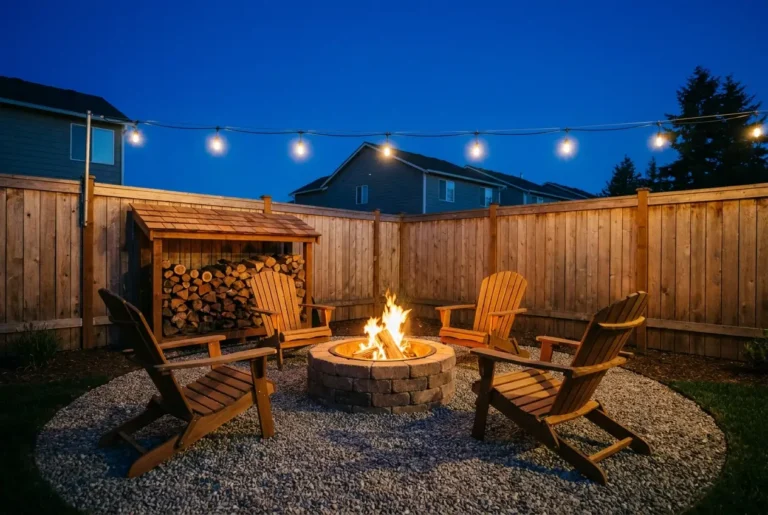
The corner post solves this. Tuck a steel log rack into the angle of the fence, which the 10-Foot Corner Test already put well away from the flames. Cover just the top of the stack so air still moves through the sides.
| Where the wood goes | Verdict |
|---|---|
| Stacked beside the pit | 🚫 Fuel inside the clearance zone |
| Against the house wall | 🚫 Invites insects toward the siding |
| On bare ground | 🚫 Bottom logs soak up moisture |
| Raised rack in the fence corner, top covered | ✅ Dry, out of the way, easy to grab |
Dry, seasoned wood also burns with less smoke than green wood, which your neighbors will notice.
17. Tabletop Fire Bowl on a Stone Side Table for Two
Some nights don’t call for a full fire. Two people, two mugs, and a small flame at elbow height is plenty.
A 15-inch concrete tabletop bowl like the VEVOR model ($49.99 at Home Depot when we checked) burns rubbing alcohol instead of wood. Set it on a stone or concrete side table in the open part of the patio corner, never on wood or glass.
It still follows the same clearance thinking as a big pit. Never refill a burner while it’s lit or still warm.
A smaller flame shrinks the fuel you burn, not the care you owe it. Same open sky, same clear surface, same person watching.
18. Open Sky Over the Pit, Tall Planters Framing the Corner
Pergolas and fire pits show up together in a lot of corner fire pit ideas online. This is where we disagree.
📌 Good To Know
This Old House calls for at least 21 feet of clearance above a fire pit and says never to place one under a covered patio or low-hanging tree limbs. A wood pergola roof over flames works against both.
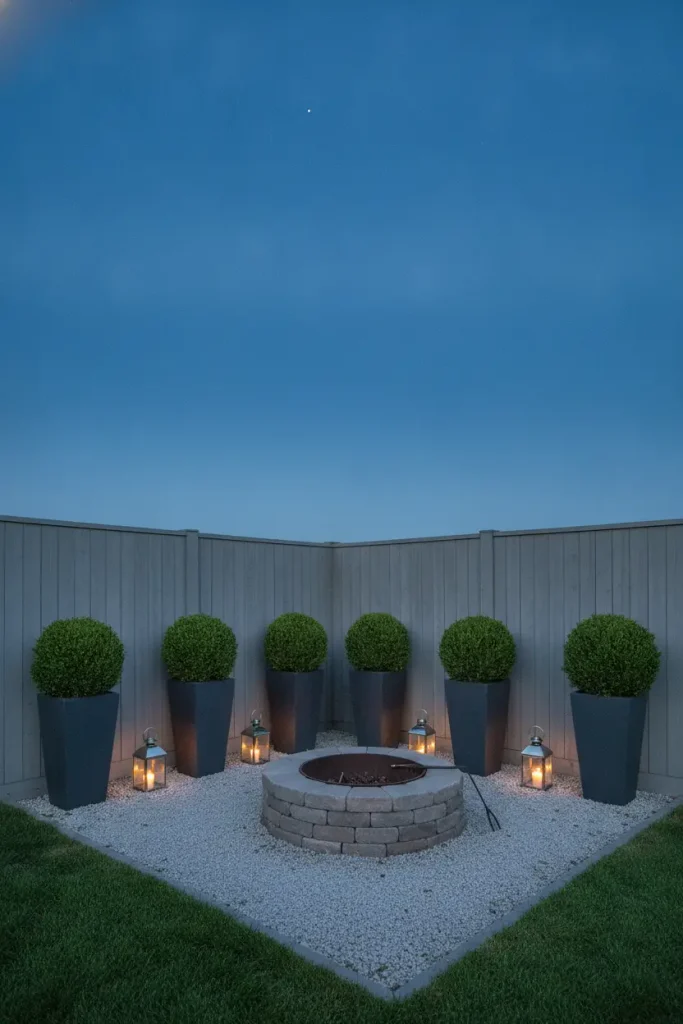
You can get that same framed, roomlike feeling without a roof. Line the fence corner with tall square planters, around 20 inches or taller, planted with a dwarf evergreen suited to your zone, such as boxwood in much of Zones 5 to 8. The evergreens give height and structure, and the sky above the fire stays wide open.
If you already have a pergola, put the seating under it and keep the pit out past its edge.
19. S’mores Station on a Metal Cart Parked at the Bench End
Every fire night turns into a snack night. Give the snacks their own home.
A rolling metal utility cart parked at the far end of the bench holds a tray of graham crackers, chocolate, marshmallows, enamel plates, and long roasting forks. It keeps sticky hands and paper packaging away from the pit, and it rolls into the garage when the night’s done.
Use long metal roasting forks so arms stay back from the heat.
Keep napkins and packaging on the cart, not the pit rim.
Paper plates stacked within reach of flying sparks.
Short sticks that pull kids right up to the rim.
Stock it in the kitchen, roll it out, roll it back. Done.
20. Spark Screen Plus a Gravel Buffer for Kids and Dogs
Kids and dogs don’t read clearance charts.
The U.S. Fire Administration recommends a metal screen over wood-burning fires to keep sparks from floating out, and closely watching children whenever the fire pit is in use. A 30-inch stainless mesh spark screen was $77.33 at VEVOR when we checked, and some Sunnydaze bowls include one in the box.
Measure your pit’s rim and buy a screen that sits flat on it.
Mark a gravel ring around the pit as the no-running zone and teach it before the first fire.
Assign one adult as the fire watcher for the whole night.
Leash or bring dogs inside while the steel is still hot after the flames die down.
Steel bowls hold heat long after the fire looks finished, so the gravel ring rule stays in place until the rim is cool to the touch.
21. Shut-Down Station Tucked by the Corner Post
The best corner fire pit setups plan the ending as carefully as the start.
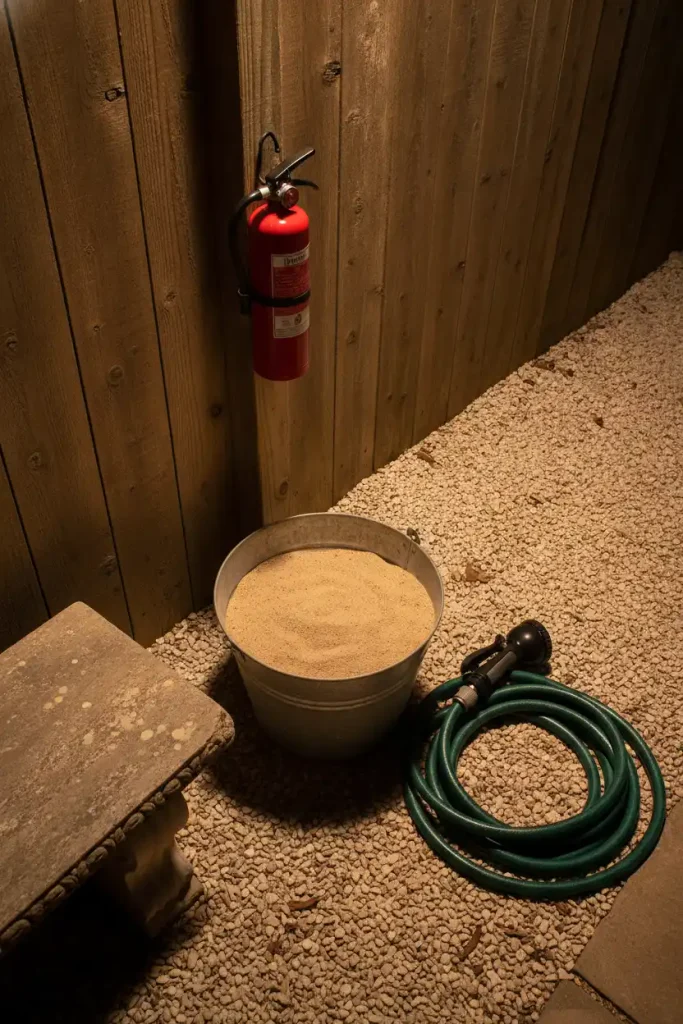
That corner post, roughly 15 feet from the pit, is close enough to reach fast and far enough to stay out of the way. Park three things there before the first fall fire.
This Old House notes that water can crack ceramic pits and even some metal ones, so dry sand is the gentler first choice. A First Alert HOME1 extinguisher was $27.99 on First Alert’s site when we checked. Hang it on a hook screwed into the post at waist height, where anyone can grab it.
Frequently Asked Questions
How far should a fire pit be from a fence?
The U.S. Fire Administration, This Old House, and HGTV all point to at least 10 feet from your home or anything that can burn, and HGTV includes fences and neighboring yards in that list. HGTV adds that 20 feet is even better. Your city or county code can require more, so check local rules and your pit’s manual, then use whichever distance is larger.
Can you put a fire pit in the corner of your yard?
Yes, as long as the pit itself sits far enough from both fences. In a corner, the clearance rule applies to two fence lines at once, which usually pushes the center of the pit about 15 to 17 feet out on the diagonal from the corner post. The corner then works best as the seating, lighting, and planting zone.
What should you put on the ground around a fire pit?
Use non-combustible materials such as crushed stone, pea gravel, brick, pavers, or sand. HGTV recommends removing vegetation around the pit, including lawn, since dry grass can scorch or catch from embers. This Old House advises setting the pit itself on a level stone, concrete, or brick surface. Avoid wood decks and enclosed porches entirely.
Can you use a fire pit under a pergola or covered patio?
It’s not a good idea. This Old House says never to place a fire pit under a covered patio or low-hanging tree limbs and calls for at least 21 feet of clearance above the pit. If you love the look of a pergola, put the seating under it and set the fire pit out in open sky beyond its edge.
Do you need a permit for a backyard fire pit?
Sometimes. HGTV notes that some communities require a permit for a permanent fire pit, and some codes forbid open flames on wooden decks. Portable bowls are often treated differently from built-in rings. Call your city or county building department or local fire department, and check HOA rules and your lease if you rent.
How much space do you need for a corner fire pit area?
Plan on more room than most photos suggest. With a 30-inch bowl, the center sits roughly 11 feet from each fence, and you still need space around it for chairs on the open side. A small 19.5-inch smokeless bowl saves a little room, while a 46-inch block ring needs the most. Measure before you buy anything.
How do you safely put out a fire pit?
Let the fire burn down, then smother it with dry sand or sprinkle water slowly while stirring the ashes. This Old House warns that water can crack ceramic and some metal pits, and HGTV suggests sand or dirt for metal bowls. For gas pits, turn off the fuel supply first. Never head inside until everything is cold.
Before Your First Fall Fire
All 21 of these corner fire pit ideas come down to one principle: let the corner hold the people and let the open yard hold the flame. Run the 10-Foot Corner Test first, choose the pit size that fits your diagonal, and then build outward with benches, planters, lights, and a shut-down station by the post.
Start small if you need to. A renter bowl on step stones and a strand of café lights can carry you through this whole fall, and the gravel pad or block ring can wait for spring.
Save this pin to your fall backyard board so the corner measurements are handy the next time you’re standing out there with a tape measure.