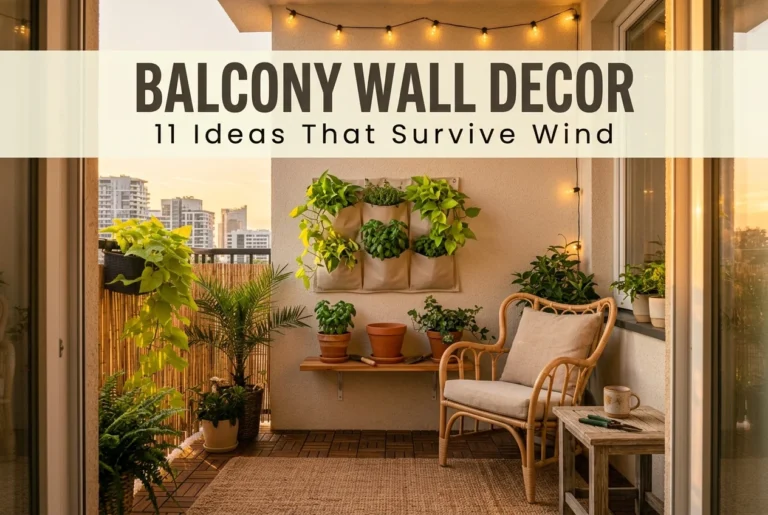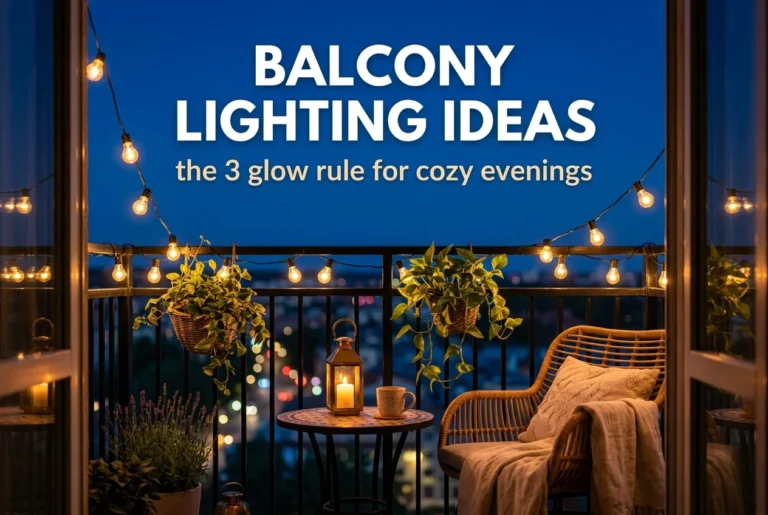
Balcony Covering Ideas That Solve Shade and Privacy Together

Most balcony covering ideas fail for the same boring reason. They fix one problem and quietly create two more. You hang a shade sail, and now the wind treats your balcony like a spinnaker. You zip-tie a privacy screen to the railing, and now the space is dark by four in the afternoon.
Here is the promise. By the end of this you will know exactly which of the three balcony planes to cover first, what to put on each one, and which purchase your lease will make you undo. It takes a weekend. It does not take a contractor.
Skip ahead if you already know your problem is the floor. That section is real and most guides pretend it does not exist.
If you rent, start with our renter friendly upgrades that move with you and come back. Everything below assumes nothing gets drilled unless you say so.
The Three-Plane Rule: Read Your Balcony Before You Buy Anything
Every balcony has three surfaces you can cover. Overhead, upright, underfoot. That is the whole system.
The reason so many balcony covering ideas disappoint is that people buy for the wrong plane. Someone whose real complaint is the neighbor across the courtyard buys a canopy. Someone squinting at 2pm buys a railing screen. Both spend money. Neither fixes the thing that was bothering them.
So run this first. It takes four minutes and a phone.
| Plane | Fixes | Skip it if | Typical spend |
|---|---|---|---|
| Overhead | Direct sun, light rain, heat on the slab | Your balcony is already recessed under the unit above | $60 to $250 |
| Upright | Sightlines, wind, an ugly railing | You face a treeline or an empty lot | $25 to $120 |
| Underfoot | Concrete gray, heat underfoot, water stains | You have real decking already | $40 to $200 |
Here is the contrarian part. For most apartment balconies, upright is the better first buy, not overhead. A railing screen costs less, installs without touching the ceiling, blocks low afternoon sun (which is the sun that actually hurts), and cuts the wind that would have wrecked your overhead cover anyway. Overhead is the upgrade you earn later.
Run the compass check before you spend anything
Open the compass app on your phone and stand at the railing.
West-facing means brutal low sun from about 3pm onward. Overhead covers barely help, because that light comes in sideways. You want an upright cover, ideally a curtain you can slide.
South-facing means high overhead sun most of the day. This is the one case where a sail or awning genuinely earns its price.
East-facing gets gentle morning light and usually needs no shade at all, just privacy.
North-facing gets almost no direct sun. Do not buy shade. Buy shade garden ideas for low light corners instead and put the money into plants and floor.
That one check saves more money than any product recommendation on this page.
Overhead Balcony Covering Ideas That Survive Actual Wind
A balcony sits higher than a patio and catches wind from angles a backyard never does. Every overhead cover you buy has to answer for that.
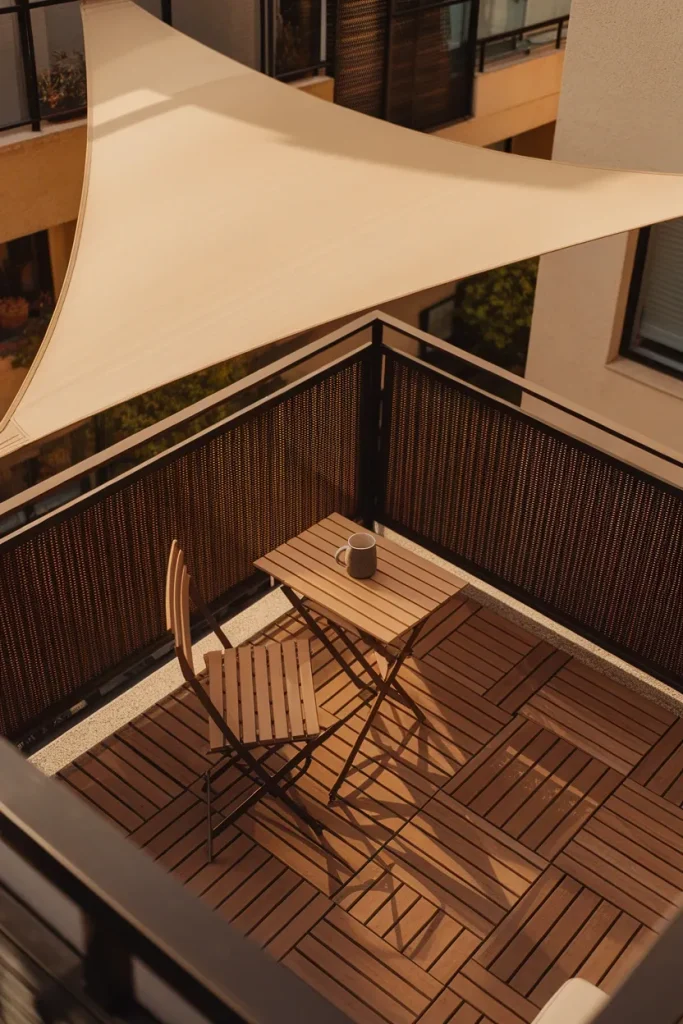
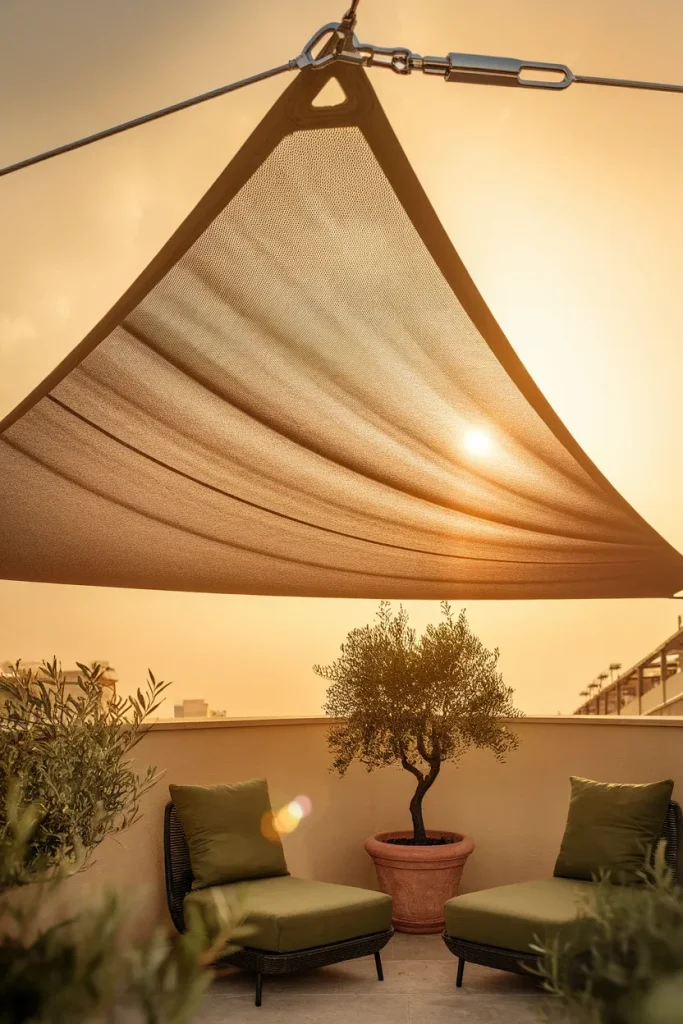
Shade sails
A triangular sail like the ColourTree 12 foot equilateral or the Vigoro almond triangle sold at Home Depot runs in the $40 to $90 range for common sizes. They work, with one rule: tension is everything. A loose sail flaps, and flapping is what tears grommets out. Pull each corner tight enough that the fabric hums when you flick it. Use turnbuckles, not rope. And take it down before a named storm, not after.
Cantilever and half umbrellas
A half-round umbrella that sits flush against the wall is the most underrated option on this list. No anchor points in the ceiling, no lease conversation, and you fold it in nine seconds when the forecast turns. Expect $70 to $180 for a decent one.
Retractable awnings
The best performer and the biggest commitment. Retracting means you decide daily whether to be covered, which is exactly right for a balcony. It also means brackets, which means drilling, which means a conversation with your building. Budget $200 to $600 plus install.
DIY fabric canopy
Outdoor drop cloth, two tension rods, done. It is the cheapest overhead cover there is, usually under $45 all in. It is also the first thing to fail in a gust, so treat it as seasonal rather than permanent.
One thing almost nobody mentions. If you plan to put any flame under a cover, whether that is a grill or a tabletop fire bowl, check your building’s rules before the cover goes up, not after. A fabric ceiling over an open flame is a different object than a fabric ceiling over a coffee cup. Many multi-family buildings ban grills on balconies outright.
Balcony Privacy Screen Ideas for the Railing
This is the upright plane, and for most people it is the highest-return purchase on the whole balcony.
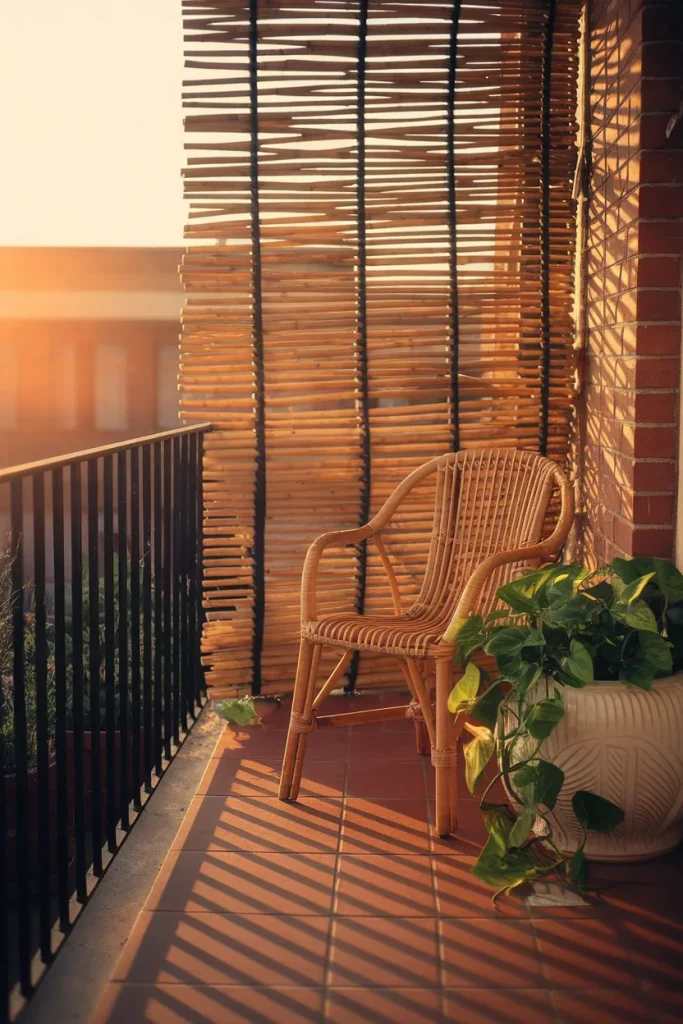
Rolled bamboo and reed screens
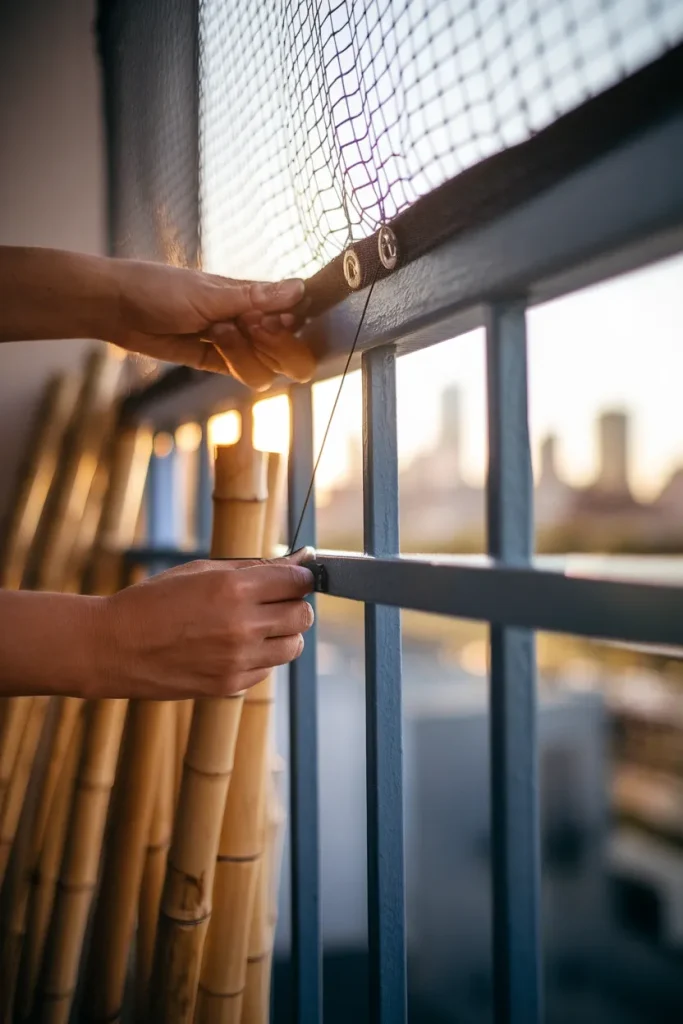
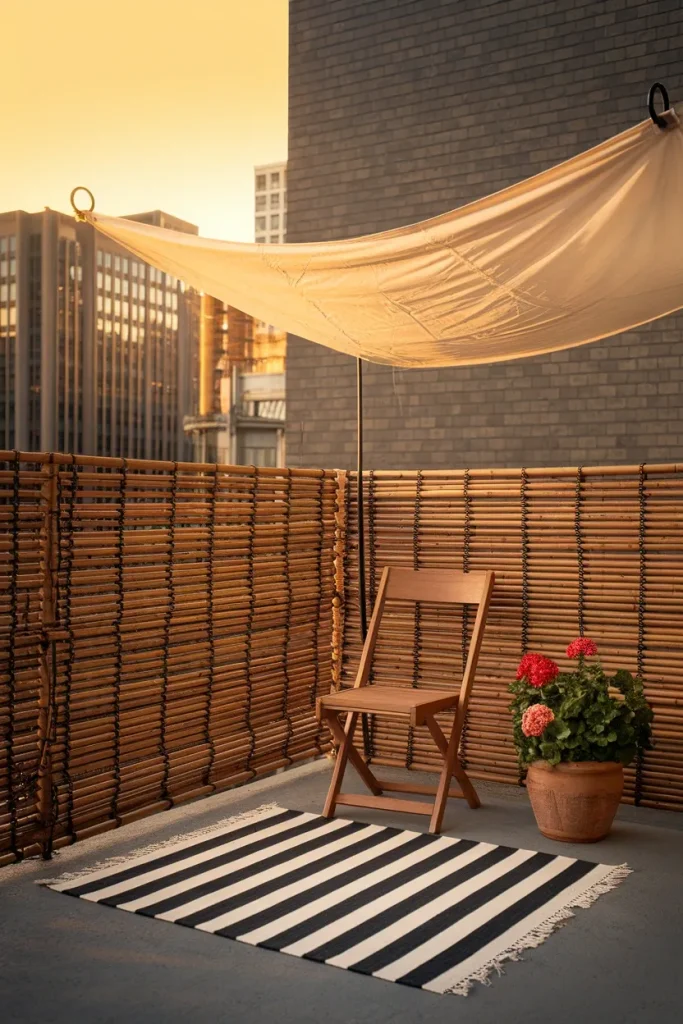
Products like the Vigoro 6 foot by 8 foot natural bamboo fence, the Backyard X-Scapes rolled bamboo panel, or a Trademark Innovations reed screen sized for porches and balconies all do the same job. Roll it out, zip-tie it through the railing every 12 inches, trim the excess with loppers. Usually $30 to $70. It reads as intentional from the street, which cheap plastic never does, and it comes off in ten minutes on move-out day.
Windscreen fabric for wind and privacy
The mesh privacy fabric sold in 3 foot by 10 foot or 3.2 foot by 16.5 foot rolls is the practical choice if wind is your real enemy. Look for a stated blockage percentage. Around 90 percent gives you real privacy; anything lower is more of a haze. Grommets every 12 to 18 inches, cable ties included on most, and it survives weather that shreds bamboo.
Artificial hedge panels
Divisive, and I will defend them anyway. Interlocking boxwood panels give you a green wall with zero watering and zero light requirement, which matters on a north-facing balcony where nothing living will thrive. Buy the UV-stable ones. The cheap ones go gray in a season.
Lattice and slat panels
Best when you only need to block one specific angle, like a neighboring door. A single 4 foot panel wedged into a corner does more than wrapping the entire railing.
Living Covers: Plants That Screen Without Breaking the Weight Limit
Plants are the prettiest balcony covering ideas and the ones most likely to get you a letter from management.
The problem is weight. Wet potting soil runs roughly 12 to 16 pounds per cubic foot, so a single 16 inch pot fully watered can clear 40 pounds. Multiply that by a row of them along a railing and you are loading a cantilevered slab in a way nobody designed for. This is not theoretical caution. Look at one university’s published balcony rules, which caps planters at 20 pounds, requires drip trays, and separately bans privacy screens that block visibility. Plenty of leases read exactly like that.
So go light and go vertical:
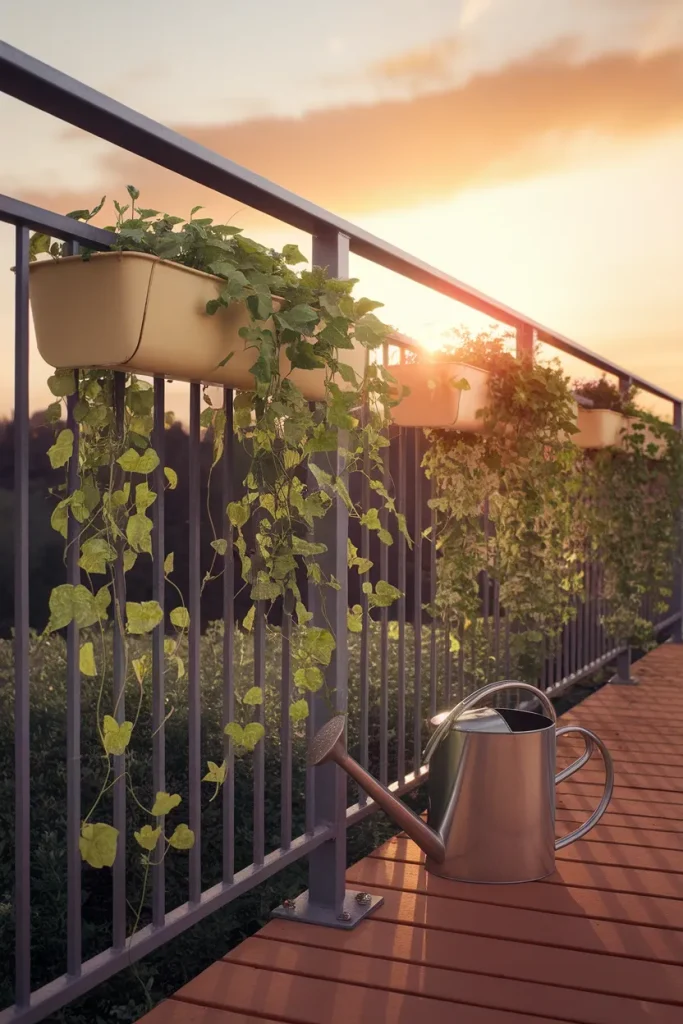
- Railing planters with trailing plants beat floor pots for screening, because the greenery hangs in your sightline rather than sitting below it.
- Sweet potato vine and creeping jenny fill a railing faster than almost anything and cost a few dollars a plug.
- Lightweight resin or fabric grow bags instead of ceramic saves you half the weight before you add a single scoop of soil.
- Cut the soil weight by filling the bottom third of deep pots with perlite or crushed water bottles.
- Match the plant to the wall, not the wish. Check your USDA plant hardiness zone before buying any perennial you expect to overwinter in a pot, and assume a container runs roughly one zone colder than the ground nearby, because the roots are exposed on all sides.
For most of Zones 5 through 9, an annual vine planted after the last frost (typically mid-April in Zone 5, closer to early March in Zone 9) fills a railing by mid-June. Confirm your own last frost against your local extension office, because it swings by a couple of weeks with elevation and proximity to water.
Balcony Floor Covering Ideas, the Plane Everyone Forgets
Search results for balcony covering ideas almost never mention the floor. That is a mistake, because the floor is the largest visible surface on a small balcony and it is usually stained concrete.
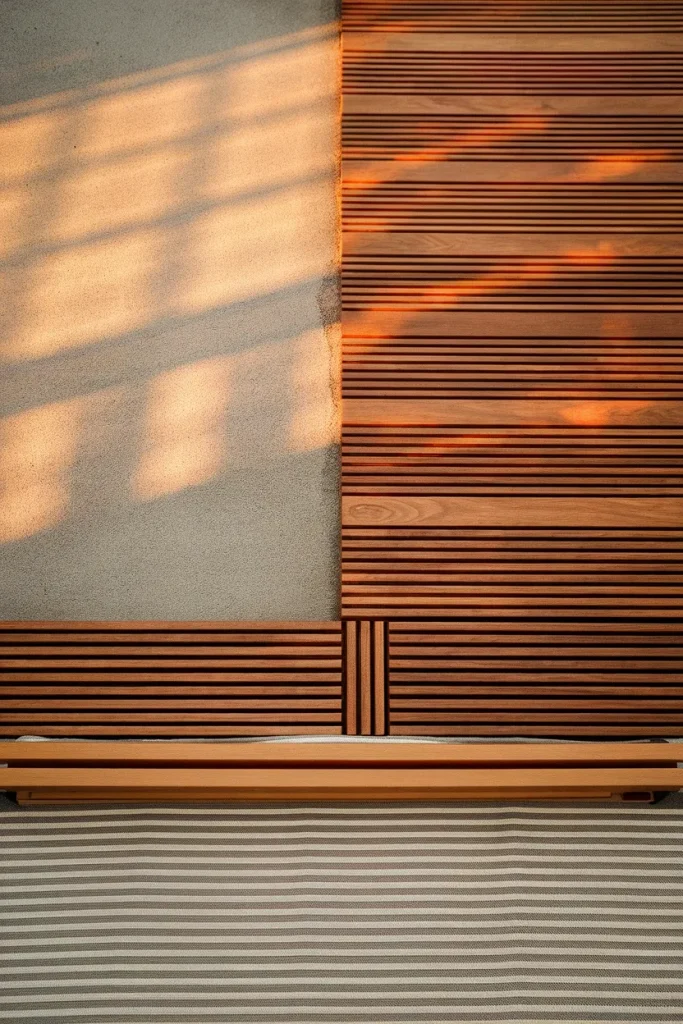
Interlocking deck tiles
Acacia wood tiles like the Pro Space 12 inch six-slat packs, or all-weather plastic versions from BTMWAY and Yangming, snap together over concrete with no adhesive. A 10 pack covers 10 square feet. Most small balconies need 30 to 50 square feet, which lands in the $80 to $200 range. They lift out in sections when you move.
Outdoor rugs
Fast, cheap, and the single biggest visual change per dollar. Buy polypropylene, not polyester and definitely not an indoor rug moved outside. Polypropylene sheds water instead of holding it, which is the difference between a rug that lasts three seasons and one that grows mildew by August.
One warning nobody gives you. Anything you lay on a balcony floor traps water underneath. If your slab drains toward a scupper or a gap under the railing, do not block that path. Lift rugs and tiles after heavy rain for the first month and check what is happening underneath. Trapped water stains concrete, breeds mildew, and in the worst case seeps toward the unit below, which turns your $60 rug into a repair bill.
Slatted tiles beat solid ones for exactly this reason. Water goes through instead of sitting.
Outdoor Curtains: The One Cover That Does Both Jobs
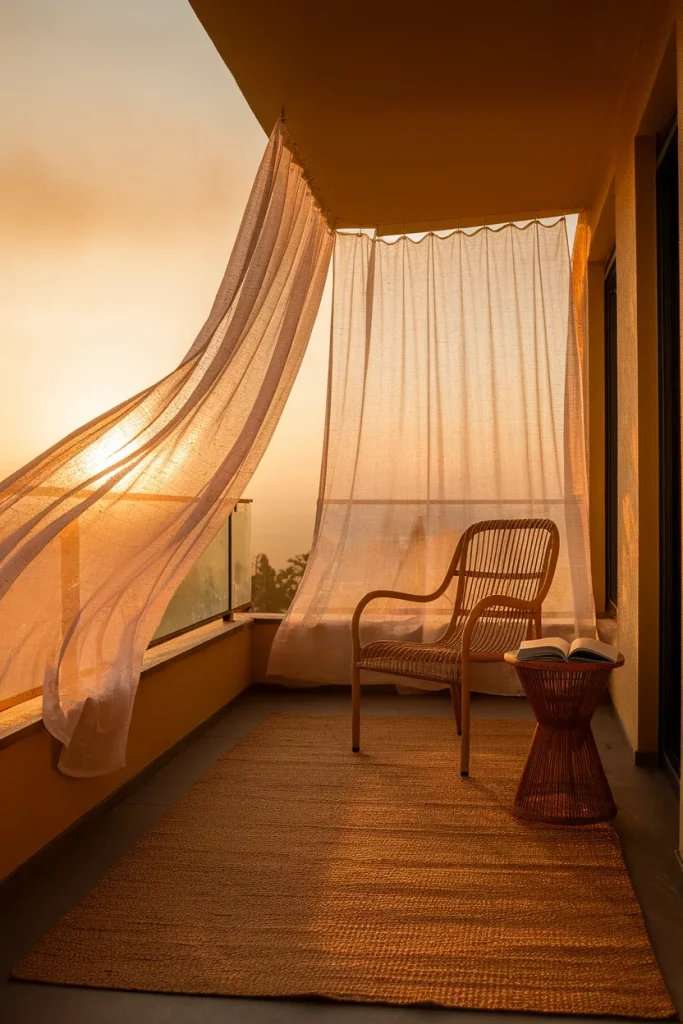
Curtains deserve their own section because they are the only balcony cover that switches modes.
Closed, they block low western sun and screen you from the unit across the way. Open, you get your view and your light back. No other option on this page gives you both states.
The install is the part people overask about. You do not need brackets. A heavy-duty tension rod spanning wall to wall inside a recessed balcony holds a pair of outdoor panels fine, and it leaves nothing behind. For open-sided balconies, run the rod from the wall to the corner post so the curtain sweeps across the exposed angle rather than trying to wrap everything.
Two details that decide whether this works:
- Weight the hems. Curtain weights, or a length of chain in the hem pocket, stop the whole thing behaving like a flag. Skip this and you will hate them within a week.
- Buy grommet-top, not rod-pocket. Grommets slide. Rod pockets bind, and a curtain you cannot pull one-handed is a curtain you stop pulling.
Expect $25 to $60 a panel, plus about $20 for the rod.
Read Your Lease Before You Read the Reviews
This section exists because it is the most common way balcony covering ideas end in wasted money.
Building rules vary wildly, and the restrictions are rarely where you expect. The Stanford housing notice linked earlier bans privacy screens outright and prohibits hanging rugs, flags or towels from railings, while permitting neatly arranged plants under a weight cap. Other buildings allow screens but require a specific color. Others care only that nothing is visible above the railing line.
Three questions to ask before you buy:
- Can anything be attached to the railing, and does the attachment have to be removable without tools?
- Is there a color or height restriction on screens?
- Are grills or open-flame devices allowed at all?
Ask by email, not in the leasing office. You want the answer in writing, because the person at the desk changes and your screen does not.
If the answer is no on everything, you still have the floor and freestanding options. A weighted freestanding screen panel touches nothing, and no lease can object to a rug.
Light It or the Whole Thing Disappears at 8pm
A covered balcony is darker than an uncovered one. That is the point during the day and the problem at night.
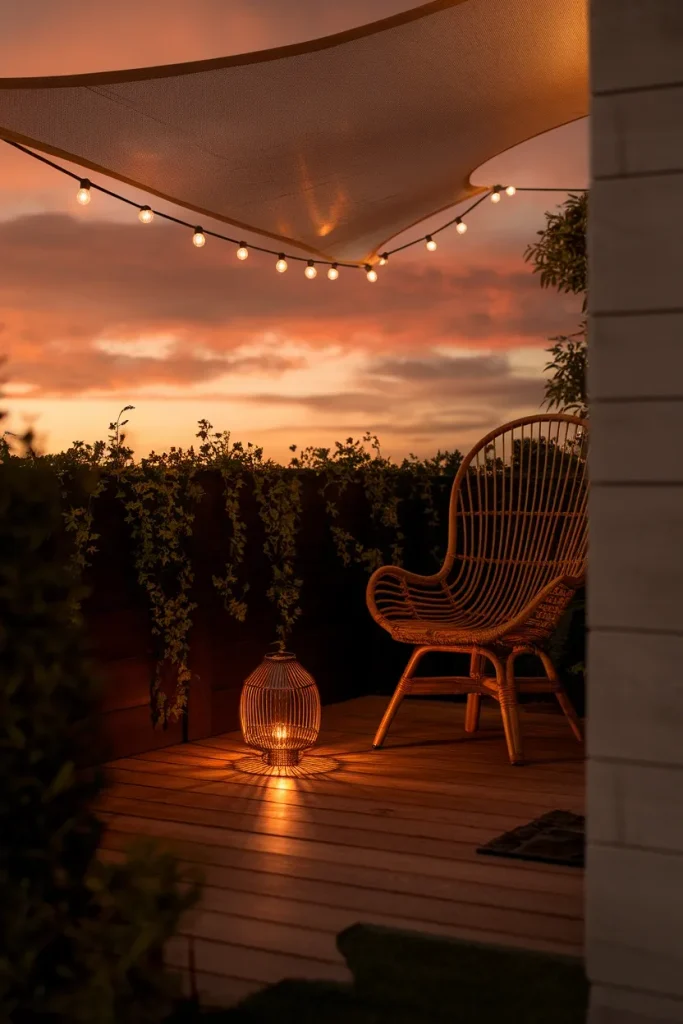
String lights are the fix, and they are the cheapest good decision on this list. Brightech and Feit both make weatherproof commercial-grade strands with shatterproof bulbs, usually $25 to $45 for 24 to 48 feet. Run them along the underside of your overhead cover rather than the railing, so the light bounces down instead of glaring sideways into your eyes.
Two more lighting notes worth the sentence each. Warm bulbs only, somewhere around 2200K to 2700K, because cool white makes an outdoor space feel like a parking garage. And add one low light at floor level, a lantern or a solar puck, so the space has depth instead of a single bright ceiling line.
What This Actually Costs at Three Budgets
Numbers make decisions easier, so here is the whole system at three tiers. Treat these as current ballparks rather than fixed prices, because outdoor goods swing hard between spring and fall.
| Tier | Overhead | Upright | Underfoot | Rough total |
|---|---|---|---|---|
| Under $150 | DIY drop cloth canopy on tension rods | Rolled bamboo, zip-tied | One polypropylene outdoor rug | $110 to $150 |
| $150 to $400 | Half-round wall umbrella | 90 percent windscreen fabric plus railing planters | Interlocking deck tiles, 40 sq ft | $260 to $390 |
| $400 and up | Retractable awning, installed | Freestanding slat panels plus outdoor curtains | Full tile floor plus a layered rug | $700 to $1,200 |
The under $150 tier is not a consolation prize. It is genuinely what I would recommend to anyone in a one-year lease, because every item in it leaves with you.
Your Weekend Order of Operations
Do it in this order and you will not redo anything.
Saturday morning. Compass check. Email the building with your three questions. Clear and scrub the slab, because everything else goes on top of it and you will not want to move it later.
Saturday afternoon. Floor first. Tiles or rug. This is the layer everything else sits on, and finishing it immediately makes the rest feel worth doing.
Sunday morning. Upright plane. Bamboo, windscreen or panels, whichever your building allowed. Zip ties, loppers, done in under an hour.
Sunday afternoon. Overhead, only if the compass check said you need it. Then lights, last, once you know where the ceiling actually is.
The following weekend. Plants. Not before. Fit the greenery to the finished space rather than working around pots you placed on day one.
Balcony Covering Ideas FAQ
How do you cover a balcony without drilling? Tension rods for curtains and canopies, zip ties for bamboo and windscreen fabric, freestanding weighted panels for screens, and loose-laid tiles or rugs for the floor. That combination covers all three planes with nothing permanently attached. Half-round umbrellas that lean against the wall are the no-drill answer for overhead shade.
What is the cheapest way to cover a balcony? A rolled bamboo or reed screen on the railing, usually $30 to $70 for an 8 foot roll, plus a polypropylene outdoor rug. Under $100 gets you privacy and a finished floor, which is most of the visual change. Skip the overhead cover until you know you need it.
Can my apartment make me take down a balcony privacy screen? Yes, in many buildings. Some leases and housing policies prohibit screens that block visibility, restrict what can hang from a railing, or cap planter weight. Ask in writing before you buy, and keep the reply.
What is the best balcony cover for high wind? Mesh windscreen fabric on the railing, because it lets air pass through instead of catching it like a sail. For overhead, choose something you can retract or fold in seconds rather than something fixed. Tension every corner properly, use turnbuckles rather than rope, and take fabric down ahead of storms.
How do you cover a balcony floor cheaply? An outdoor polypropylene rug is the fastest and cheapest option, often under $60. Interlocking deck tiles cost more, around $2 to $5 per square foot, but they look built-in and still lift out when you move. Choose slatted tiles so water drains through.
Do balcony covers block natural light inside? Solid overhead covers and dark screens can noticeably dim the room behind the balcony, especially on north-facing units. Lighter fabrics, mesh at lower blockage percentages, and curtains you can open all preserve interior light while still cutting glare.
Are there temporary balcony covers for rentals? Nearly everything here is temporary by design. Bamboo rolls, windscreen fabric, tension rod curtains, loose-laid tiles, rugs, freestanding panels and folding umbrellas all remove without patching or repainting.
Start With One Plane, Not the Whole Balcony
The best balcony covering ideas are not the most expensive ones. They are the ones matched to the right plane, allowed by your building, and light enough to survive a windy Tuesday.
Run the compass check. Email the building. Fix the floor. Everything after that is decoration, and decoration is the easy part.
If your balcony is really a small patio, the same layering logic scales up. Our guide to building a small backyard oasis on a budget walks the same three planes with more square footage to play with.
Which plane is your problem? Start there, and give yourself the weekend.