Flagstone Fire Pit Ideas: The Beginner’s Guide to Picking Stone and Building Yours

Most flagstone fire pit ideas you save on Pinterest leave out the one detail a beginner needs: what’s actually holding the fire. In most of those builds, it’s a steel ring. The stone is the frame around it.
That’s good news. You don’t need masonry skills or a contractor to pull this off. You need a level circle of compacted gravel, the right thickness of stone in the right spot, and one honest weekend.
Below you’ll find seven ideas sized for real budgets. The smallest is a portable pit on a stone pad, and the biggest is a sunken flagstone fire pit area with a curved seat wall. You’ll also get the Heat-to-Path Stone Map, a simple chart that shows which flagstone belongs next to the flames and which belongs out on the path. Prices come from retailer listings checked in October 2026, so you can plan with numbers instead of guesses.
One safety note before any stone gets moved. Check your city’s burn rules before you light anything, keep the clearance from structures and branches that your fire pit’s manual and local code call for, and never leave a fire unattended.
Natural Flagstone vs. Flagstone-Look Block: Read the Label First
Here’s the first surprise for most beginners. Search “flagstone fire pit kit” and you’ll land on products like the Oldcastle Ashland Concrete Fire Pit Kit at Lowe’s. Lowe’s describes it as made with “flagstone block,” and the product name says concrete. It’s cast block with a split-stone face, not quarried rock.
Nothing wrong with that. The Ashland kit builds a ring about 43.5 inches square and 12.5 inches tall, and it ships with a 31-inch metal fire ring. Blocks are uniform, so they stack fast.
Natural flagstone is different. It’s real stone, usually bluestone, sandstone, limestone, quartzite, or slate, split into flat slabs. No two pieces match. Fitting them takes patience, and the result looks like it has always been there.
Plenty of good builds mix the two: a block kit for the ring, natural flags for the patio around it. If you like the clean, uniform look all the way through, our step-by-step paver fire pit build covers that route block by block.
| 🪨 Natural flagstone | 🧱 Flagstone-look block |
|---|---|
| Quarried stone split into flat, irregular slabs | Cast concrete with a textured, split-stone face |
| Every piece is a puzzle fit, so it’s slower | Uniform shapes stack in an afternoon |
| Color varies slab by slab | One consistent color across the ring |
| Best for: the patio, apron, and path | Best for: a fast, tidy fire pit wall |
Weekend Flagstone Fire Pit Ideas for Beginners
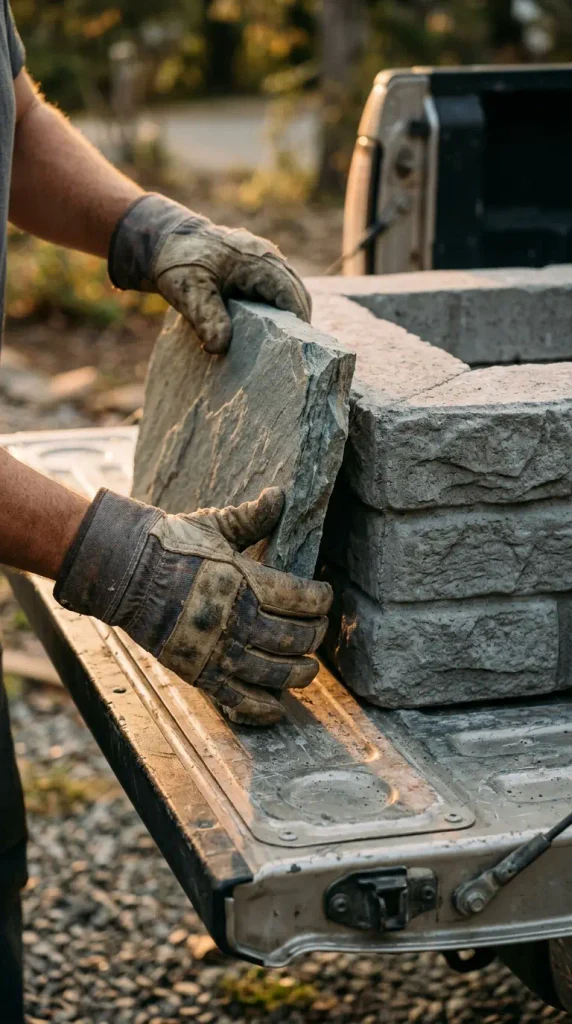
These four ideas finish in a weekend or less. None of them needs mortar.
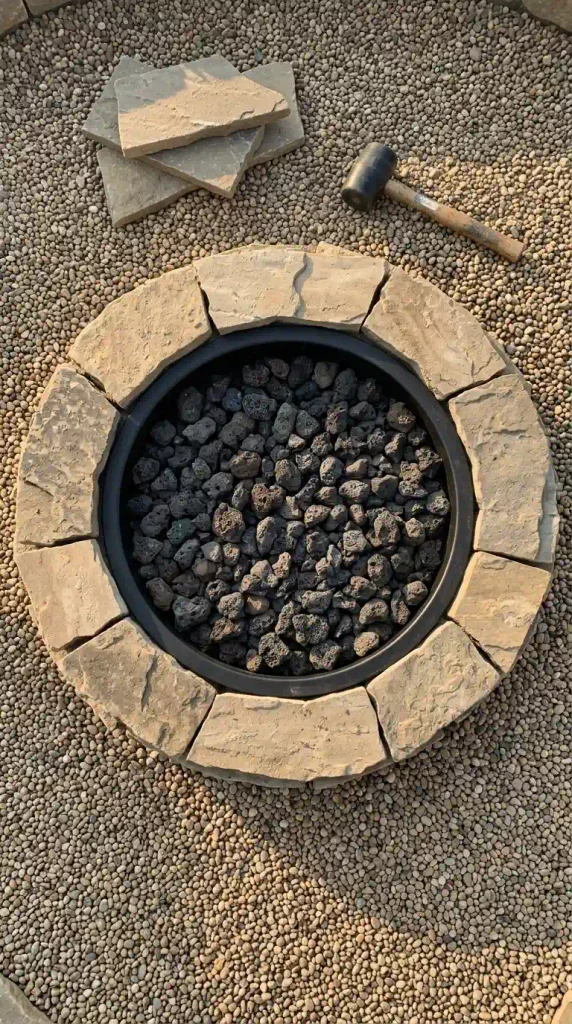
1. A stacked flagstone ring around a steel insert
Start with a steel fire ring, then dry-stack thick flagstone around it in two or three courses. The Blue Sky Outdoor Living 36-inch by 10-inch steel ring listed at $59.99 at Home Depot in October 2026. Offset each course so no joint sits over the one below, the same way you’d stack bricks.
Heads up: that ring is 0.8 mm steel. Treat it as a replaceable liner, not a lifetime part, and the stone around it will outlast it.
2. A flagstone pad under a portable smokeless pit
Renting, or not ready to commit? Lay an 8-foot circle of flagstone on compacted gravel and set a portable pit on top. The Solo Stove Yukon 2.0 is 27 inches wide and 17 inches tall, and it listed at $549.99 at Tractor Supply in October 2026. If you move, the pit goes with you and the stone pad stays behind as a patio. Ask your landlord before you dig.
3. A kit ring with a natural flagstone landing
Build the Oldcastle Ashland kit, or a similar block kit, exactly as the manual says. Then ring it with natural flagstone. You get a kit’s speed on the part that holds the fire and real stone on the part your feet touch.
4. Flagstone stepping pads set in pea gravel
This is the budget version of a full patio. Set large flags a short stride apart and fill everything between them with pea gravel. You buy far fewer square feet of stone. Edge the circle with steel landscape edging, or the gravel will wander into the lawn by July.
Cost: low
Moves with you: no
Cost: medium (the pit)
Moves with you: the pit does
Cost: medium
Moves with you: no
Cost: lowest per foot
Moves with you: no
Bigger Flagstone Fire Pit Area Ideas Worth Saving Up For
With a bigger budget or a whole season to work with, these three ideas turn the pit into an outdoor room.
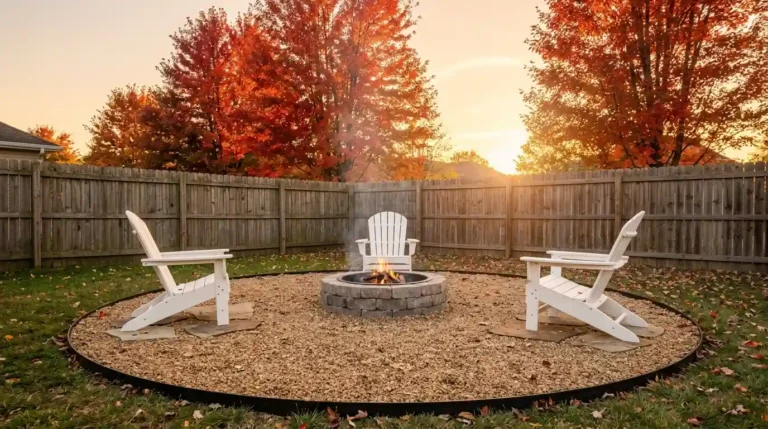
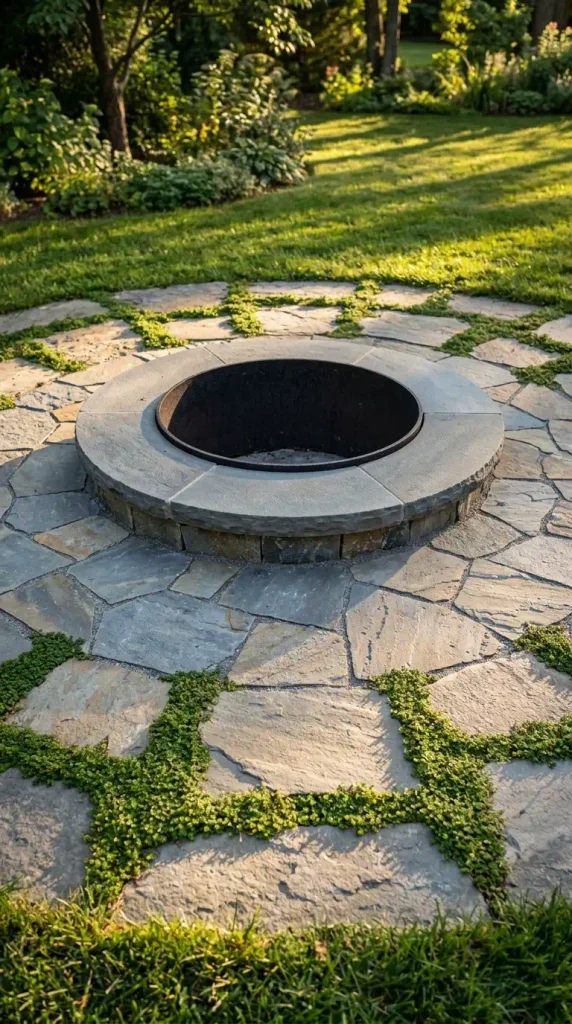
5. A full round flagstone patio fire pit
A 12-foot circle centered on the pit covers about 113 square feet. That’s enough room for four or five Adirondack chairs and a path behind them. Lay it dry, with polymeric sand joints near the fire and gravel joints at the outer edge.
6. A sunken flagstone fire pit area
Dropping the patio a step or two below the yard blocks wind and makes the circle feel enclosed. It also means digging, drainage, and a low retaining edge. Before you rent an excavator, read up on how deep to dig an in-ground fire pit so the hole doesn’t turn into a pond after the first storm.
Most permanent structures need a permit and have setback rules. Call your city building department before you dig footings or attach anything to the house.
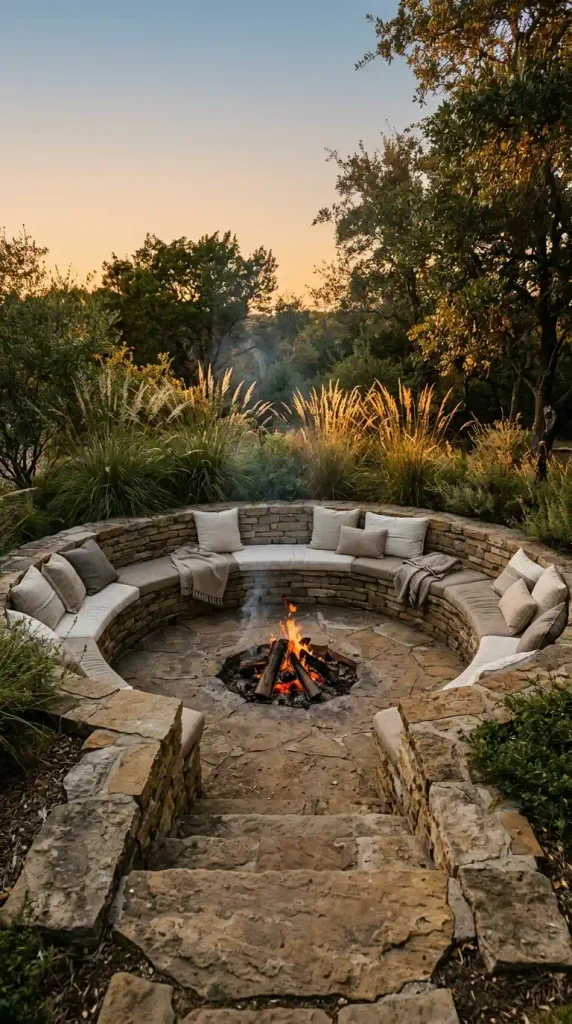
7. A curved flagstone seat wall
Wrap half the circle with a low wall capped in thick flags, built to around 18 inches tall, which is standard chair height. Guests sit on it, you skip buying extra chairs, and the wall breaks the wind. Keep the open side facing your back door so the path to the snacks stays clear.
📏 You’re ready for a bigger build if…
The Heat-to-Path Stone Map: Which Flagstone Goes Where
Here’s the part most flagstone fire pit area photos never explain. Stone near the fire has a harder job than stone near the lawn, so it shouldn’t be the same stone, the same thickness, or set the same way.
Think of four bands moving outward from the flames. The center band holds the fire and isn’t flagstone at all. The rim takes radiant heat and the most foot traffic, so it gets your thickest, densest slabs. Dense stones like quartzite and bluestone tend to handle that job better than porous sandstone or limestone.
The apron is the first few feet of patio around the rim. Embers land here. That’s why joints stay tight and filled with polymeric sand, with no plants and no wood mulch.
Out past the apron, the rules relax. Thinner flags, gravel joints, and even creeping thyme between stepping stones all work, because the fire never reaches them.
Screenshot this one before you shop.
Is Flagstone Good for Fire Pits? Only Outside the Flames
Here’s the counterintuitive part. Flagstone makes a great fire pit surround, but a poor fire pit liner.
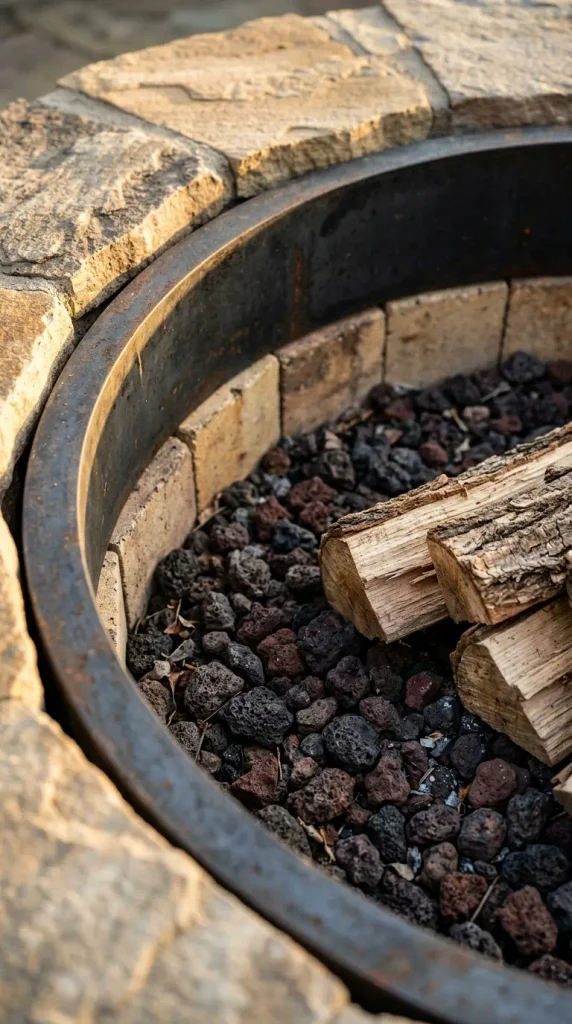
Porous stones like sandstone and limestone soak up rain. When a fire heats that damp stone fast, the trapped water turns to steam and pushes outward. The face can flake off in chips (masons call it spalling), or a slab can crack clean through. River rock is worse, because rounded stones from a streambed can hold water deep inside. Never put it in the burn chamber.
So the solid-stone pits you admire online are usually hiding a steel ring or a firebrick lining. That’s not cheating. It’s how the stone survives.
Wood brings its own moisture problem. Damp logs smolder and smoke instead of burning clean, and the EPA’s guide to best wood-burning practices says wood burns best below 20 percent moisture. A cheap moisture meter settles that question in seconds.
Line the burn chamber with a steel ring or firebrick.
Fill the floor with gravel or lava rock up to the bottom of the ring.
Burn dry, seasoned firewood.
Flagstone slabs as the inner wall that touches the flames.
River rock anywhere inside the pit.
A roaring fire the day after a soaking rain.
Where to Put Your Flagstone Fire Pit Area and How Big to Make It
Clearance rules vary a lot, so don’t trust a number you saw in a pin. The US Fire Administration’s outdoor fire safety tips for home fire pits give a short general minimum. One flagstone wall fire pit kit sold at Lowe’s asks for at least 20 feet from walls, trees, and structures in its install guide. That gap is exactly why your pit’s manual and your local code get the final word.
A few rules don’t change. Pick flat, open ground with no branches overhead. Never build on a wood or composite deck, which that same Lowe’s kit guide also warns against. Keep the pit away from your fence line and the neighbor’s shed.
Size comes next. Steel fire rings for these builds usually run 31 to 36 inches across. Block kits finish around 4 feet wide, like the Ashland’s 43.5-inch footprint or the 49-inch circle that wall kit marks out. Around that, leave room for chairs to slide back plus a clear walkway behind them.
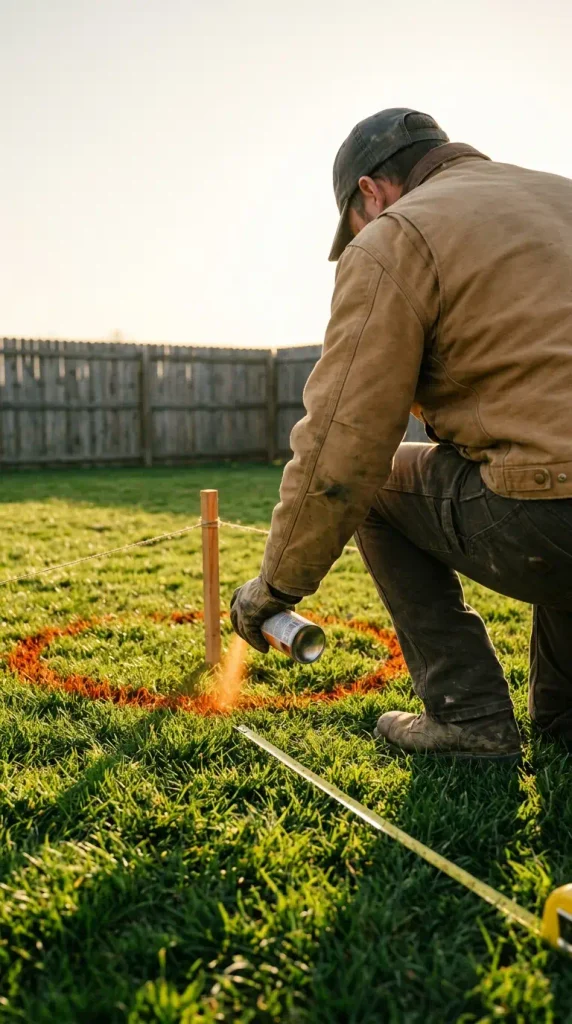
How to Build a Flagstone Fire Pit, Step by Step
The base matters more than the stone. A dry-laid flagstone patio needs at least 3 inches of compacted gravel under a layer of coarse sand. In Zones 5 and 6, where winter ground freezes hard, go deeper, often 4 to 6 inches, so frost heave doesn’t tip your flags by March. Zones 8 and 9 can stay closer to the minimum.
Drive a center stake, tie on a string, and spray the outer circle with marking paint.
Strip the sod and roots, then dig deep enough for your gravel, sand, and stone thickness combined.
Add gravel in 2-inch layers and compact each one with a plate compactor or hand tamper.
Screed about an inch of coarse sand level across the whole circle.
Center the steel ring, dry-fit the rim stones around it, then glue each course with masonry adhesive.
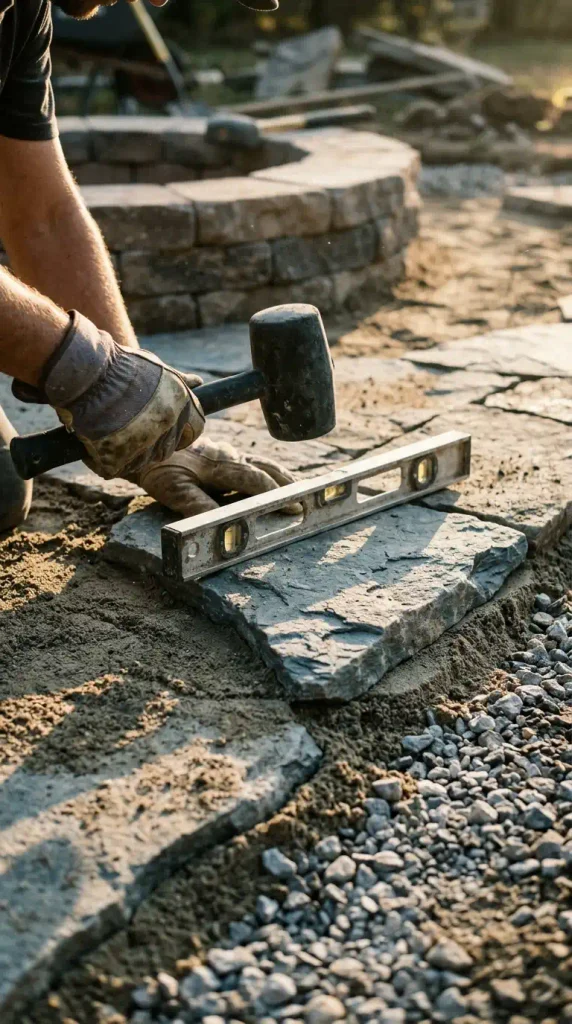
Lay apron flags biggest first, tap each with a rubber mallet, and check it with a 4-foot level.
Sweep polymeric sand into the joints and mist it exactly as the bag label says.
Fill the pit floor with gravel or lava rock, then let the adhesive and sand cure before the first fire.
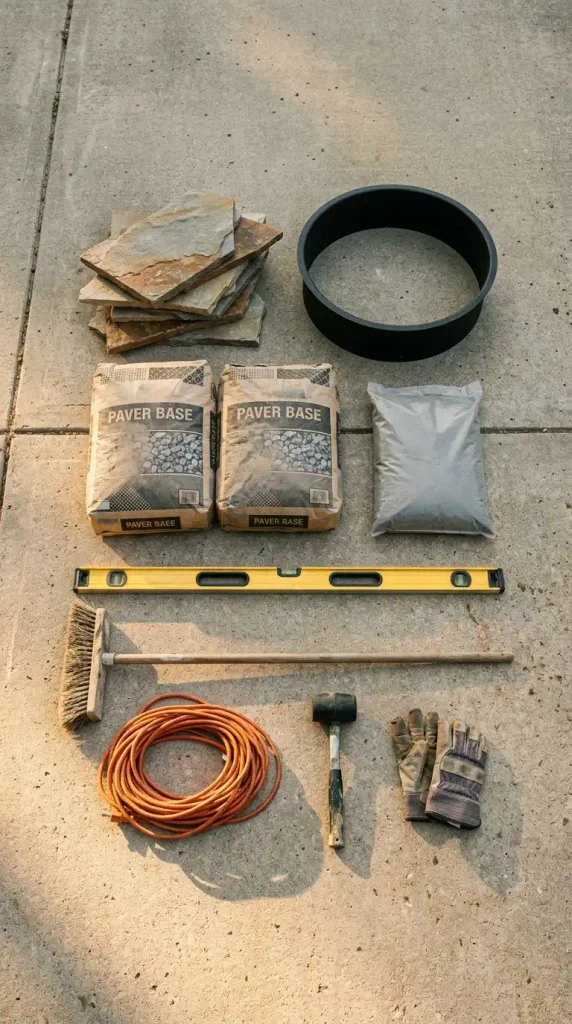
Two notes on materials. Alliance Gator G2 polymeric sand handles joints up to 2 inches wide and listed around $72 to $80 per 50-pound bag at Walmart in October 2026. Flagstone joints run wider than paver joints, so buy an extra bag.
Also, keep the patio sloping gently away from the pit. Water that pools at the rim soaks straight into the stone you want to stay dry.
Flagstone Fire Pit Cost: Kit, DIY Stone, or Hire It Out
Lawn Love’s 2026 cost data puts flagstone material at about $3.95 to $5.95 per square foot. A pro-installed flagstone patio runs $15 to $27 per square foot. The same data puts a basic fire pit add-on near $200, while custom builds run $5,000 or more.
Run those numbers on two real layouts and the picture gets clearer. An 8-foot stone pad covers about 50 square feet, so the stone runs roughly $200 to $300. Add a $60 steel ring and you’re in the $260 to $360 range before gravel, sand, and tool rental. The 12-foot patio from idea 5 is about 113 square feet, which works out to roughly $1,700 to $3,050 if a pro installs it.
Kits are the wildcard. Lowe’s doesn’t post a single national price for the Oldcastle Ashland kit, because it changes by store. Check your local listing before you compare.
Fastest build
stone plus ring, 8 ft circle
12 ft circle, installed
These are estimates built from 2026 ballpark data, not quotes. Your stone yard’s price per ton and your region will move them.
Care for Flagstone Through Freeze-Thaw and Fall Burn Season
Flagstone is low-maintenance, not no-maintenance. Each spring, walk the circle after the ground thaws. Any flag that rocks underfoot has heaved, so lift it, add a little sand, and reset it.
Top up polymeric sand wherever joints have washed low. Sweep ash and soot off the cap after big fires, before rain bakes them into the stone’s surface. And keep the gravel floor of the pit clear, so water drains instead of sitting in a puddle against the steel all winter.
Plants belong on the outer bands only. Creeping thyme between path stones smells great underfoot and fills gaps fast. Keep it well back from the apron, and pick the rest of your border with our notes on plants and gravel around a fire pit.
💡 Quick Tip
Do your spring wobble check on the first dry weekend after the thaw. A flag that rocks in April becomes a cracked flag by July.

Frequently Asked Questions
Is flagstone good for fire pits?
Flagstone works well around a fire pit but not as the surface that touches the flames. Porous stones like sandstone and limestone absorb water, and fast heat can make them flake or crack. Use a steel ring or firebrick for the burn chamber, then use dense flagstone such as quartzite or bluestone for the rim, cap, and patio around it.
How do you lay flagstone around a fire pit?
Dig out the sod, compact at least 3 inches of gravel (more in cold zones), and screed about an inch of coarse sand on top. Set the biggest flags against the rim first, fit smaller pieces outward like a puzzle, and tap each one level with a rubber mallet. Finish the joints near the fire with polymeric sand.
How much does a flagstone fire pit cost?
It depends on the build. A DIY stone pad with an 8-foot circle and a steel ring runs roughly $260 to $360 in stone and steel before base materials. Lawn Love’s 2026 data puts pro-installed flagstone patios at $15 to $27 per square foot, so a 12-foot circle lands around $1,700 to $3,050.
What do you put in the bottom of a flagstone fire pit?
Fill the bottom with gravel or lava rock up to the lower edge of the steel ring. That layer lets water drain away and keeps the fire off bare dirt. Skip river rock, since rounded stones from water can hold moisture inside and crack when they heat up. Clear out old ash before it packs the gravel down.
How thick should flagstone be for a fire pit area?
For a dry-laid patio and apron, 1.5 to 2 inch flagstone is the usual pick, because thinner slabs can crack under foot traffic and chair legs without a concrete base. Save the thickest, densest pieces, 2 inches or more, for the rim and cap where the stone takes heat and people step up to the fire.
Can you put a flagstone fire pit on a wood deck?
No. Wood and composite decking are combustible, and flagstone fire pit kit guides, including one sold at Lowe’s, warn against building on them. Set the pit on mineral ground such as compacted gravel or a flagstone patio. For a deck, look only at products the manufacturer specifically rates for deck use, and follow that manual.
Start With the Stone Map, Then the Shovel
The best flagstone fire pit ideas aren’t the fanciest ones. They’re the builds where the right stone sits in the right band. Steel holds the fire, dense slabs sit on the rim, joints stay tight where embers land, and thyme lives out on the path.
Pick your idea, mark your circle, and give the base the time it deserves. The stone part goes faster than you think.
Save this guide to your fire pit board so the Heat-to-Path Stone Map is on your phone when you’re standing in the stone yard picking slabs.
Steel holds the fire. Flagstone frames it. Keep stone out of the flames and it will outlast the pit.