17 Front Yard Landscaping Ideas on a Budget That Look Expensive

You pull into the driveway after work, and there it is again. A tired strip of patchy grass, two overgrown shrubs swallowing the porch, a flower bed that’s mostly weeds, and a bare spot by the mailbox where nothing has grown since you moved in. The house isn’t ugly. The front just says nobody’s home, even when you are.
Here’s the fix. These front yard landscaping ideas pull the whole front of the house together for under $400 if you want, and they lean on rocks, mulch, and the right curb appeal plants instead of a contractor’s invoice. I’ve rebuilt the front of a Pennsylvania duplex and a zone 7 starter home on weekend money, and I learned most of this the expensive way first. We’ll go cheap to splurge, with real prices and a zone-by-zone plant chart you can screenshot at the nursery.
Start With the Foundation Line, Not the Lawn
Most people start with the grass. Wrong move. The single highest-impact front yard fix is the foundation line, the planting bed that runs along the base of your house. Get that right and the lawn barely matters.
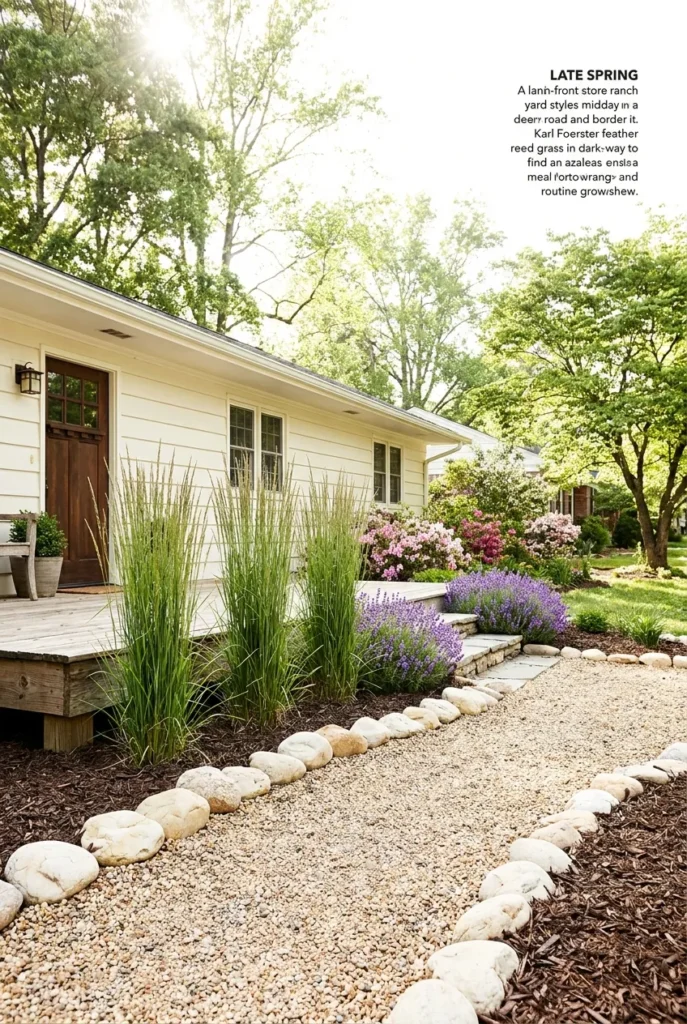
A bare foundation makes a house look like it’s floating on a parking lot. A planted one grounds it. Run a bed 3 to 4 feet deep along the front wall, edge it cleanly, and fill it in layers. You don’t need much. You need it tidy.
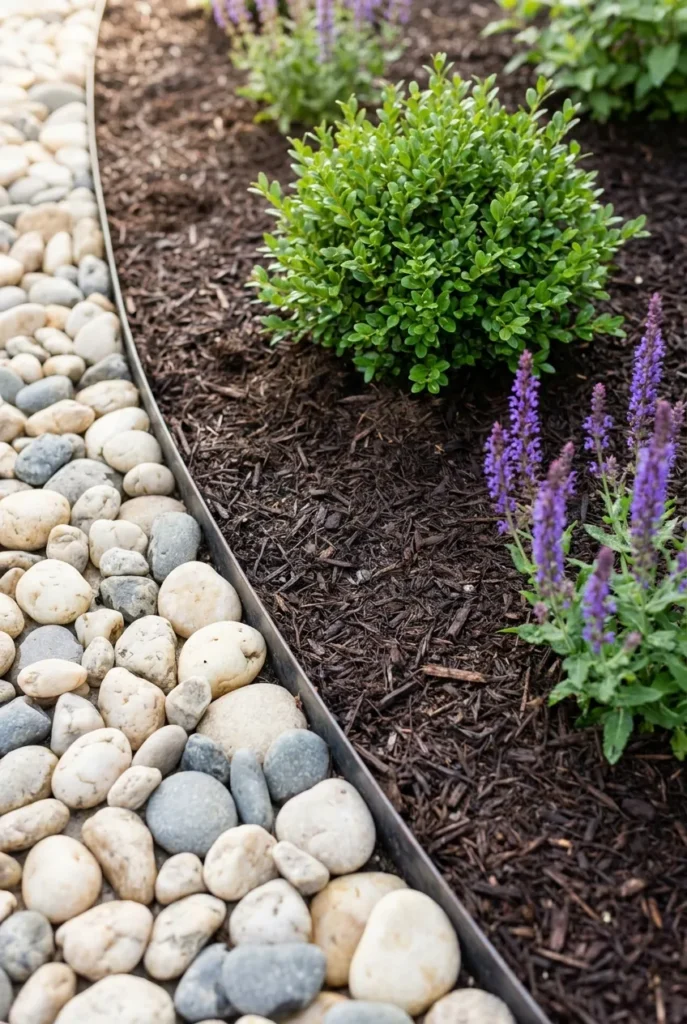
I edged my first foundation bed with $1.85 cinder blocks laid flat from Home Depot, then swapped them a year later for steel edging once I saw how much cleaner the line read. Live and learn. Start with what you can afford and upgrade the edge later. The plants do the heavy lifting either way.
For the layout logic behind any small front space, our walkthrough on making a small yard feel twice as big carries straight over to the front of the house.
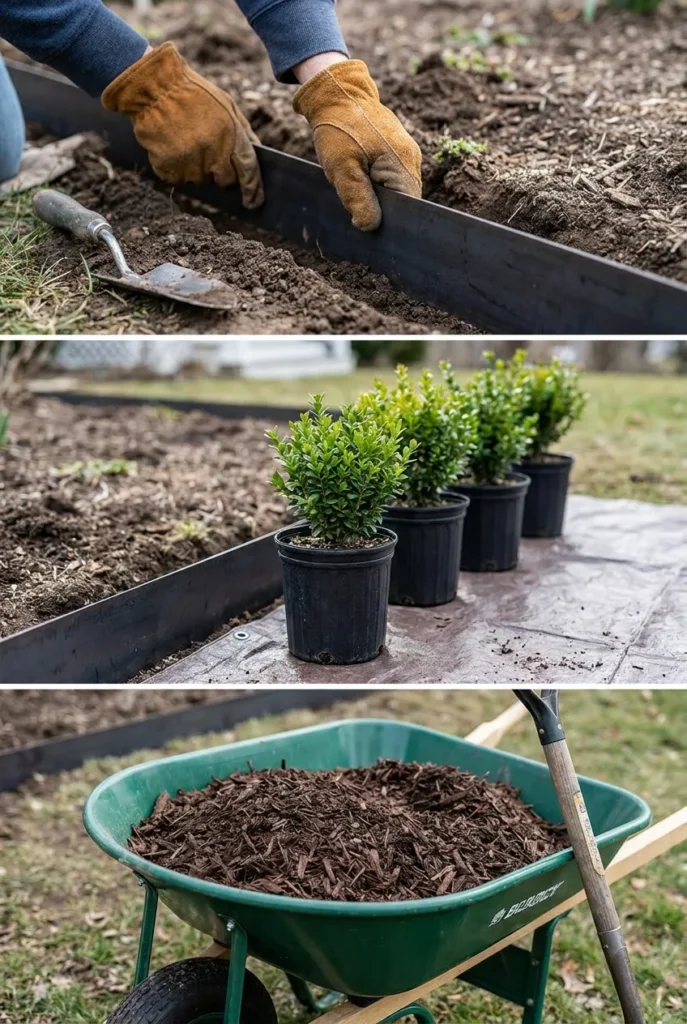
Master the Rock and Mulch Combo (The Cheapest Curb Appeal Win)
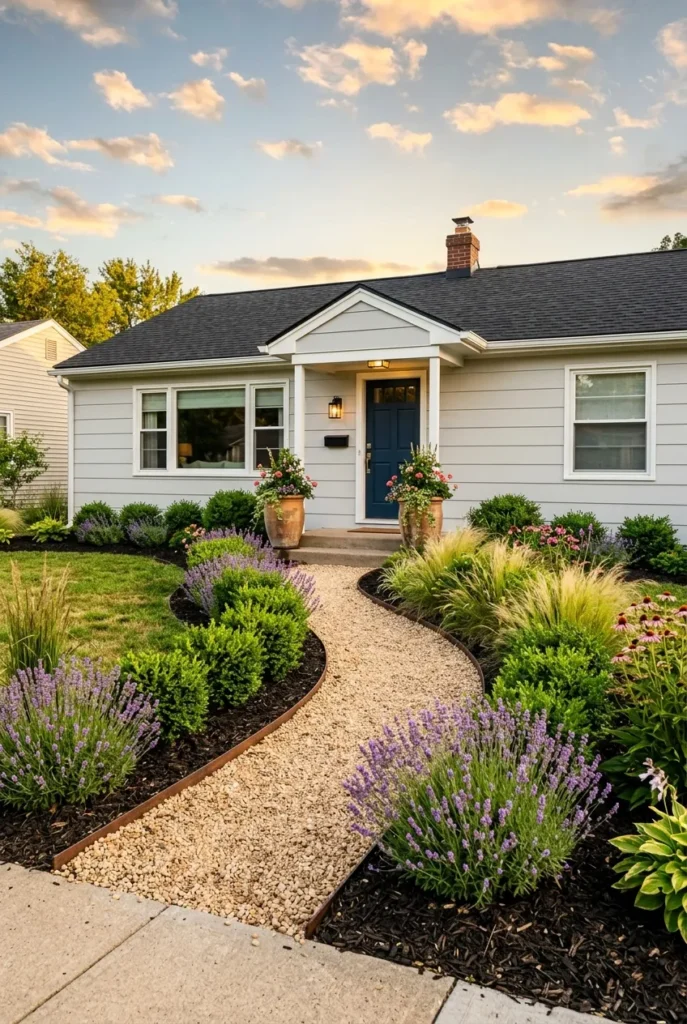
Rock and mulch landscaping for the front yard is the top-searched idea for a reason. It’s cheap, it’s low maintenance, and it photographs like money. The trick is the combo, not one or the other.
Use rock where you want permanence and zero upkeep: along the driveway, around the mailbox, under downspouts where water pools. Use mulch in the planting beds where roots need to breathe and stay cool. Cream or gray river rock reads high-end. Avoid the orange lava rock unless you’re going full desert.
Here’s the part nobody tells you. Rock is forever, so commit. I poured pea gravel over bare soil at my first place with no weed barrier underneath, and by July it was a salad bar of weeds poking through. Lay landscape fabric first, every time, or you’ll be picking dandelions out of stone for years.
- Budget tier (under $75): 6 bags of cream river rock from Lowe’s at roughly $5 a bag, plus a roll of weed barrier fabric ($18) and 4 bags of Scotts Nature Scapes mulch at $4 each. Covers a small front bed and a mailbox island.
- Mid tier ($75 to $200): Add a few accent boulders from a local stone yard ($30 to $60 each) and decomposed granite for a no-grass strip.
- Splurge ($200+): Bulk delivery of river rock by the cubic yard plus polymeric-set flagstone stepping pads.
A clean rock-and-mulch front is also the easiest base for budget backyard ideas that look expensive, so the same materials stretch front to back.
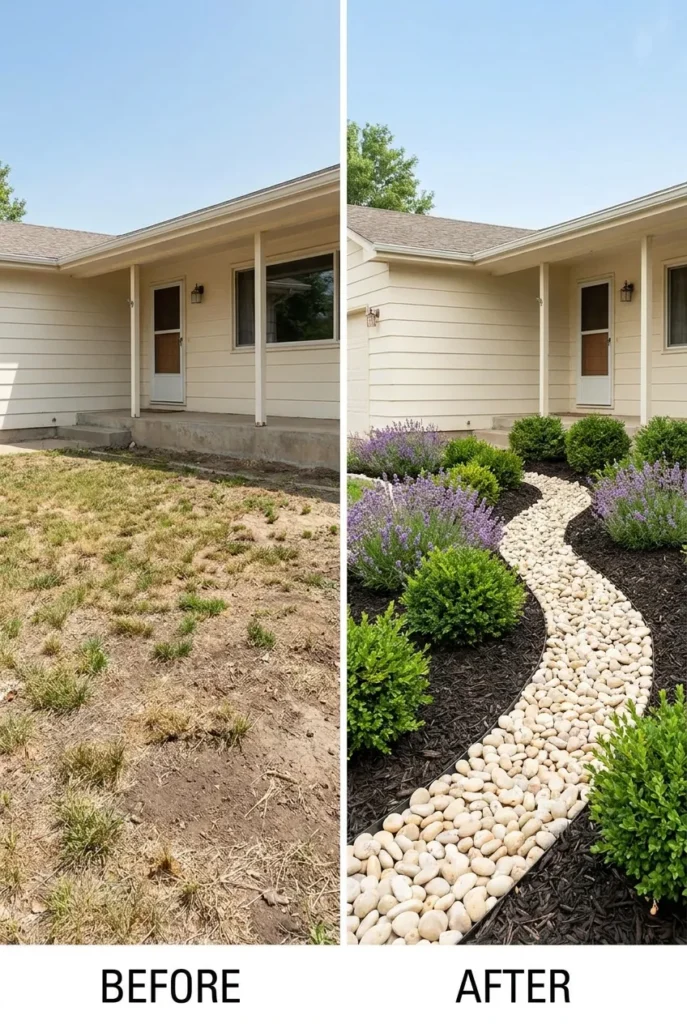
Pick Plants by Your USDA Zone (Stop Killing the Wrong Ones)
This is where budgets die. People buy a gorgeous plant, it’s wrong for their zone, it dies, they rebuy. The fix is free: look up your USDA zone once, then buy only what survives there.
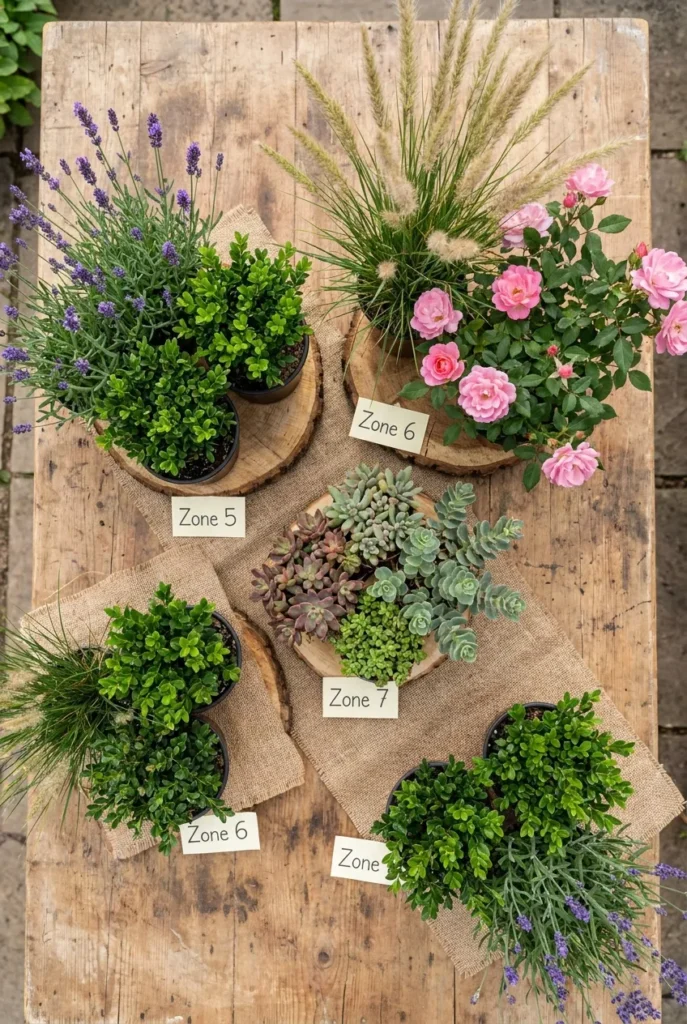
Check your zone on the free, regularly updated USDA Plant Hardiness Zone Map before you spend a dollar at the nursery. Then use the cheat sheet below. These are tough, widely available, curb-appeal-friendly picks you’ll find at Home Depot, Lowe’s, or any Bonnie Plants rack.
Front Yard Plant Match by USDA Zone
| Zone Band | 5 Reliable Curb-Appeal Plants | Avoid These |
|---|---|---|
| Zones 4 to 5 (Chicago, Denver, Boston) | Karl Foerster grass, Knock Out rose, dwarf boxwood, coneflower, sedum | Lavender in heavy clay, citrus, palms |
| Zones 6 to 7 (DC, Nashville, Atlanta north) | Lavender, boxwood, Knock Out rose, salvia, catmint | Tropical hibiscus, banana, frost-tender succulents |
| Zone 8 (Houston, Portland, the South) | Loropetalum, rosemary, dwarf yaupon holly, lantana, agapanthus | Lilac, peony, plants needing a hard winter chill |
| Zones 9 to 10 (central Florida, SoCal) | Agave, rosemary, lantana, bougainvillea, ornamental grasses | Tulips, peonies, fussy cool-season perennials |
Screenshot that. It’s the difference between a yard that fills in and one you replant every April. I burned through two rounds of lavender in zone 5 clay before I accepted catmint does the same purple-haze look and actually lives. Match the plant to the zone, or nothing else on this list matters.
For full Northern Hemisphere planting timing by zone, the Old Farmer’s Almanac frost date calendar is free and worth a bookmark.
Layer Plants in Threes (The Rule of 3, Explained Simply)
The rule of three is the cheapest design trick in landscaping. Plant in odd-numbered groups, 3, 5, or 7, and stage them by height. The eye reads odd groupings as natural and even ones as stiff.
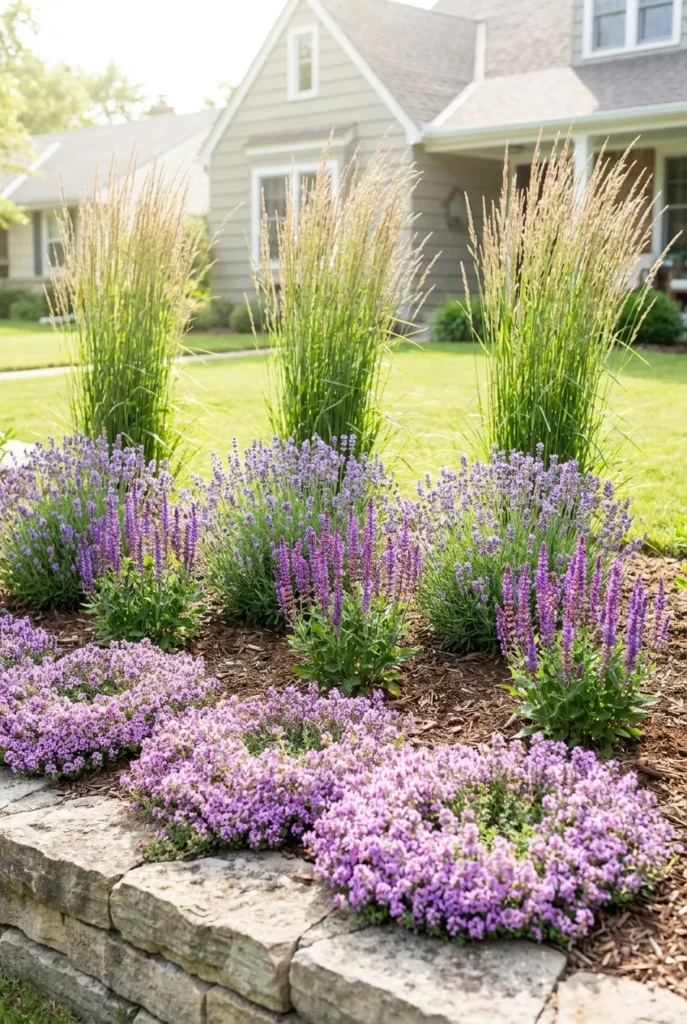
Stack three heights in every bed: tall in back, medium in the middle, low and trailing in front. A grass behind, lavender or salvia in the middle, creeping thyme spilling over the edge. That three-tier formula is what makes a $60 bed look professionally designed.
Stick to three colors, too. White, purple, and silver-green is foolproof and matches almost any house paint. More than three and the front reads busy.
Define a Walkway and Light It
A clear path to the door is curb appeal 101. A wide, slightly curving walkway feels welcoming. A skinny straight one feels like a fire exit. If your concrete path is fine, frame it. If it’s cracked, edge it with a thin gravel border to soften the damage cheaply.
Then light it. Walkway lighting is the upgrade that does the most for the least at night.
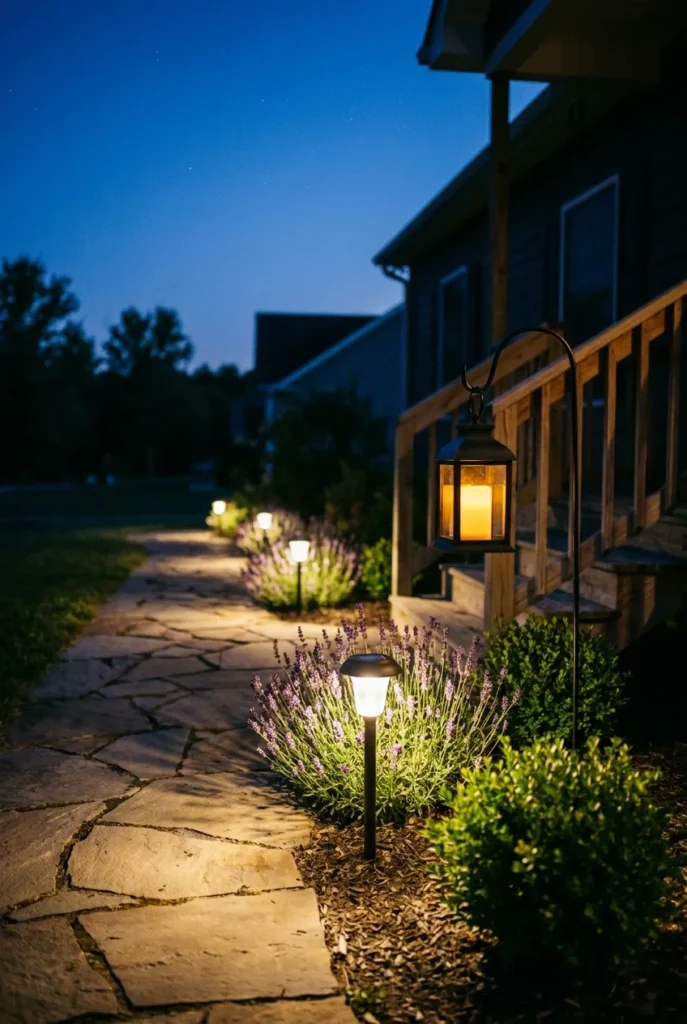
- Six solar path lights from Home Depot run about $20 for a pack of six. Stake them a foot off the path, evenly spaced.
- For brighter, longer-lasting glow, look for ENERGY STAR certified outdoor fixtures; the ENERGY STAR outdoor lighting guide explains what the label actually buys you.
- Add one warm-white solar lantern on a shepherd hook by the porch for a focal glow.
The first solar lights I bought were cheap blue-white ones, and the front looked like a runway. Swap any blue-toned bulb for a warm 2700K and the whole house softens. Warm light reads cozy. Cold light reads institutional.
Landscape a Sloped or Ranch-Style Front Yard
Two front-yard situations trip people up: slopes and long low ranch fronts. Both have a cheap fix.
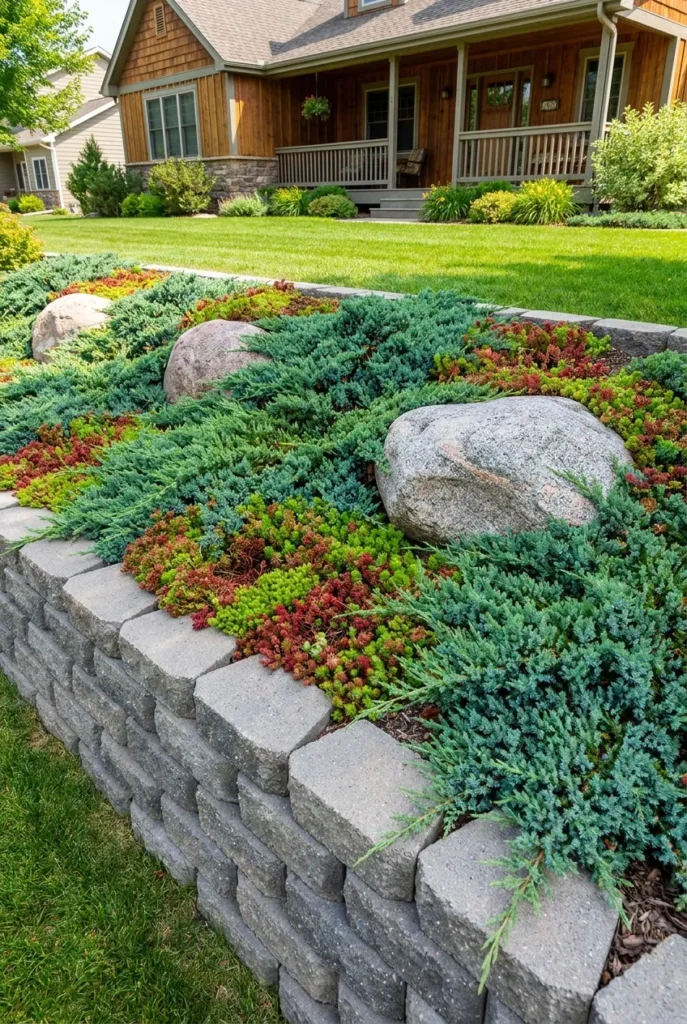
For a slope, skip the retaining wall quote. Terrace it lightly with a single row of stacked retaining blocks ($1.85 to $3 each) and plant the bank with spreading ground cover like creeping juniper or sedum that grips the soil and never needs mowing. Boulders set into the slope add weight and stop erosion at the same time.
For a ranch-style home, the house is long and horizontal, so your planting should add vertical interest to balance it. One slim upright tree or a tall ornamental grass cluster near the entry breaks up the low roofline. Repeat one plant in a rhythm across the front rather than dotting ten different things.
Go Low-Maintenance With a No-Grass or Xeriscape Front
A front lawn is the highest-maintenance, lowest-payoff square footage you own. Cutting it from the equation saves water, weekends, and money, and it’s the fastest-climbing front yard search of 2026.
Replace turf with a mix of gravel, ground cover, and planted islands. In dry-climate states this is xeriscaping, and it can be beautiful, not just a gravel lot. Anchor it with drought-tolerant plants, a few boulders, and decomposed granite paths.
If you want to push privacy and greenery without a lawn, a row of tall grasses or a slim hedge along the property edge does double duty. Our guide to budget privacy ideas that actually work translates straight to a front-yard screen between you and the sidewalk.
A Renter and HOA Reality Check (The Part Nobody Else Covers)
The front of the house is the most visible and the most regulated part of your property. Renters can’t dig up the lawn. HOA folks can’t paint the door teal. Here’s what still works.
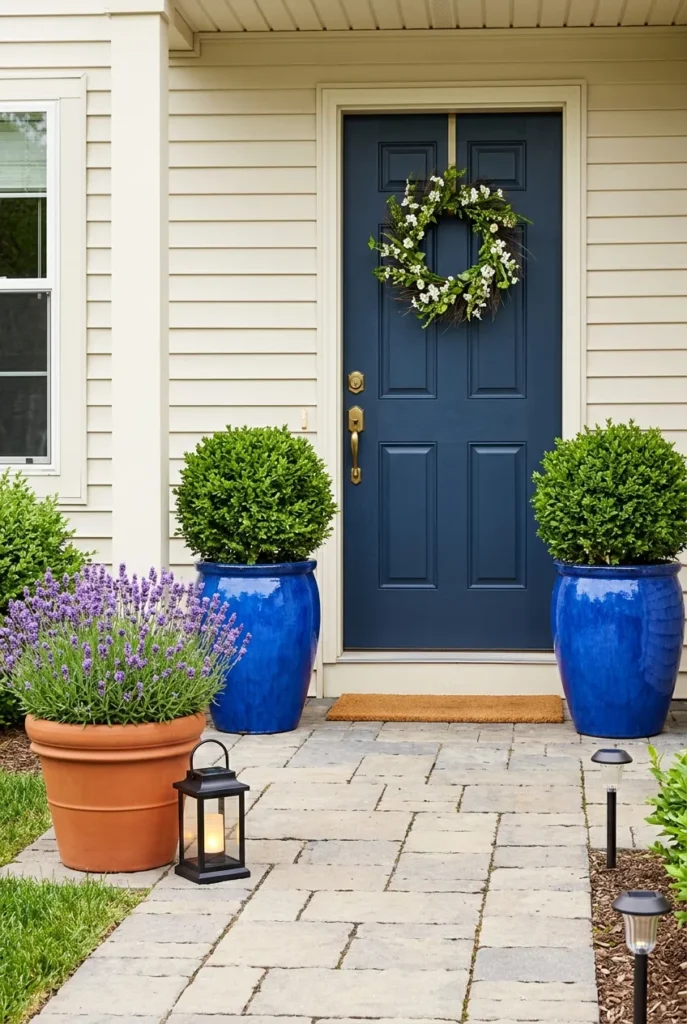
Renters: lean on big containers flanking the door, freestanding planters along the path, and solar lighting that needs no wiring. Two large glazed planters with boxwood frame an entry instantly and move with you. Mulch refreshes and clean edging are reversible and landlord-friendly.
HOA homeowners: read your covenants before buying anything, then work within them. Most HOAs allow bed refreshes, mulch, approved plant lists, and lighting. Keep it tidy and symmetrical and you’ll sail through. Symmetry is the secret password of HOA curb appeal.
Budget vs Splurge: A Front Yard Cost Snapshot
| Element | Budget (under $75 to $100) | Splurge ($200+) |
|---|---|---|
| Foundation bed | Cinder block edge + cedar mulch ($40) | Steel edging + flagstone ($300+) |
| Rock border | Bagged river rock ($30) | Bulk-delivered stone by the yard ($250+) |
| Plants | 5 nursery perennials ($50) | Mature specimen tree + perennials ($400+) |
| Walkway lighting | Solar path light 6-pack ($20) | Low-voltage hardwired path lights ($350+) |
| Entry planters | Terracotta pots ($12 each) | Glazed ceramic or concrete ($120+ each) |
A genuinely sharp front yard refresh lands under $400 in the budget column. The splurge column climbs past $1,500 and still skips the contractor. For before-and-after proof on real timelines, our roundup of real backyard makeovers with costs shows what people pulled off themselves.
Mistakes That Quietly Wreck a Front Yard
A few cheap errors undo all the work. Watch for these.
- Skipping weed fabric under rock. You’ll regret it by midsummer.
- Buying mature-size shrubs that swallow the porch in three years. Read the tag.
- Mixing five hardscape materials. Pick two and repeat them.
- Planting one of everything. Repeat plants in threes for rhythm.
- Cold blue-white path lights. Go warm, always.
- Ignoring your USDA zone. Free to check, expensive to skip.
Seasonal Tip: Plant in Fall for a Free Head Start
Fall beats spring for front-yard planting in most US zones. Roots settle in cool soil, and nurseries clearance perennials 40 to 60 percent off in September and October. I grabbed $300 of perennials for around $110 at a local zone 7 nursery one October, and they came back fuller the next May than anything I planted in spring.
FAQ
What are the cheapest front yard landscaping ideas?
The cheapest high-impact moves are a fresh layer of cedar mulch in the foundation beds, a clean edge cut around them, a rock border along the driveway over weed fabric, and a solar path light 6-pack. You can refresh a small front for around $100 and it reads instantly cared-for. Add perennials from fall clearance to stretch the budget further.
What is the best landscaping in front of a house?
The best front yard landscaping starts at the foundation line: a 3 to 4 foot planted bed running along the base of the house, layered in three heights, repeated in odd-numbered groups, and tied to a clear lit walkway. Match plants to your USDA zone so they fill in instead of dying. That foundation-plus-walkway combo beats any single flashy feature.
What is the rule of 3 in landscaping?
The rule of three says to plant in odd-numbered groups, 3, 5, or 7, instead of pairs or even rows. Three of the same plant read as an intentional clump, while two read as a mistake. It applies to plants, planters, and boulders, and it’s the simplest way to make a budget bed look designed.
What are the best front yard plants for full sun?
For full sun on a budget, lean on lavender, Knock Out roses, salvia, catmint, Karl Foerster grass, and sedum in zones 5 to 7, or rosemary, lantana, and agave in zones 8 to 10. They’re drought-tolerant, widely sold, and tough. Always confirm the pick against your USDA zone first.
How do I landscape a sloped front yard cheaply?
Terrace lightly with one row of stacked retaining blocks (around $2 to $3 each) and plant the bank with spreading ground cover like creeping juniper or sedum so you never mow it. Set a few boulders into the slope to anchor soil and add weight. Skip the retaining-wall contractor quote entirely for a gentle grade.
Can renters landscape the front of the house?
Yes, with reversible moves. Big matching planters flanking the door, freestanding path planters, fresh mulch, clean edging, and solar lighting all work and move with you. Skip digging up turf or anything permanent, and check your lease first. The look reads high-end without a single permanent change.
Is a no-grass front yard cheaper long-term?
Significantly. You drop the mower, the fertilizer, the irrigation, and the weekly mowing from March through October. Average US lawn care runs $500 to $1,000 a year, so a gravel-and-perennial front nearly pays for itself after the first season and only gets cheaper.
Save This Before Your Next Yard Weekend
Front yard landscaping on a budget comes down to doing less, but doing it on purpose. Fix the foundation line first, master the rock and mulch combo, match your plants to your zone, and plant everything in threes. Light the walkway warm, keep it symmetrical, and the front of the house finally looks like someone lives there and loves it.
If you want a softer, more romantic take on the front beds, our cottage garden yard ideas with a zone cheat sheet is the natural next read. Pin the zone plant chart above to your Front Yard board so it’s with you at the nursery. Which fix are you starting with this weekend?