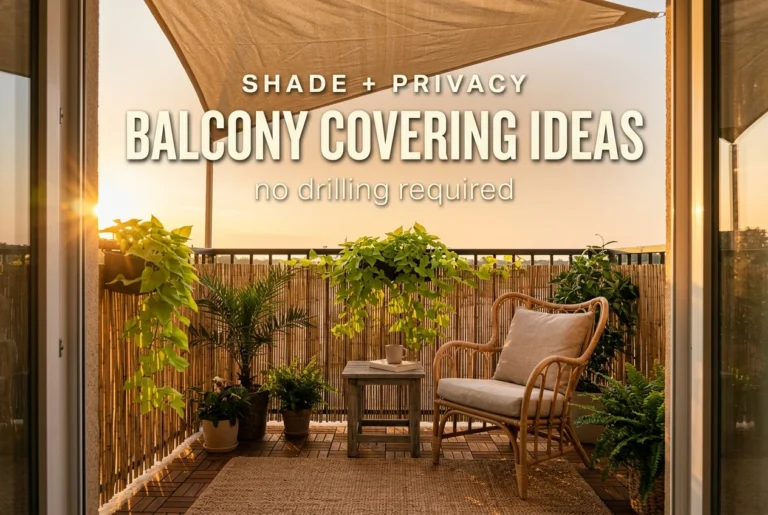
Balcony Flooring Ideas That Hide Ugly Concrete Without Losing Your Deposit

Concrete balconies have a specific kind of ugly. Not dramatic. Just gray, slightly stained, faintly sloped toward a drain, and stamped with whatever texture the builder’s crew was using that week. You put a chair out there, you sit in it once, and you never go back.
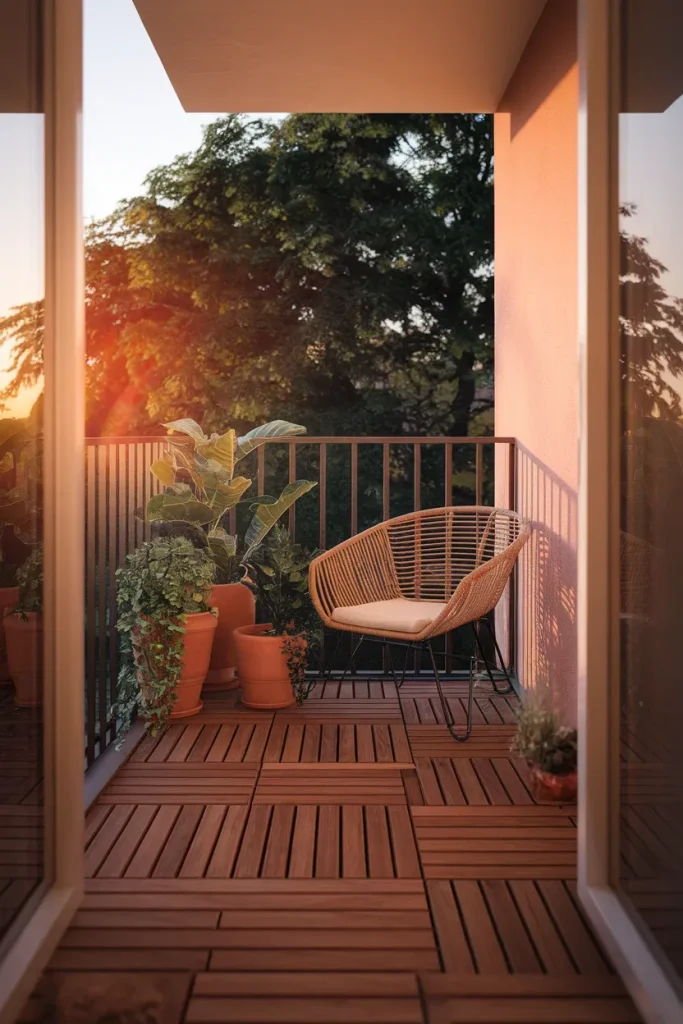
Good news: the floor is the cheapest thing on that balcony to fix, and you almost never need permission to do it. Most balcony flooring ideas that actually work are reversible by design. The balcony flooring ideas below all sit on top of the existing slab. No adhesive on the concrete, no drilling, no anchors, nothing your building manager can point at during a walkthrough. It’s the same trick that works on an ugly backyard makeover on the cheap, scaled down to forty square feet.
One thing before the pretty pictures. Balconies have a weight budget that patios don’t, and almost nobody writing about balcony floor covering mentions it. We’re fixing that first.
Why Your Concrete Balcony Looks So Rough (And What Actually Fixes It)
Builder concrete is poured to shed water and pass inspection. Nobody was thinking about your morning coffee.
Three things make it read as ugly. The color is a flat, cool gray that goes greenish in shade. The surface is textured just enough to hold dirt in every pore. And the slope, usually a quarter inch per foot toward the edge or a drain, means water sheets across it and leaves mineral tracks behind.
You can’t fix any of that by cleaning harder. Pressure washing lifts the loose dirt and then the stains come back next season, because the pores are still open and the slope still runs the same way.
Covering it works better than treating it. Balcony flooring that sits above the slab hides the color, hides the texture, and hides the slope all at once, while still letting water get to the drain underneath. That last part is the whole game, and it’s where cheap solutions fail.
Here’s the honest tradeoff nobody puts in the listicle: every covering you add makes the floor prettier and the maintenance slightly worse. You’re trading a surface you can hose off for a surface you’ll occasionally lift. Worth it, but go in knowing.
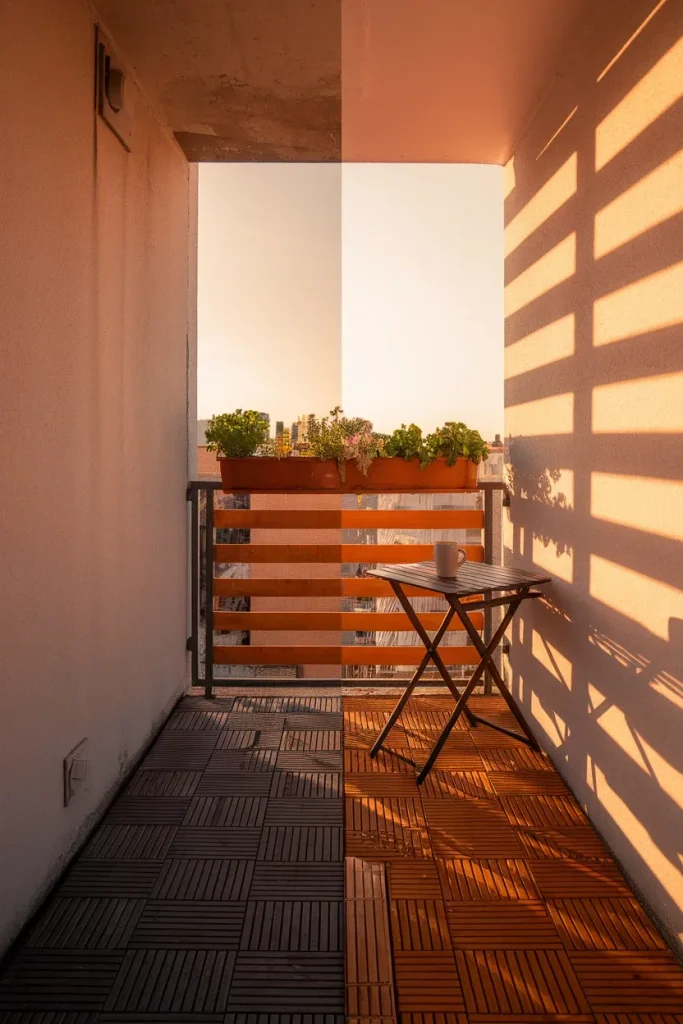
The Three Pound Rule: Weigh Balcony Flooring Before You Buy It
This is the framework worth screenshotting. Before you fall for a floor, look up the weight per square foot of the balcony flooring you’re considering, then sort it into one of three tiers.
Tier 1, under 3 pounds per square foot. Safe on essentially any balcony, light enough to carry up in one trip, and easy to pull up when you move. Perforated PVC tiles run right around 1 pound per square foot. Wood-topped tiles on a plastic base land near 2 to 3. Outdoor rugs are under 1. This tier covers most renters and most small balconies.
Tier 2, roughly 3 to 8 pounds per square foot. Fine on most concrete balconies, but read your lease and think about how the load spreads. Rubber rooftop tiles sit here at about 6 pounds per square foot. So does a thin paver on pedestals.
Tier 3, over 8 pounds per square foot. Stone, full-thickness porcelain, poured overlays, anything mortared. Get written approval from your building before you buy, and on an older structure ask whether an engineer needs to look at it.
Why sort balcony flooring by weight instead of just picking what’s pretty? Because the spread is enormous. Outdoor deck tiles range from roughly a pound to about 25 pounds per tile depending on material, which means two floors that look nearly identical in photos can differ by a factor of twenty in load.
A worked example. A 6 by 8 foot balcony is 48 square feet. PVC tiles at 1 pound per square foot add about 48 pounds total, less than one adult standing on it. Sterling-style rubber rooftop tiles at 6.1 pounds per square foot add roughly 293 pounds, before furniture, before planters full of wet soil, before people. Same floor area. Very different conversation with your landlord.
Most residential balconies are engineered with real margin, so Tier 1 and Tier 2 rarely raise an eyebrow. Your building manager is still the right person to confirm your specific structure, especially on anything older or anything with a visible crack in the underside.
Interlocking Deck Tiles: The Fastest Balcony Flooring Fix
If you want one recommendation and no further reading, it’s this one. Snap-together tiles are the reason apartment balcony flooring ideas got popular in the first place, and they remain the most forgiving balcony floor covering you can buy.
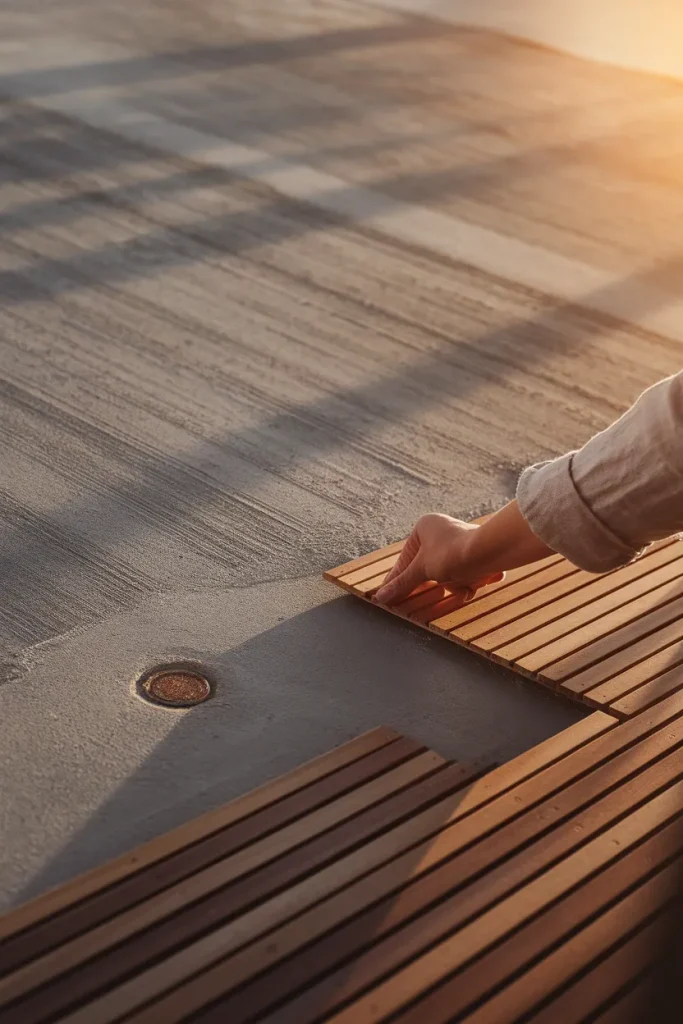
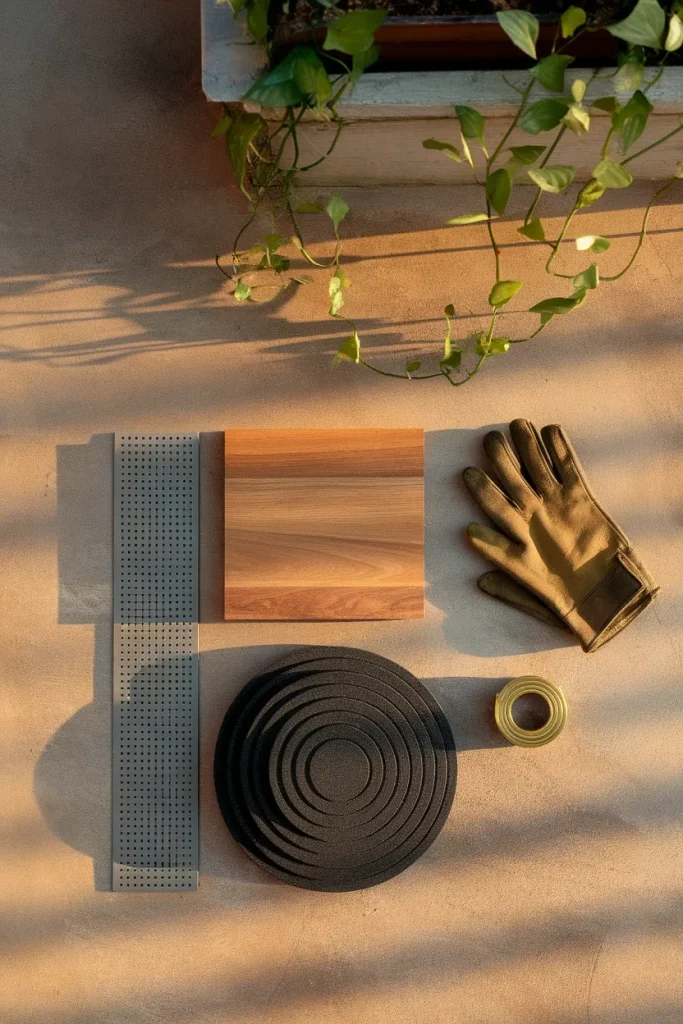
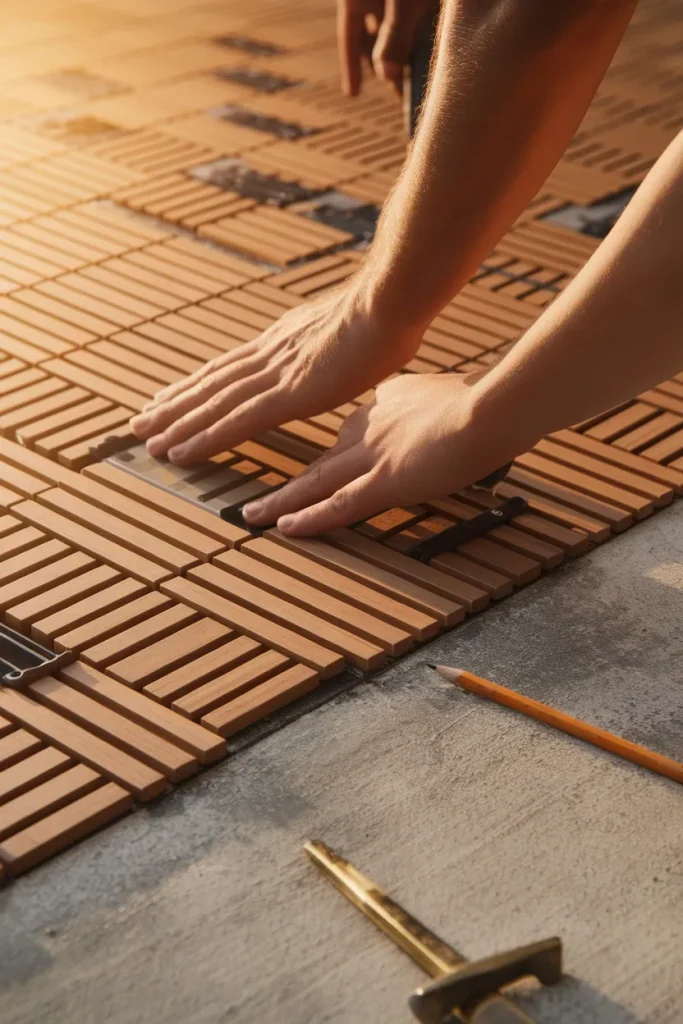
They click edge to edge into a floating grid. Nothing bonds to your concrete. You lay them over the existing slab and cut the last row with a jigsaw or a fine-tooth handsaw. The finished floor sits about three quarters of an inch proud of the slab, so water still runs to the drain underneath.
Cost lands in a predictable band, which is rare among balcony flooring ideas. Perforated PVC tiles run around $5 per square foot. Wood-topped tiles are often cheaper: IKEA’s RUNNEN decking in acacia is $34.99 for a nine-tile pack covering 8.719 square feet, which works out to roughly $4 per square foot for real wood on a plastic base. On a 48 square foot balcony that’s about six packs and a little over $200 for the whole floor.
Installation notes that save you an afternoon:
- Sweep and rinse the slab first, then let it fully dry. Anything you trap under the tiles stays there.
- Start at the most visible corner, usually the one you see from the doorway, so your cut row ends up against the railing where nobody looks.
- Dry-fit the full floor before you cut anything. Balconies are rarely square, and the wall side is usually the culprit.
- Leave a half inch gap at the drain. Do not tile over it.
- Buy one extra pack. You will crack a tile on the cut row.
The one honest complaint about tiles: they read as slightly modular up close. From a chair, from the doorway, and in every photo you’ll ever take, they read as a wood floor.
Wood Balcony Flooring Brings Warmth (And Graying Nobody Warns You About)
Wood is the look most people are actually after when they search for balcony flooring ideas. Warm, natural, softens all that gray. It also changes on you, and the sellers stay quiet about it.
Here’s the mechanism. Ultraviolet light starts photodegrading wood the moment it goes outside, and per the USDA Forest Products Laboratory’s Wood Handbook, sunlight starts breaking down the wood surface almost immediately, with extractive color change measurable within minutes of exposure. Lignin makes up 20 to 30 percent of the wood surface and degrades faster than the cellulose around it, which loosens surface fibers and pulls the color toward silver-gray.
The reassuring part of the same research: erosion is genuinely slow. Roughly a quarter inch of wood is lost in a century. Your tiles are not dissolving. They’re just changing color.
So you get a choice, and both answers are fine.
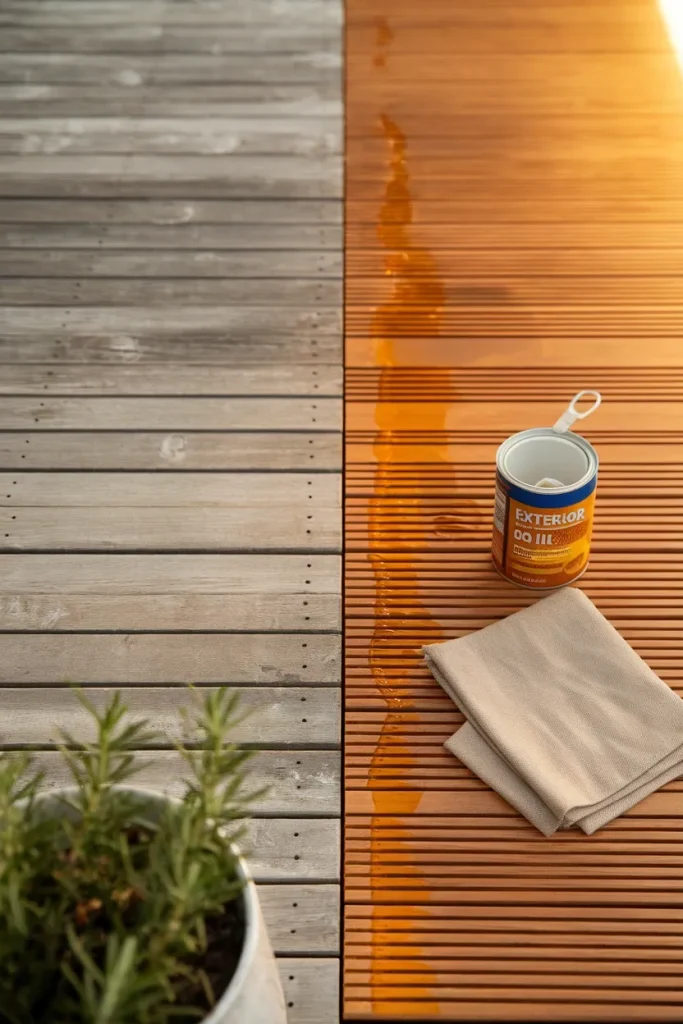
Let it gray. Silver-weathered acacia against a white wall is a look people pay for. Zero maintenance. Just hose it and move on.
Keep it honey. Re-glaze or re-oil once or twice a year. IKEA says the same about RUNNEN, and flags color change, small cracks, and a dry chalky surface as your cue. Twenty minutes with a cloth and a can of exterior oil on a dry spring afternoon.
Skip untreated softwood tiles for a full-sun balcony. Acacia, ipe, and eucalyptus hold up far better than the cheap pine you sometimes see in the same aisle at a similar price.
Outdoor Rugs: Cheap Balcony Flooring Ideas That Take Ten Minutes
Not every balcony needs a construction project. Sometimes you need the concrete gone by Saturday, and the simplest small balcony flooring ideas are the ones you can finish before lunch.
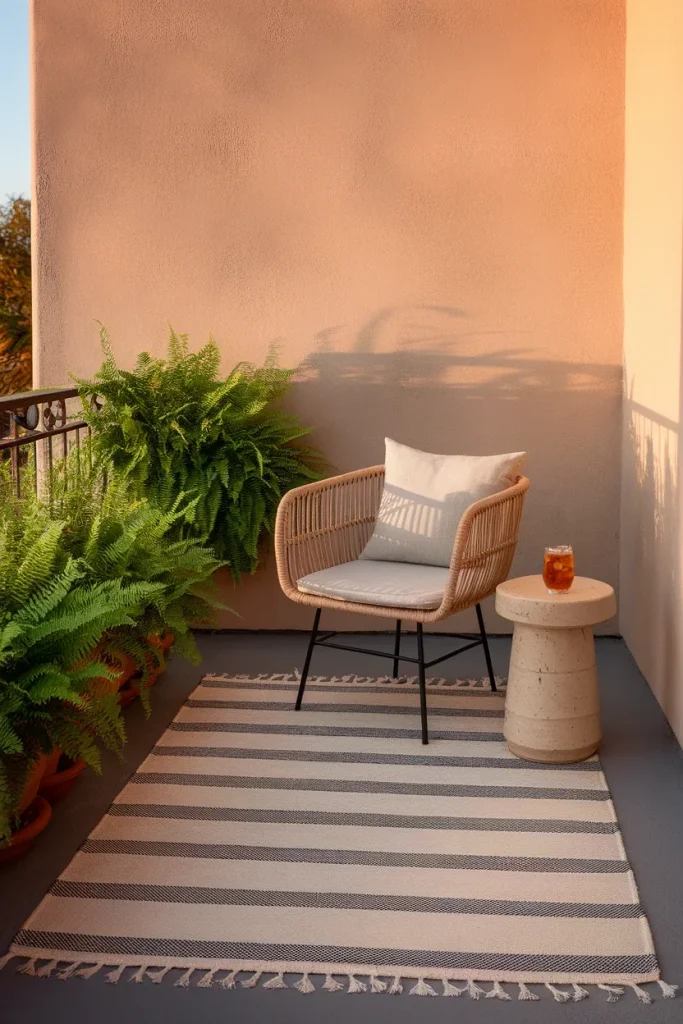
A flat-woven polypropylene outdoor rug covers a small balcony floor in one motion. No cutting, no clips, no tools. It’s the lightest option on the list at well under a pound per square foot, and it’s the easiest to undo, which makes it the natural companion to renter friendly upgrades that move with you.
Size it deliberately. On a balcony, a rug that leaves four to six inches of concrete showing on all sides looks intentional. A rug that runs wall to wall looks like a rug you couldn’t fit. Counterintuitive, but it’s the same principle behind good small backyard patio ideas: a defined edge makes the space read bigger, not smaller.
Buy polypropylene, not jute, not cotton, not wool. Jute looks gorgeous in the listing photo and turns into a damp mat that stains your slab by August.
And here’s the rule that saves your concrete: lift the rug after heavy rain. Which brings us to the part everyone skips.
Paint, Peel and Stick, and Pebbles: Three Balcony Floor Coverings Compared
Three budget balcony floor coverings, three very different risk profiles.
Concrete paint or stain. Cheapest per square foot and the only option that doesn’t raise your floor height. Also the only one on this page that permanently alters your landlord’s slab, so renters should stop here and pick something else. Owners: clean, etch, prime, and use a paint rated for exterior concrete foot traffic. A stencil in a soft terracotta or sage reads far more expensive than the effort involved.
Peel and stick outdoor tiles. Fast and genuinely pretty. The adhesive is the problem. Direct sun heats a dark tile enough to soften the glue, and when you eventually lift them, the residue is yours to deal with. Use these on a covered or shaded balcony, or accept that removal day involves a heat gun and a scraper.
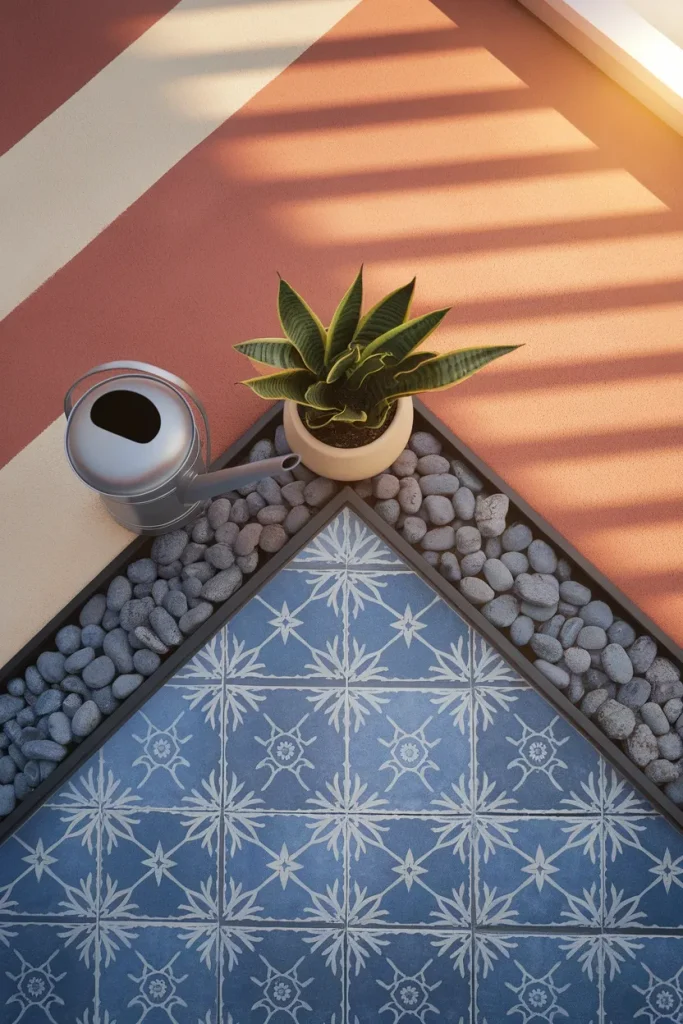
Pebbles and river rock. Beautiful in a spa-ish way, cheap by the bag, and the fastest way to make a drain fail. Loose stone migrates into the drain, holds water against the slab, and gets swept off the edge by wind on higher floors. If you love the look, contain it: a shallow border of river rock inside a metal edging strip, or a single pebble tray beside the door, not the whole floor.
Ranked by how likely you are to regret it: pebbles first, then peel and stick, then paint. Those are the three cheap balcony flooring ideas that most often get undone a year later. Tiles and rugs stay out of the regret list entirely, which is why they got their own sections.
What Happens Under Your New Balcony Flooring
Every article on this topic ends at installation. That’s the wrong place to stop, because the interesting part of floating balcony flooring is the half inch of air under it.
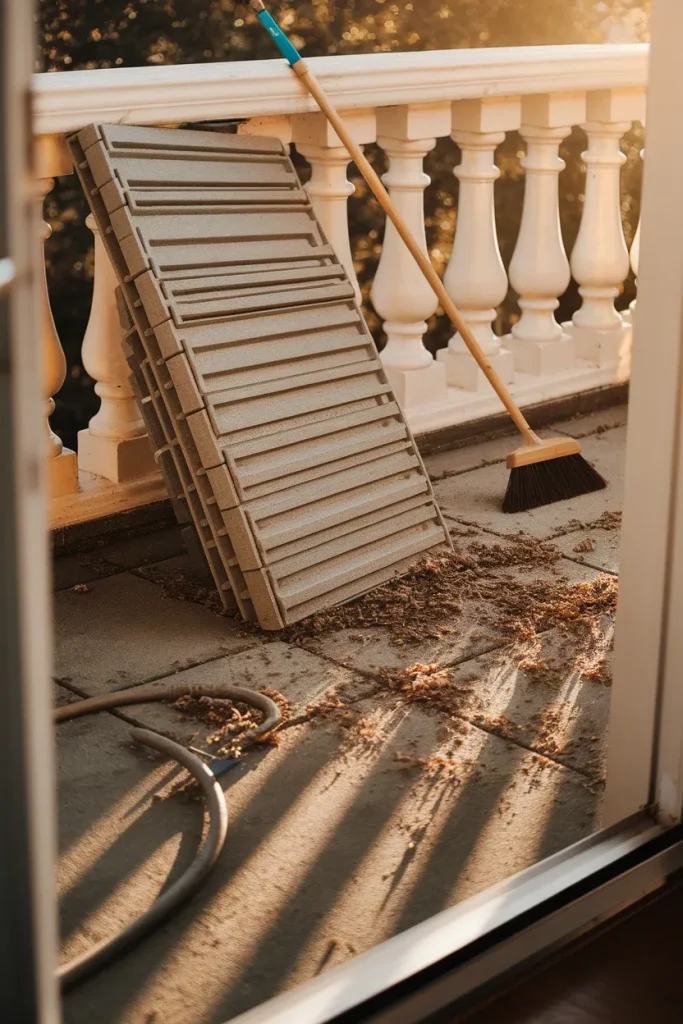
That gap is doing real work. Water reaches the drain, air moves across the slab, and the concrete dries between rains. It also collects things: leaf litter, pollen, potting soil, the fine grit that blows onto every balcony above the second floor.
Let it pack in and the gap stops draining. Now you have a damp slab held under a covering that doesn’t dry. The EPA’s guidance for water-damaged materials is to dry any wet material within 24 to 48 hours to prevent mold growth, and their summary line is blunt: the key to mold control is moisture control. A clogged underfloor blows straight through that window, every time it rains.
The maintenance rhythm is simple. Twice a year, spring and fall, lift the tiles. Snap-together tiles come up in sections in about ten minutes. Sweep the slab, rinse it, let it dry fully, snap them back. Rugs get shaken out and hung over the railing for an afternoon on the same schedule.
Choose perforated tiles if your balcony holds water anywhere, whatever else your balcony flooring does. Manufacturers make the drainage claim explicitly, and Greatmats markets its perforated PVC line on exactly this point, that water passes through and mold and mildew don’t get their damp surface. Solid-backed tiles look better in the box and drain worse in reality.
One thing to watch on a covered balcony: without rain flushing the gap, dust accumulates faster than you’d expect. Covered balconies need the lift-and-sweep more often, not less.
A Weekend Balcony Flooring Plan for Forty Square Feet
Here is the whole balcony flooring project, hour by hour.
Friday evening, thirty minutes. Measure. Length times width, then add ten percent for cuts and the tile you’ll crack. Note where the drain sits and which direction the slope runs. Photograph the bare slab, because you will want the before shot and you will forget.
Saturday morning, one hour. Clear everything off, sweep, rinse, and leave it to dry in the sun. Order or pick up your tiles while it dries. Six packs of RUNNEN at $34.99 covers roughly 52 square feet with margin, which is about $210 for a 40 square foot balcony.
Saturday afternoon, two hours. Dry-fit the whole floor without cutting. Adjust your starting corner until the cut row falls against the railing. Cut the last row with a jigsaw. Snap everything down.
Sunday, one hour. Rug on top if you’re layering, furniture back, plants back. Pull the pots four inches off the wall so air moves behind them.
Total: about four and a half hours across two days, and roughly $210 to $260 depending on whether you add a rug. That’s the entire project.
Run the Three Pound Rule one last time before you commit. Forty square feet of wood-topped tile at about 2.5 pounds per square foot is roughly 100 pounds. Tier 1. Nobody’s going to ask you a single question about it.
Balcony Flooring FAQ
What is the cheapest way to cover an ugly concrete balcony floor?
An outdoor polypropylene rug, easily the cheapest of the balcony flooring ideas here. You can cover a small balcony for well under $100, it takes ten minutes, and nothing is permanent. If you want the concrete gone completely rather than mostly, wood-topped snap tiles are the next step up at roughly $4 per square foot, which puts a 40 square foot balcony near $160 to $210.
Can I put flooring on my apartment balcony without asking the landlord?
Anything that floats on top of the slab and lifts out cleanly is generally fine, and that covers rugs, snap-together tiles, and freestanding platforms. Anything that bonds, drills, or permanently changes the surface, meaning paint, stain, adhesive tile, and mortar, needs written permission. Read your lease. Some buildings also have rules about weight and about what’s visible from the street.
Do interlocking deck tiles damage a balcony floor?
Not on their own. They rest on plastic feet and lift out. The damage comes from neglect, not from the tiles: trap debris and standing water under them for a couple of years and you can end up with staining or efflorescence on the slab. Lift and sweep twice a year and the concrete underneath comes out looking the same as the day you covered it.
How much weight can a balcony hold?
More than any of these floors add, in almost every case, but the exact figure depends on your building’s structure and age, so your building manager or a licensed structural engineer is the right person to confirm. Use the Three Pound Rule as your screen. Under 3 pounds per square foot is a non-issue. Over 8 pounds per square foot, ask first.
Do outdoor rugs trap moisture on a concrete balcony?
They can, and this is the main failure mode. A rug left flat on damp concrete through a rainy stretch holds water against the slab well past the 24 to 48 hour window where mold gets started. Choose an open flat weave in polypropylene, and hang it over the railing for an afternoon after heavy rain.
What flooring is best for a balcony that gets full afternoon sun?
Light-colored PVC or composite balcony flooring. Dark surfaces get genuinely too hot to stand on barefoot, and full sun is where peel and stick adhesive softens and where untreated wood grays fastest. If you want wood in full sun, use acacia, ipe, or eucalyptus rather than pine, and plan on oiling once or twice a year.
How long do wood deck tiles last outside?
The wood itself lasts a long time. Surface erosion is slow enough that only about a quarter inch is lost in a century. What actually ends a tile’s life is the plastic base cracking or the clips failing. That usually shows up somewhere in the five to ten year range, depending on sun exposure and foot traffic. Buy a spare pack at install and you can swap individual tiles instead of redoing the floor.
Start With the Floor
Balconies are small enough that one change reorganizes the whole space. Of every balcony flooring idea on this page, the cheapest still beats leaving the concrete bare. Cover it and suddenly the chair looks intentional, the plants look styled, and you find yourself out there on a Tuesday for no particular reason.
Pick your tier first, your look second. Measure this weekend, dry-fit before you cut, and leave the drain alone.
Which one are you leaning toward, the snap tiles or the rug? Whichever you pick, take the before photo. You’ll want it.