Front Yard Landscaping Ideas for Curb Appeal That Still Look Right From the Street

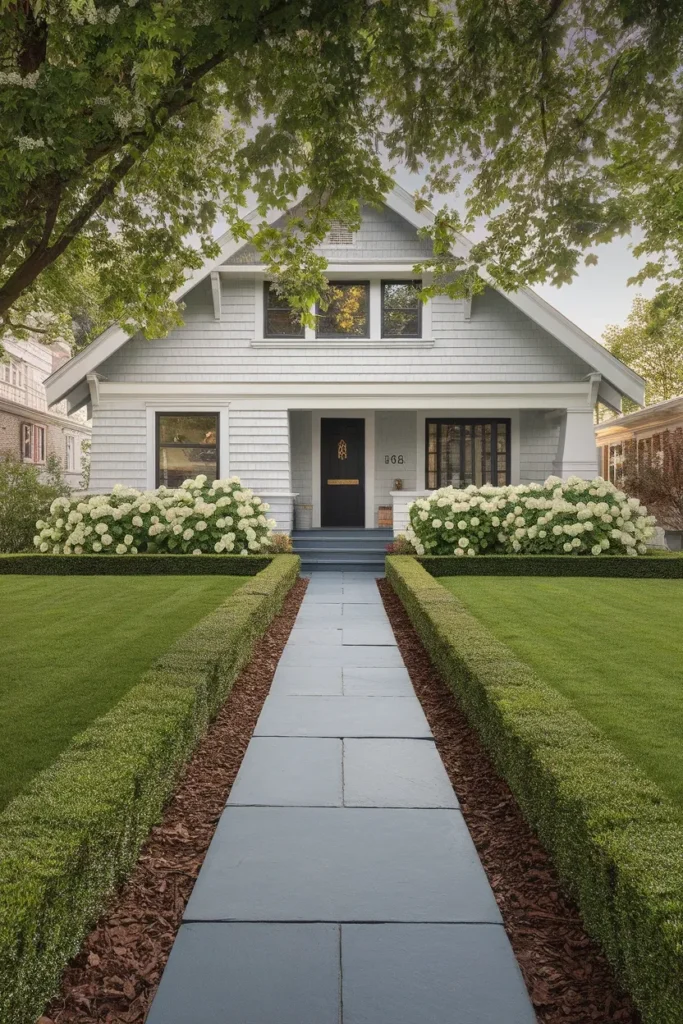
Most front yard landscaping ideas for curb appeal fail for a boring reason. They get designed from three feet away, on your knees, with a trowel in your hand. Then they get judged from forty feet away, by someone driving past at 25 miles an hour. Two completely different views of the same yard.
Four seconds. That’s roughly how long a passing car gives your house.
So the question isn’t which plants are prettiest up close. It’s which choices survive the distance. We’ve redone the front of our own place twice now, and the second version cost less while looking three times better, mostly because we stopped buying plants and started fixing shapes. If you’re working with a narrow lot, our guide to small front yard landscaping ideas covers the measuring side in more depth. This one is about the view from the curb.
When people search front yard landscaping ideas curb appeal, they’re usually asking a narrower question underneath: what actually makes the front of a house look finished from the street? Below you’ll get that answer in four parts. A budget split built on published research. Real 2026 front yard landscaping costs, line by line. The spacing math nobody prints on the plant tag. And the clutter audit that fixes more curb appeal than any shrub ever will.
Curb Appeal Gets Judged in Four Seconds From a Moving Car
Here is the test we run before spending a dollar on front yard landscaping. Walk to the far edge of your property, turn around, and take a photo with your phone. Then shrink that photo to the size of a postage stamp on your screen.
What’s still visible at that size is what curb appeal actually is.
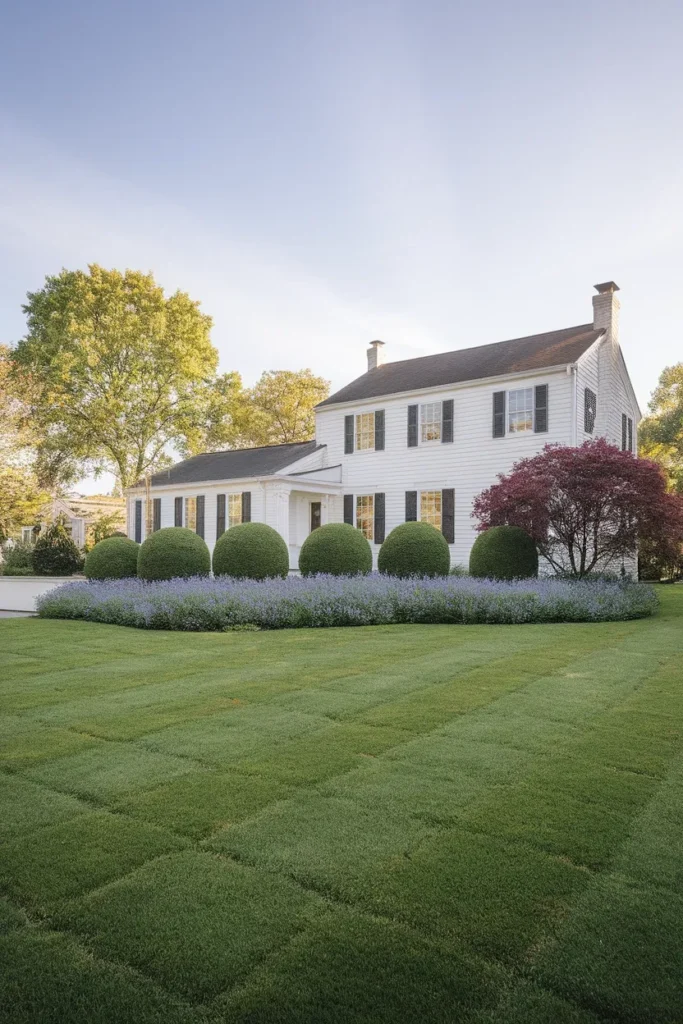
At thumbnail size, individual plants disappear. Color blobs stay. Bed shapes stay. The front door stays, the roofline stays, and any large mass of one thing stays. A bed with fourteen different plants in it turns to gray-green mush. A bed with three groups of five turns into three clean shapes you can read instantly.
That’s the whole trick. Repetition beats variety at distance, every single time. It’s also the cheapest curb appeal upgrade available to you, because it costs nothing except restraint at the nursery.
Most homeowners buy one of everything because the nursery is a candy store in April. We did exactly that our first year, filling a twenty-foot foundation bed with about eleven different perennials from the clearance rack at Lowe’s. From the porch it looked charming. From the street it looked like nothing at all, just a fuzzy strip of green under the windows. The fix cost us nothing the following spring: we moved the strays to the side yard and repeated the three plants that had performed best.
Two more distance rules worth writing down. Odd-numbered groups of three, five, or seven read as intentional; even-numbered pairs read as formal, which only works if your house is symmetrical. And any single plant smaller than about eighteen inches across is invisible from the curb unless you plant nine of them together.
The 42/36/22 Rule for Splitting Your Front Yard Budget
Every roundup of front yard landscaping ideas gives you ideas. Almost none gives you a way to divide money between them, which is the part that actually decides whether your yard looks expensive.
So we built a split, and we built it on real numbers rather than taste.
Virginia Cooperative Extension published a survey on how landscape plants affect perceived home value that found landscape improvements added 5.5% to 11.4% to perceived home value depending on the state. More useful for our purposes, the study broke down which factors drove that value. Design sophistication accounted for 42%. Plant size accounted for 36%. Diversity of plant material accounted for just 22%.
We turned that into a spending rule.
The 42/36/22 Rule
Split your front yard landscaping budget the same way buyers weight what they see: 42% on design, 36% on size, 22% on variety. Design money buys shapes and edges and layout. Size money buys fewer, larger plants. Variety money buys the color everyone wants to buy first. Every curb appeal decision below maps back to one of those three buckets.
| Bucket | Share | What it actually pays for | Typical first purchase |
|---|---|---|---|
| Design sophistication | 42% | Bed shape, bed depth, edging, walkway width, mulch, repetition, symmetry around the door | Steel edging and 15 bags of mulch |
| Plant size | 36% | Fewer plants at 3 gallon or 7 gallon instead of many at 1 gallon, one properly sized tree | Three 7-gallon shrubs instead of twelve 1-gallon |
| Plant diversity | 22% | Seasonal color, a second and third species, containers by the door | Two large planters and a flat of annuals |
Run a $1,000 budget through it and you get $420 on design, $360 on size, and $220 on variety. Run $300 through it and you get $126, $108, and $66, which is still enough for a trench edge, a pallet of mulch, one good shrub, and a pot of mums.
Now the contrarian part. Buy the flowers last.
Almost everyone reverses this, walking out of Home Depot in April with four flats of petunias and no plan, because color is the fun purchase. The data says color is the smallest curb appeal lever you have. A yard with beautiful bed shapes and no flowers reads as well-kept. A yard with flowers scattered across a shapeless bed reads as messy. To be fair, the flowers do make you happier on a Tuesday, which counts for something. Just buy them third.
Fix the Frame Before You Buy a Single Plant
Your house is the biggest thing in the photo. Plants are the trim.
Before a nursery run, spend a Saturday on the four elements that frame the entry. Every one of them is cheap, permanent, and visible at thumbnail size. That combination makes them the highest-return curb appeal work you can do without ever touching a shovel.
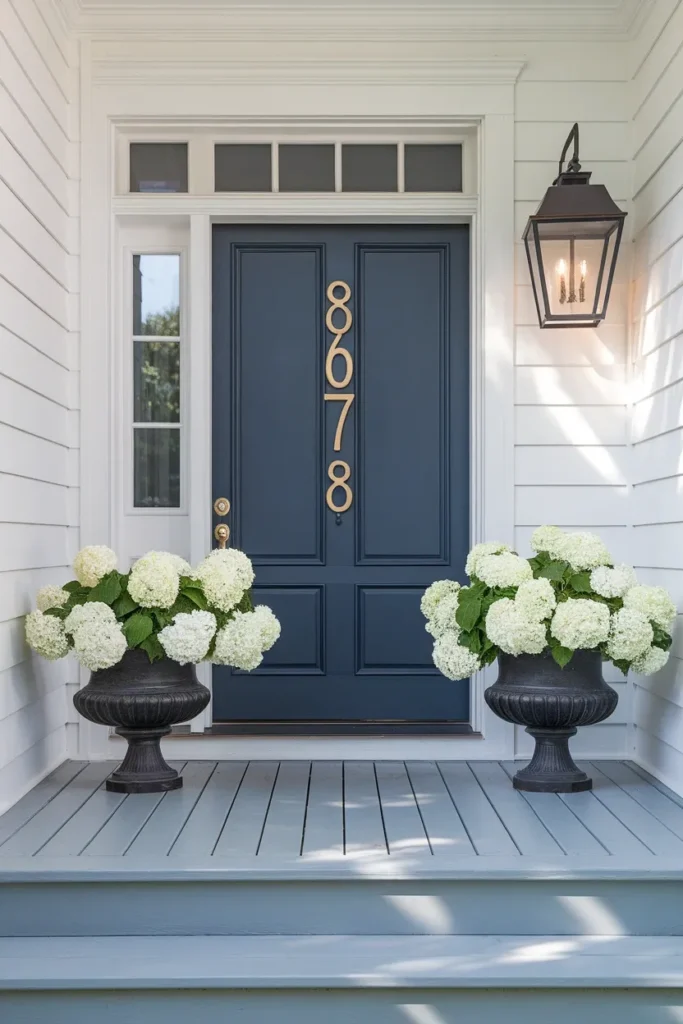
The front door. A gallon of exterior paint in a saturated color runs about $45 to $60 at Home Depot. Behr Marquee in a deep black, a navy, or a clay red will do more for a photo than $300 of shrubs. Paint the door, not the whole facade.
House numbers. Most homes have four-inch numbers installed in 1994 that nobody can read from a car. Go to eight or ten inches, in a finish that contrasts hard with whatever is behind them. Modern floating numbers run roughly $10 to $20 each. Mount them vertically beside the door if the horizontal run above it is cramped.
The mailbox. If it’s the standard dented aluminum on a leaning cedar 4×4, it’s aging your whole yard. A new post and box comes in around $60 to $120, and a small planted ring at its base is one of the highest-return square feet in the entire yard.
The porch light. Two matching fixtures flanking the door, sized bigger than feels right. Undersized porch lights are the single most common exterior mistake. As a rough guide, a wall lantern should be about one quarter the height of the door.
Do all four and you’ve spent maybe $250. Skip all four and your $2,000 in front yard landscaping is decorating a face nobody is looking at.
Give the Beds a Shape That Reads From the Curb
This is where the 42% goes, and it’s the section most people skip because dirt work isn’t fun. It’s also the part of front yard landscaping that survives being shrunk to a thumbnail.
Three numbers matter.
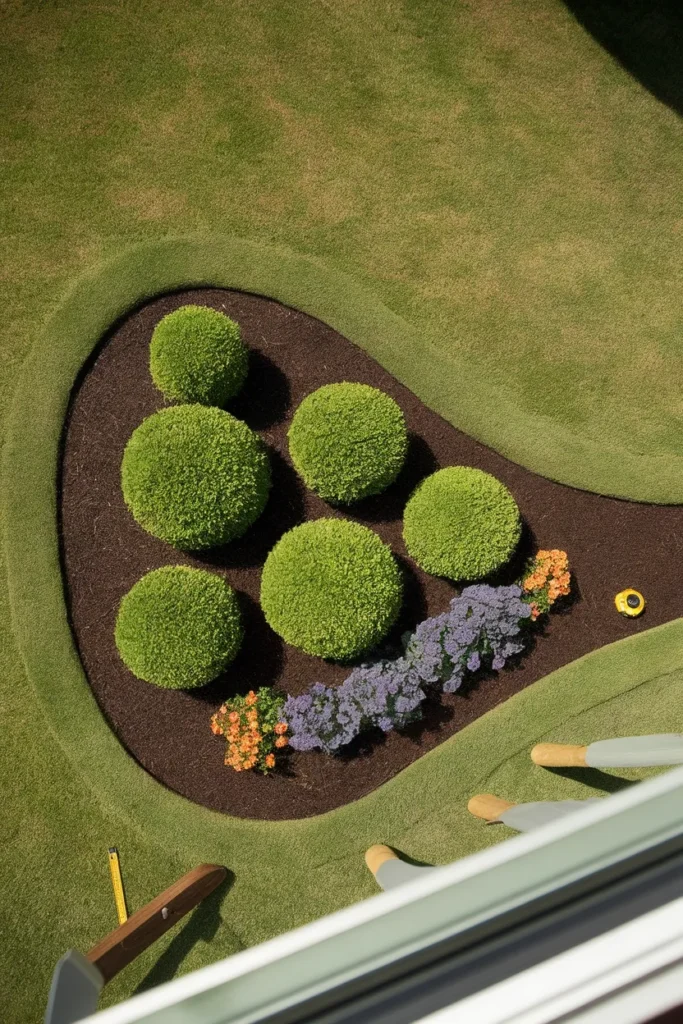
Bed depth. The typical foundation bed in an American subdivision is about 24 to 30 inches deep, which is roughly half of what it should be. Aim for a minimum of 4 feet, and 6 to 8 feet if your house is two stories. A shallow bed makes a house look like it’s standing at attention on a bare slab. A deep bed makes it look settled into the ground.
Bed length. Run the bed the full width of the facade, then keep going past the corner by 3 or 4 feet. Beds that stop exactly at the corner of the house draw a hard line that shortens the whole front.
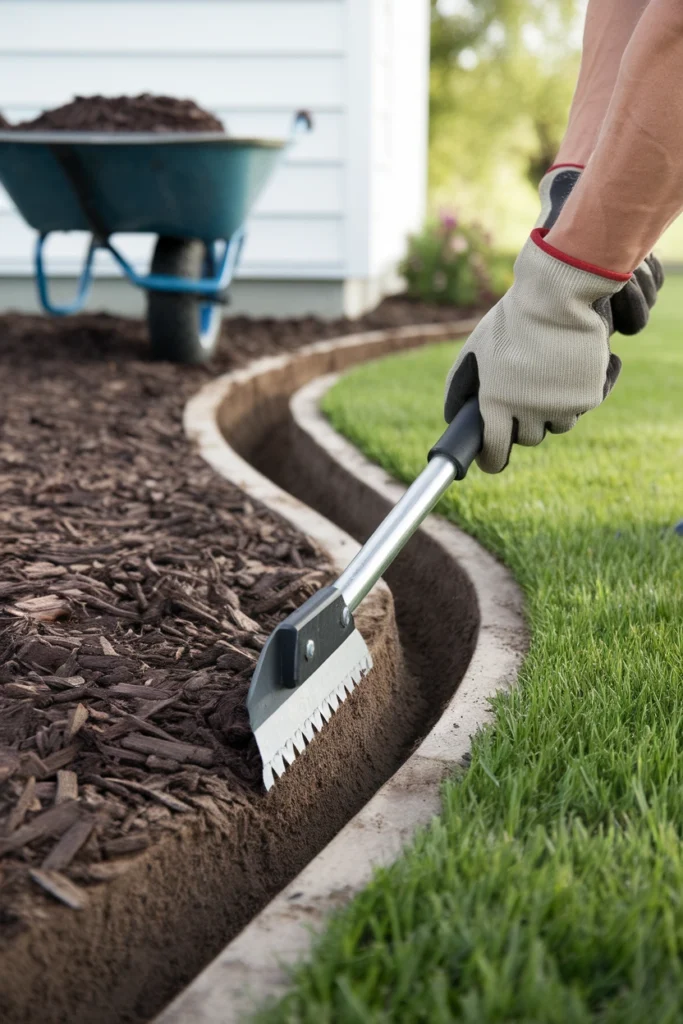
The edge. A clean edge does more visual work than the plants inside it. You have three options. A hand-cut trench edge is free and takes about an hour per 30 feet. Steel or aluminum edging holds a long curve beautifully. Brick and paver edging costs the most and doubles as a mowing strip. Professional installation runs $3.50 to $8.80 per linear foot, so a 60-foot bed edge lands at $210 to $528. Set it yourself and the same run costs about $90 in materials. Our full breakdown of garden edging ideas walks through which one suits which bed.
Then mulch. Two to three inches, pulled back from the base of every trunk by a couple of inches, never piled into a volcano against the bark. Dark brown or black shows plant shapes better than red does, and red fades orange by August. Bagged Vigoro at Home Depot runs about $2.50 for a 2 cubic foot bag, and a 4 for $10 promotion usually runs through the summer. That’s how a 200 square foot bed gets fully mulched for around $35, which is the best curb appeal return per dollar in this entire article.
One small caution from experience. We once ordered 3 cubic yards of bulk mulch for a job that needed 1.5, mostly because a yard sounds small until it’s sitting in your driveway. Measure your beds in square feet, then divide by 100 for 3 inches of depth. That gives you cubic yards.
Buy Fewer Plants and Buy Them Bigger
Plant size is 36% of perceived value, and it’s the bucket where homeowners consistently underspend on front yard landscaping.
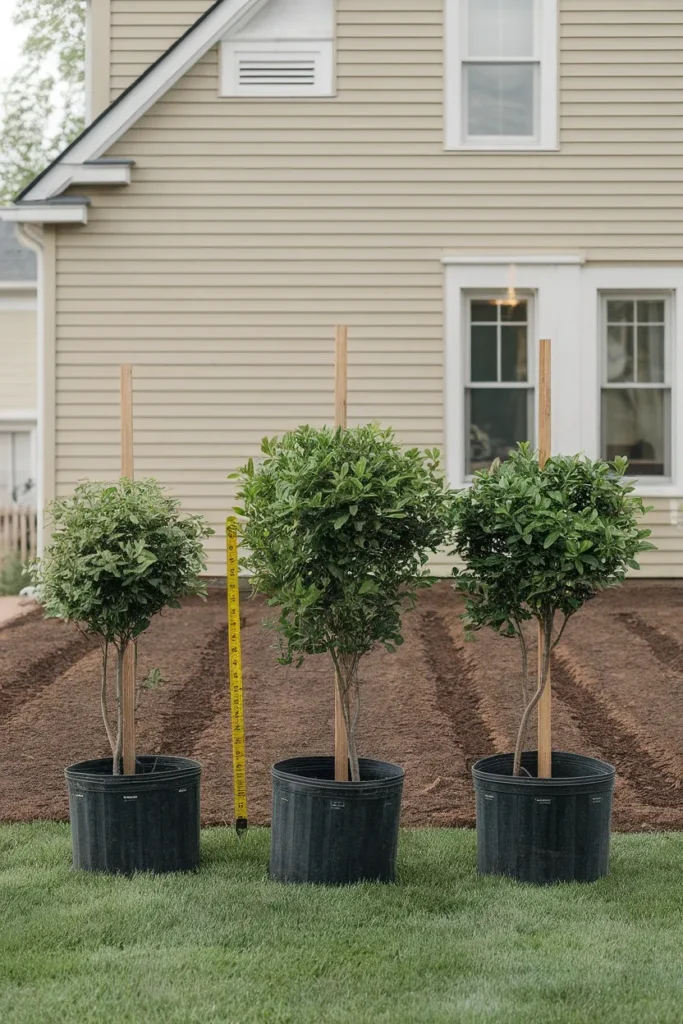
Here’s the math that makes it obvious. Twelve 1-gallon shrubs at $12 each is $144, and it looks like nothing for three years. Four 7-gallon shrubs at $55 each is $220, and it looks finished the afternoon you plant it. You paid $76 more and bought back three growing seasons of curb appeal.
Nurseries push the small sizes because they move faster. Buy the biggest size your car will carry.
Then space them for year five, not for today. This is the mistake in almost every front yard we’ve ever looked at, and it’s the reason so many foundation beds turn into a solid wall of overgrown green that swallows the windows. Read the mature width on the tag and place plants at that full distance, center to center. Yes, the bed will look sparse the first year. Fill the gaps with annuals or a temporary ground cover, and stop.
A quick spacing reference for the shrubs people actually plant out front:
| Plant | Mature width | Plant centers | Notes |
|---|---|---|---|
| Boxwood, dwarf varieties | 3 to 4 ft | 3 ft apart | Slow, forgiving, evergreen structure |
| Hydrangea, panicle types | 5 to 7 ft | 5 ft apart | Needs real room, most common overplant |
| Dwarf fothergilla | 3 to 4 ft | 3 ft apart | Excellent fall color |
| Inkberry holly | 4 to 6 ft | 4 ft apart | Native boxwood substitute |
| Little Lime hydrangea | 4 to 5 ft | 4 ft apart | Reliable, blooms on new wood |
| Nandina, dwarf varieties | 2 to 3 ft | 2 ft apart | Check local invasive status first |
Trees are the other size lever. One properly placed tree does more for front yard curb appeal than any other single purchase. Professionally planted, it runs $565 to $680 on average, with the full range landing anywhere between $120 and $2,500 depending on caliper. Plant it off to one side rather than centered on the house, at least 15 to 20 feet from the foundation for anything that matures over 25 feet.
Build Three Layers That Survive Your Zone
Diversity is the smallest bucket at 22%, but it’s the one that decides whether your front yard landscaping looks good in February.
Three layers, that’s all.
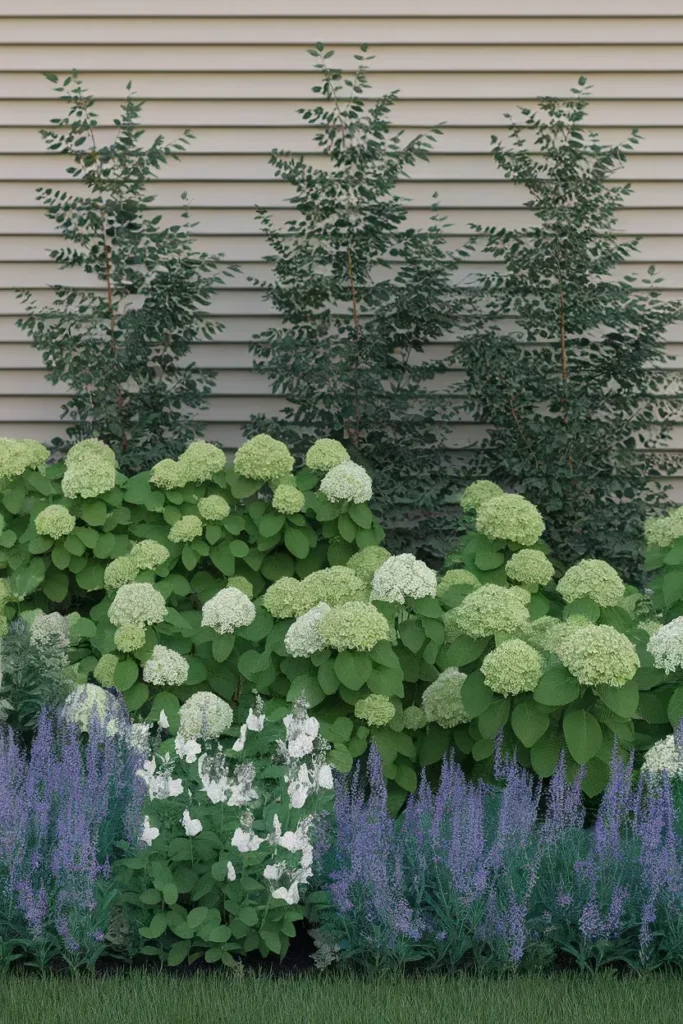
Layer one, evergreen structure. Roughly 40% of your plant count. Boxwood, inkberry holly, dwarf conifers, or in warmer regions, dwarf yaupon. This is the layer that carries the yard from November to April, and it’s the layer people cut first when the budget gets tight. Don’t.
Layer two, deciduous seasonal interest. Roughly 40%. Hydrangea, spirea, fothergilla, viburnum, ninebark. These carry summer bloom and fall color, then step back.
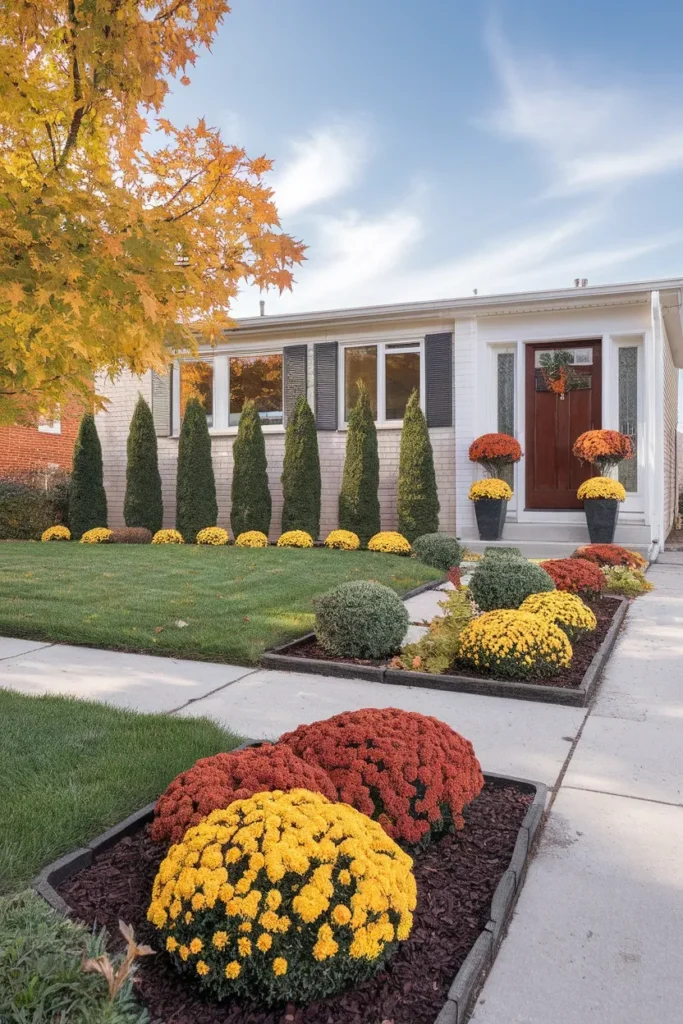
Layer three, color and texture. The last 20%. Perennials like catmint, coneflower, and salvia, plus containers by the door that you swap seasonally: pansies in spring, coleus in summer, mums in fall.
Everything above depends on where you live, so check your USDA plant hardiness zone before you buy anything. The 2023 map lets you enter a zip code and get your zone in about five seconds. Most of the American suburbs this article is written for sit in Zones 5 through 9.
Timing matters as much as selection. Fall is the better planting season for shrubs and trees across most of Zones 5 through 8. Roots keep working after the top growth stops, so the plant gets a real head start the following spring. For spring planting, wait until after your typical last frost. In Zone 5 that usually falls in mid to late April, in Zone 7 around mid-April, and in Zone 9 as early as February. Those are typical ranges rather than promises, so confirm with your local extension office first.
We learned that one the expensive way. Two flats of Bonnie Plants annuals went in during a warm week that turned out to be a fake spring, and a frost took most of them eight days later.
Hide the Cans, the Meter, and the Garage Door
Nobody writes about this part, and it’s often the biggest single curb appeal win available.
Walk to the street and count the objects in view that aren’t supposed to be part of the design. Trash and recycling bins. The gas or electric meter. A coiled hose against the foundation. AC condenser. Downspout extensions crossing the lawn. A basketball hoop. Two cars parked directly in front of the house.
Now count the objects that are part of the design. If the first list is longer, no amount of planting will fix the photo.
Fixes are cheap and mostly one-time:
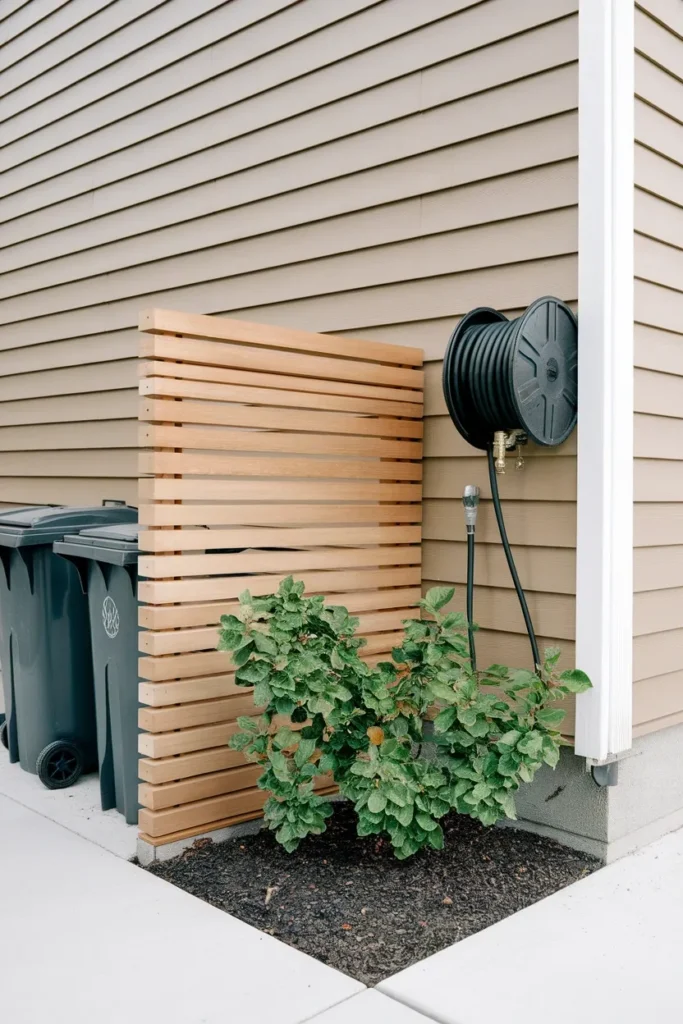
- Bins. A cedar screen or three-sided lattice enclosure runs about $120 to $250 in materials. Moving them behind a side gate costs nothing at all.
- Meters. Plant a loose group of three shrubs in front, leaving at least 3 feet of clearance for meter reading and service access. Never box a meter in.
- Hoses. A wall-mounted reel is roughly $30 to $60. It removes a coil of green vinyl from the exact spot the eye lands.
- Downspouts. Bury the extension in a shallow trench with a pop-up emitter, or at minimum run it into the bed rather than across the lawn.
- The garage door. On a lot of American homes the garage is 30% to 40% of the facade and painted flat builder white, which pulls the eye away from the front door. Paint it the same color as the siding so it recedes, and put the contrast color on the front door instead. That single move costs a weekend and about $70.
Photograph the yard again after this pass. The curb appeal difference is usually larger than a $500 plant order buys you.
Light the Walk So It Still Works at 9 p.m.
Half the year, the only time your neighbors see your house is after dark.
Two rules keep outdoor lighting from looking like an airport.
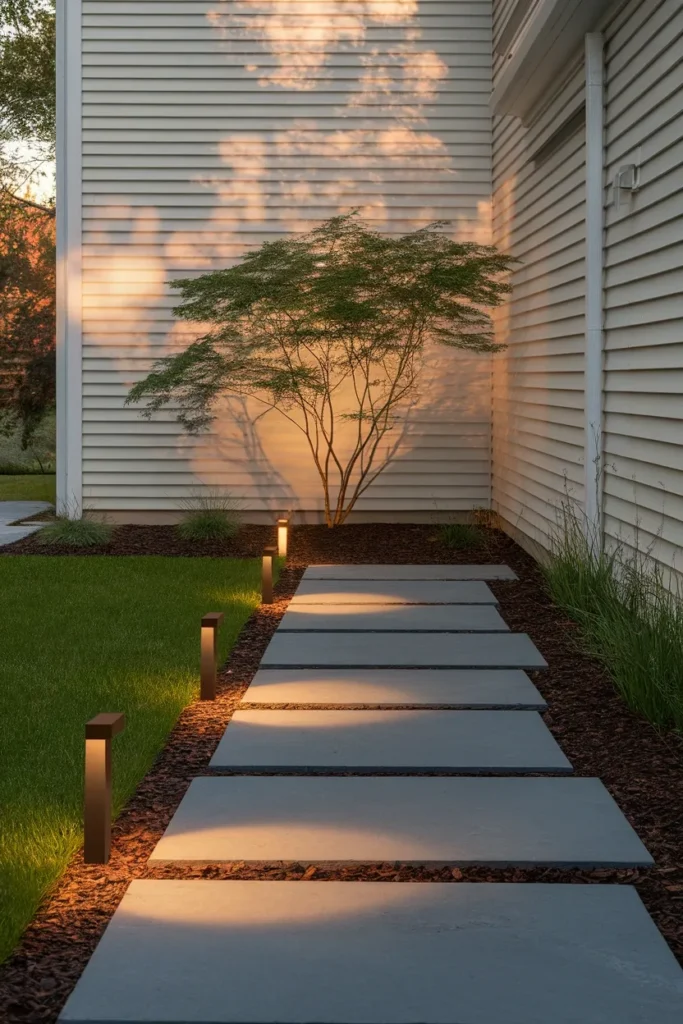
First, don’t line the walkway with evenly spaced lights on both sides. That’s the runway look, and it reads as cheap. Stagger them instead, alternating sides, spaced 8 to 10 feet apart, and use fewer than you think. Six lights along a 40-foot walk is plenty.
Second, aim light at something. A fixture pointed at the ground lights the ground. A fixture pointed up into the canopy of a small tree lights the tree, throws shadow onto the facade, and gives the whole front depth that flat lighting never produces. Two uplights on the corners of the house plus one on a specimen tree will beat a dozen path lights.
Budget reality: a full low-voltage installed system runs $2,000 to $4,500 professionally. A Hampton Bay solar 6-pack from Home Depot runs about $13 to $25 and will get you through a season or two. Solar output is dim, usually 6 to 16 lumens per fixture. So use solar along the path edge, then spend the real money on two or three plug-in LED uplights that actually throw a beam.
Warm color temperature only. Anything above 3000K turns a warm brick house a strange blue-gray, and it’s the fastest way to make good front yard landscaping look like a parking lot.
What Front Yard Landscaping Actually Costs in 2026
Pricing on front yard landscaping is usually vague, so here are the real numbers from current 2026 cost data, followed by three curb appeal tiers built with the 42/36/22 Rule.
Going rates right now:
| Line item | Typical 2026 cost |
|---|---|
| Full professional landscaping, standard lot | $3,516 average, $200 to $14,800 range |
| Professional rate per square foot | $4.50 to $14.50 |
| Mulch, installed | $77 to $94 per cubic yard |
| Bagged mulch, DIY | About $2.50 per 2 cubic foot bag |
| Shrub, installed | $25 to $230 each |
| Tree, installed | $565 to $680 average |
| Flower bed installation | $800 to $3,000 |
| Landscape edging | $3.50 to $8.80 per linear foot |
| Low-voltage lighting system | $2,000 to $4,500 |
Tier one, the $300 weekend. Cut a trench edge yourself. Mulch the beds with bagged product on sale, paint the front door, upsize the house numbers, and add two large planters by the entry. Almost all design money, almost no plant money. Highest curb appeal return per dollar on this whole page.
Tier two, the $1,200 season. Everything above, plus deepen the foundation beds to 4 feet and add steel edging along the front curve. Buy five to seven shrubs at 3 to 7 gallon size, then stagger in path lights. Roughly $500 design, $430 size, $270 variety.
Tier three, the $4,000 project. Everything above, plus one professionally planted tree, a widened walkway, a bin screen, and a small plug-in uplighting system. At this tier, pay a designer for two hours of layout advice. Design sophistication is still the largest slice.
Whichever tier you pick, spend the first dollar on shape and the last dollar on flowers.
Frequently Asked Questions
How much does front yard landscaping cost?
Professional front yard landscaping runs about $3,516 on average in 2026. Real projects land anywhere from $200 to $14,800 depending on size and scope, and pros generally charge $4.50 to $14.50 per square foot. A DIY refresh of edging, mulch, and entry details lands closer to $300, which is why we recommend starting there.
What landscaping projects should I tackle first?
Bed shape and bed edges, before plants. Deepen the foundation beds to at least 4 feet, cut a clean edge, and mulch. Those three front yard landscaping moves cost the least and change the most, because design sophistication carries 42% of perceived landscape value.
Will landscaping boost my home’s value?
Virginia Cooperative Extension research found landscape improvements raised perceived home value by 5.5% to 11.4%. On a $400,000 home that works out to roughly $22,000 to $45,600. Perceived value and appraised value aren’t identical, so treat the figure as buyer psychology rather than a guaranteed return.
What is the cheapest form of front yard landscaping?
A hand-cut trench edge plus bagged mulch. The edge is free apart from your time, and 200 square feet of bed can be mulched for around $35 during a 4 for $10 bag sale. That combination buys more curb appeal per dollar than anything else on the shelf. Native ground covers are the cheapest long-term lawn replacement, since they don’t need reseeding.
How can I make my front yard look more expensive than it is?
Repeat one plant in groups of three or five instead of buying one of everything. Keep the mulch dark brown rather than red. Size the house numbers and porch lights larger than feels correct, then get every piece of plastic and every hose out of view. Restraint reads as expensive; variety reads as accidental.
What plants look good in the front yard?
Build around 40% evergreen structure, 40% deciduous seasonal interest, and 20% color. In Zones 5 through 9 that usually means boxwood or inkberry holly for the bones, panicle hydrangea or spirea in the middle, and catmint, coneflower, or seasonal containers up front. Check your zone before buying anything.
When is the best time to plant?
Fall, for most shrubs and trees in Zones 5 through 8. Roots keep growing after the leaves drop, so the plant establishes over winter. If you’re planting in spring, wait until after your typical last frost date, which is usually mid to late April in Zone 5 and as early as February in Zone 9.
Where to Start This Weekend
Take the photo. Shrink it to a thumbnail. Whatever disappears at that size wasn’t doing any work for you.
Then pick one bed, probably the one directly in front of your entry, and give it the full treatment. Cut it deeper, cut a clean edge, mulch it dark, and repeat one plant across it in a group of five. That’s a Saturday and roughly $150. It’ll look better than the rest of the yard, which is exactly the point, because now you know what the standard is.
The next bed goes faster. So does the one after that. Of all the front yard landscaping ideas for curb appeal on this page, the one that actually gets done is the one that fits in a single Saturday.
If keeping it sharp is the part you’re worried about, our guide to low maintenance front yard landscaping covers the plant choices that hold up with almost no attention.
Which bed are you starting with? Tell us in the comments, and if you’ve got a before photo, we’d love to see the after.