Stamped Concrete Patio Ideas That Look Just Like Real Stone
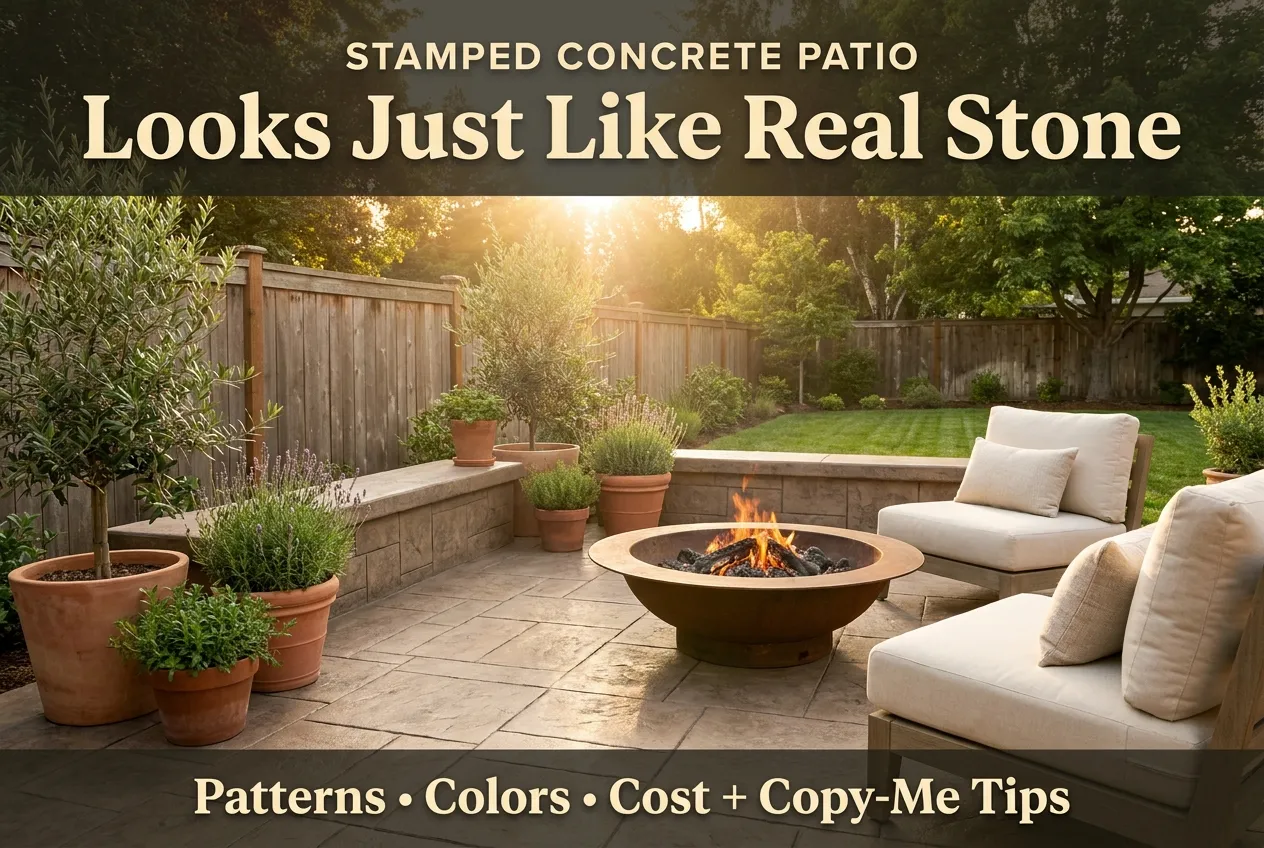
Want the look of hand-laid flagstone without the hand-laid price? That’s the whole pitch of a stamped concrete patio, and honestly, it delivers more often than people expect. You pour one continuous slab, press a pattern and color into it while it’s wet, and end up with a surface that reads like slate, brick, or weathered wood from six feet away. Below you’ll find the patterns that actually fool the eye, the color combos that dodge the fake-looking gray, real 2026 cost ranges, and a stylist-style method for making your slab look custom instead of contractor-generic.
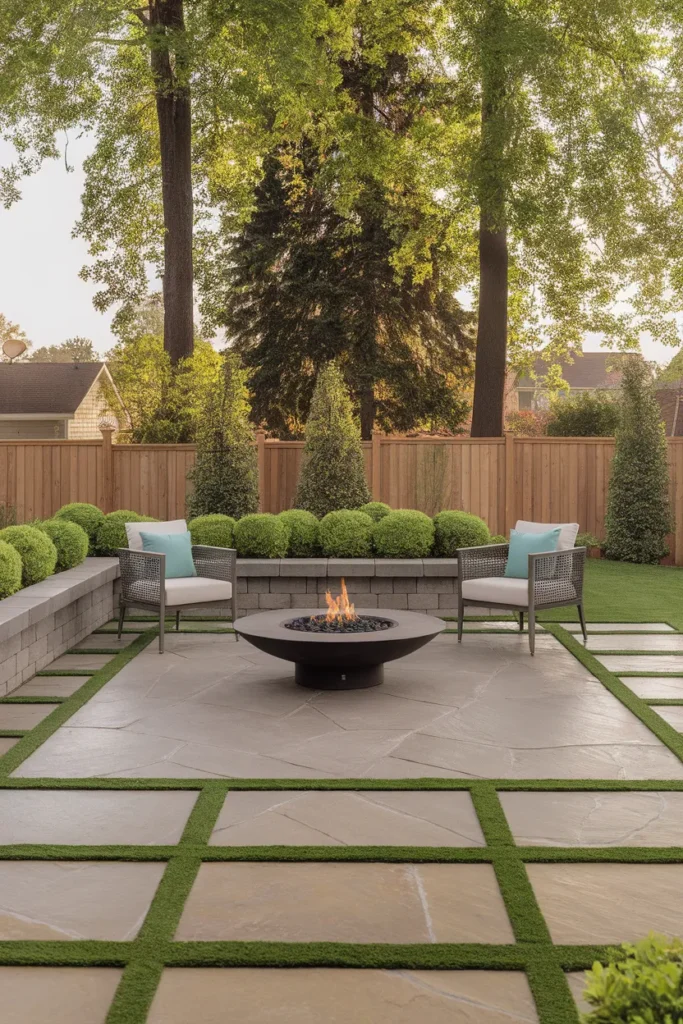
What Is a Stamped Concrete Patio, Exactly?
Stamped concrete is a decorative pour. Fresh concrete gets a base color mixed in, a contrasting “release” color dusted on top, then textured mats press a pattern into the surface before it cures. The result mimics stone, brick, slate, or wood plank at a fraction of what those materials cost to install by hand.
Think of it as one solid slab wearing a very convincing costume. Because it’s a single monolithic surface, you skip the dozens of joints you’d get with pavers. That’s the big visual win, and it’s also the big maintenance trade-off, which we’ll get to.
If you already have a plain gray slab you hate, you don’t always need to demolish it. A stamped overlay can go right on top, which is the same trick people use to give a tired concrete patio a full makeover without starting from scratch.
The Stone-Match Method: How to Make Concrete Read as Real Stone
Here’s the framework I lean on so a poured slab doesn’t scream “concrete.” Call it the Stone-Match Method. Three checks, in order: Pattern, Palette, Placement. Nail all three and guests assume you paid for quarried stone.
Pattern picks the illusion. Palette sells it with two or more tones so it never looks flat. Placement hides the tell-tale seams and orients the pattern to your house lines. Miss any one and the eye catches the fake.
Use it as a filter for every idea below. Does this choice pass Pattern, Palette, and Placement? If yes, it’ll look custom.
Stamped Concrete Patio Patterns That Actually Fool the Eye
Pattern is the first Stone-Match check, so start here. These are the patterns pulling the most weight on Pinterest and in the top-ranking galleries right now.
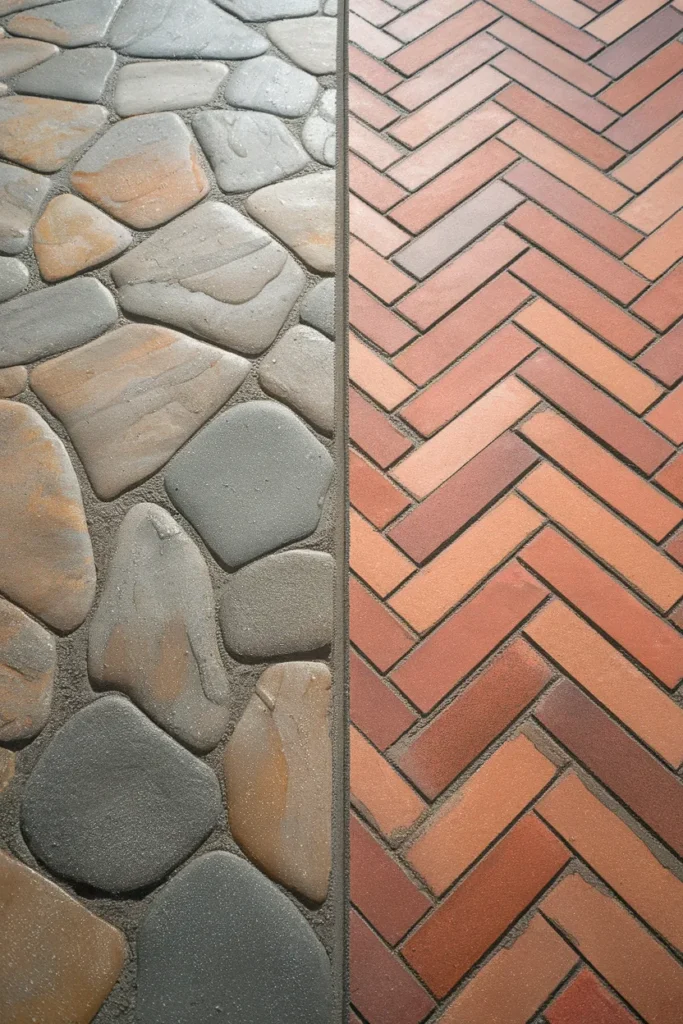
Ashlar slate. Clean rectangular blocks in staggered sizes. It’s the most forgiving pattern and the one that reads “high-end patio” fastest. Great for modern and transitional homes.
Random flagstone. Irregular, organic shapes with rounded edges. This one hides imperfections beautifully and suits cottage, rustic, and natural yards. If you love the flagstone patio ideas that look custom but not the price of real stone, this is your pattern.
Wood plank. Long board-look impressions with grain and knots. Trendy, warm, and surprisingly convincing when the color has variation. Perfect near a deck or pergola.
Herringbone and running-bond brick. Tight, repeating brick angles for a classic, old-world feel. Reads formal and works well as a border even if the field is something else.
Cobblestone. Rounded, chunky stones for a European courtyard vibe. Busy, so it shines in smaller doses or entries.
Quick gut check: match the pattern scale to your yard. Big slate blocks can overwhelm a tiny patio, while small cobbles get lost on a wide-open slab.
Colors and Palettes: The Second Stone-Match Check
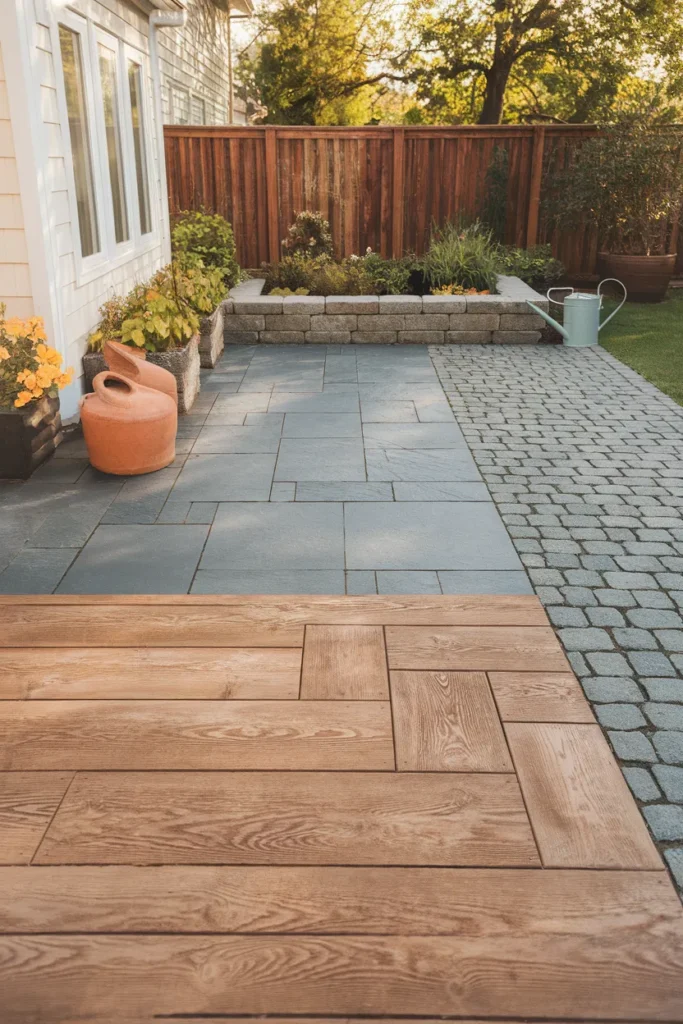
Flat, single-tone gray is the number one reason a stamped patio looks fake. Real stone is never one color. So the rule is simple: use a base color plus a contrasting release, and let the two mottle together.
Warm palettes are winning on Pinterest right now, where tan, taupe, and brown searches show up as their own guided tiles. Cooler grays still look sharp on modern homes.
A few pairings that photograph beautifully:
- Weathered tan base with a walnut-brown release for a natural stone look.
- Driftwood gray base with a charcoal release for modern slate.
- Warm buff base with a light release for a whitewashed, sun-bleached feel.
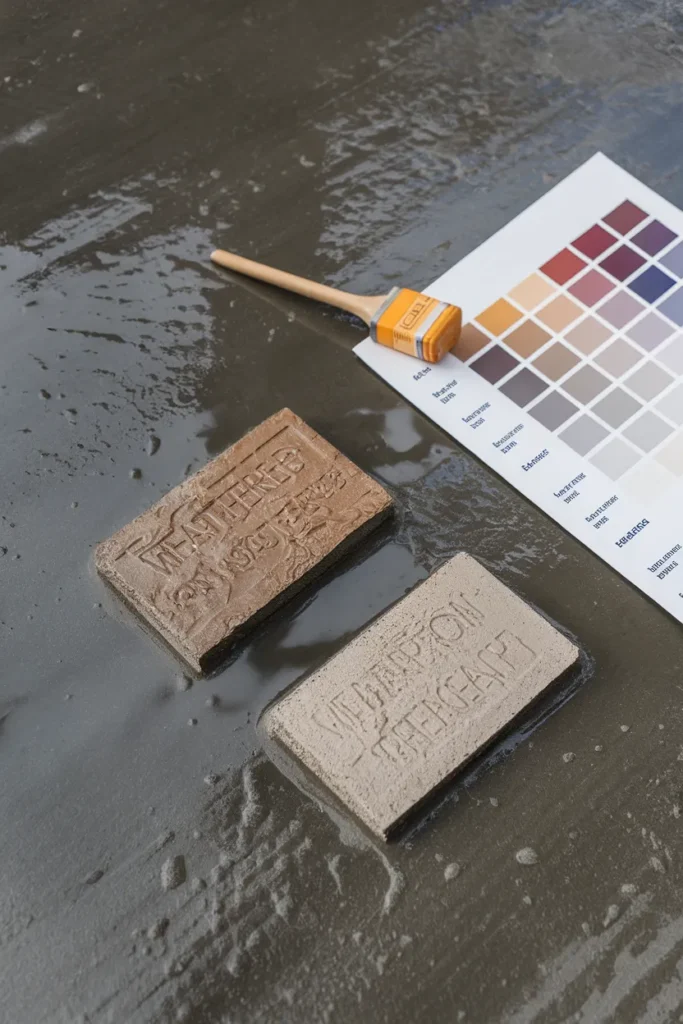
The highest-value tip in this whole guide: always test your color on a sample panel outdoors, in daylight, before the crew pours the whole patio. Colors dry lighter than they look wet, and the difference between “gorgeous” and “not what I pictured” is one afternoon of testing.
Design Ideas by Space: Small Yards, Pool Decks, and More
Stamped concrete flexes to fit almost any footprint, which is why the Pinterest guided tiles are full of “small backyard,” “pool deck,” and “layout” prompts.
Small backyards. Choose a single medium-scale pattern like ashlar slate and run it corner to corner. Continuous surface tricks the eye into reading the space as larger. Skip busy borders in tight spaces.
Pool decks. Textured seamless-stone finishes add grip and stay cooler in lighter colors. Slip resistance matters most here, so ask about a broadcast anti-slip additive in the sealer.
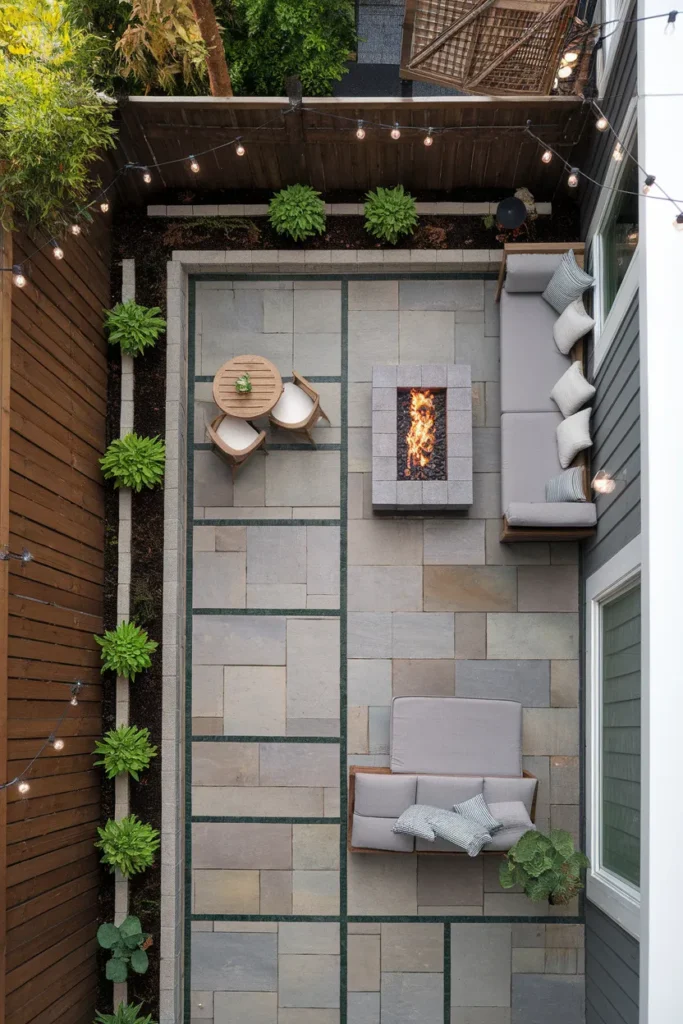
Layout and zones. Break a big slab into “rooms” using contrasting stamped borders. One zone for dining, one for lounging around the fire.
Wraparounds and walkways. Carry the same pattern from patio to walkway to entry so the whole yard feels intentional, not patched together.
If a full pour is out of budget this year, browse budget paver patio ideas for a lower-commitment path that still gives you a finished, seam-defined look.
Fire Pits, Borders, and Upgrades That Elevate the Slab
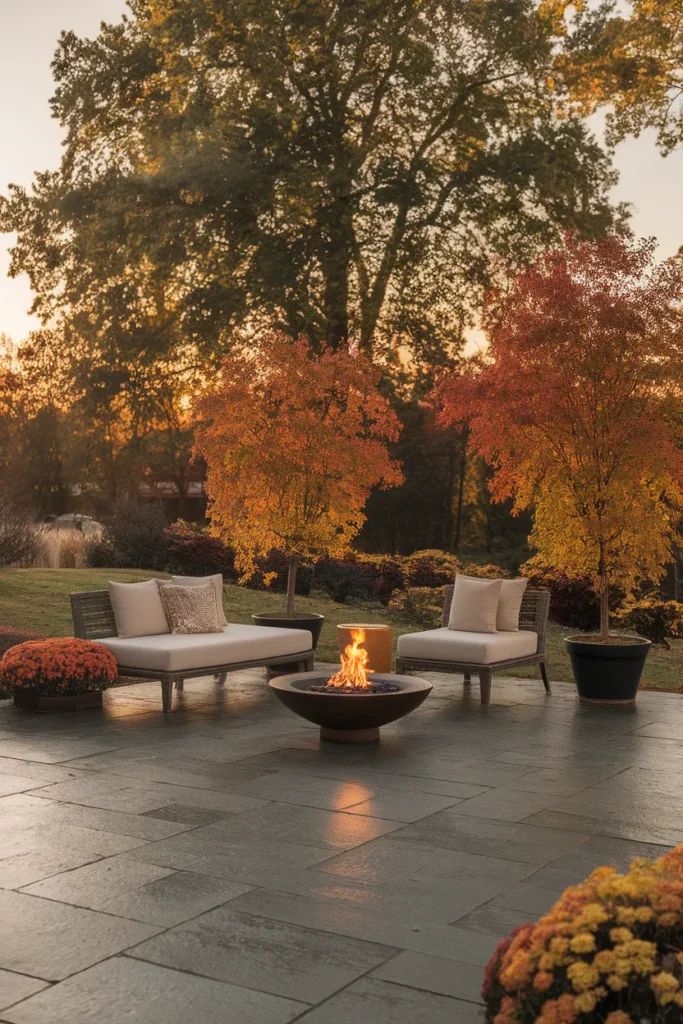
The pins pulling the most saves almost all share one thing: a fire feature. A stamped patio with a fire pit is the single most-searched upgrade, and it’s easy to see why on a cool fall evening.
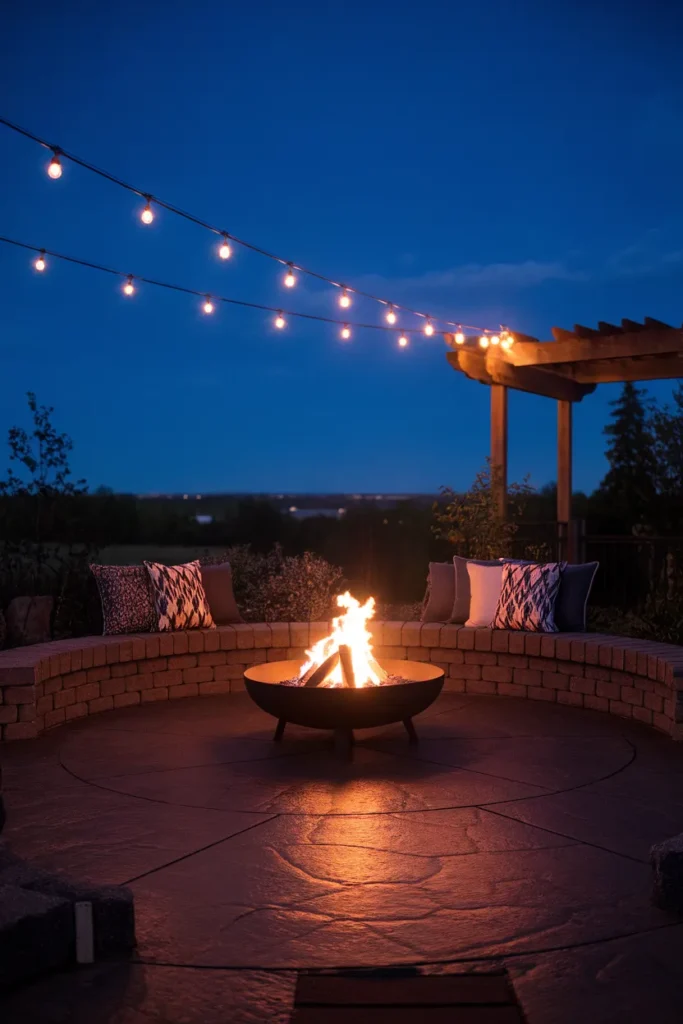
Fire pit or fireplace. Center a round steel bowl or build a seat-wall ring. The stamped stone-look ground plane makes even a modest fire pit feel built-in.
Contrasting border. A brick-stamped border around a flagstone field frames the whole patio like a rug frames a room. This is a Placement move straight out of the Stone-Match Method.
Pergola or shade. A cedar pergola overhead turns a flat slab into an outdoor room and gives you somewhere to hang lights.
Planters and greenery. Big glazed pots soften all that hardscape. Soft plus hard is what makes a patio feel designed rather than paved.
Style It Like a Pro: Furniture, Rugs, and Lighting
Here’s the angle the contractor galleries skip. The pour is only half the look. How you dress the slab decides whether it reads like a magazine patio or an empty concrete pad.
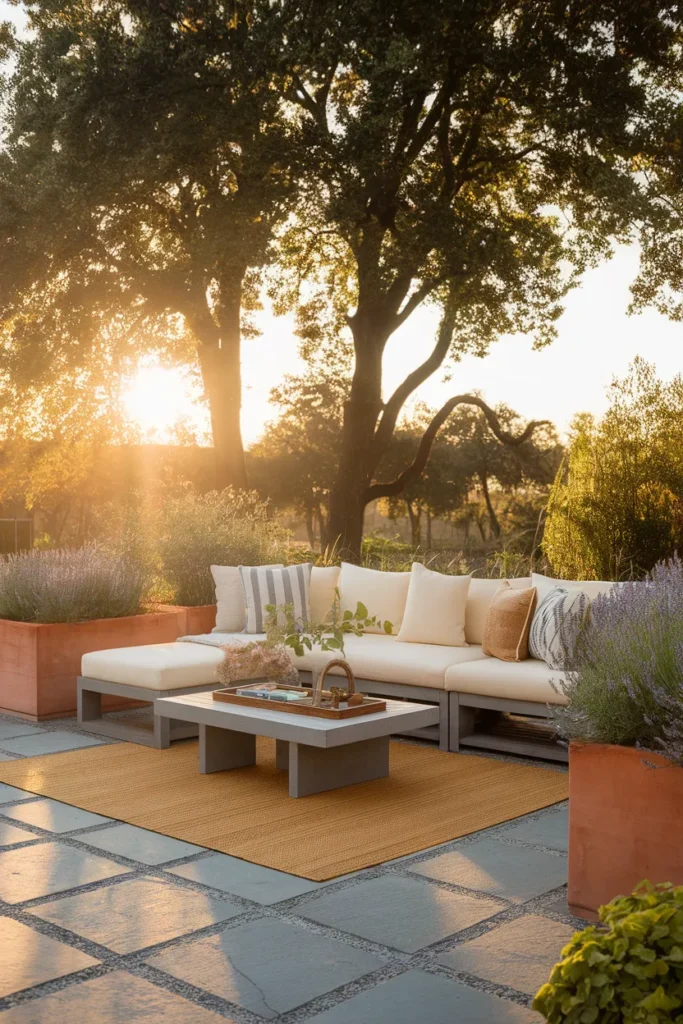
Anchor the space with an outdoor rug that echoes your release color. Add a low-profile sofa or a bistro set sized to the zone, never oversized. Layer lighting at three heights: overhead string lights, a lantern or two at seat level, and a warm glow from the fire feature.
Repeat one material for cohesion. If your border stamp is brick-toned, pull that warmth into terracotta pots or a rust-colored cushion. That repetition is what stylists do, and it costs almost nothing.
Pros and Cons of a Stamped Concrete Patio
Let’s be fair about the trade-offs, because no surface is perfect.
Pros. One continuous slab means no weeds pushing up between joints and no shifting pavers. It’s cheaper than natural stone, endlessly customizable in pattern and color, and low effort day to day.
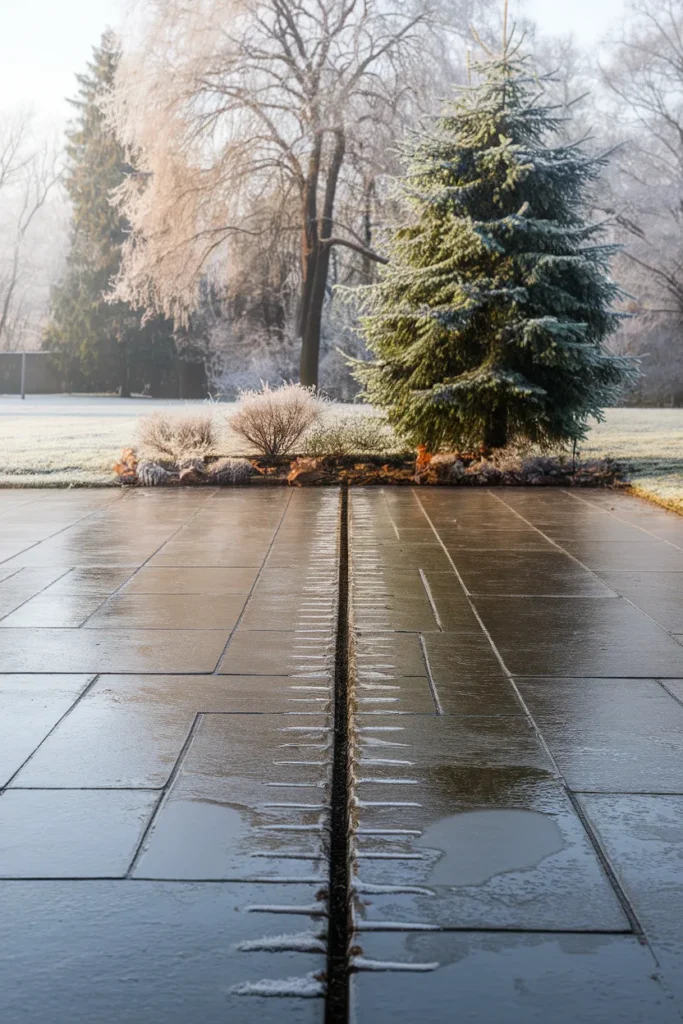
Cons. Concrete cracks. It will, eventually, especially through freeze-thaw cycles, and a crack in a stamped pattern is harder to hide than a lifted paver you can simply reset. It can get slippery when wet without an additive, and it needs resealing every couple of years to keep the color rich.
One honest, slightly contrarian take: if you live somewhere with brutal winters and you obsess over hairline cracks, pavers may frustrate you less over ten years, because a damaged paver is a swap, not a patch. Stamped concrete rewards people who can live with a little natural aging.
Freeze, Thaw, and Your USDA Zone: Will It Survive Your Winter?
This is the part almost nobody explains for a national audience. Stamped concrete lives or dies by how well it’s poured for your climate.
In colder regions, roughly USDA Zones 3 through 6, freeze-thaw cycling is the main enemy. Water seeps into tiny pores, freezes, expands, and stresses the surface. The fixes are a proper base, air-entrained concrete, control joints, and a quality sealer. In milder Zones 7 through 10, cracking pressure is lower and your bigger concerns are heat, color fade, and slip resistance around pools.
Wherever you are, drainage decides longevity. Water that pools and refreezes is what does the damage, so grading the slab to drain away from the house matters as much as the mix. If you want the official view on how hard surfaces shed or absorb water in your yard, see how hard surfaces affect yard drainage.
Stamped Concrete Patio Cost in 2026
Numbers move, so treat these as current ballparks and confirm quotes locally. Per 2026 industry cost data, basic stamped concrete runs in the range of [$10 to $14 per square foot], with more involved multi-color, multi-pattern projects reaching [$18 to $20+ per square foot. A typical stamped patio total often lands in the [$2,300 to $5,200 range , depending on size and complexity, per current published ranges you can double-check via current stamped concrete cost ranges.
For the popular “how much for a 20×20” question: that’s 400 square feet, so at roughly $12 to $18 per square foot you’re looking somewhere in the $4,800 to $7,200 range before regional labor swings.
Cheaper path: a stamped overlay on an existing sound slab typically costs less than a full tear-out and pour, often in the [$6 to $14 per square foot range . That’s the renter-friendly-ish, budget-minded move if your current concrete is structurally fine and just ugly.
Stamped Concrete vs Pavers: Which Should You Choose?
Both give you a stone-look patio, so it comes down to how you weigh cost, repairs, and looks.
Stamped concrete usually wins on upfront cost for large areas and on that seamless, continuous look. Pavers win on repairability, since you can lift and replace a single unit, and they flex with ground movement instead of cracking. Stamped concrete needs resealing; pavers need occasional joint sand and weeding.
Quick rule of thumb: choose stamped for the smoothest custom look at a friendly price, choose pavers for the easiest long-term repairs in freeze-thaw country.
| Factor | Stamped Concrete | Pavers |
|---|---|---|
| Upfront cost (large area) | Usually lower | Usually higher |
| Repairs | Patch or resurface | Lift and replace one unit |
| Cracking | Can crack over time | Flexes, rarely cracks |
| Maintenance | Reseal every ~2 to 3 yrs | Joint sand, weeding |
| Look | Seamless, continuous | Defined joints |
Sealing and Maintenance: Keeping the Color Rich
A stamped patio is low effort, not no effort. Sweep it, rinse it, and reseal it on a schedule to keep the color from going dull and chalky.
Plan to reseal roughly every two to three years , sooner in harsh sun or heavy use. A fresh coat deepens the color, adds slip resistance, and protects against stains. Skip it too long and the surface fades and gets thirsty for water, which is exactly what invites freeze damage.
Can You Stamp Over an Existing Concrete Patio?
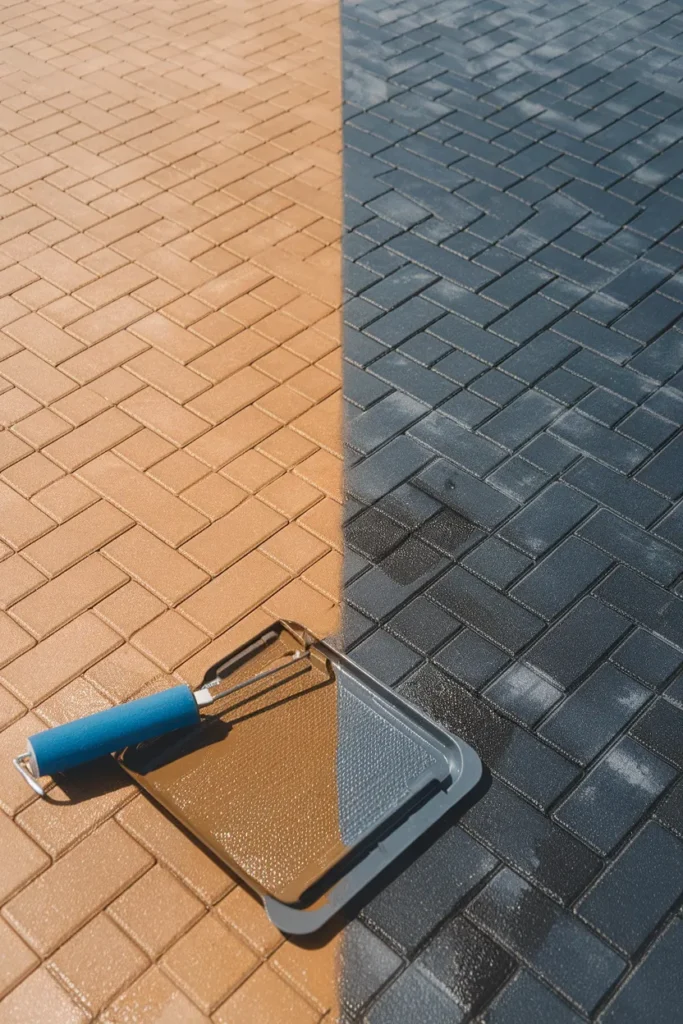
Often yes, and it’s a favorite money-saver. If your current slab is structurally sound, level, and not badly cracked, a stamped overlay can bond on top and give you the stone look without demolition.
The catch is condition. Deep cracks, heaving, or crumbling mean the base problems will telegraph through the overlay, so those need fixing or removal first. When in doubt, have a pro assess the slab before you fall in love with a pattern.
Frequently Asked Questions
What is a stamped concrete patio?
It’s a poured concrete patio that gets colored and pressed with textured mats while wet, so it mimics stone, brick, slate, or wood in one continuous, seam-free slab.
How much does a 20×20 stamped concrete patio cost?
A 20×20 patio is 400 square feet, so at roughly [$12 to $18 per square foot] you’re generally in the [$4,800 to $7,200 range ] before regional labor differences.
What is the downside of stamped concrete?
The main downsides are cracking over time (especially in freeze-thaw climates), harder spot repairs than pavers, slipperiness when wet without an additive, and the need to reseal every couple of years.
Is a stamped concrete patio cheaper than pavers?
For larger areas, stamped concrete is often cheaper upfront than pavers, though pavers can be cheaper to repair over the long run since you replace single units instead of patching a pattern.
Do stamped concrete patios crack?
Yes, concrete can develop hairline cracks over time. Proper base prep, control joints, air-entrained mix, and good drainage minimize it, but some natural aging is normal.
Can you stamp over an existing patio?
Usually, if the slab is sound and level. A stamped overlay bonds on top and skips demolition, but badly cracked or heaving concrete needs repair or removal first.