
How to Build a Small-Yard Chicken Coop: Plans, Sizing and Predator-Proofing

Most coop plans assume you have an acre and a pickup truck. You have a fenced lot, a neighbor with an upstairs window, and maybe 60 square feet to spare. These DIY chicken coop ideas start from that reality, not from a farm.
We’ll size your coop by hen count first, using a tool we call the Hen-to-Footprint Chart. It turns extension-service space rules into real cut sizes, like a 4 by 4 foot coop over a 4 by 10 foot run for four hens. Then you’ll pick a spot the neighbors can live with, build over one weekend, and close every gap a raccoon could pry open.
You’ll also get two things most coop guides skip. One is the rule check that keeps you from building something your city makes you tear down. The other is a fall trick that turns your hens into a cleanup crew for your raised beds.
Late fall is a smart time to start. A coop built now gets all winter to settle before chick season arrives at the feed store in spring.

Check Your City’s Chicken Rules Before You Buy Lumber
A coop is a small building with live animals inside. That puts it under two sets of local rules, one for keeping birds and one for putting up structures.
Lowe’s DIY coop guide flags the usual limits: how many birds you can keep, whether roosters are allowed, and how big the coop can be. The CDC adds a blunt detail. Many cities ban roosters because the crowing breaks noise ordinances.
Run through this list before a single 2×4 goes in your cart.
📏 Before-you-build rule check
Most permanent structures need a permit and have setback rules. Call your city building department before you dig footings or attach anything to the house.
Rules are half the job. The other half lives on the far side of your fence.
A legal coop can still turn into a complaint if the run sits under a neighbor’s bedroom window. Point the run away from their patio. Mention the plan before you build, not after the hens arrive. And if you’d like to block the view both ways, these budget backyard privacy fixes go up in an afternoon.

The Hen-to-Footprint Chart: How Big to Build
Most DIY chicken coop ideas online skip the sizing math, and the advice that does exist is all over the place. One top-ranking ideas post says 2 to 3 square feet per bird. Another says 3 to 4.
Oregon State University Extension gives the clearest rule. Plan at least 3 square feet of coop floor per bird if the hens also have a run, and 8 to 10 square feet per bird if they don’t. Oregon State doesn’t size the run. The rule of thumb most keepers use is 8 to 10 square feet per hen, and we treat that as the floor, not the goal.
Those numbers are useful. They just aren’t cut sizes. So we turned them into dimensions you can hand to the lumber desk. Screenshot this one.
Notice the 4-hen row. A 4 by 4 foot floor is exactly half of a 4 by 8 sheet of plywood, so one sheet gives you the floor and a back wall with almost no waste.
Now the small-yard trick hiding in that chart. Oregon State recommends raising a coop at least 1 foot off the ground to discourage rats, snakes, raccoons, and skunks. Go higher, about 2 to 3 feet, and set the coop inside the run. The shaded ground underneath becomes run space. A 4 by 4 coop stacked over one end of a 4 by 10 run uses 40 square feet of yard. Built side by side, the same pair takes 56.

Pick a Spot That Works for You, Your Hens, and Next Door
Location decides how much you’ll enjoy this coop in February.
Water comes first. Pick the highest ground in the yard so rain drains away from the run instead of collecting in it. A low run turns to mud, and mud starts to smell by spring.
Your own feet come next. You’ll walk out to this coop at least twice a day, sleet included. Oregon State also suggests building near the house or wherever people pass often, because human traffic discourages wildlife. In a small yard, close is easy.
Then light. Morning sun dries the run and gets the hens moving. Afternoon shade from a tree, the fence, or shade cloth keeps summer heat in check. If you’ve never tracked where sun actually lands in your yard, our six-photo sun mapping method for small yards takes one clear day and a phone.
Put the coop on the highest, best-drained patch of yard.
Keep it a short walk from the back door.
Give the run afternoon shade.
Dense shrubs right beside the run. They give predators cover.
The strip of yard beside your neighbor’s patio.
Low spots where water sits after rain.

6 DIY Chicken Coop Ideas That Fit a Small Yard
Once you know your size and your spot, style is the fun part. Each of these designs suits a yard where every square foot already has a job.
1. The Raised Coop Over the Run
This is the stacked setup from the chart. Hens get shade and a dry dust-bath spot under the coop, and you get an egg door at waist height. For three to six hens in a small yard, it’s our first pick.
2. The A-Frame Chicken Tractor
A triangle frame on two wheels that you drag to fresh grass every few days. It suits two or three hens and works well for renters, since nothing gets dug or poured. Build it 4 by 8 feet and it doubles as the fall garden helper described further down.
3. The Shed or Playhouse Conversion
If an old garden shed or a kids’ playhouse already sits in the yard, you’re halfway there. Add a pop door, a roost, a nest box, and hardware cloth over every window and vent.
4. The Fence-Corner Lean-To
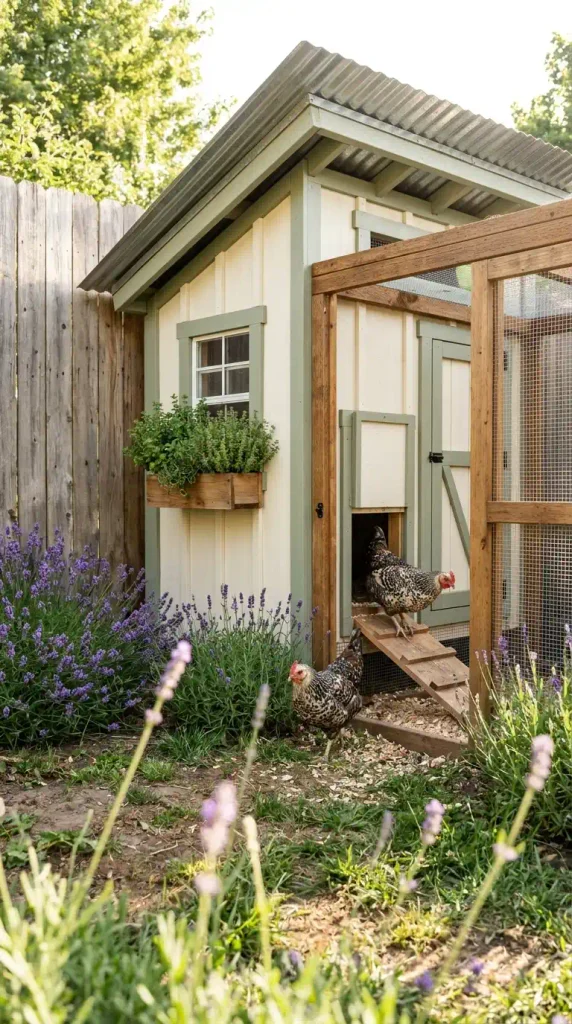
Your back corner already has two walls standing. A shed-roof coop tucked into that corner hides well and frames up fast. Set its own 4×4 posts so it never hangs on the fence boards. Check your setback rule first, because some cities won’t let a coop sit on the property line.
5. The Kit You Finish Yourself
Kits save build time, not money. At Tractor Supply, the OverEZ Medium Chicken Coop lists between about $1,700 and $2,000, depending on the style. Its base measures about 38 by 45 inches without the nest box, per the listing’s Q&A. That’s roughly 12 square feet, so by the chart’s math it comfortably houses about four standard hens, even though the box says ten. Whatever kit you buy, check its bird count against the chart.
6. The Pallet-Wall Budget Coop
Free pallets make sturdy walls for a cheap coop. Look for the HT stamp, which means heat-treated, and pass on any pallet stamped MB, which marks methyl bromide fumigation. Line the inside with plywood so the walls scrape clean.
How to Build a Small Chicken Coop in One Weekend
Budget first. Angi puts the typical cost of building a chicken coop at $300 to $2,000, with a national average near $650. Bob Vila’s cost guide says a small coop for four chickens built from the least expensive materials could run about $200. Lumber prices swing by region and by month, so price your cut list in the Home Depot or Lowe’s app before you drive over.
This plan builds the 4 by 4 raised coop from the chart. A confident DIYer can finish it in a weekend. First-timers should budget a third day and not feel bad about it.
Friday evening: mark and cut. Mark a 4 by 4 floor on half a sheet of plywood. Cut your 2×4 framing and four 4×4 legs. Pre-drill near board ends so they don’t split.
Saturday morning: base and legs. Frame the floor, then bolt on the legs so the floor sits 2 to 3 feet up. Check level both ways before you go further.
Saturday afternoon: walls and openings. Frame the walls. Cut a pop door, a people door, and vent openings high on the walls, above where the roost will go.
Sunday morning: roof. Build a single-slope roof that sheds rain away from the doors. Corrugated metal or polycarbonate panels are light and go on fast.
Sunday afternoon: wire and doors. Screw hardware cloth over every opening with washers under the screw heads. Hang doors to swing outward so you can reach every corner when you clean.
Sunday evening: fit-out. Add the roost bars, the nest box, and a few inches of pine shavings. Then lock it up for the night.

Predator-Proof It (Chicken Wire Won’t Cut It)
Chicken wire keeps chickens in. It doesn’t keep raccoons out. The thin twisted mesh can be torn open, and the holes are wide enough for a raccoon’s hand to reach through and grab a bird.
Use galvanized hardware cloth instead. Half-inch, 19-gauge mesh is the standard pick for windows, vents, and the lower walls of the run. In late October 2026, Home Depot listed 36-inch by 50-foot rolls of it at roughly $55 to $85, depending on the brand.
Do the roll math before you buy. A 4 by 10 foot run has a 28-foot perimeter. One 50-foot roll wraps the bottom 3 feet of that run and leaves about 22 feet for coop vents and windows. If you want a buried apron too, plan on a second roll.
| Hardware cloth | Chicken wire | |
|---|---|---|
| Mesh | 1/2-inch welded squares | Twisted hexagons, usually 1 inch or wider |
| Stops a raccoon’s reach | Yes | No |
| Stops rats and weasels | Mostly, at 1/2 inch | No |
| Cost | Higher: about $55 to $85 per 36-inch by 50-foot roll at Home Depot | Lower |
| Best use | Windows, vents, run walls, aprons | Fencing hens out of garden beds |
Diggers come next. Oregon State’s backyard coop design guide recommends burying run fencing 6 inches to 1 foot deep to stop coyotes, foxes, dogs, and rodents. It also calls for netting or wire over the top of the run and a motion-detector light outside the coop.
Can’t trench? Lay an apron instead. Fasten a 12 to 24 inch strip of hardware cloth to the base of the run wall and lay it flat on the ground. Pin it with U-shaped garden staples, then cover it with dirt or gravel.

Finish with the latches. Raccoons work with their hands, so pick latches that take two separate moves, like a barrel bolt with a carabiner clipped through it. An automatic door covers the nights you get home late. This fall, Walmart listed the Run-Chicken T50 and ChickenGuard door openers at about $140 each, and the Omlet Autodoor sells for about $200.
Inside the Coop: Roosts, Nest Boxes, and Airflow
Hens sleep on roosts, lay in nest boxes, and need air that moves without blowing on them. Get those three right and the coop mostly runs itself.
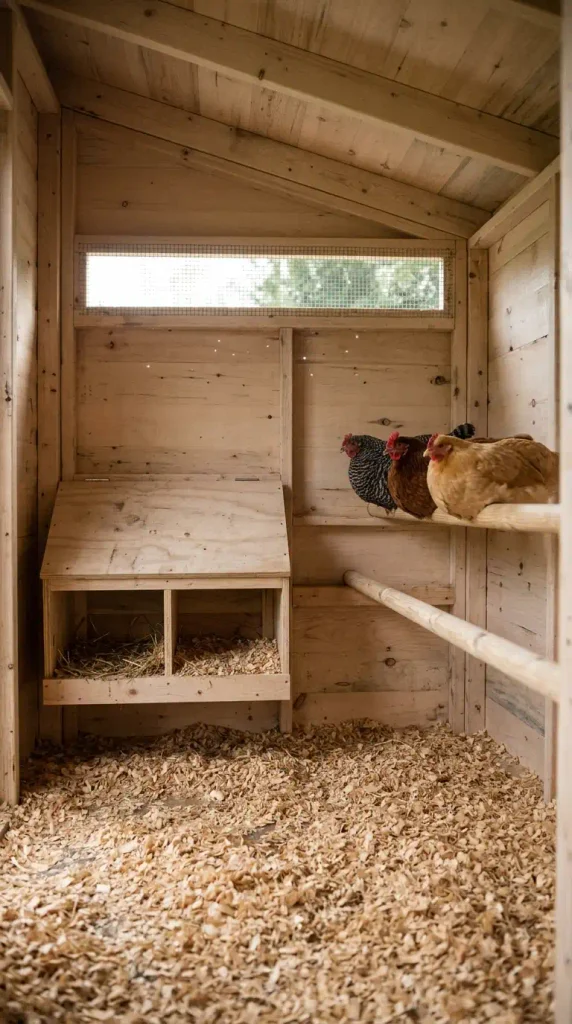
Start with the roost. Oregon State suggests 1 to 2 inch square lumber with the top edges rounded off, set about 2 feet above the floor. Space bars 10 inches apart and allow 5 to 10 inches of bar per bird. A 2×2 with sanded edges does the job.
Nest boxes come second. Oregon State says to plan one for about every four hens, roughly 12 inches deep, wide, and tall. Most keepers also mount the boxes lower than the roost bars. When a nest box is the highest perch in the coop, hens sleep in it, and you collect dirty eggs every morning. A box roof sloped at 45 degrees keeps birds from roosting on top.
Bedding is the cheap part. Tractor Supply’s Flake Premium Pine Shavings come in 8-cubic-foot bags for under $10, and a few inches covers a 4 by 4 floor with plenty left over.
Now the part that surprises people: skip the insulation. Oregon State says coops don’t need to be insulated, as long as there are no drafts. Winter trouble comes from trapped moisture instead. Hens breathe out water all night, and droppings add more. Seal a small coop tight and that damp air hangs around the roost.
So vent high. Put openings near the top of the walls, above roost level, so warm wet air escapes over the birds instead of across them. The CDC also notes that poultry can stay warm outdoors in winter inside a draft-free shelter. We’d skip the heat lamp, too. A hot bulb hanging over dry pine shavings is a fire risk you don’t need.
Put Your Hens to Work on Fall Garden Beds
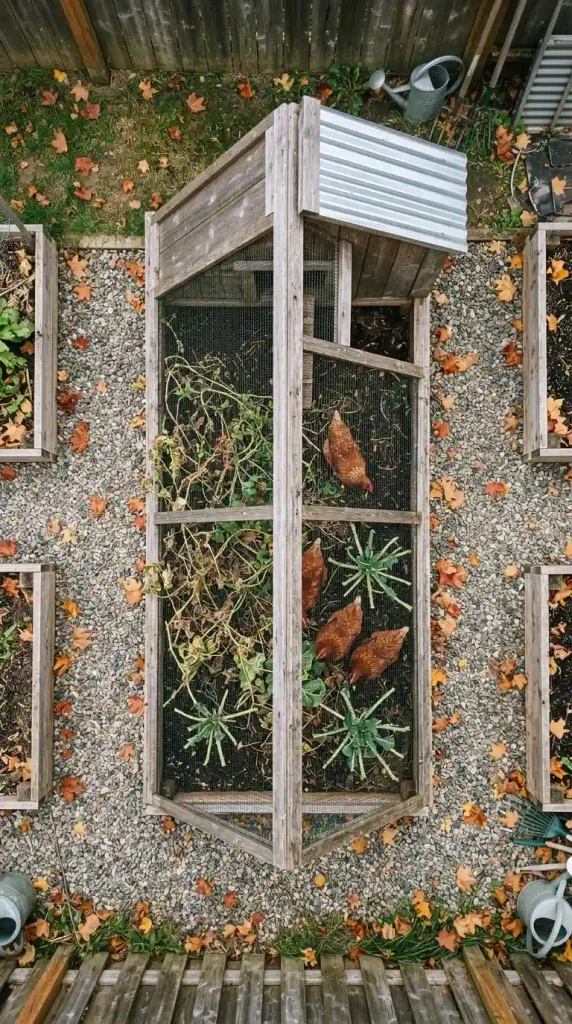
Here’s the move that makes a small-yard flock pull double duty. Build your chicken tractor to the same footprint as a raised bed. A 4 by 8 foot tractor sits right over a standard 4 by 8 bed, and at the chart’s run math it holds three hens.
After your last fall harvest, set the tractor over a spent bed. For a week or two, the hens scratch out weeds, eat bugs and seeds, and leave droppings behind. Then roll it to the next bed.
Your zone sets the start date. Burpee’s frost chart puts the average first fall frost around October 1 to 15 in Zone 5 and October 30 to November 15 in Zone 7. In Zone 9 it’s closer to early December. Those are averages, so check your own dates with your county extension office.
Timing is the whole point. Raw manure needs a long rest before you eat anything grown in it. Virginia Tech Extension’s food-safety guidance says to work chicken tractor manure into the bed, then wait at least 90 days before harvesting crops that stay off the ground. Wait 120 days for crops that touch the ground, like lettuce and carrots. A bed the hens finish in early November clears 120 days by early March, ahead of most spring harvests.
If those beds are still on paper, start with the Parallel Twins plan in our raised garden bed layouts for small backyards. It sets two 4 by 8 beds with a 4-foot path, so a tractor has room to roll between them. A Greenes Fence 4 by 8 cedar bed runs around $130 at Home Depot, so it’s an easy size to build your tractor around.
Same footprint, two jobs. A 4 by 8 tractor fits a 4 by 8 bed, so your hens clear it in fall and the bed rests all winter before you plant.
Keep the Flock (and Your Family) Healthy
Backyard hens can carry germs like Salmonella even when they look clean and healthy. The fix is a few habits, and a smart coop layout makes those habits easy.
Plan a cleanup spot into the build. The CDC’s backyard poultry health guidance says to wash your hands with soap and running water after touching hens, eggs, feeders, or anything in the run. It also suggests keeping hand sanitizer near the coop for times when soap and water are too far away. Keep a pair of coop-only boots outside the house. Clean feeders and waterers outdoors, never in the kitchen sink.
Kids need extra care. The CDC says children under 5 shouldn’t handle chicks or other poultry, and older kids should wash up with an adult watching.
If anyone in your home is very young, an older adult, or has a weakened immune system, talk with your doctor before the hens arrive. Line up a veterinarian who treats poultry, too.
Eggs need a little care as well. Collect them every day and toss cracked ones. Don’t wash warm, fresh eggs in cold water, which the CDC warns can pull bacteria inside the shell.
⚠️ Watch Out
Never bring hens indoors, even during a cold snap. The CDC says to keep poultry out of the house entirely, especially anywhere food or drinks are made, served, or stored.

Frequently Asked Questions
How big should a chicken coop be for 4 chickens?
Plan at least 12 square feet of coop floor if the hens also get a run, based on Oregon State Extension’s 3 square feet per bird. We’d build 4 by 4 feet instead. That’s 16 square feet, and it fits on half a sheet of plywood. Pair it with a run of about 40 square feet, such as 4 by 10 feet.
Is it cheaper to build or buy a chicken coop?
Building usually costs less. Angi estimates that building your own coop costs about half of buying a ready-made one, and its typical build range runs $300 to $2,000. Premade wooden coops like the OverEZ Medium list around $1,700 to $2,000 at Tractor Supply. A basic coop for four hens from low-cost materials can land near $200.
Should I use chicken wire or hardware cloth?
Use hardware cloth anywhere a predator could reach or chew. Half-inch, 19-gauge galvanized hardware cloth keeps out raccoon hands and most rats and weasels. Chicken wire keeps hens contained but can be torn open. Save it for jobs like fencing hens out of garden beds, and use hardware cloth on windows, vents, run walls, and buried aprons.
Do I need a permit to build a chicken coop?
It depends on your city and the size of the coop. Many towns cap the number of hens, ban roosters, and set distances a coop must keep from property lines or neighbors’ homes. Some also require a permit for structures above a certain size. Check your city code, call the building department, and read any HOA rules first.
Where should I put a chicken coop in my backyard?
Choose the highest, best-drained ground you have, close enough to the house that you’ll check on it twice a day. Give the run afternoon shade, keep dense shrubs away since they can hide predators, and aim the run away from your neighbor’s patio and windows. Morning sun helps the run dry out after rain.
How often should you clean a chicken coop?
Plan on a weekly cleaning. Oregon State notes that a well-designed coop is easy to keep up with weekly cleanings, and outward-swinging doors help you reach every corner. Collect eggs daily, top up pine shavings as they pack down, and do any scrubbing outdoors with gloves on, as the CDC recommends.
Does a chicken coop need insulation for winter?
No. Oregon State says coops don’t need to be insulated, only free of drafts. The real winter problem is moisture from breathing and droppings. Put vents high on the walls, above the roost, so damp air escapes over the birds. Skip heat lamps, which are a fire risk over dry bedding.
Count Your Hens, Then Build
Every one of these DIY chicken coop ideas starts with one number: how many hens you want. Find that row on the Hen-to-Footprint Chart, check it against your city’s limit, and your coop size, run size, and roost length all follow.
From there, pick the high, dry spot near the house. Block out a weekend. Buy the hardware cloth before anything decorative.
Build this fall and your coop gets a quiet winter to settle in, and your raised beds get a spring-ready cleanup crew. Save this guide to your backyard chickens board so the chart is on your phone when you’re standing in the lumber aisle.