How to Style DIY Fall Backyard Decor on Any Budget (9 Ideas)

The first real windstorm of October is the honest critic of every fall yard. Ours came through at 6 a.m. and rolled a pumpkin off the deck rail into the neighbor’s hosta bed, where it sat looking guilty for two days. That is the part most DIY fall backyard decor ideas leave out. Your backyard is outside, in the weather, and the pretty flat-lay that photographs beautifully on Saturday can be a soggy mess by Wednesday.
So this list is built a little differently. Every idea below is sorted by what it costs and whether it survives rain, wind, and a light frost. Some of it is a $1.25 run through Dollar Tree. Some of it is a fire pit you will use for the next eight years. Most of it lands in the middle, and all of it works in a plain rectangle of a yard with a fence and a patio slab.
One framework holds the whole thing together.
The $40, $150, $400 Fall Yard Ladder
Every idea here sits on one of three rungs. The $40 rung is decor you buy once and store: crates, a few real pumpkins, a bag of gourds, dollar-store lanterns. The $150 rung adds living color and light, which is where most yards make their biggest visual jump. The $400 rung buys the heat source that keeps people outside after dark in November. Climb one rung a year and your fall yard compounds instead of restarting every September.
1. Weight the crate stack before the first storm, not after
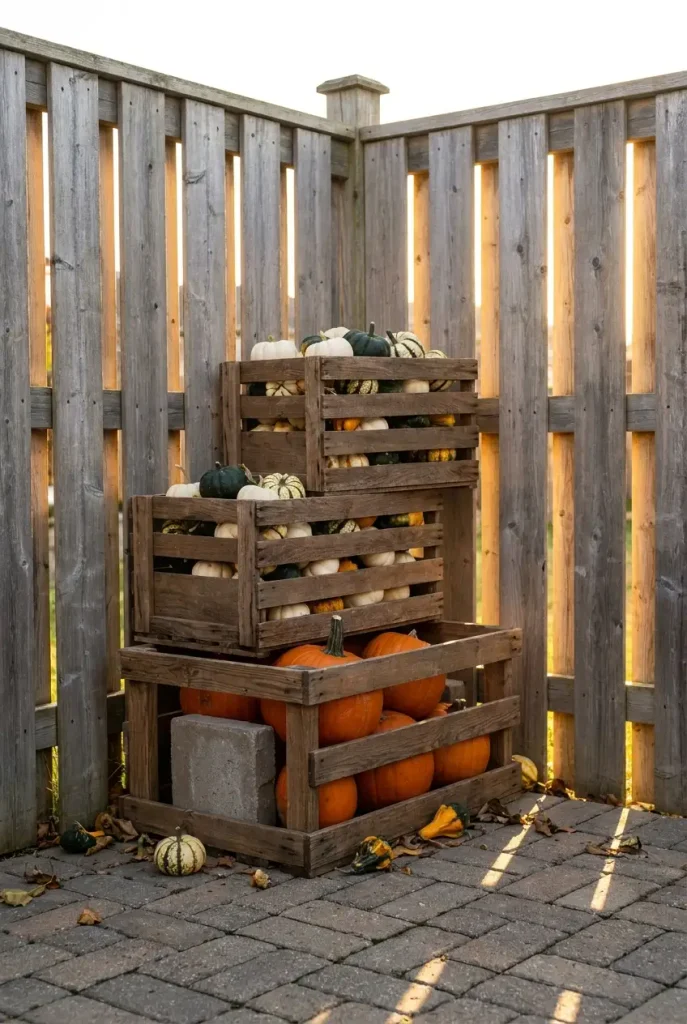
Wooden crates are the backbone of a harvest display, and they are also the thing most likely to end up on its side by Thursday. Greenes Fence crates run around $15 each at Home Depot and Lowe’s, and they stack three high without wobbling if you load them correctly.
My own stack went over twice before I figured out the order
Put a paver or a half bag of potting soil inside the bottom crate. That single step kills almost all of the tipping.
Stagger the stack back, not straight up, so the center of gravity leans into the wall or fence.
Heaviest pumpkins on the bottom crate, small gourds up top. Never the reverse, however good it looks.
Set the whole thing on the patio, not on grass. Wet grass under a loaded crate turns into a mud pit in one week, and the bottom slat starts to rot by Halloween.
2. Buy garden mums in odd numbers, then get them in the ground
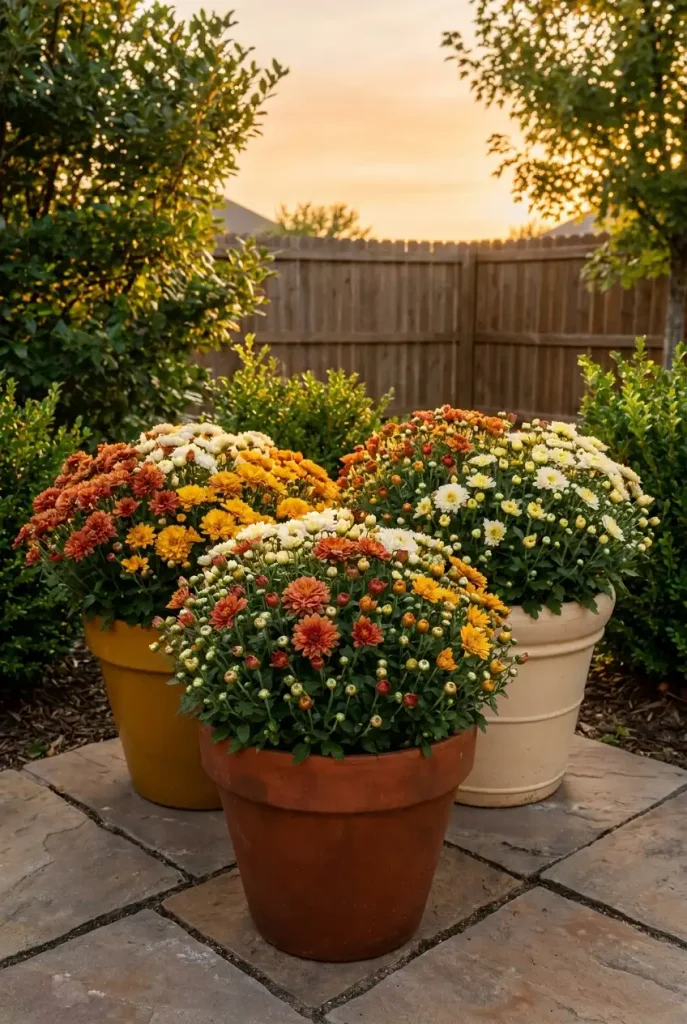
Three pots read as a designed group. Two read as an accident. Odd-number grouping is the cheapest styling trick in fall decorating, and it costs nothing extra.
Here is the part the pretty galleries skip. Most mums sold in September are bought in full bloom, displayed for six weeks, and thrown away. Virginia Cooperative Extension makes the timing problem plain in its guidance on overwintering garden mums through winter: garden mums root best when planted in late August or early September, they want six or more hours of direct sun, and the later they go in the ground, the lower the survival rate. Which means the mums you buy in full color in October are already fighting uphill.
| Leave them in the pot | Plant them in a bed |
|---|---|
| Move the grouping anywhere, any week | Roots establish before the ground freezes |
| Dries out fast, needs water every day or two | Holds moisture, far less babysitting |
| Almost always a one-season plant | A real shot at coming back in Zones 5 to 9 |
Buy the pots with tight buds rather than open flowers. They look less impressive on the shelf and hold color two to three weeks longer on your patio.
3. Raid Dollar Tree, but only for the six things that survive rain
Not everything on that fall aisle belongs outdoors. Dollar Tree’s core shelf still holds at $1.25, with multi-price items running higher, so a smart cart is genuinely under $20. The trick is knowing what dissolves.
Fabric pumpkins, paper garland, and cardboard-backed signs turn to pulp in one rainstorm. Resin, plastic, metal, and glass do not. Shop that line and nothing else.
🛒 The rain-proof dollar cart
That cart is the entire $40 rung of the ladder, and it is where I send anyone decorating a backyard for the first time. If you want the full budget breakdown, our guide to budget Dollar Tree backyard decor goes deeper on what holds up season to season.
Skip the fabric. Every single time.
4. Hang the café bulbs low over the seats, not around the fence
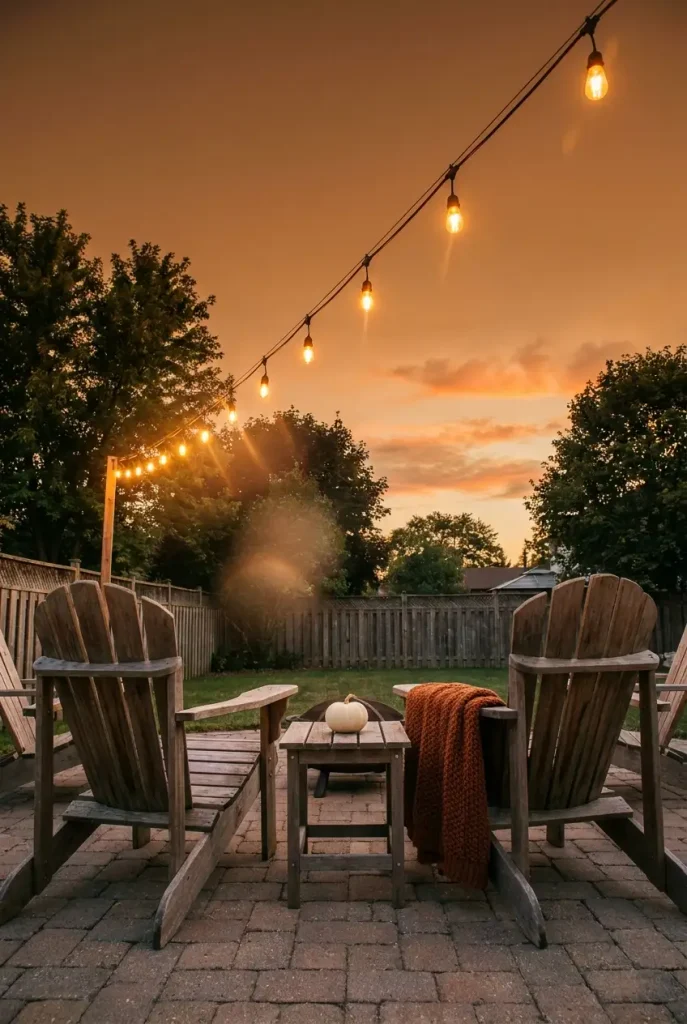
Most people staple string lights along the top of the fence. It is the easy run, and it is the wrong one. Fence-line lights push glow outward into the neighbor’s yard and leave the seating area in a dark hole.
Run them instead as a low canopy, roughly 8 feet overhead, directly above where people sit. A 48 foot commercial-grade run from Brightech or Feit usually lands in the $40 to $70 range and covers a typical patio with one strand. String it on a guide wire between the house and a post or a tree, with the wire doing the work and the light strand hanging loose off it.
The first year I did this I zigzagged four strands across the whole yard and it looked like a used car lot. One strand, low, over the chairs. That is the whole idea.
Bulbs stapled along the fence top. The perimeter glows, the chairs sit in shadow, and the yard reads flat and wide.
One strand on a guide wire, 8 feet over the seats. The light drops onto faces and the table, and the yard gains a ceiling.
Use outdoor-rated, UL-listed lights and cords on a GFCI outlet. Anything beyond plugging into an existing outlet is a job for a licensed electrician.
If your patio layout is fighting you on where the seats should even go, our patio layout ideas for small yards covers the anchor-point problem first.
5. Give the fire pit its 10 feet
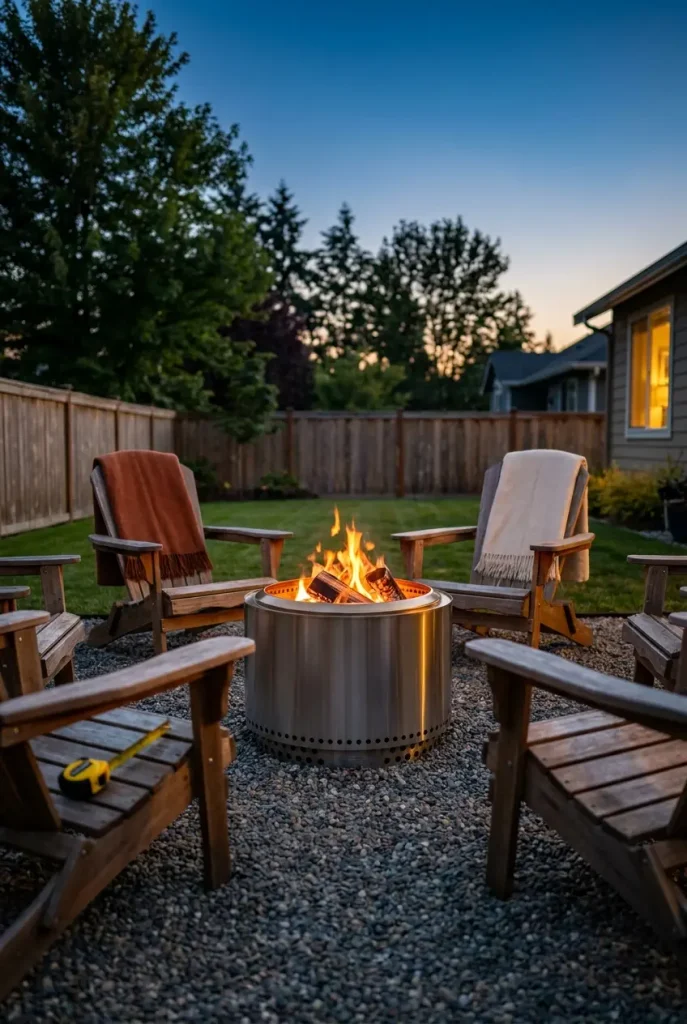
Heat is what extends your backyard season past the first cold snap, and a fire pit is the single biggest jump on the $400 rung. A smokeless steel pit like the Solo Stove Bonfire 2.0 sits in the $200 to $300 range depending on the bundle, and Sunnydaze sells steel bowls for well under $150.
Placement matters more than the pit you buy. The U.S. Fire Administration’s outdoor fire safety guidance puts fire pits, chimneys, and outdoor fireplaces at least 10 feet from the home or anything that can burn, and campfires at least 25 feet from tents and shrubs. Ten feet is farther than most patios assume. Measure it with a tape before you commit to a spot, because the answer often moves the whole seating plan.
⚠️ Watch Out
Check your city’s burn rules before you light anything, keep the clearance from structures and branches that your fire pit’s manual and local code call for, and never leave a fire unattended.
A metal spark screen over a wood fire is the cheapest safety buy you will make all season. Under $40, and it keeps embers off the throw blankets.
6. Cornstalks on the posts, clean straw on the beds, hay nowhere
Here is the contrarian one. Hay bales are the classic fall photo prop and the worst thing you can set next to your garden beds.
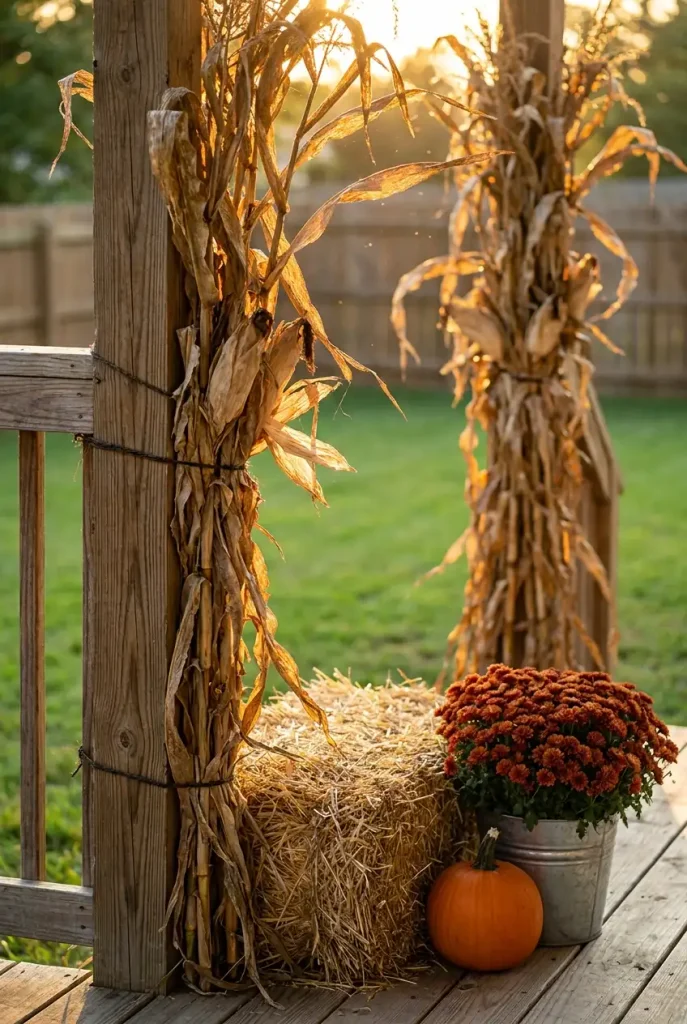
Hay is cut grass with seed heads still in it, so it seeds weeds into everything it touches and mats down into a slimy layer when it gets wet. Straw is the hollow leftover stalk after grain harvest, with the seed removed. Virginia Cooperative Extension specifies clean straw, explicitly not hay, when it lists what to mulch garden mums with, along with pine needles and loose shredded bark at a depth of 3 to 4 inches over the crown.
Buy a straw bale, around $10 to $15 at Home Depot or Tractor Supply, and use it as a seat riser now and as mulch in November.
Zip-tie cornstalk bundles to fence posts and deck posts, where wind cannot knock them over.
Hay bales anywhere near a bed you care about, unless you enjoy weeding in April.
Free-standing cornstalks leaned against nothing. They fall on the first gusty night.
I learned the hay lesson the expensive way, pulling grass out of a raised bed all the following spring after one photogenic October. One bale, one season of weeding. Straw costs the same.
For bed-level color that carries past the decor, our fall garden inspiration for beds has the plant side of it.
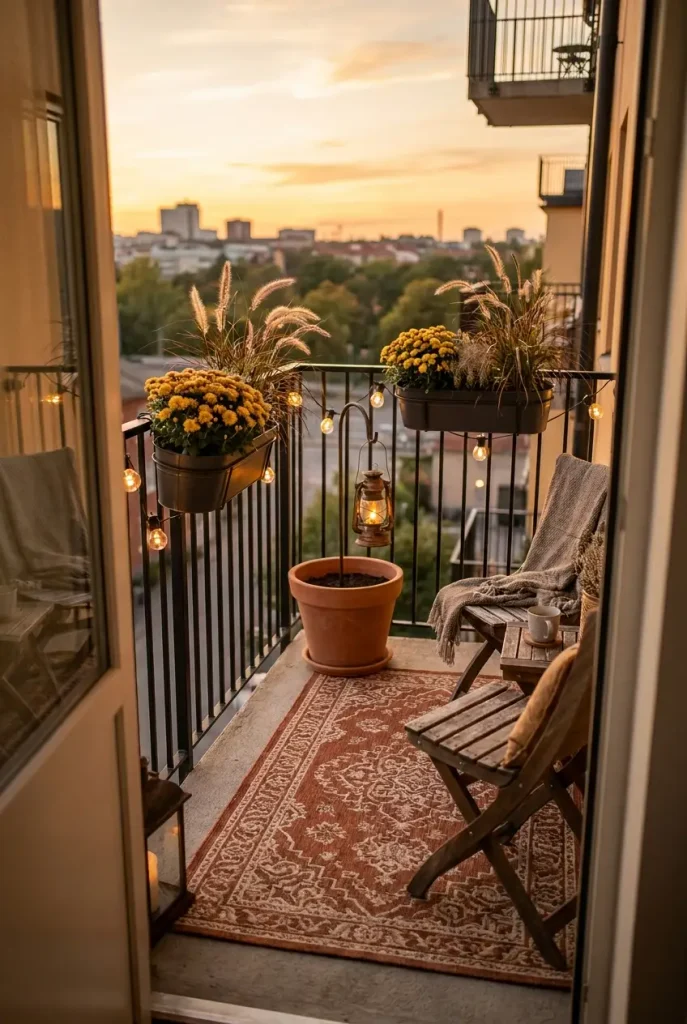
7. The no-drill version for renters and balconies
Renting does not have to mean skipping the whole season. Every idea above has a version that leaves no holes and comes with you when the lease ends.
- ▸Tension rod across a balcony doorway or railing corner, with lightweight faux garland clipped on
- ▸Railing planters that hook over instead of screwing in, filled with mums and ornamental grasses
- ▸Freestanding shepherd’s hooks pushed into a large pot of soil to carry lanterns at any height
- ▸Battery or solar café bulbs looped over an existing railing, no outlet and no staples
- ▸An outdoor rug in rust or plaid to define a seating square on concrete
The rug is the one most people underestimate. On a bare concrete balcony it does more for the room-like feeling than any amount of pumpkins, and it rolls up into a closet in November.
8. Put the light at ankle height, not eye height
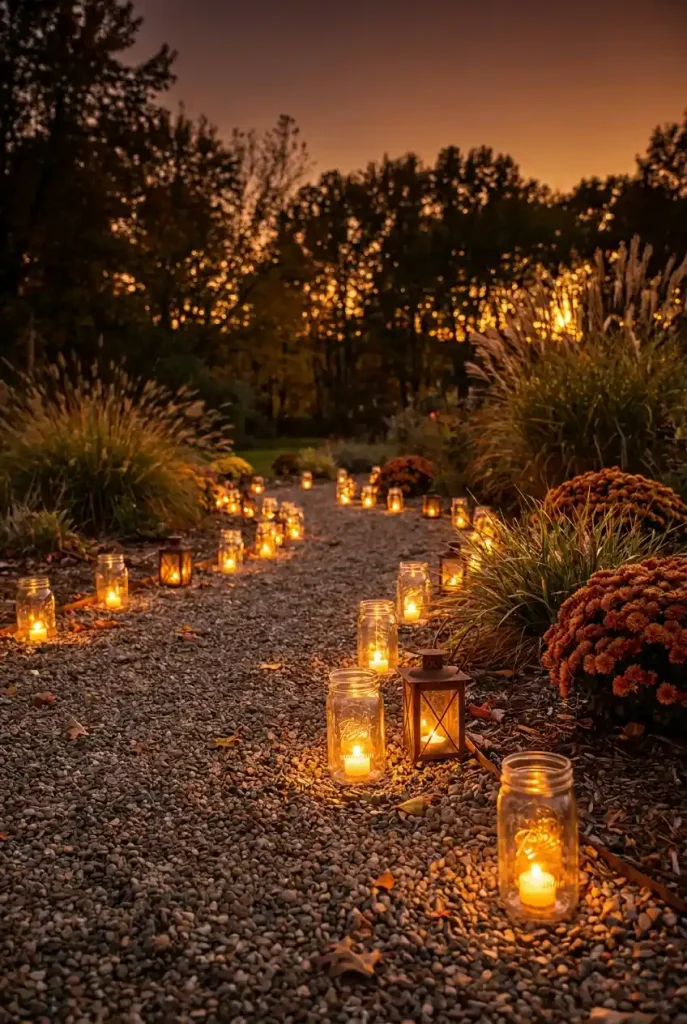
Backyards get dark fast in October, and the instinct is to add brighter light up high. Do the opposite. Low light reads as warm and intentional; overhead floodlight reads as a parking lot.
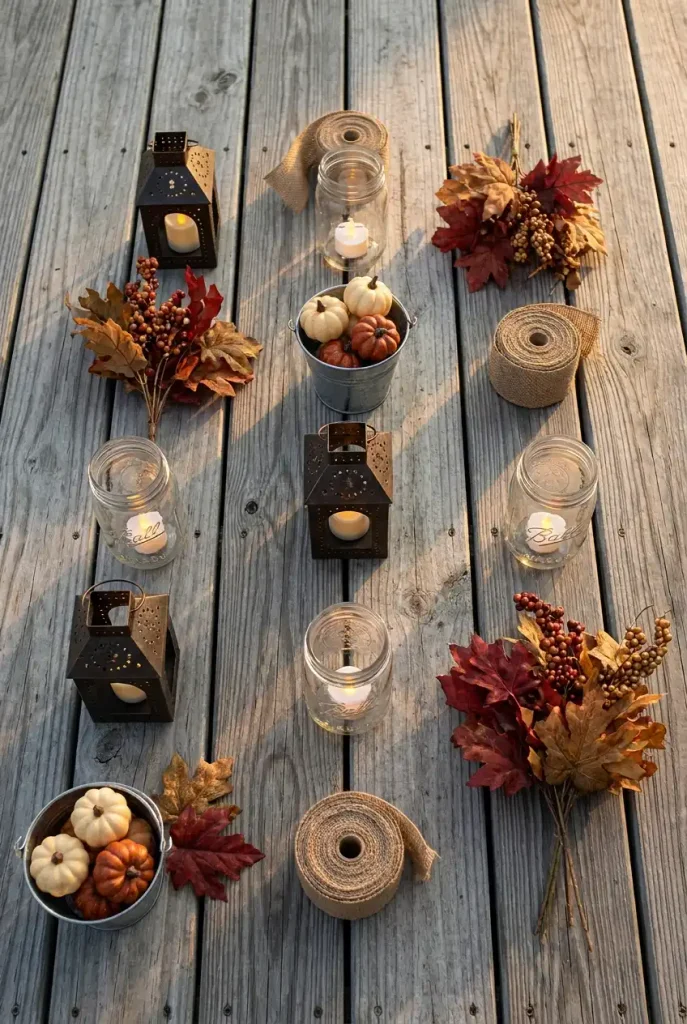
Line a walkway or a bed edge with lanterns and jars at ankle height, roughly 3 feet apart, and let them mark the path rather than illuminate it. Battery tea lights in glass jars cost a few dollars and throw exactly the right amount of glow. Solar stake lanterns from Target or Walmart usually run $8 to $20 each and need no wiring at all.
Stagger them slightly off a straight line. A perfectly spaced row looks like runway markers, and a loose zigzag looks like someone with taste put them there.
9. Plan the teardown in October, not in a panic in November
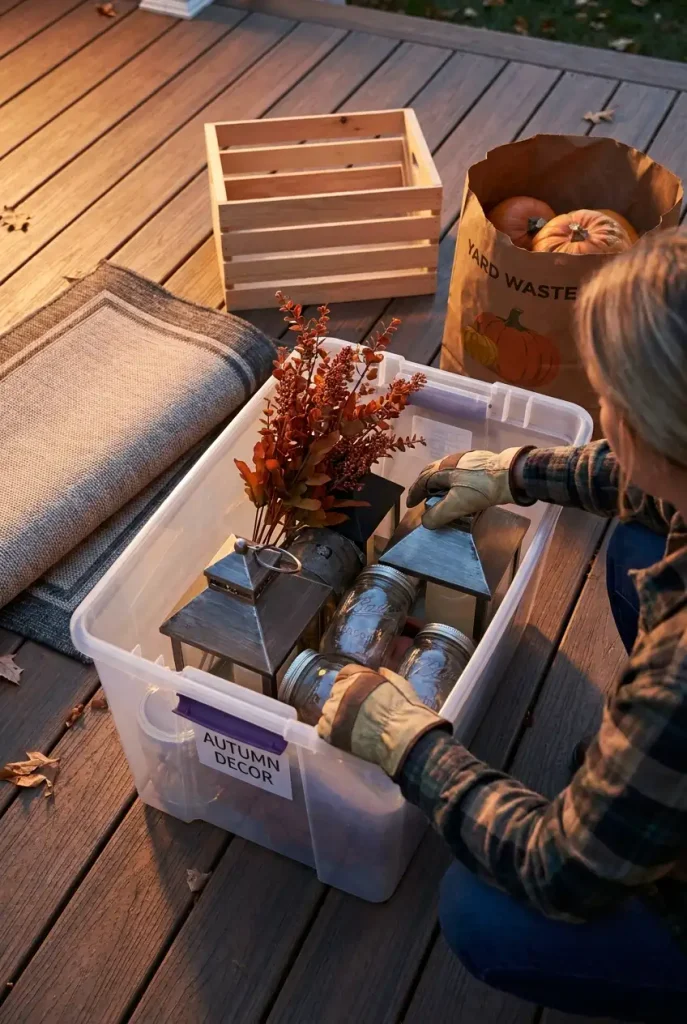
Nobody writes this part down, and it is the reason garages fill up with mildewed gourds. Decide in advance where each thing goes when the season ends, and next September starts from a box instead of a shopping trip.
Real pumpkins and gourds go in the compost or the yard-waste bin once they soften, never the trash. Straw bales break apart into mulch over the beds after the first hard frost, which is also when Virginia Cooperative Extension says to stop cutting mums back and let the old foliage insulate the crown. Cornstalks go out with the yard waste. Crates, lanterns, jars, and faux stems get dried fully and stored in one labeled bin, which is your entire $40 rung recovered for free.
A fall yard that gets stored properly is a yard you only pay for once. Every rung of the ladder you climb stays climbed.
Do it on a dry afternoon in early November, before the first freeze locks everything to the patio.
DIY Fall Backyard Decor Ideas Frequently Asked Questions
When should I put out fall decorations outside?
Early to mid September works for anything non-living: crates, lanterns, cornstalks, and faux stems. Hold the real pumpkins until late September, because a whole pumpkin set on a warm patio in early September often softens before Halloween. Garden mums are the exception in the other direction. If you plan to plant them, late August or early September is the window that gives roots time to establish.
How do I decorate my backyard for fall on a budget?
Stay on the $40 rung of the ladder. Three wood crates, a handful of real pumpkins, and a cart of metal lanterns and glass jars from a dollar store come in under $40 total and do most of the visual work. Add battery tea lights rather than wired lighting. Skip anything fabric or paper, since that is where cheap outdoor decor fails first.
What colors work best for outdoor fall decor?
Rust, deep gold, cream, and warm brown read as autumn without looking like Halloween. Keep the palette to three colors and repeat each one at least twice around the yard, which is what makes a grouping look styled rather than collected. White pumpkins are the easiest way to brighten a display against a dark fence or an evergreen backdrop.
How do I keep fall decorations from blowing away or getting moldy?
Weight the bottom of any stack with a paver or a bag of soil, and tie tall items like cornstalks to a post rather than leaning them. For mold, keep everything off wet grass and on pavers or decking so air moves underneath. Lift and rotate whole pumpkins once a week, and pull any that show a soft spot before it spreads to the rest.
What are the easiest fall plants for outdoor containers?
Garden mums, ornamental kale, ornamental grasses, pansies, and asters all handle cool nights well across Zones 5 to 9. Mums want six or more hours of direct sun and daily watering in a pot. Ornamental grasses need the least attention of the group and hold their shape into winter, which makes them the best value per pot.
How can I decorate for fall without a porch or a yard?
Work the vertical surfaces and the floor. A tension rod carries garland across a balcony doorway, hook-over railing planters hold mums without hardware, and an outdoor rug in rust or plaid defines a seating square on bare concrete. Solar café bulbs loop over a railing with no outlet needed. All of it packs down and moves with you.
Wrapping up
A fall backyard does not need 40 ideas. It needs three rungs, a stack that stays upright, and one light source low enough to make people want to stay outside after the sun drops. Start with whichever rung matches your budget this year, get the crates weighted before the first storm rolls through, and let it compound from there.
Save this one to your fall board so it is waiting for you next September, when the mums hit the shelves and you would rather not start over.
📌 Good To Know
Pin the crate stack photo, not the wide shot. Vertical close-ups of one clear idea outperform whole-yard views on Pinterest almost every time.