12 Simple Tree Lighting Ideas for Cozy Fall Nights

By the second week of September the good part of the evening moves. Dinner outside still works, but the yard goes flat around 7:30 and everyone drifts back in. That is the problem these tree lighting ideas solve, and they solve it using the thing already standing in your yard.
A lit tree does something outdoor string light ideas strung over a patio table cannot. It gives the dark a shape. Bark catches warm light in a way a fence panel never will, and one glowing maple reads from the kitchen window, from the driveway, and from the neighbor’s side of the street.
Set that against how the top-ranking pages tell you to do it, and one flaw shows up in every single one of them: wrap everything. Our rule says the opposite. We call it The Three-Glow Rule, and it puts one tree lit at three heights ahead of five trees lit flat.
Twelve ideas below. Real Home Depot prices pulled this month, the wrap math installers actually use, and the quiet mistake that kills a trunk.
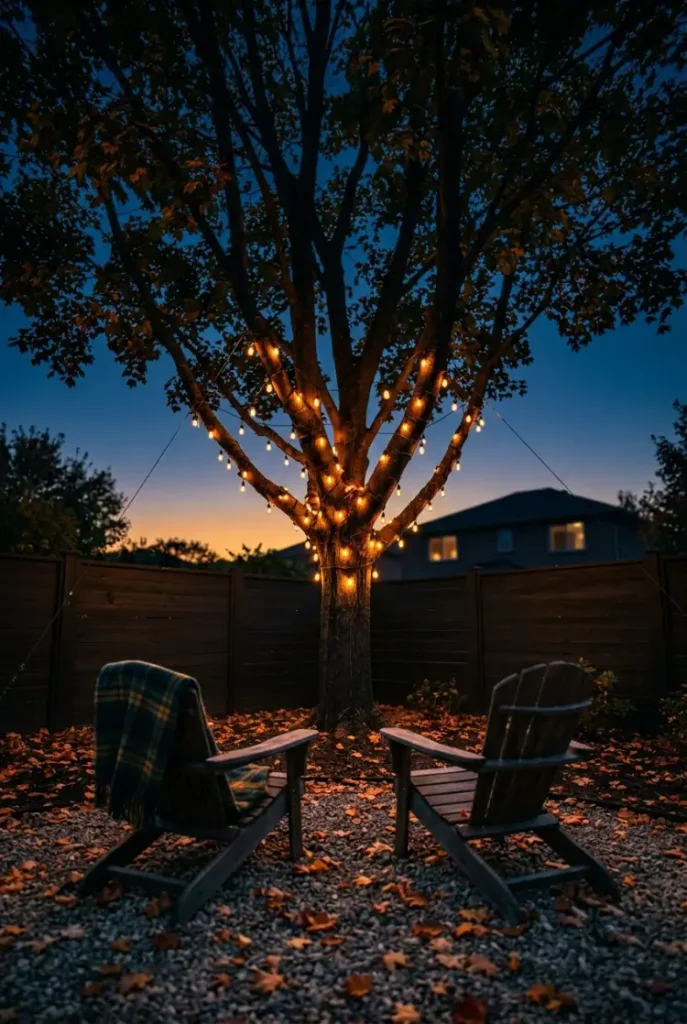
The Three-Glow Rule
A tree reads as lit when light reaches it at three heights. One height is the reason most lit trees look half finished. Ground glow is a spotlight in the mulch aimed up the trunk. Mid glow is whatever wraps or drapes between knee height and the first big branch.
Canopy glow is anything overhead: a strand run out to the house, lanterns hung on a limb, bulbs threaded through the outer branches. Land all three on a single tree and it carries the whole yard. Land one height on four trees and the yard just reads gray. Every one of the tree lighting ideas below leans on at least one of those three heights, and the strongest of them stack all three on a single trunk.
1. Pick one tree and give up the rest
Every page ranking on the first results page tells you to wrap the trunks, then the branches, then the pair of potted olives by the door. Skip most of that.
Glow only registers against dark. Light three trees across a 40-foot yard and you get an evenly gray backyard with no focal point, which is the same result as leaving the porch bulb on all night. Light one and the eye goes there every single time you step outside.
Choose the tree you can see from wherever you actually sit, then give that one tree all three glows. A 48-foot Brightech Ambience Pro strand runs $39.99 at Home Depot and carries fifteen S14 LED bulbs spaced 3 feet apart. That is enough to make one mid-size maple the reason you go out at all.
The other trees are not wasted. They are the dark that makes the lit one work.
Contrast is the whole effect. One lit tree in a dark yard reads as intentional. Four lit trees read as a parking lot.
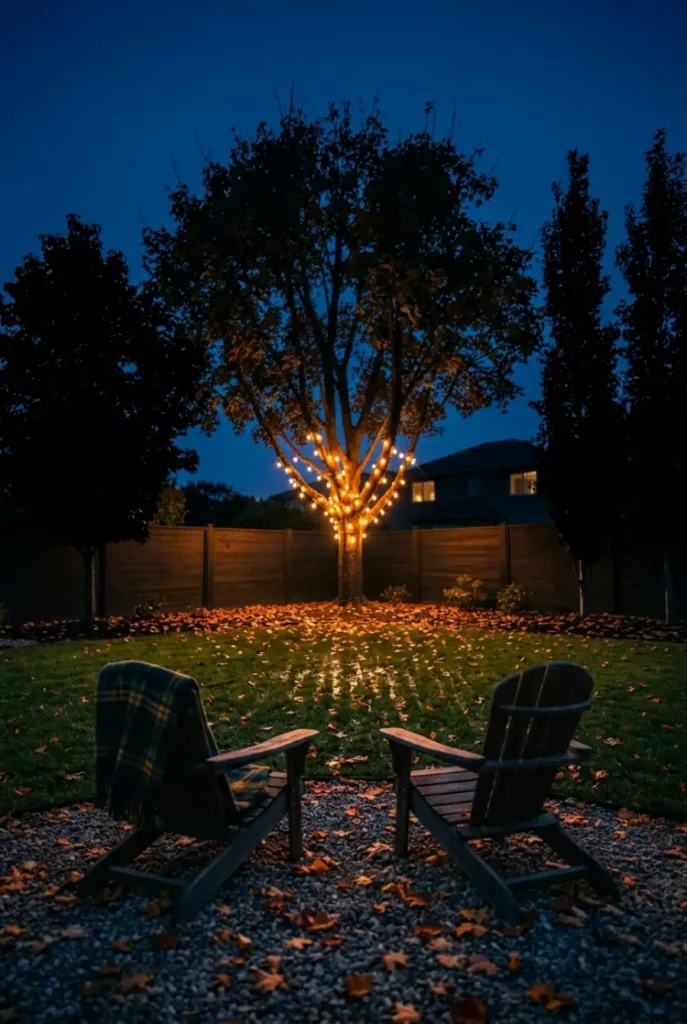
2. Start from the ground, before anything touches bark
Before a single strand goes near the bark, walk out at dusk with a flashlight and aim it up the trunk from about four feet out. That is a free preview of ground glow, and on a tree with any texture at all it usually wins outright.
Angle matters more than wattage. John Cullen Lighting puts narrow trunks at a 45-degree upward angle. Gardeningetc cites roughly 1200 lumens per recessed uplighter for a mature tree, closer to 5000 lumens for a dense oak. A Commercial Electric 400-lumen plug-in spotlight at $12.97 handles a slim birch or a young pear just fine.
Here is the real argument for going this route first, and it has nothing to do with looks. Nothing wraps the tree.
| Uplight from the ground | Wrap the trunk |
|---|---|
| Nothing encircles the wood, so no girdling risk | Must come off, or it cuts in over time |
| One to three fixtures, from $9.97 each | 60 to 140 feet of string on a mid-size trunk |
| Shows off bark texture and branch structure | Reads as decorated rather than architectural |
| Install in twenty minutes with a stake | A full afternoon, and a ladder |
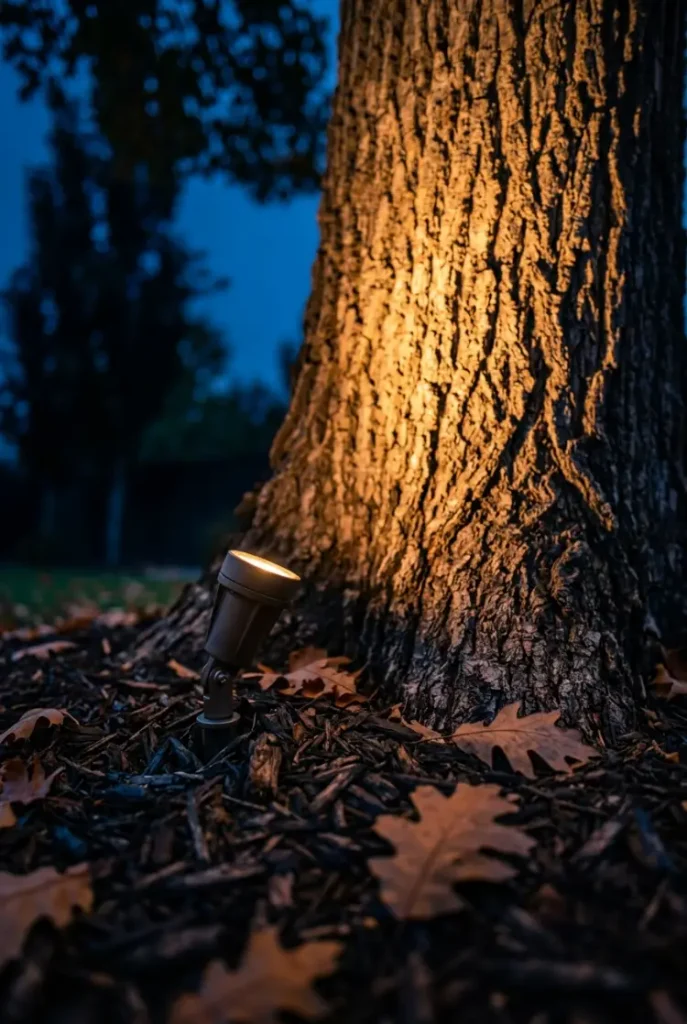
3. The wrap math, and why the formula lies to you
There is a working formula for this. It undersells.
- Measure trunk circumference in inches, then trunk height in feet up to the first big branch.
- Multiply the two, then divide by your pass spacing in inches. A 30-inch trunk, 6 feet tall, at 3-inch spacing calls for 60 feet of string.
- Add 10 percent for bark irregularity, then buy one more strand than that.
Step three is not padding. Christmas Light Source skipped the formula entirely and measured an 18-inch pecan by hand, and got 23 feet of cord per foot of trunk at 4-inch spacing against the roughly 14 feet the formula predicts. The formula treats every pass as a flat circle. A real spiral over real bark eats more wire than that.
Installers do not even agree on spacing. Certified Lights recommends 4 inches. Christmas Lights Etc. says 2 to 3.
Wrap a length of rope over one marked 12-inch band of trunk at the spacing you want, then measure the rope you used.
Multiply that number by the trunk height in feet. On an 18-inch pecan at 6-inch spacing this comes out near 11 feet per foot, so 110 feet for a 10-foot trunk.
Convert to strands. 100-count 5mm mini strings run 33 feet each at 4-inch bulb spacing, so 110 feet is roughly four strings. Buy five.
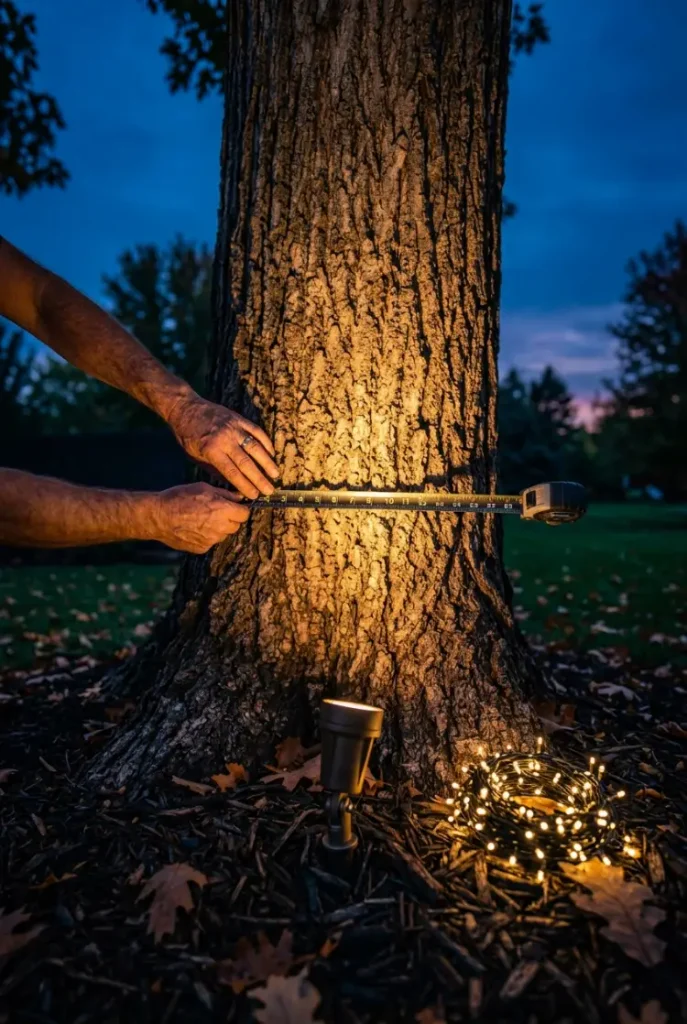
4. The thing none of the top-ranking pages tells you
Does a strand of cafe bulbs actually hurt a tree?
Wrapped tight and left on, yes. NDSU Extension is blunt about it: anything that encircles a stem and stays there will eventually girdle the tree, and wire left on a trunk will girdle it on a timeline nobody can predict. Their words: it might take 2 years, or 20.
Davey Tree draws the line somewhere you can actually act on. Laying a strand over the top of branches is fine. Spiraling it around them is what girdles. So drape where you can, wrap the trunk only, and keep both off any tree planted in the last few years.
One twist tie, left on from a single season, was already digging into the stem by the following spring. That is the whole warning, and it took twelve months.
⚠️ Watch Out
Zip ties, wire twists, cable, rope, and tight light strands all do the same thing to a growing trunk. If it encircles the wood and stays there, it eventually strangles it. Secure with twine or electrical tape instead, and set a calendar reminder for takedown.
5. Run one canopy line from the tree to the house
One line from a high branch to the house fascia turns a lawn into a room. That is canopy glow doing the heaviest lifting in The Three-Glow Rule, and it is the cheapest square footage you will ever add to a house.
Run a stainless guide wire first, then hang the strand from it with S-hooks. The wire carries the weight and the strand simply hangs, which is why a 48-foot run does not sag into your head by November. Enbrighten’s Classic Cafe 48-foot string is UL-listed for permanent indoor and outdoor installation and links up to 750 feet, so one long run is realistic rather than theoretical.
No tree tall enough to anchor to? That is a different build, and we walked through it separately in hang string lights without trees.
Canopy line shopping list
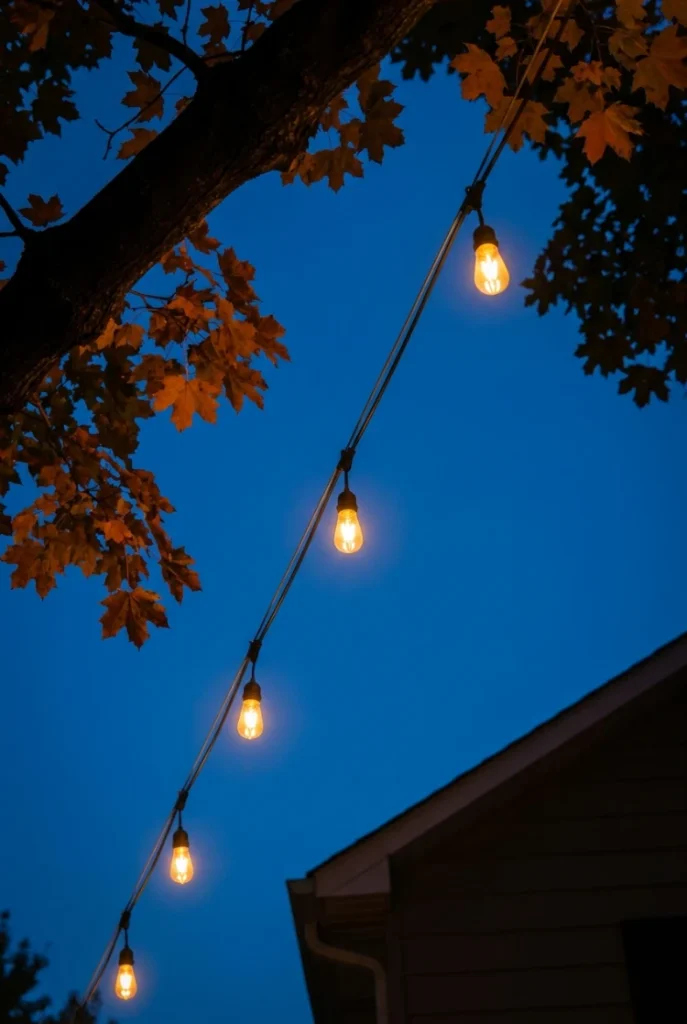
6. Solar, for the tree you cannot run a cord to
The back corner tree has no outlet. Solar earns its keep there and almost nowhere else.
Brightech’s 48-foot Ambience Pro solar version runs $69.99 at Home Depot, which is $30 above the plug-in twin at $39.99. You are paying for the panel, and what you give back is runtime on a short October day after a gray afternoon. Set expectations at four to six hours, not dusk to dawn.
For ground glow the math flips in your favor. A Hampton Bay 55-lumen solar spot light is $9.97, so three of them staked around one trunk land under $30 total. One caveat worth knowing before you buy: that model’s spec sheet lists its IP rating as Not Rated, so keep it clear of standing water and off any downspout splash line.
7. Pick 2700K and stop reading reviews
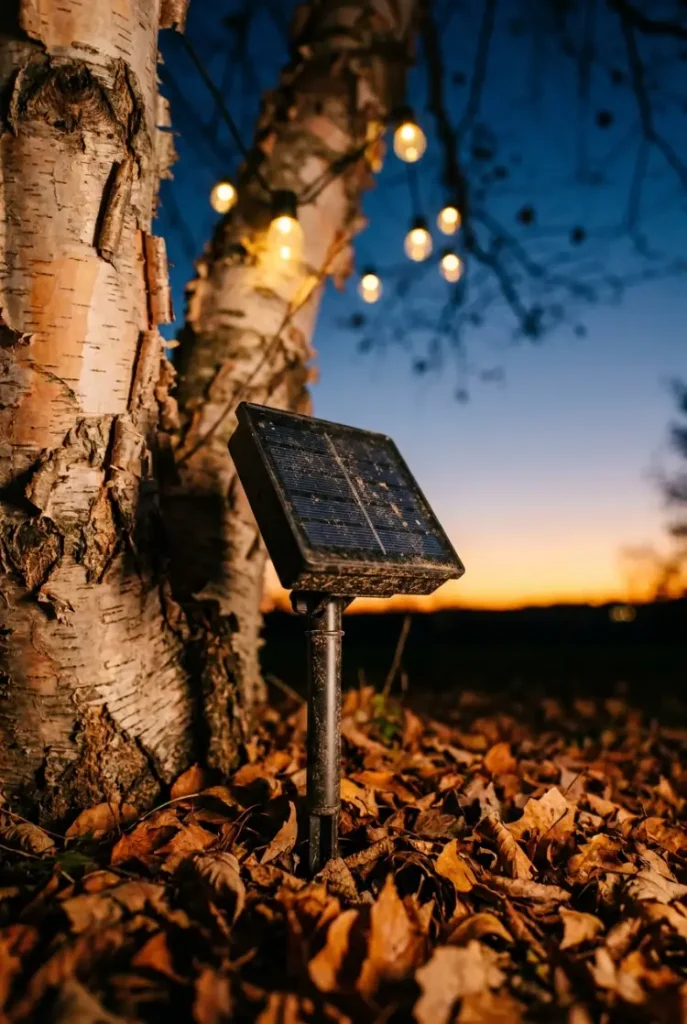
Every designer quoted on the two top-ranking pages lands inside the same narrow window. Asco Lights recommends 2700K or 3000K for tree uplighting. John Cullen Lighting puts warm white “in the region of 2700K-3000K”. Brightech ships its 48-foot Ambience Pro at 2700K and calls it soft white, the number worth memorizing before you reach a shelf.
There is exactly one real exception, and it is a specialist move. 4000K behind a glare guard, aimed down through a canopy, reads as moonlight instead of as a floodlight. Without the shielding it just reads as a security light.
Anything cooler than 3000K straight onto bark goes blue and clinical. Bark is a warm-toned material. Cool light fights it, every time.
| Color temp | What it does on a tree |
|---|---|
| 2500K | Candle-warm. Lovely on cafe bulbs, slightly muddy as an uplight. |
| 2700K | The house default. Warm, flattering on bark, matches most porch bulbs. |
| 3000K | The top of the designer range. Crisper on green foliage. |
| 4000K | Moonlight effect only, aimed down through a canopy behind a glare guard. |
| 5000K and up | Reads as a security floodlight. Skip it. |
8. Young trees get lanterns, never a wrap
Davey Tree is direct about this one: skip lights entirely on a young, newly planted, weak, or damaged tree. A trunk still putting on real diameter every season is exactly the trunk a wire cuts into fastest.
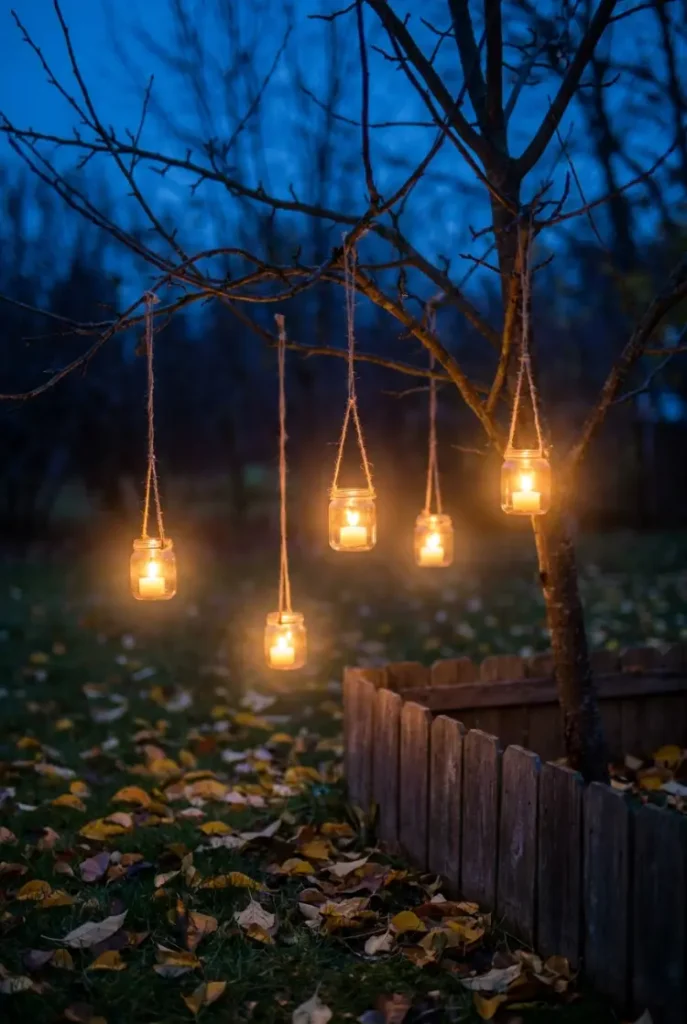
Lanterns solve it cleanly. Hang three or five at staggered heights from the outer branches, each on a loose loop of jute you can lift off with one hand. The branch carries the weight for two hours a night and nothing squeezes the wood.
Odd numbers at uneven heights read as designed. Four at matching heights reads as a store display, which is the most common way this idea goes wrong.
And if a branch starts bending toward its limit, take one off. Davey says to stop hanging at that point, and a limb that snaps in the first ice storm of the year is why they put it that plainly.
Three or five lanterns, uneven heights, loose jute loops.
Hang from the outer third of a branch, where flex is natural.
Use solar or battery so no cord runs up the trunk.
Any spiral wrap on a trunk under three years in the ground.
Wire, zip ties, or cable as the hanger.
Matching lanterns at matching heights in a straight line.
9. Renters and balcony people, this one is yours
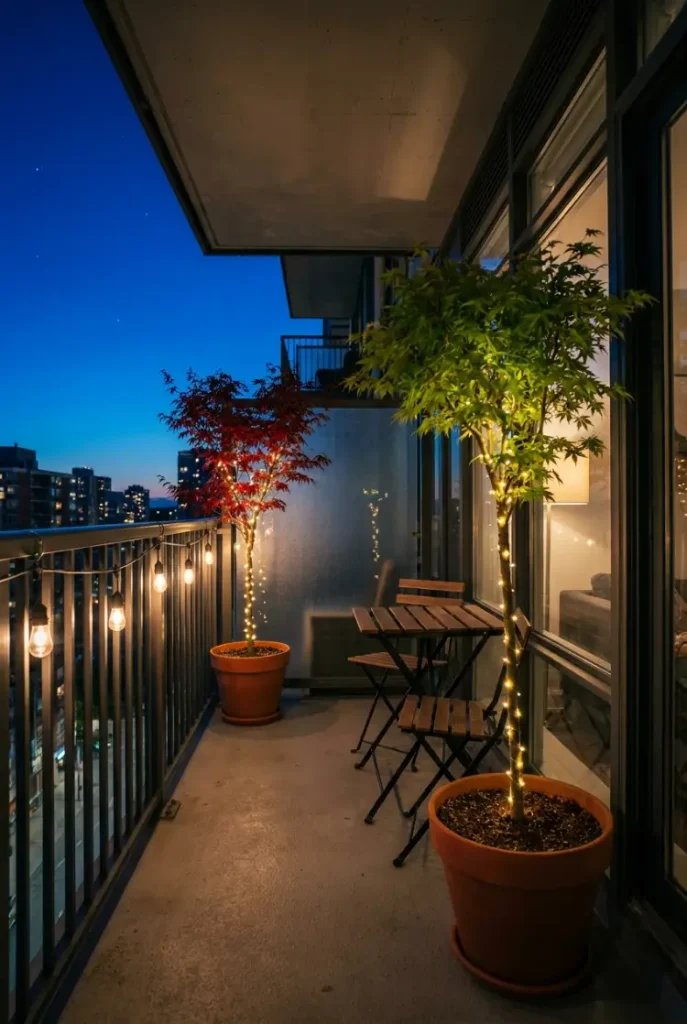
A pair of potted trees does the same job as a lit maple at roughly a tenth of the scale, and every part of it leaves with you when the lease ends. Both top-ranking pages open with this idea, which tells you exactly how well it photographs.
The Three-Glow Rule still applies here, just compressed. A mini spotlight tucked in the pot gives you ground glow. A loose spiral of 5mm minis up the stem gives you mid glow. A short strand clipped along the railing above gives you canopy glow.
What holds up in a 14-inch terracotta or resin pot across USDA Zones 5 to 9:
- ▸Japanese maple, hardy through Zone 5, and the branch structure lights beautifully once leaves drop.
- ▸Boxwood standard, the clipped lollipop shape, holds green all winter in Zones 5 through 9.
- ▸Dwarf Alberta spruce, dense enough that 100 minis look like twice as many.
- ▸Olive, silver leaves that catch warm light well, though it needs to come inside below Zone 8.
Nothing drills. Nothing threatens the deposit.
10. Budget decides the look more than taste does
Most tree lighting ideas cost less than a single patio chair, which is the part nobody mentions while showing you a hundred-foot canopy install. So here is what each tier actually buys, at Home Depot prices pulled this month.
At the low end you are buying one 48-foot Hampton Bay S14 LED strand at $24.97 and a roll of jute. One tree, one glow, and it honestly looks fine from the kitchen window.
The middle tier is where most people should land. An Enbrighten Bistro 48-foot strand at $83.99 plus three Commercial Electric 400-lumen spotlights at $12.97 each covers two of the three glows on a single tree. Those acrylic bulbs also shrug off hail that would take out glass. Most people stop there.
At the top, a VOLT hardwired kit with a 100-watt transformer, four spotlights, and two path lights runs $299.99. That is the tier where a yard stops looking decorated.
11. Outdoor rated means something specific
Outdoor rated is a spec. Half the strands on a big-box shelf do not have it.
The CPSC names the UL 588 standard for seasonal lighting, and the three things it requires are plain enough to check: minimum wire size, sufficient strain relief, and overcurrent protection. A strand missing any one of the three is, in the Commission’s own words, a substantial product hazard.
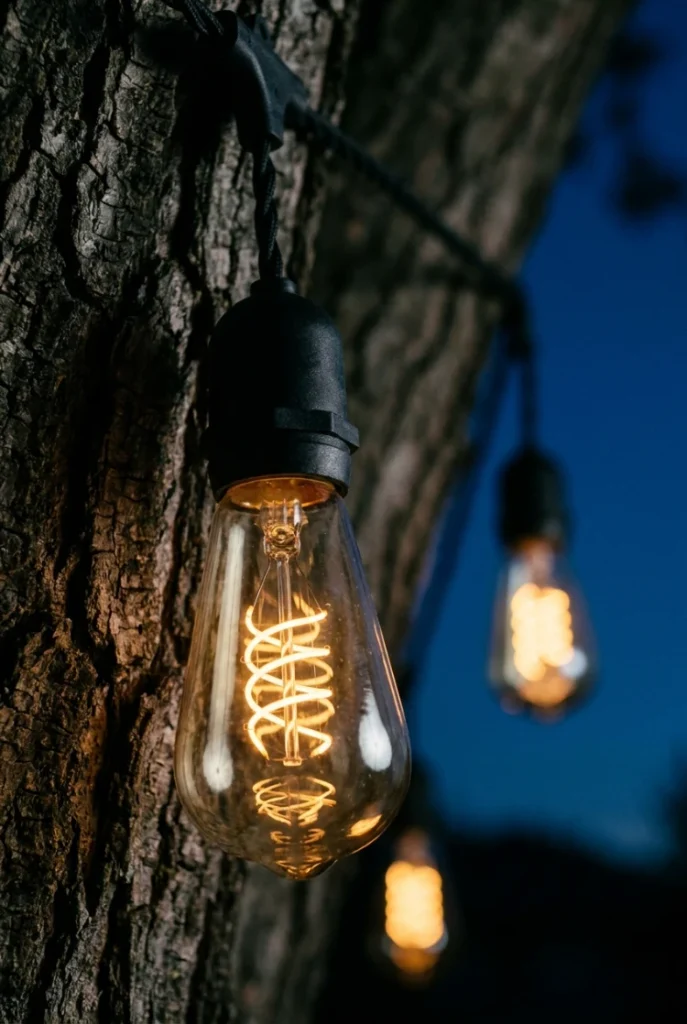
So read the box for a wet-location or IP rating, not just the word outdoor. Lowe’s Harbor Breeze 48-foot LED Edison string, for one, is wet rated and IP65. Plenty of strands at the same shelf price are neither.
Watch your daisy chain too. Installers cap trunk-wrap runs at three to four sets before a fresh power feed, and a 750-foot linkable rating is a strand spec, not a circuit rating.
📌 Good To Know
Use outdoor-rated, UL-listed lights and cords on a GFCI outlet. Anything beyond plugging into an existing outlet is a job for a licensed electrician.
12. October is the easy half
March is where people lose trees.
Set the takedown date the same afternoon you finish the install. A strand that goes up in mid-September and comes off before the tree breaks dormancy has done no damage at all. The same strand left through two growing seasons is the one NDSU ends up photographing.
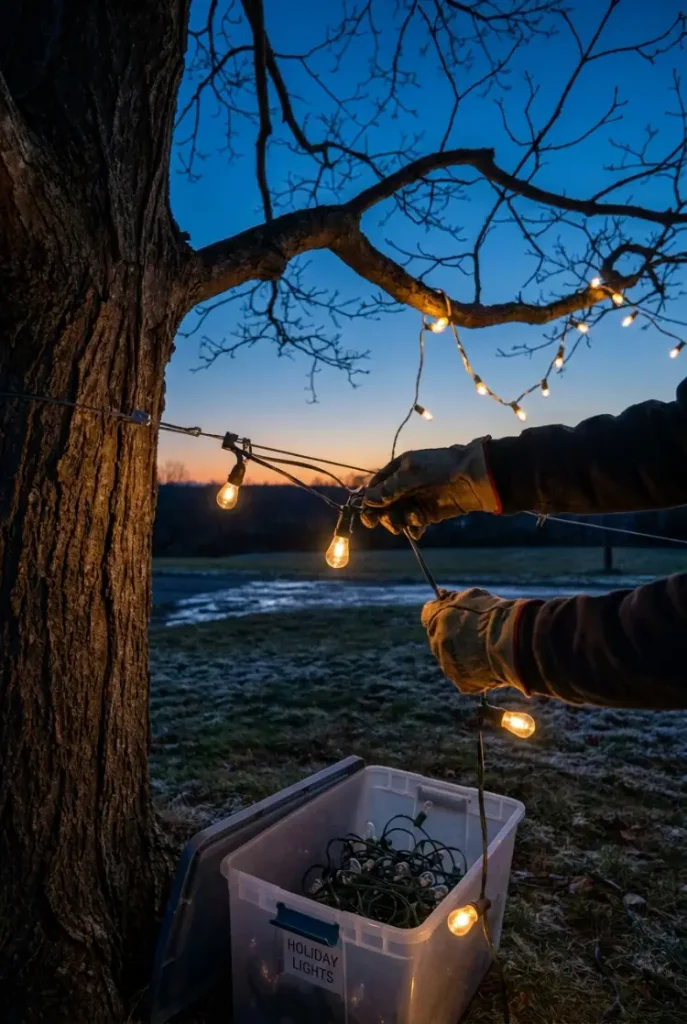
Three things make March painless. Jute ties instead of zip ties. A guide wire that carries the strand, so nothing is tied to living wood. One labeled bin, so you are not untangling four strands with cold hands.
Across Zones 5 through 9 that removal window opens well before bud break, and it shifts by weeks depending on where you garden. Confirm yours against the USDA Plant Hardiness Zone Map or your county extension office rather than the calendar.
Fall install, spring removal, same tree the following September. That rhythm is why these tree lighting ideas keep working instead of quietly costing you a mature maple.
The wire stops being decoration and becomes a tourniquet. Bark swells around it, the tie disappears into the stem, and the branch above it dies back.
Six months of glow, zero cost to the tree, and the same maple is ready to do it again next September.
Frequently Asked Questions
How do you uplight a tree?
Stake a spotlight in the mulch two to four feet from the trunk and aim it up the trunk line. John Cullen Lighting uses a 45-degree angle on narrow trunks. Budget roughly 1200 lumens for a mature tree and closer to 5000 for a dense oak. Two fixtures on opposite sides beat one bright fixture, because a single beam flattens the bark.
What is the best way to put lights on a tree?
Ground up, in the order of The Three-Glow Rule. Of all the tree lighting ideas here, uplighting goes first, because it costs least and touches nothing at all. Add a trunk wrap second, using twine or tape to secure the joins rather than wire. Finish with a canopy line on a guide wire. Drape over branches rather than spiraling around them wherever the look allows.
What color uplighting should I use?
2700K to 3000K warm white, which is where both designers quoted on the top-ranking pages land. 2700K is the safer default and matches most porch bulbs. Reserve 4000K for a moonlight effect aimed down through a canopy behind a glare guard. Anything 5000K or cooler turns bark blue and reads as a security light.
Which trees should I light in a yard?
Pick one, and pick the one you can see from wherever you sit. Tree lighting ideas live or die on contrast, so a yard with a single lit tree beats the same yard with four of them glowing at once. Trees with visible branch structure or textured bark pay off most: maple, oak, birch, crape myrtle. Skip anything planted in the last few years, anything storm damaged, and anything with branches that already bend under their own weight.
How many string lights do I need to wrap a tree?
Multiply trunk circumference in inches by trunk height in feet, then divide by your pass spacing in inches. A 30-inch trunk, 6 feet tall, at 3-inch spacing needs about 60 feet. Then add 10 percent, because a real spiral over real bark uses more wire than the formula predicts. Add 50 to 100 percent again if you are wrapping branches.
Can you leave lights on a tree year round?
Only if nothing encircles the wood. Davey Tree says year-round is workable with outdoor-rated LED strands that lay over branches rather than spiral around them. NDSU Extension is clear that anything encircling a stem will eventually girdle it, on a timeline that ranges from 2 years to 20. Wrapped strands come off every spring.
Do string lights damage trees?
The strand itself does not. Constriction does. A twist tie left on for one season was already digging into the stem by the next spring, and a wrap left through two growing seasons kills the wood above it. Use twine or tape, wrap loosely, hang from a guide wire where you can, and take everything down before bud break.
Before the clocks change
The whole thing reduces to one tree, three heights, and a takedown date on the calendar. Everything past that is preference. A $24.97 strand and a $9.97 solar spot will change how a yard feels at 7:30 on an October evening more than any furniture purchase will, and the work fits in an afternoon.
Start with the tree you can see from your chair. Add ground glow first, since it is the cheapest and the gentlest on the trunk. Build up from there across the fall.
If you want the rest of the yard to catch up, our cozy backyard ideas under $200 covers the chairs and fire pit side of the same evening. Save these tree lighting ideas to your fall board so they are waiting when the clocks change.