Cottage Garden Sheds That Turn Storage Into the Prettiest Corner of Your Yard

Most cottage garden sheds start life as the ugliest thing you own. Ours was a gray builder-grade box parked against the back fence, holding a mower, a cracked hose reel, and roughly nine thousand spiders. Six weekends later it was the thing guests walked toward first.
That gap between “storage” and “destination” is smaller than it looks. It is not a full rebuild, and it is rarely about buying a prettier shed. It comes down to paint, one door detail, and about two feet of planting at the base. Everything else is decoration.
This guide walks through the details that actually read as cottage, the plants that hold the look through a US growing season, real 2026 costs, and the permit rule most photo roundups skip entirely. If you want the shed to feel like a discovery, pair these ideas with a few secret garden layout tricks so it reveals itself slowly instead of announcing itself from the patio door.
What Makes a Shed Read as Cottage and Not Just Cute
Cottage style is a set of rules pretending to be no rules at all. It looks casual. It is actually pretty structured, and once you see the structure you cannot unsee it.
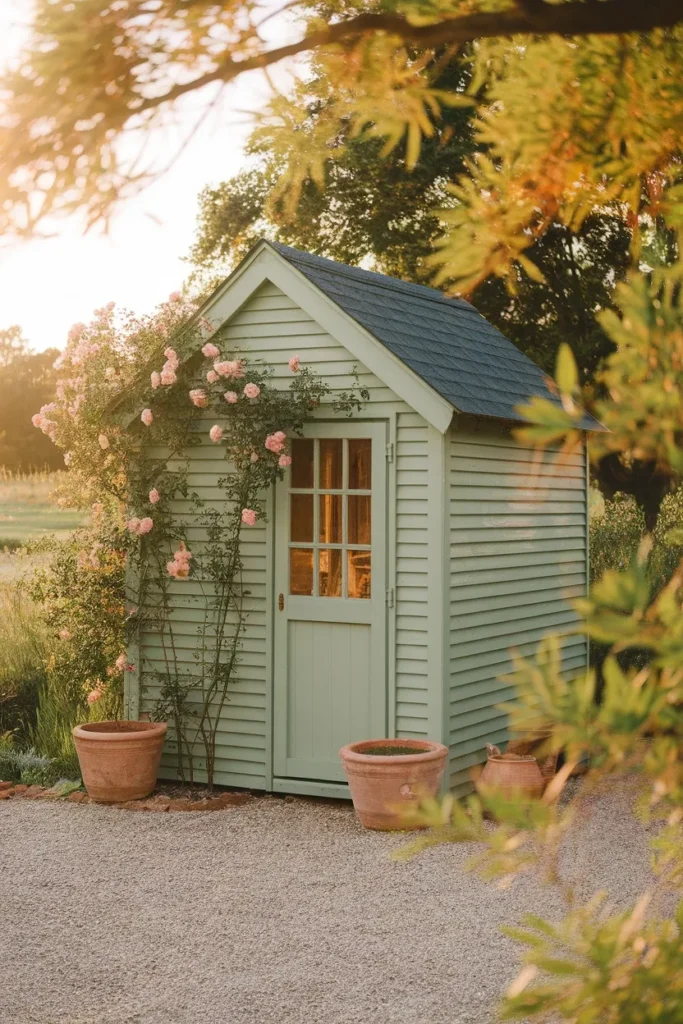
Three things do the work. Soft muted color instead of bright saturated color. Handmade or aged texture instead of smooth plastic. And planting that touches the building, so the shed looks grown into the ground rather than dropped onto it.
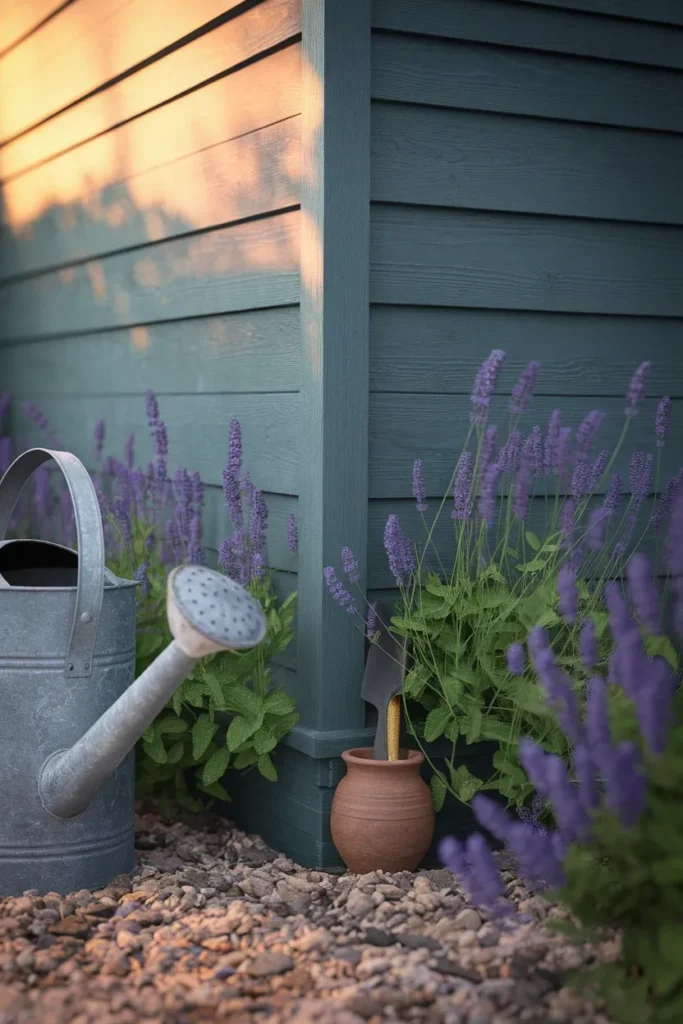
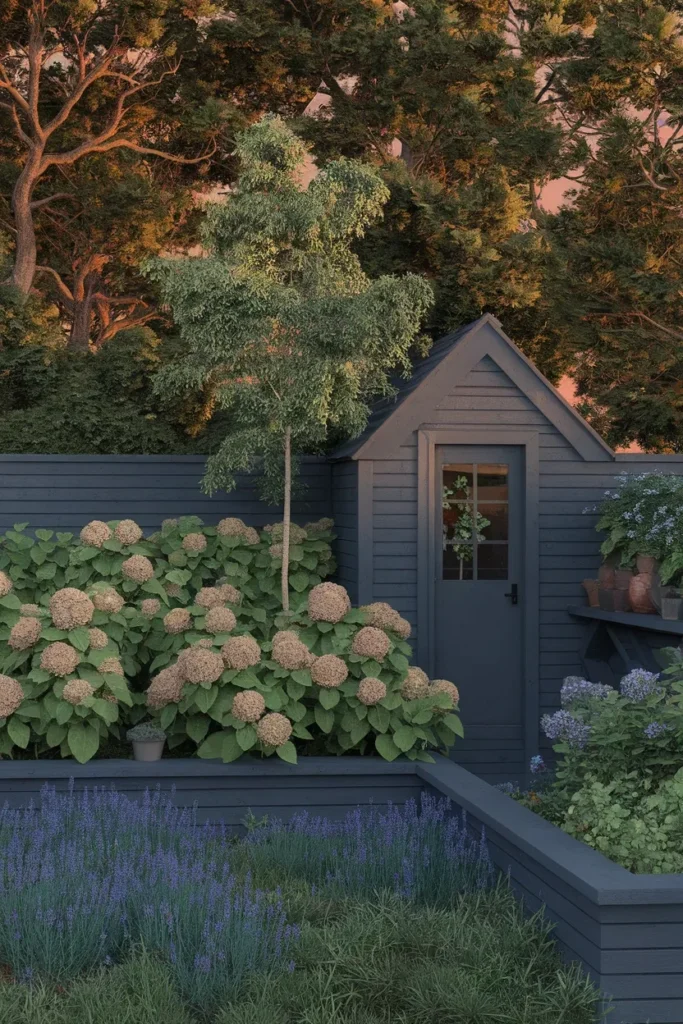
That third one is the one people skip. A shed floating on bare mulch reads as storage no matter what color it is. The same shed with catmint flopping over its base and a clematis halfway up one wall reads as cottage immediately.
Cottage garden sheds also tend to be small. Under 120 square feet is the sweet spot, and that is not just an aesthetic preference (more on the permit reason for that number below). Small buildings look charming. Big ones look like they belong to a contractor.
One more thing separates the real ones from the staged ones. Working sheds are convincing. A pair of muddy clogs by the door, a watering can that is clearly used, a bench with actual soil on it. Perfection reads as a showroom.
The Three-Ring Charm Method
Here is the framework we use on every shed project now, and it is the fastest way to spend money in the right order. Think of the shed as three concentric rings. You work outward, and you finish each ring before you touch the next one.
Ring 1: the shell. Paint, door, window, roofline, hardware. This is the highest-impact money in the whole project and it is roughly 60 percent of the visual result.
Ring 2: the collar. The two-foot band of planting and pots that touches the building on all visible sides. This is 30 percent of the result and usually under $150.
Ring 3: the approach. The path, the edging, the gate or arch you pass through to reach it. This is the last 10 percent, and it is what turns a pretty shed into a place you walk to.
| Ring | What it covers | Typical spend | Weekend time | Skip it and you get |
|---|---|---|---|---|
| 1. Shell | Paint, door swap, window box, hardware | $150 to $600 | 1 to 2 weekends | A nice color on a plain box |
| 2. Collar | Base planting, pots, climbers, mulch | $60 to $200 | 1 weekend | A building sitting on dirt |
| 3. Approach | Path, edging, arch, lighting | $80 to $400 | 1 weekend | A shed nobody walks to |
The order matters more than the budget. Most failed cottage garden sheds go wrong right here. People start with Ring 3 because a gravel path feels productive on a Saturday, then run out of steam and money before the shell ever gets painted. You end up with a beautiful walkway leading to a gray plastic box.
Paint Colors That Do the Heaviest Lifting
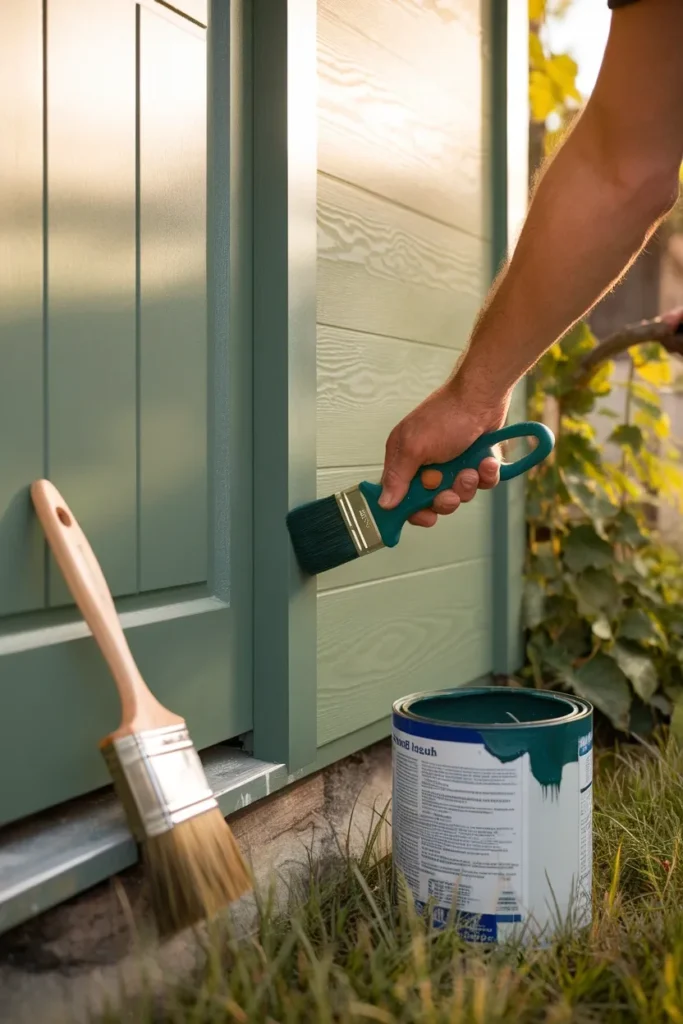
Color is the cheapest transformation available. A gallon of exterior paint runs around $50 to $60 for something like Behr Marquee at Home Depot, and one gallon covers most sheds under 100 square feet with two coats.
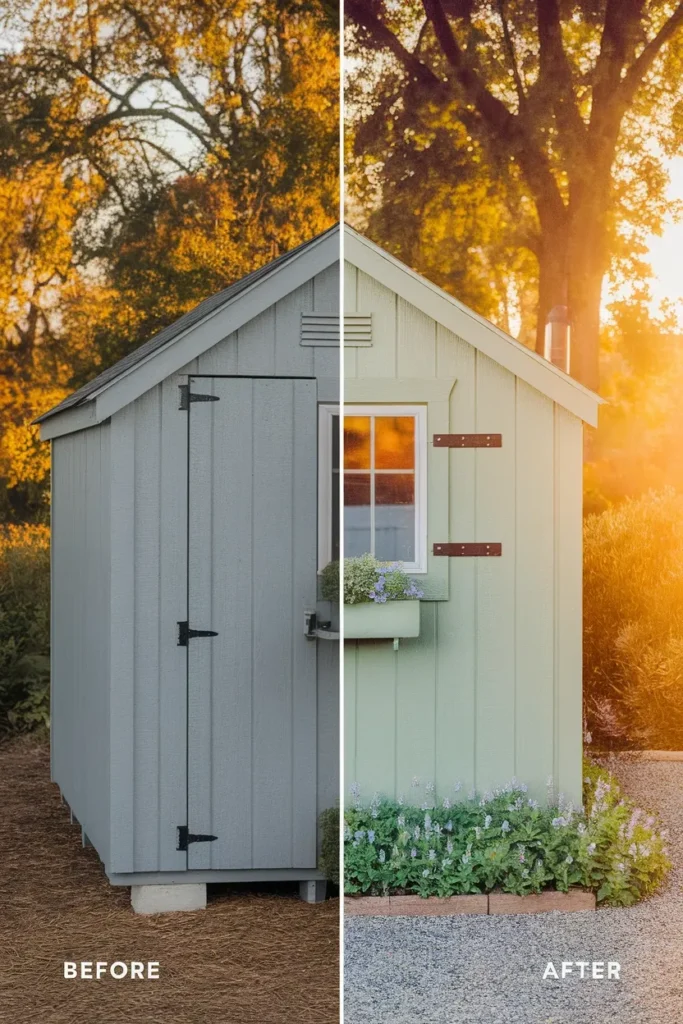
The colors that consistently work are muted and slightly gray. Sage green. Soft dove gray. Warm cream. Dusty blue. Deep charcoal if your garden is very green and you want the plants to pop. Barn red works, though it pushes farmhouse rather than cottage.
The colors that fail are the pure ones. Bright white goes stark against foliage and shows every splash of mud. True primary blue reads playhouse. Anything with a strong yellow base tends to look dingy within two seasons.
A trick worth stealing: paint the body one color and the door and window trim a shade or two deeper in the same family. Sage body with forest green trim. Cream body with soft olive trim. It costs one quart extra and it is the single detail that makes a $400 shed look custom.
Prep is boring and it decides everything. Scrub the siding, let it dry fully, prime any bare wood, and paint when nothing is dripping. Honestly, our first coat went on over slightly damp cedar and it peeled in sheets by the following July. We redid it properly and the second version has held for years.
Doors, Windows, and the Roofline Details That Sell It
If you only change one physical thing, change the door. Standard shed doors are flat, wide, and unmistakably utilitarian. Cottage doors are narrower, taller-looking, and have something happening on them.
Four upgrades, in order of effect per dollar:
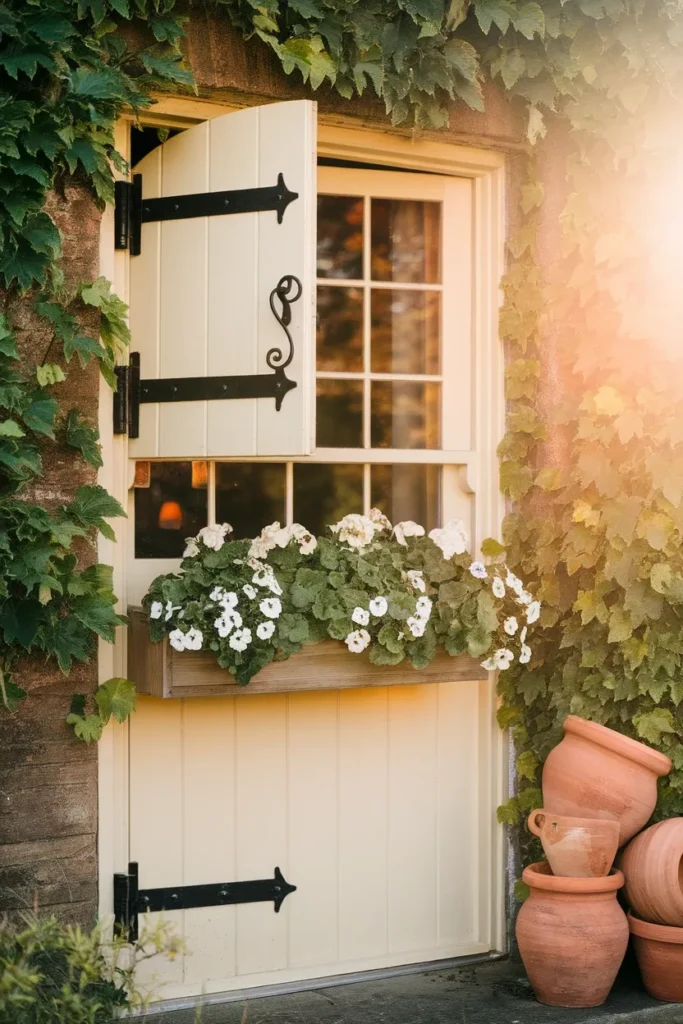
- Add a window to the door. A single divided-light panel, or two, cut into the existing door. This is the highest-value change on the entire building because it turns a wall into a face.
- Split it into a Dutch door. Cut horizontally, add a second set of hinges and a barrel bolt. Leaving the top half open while you pot is one of those small daily pleasures that justifies the whole project.
- Swap the hardware. Black wrought-iron strap hinges and a thumb latch cost under $60 at Lowe’s or Ace Hardware and instantly age the building by fifty years.
- Hang a window box. Cedar, mounted under the front window, planted with trailing white bacopa or ivy geraniums. Around $40 built, less if you have scrap cedar.
Rooflines matter less than people think, but two details help. Extend the eaves a few inches if you are building from scratch, because deeper shadow under the roof edge reads as older architecture. And if the shed came with a plain ridge, a simple finial or a small copper cupola gives the eye somewhere to land.
Windows deserve one note. The divided light pattern is doing almost all of the heavy lifting here, so the grid of muntins matters far more to the finished look than the quality of the glass sitting behind it. You can fake it convincingly with thin painted wood muntins glued over an existing pane, and from six feet away nobody can tell.
The Two-Foot Planting Collar
This is Ring 2, and it is where most photo-roundup advice runs out. The base of the building needs three planting layers to stop reading as a box on dirt.
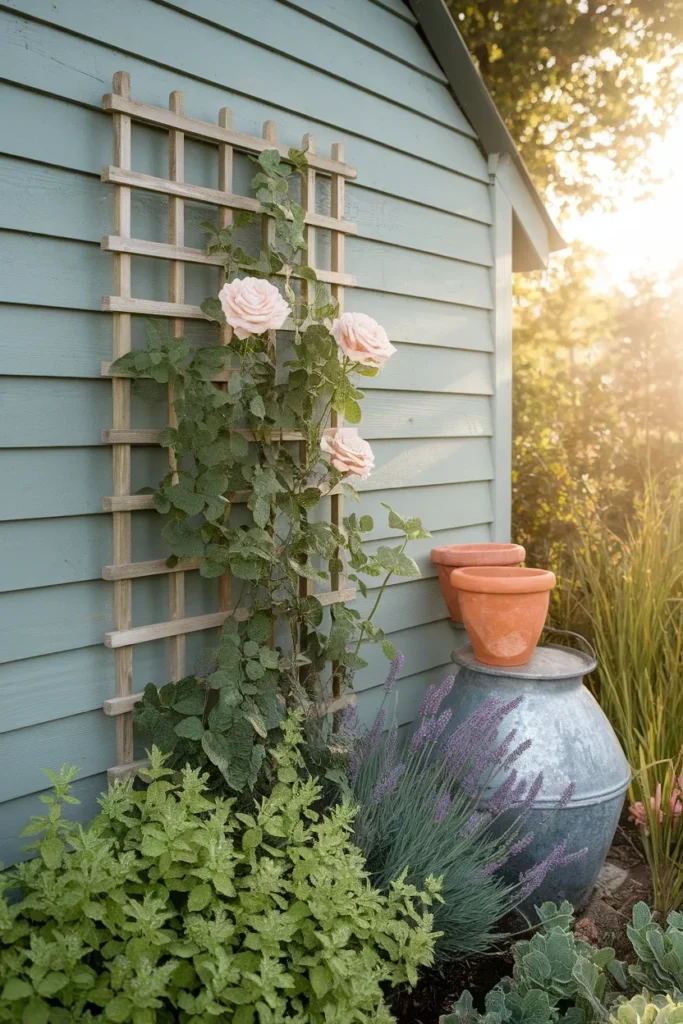
Layer one, the climber. One vertical plant on the sunniest visible wall. Climbing roses are the classic choice. Clemson’s extension service notes that roses need six to eight hours of direct sun plus good airflow. Give the canes a trellis that stands an inch or two off the siding instead of nailing them flat against it. ‘New Dawn’ is forgiving and hardy through Zones 5 to 9. In shade, climbing hydrangea (Zones 4 to 8) does the same job more slowly. For fast cover in a single season, ‘Jackmanii’ clematis or ‘Major Wheeler’ honeysuckle both work.
Layer two, the mid-height flop. Plants that spill and blur the line where siding meets soil. Catmint ‘Walker’s Low’ (Zones 4 to 8), ‘Munstead’ lavender (Zones 5 to 9), hardy geranium, and lady’s mantle all do this well. Feed roses and perennials with something like Espoma Rose-tone, usually under $15 for a four-pound bag.
Layer three, the pots. Three to five containers in varied heights, clustered rather than lined up. Terracotta and galvanized both read cottage. Bloem resin planters run roughly $10 to $25 and survive freeze cycles better than real clay.
Timing depends entirely on where you garden. Last frost is typically mid-April in Zone 6 and can run into late May in Zone 4, so confirm your own band on the USDA plant hardiness zone map before you buy anything perennial. Zone lines shifted in the 2023 update and a lot of gardeners are one half-zone warmer than they think.
Fill new beds with a bagged soil like Miracle-Gro Garden Soil for the top layer and native soil below. Cheaper, and the roots get down into real ground faster.
Give the Shed an Approach
A shed you can see is decoration. A shed you walk to is a destination, and the walk is what your brain files as charming.
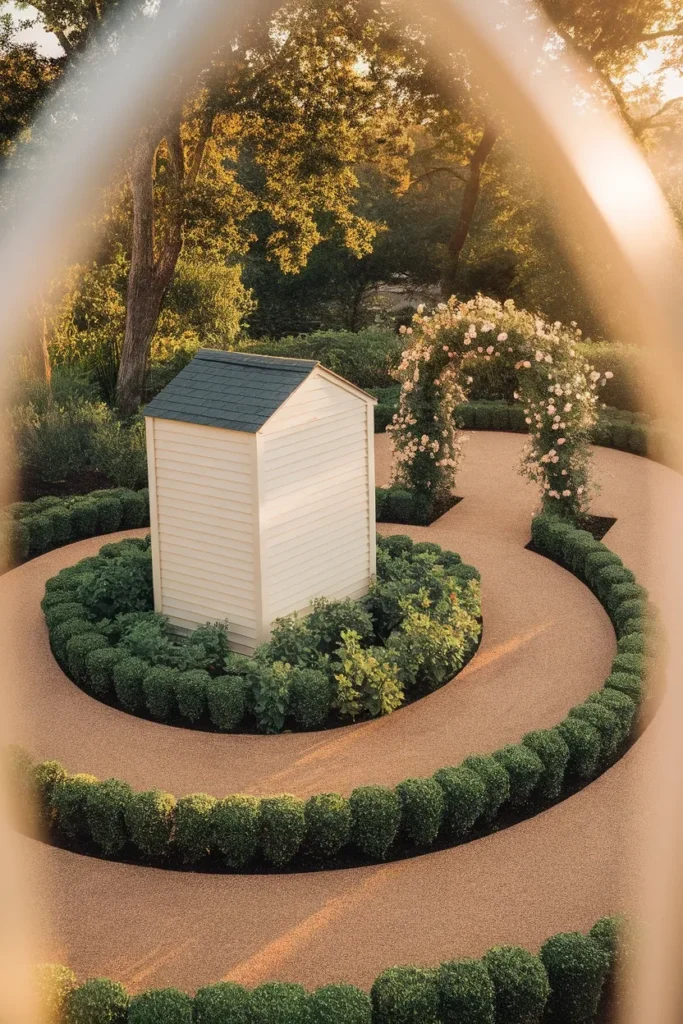
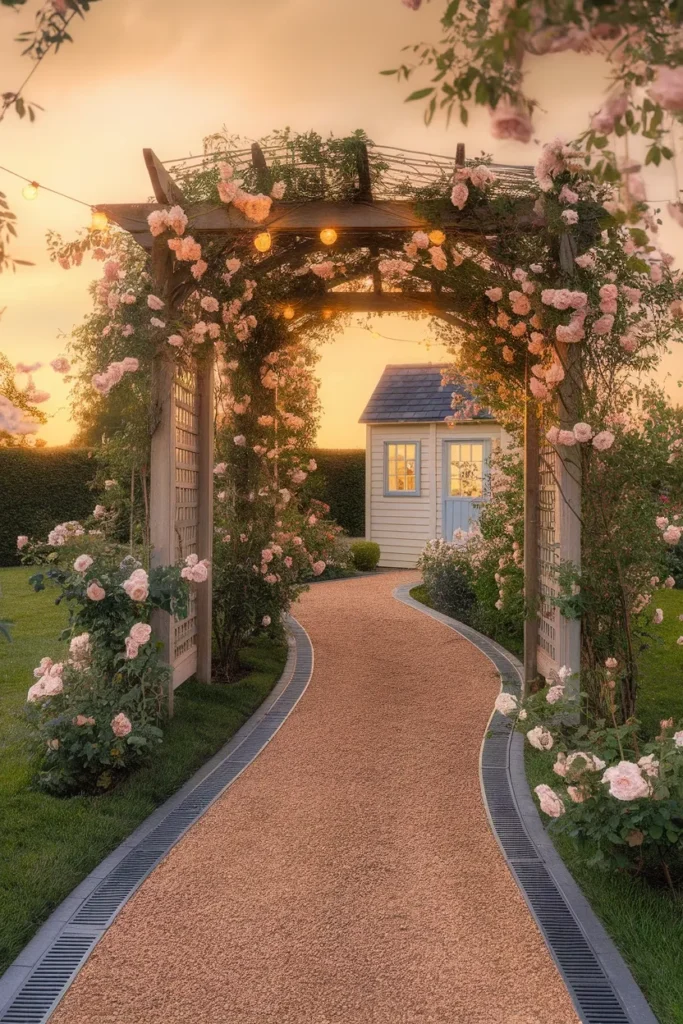
Curve the path. Straight lines read formal and they let the eye finish the trip in half a second. A gentle curve, even a shallow one across ten feet, makes the same yard feel deeper. Pea gravel is the cheapest convincing surface at roughly $40 to $70 per cubic yard delivered, or a few bags from Home Depot for a short run. Stepping stones set into grass work too and cost less.
Edge it. This is the difference between a path and a bare patch. Steel edging, flush brick, or a simple cut trench all hold gravel where it belongs, and our garden edging ideas guide breaks down which material suits which soil and mowing setup.
Add a threshold. An arch, a low gate, a pair of matching shrubs flanking the path entrance. Passing through something small makes the shed feel like its own room. A cedar arbor kit runs around $150 to $300 at most garden centers, and a rambling rose will cover it within two seasons.
Light it. String lights along the eave line do more for a cottage shed after dark than any other single purchase. Brightech Ambience Pro strands run roughly $40 to $50 for a 48-foot run and the warm bulbs read like a porch rather than a stadium. One solar lantern on a shepherd’s hook halfway down the path finishes it.
If your yard is tight, the approach can be short. Six feet of curved gravel with edging on both sides still does the job. Our full small backyard garden design breakdown covers path widths and bed reach limits if you are working with less room than you would like.
Inside the Shed
The interior matters more than you would expect, because the open door is part of the exterior view. Anyone standing in the garden sees straight in.
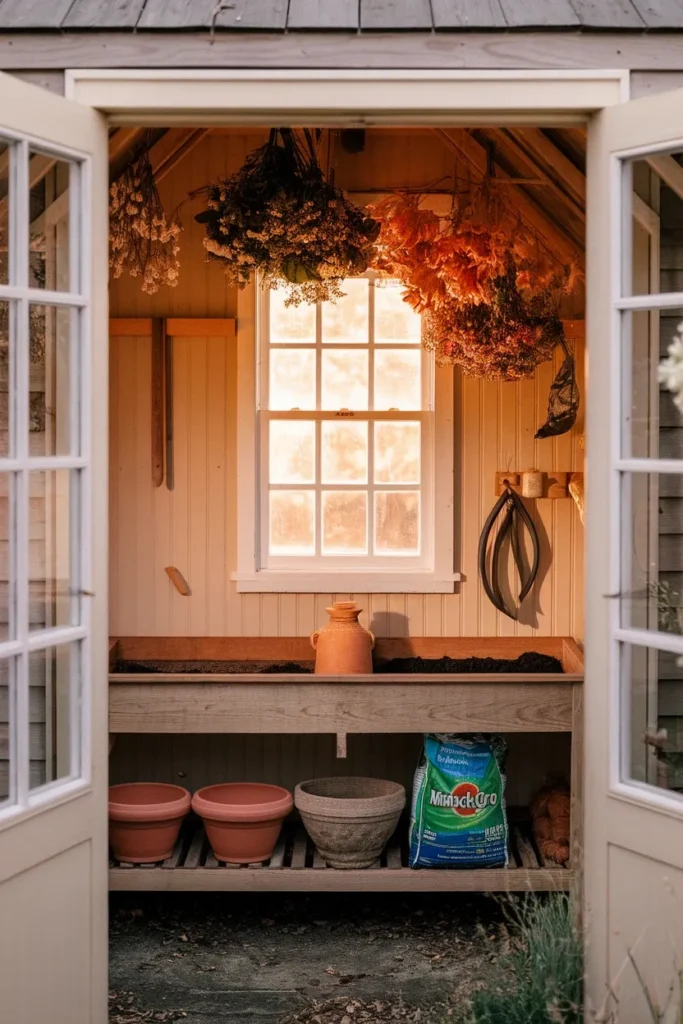
Start with the back wall. That is the surface framed by the doorway, so it gets the treatment: paint it a shade lighter than the exterior, or clad it in beadboard, and hang tools on it in a deliberate arrangement. Pegboard painted the same color as the wall disappears and still holds everything.
Build or buy a potting bench under the window. Waist height, roughly 36 inches, with a lower shelf for bagged soil and pots. A cedar build from Greenes Fence lumber comes in around $80 in materials. The bench is the reason the shed looks used.
Get the storage off the floor. Open floors photograph well and, more usefully, they let you actually walk in. Wall-mounted rails for long-handled tools, a shelf above the door for things you touch twice a year, hooks for hoses and buckets.
Then add one thing that has no function. A vintage mirror, a bundle of drying flowers, a chipped enamel pitcher holding twine. Dollar Tree and thrift shelves are full of these for a few dollars, and that single useless object is what makes the space read as somebody’s rather than a store’s.
Leave the top half of the Dutch door open on nice days. Light gets in, the interior becomes part of the garden view, and the shed stops feeling like a locked container.
What Cottage Garden Sheds Actually Cost
Photo roundups never mention money, so here are real 2026 numbers.
Buying new, a prefab shed runs about $10 to $30 per square foot, which puts an 8×10 in the $800 to $2,400 range and a 10×12 around $1,200 to $3,600. Custom builds climb fast, roughly $25 to $150 per square foot, and a 10×10 custom shed commonly lands between $2,500 and $15,000. DIY kits you assemble yourself start near $300 and top out around $4,300 depending on size and material.
Most people reading this already own a shed, though, and that changes the math completely.
Tier one, under $200. Paint the body and trim, swap the hardware for black iron, add three pots and a climber at the base. One weekend. This alone gets you most of the way there.
Tier two, $200 to $700. Everything above plus a door window or Dutch door conversion, a cedar window box, a short gravel path with edging, and string lights.
Tier three, $700 to $2,000. Add an arbor at the path entrance, a built potting bench, a proper planted border wrapping two sides, and either a cupola or a full door replacement.
Now the part nobody covers. Permits. Many jurisdictions exempt sheds under a size threshold, and while the International Residential Code baseline is 200 square feet, roughly half of US jurisdictions use a stricter limit. California’s state building code sets it at 120 square feet. New York City uses 120 as well while the rest of the state allows 144. Virginia goes up to 256.
Setbacks apply even when a permit does not. Side and rear setbacks commonly run 3 to 10 feet, and corner lots often require 10 to 25 feet from the street-facing side. Plenty of towns also want a zoning permit for a structure that needs no building permit at all. Call your local building department before you pour a base. This is general guidance, not legal advice, and the rules are genuinely local.
Mistakes That Make a Cottage Shed Look Fake
Some of these are counterintuitive, and one of them is going to annoy people. These are the six patterns that separate convincing cottage garden sheds from the ones that look like a hardware store aisle got glued to a wall.
Too many decorations, not enough plants. Signs, shutters that do not close, a wagon wheel, three wind chimes. Decoration bolted to a building reads as costume. Plants growing on a building read as time. Given the choice between a $30 sign and a $30 climber, buy the climber every time.
Perfect symmetry. Matching pots on both sides of the door, evenly spaced everything. Cottage gardens grew out of practicality and crowding, so a little imbalance is the point. Odd numbers of pots. One side heavier than the other.
New everything. All-new cedar, all-new hardware, all-new pots in the same finish. Mix in one aged element and the whole thing relaxes. A salvaged door, a rusted latch, secondhand terracotta with mineral crust on it.
Mulch moat. A perfectly weeded ring of dark bark separating the building from every plant. That gap is exactly what makes a shed look installed. Plant into it.
Ignoring the sun. This is the expensive one. A climbing rose on the north wall will sulk for three years and never bloom well. Watch the shed for one full day, note which walls get six or more hours, and put the roses there. Shade walls get climbing hydrangea or ferns instead.
Scale mismatch. A 12-foot shed next to a 6-foot fence with nothing between them looks like a barn. Step the heights down with a small tree, then a shrub, then perennials, so the eye walks down from the roof to the ground.
Frequently Asked Questions
What is the difference between a potting shed and a garden shed?
A garden shed stores things. A potting shed is set up to work in, which usually means a bench at waist height, a window over that bench for light, and shelving for pots and soil. Most cottage garden sheds are really potting sheds with better paint. You can convert one into the other in a weekend by adding a bench and cutting a window.
Do I need a permit to build a garden shed?
Often not, if it stays under your local size threshold. The IRC baseline is 200 square feet, but about half of US jurisdictions are stricter, with 120 square feet being very common and California using that figure statewide. Setbacks apply regardless, usually 3 to 10 feet from side and rear lot lines. Check with your local building department first, because zoning permits are sometimes required even when a building permit is not.
What color should I paint a cottage garden shed?
Muted, slightly grayed colors work best against green. Sage green, dove gray, warm cream, dusty blue, and deep charcoal all read cottage. Paint the trim two shades deeper than the body in the same color family. Skip bright white and pure primary colors, which look stark next to foliage.
What should I plant around a garden shed?
Three layers. A climber on the sunniest wall (climbing rose, clematis, or honeysuckle), mid-height perennials that flop against the base (catmint, lavender, hardy geranium, lady’s mantle), and a cluster of three to five pots at varied heights. Confirm your USDA zone before buying perennials so the climber survives winter.
How much does it cost to make a plain shed look like a cottage?
If you already own the shed, roughly $150 to $200 covers paint, iron hardware, three pots, and a climbing plant, which is most of the visual result. Going further with a Dutch door, window box, gravel path, and lighting lands in the $200 to $700 range. Buying a new prefab shed is a separate cost, typically $10 to $30 per square foot.
Can you turn a plastic or metal storage shed into a cottage shed?
Yes, with adjustments. Resin and metal need a bonding primer before paint or it will peel. Hardware usually cannot be screwed into thin panels, so cosmetic hinges get adhered rather than mounted. The base planting and the path matter even more here, because the plants are doing the work the siding cannot.
What size should a cottage garden shed be?
Small looks better. Most of the cottage garden sheds that photograph well sit between 64 and 100 square feet, so an 8×8 or 8×10 gives you a potting bench, storage, and room to stand while staying under most permit thresholds. Anything over 120 square feet starts looking like an outbuilding rather than a garden feature, and it triggers permits in many places.
Start With Ring One
The temptation is to plan the whole thing. Sketch the path, price the arbor, browse rose varieties for a month. Meanwhile the gray box sits there.
Pick a paint color this weekend instead. One gallon, one quart of trim, one Saturday. Then buy a climber and three pots and get Ring 2 in the ground before your last frost date passes. The path can wait until fall, and honestly it will be easier to place once you have spent a summer walking out there and can see the line your own feet already wore into the grass.
Cottage garden sheds are not built in one go. Ours took two seasons and the middle stage looked strange for a while. It still turned into the corner of the yard everyone drifts toward.
If you try one of these, we would love to hear which ring you started with and what color you landed on.