French Cottage Garden Ideas That Make an Ordinary Yard Feel Romantic

Most French cottage garden photos you save on Pinterest are hiding the same three ingredients, and none of them are flowers.
Gravel. Repetition. Something old.
That is the whole trick. It is also why a yard in suburban Ohio can read as convincingly French as one outside Aix, without a stone farmhouse or a wall that has been standing since Napoleon. You need a path that crunches underfoot, one plant repeated until it looks deliberate, and a single object weathered enough to look rained on for a decade.
I have been rebuilding my own back garden in this style for four seasons, and I have wasted enough money to know which parts actually matter. What follows is nine ideas that move a yard toward that look, plus the proportion rule I use to keep the whole thing from collapsing into generic cottage mush. If you also want the enclosed, tucked-away feeling that French gardens do so well, the same principles stack neatly onto a hidden backyard escape.
Fair warning. The first idea involves buying rocks before you buy a single plant.
What Actually Makes a Garden Read as French
Here is the distinction almost nobody spells out.
An English cottage garden is generous and a little chaotic. Plants tumble into each other, self-seed where they like, and the beauty comes from abundance. Nothing is squared up. It is a garden that looks like it happened.
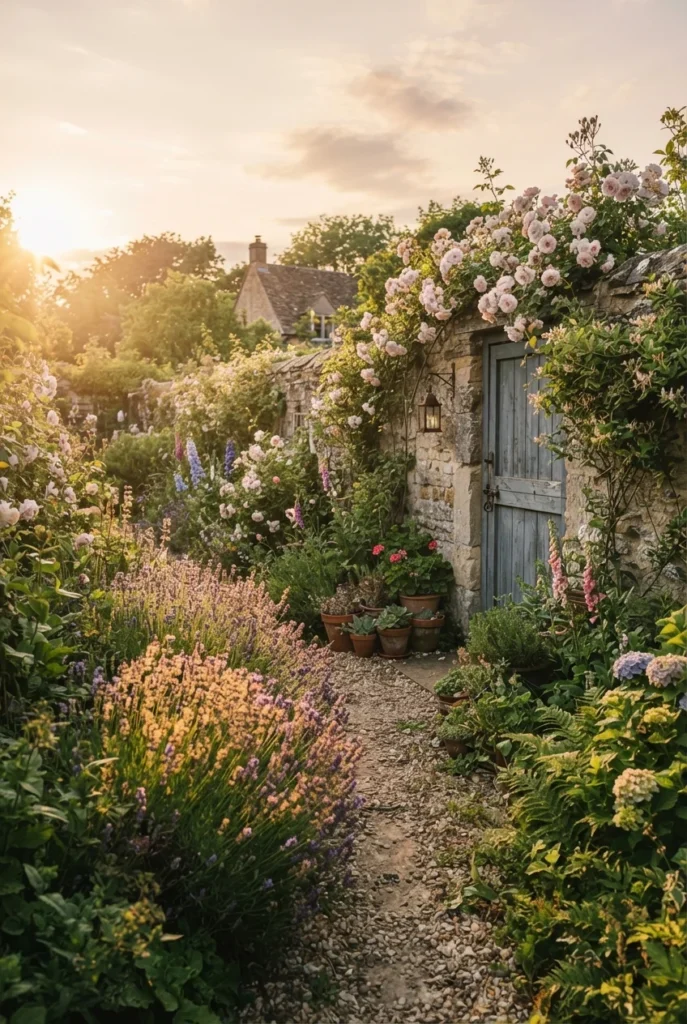
A French cottage garden is the same romance laid over a skeleton. Underneath the roses there is always an axis, a repeated shape, or a clipped edge holding the softness in place. Think of a farmhouse kitchen garden in Provence: wild lavender and poppies, sure, but planted in rows, framed by gravel, backed by a wall. The plants riot. The structure does not.
That tension is the entire style. Loose plants, tight bones.
Once you understand this, the ideas below stop being a random shopping list and start being a sequence. Bones first, romance second.
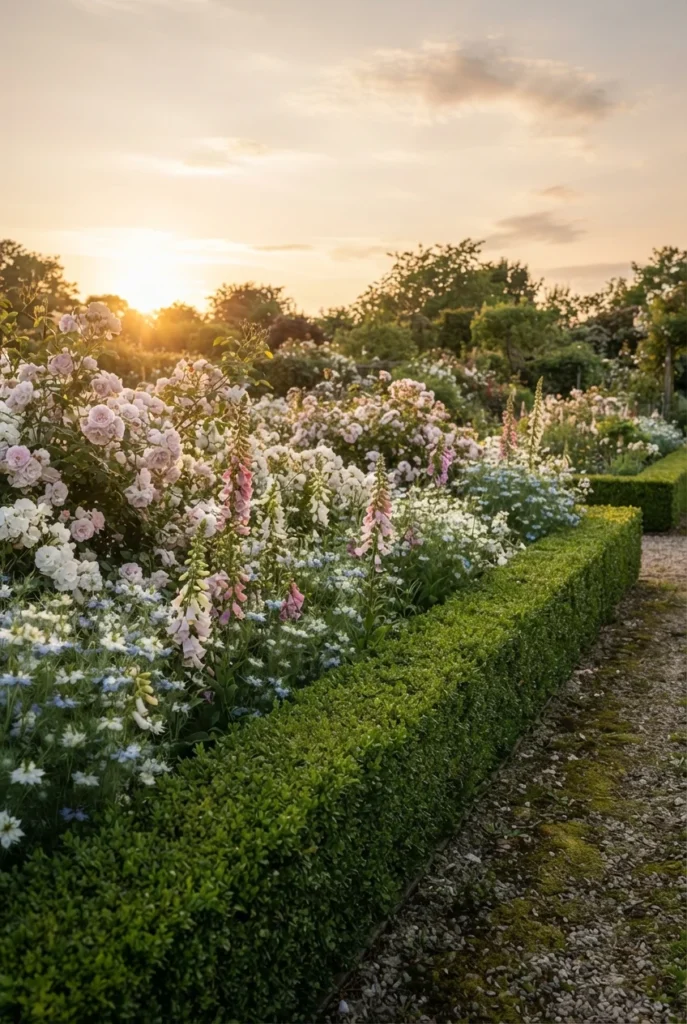
The Bones, Blooms, and Basket Rule
This is the framework I use on every bed, and it is the fastest way to diagnose why a garden looks almost right but not quite.
Split every planting area into three parts. One third bones, one third blooms, one third basket. Bones are anything still standing in February. Blooms are the romance layer. Basket is anything you can actually pick and carry inside.
Most American yards attempting this style land at roughly ninety percent blooms and ten percent bones, which is why they read as generic cottage instead of French. The fix is almost always more structure, not more flowers.
| Third | What it covers | Real examples | Rough share of budget |
|---|---|---|---|
| Bones | Anything still there in winter | pea gravel, stone edging, boxwood, iron arch, weathered gate, low wall | 60% |
| Blooms | The romance layer | climbing roses, lavender, foxglove, nigella, peonies, hydrangea | 30% |
| Basket | Anything you can pick | thyme, chives, sorrel, espaliered pear, cutting dahlias | 10% |
Notice the budget skew. Bones eat most of the money and only a third of the space, because gravel and stone cost more per square foot than a six dollar perennial. That imbalance is normal. It is also why so many people skip the bones and wonder why year three still looks like a flower bed with ambition.
What each third actually costs
For a bed roughly 10 feet by 4 feet, here is a realistic 2026 range. Bones run from around $150 to $400. That range depends on whether you use bagged pea gravel from Home Depot (roughly $5 a bag, and you will need more bags than you think) or order a half yard in bulk. Blooms run about $80 to $200 if you buy 4 inch perennials rather than gallon pots. Basket is the cheap third at $20 to $40, mostly Bonnie Plants herb starts at around $6 each plus a couple of Burpee seed packets.
Total for one properly built bed: somewhere between $250 and $640.
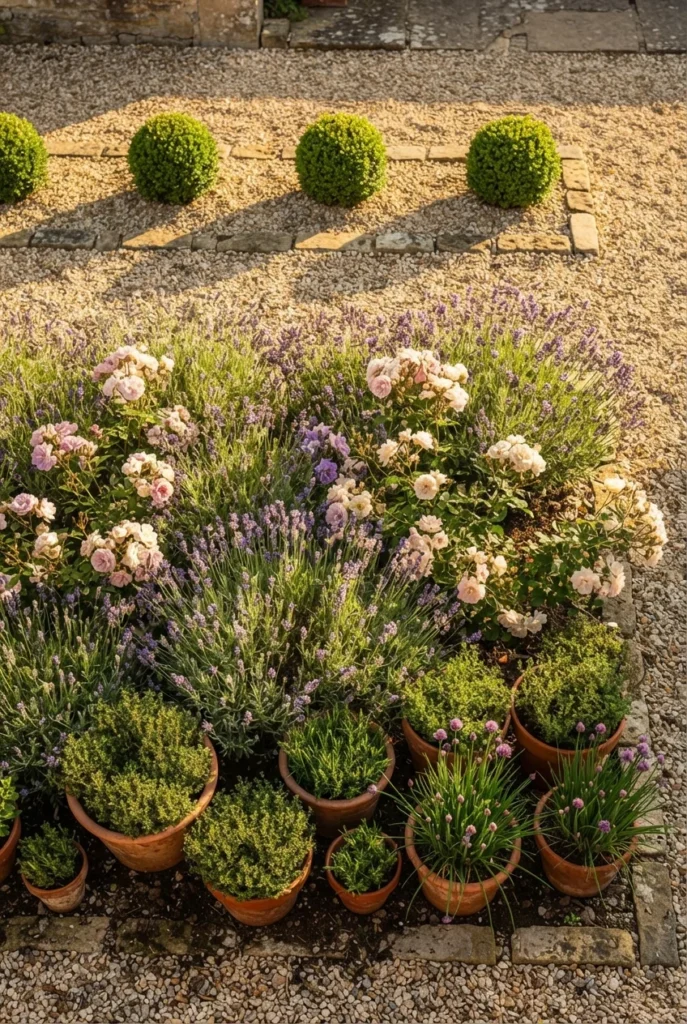
Start With Gravel, Before You Buy a Single Plant
Gravel is the cheapest, fastest, highest impact thing in this entire article, and it is the one step people skip.
A gravel path does three jobs at once. It sets an axis, so the eye has somewhere to go. It gives you that crunch underfoot, which is a sensory cue your brain files under old European courtyard. And it makes every plant beside it look framed rather than random.
Two numbers matter here. Depth: 2 to 3 inches of compacted pea gravel or decomposed granite. Anything thinner migrates within a season. Width: 30 inches minimum for a path one person walks, 48 inches if two people should pass or if you want a table to sit on it.
I learned the depth number the hard way. My first path was maybe an inch of pea gravel scattered straight onto bare soil in April, no edging, no fabric. By July it had crept into the lawn, and I spent a Saturday raking gravel out of grass with a leaf rake, which is exactly as tedious as it sounds. Now I dig down 3 inches, lay landscape fabric, and edge both sides.
Speaking of which, the edge does more visual work than the gravel does. A crisp border is what separates a gravel path from a gravel spill, and if you want the cheap version, a hand-cut trench beats plastic edging every time. There is a full breakdown of sharp garden edging options worth reading before you buy anything.
For color, stay warm and pale. Buff, cream, oatmeal, soft gray. Avoid the blue-gray crushed stone sold for driveways, which reads industrial and kills the whole mood instantly.
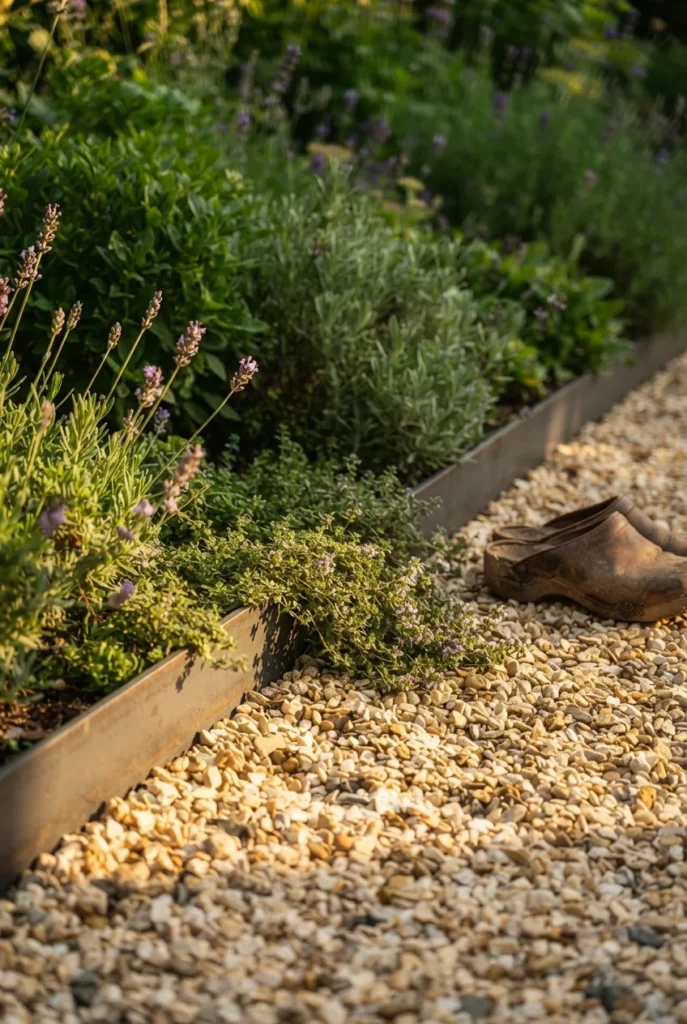
Plant Lavender the French Way, in Rows and Repeats
One lavender plant is a herb. Nine lavender plants in a line is a photograph.
This is the single biggest mental shift for American gardeners raised on the one-of-everything nursery habit. French planting repeats. Rows, drifts, matched pairs flanking a gate, the same silver mound echoed three times down a path. Repetition is what makes a modest yard look designed rather than collected.
English lavender is the workhorse here, and it is rated hardy from zone 5 through zone 9 by NC State Extension. Mature size runs about 1 to 2 feet tall and 2 to 3 feet wide. Space plants roughly 24 to 30 inches on center if you want them to knit into a continuous row by year three. Full sun, six hours minimum. Sharp drainage, always.
That last requirement killed my first four plants. I put Munstead lavender into heavy clay in a low spot, watered it like a hydrangea through a wet spring, and lost every one to root rot by August. The replacements went into the same bed with a shovel of pea gravel worked into each planting hole and a gravel mulch collar instead of bark. Those are still alive four years on. Lavender would rather be thirsty than damp, every single time.
If your zone runs colder than 5, swap in Russian sage or catmint for the same silver-purple haze. Before you commit, check your USDA plant hardiness zone against the 2023 map, since the zone lines shifted in a lot of places and your old assumption may be a half zone off.
A bag of Espoma Garden Lime (around $10 at Lowe’s) is worth it if your soil runs acidic. Lavender prefers slightly alkaline ground, which is the opposite of what most American lawns provide.
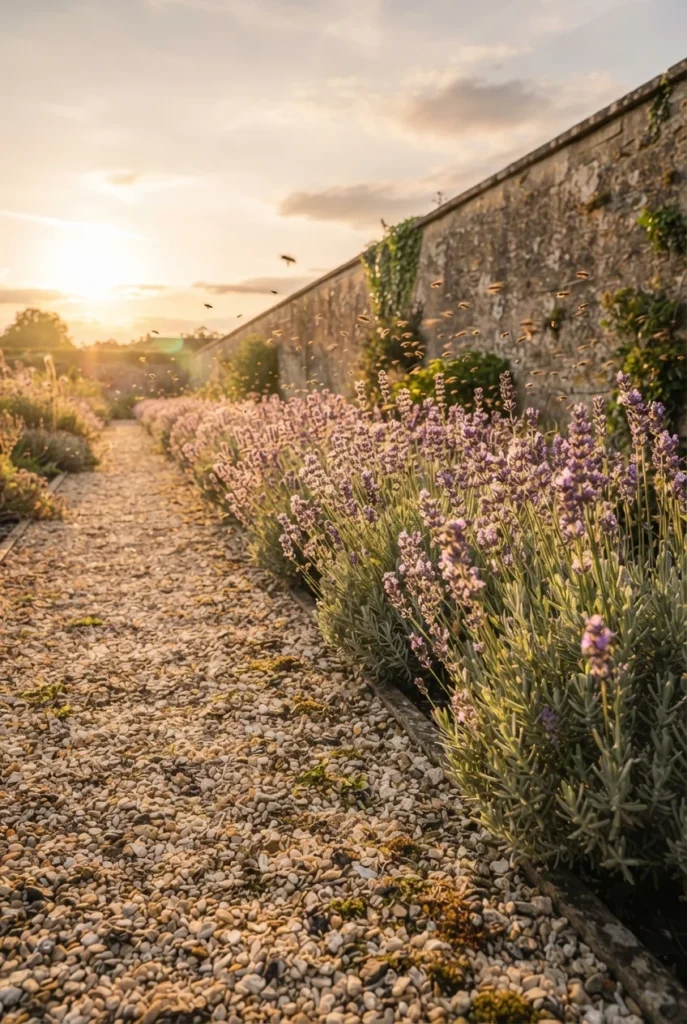
Get Your Roses Off the Ground
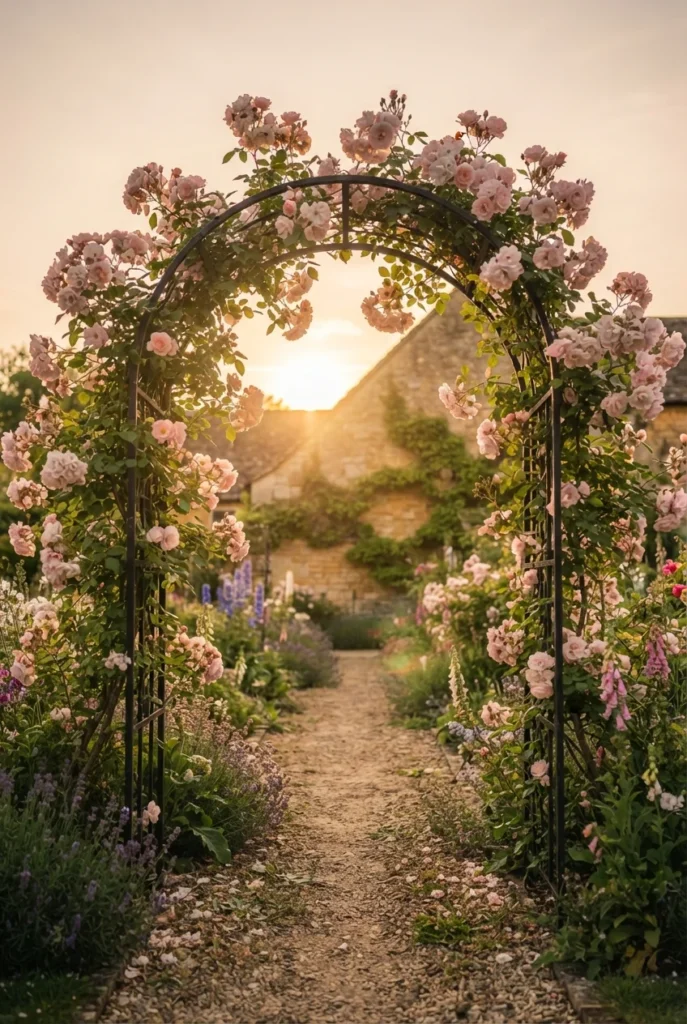
Nothing turns a flat yard romantic faster than one rose growing on something vertical.
A rose in a bed is pretty. The same rose swallowing an iron arch, climbing a wall, or wrapping a wooden obelisk is the image people save. Height is what creates the sense of enclosure that makes a garden feel like a room instead of a lawn with edges.
Your three options, cheapest first:
- A wooden or metal obelisk. Around $40 to $120, drops into an existing bed in five minutes, instantly adds four to six feet of height. Gardener’s Supply sells sturdy powder-coated versions. Best first move if you are testing the look.
- An iron arch over the path. Roughly $80 to $250. This is the highest impact single object in the whole style, because it frames the view and gives the eye a threshold to pass through.
- Wall or fence training. Free if you already have the wall. Eye bolts and horizontal wire run about $25 total, and a climber trained flat against warm masonry is the most authentically French version of all.
For varieties, look for repeat-flowering climbers in soft colors: creamy whites, blush pinks, pale apricot. Skip the fire-engine reds and the bright yellows, which pull the palette toward American front-yard rose bed and away from Provence.
Prune the horizontal canes, not the vertical ones. Training a cane sideways forces flowering along its whole length instead of only at the tip, which is why French espalier work looks so absurdly full.
Terracotta, Zinc, and Weathered Stone
Containers do a huge amount of work in this style, and the material matters more than what you plant in them.
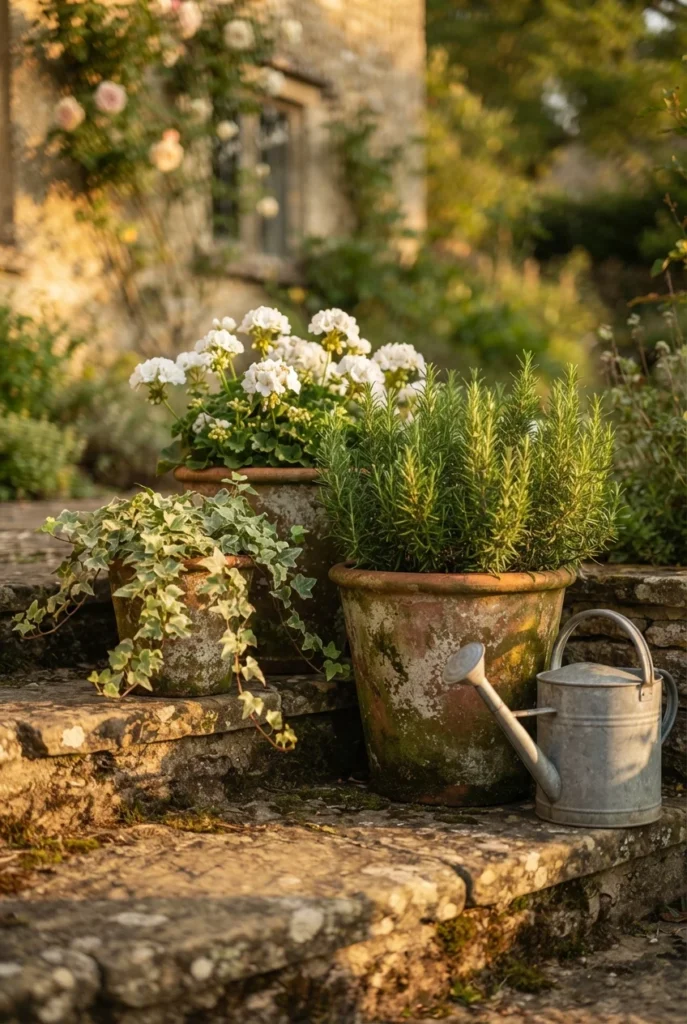
The French container palette is short: aged terracotta, galvanized or zinc, and pale carved stone. That is basically it. Glossy glazed ceramic in teal or cobalt is lovely, and it belongs in a different garden entirely.
Three rules that make cheap pots look expensive:
- Cluster in odd numbers, mixed heights. Three pots of graduated size beat six matching ones every time.
- Age the new terracotta. Brush plain yogurt or buttermilk on the outside, set the pot in shade, and moss and algae start colonizing within a few weeks. It costs nothing and takes off that raw orange showroom finish.
- Repeat one pot shape. Same silhouette, three sizes, placed at intervals along the path.
Bloem and the generic Home Depot terracotta lines both work fine as a base. Dollar Tree sells small terracotta saucers at $1.25 each that are genuinely useful for propping smaller pots up to different heights.
One winter mistake worth passing on: I left six full terracotta pots outdoors through a zone 6 January, and four of them cracked clean through by March. Wet soil freezes, expands, and splits the clay. Now they get emptied and stacked under the deck by Thanksgiving, and I have not lost one since.
Tuck a Potager Into the Middle of It
Here is the piece that separates a French garden from a French-looking garden.
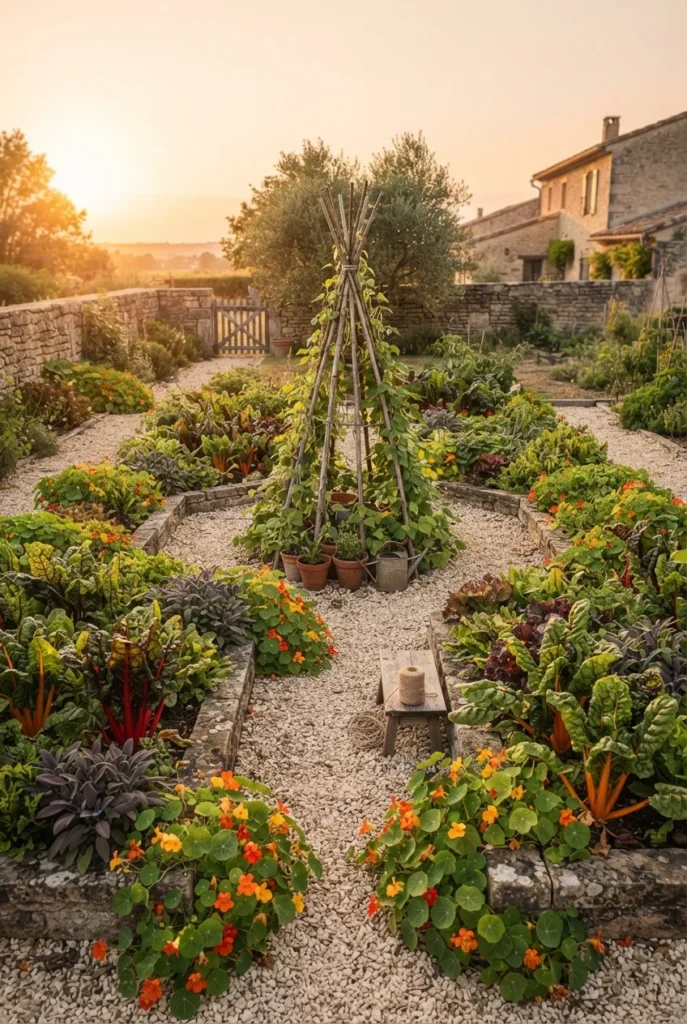
A potager is a kitchen garden laid out to be beautiful, and it is the reason food ends up in the middle of the ornamental beds rather than banished to a corner behind the garage. Lettuce edging a rose bed. Rainbow chard as a foliage plant. An espaliered pear flattened against a warm south wall. In France, the pretty garden and the useful garden were never separate things.
The look is simple to fake at small scale. Pick four to six edibles that earn their keep visually:
- Purple sage and tricolor sage for silver and plum foliage that holds all season
- Rainbow chard planted in a short row, since the stems glow when backlit
- Thyme and chives along the path edge, where brushing past them releases scent
- Bush beans on a teepee for vertical structure in a bed that lacks it
- Nasturtiums spilling over gravel, edible flowers and leaves included
Beds want to be reachable from both sides, which in practice means 3 to 4 feet wide, no more. Paths between them run 18 to 24 inches at minimum. If you want the full layout math on bed sizing and sun mapping, the small backyard garden design guide covers the spacing rules in detail.
The one thing not to do is line the potager with treated lumber raised beds and call it done. If you want raised beds, Vego Garden’s corten-look metal panels weather to a soft rust brown that sits far better against gravel than fresh pine.
Add the Patina Layer
Every convincing French cottage garden contains at least one object that predates the garden.
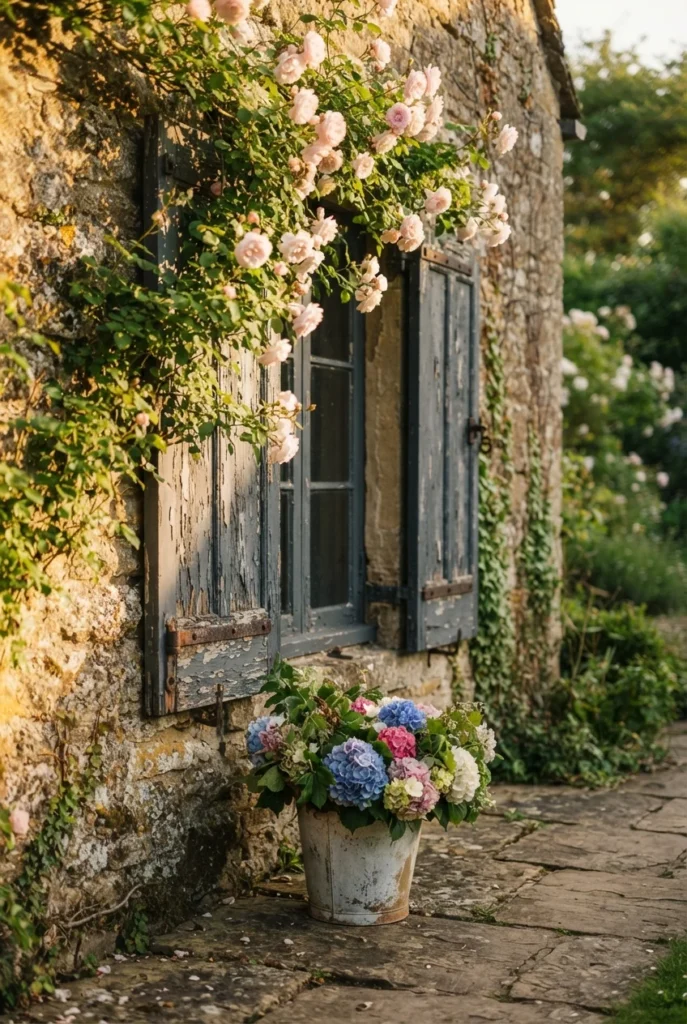
An old gate leaned against a wall. Wooden shutters with peeling gray-blue paint. A zinc bucket gone chalky. A stone trough. These objects do something plants cannot do at any speed: they imply time. A garden with one genuinely weathered thing in it reads as decades old, even in its second summer.
Where to find them, roughly in order of cost:
- Estate sales and rural flea markets, best value by a wide margin
- Habitat for Humanity ReStore, where old shutters and doors turn up constantly for $10 to $30
- Facebook Marketplace, searching shutters, iron gate, galvanized, stone trough
- HomeGoods and World Market for a new object that has been distressed convincingly
Restraint is the rule. One or two weathered pieces read as authentic, and five or six read as a themed restaurant. My own count is exactly two: a set of gray-blue shutters mounted flat on the fence behind the roses, and a rusted iron gate that opens onto nothing at all. That second one is pure theater, and it is still the most photographed corner of the garden.
Color matters. French exterior wood tends toward soft gray-blue, sage, dove gray, and off-white. Not primary blue. Not black.
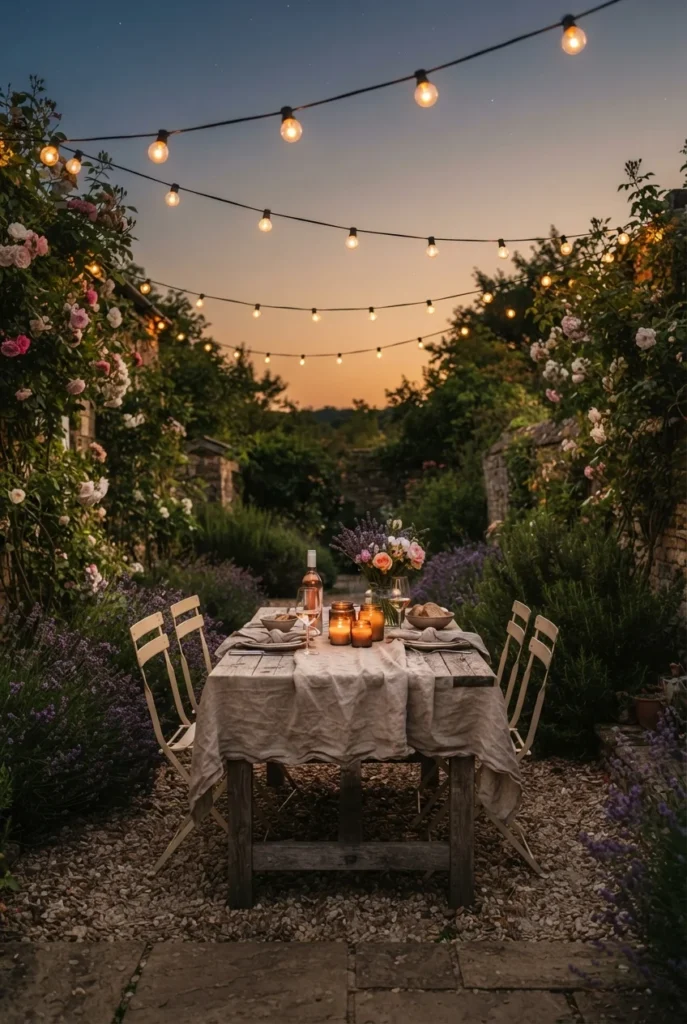
Light It for Evening, Then Put a Table Under It
The version of this garden that ends up on Pinterest is almost always shot at dusk.
Warm light does something to gravel and stone that daylight does not. Shadows lengthen, the honey tones in limestone come forward, and a plain rectangular yard suddenly has depth. It is also when the garden actually gets used, which is the point of building one.
Keep the lighting simple and warm. Brightech Ambience Pro string lights (roughly $40 to $60 for a 48 foot run) strung in two straight parallel lines over a gravel terrace is the whole effect. Warm white only, somewhere around 2200K to 2700K. Cool white bulbs make a French garden look like a parking lot, and no amount of lavender fixes that.
Under the lights: one table, chairs that do not match perfectly, a linen cloth that is allowed to wrinkle. Bistro chairs in cream or sage. A row of squat candles down the center in glass jars.
Honestly, this is the step that converts a garden from something you photograph into something you sit in until eleven at night. Worth doing before the plants are finished.
The Order to Actually Build It In
Four seasons of doing this out of order taught me the sequence. If you are starting from a blank rectangle of lawn, here is what works.
Year one, fall: Kill or lift the turf where the path will go. Dig 3 inches down, lay fabric, edge both sides, fill with pale gravel. Plant the bones only. Boxwood, one arch, the gate.
Year one, spring: Plant lavender and any other silver-foliage repeat in rows. Get the roses in and tied to their supports early, since they need two full seasons to look like anything.
Year two: Add the blooms layer around the established bones. Foxglove, nigella, peonies, hydrangea. Everything now has structure to lean against.
Year three: Slip in the potager, the containers, the patina objects, the lights. This is the fun year, and it only works because the first two years happened.
Most people run this backward, buying flowers in year one and wondering why the garden never coheres. Bones are boring to buy and they are the whole difference.
French Cottage Garden Ideas: Frequently Asked Questions
What is a French cottage garden?
It is a romantic, plant-heavy garden built over a visible structure. Gravel paths, clipped hedges, stone or iron elements, and a repeated planting rhythm sit underneath loose flowering plants like roses, lavender, and foxglove. The look borrows from rural French farmhouse and presbytery gardens, where ornamental and edible plants shared the same beds.
What plants go in a French cottage garden?
The core palette is English lavender, climbing and shrub roses, boxwood, peonies, foxglove, nigella, hydrangea, catmint, and ornamental grasses. Herbs earn a place too: thyme, rosemary, sage, and chives. Homes & Gardens adds lilacs, coneflowers, sunflowers, clematis and grape vines to that provincial list. Soft colors do the heavy lifting, mostly white, blush, lavender, and pale apricot.
What is the difference between a French and an English cottage garden?
Structure. English cottage gardens are deliberately informal and let plants self-seed wherever they land. French versions apply the same abundance over a visible framework of axes, clipped edges, gravel, and repetition. Same flowers in many cases, different underlying geometry.
Can you create a French cottage garden in a small yard?
Yes, and small spaces often suit it better. A courtyard of 12 by 15 feet has room for a gravel floor, a single rose arch, a lavender row, and clustered terracotta. Enclosure is an asset in this style, so fences and walls work in your favor rather than against you.
What gravel should I use for French garden paths?
Pea gravel or decomposed granite in warm pale tones: buff, cream, oatmeal, or soft gray. Lay it 2 to 3 inches deep over landscape fabric with edging on both sides. Avoid blue-gray crushed driveway stone, which reads industrial against soft planting.
Is a French cottage garden low maintenance?
More than an English cottage garden, less than a gravel yard. Gravel and clipped evergreens need very little once established. Roses want annual pruning, and lavender needs a hard shear after flowering to stop it going woody. Budget roughly one focused hour a week through the growing season for a small yard.
When should I plant a French cottage garden?
Fall is best for the structure and woody plants, since roots establish while the soil is still warm. Spring works for lavender and perennials in colder zones, after your last frost date has passed. In zones 5 and 6 that usually means mid to late April, though it varies year to year, so confirm against your local extension office before you commit trays of plants to the ground.
Start With the Path
If you take one thing from all of this, take the order.
Buy gravel before you buy flowers. Repeat one plant nine times instead of buying nine different plants. Find one old object and let it do the aging that your garden has not had time to do yet. The romance layer is easy and it arrives quickly, but it only holds together when there is something underneath it.
Four seasons in, my own garden still is not finished, and I have made peace with the fact that it never will be. That is arguably the point.
Pick your path line this weekend and mark it with a garden hose. Stand at the back door and look at it. If the curve makes you want to walk down it, you have the bones of a French cottage garden already, and everything else is decoration. And if you are working with a genuinely tight space, run the numbers on bed widths first with a proper small backyard garden design plan before the gravel goes down.
Which idea are you starting with?