9 Cozy Backyard with a Shed Ideas That Make the Back Corner Your Favorite Seat

Most sheds sit at the back of the yard doing one quiet job: hiding the mower. That wastes the best wall you own. These cozy backyard with a shed ideas use that wall as the backdrop for a spot you’ll actually sit in, instead of a box you mow around.
Timing matters. Clocks fall back on Sunday, November 1, and after that the yard goes dark before dinner. So every idea below is built to work after sunset, in a sweater, with a mug of cider in your hand.
You’ll find paint colors that make a plain shed recede by day and glow at dusk. There’s a gravel landing you can lay in one afternoon for about $50, string lights for a shed with no outlet, and planting that hides hard corners without giving mice a place to move in.
Start with the Hide, Blend, or Feature Test under the photo. It takes two minutes, and it tells you which of these nine ideas fit your shed, so your Saturday goes to the right ones.
The Hide, Blend, or Feature Test
Every shed plays one of three roles in a yard. Pick the role first and you’ll stop buying things that fight it. Run three quick checks in order. First, decide if you honestly like looking at the shed as it is. Second, check if you can paint it, since renters and resin sheds usually can’t. Third, measure the level ground in front of the door and look for about 6 feet. If you don’t like it and can’t paint it, you’re on the Hide route. Plain but paintable puts you on Blend. A shed you like, with room out front, is a Feature shed.
The Hide, Blend, or Feature Test
Ideas 7 and 9 work on every route.
1. Paint the Shed a Deep, Warm Color Instead of White
White sheds look crisp in catalog photos and glaring in a real yard. Against green hedges and a gray fence, a pale box is the first thing your eye lands on. If the Hide, Blend, or Feature Test put you on the Blend route, that’s the opposite of what you want.
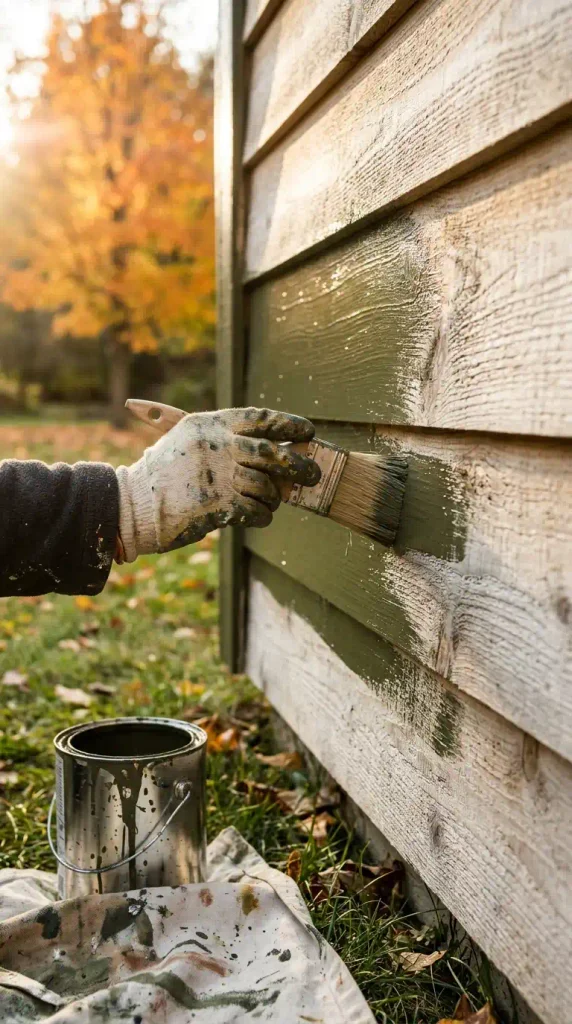
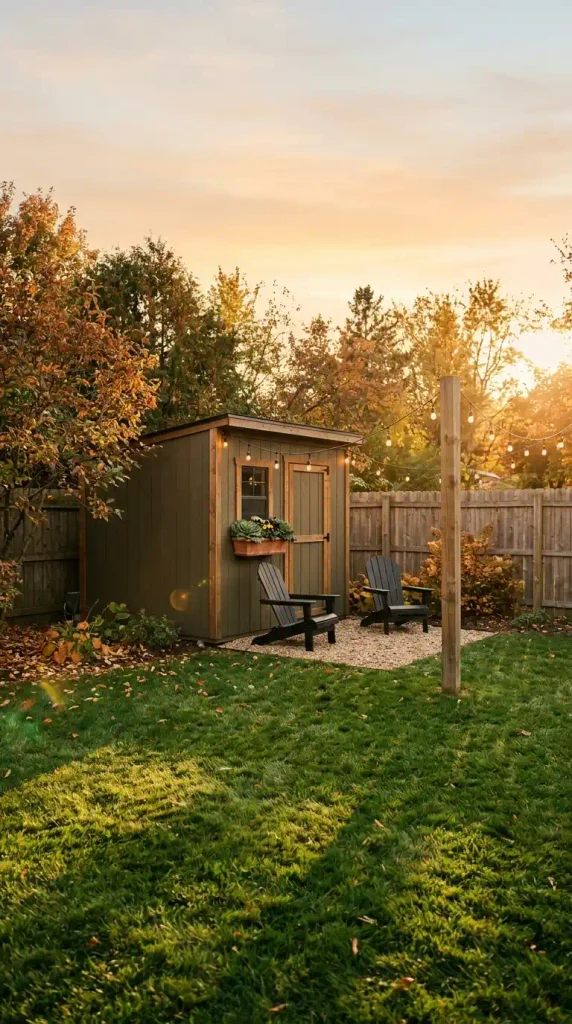
Go dark. Deep olive, forest green, charcoal, and warm black all sink back into the planting by day, then turn into a backdrop at night that makes café bulbs and a lit window look warmer.
BEHR Premium Plus exterior paint runs about $48 a gallon at Home Depot. Two coats on a typical 8×10 shed usually take around 2 gallons, so budget roughly $100. Paint the trim one shade darker than the walls instead of white.
| 🎨 Color direction | What it does in your yard |
|---|---|
| Deep olive or forest green | Disappears into hedges and lawn by day |
| Charcoal or warm black | Makes string lights and windows glow warmer at night |
| Barn red or brown red | Reads as a feature and pairs with fall maples and cedar |
| White or pale cream | Pops forward, so save it for a Feature shed |
You keep the outline. You lose the glare.
2. Hang a 24 Inch Window Box Under the Shed Window
Flowers at eye level do more for a shed than any sign or wreath. A window box puts color exactly where you look, and it’s the small sign of care that tells everyone somebody spends time out here.
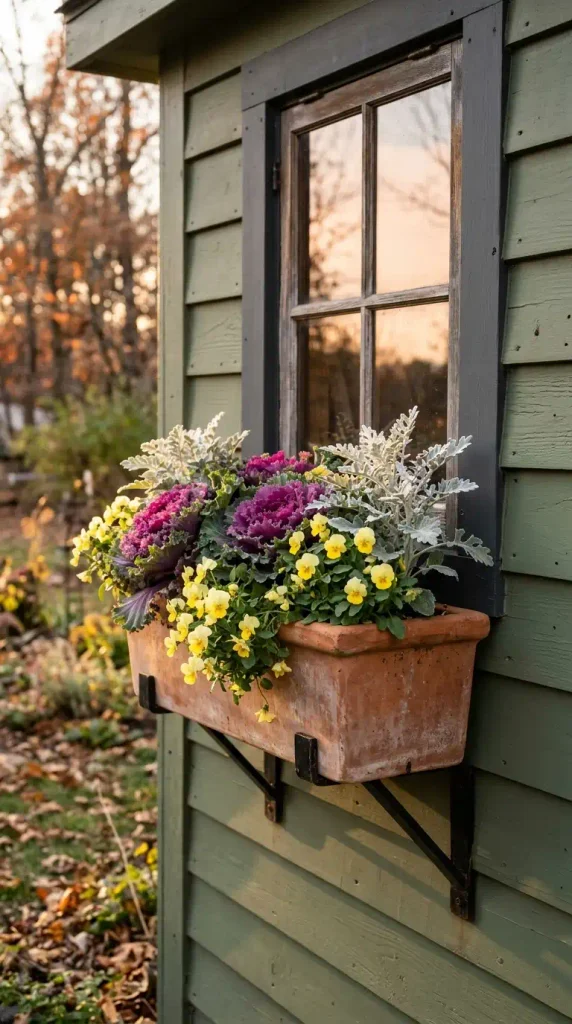
Bloem’s Dura Cotta 24 inch box sells for under $20 at Home Depot and weighs next to nothing, so two steel brackets screwed into the framing below the sill will hold it. Sheds without a window can take one beside the door at the same height.
Fall timing depends on where you live, so look up your zone on the USDA plant hardiness zone map before you shop. In Zones 5 and 6, first frost typically lands in October, so it may already be behind you. Zone 7 usually sees it between late October and mid November. Zone 8 tends to get it in November, and Zone 9 often holds out until late November or December. Your county extension office can give you the average date for your town.
🪴 Fill a 24 inch box for fall
Plan on five or six plants for a full 24 inch box. Crowd it. Sparse boxes look sad by November.
3. String Café Lights Off the Shed Roofline, No Outlet Needed
Most people buy the string lights first and figure out the far anchor later. Flip that. The shed roofline already gives you one strong, high anchor. All you need is a second one 10 to 20 feet away, like a sturdy tree or a cedar 4×4 post set in a bucket of concrete.
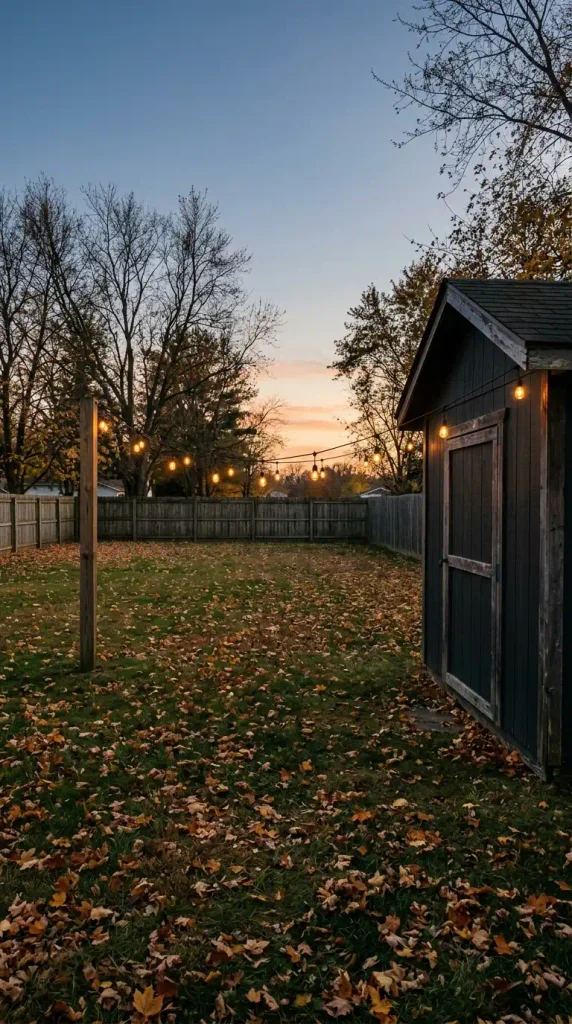
For a shed with no outlet, Brightech’s Ambience Pro solar strand is the easy answer. The 48 foot version runs around $60, charges from a detachable panel you stake in the sun, and switches on by itself at dusk. With an outdoor outlet nearby, the corded 48 foot LED version usually costs $40 to $55.
- Screw two eye hooks into the shed fascia at the ends of your run.
- Stretch a steel guide wire between the shed and your far anchor.
- Clip the cord to the wire with zip ties every 2 to 3 feet, so the wire carries the weight.
- Leave about 6 inches of sag in the middle. Tight lines look like a parking lot.
For path lights and uplighting beyond the shed, our outdoor lighting plan built around the time change picks up where this leaves off.
⚠️ Watch Out
Use string lights and extension cords rated for outdoor use and listed by UL, plugged into a GFCI outlet. Anything beyond plugging into an existing outlet, including running new power out to the shed, is a job for a licensed electrician.
4. Lay a 4×6 Gravel Landing at the Shed Door for About $50
Nine bags of pea gravel turn the muddy patch in front of the door into a floor. That’s the quiet trick behind most backyard shed with patio photos you’ve saved. The ground changes, so your brain reads the space as a room.
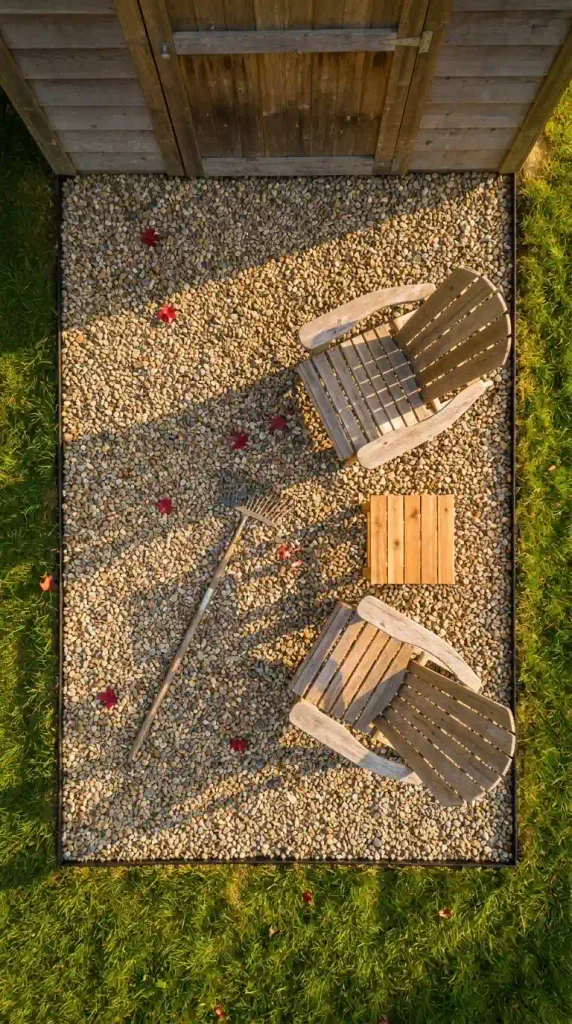
Vigoro’s 0.5 cubic foot bag of pea gravel costs under $6 at Home Depot, and the listing says one bag covers up to 2.75 square feet. A 4×6 landing is 24 square feet. Nine bags gets you there at about 2 inches deep, for roughly $50.
Cut the sod and lay landscape fabric. Edge the rectangle with steel edging so stones stay out of the lawn. If your ground stays soft after rain, dig deeper and build a compacted base first. Our walkthrough of the base layers under a gravel seating corner shows how deep to go.
Rake it flat. Then sit in it before you buy anything else.
5. Turn the Chairs Around So the Shed Is Behind You
Here’s the layout mistake in a lot of shed corners: the chairs face the shed. You end up staring at a door and a padlock.
Turn them around. With the shed wall at your back, it works like the high back of a restaurant booth, blocking wind from one side and giving you something solid behind your shoulders. Your view becomes the garden and the warm windows of the house. On the Feature route of the Hide, Blend, or Feature Test, this move costs nothing if you already own chairs.
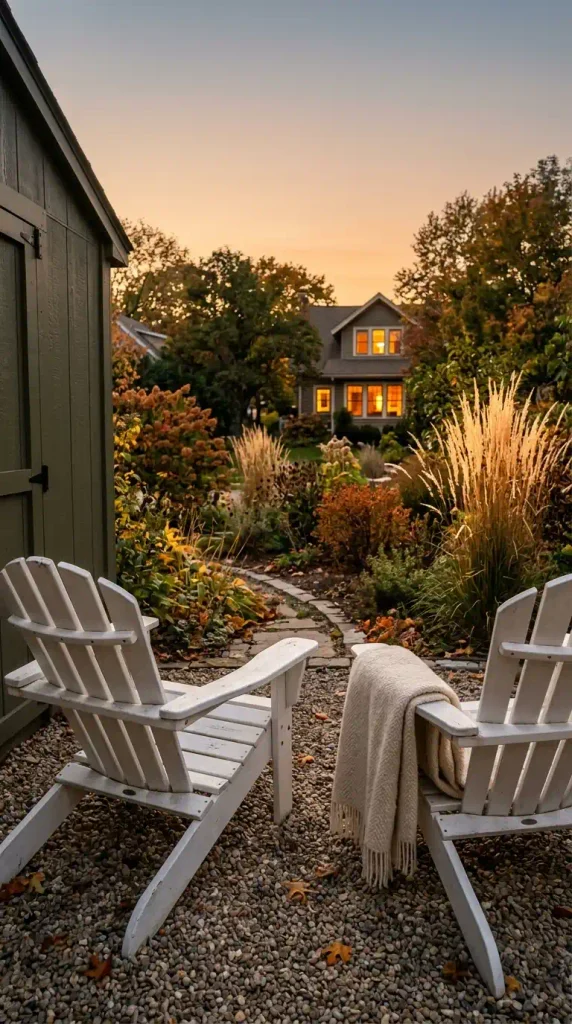
If you’re buying new, POLYWOOD’s Classic Folding Adirondack starts around $249 and folds flat, so it can spend winter inside the shed. Measure the door swing before you place anything. An outswing door can sweep 3 feet of your landing.
Set chairs 2 to 3 feet off the shed wall, angled slightly toward each other.
Keep a clear 3 foot path to the door.
Chairs that face the shed door and its padlock.
A side table parked inside the door swing.
6. Grow a Vine on a Trellis Set 4 to 6 Inches Off the Siding
Vines planted straight against wood siding hold moisture on the boards and can work their way under the clapboards. Illinois Extension’s guidance on vines and wood siding calls for 4 to 6 inches of air between trellis and wall. It even suggests hinging the trellis at the base so the whole thing folds down when you repaint.
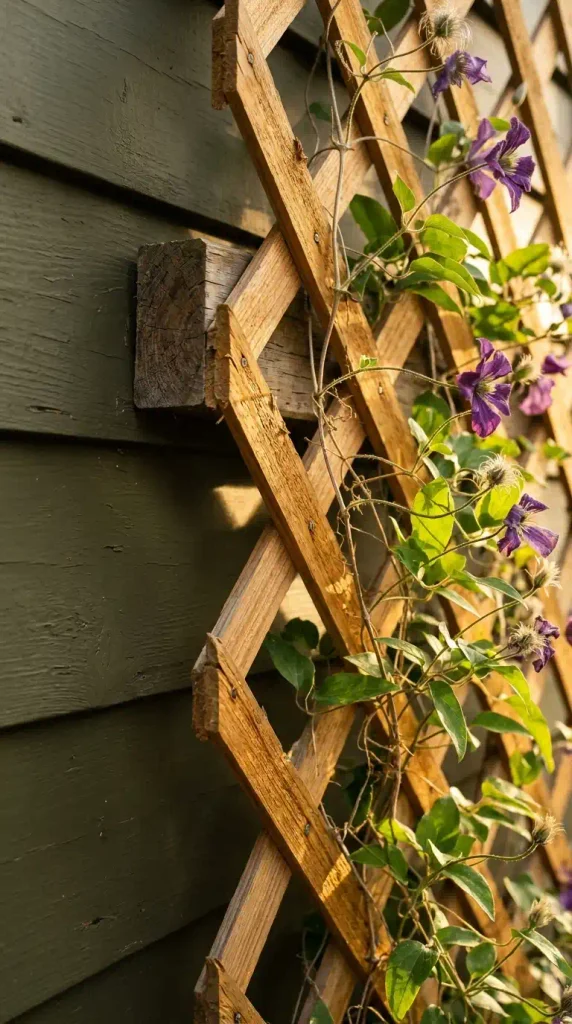
Pick the vine by sun. Clematis wants about six hours of direct light, so give it a south or west wall. Climbing hydrangea handles part shade and does best in the cooler half of Zones 5 to 9. In Zones 8 and 9, star jasmine twines up a trellis fast and smells sweet on warm evenings. Fall is a fine time to plant any of them while the ground is still warm.
The gap is the whole trick. Air behind the leaves keeps the siding dry, and you still get a green wall that makes a Blend shed look planted, not parked.
7. Design the Corner for the View From Your Kitchen Window
Between November and March, you’ll look at the shed through glass far more often than you’ll sit beside it. Most shed roundups skip that completely. They style the corner for a July afternoon, then it sits there as a dark lump for five months. So plan the corner as a picture first, and run this check at dusk once the clocks change.
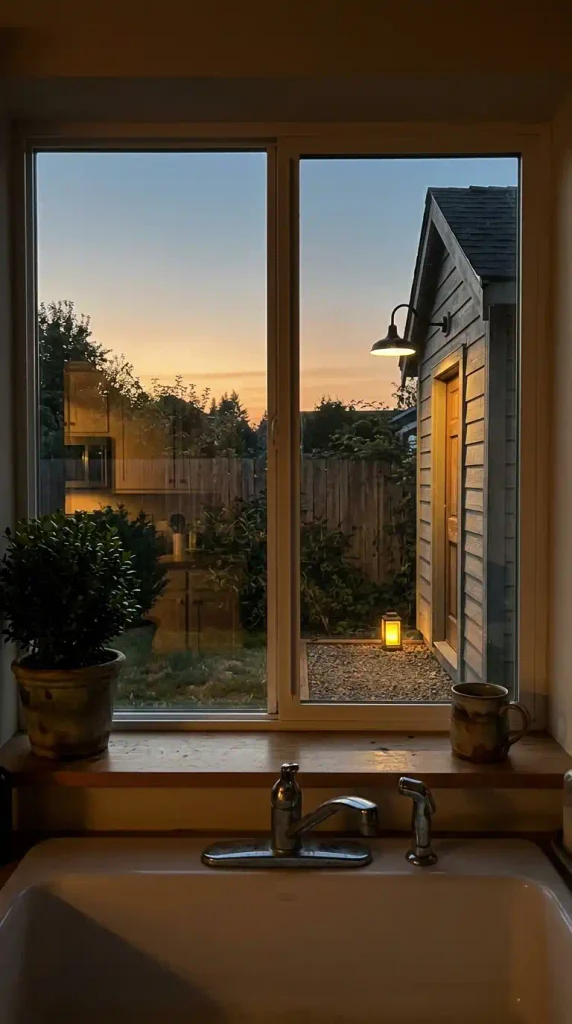
🌙 The Window Test
Stand at the kitchen sink or back door around 5 p.m. and look only at the shed corner.
Notice what’s dark. It’s usually the door and the ground in front of it.
Add one warm light at the door, like a solar barn light on the fascia or a flameless lantern on the landing.
Plant or pot one evergreen where the window frames it, so January isn’t all bare sticks.
Skip bright white floodlights and motion sensors here, because seen from inside the house they read as a security light instead of a warm glow.
8. Hide the Shed’s Blind Side With Evergreens and an 18 Inch Gravel Gap
The instinct with an ugly shed wall is to plant right up against it. Don’t. Dense planting hard against the walls keeps the siding damp and hands mice a sheltered runway to the door.
Leave an 18 inch strip of gravel along the wall instead, and plant beyond it. You can still reach the siding with a brush, and the border hides the bottom of the shed from the house just as well. On the Hide route of the Hide, Blend, or Feature Test, this is where your money goes first.
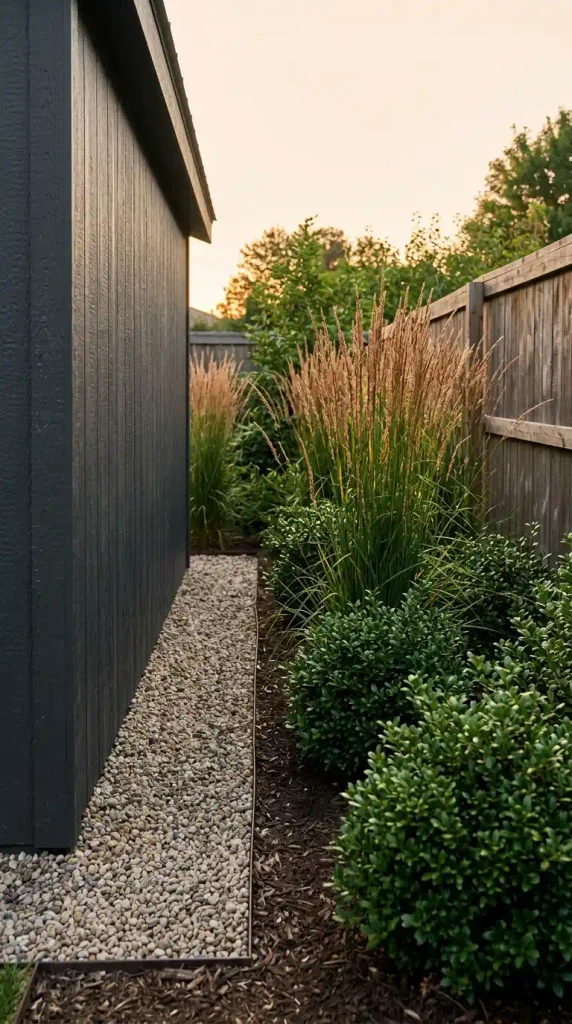
- ▸An 18 inch gravel strip against the wall, with plants beyond it.
- ▸Mulch at least 3 inches deep in the bed to keep weeds down.
- ▸One evergreen for every two grasses or perennials, so winter isn’t bare.
For the backbone, inkberry holly stays glossy green all winter across Zones 5 to 9, and Karl Foerster feather reed grass catches low fall sun like a lamp. For a taller screen, our guide to evergreen screens that wrap a seating area walks through arborvitae and holly options.
The shed stays. The eyesore goes.
9. Keep a Cold Night Kit Inside the Door, Then Sit in the Doorway
Wool throws. Two flameless lanterns. Seat cushions. Store those three things on a shelf just inside the shed door and the corner is ready in under a minute, instead of costing you a trip to the house for every comfort.
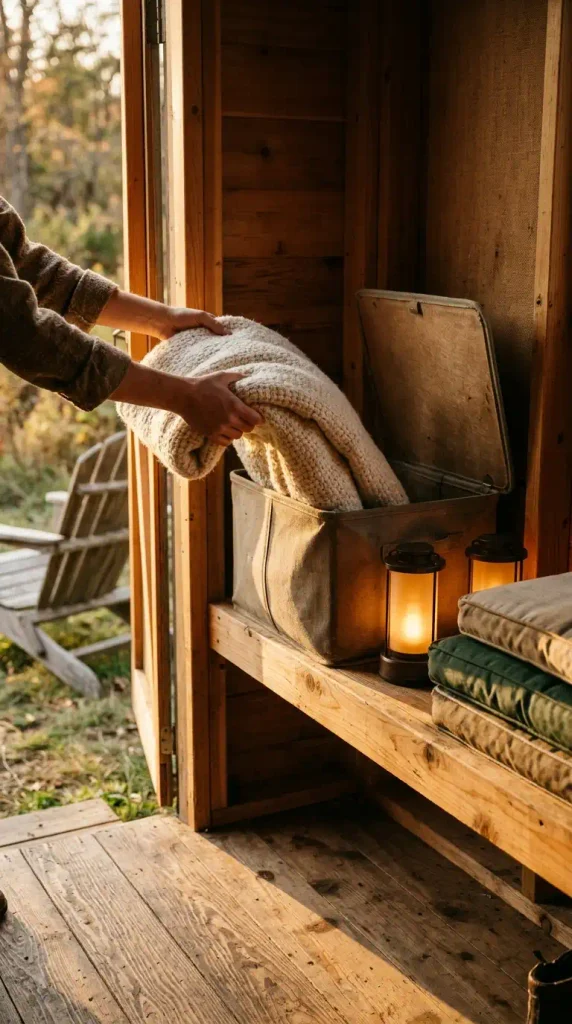
Keep it all in a lidded bin off the floor, because sheds run damp and mice love wool. Flameless matters too. A wood shed, dry leaves, and an open candle are a bad mix, and LED lanterns with a timer switch on by themselves every evening.
On a windy night, open both doors, set one chair just inside on a small outdoor rug, and let the shed become the room. You get the reading nook from every shed conversion list, minus the insulation and wiring bill. It works on any route of the Hide, Blend, or Feature Test.
Store the comfort where you sit, and you’ll sit there more.
Shed Corner Questions, Answered
How do I make the area around my shed feel cozy?
Start outside the door, not inside. A small gravel or paver landing, two chairs with their backs to the shed wall, and one warm light source do most of the work. Then soften the hard edges with a window box or a vine on a trellis. Warm, dark paint helps the shed sink into the yard, so the chairs become the focus instead of the building.
What should I put around a shed?
Keep an 18 inch strip of gravel right against the walls so the siding stays dry and mice have no cover. Beyond that, plant a border with one evergreen, such as inkberry holly, for every couple of ornamental grasses or perennials. Add a path to the door and a landing in front of it so the shed looks connected to the rest of the yard.
What color should I paint a backyard shed?
Deep, warm colors usually work best in a planted yard. Olive, forest green, charcoal, and warm black recede into hedges by day and make string lights look warmer at night. Pale colors pop forward, so save white or cream for a shed you want as the focal point. Paint the trim a shade darker than the body, rather than bright white, to keep the outline soft.
Can you hang string lights from a shed?
Yes. The shed roofline makes a solid high anchor. Screw eye hooks into the fascia, run a steel guide wire to a post or tree 10 to 20 feet away, and clip the cord to the wire so the bulbs hang without strain. If the shed has no outlet, a solar strand with a staked panel avoids new wiring entirely.
Do vines damage a wooden shed?
They can. Vines growing directly on wood siding trap moisture and can work under the boards. The safer setup is a trellis mounted 4 to 6 inches off the wall so air moves behind the leaves. Twining vines like clematis or star jasmine suit a trellis well, and you can hinge the trellis at the base so it folds down when you repaint.
Where is the best place for a shed in a backyard?
Pick level ground that drains well. Walk the yard after a heavy rain and avoid any spot where water pools. Keep it close enough to reach easily with a mower, and leave room on every side for maintenance. Before you move or build one, check your local setback rules and any HOA guidelines, which can limit size, height, and distance from property lines.
How do I keep mice and pests away from my shed?
Take away cover and food. Keep tall plants, firewood, and leaf piles off the walls, and leave a gravel strip at the base so nothing can hide there. Inside, store cushions, throws, birdseed, and grass seed in lidded bins or metal cans, never open bags on the floor. Fill gaps under the door with a sweep or weatherstripping, and clear clutter every few months.
Start With One Corner This Weekend
A shed doesn’t need a full conversion to earn its spot. Paint, a patch of gravel, two chairs facing the right way, and one warm light will make most back corners feel like a room by Sunday night. Everything else on this list can come later, one Saturday at a time.
If you only do one thing this week, run the Window Test at dusk. It shows you exactly what the corner needs first.
Save these cozy backyard with a shed ideas to your backyard board, so the plan is ready when you’re standing in the garden center aisle next spring.