Fall Japanese Cozy Backyard Ideas: Your Easy Game Plan

Most Japanese garden advice is built for looking. Raked gravel, one stone lantern, a maple you admire through the kitchen window. These Japanese cozy backyard ideas are built for sitting instead, on a cool fall evening with a wool throw on your knees and the light going amber behind the fence.
That shift matters more than any ornament. A copied temple garden can feel cold in a US yard: gray stone, gray gravel, and nowhere to rest.
The fix is simple. Add a seat, a screen, a little warmth, and plants that actually survive your zone.
So this is a game plan, not a mood board. You’ll get The Two-Weekend Zen Game Plan, a zone-checked plant table for Zones 5 to 9, and honest price tiers from Home Depot, Lowe’s, and Amazon. You’ll also get the one rule most Japanese style backyard guides skip. Every idea fits a small yard, a rental, or one quiet corner of a bigger lot.
Build the Seat First, Then Everything Else
Skip the lantern for now. The curator of the Morikami Museum and Japanese Gardens has pointed out that setting a lantern in your yard doesn’t make it a Japanese garden. It doesn’t make it comfortable either.
Warmth starts where your body lands. Pick the spot with the best evening light and the least street noise. Put a seat there before you buy a single plant.
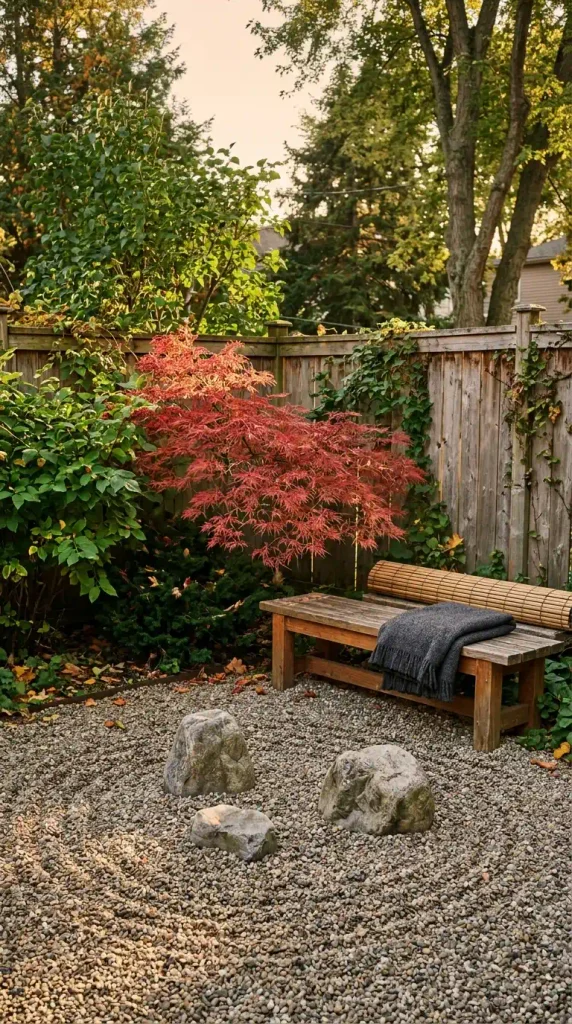
Low and wide beats tall and upright. Traditional Japanese houses have the engawa, a wooden veranda edge where people sit close to the garden at nearly floor height. A 16 to 18 inch cedar bench gives you that same low, settled feeling. So does a Polywood Adirondack in a dark gray finish, and because Polywood is HDPE plastic lumber, it never needs sealing or staining. If your corner is under 100 square feet, these small backyard patio layouts that feel bigger will help you size the seat to the space.
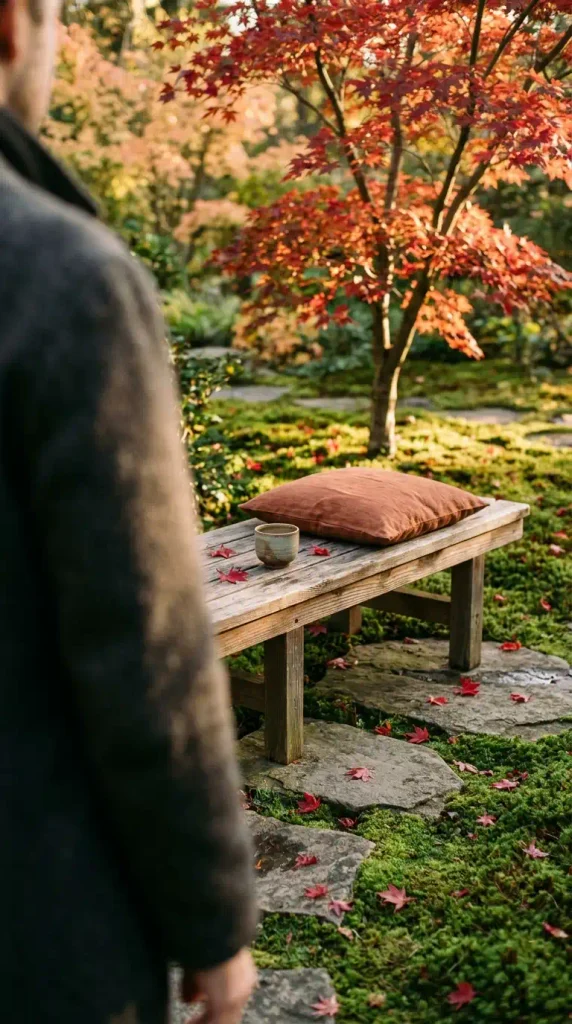
Back the bench against a fence or wall so you feel sheltered.
Face the seat toward one focal point: a maple, a stone, or a bowl of water.
A tall bistro set that perches you above the garden.
Buying a lantern before you know where you’ll sit.
Sit there for ten minutes at dusk. If it feels good with nothing else around it, you’ve found your spot.
A Bamboo or Cedar Screen That Wraps the Corner
Enclosure is the quiet half of a Japanese garden. Traditional gardens draw a clear line between the garden and the street, usually with a low wall, a fence, or a hedge. In a US yard, that same line also hides the neighbor’s grill and the glare from their garage light.
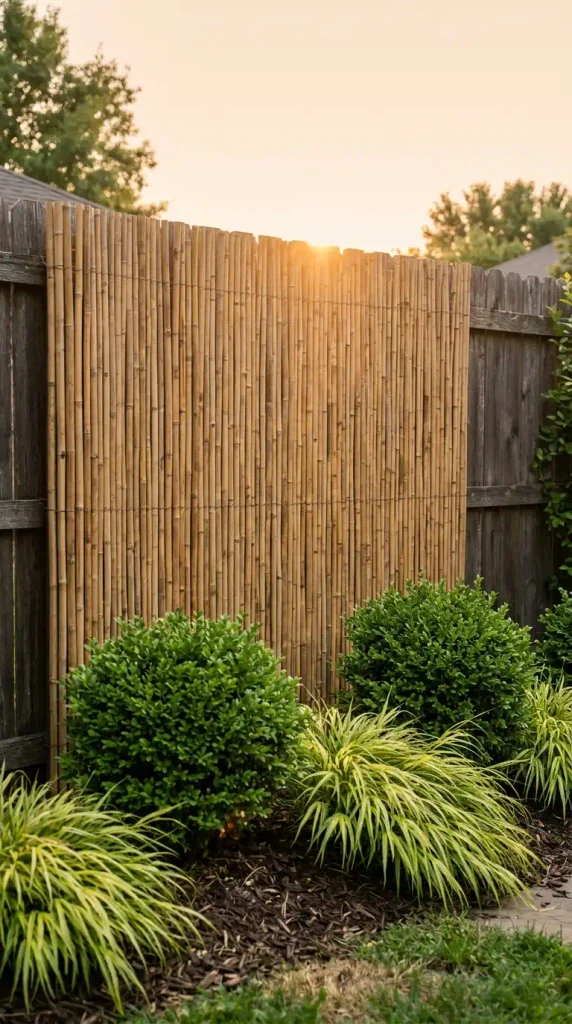
Three ways to build it, depending on budget and how long you plan to stay:
| Screen | Cost tier | Install | Best for |
|---|---|---|---|
| 🎋 Rolled bamboo, 6 x 8 ft | Around $150 per panel | One afternoon, wire to an existing fence | Renters, instant height |
| 🪵 Cedar slat panel | Medium | One weekend with posts | Owners who want it to last |
| 🌿 Japanese holly hedge | Low per plant, slow payoff | One morning to plant, a few years to fill | Patient gardeners in Zones 6 to 8 |
Rolled bamboo is the fastest win. A 6 by 8 foot Backyard X-Scapes panel runs around $150 at Home Depot, and its galvanized wires let you tie it to chain link or wood. When the lease ends, it rolls back up.
Cedar slats take longer but feel more permanent. Stain them charcoal for a shou sugi ban look without a torch. For an evergreen screen that grows in, our living hedge and tree screens for fall cover spacing and plant picks.
One warning: natural bamboo weathers toward silver gray outdoors. Some people love that. Plan for it either way.
The Two-Weekend Zen Game Plan
Two weekends. That’s the whole timeline. The plan stacks the work so the parts that make the corner feel good (seat, screen, gravel) happen first, and the parts that depend on weather (planting, water) come second. You can stop after Weekend 1 and still have a finished, usable corner.
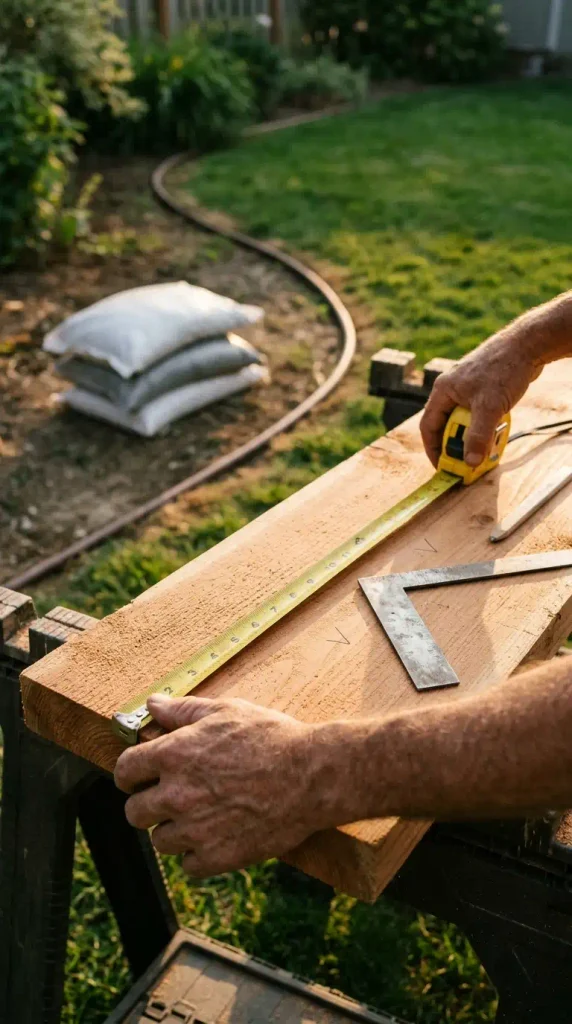
Planting is the one step to check against your zone. The UF/IFAS Extension fact sheet on the Japanese maple planting window by zone lists fall as a fine planting time in Zones 5 and 6 and year-round in Zones 7 and 8.
Late October in Zone 5 is a different story. If the ground is close to freezing, finish Weekend 1 now and push Weekend 2 to spring. Gravel and cedar don’t care about frost.
Rake a Small Gravel Field for a Zen Garden Backyard
Raked gravel looks fussy. It isn’t. In the dry garden style called karesansui, gravel stands in for water and stones stand in for mountains or islands. A 3 by 5 foot patch beside your bench is enough to read as intentional.
Outline a 3 by 5 foot rectangle or soft oval with a garden hose, then strip the sod about 3 inches down.
Lay landscape fabric and pin black steel edging around it so the gravel stays put.
Pour pea gravel or decomposed granite 2 to 3 inches deep. Decomposed granite holds the sharpest rake lines.
Set three stones in an uneven triangle, then rake circles around them and straight lines across the rest.
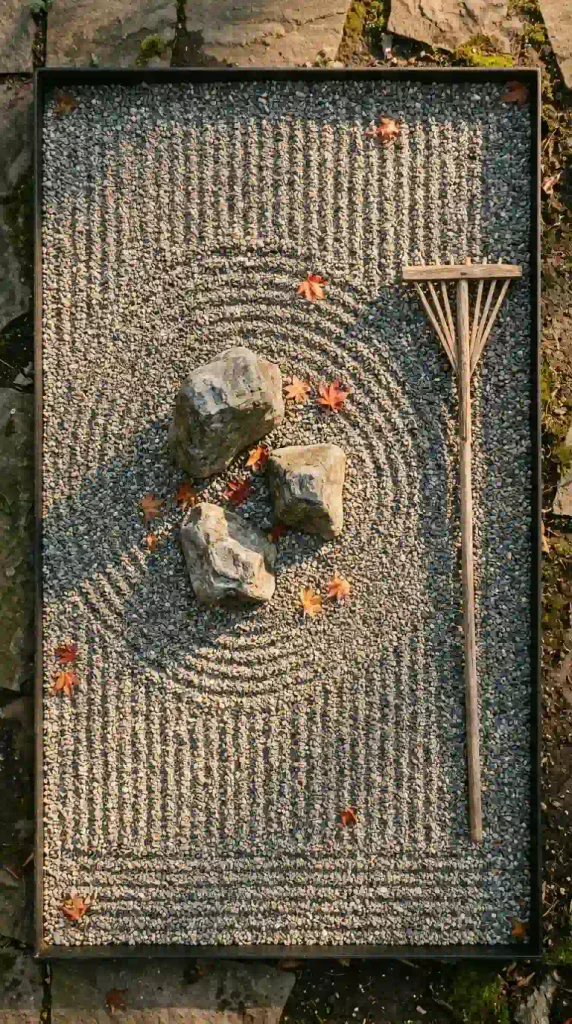
The math is friendly. A 15 square foot patch at 3 inches deep needs about 3.75 cubic feet, so roughly eight 0.5 cubic foot bags. Bagged pea gravel usually costs under $10 a bag at Lowe’s or Home Depot.
Odd numbers matter here. Three stones feel natural, and two look like a pair of shoes.
A common first-time mistake is going too shallow. At an inch deep, the fabric shows through after the first hard rain and the rake lines smear into mush.
Japanese Style Backyard Plants That Survive Zones 5 to 9
Plant tags make every maple sound easy. They aren’t, at least not in full afternoon sun. The UF/IFAS fact sheet warns that Japanese maples can scorch in an overly sunny spot, so give yours morning light and afternoon shade.
The bigger rule is to work with your zone, not against it. Before you shop, look up your ZIP on the hardiness zone map from the USDA, then pick from the rows that include your number.
| Plant | Zones | Light | Its fall job |
|---|---|---|---|
| 🍁 Japanese maple | 5 to 8 | Morning sun, afternoon shade | The red or gold focal tree |
| 🌾 Japanese forest grass | 5 to 9 | Part shade | Golden mounds that soften stone |
| 🌿 Japanese painted fern | 4 to 8 | Shade | Silver fronds under the maple |
| 🌿 Autumn fern | 5 to 8 | Part to full shade | Coppery fronds near the gravel |
| 🌳 Japanese holly | 6 to 8 | Sun to part shade | Evergreen backbone for winter |
A young potted Japanese maple is the big buy, often in the $50 to $150 range depending on cultivar. For a small yard, a weeping type like ‘Inaba shidare’ stays compact and turns bright red in fall. Japanese forest grass runs around $20 to $30 for a 1-gallon pot.
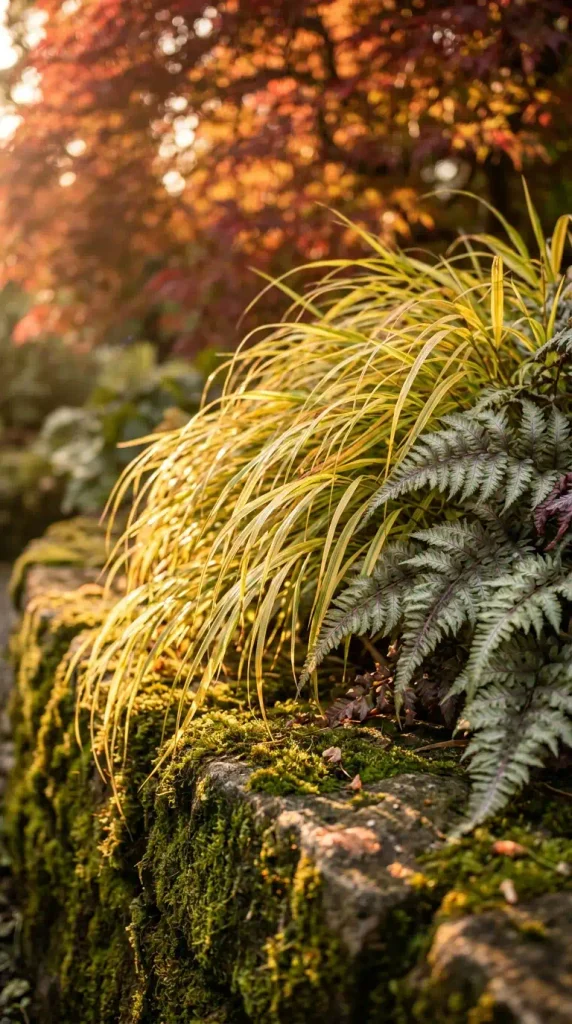
Here’s the surprise for most first-time growers: Japanese forest grass often looks best in fall, not summer. Its leaves can pick up a pink or coppery blush as nights cool. In hot Zone 9 summers, keep it in real shade, since it prefers cooler climates.
Low Lantern Light: Japanese Patio Ideas for Longer Evenings
Light low, light warm, and light only a few things. Japanese gardens use lanterns sparingly. Line every path with them and the corner starts to feel like a theme restaurant.
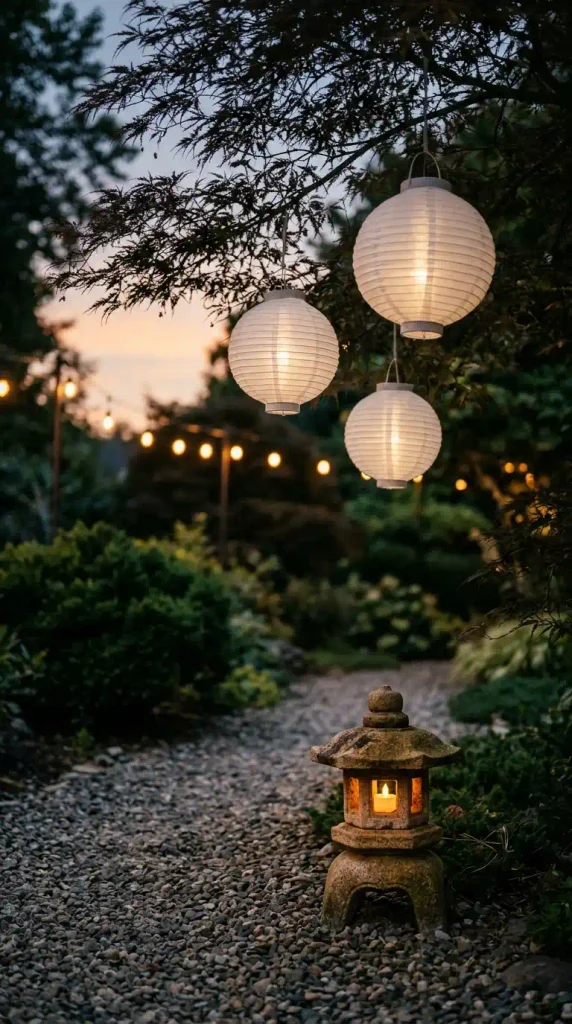
Three layers do the job. A stone or cast concrete lantern beside the gravel holds a flameless LED candle. Solar paper lanterns hang in the maple, often under $40 for a multi-pack on Amazon. Café bulbs from a brand like Brightech or Feit run on a guide wire over the bench.
Color temperature is the quiet secret. Bulbs at 2700K or lower glow amber. Anything near 5000K turns your Japanese corner into a parking lot.
🏮 Your lantern shopping list
Use outdoor-rated, UL-listed lights and cords on a GFCI outlet. Anything beyond plugging into an existing outlet is a job for a licensed electrician.
Add Real Warmth With a Smokeless Fire Bowl
Fall evenings turn cold fast once the sun drops, especially in Zones 5 and 6. A throw helps. Real heat helps more.
The simplest fix is a smokeless fire bowl on gravel. Solo Stove’s Bonfire 2.0 uses a double-wall design that pulls air in through vents at the bottom, which cuts most of the smoke. It usually lands in the $200 to $300 range depending on sales. Set it on pea gravel or pavers, out from under the maple, and well away from the bench.
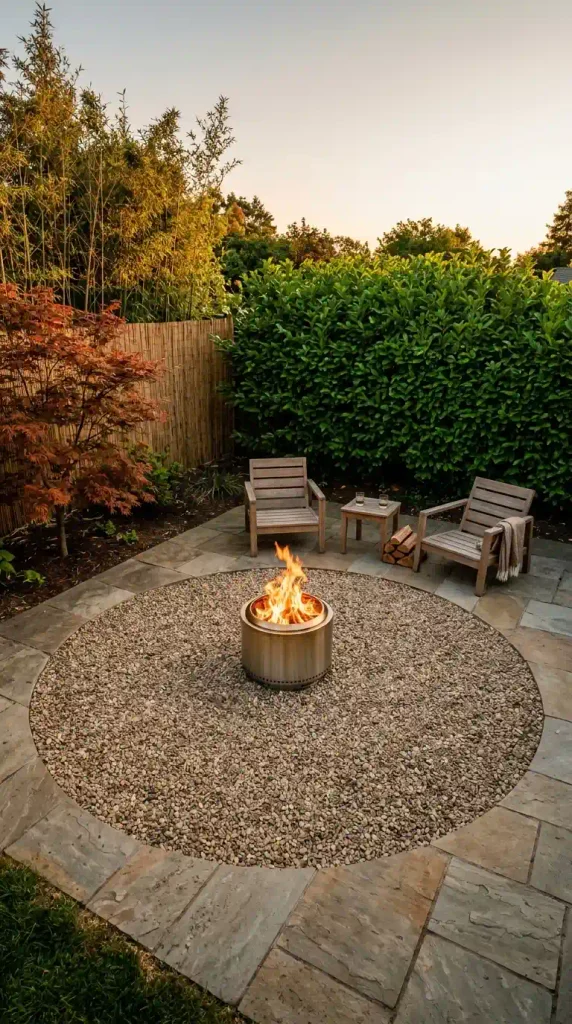
The most common placement mistake is putting the bowl right where the seat already is. Then a breezy night pushes leftover smoke and sparks straight into your lap. Watch which way the evening wind usually blows, and set the bowl downwind of the bench. For a permanent pad, we have a guide to building a gravel fire pit pad with edging and depth.
Here’s the contrarian take. If your only good corner sits under the maple canopy, skip open flame there entirely. A bigger wool throw, a lidded mug, and a warm café bulb overhead do more than you’d expect.
⚠️ Watch Out
Check your city’s burn rules before you light anything, keep the clearance from structures and branches that your fire pit’s manual and local code call for, and never leave a fire unattended.
Small Japanese Garden Ideas for Water Sound, No Pond Required
Street noise kills stillness faster than clutter does. Japanese gardens treat sound as part of the design, and trickling water is the classic way to cover a neighbor’s AC unit or passing cars.
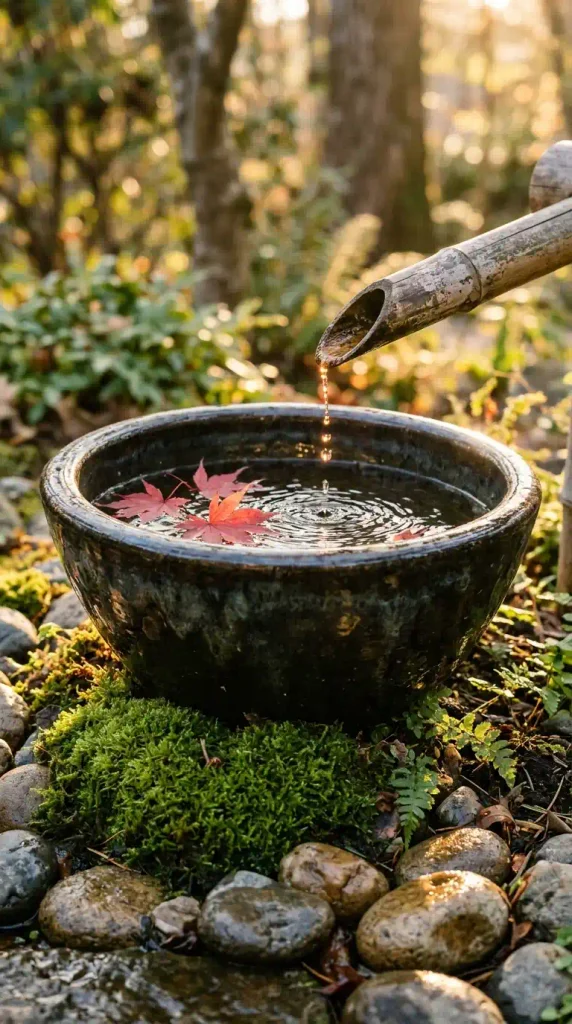
You don’t need to dig. A glazed ceramic bowl fountain or a tsukubai-style stone basin with a bamboo spout gives you that soft trickle at bench distance. Kits from Wayfair or Amazon usually fall in the $80 to $200 range. A solar pump skips the extension cord.
A pretty corner where the loudest sounds are the neighbor’s AC unit and cars on the street.
A glazed bowl with a bamboo spout at the gravel’s edge, trickling just loud enough to soften the hum from the bench.
A shishi odoshi, the bamboo “deer scarer” that tips and clacks, is fun but loud. Put it at the far end of the yard, not beside your ear.
In Zones 5 and 6, drain the bowl and bring the pump inside before hard freezes. Ice can crack glazed ceramic in a single cold night.
Let It Go a Little Wild for Winter
Resist the big fall cleanup. Wabi-sabi, the Japanese idea of beauty in things that are imperfect and passing, is on your side here.
Leave the forest grass standing until spring, then cut it back once new shoots appear. Let a few maple leaves stay on the gravel edge. Moss creeping onto a stone is a win, not a chore.
The Japanese holly carries the green through winter. Cushions go inside, but keep one weatherproof throw in a lidded storage box by the bench for clear, cold nights.
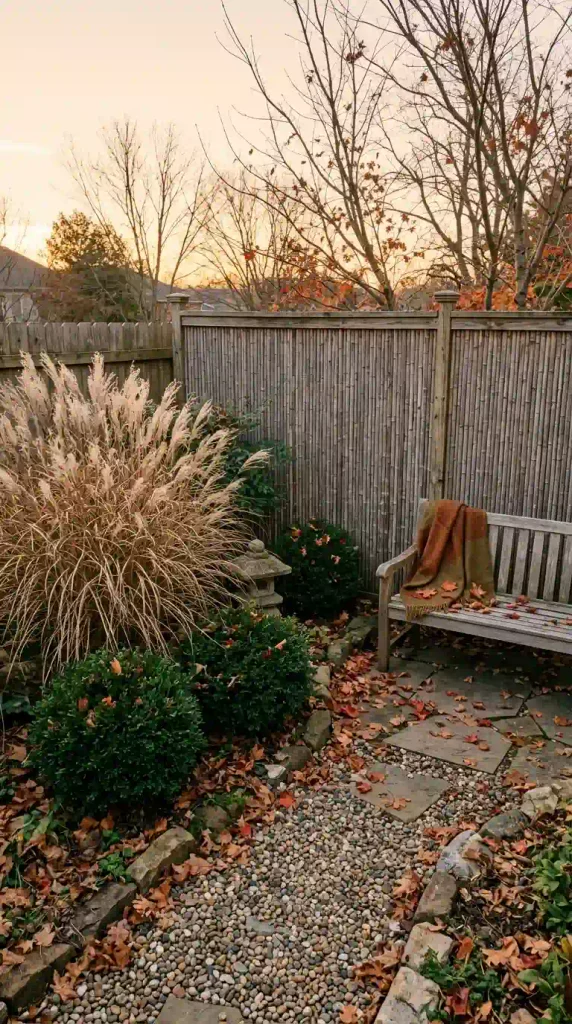
A garden that changes with the season feels lived in, and lived in is what makes a corner feel warm.
Japanese Cozy Backyard Ideas FAQs
How do I make my backyard look Japanese on a budget?
Start with structure, not decor. A rolled bamboo screen, a small raked gravel field, three stones, and one Japanese maple read as Japanese in a way a pile of ornaments never will. Bagged pea gravel is cheap, and a 3 by 5 foot patch needs only about eight bags. Add one lantern last, once you know exactly where you’ll sit.
How do you make a simple Japanese garden?
Pick one corner and give it a clear edge with a fence, screen, or hedge. Inside it, combine three things: stone (a few rocks in odd numbers), green (a maple, ferns, or forest grass), and open space (raked gravel). Keep the color mostly green with one seasonal accent. That’s a complete small Japanese garden, and you can finish it in a weekend.
What plants work best for a Japanese garden in the US?
Match plants to your USDA zone first. Japanese maple handles roughly Zones 5 to 8, Japanese forest grass 5 to 9, Japanese painted fern 4 to 8, and Japanese holly about 6 to 8. In hot Zone 9 summers, keep forest grass in real shade or swap in a local native with a similar arching shape.
How do I maintain a Japanese garden in fall and winter?
Rake the gravel after storms, pull weeds before they set seed, and leave ornamental grasses standing until spring. Cut forest grass back once new growth starts. In Zones 5 and 6, empty water bowls and store pumps before hard freezes. Bring cushions in, and keep a weatherproof throw in a lidded box near the bench for cold evenings.
Can I combine Japanese and other garden styles?
Yes. Japanese elements blend well with woodland and modern gardens because they share natural materials and restraint. The trick is a clear boundary. Give the Japanese corner its own edge, like a screen or a gravel border, so it reads as its own room. Repeat one material, such as cedar or dark gray stone, in both areas to tie them together.
What colors make a Japanese garden feel warm?
Lean on layered greens, then add warmth with materials and light instead of lots of flowers. Cedar, charcoal stain, and terracotta tones feel warm against gray stone. In fall, a single red or orange maple becomes the accent. At night, warm white bulbs around 2700K keep the whole corner amber instead of blue.
Start With One Corner This Weekend
You don’t need a koi pond or a contractor. You need one seat in the right spot, a screen behind it, a patch of raked gravel, and a few plants that like your zone. Add light and warmth last, and let the season do the decorating.
Start Weekend 1 of the game plan while the weather still cooperates. If frost beats you to the planting, spring is waiting.
Save this to your fall backyard board so the plant table and the two-weekend plan are handy at the garden center. These Japanese cozy backyard ideas get better every year the maple grows.