
Fall Outdoor Lighting Landscaping Ideas: What to Do and When

On November 1, the clocks fall back and your yard loses an hour of evening light in a single night. These outdoor lighting landscaping ideas are built around that date and two others that matter just as much in fall: your first frost and the week your trees drop their leaves.
Most lighting guides hand you a pile of fixtures and wish you luck. Timing is the part they skip. Bury cable after the ground freezes and you’re chipping at frozen clay. Aim a tree light in September and it’s pointing at empty air by Halloween.
So we built this around a simple schedule we call the Fall Back Lighting Calendar. It covers the first night walk, the install weekend, the leaf drop, and the timer reset.
You’ll also get real spacing numbers and honest price tiers. And you’ll learn the one bulb mistake that turns red maples gray at night. Most of it fits in two weekends and a budget under $200.
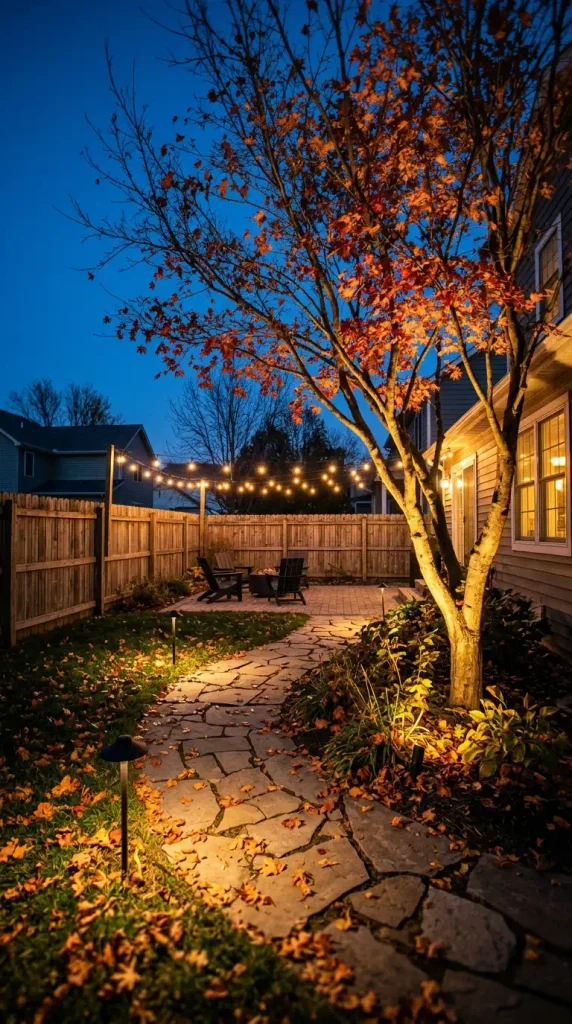
The Fall Back Lighting Calendar: What to Do Each Week
Fall lighting work runs on three dates, not one. Your first frost, the week your leaves drop, and November 1.
First frost usually lands in mid to late October in Zone 5 and late October in Zone 6. In Zones 8 and 9 it comes somewhere in November or December. The ground freezes a few weeks after that, and your cable needs to be in before it does.
Not sure of your band? Look up your zone on the USDA hardiness map, then ask your county extension office for your local frost date. Treat any chart as a typical range, not a promise.
Here’s the calendar. Slide it a week or two earlier in Zone 5 and later in Zones 8 and 9.
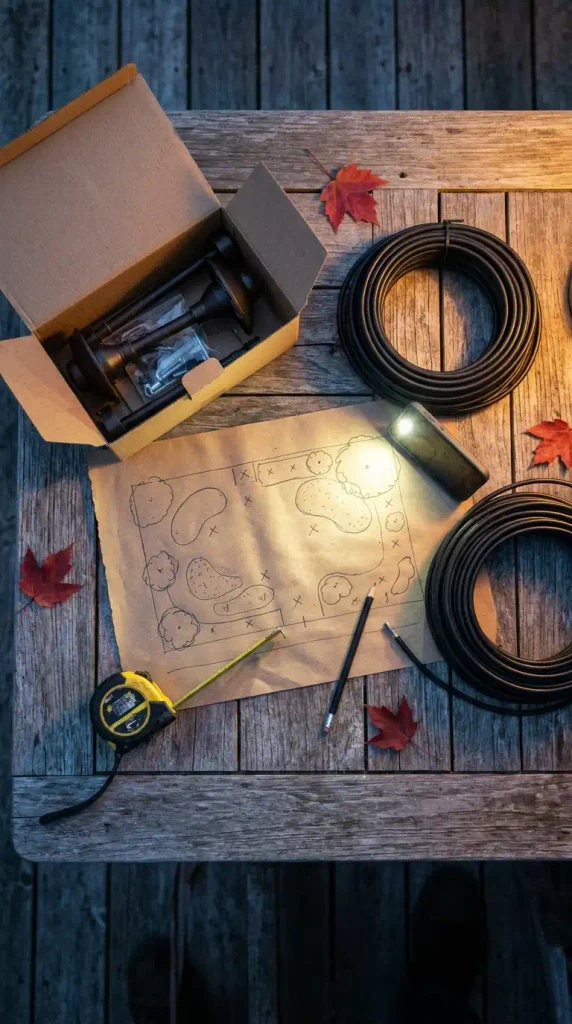
🍂 THE FALL BACK LIGHTING CALENDAR
Start With a Night Walk, Not a Shopping Cart
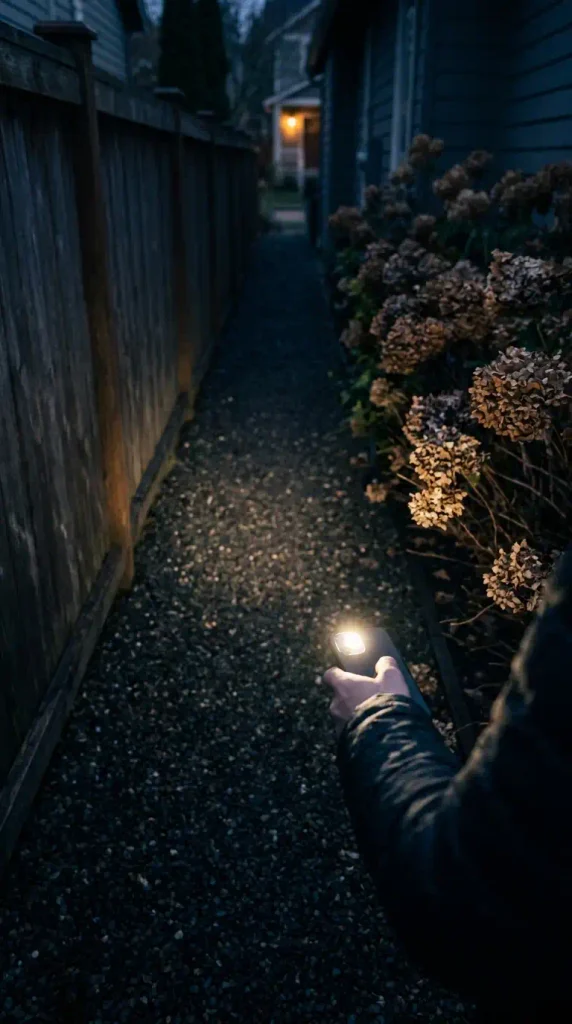
Before you buy a single light, go outside about 30 minutes after sunset with a phone flashlight and a notepad. Walk the route a guest would take. Then walk the route you take to the trash cans.
You’re looking for three things. Spots where someone could trip. Features worth showing off, like a maple, a stone wall, or a big planter. And the places people actually sit.
Every light should do one of those three jobs: safety, accent, or gathering. A fixture with no job is just clutter that glows.
Fall is the easiest season for this walk. It gets dark early enough to do it before dinner, and the thinning canopy shows you where tree light will really land.
Check the view from the street too. A yard gets judged from the sidewalk, which is why our front yard landscaping ideas for curb appeal start from about 40 feet back. Lighting works the same way.
Walk the guest route and your own chore route 30 minutes after sunset.
Mark every step, edge, and dark corner on a rough sketch with an X.
Circle two or three features worth lighting. Stop there. Restraint looks expensive.
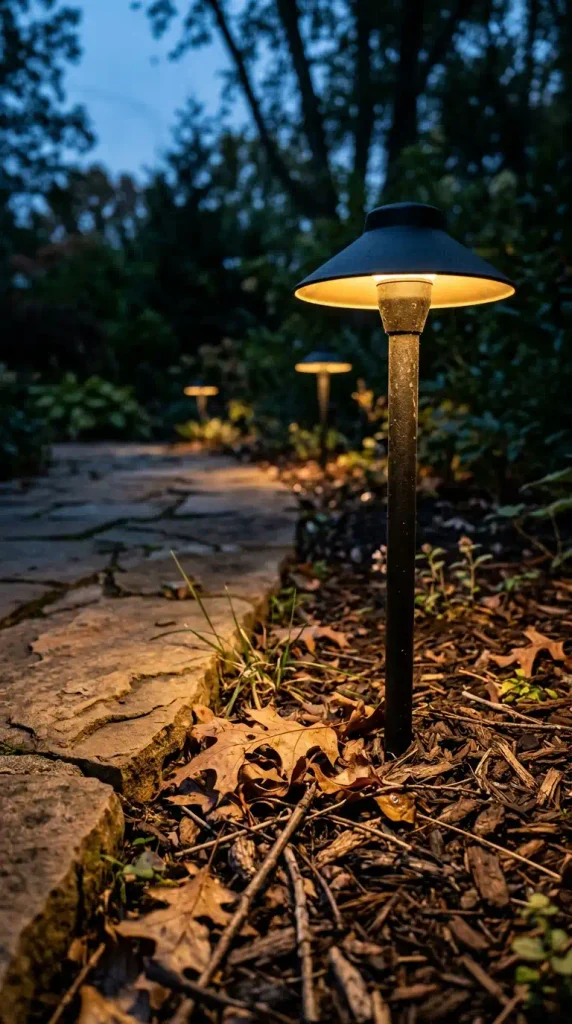
Path Lighting Ideas That Still Work Under Falling Leaves
Path lights do the hardest job in the yard, and fall makes it harder. Leaves pile up around the stems and smother the pool of light on the ground.
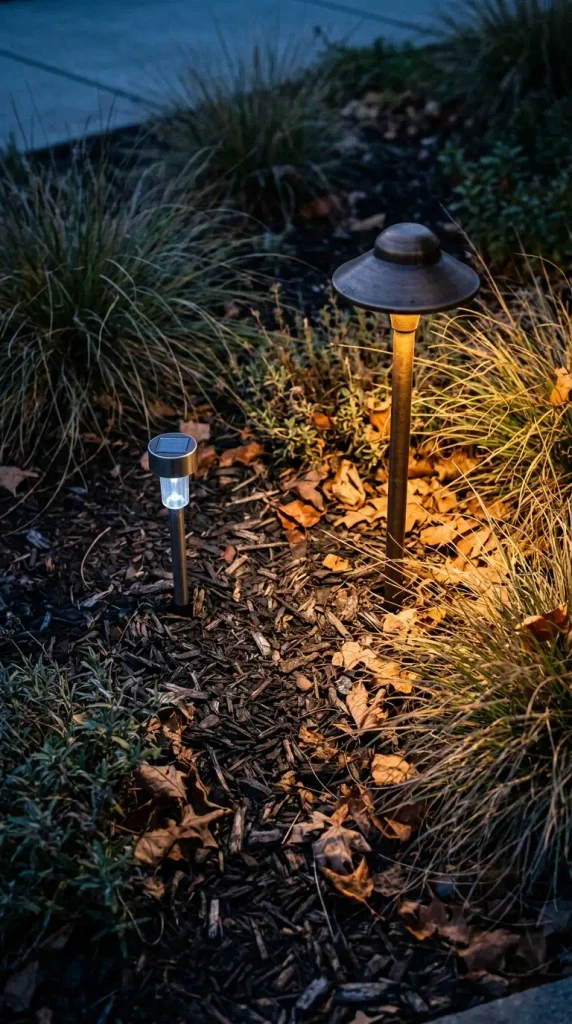
Taller fixtures help. A light that stands about 15 inches high sits above most leaf drifts and throws a wider circle. Space low voltage path lights roughly 8 to 15 feet apart, and stagger them from one side of the walk to the other. A straight double row looks like an airport runway.
Keep the brightness low. Many residential path lights put out only 20 to 30 lumens, and that’s plenty for a walk. A Hampton Bay six pack of 28 lumen low voltage path lights runs around $70, which covers a typical front walk.
Solar path lights need tighter spacing, closer to 6 to 8 feet, because each one is dimmer.
One habit beats any fixture upgrade. Kick the leaves off your path lights once a week in October and November. Two minutes, tops.
Uplight Your Trees After the Leaves Drop
Here’s the timing trick none of the big guides mention. A tree you light in September is a different tree by mid November.
With leaves on, an uplight hits a solid wall of foliage and glows. After leaf drop, that same beam shoots straight through bare twigs and into the sky. You lose the glow and gain light pollution.
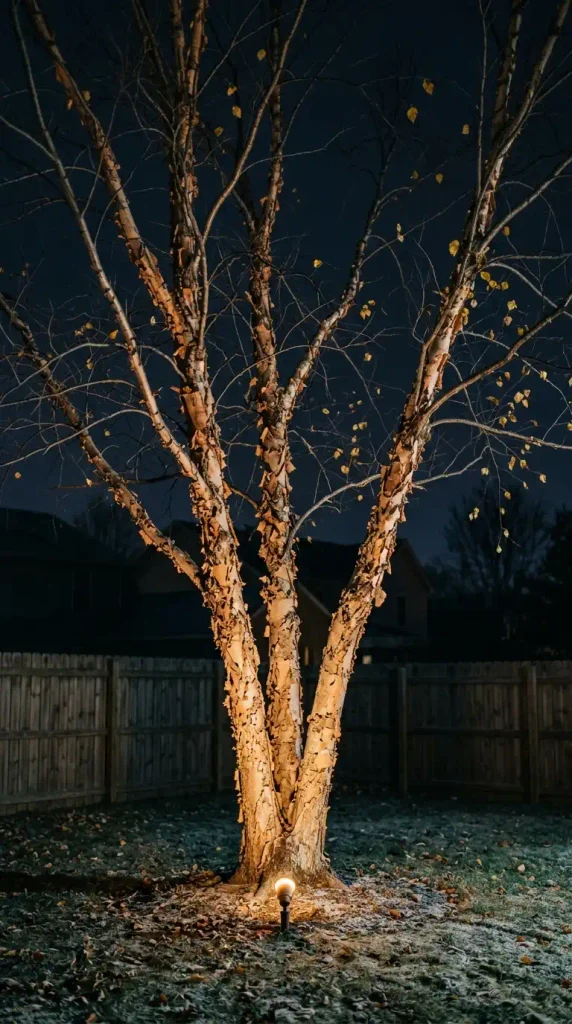
So set your spotlights in October, then aim them again once most leaves are down. Pull the fixture a couple of feet back from the trunk. Tilt it so the beam grazes the bark and the first big limbs. Bare branches make strong night shapes, especially on oaks, river birch, and Japanese maples.
If you want color control, a smart fixture like the Philips Hue low voltage spotlight runs around $115 to $120 each. For most yards, a plain warm white spot does the same job for far less.
Want more ways to light a single tree? Our simple tree lighting ideas for fall nights cover wraps, spirals, and hanging lanterns.
Spotlight tight to the trunk, pointed high into a full canopy. Looks great until the leaves fall, then the beam escapes into the sky.
Same fixture, moved a couple of feet out and tilted lower. The light now grazes bark and branch shapes and stays on the tree.
Warm Light Beats Cool Light on Fall Color
Some big retail guides suggest cool, bluish bulbs for plants and warm bulbs for stone and wood. In fall, we’d skip that advice.
Cool light flattens warm colors. Red maple leaves, gold ginkgo, rust mums, and orange pumpkins all lean gray under a 5000K bulb. Warm light around 2700K pulls those reds and golds forward instead.
Warm light is also kinder to the night sky. DarkSky International, the group behind the DarkSky Approved seal, suggests warm light no higher than 3000K and fixtures aimed down or straight at their target. Their five principles for dark sky friendly home lighting make a quick gut check before you buy.
Our rule is simple. Every bulb in the yard lands between 2700K and 3000K. Bulbs labeled “daylight” usually run around 4000K to 5000K, and they belong in a garage, not a garden bed.
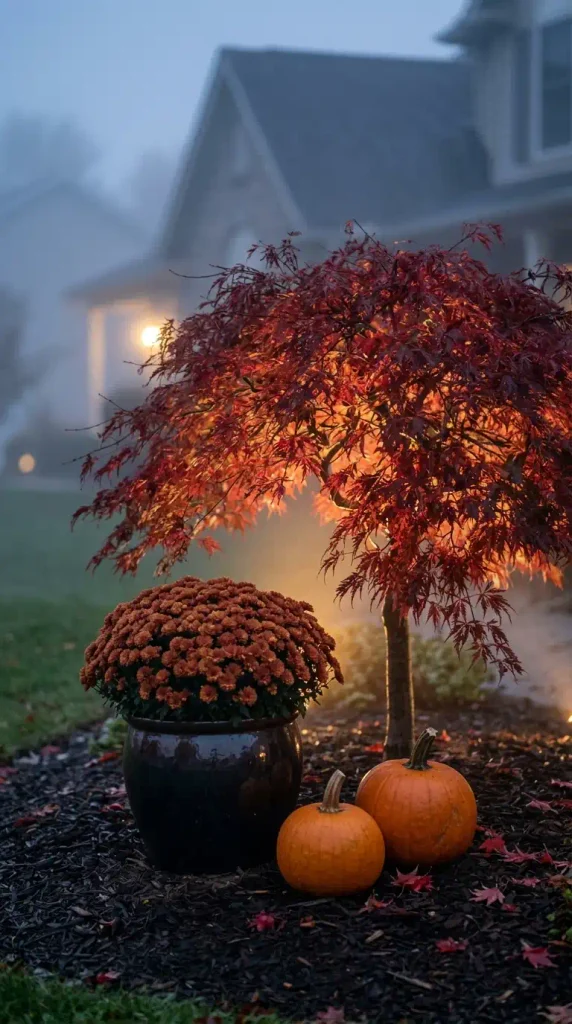
Use 2700K to 3000K bulbs on plants, paths, and patios.
Pick shielded fixtures that point down or straight at the target.
Bulbs labeled daylight, around 4000K to 5000K, on fall foliage.
Bare floodlights aimed across the fence at a neighbor’s windows.
Low Voltage or Solar: What Works When Days Get Short
Solar looks like the easy answer. No cable, no outlet, no digging. The catch is that fall gives solar panels less of what they need. Days are shorter and the sun sits lower, and solar lights only work at their best when the panels get the hours of sun the maker calls for.
That’s why we use solar for accents and low voltage landscape lighting for anything you walk on.
Prices are friendlier than most people expect:
- A Mainstays six pack of solar path lights is about $20 at Walmart, but each light puts out roughly 12 lumens.
- A SUNVIE all in one low voltage kit with 12 lights, a transformer, and 100 feet of cable runs about $140.
- Designer path lights from brands like Hinkley or WAC climb to around $200 to $255 each.
Low voltage runs through a transformer that plugs into an outdoor outlet and steps household power down to about 12 volts. Use outdoor rated, UL listed lights and cords on a GFCI outlet. Anything beyond plugging into an existing outlet is a job for a licensed electrician.
| 🔌 Low voltage | 🌞 Solar | |
|---|---|---|
| Fall brightness | Steady every night | Drops on short, cloudy days |
| Starter cost | About $140 for a 12 light kit | About $20 for a six pack |
| Best job | Paths, steps, trees | Accents in sunny beds |
| Effort | One weekend | One afternoon |
Your Install Weekend: Do It Before the Ground Freezes
Plan one weekend in mid to late October in Zones 5 to 7, or in November farther south. Dry soil and mild afternoons make digging easy.
- Add up the watts. Multiply the total wattage of every fixture by 1.25, then buy a transformer at least that big. A 120 watt transformer with a timer and photocell runs around $45 to $55 at Home Depot.
- Pick your cable. Use 14 gauge for systems up to 200 watts and 12 gauge above that.
- Lay it out first. Set every fixture on top of the ground, with the first one at least 10 feet from the transformer.
- Test at dusk. Move lights now, while the cable is still loose.
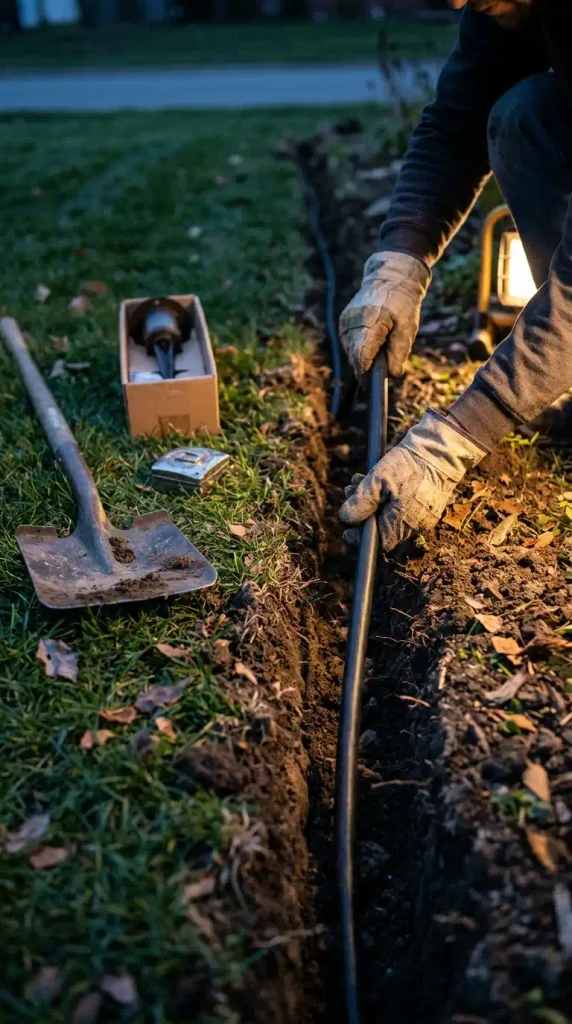
- Bury the cable. Kichler’s install sheets call for at least 6 inches. Some pros go shallower so they can move fixtures later. If your lawn gets core aerated in fall, go with 6 inches to keep the tines off your wire.
- Leave slack. Coil a little extra cable at each light so you can shift it a foot next spring.
Call 811 a few days before you dig. It’s free, and it keeps your shovel away from buried gas and power lines.
⚠️ Watch Out
Never join landscape cable with indoor wire nuts or tape. Use waterproof connectors rated for direct burial, and only cable marked for direct burial. Regular lamp cord breaks down underground.
Patio Lighting for Fall Evenings Outside
Landscape lights handle the yard. The patio needs softer, closer light, because that’s where people actually sit.
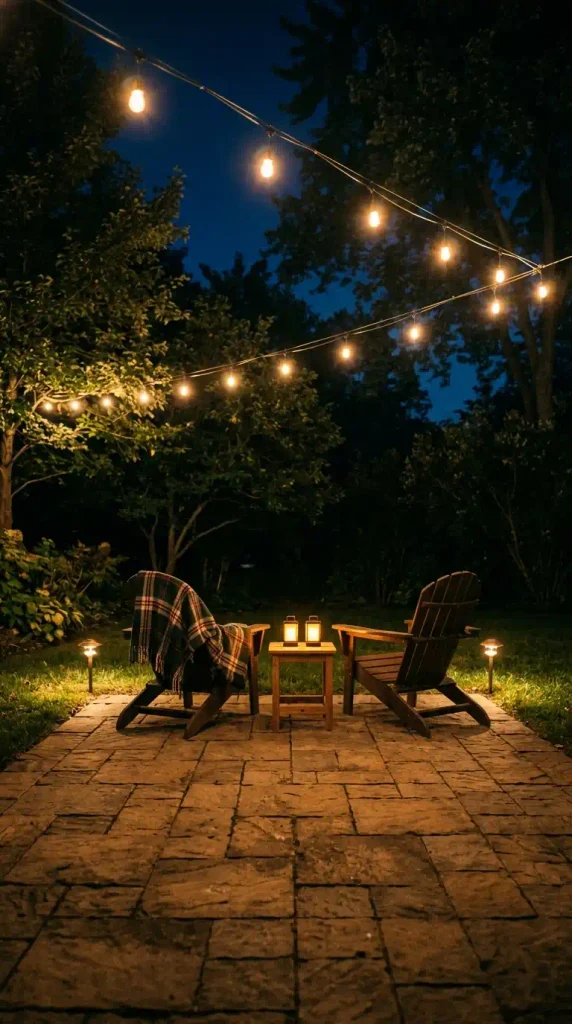
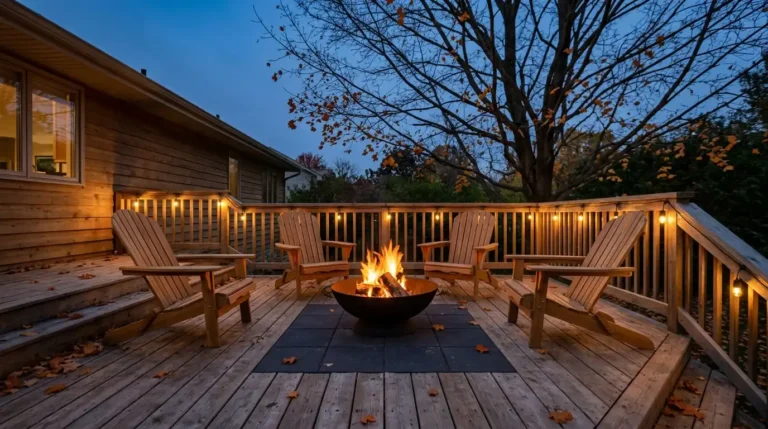
Think in three layers: one overhead source, one or two at table height, and a little light low near the edges.
For overhead, warm string lights on a steel guide wire give you the most glow for the money. Table lanterns with LED candles add flicker without a flame near cushions or dry leaves. Then a path light or two where the patio meets the lawn ties the seating to the rest of the yard, so it doesn’t float in the dark.
Put the patio on its own switch or timer channel. You’ll want the yard lights on every night, but the patio only when someone’s out there.
We pulled together 27 more cozy outdoor lighting ideas for fall if you want more ways to dress the seating area itself.
🪑 Copy this fall patio setup
The November 1 Reset and Late Fall Upkeep
Daylight saving time ends at 2 a.m. on Sunday, November 1, 2026. In Indianapolis, sunset moves about 45 minutes earlier overnight and lands just before 5:30 p.m.
How your lights react depends on the control:
- Photocell: it turns lights on when it senses dark, so it adjusts by itself.
- Astronomical timer: it tracks sunset by date and location, so it adjusts too, as long as its clock is right.
- Plain clock timer: it has no idea anything changed. Your lights will come on an hour late until you fix it.
Check every transformer and timer that weekend. Then keep a short late fall routine:
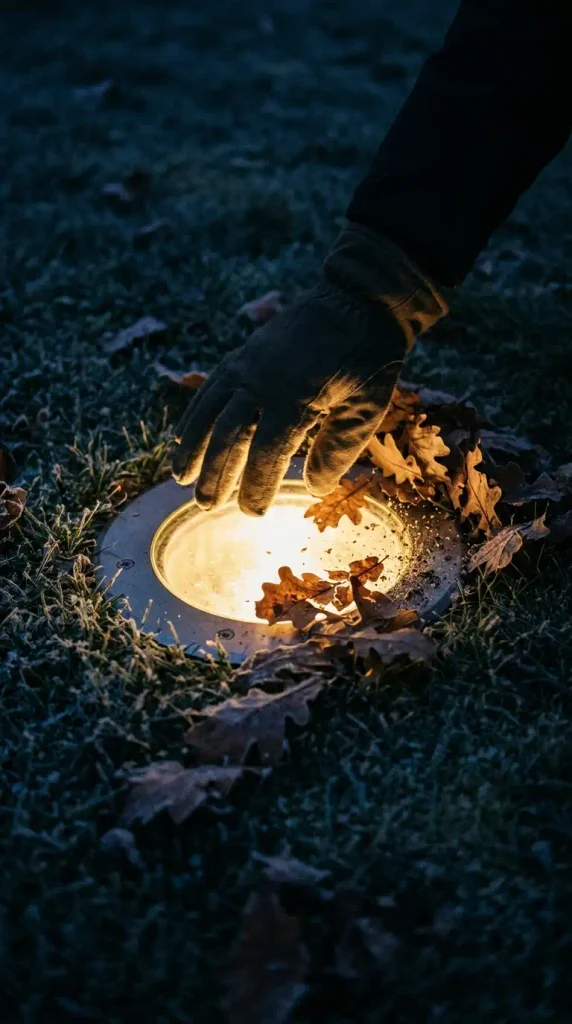
- Clear leaves off path lights and in ground well lights every week until the trees are bare.
- After the first hard freeze, walk the system at dusk and look for dark fixtures. Frozen soil can heave a stake or loosen a connector.
- Plan holiday lights on their own outdoor outlet. Don’t hang them off your landscape transformer.
Lights coming on an hour late after November 1? That’s a plain clock timer. Reset it once, or swap in a photocell and never think about it again.
Outdoor Lighting Landscaping Ideas Frequently Asked Questions
How far apart should path lights be?
Space low voltage path lights about 8 to 15 feet apart, and stagger them from side to side so the walk doesn’t look like a runway. Solar path lights are dimmer, so set them closer, around 6 to 8 feet apart. In fall, choose fixtures about 15 inches tall so leaf drifts don’t bury the light. Before you bury any cable, test the spacing at dusk with the fixtures sitting on top of the ground.
What color temperature is best for landscape lighting?
Stay between 2700K and 3000K for nearly everything outdoors. Warm light makes fall reds and golds glow, flatters stone and wood, and is easier on the night sky. DarkSky International recommends staying at or under 3000K. Skip bulbs labeled daylight, which usually run around 4000K to 5000K. They make foliage look gray and the whole yard feel like a parking lot.
Can I install landscape lighting myself?
Yes, if you stick to a low voltage system that plugs in. The transformer plugs into a GFCI outdoor outlet and steps power down to about 12 volts, so most homeowners finish in a weekend. Size the transformer at 1.25 times your total fixture wattage, and call 811 before you dig. Adding a new outlet or hardwiring anything is a job for a licensed electrician.
How deep do you bury low voltage landscape wire?
Follow the instructions that come with your cable. Kichler’s install sheets call for at least 6 inches of cover. Some installers keep cable shallower so fixtures are easy to move later. If your lawn gets core aerated in fall, go with 6 inches so the aerator tines can’t nick the wire. Always use cable rated for direct burial.
Do solar landscape lights work in fall and winter?
They work, but they get dimmer and shut off sooner. Short days and a low sun angle mean less charge, and solar lights perform best only when the panels get the hours of sun the maker recommends. Use solar for small accents in sunny beds. For paths and steps you rely on every night, low voltage is the steadier choice.
When should you install outdoor landscape lighting?
Early to mid fall is ideal. Plan in early October, test layouts by mid October, and bury cable before the ground freezes. In Zones 5 to 7 that usually means late October, and in Zones 8 and 9 you have into November. Wait until most leaves drop before you do the final aiming on tree lights.
Can you have too much landscape lighting?
Yes. Light every inch and the yard loses its depth, starts to feel like a parking lot, and spills glare into neighbors’ windows. Give each fixture one job: safety, accent, or gathering. Most small yards look best with lit paths, two or three accent features, and a lit seating area. Leave some shadow on purpose, because the dark is what makes the lit parts stand out.
Your Yard After Dark
Fall is a short window, and that’s the point. Walk the yard this week, lay your lights out before the ground freezes, and aim the trees again once the leaves let go. Then reset the timer on November 1 and enjoy the long evenings you just bought back.
Start small if you need to. Of all the outdoor lighting landscaping ideas here, one lit path and one glowing tree will change how your yard feels after dinner the most.
Save this guide to your fall projects board so the calendar is waiting for you next October. Pin the hero image, and come back when the first leaves start to drop.
One Comment