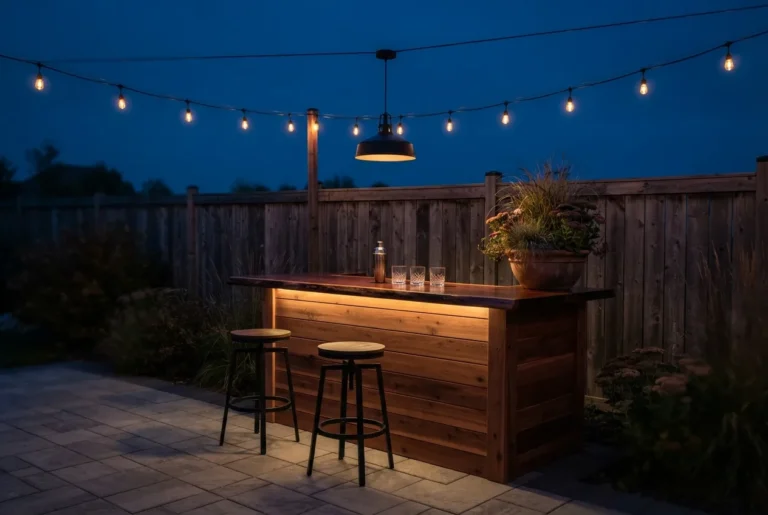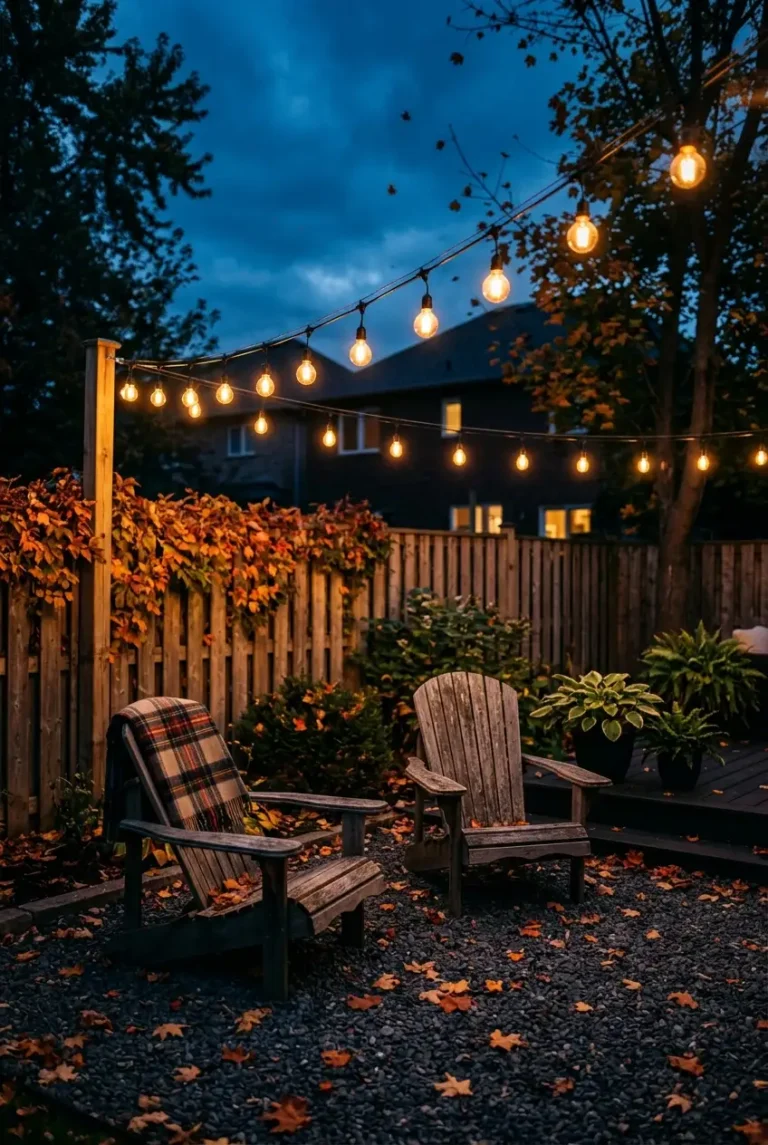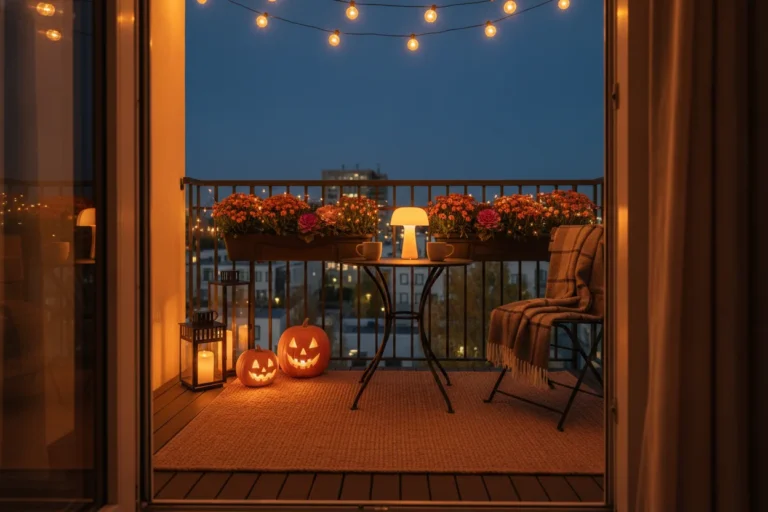
Boho Outdoor Lighting Ideas: How to Hang String Lights for Fall

Fall is when a backyard either glows or goes dark at six. The sun drops behind the fence before dinner, the air turns sharp, and the patio you used all summer becomes a black rectangle you walk past. Most boho outdoor lighting ideas saved on Pinterest skip the part that decides whether yours looks good: how high the strand hangs, what color the bulbs are, and what you anchor to when there is no pergola and no tree.
So that is what we are doing here.
One main run of warm bulbs overhead. Two smaller layers underneath. A cord route that survives rain, and a setup that still works the week the clocks change. You need a tape measure, a cordless drill, and most of a Saturday afternoon. For a standard patio the whole thing lands somewhere between $60 and $150, less if you already own a ladder and a box of zip ties.
The look is woven, warm, and a little uneven. The method is not.
Why most backyard lighting misses the boho mark
Bohemian light is low, warm, and repeated. That is the whole idea. You are not lighting a work area, you are making four or five soft pools of amber that overlap and leave shadow in between. A single bright fixture on the back wall does the opposite: it flattens everything, throws hard shadow across the seating, and makes the yard feel like a parking lot.
Three things separate the look you saved from the one you built.
Warmth. Height. Repetition.
Bulb color does more work than bulb count. Anything above 3000K reads blue and clinical outdoors, which is why a $30 strand in soft white beats a $90 strand in daylight white every time. Height decides glare. Repetition, meaning the same bulb shape showing up in three places instead of one, is what makes a patio read as styled rather than lit.
Run one strand overhead, then add two low sources at seat height.
Stick to 2200K to 2700K bulbs across every fixture you own.
Let the strand sag. A straight line looks like a job site.
One bright wall fixture doing all the work.
Mixing 5000K security floods with warm café bulbs.
Color changing strands left on the rainbow setting.
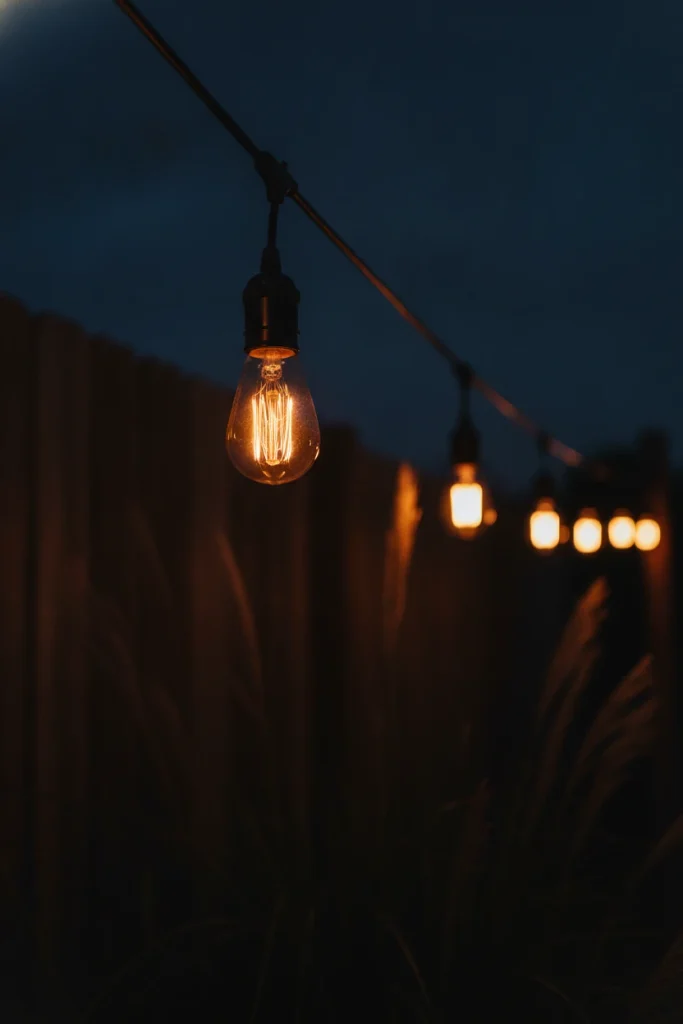
The 9-3-2700 Rule for boho patio lighting ideas
Here is the whole method in three numbers. Nine feet, three layers, 2700 Kelvin.
Nine feet is where the lowest point of the sag should land. Retailer and brand install guides put patio string lights at 8 to 10 feet above the ground, and nine sits in the middle of that band. Higher and the light scatters before it reaches the table. Lower and you are looking straight into a filament every time you sit down.
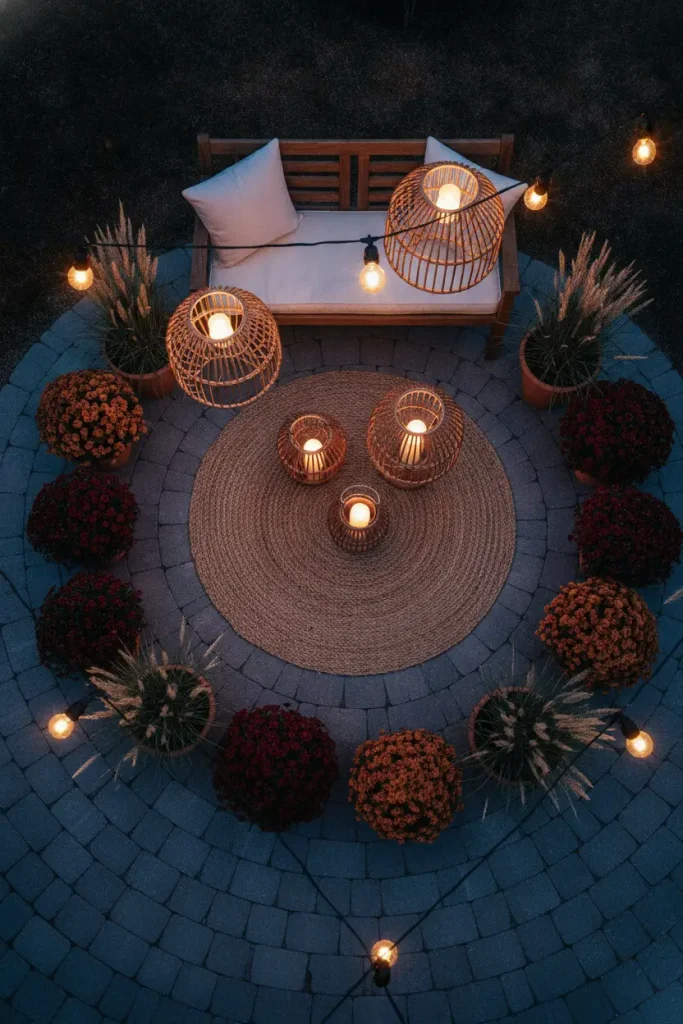
Three layers means overhead, mid, and ground. The strand is layer one. A cluster of rattan or woven pendants at about 6 feet is layer two. Lanterns and candles on the table and the ground are layer three. Two layers reads unfinished. Four gets busy.
2700K is soft white. It is the color temperature printed on nearly every café style strand worth buying, including the Brightech Ambience Pro, and it is the number to match when you buy solar lanterns later so nothing clashes.
Write those three numbers on your hand before you go to the store. Everything after this is just execution.
Measure the run before you buy a single strand
Walk the route you want the lights to travel and measure it with a tape, not with your eyes. Then add 20 percent. Sag eats length, and so does the drop from the anchor point down to the first bulb.
Most café strands come in 48 foot lengths. Bulb spacing tells you how the run will read: a 48 foot Brightech Ambience Pro carries 15 S14 bulbs, which works out to one bulb roughly every three feet and gives you that loose, spaced, bistro look. A 48 foot Hampton Bay strand with 24 bulbs puts one every two feet and reads denser and brighter. Neither is wrong. The spaced version is more boho.
Here is where I will disagree with almost every pin you have saved.
Skip solar for your main run. Solar strands are the default recommendation in fall lighting roundups, and fall is exactly when they fall apart. Panel charge depends on daylight, and daylight is the thing that is disappearing. You want the lights on at 5:30pm in November on the same short gray day that gave the panel four weak hours of charge. Plug in your overhead run. Save solar for the lanterns and path lights on layer three, where a dim evening costs you nothing.
One more filter before checkout. Look for ENERGY STAR certified decorative light strings, which draw no more than 0.2W per bulb, use about 92 percent less energy than incandescent strands, and carry at least a three year warranty. Outdoor labeled ones are weathering tested, which matters more in October than it does in June.
| Plug-in LED (main run) | Solar (accents only) |
|---|---|
| Hampton Bay 48 ft, 24 bulbs, around $30 | Harbor Breeze 48 ft solar, around $60 |
| Brightech Ambience Pro LED 48 ft, 15 bulbs, around $40 | Brightech solar versions, roughly $54 to $75 |
| Same brightness in January as in July | Dims as fall days shorten |
| Needs a GFCI outlet and a cord route | Needs six hours of direct sun on the panel |
Where to anchor when you have no pergola and no trees
This is the question everyone actually has, and it is the one the inspiration posts quietly skip. You have four options, and they are not equal.
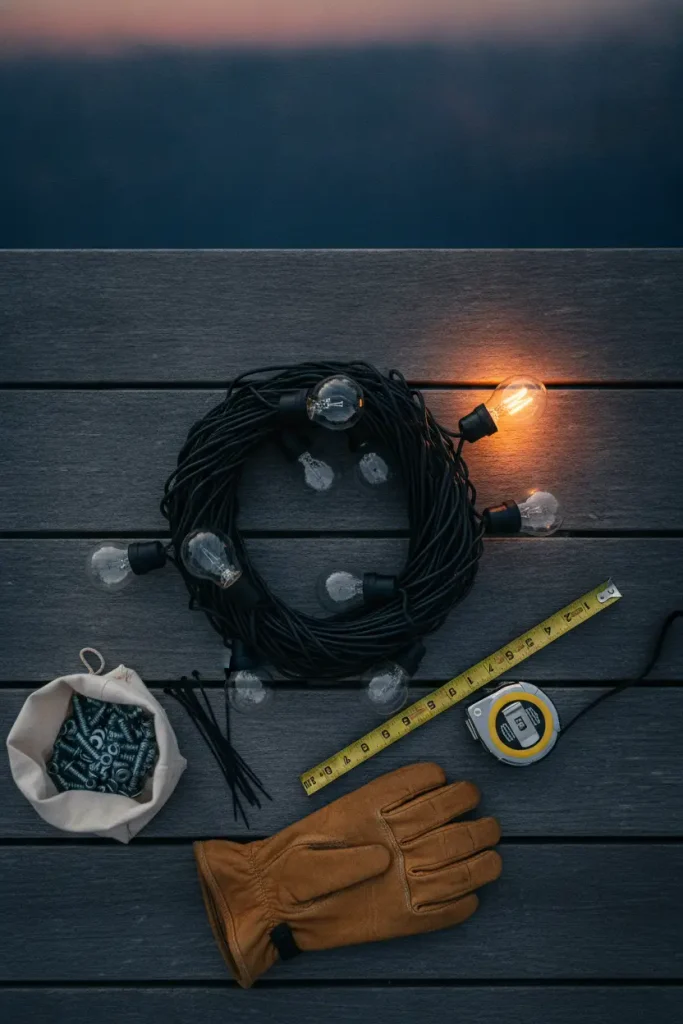
The house wall is the strongest and the cheapest. A 3/8 inch galvanized eye bolt driven into a stud or a fascia board holds a full 48 foot run without complaint. Fences are the weakest. A six foot cedar fence post flexes in wind and will drag your sag down over a season, so use it as a midpoint, never as an end anchor.
Trees work beautifully and need one accommodation. Never wrap wire tight around a trunk or a limb. Use a length of old garden hose as a sleeve, or a tree strap, so the cable cannot cut into bark as the tree moves.
No wall, no fence, no tree? Set your own posts. A 4×4 cedar post in a five gallon bucket of concrete is the standard fix, and the full build, spacing and concrete ratio included, is laid out in our guide to DIY string light poles. Two posts plus a house wall covers most rectangular patios.
Hang the run on a guy wire, not on the cord
Here is the part that separates a strand that lasts three years from one that sags to the ground by Thanksgiving. Do not hang the light cord itself. Hang a steel cable, then clip the lights to it.
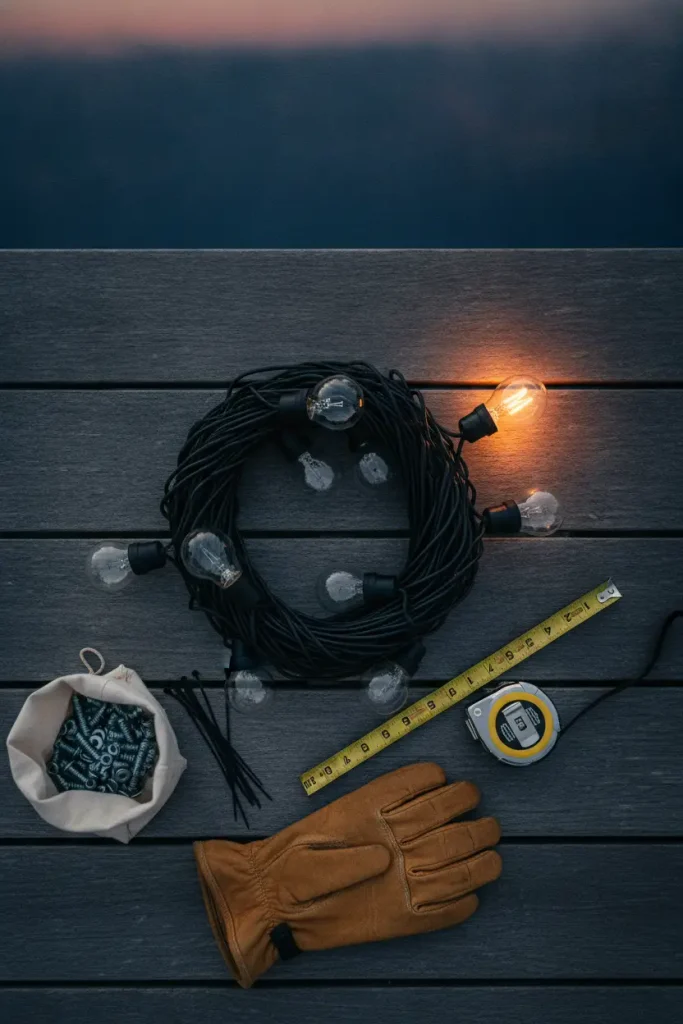
A 1/8 inch galvanized aircraft cable, two turnbuckles and four wire rope clips run about $25 to $35 at Home Depot or Lowe’s. That cable carries the weight and the wind load. The light cord just rides along.
Mark both anchor points at 10 to 11 feet, so the cable still sits near 9 feet at the lowest sag.
Drill a pilot hole into a stud or fascia board, then drive a 3/8 inch galvanized eye bolt into each end.
Run the cable, clamp it with two wire rope clips per end, and add a turnbuckle so you can retension it in spring.
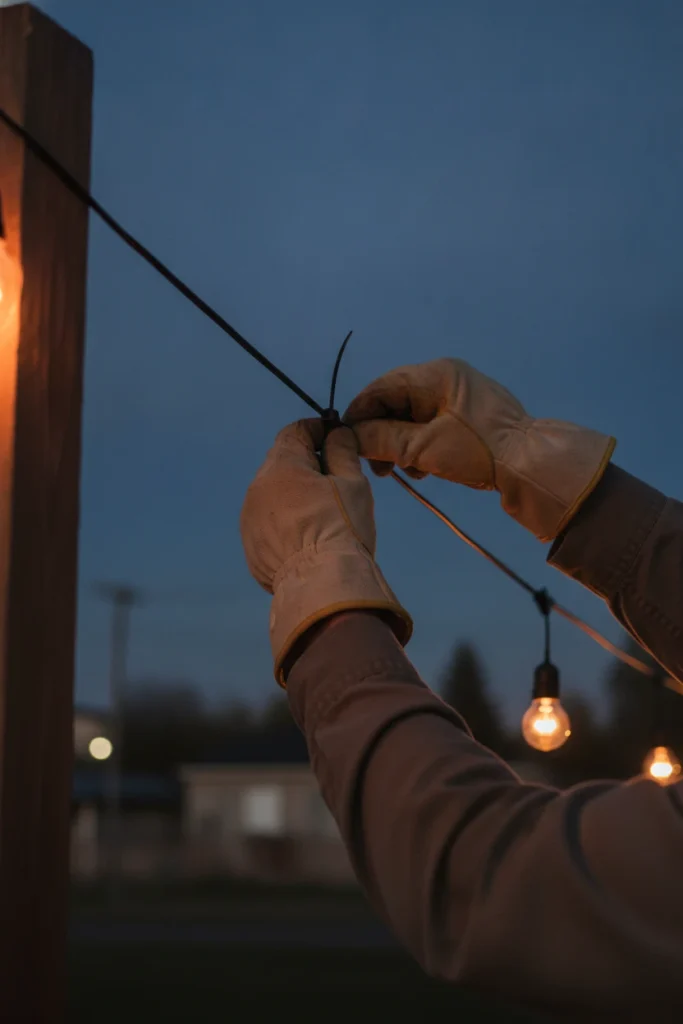
Clip the strand to the cable every two to three feet with UV rated black zip ties or velcro straps.
Leave the last 18 inches loose at the outlet end so wind pulls on the cable, never on the plug.
Cheap white zip ties go brittle in cold and snap around the first hard freeze. Black UV rated ones cost about a dollar more for a bag of 100 and survive the winter. Small thing. Saves you a February ladder trip.
Power it without running a cord across the patio
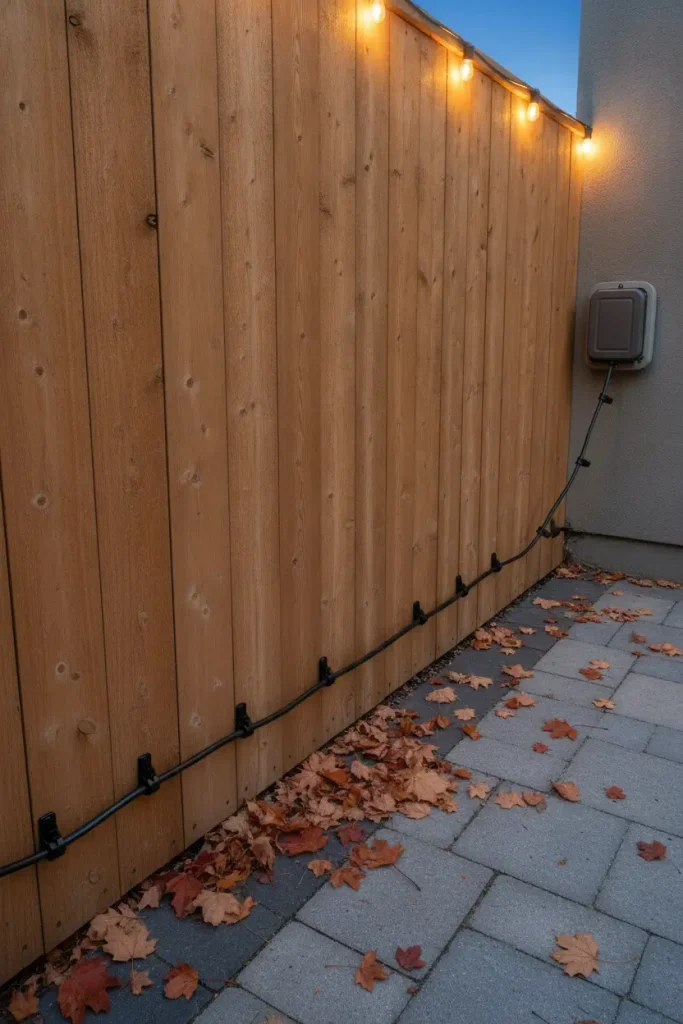
Plan the cord route before you plug anything in. Run it along the base of the fence or the edge of the deck, clip it every few feet with outdoor cord clips, and keep it out of the walking path entirely. A cord taped across a patio is the single most common thing that turns a nice setup into a trip hazard by the second party.
Use an outdoor rated extension cord, which has a thicker jacket than an indoor cord and is marked for outdoor use on the tag. Indoor cords are not rated for moisture and should never go outside, even under a roof. If your only outlet sits inside a wall of the house, a weatherproof in-use outlet cover is the fix, and that is electrician territory.
⚠️ Watch Out
Use outdoor-rated, UL-listed lights and cords on a GFCI outlet. Anything beyond plugging into an existing outlet is a job for a licensed electrician.
A $12 outdoor timer or a smart plug is worth adding while you are out there. Set it to switch on at sunset and off at 11pm, and the lights stop being something you remember to turn on.
Layer two and three: rattan, lanterns and candlelight
The overhead run is the structure. These two layers are the reason it looks bohemian instead of just lit.
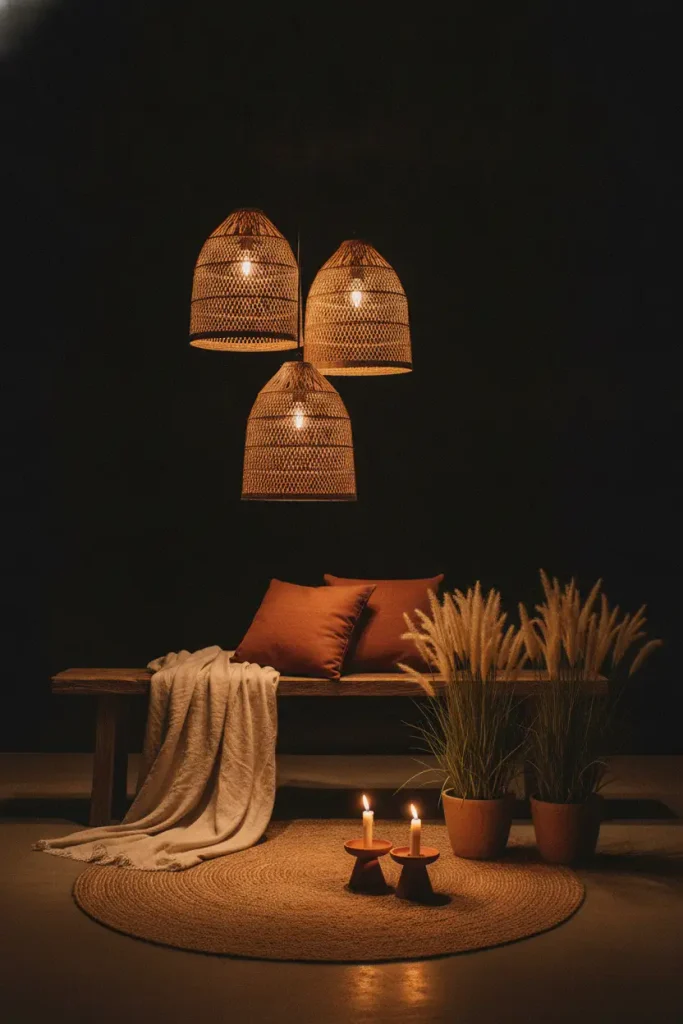
Layer two hangs at about six feet. Woven rattan and bamboo pendants are the shape doing the heavy lifting in every high performing pin on this keyword, usually clustered in threes at staggered heights rather than spaced evenly. Hang them from a shepherd’s hook, a pergola beam, or a low branch. Battery pucks with a 2700K bulb work fine inside them, which keeps this layer completely cord free.
Layer three sits at seat height and below:
The layer three shopping list
Textiles matter more than you expect. A pale rug and a cream throw bounce light back into the seating area, and a dark one absorbs it, which is why two patios with identical strands can look completely different. The rest of the styling, from cushions to shade, is covered in our roundup of cozy boho backyard ideas.
Fall-proof it before first frost
Two dates should shape your timing.
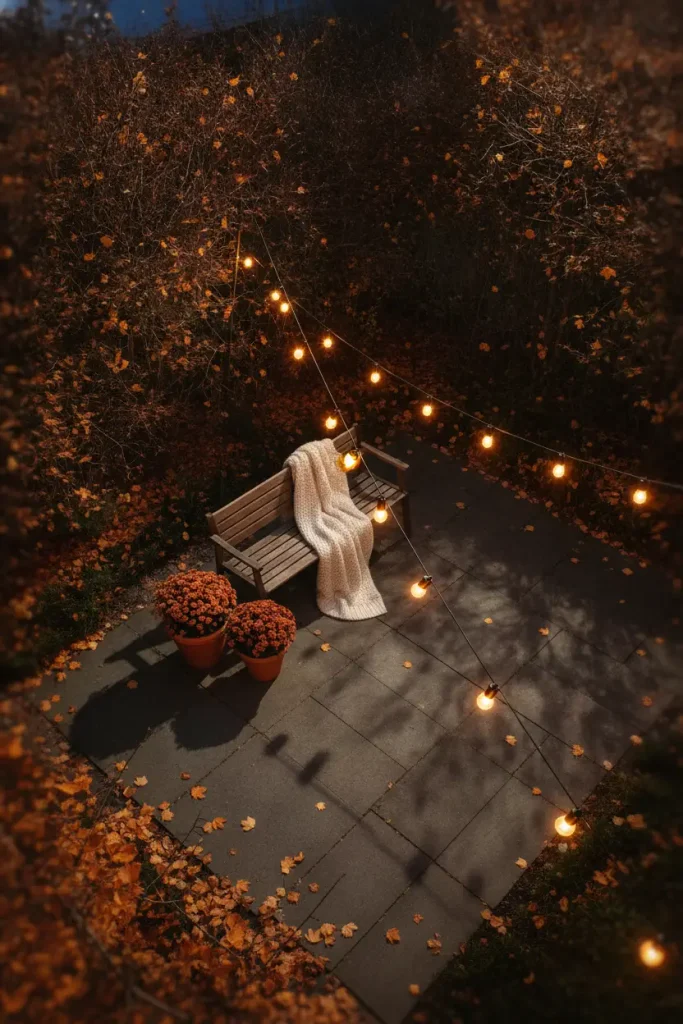
The first is the clock change. Daylight saving time ends on Sunday, November 1, 2026, and sunset jumps a full hour earlier overnight. Whatever your patio looked like at 6pm on Saturday, it will look like 5pm light on Sunday. Getting the lights up in late September or early October means you are ready for that shift instead of reacting to it.
The second is your first frost. In Zone 5 it typically lands in early to mid October, Zone 6 mid to late October, Zone 7 late October into early November, Zone 8 around mid November, and Zone 9 into early December. Those are typical ranges and they move year to year, so confirm yours against the USDA Plant Hardiness Zone Map or your county extension office before you plan a build date.
Before the cold sets in, do three things. Drip loop every cord connection, meaning let the cord hang below the plug so water runs off instead of into it. Retension the turnbuckle, because a strand that sagged to seven feet in October will be brushing shoulders by December. Move any solar lanterns to the sunniest edge of the yard, since the low fall sun angle cuts their charging window sharply.
Warm light at nine feet turns a dark yard back into a room, on exactly the evenings you would otherwise stay inside.
Renting, or working under a roof? No-drill options that hold
Nothing above requires you to own the house.
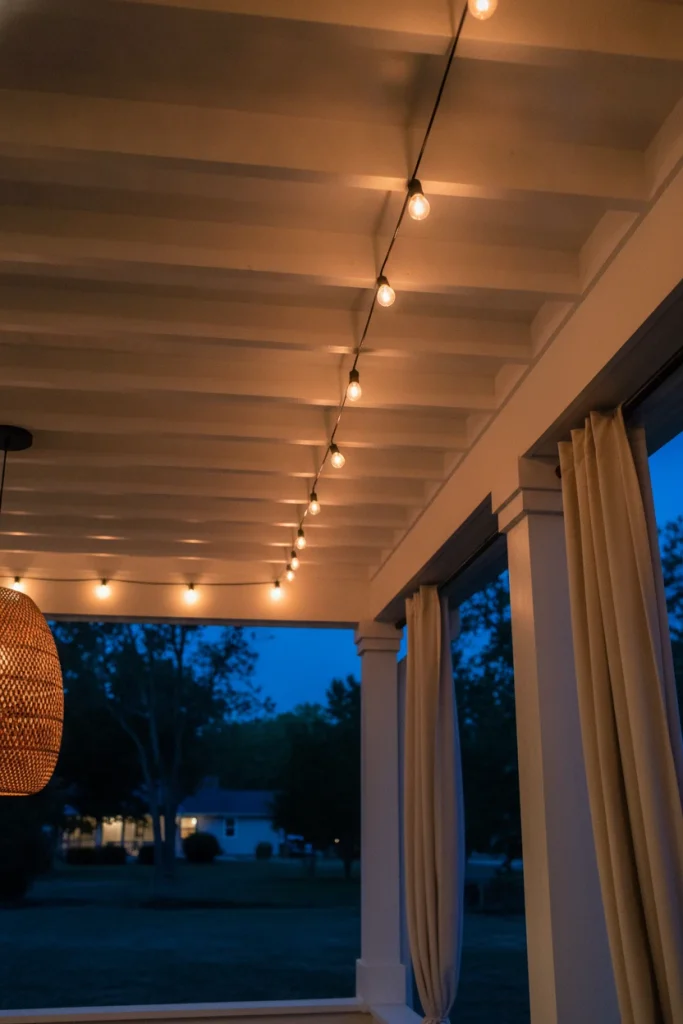
Under a covered patio or a porch ceiling, adhesive hooks rated for at least five pounds hold a 48 foot LED strand easily, since the strand itself weighs very little once the cable carries no load. Clean the surface with rubbing alcohol first, press for 30 seconds, and wait an hour before hanging anything. On vinyl siding, vinyl siding hooks slide under the lap and need no fasteners at all. Along a railing, velcro straps beat zip ties because you can undo them without scissors.
- ▸Adhesive hooks rated 5 lb or higher, about $6 for a pack of six.
- ▸Vinyl siding hooks, roughly $8 for 20, no drilling and no holes.
- ▸Freestanding poles in planters, the only option that moves with you.
- ▸Tension rod across a balcony alcove, for spaces under six feet wide.
One warning on adhesive. It loses grip in the cold, so check every hook in the first week of real freezing weather. The full layout approach for roofed spaces, including which direction to run the strands so the beams work for you, is in our guide to string lights on a covered patio.
FAQ
What is boho style lighting?
Boho lighting is warm, low, and repeated rather than bright and centralized. It leans on natural materials like rattan, bamboo, jute and hammered metal, uses amber toned bulbs in the 2200K to 2700K range, and spreads several small sources around a space instead of one strong fixture. Texture matters as much as the light itself, which is why woven shades and lanterns show up constantly.
What is the rule of thumb for outdoor lighting?
Two rules cover most of it. Hang overhead string lights so the lowest point of the sag sits 8 to 10 feet above the ground, and keep every bulb in the space at the same warm color temperature, ideally 2700K. Beyond that, aim for three layers, overhead, around six feet, and at ground level, so light overlaps instead of arriving from one direction.
What is the best way to hang string lights on my patio?
Run a 1/8 inch galvanized steel guy wire between two solid anchor points, then clip the light strand to that cable with UV rated zip ties every two to three feet. The cable carries the weight and the wind load, so the light cord never stretches. Add a turnbuckle at one end so you can retension the run each spring in about a minute.
How do you hang string lights on a covered patio without drilling?
Use adhesive hooks rated for at least five pounds, cleaning the surface with rubbing alcohol first and letting the adhesive cure for an hour before you hang anything. On vinyl siding, vinyl siding hooks slide under the lap with no fasteners. Both lose grip in cold weather, so check them once when temperatures first drop below freezing.
How do you hang string lights outside without an outlet?
Battery operated strands with a timer cover short runs, and solar strands work if the panel gets six hours of direct sun, though output drops as fall days shorten. For a full length overhead run with reliable brightness, an outdoor rated extension cord from an existing exterior outlet is more dependable. Adding a new outdoor outlet is a licensed electrician’s job.
What are the trends for outdoor lighting in 2026?
The saves on Pinterest right now cluster around clustered rattan and basket pendants at mixed heights, warm amber glow against dark backgrounds rather than evenly bright patios, and pergola runs paired with cream drapery. Dimmable and timer controlled setups are common. Take trend claims lightly and build around warmth and height, which do not go out of style.
Put it up this weekend
A dark backyard in October is not a design problem, it is a scheduling one. Measure your run on Friday, pick up a strand and a cable kit on Saturday morning, and you can be sitting under it by dinner. Nine feet, three layers, 2700K. Everything else is just which lanterns you like.
Once it is up, the yard stops closing at sunset, which is the entire point of doing this before the clocks change rather than after.
Save this to your fall backyard board so the measurements are there when you are standing in the aisle.