12 Inviting Outdoor Dining Lighting Ideas for Cozy Fall Nights

The best outdoor dining lighting ideas are the ones that still work in October. That is the part most guides skip. A patio that glowed all July can go flat and gray by the first week of fall, and the lights did not change at all. The yard around them did.
Leaves drop. The ground stops bouncing light back. Dinner starts at 6:15 instead of 8:00, and suddenly the strand that looked warm in August reads thin and scattered.
So this list is built around a fall problem, not a summer one. You will get bulb specs, a table-height fix, a real answer on solar, fire pit clearance from the people who write the fire rules, and a rig that survives dew and a time change. Twelve ideas, ordered by how much they change the room.
All of it runs on one method we use for every evening space, called the Three-Height Dusk Map.
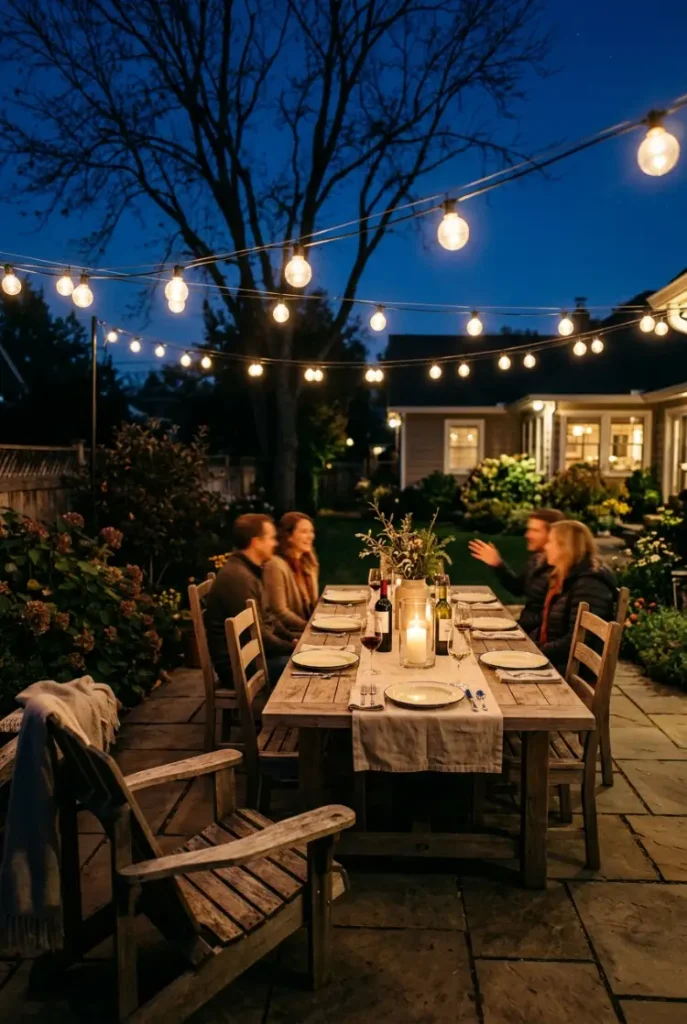
The Three-Height Dusk Map
Stand where you will actually sit, then check light at three heights. Overhead, roughly 8 to 9 feet up, is your ceiling. Eye level, around 4 to 5 feet, is where faces and edges live. Table level, 0 to 30 inches, is where food and hands are.
Most patios have one of the three and nothing else. Overhead strings alone give you a lit ceiling and a dark table. Candles alone give you a warm table floating in a black yard. Fill all three and the space reads finished, even on a budget.
Walk it at 6 p.m. in October, not at noon. The map only tells the truth in the dark.
1. Hang the canopy lower once the leaves quit on you
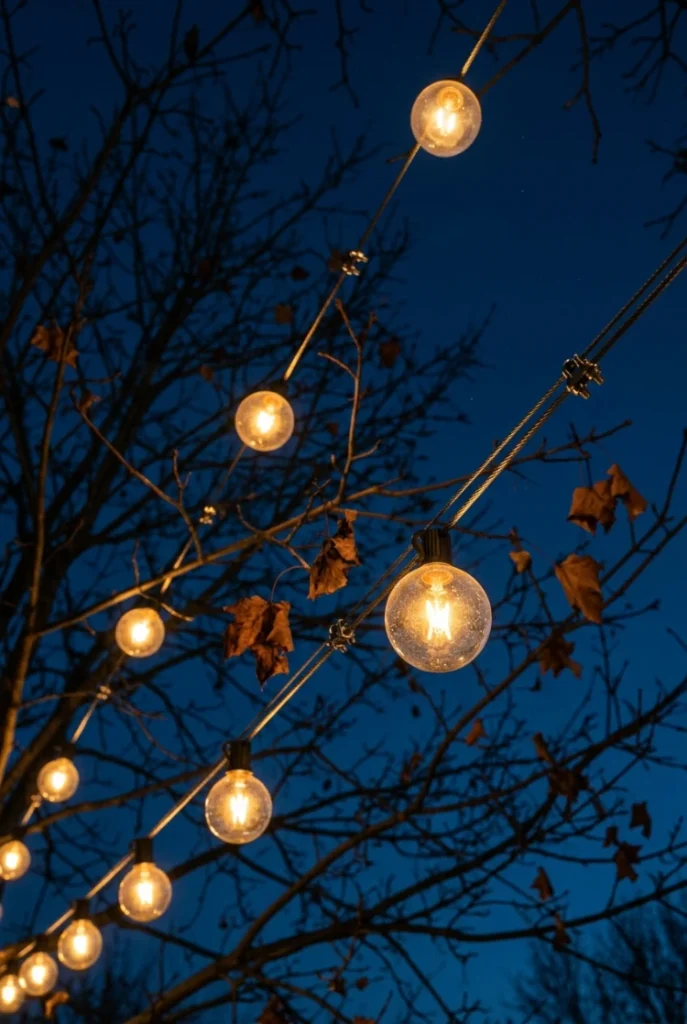
October takes your ceiling away. All summer, a full tree crown caught your string lights and threw the glow back down. Bare branches do not do that, so the same strand scatters into a dark sky and the table under it dims by a noticeable amount.
The fix is height, not wattage.
Drop your anchor points to about 8 feet over the table, down from the 10 to 12 feet that works in summer.
Tighten the spread. Two passes directly over the table beat five passes spread across the whole yard.
Run a stainless guide wire first, then clip the strand to it. Sag is what makes a fall patio look sloppy.
Commercial-grade G40 strands from Brightech or Feit run around $30 to $45 for a 48-foot length, and they take a season of wind better than the thin decorative kind. If your anchor points are the problem, here is how we hang string lights without trees.
2. Warm white or nothing
Bulb color does more work than bulb count. Anything above 3000K pulls the blue end forward, and blue light makes fall food look gray and skin look tired. Warm bulbs sit in the same range as candle flame, which is why they flatter a table without anyone knowing why.
ENERGY STAR explains how Kelvin ratings change the mood of a light: lower Kelvin numbers read yellow, higher numbers read white or blue. The Department of Energy puts most white bulbs on the market between 2700K and 5000K, so you have to read the box.
| 2700K warm white | 4000K cool white |
|---|---|
| Close to candle and incandescent color | Reads clinical outdoors after dark |
| Makes rust, wood, and dried grasses glow | Flattens fall color to brown |
| Attracts fewer flying insects | Pulls in more late-season gnats |
A 12-pack of warm white replacement bulbs runs under $20 at Home Depot or Lowe’s. Cheapest upgrade on this whole list.
No image on this entry.
3. Give the table its own light
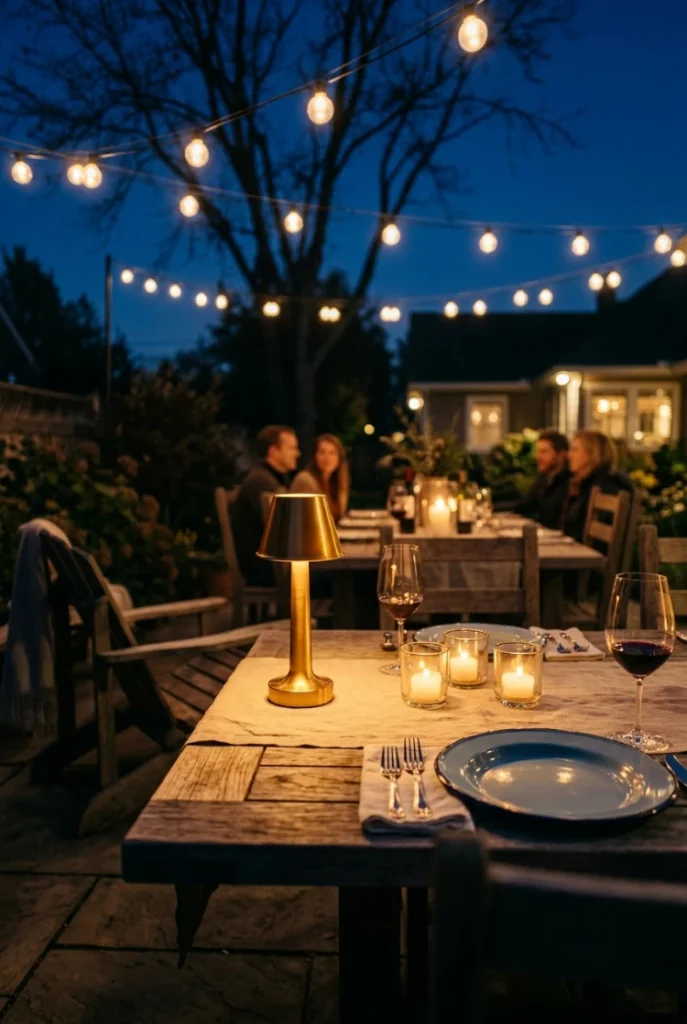
Why does the food look gray under a lit canopy? Because overhead light lands on the top of everything and the sides of nothing. Faces go shadowed. Plates go dull.
The Illuminating Engineering Society points at a very low target for dining surfaces, somewhere around 3 to 6 footcandles, which is far dimmer than most people guess. That is the whole trick. You do not need more light. You need it lower and closer.
Portable rechargeable table lamps in the $40 to $90 range have taken over restaurant patios for exactly this reason. Two of them, plus three glass votive holders from Dollar Tree at roughly a dollar each, will beat a second strand of overhead bulbs every single time.
4. Skip solar this season and run a plug with a timer
Two ways to power a fall patio, and only one of them holds up past 7 p.m.
Solar is the default recommendation everywhere, and for fall it is the wrong one. Panels need daylight to bank a charge, and the daylight window shrinks exactly when you start eating outside earlier. Industry testing puts cold-season solar output down roughly 30 to 50 percent, between shorter charging hours, a lower sun angle, and batteries that hold less in the cold. A strand that ran six hours in July may quit before dessert in November.
Run an outdoor-rated cord to a GFCI outlet and add a mechanical timer.
Pick dual-charge gear with a USB backup if you want solar anyway.
Pure solar strands under a tree or a north-facing eave.
Indoor extension cords, even for one night.
Use outdoor-rated, UL-listed lights and cords on a GFCI outlet. Anything beyond plugging into an existing outlet is a job for a licensed electrician.
5. Add fire, because it puts out real light
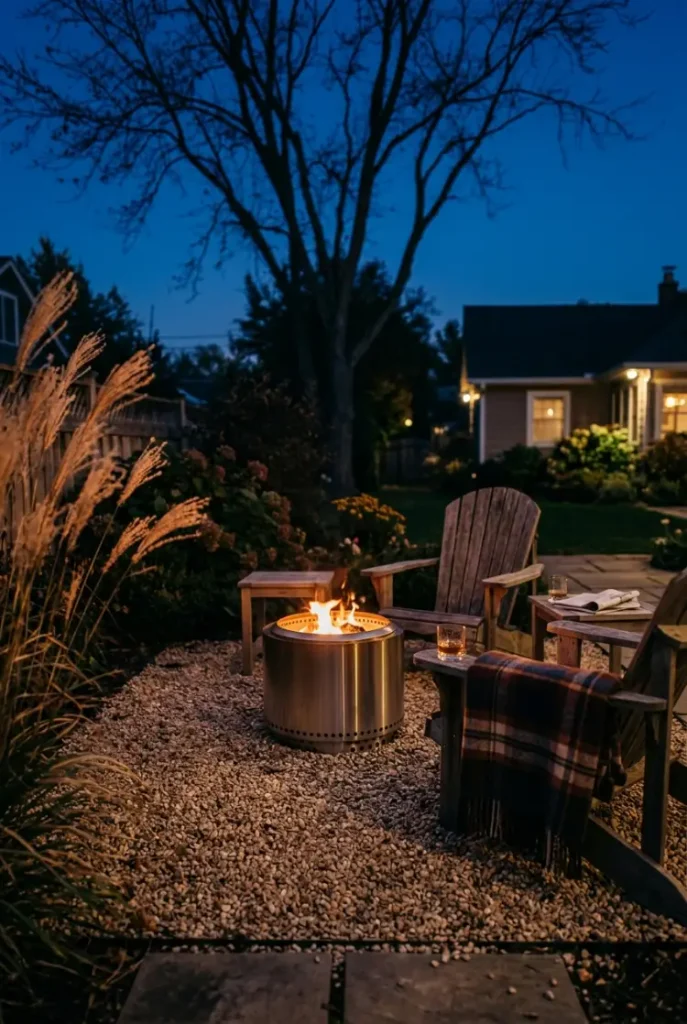
Fire earns its spot for a boring reason. It throws usable light at eye level and heat at the same time, which is the only thing on this list that does both.
A smokeless steel pit sits in the $200 to $400 range from Solo Stove, and simpler bowls from Sunnydaze land under $150. Either one covers the middle height in the Dusk Map without a single cord.
Placement is the part people get wrong. The US Fire Administration’s outdoor fire safety guidance puts fire pits, chimneys, and outdoor fireplaces at least 10 feet from your house or anything that can burn, with a metal screen over wood fires to keep sparks down.
⚠️ Watch Out
Check your city’s burn rules before you light anything, keep the clearance from structures and branches that your fire pit’s manual and local code call for, and never leave a fire unattended.
6. Light one covered corner so drizzle does not end dinner
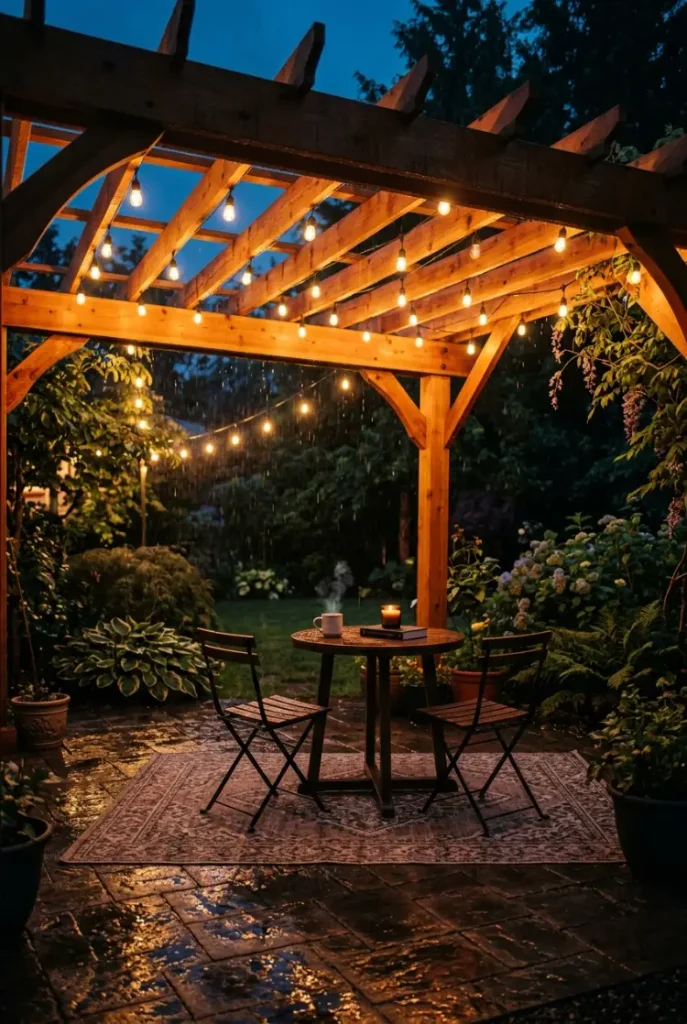
Rain is what actually ends fall dinners, and it usually arrives after the food is already out. A pergola bay, a deep eave, or an 8×8 patch under a shade sail is enough. Light that one zone properly and you always have somewhere to move.
The covered-corner kit
Rafters give you anchor points a bare yard never will, which is why covered patio string lights go up in an afternoon instead of a weekend. Hang them tight. A sagging strand under a roof catches drips and drops them on the table.
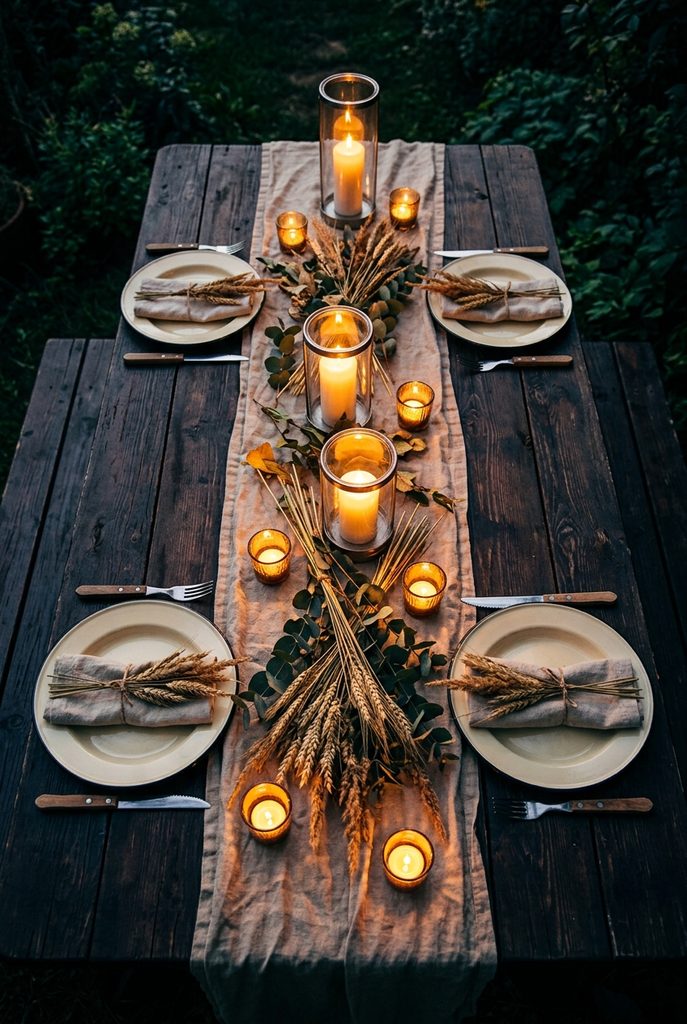
7. Run lanterns down the center at three heights
Three heights, one runner. A line of identical lanterns reads flat, and a single tall one blocks the person across from you. Stagger them and the table gets depth.
Build it with a tall lantern at roughly 14 inches, a mid one near 9 inches, and a cluster of low votives at 3 inches. Then repeat the pattern if your table runs past 6 feet.
Glass lanterns from IKEA and World Market sit in the $10 to $30 tier, and flameless LED pillars solve the wind problem that kills real flames on an open patio. Keep the whole run under 15 inches at its tallest so nobody is talking around a candle.
8. Uplight one tree and the whole yard gets deeper
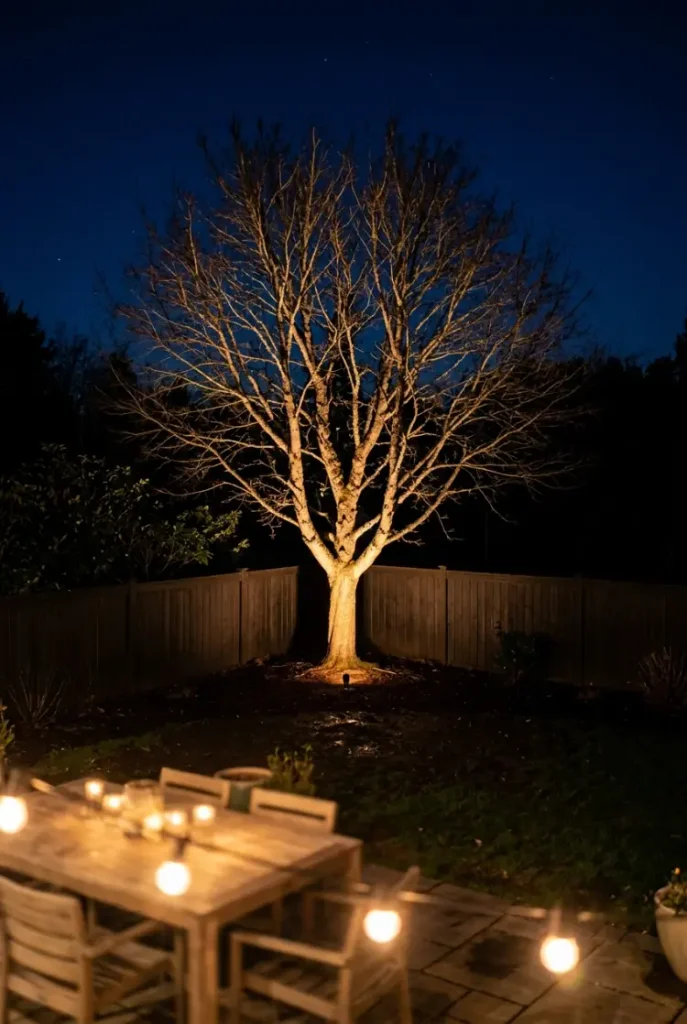
Most yards stop at the fence line after dark. The eye hits a wall of black about 12 feet out, and the patio starts to feel like a small lit box.
One uplight aimed into a single tree fixes that for around $25 to $60. Fall is the ideal season for it, because a bare trunk and branch structure throws a far better shadow than a full summer crown. Set the fixture 18 to 24 inches from the base, angle it up the trunk, and leave everything else dark.
Lighting something beyond the table tells your eye the yard keeps going, and a small patio reads twice its size.
One tree. Not four. A yard lit evenly in every direction looks like a parking lot.
9. Light the step before somebody finds it with a shin
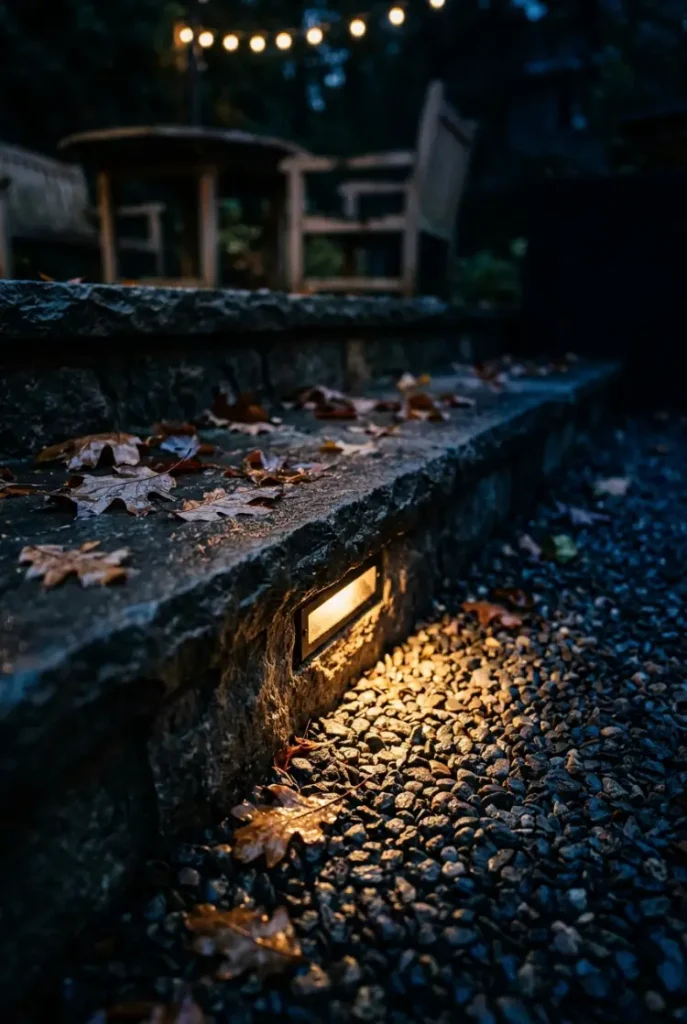
Somebody always finds the step. In June they find it at 9 p.m. with plenty of ambient light left. In late October they find it at 5:40, carrying a full dish.
- ▸Mark every change in level, even a single 6-inch riser.
- ▸Aim low and across, never up into anyone’s eyes.
- ▸Space path lights 6 to 8 feet apart, staggered, not lined up like a runway.
- ▸Match them to 2700K so they do not fight the table.
Recessed stair pucks and low-voltage path sets start under $40 for a small run at Lowe’s or Menards. This is the least photogenic idea here and probably the one your guests will notice most.
10. Renters: three poles in planters, zero holes
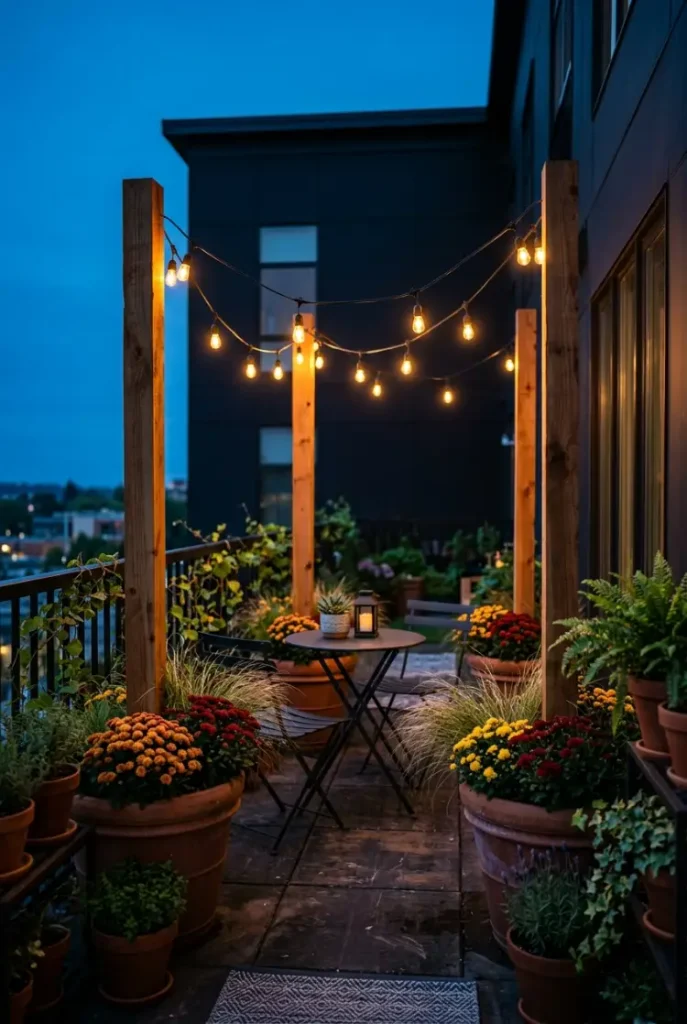
No drilling. No landlord email. Set a 4×4 cedar post or a 10-foot length of metal conduit into a planter, fill it with quick-set concrete, and you have an anchor point that travels with you when the lease ends.
| Planter poles | Drilled eye hooks |
|---|---|
| No damage, no deposit risk | Permanent holes in siding or fence |
| Move them when the table moves | Fixed layout forever |
| One afternoon, about $60 to $110 for three | Under $15 in hardware |
A cedar 4×4 runs around $15 to $25 at Home Depot, Bloem planters sit under $20, and one 50-pound bag of quick-set fills a pot with room to spare. Full build here: DIY string light poles. Weight the pot bottom with gravel first so a gust does not take the whole thing over.
11. Dim it down once the plates clear
The last hour is the one people remember. Dinner needs enough light to see a plate. The hour after dinner needs about half that, and dropping it is what keeps people in their chairs instead of drifting inside.
Put the overhead strand on its own dimmer or plug it into a smart plug with two scenes. Kill the task light near the grill entirely. Let the fire and the table lamps carry the rest.
📌 Good To Know
Check the strand before you buy a dimmer. Plenty of LED string lights are non-dimmable, and forcing it gives you a flicker you cannot fix.
Two scenes is plenty. Bright for serving, low for everything after.
12. Winterize the rig in one October afternoon
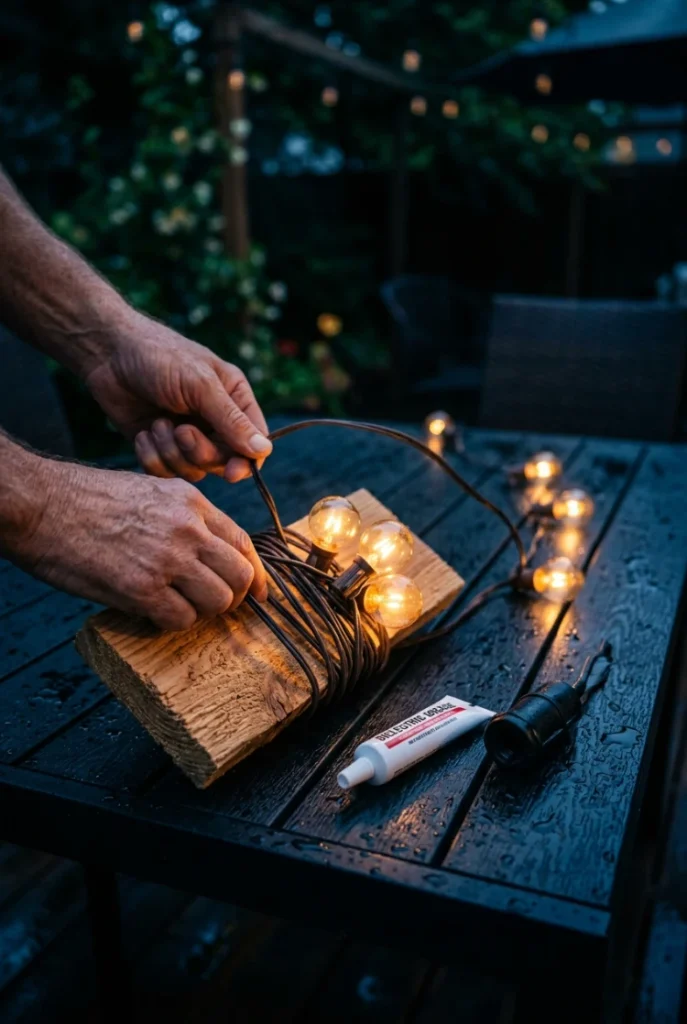
Everything above fails the same way, and it fails in November. Water gets into a socket, a cord sits in a puddle, and a strand that cost real money dies one bulb at a time.
Before the first hard frost
Twenty minutes of this in October buys you the same rig next spring. Skip it and you are re-buying strands every year, which is how a $40 decision quietly becomes a $200 one.
Frequently asked questions
How high should you hang lights over an outdoor dining table?
Two different numbers depending on the fixture. A fixed pendant or chandelier hangs with its bottom edge 30 to 36 inches above the tabletop, which keeps sight lines clear across the table. Overhead string lights sit much higher, around 8 to 9 feet above the ground, so nobody walks into them and the glow spreads across the whole eating area.
What color temperature is best for outdoor dining lights?
Stay at 2700K to 3000K. That range sits close to candle and incandescent color, and it flatters food, wood, and fall foliage. ENERGY STAR notes that lower Kelvin numbers appear more yellow while higher numbers read whiter or bluer. Anything at 4000K or above turns an evening patio clinical and washes the color out of your table.
How do you hang string lights on a patio without trees?
Create your own anchors. Run a stainless guide wire between two fixed points, then clip the strand to the wire so the electrical cord carries no tension. Where no fixed points exist, set 4×4 cedar posts or 10-foot metal conduit into planters filled with quick-set concrete. Three poles cover most patios, and eye hooks on the house handle the rest.
Do solar string lights work in fall and winter?
They work, with real limits. Shorter days cut charging time, a lower sun angle weakens what the panel collects, and cold reduces battery capacity, so expect roughly 30 to 50 percent less runtime than summer. If you want solar anyway, choose a model with USB backup charging and a larger battery, and keep the panel clear of leaves.
How many lumens do you need over an outdoor dining table?
Less than most people assume. The Illuminating Engineering Society references a dining table target around 3 to 6 footcandles, which is genuinely dim. Practically, a handful of warm bulbs overhead plus two small table lamps gets you there. Over-lighting is the more common mistake, and it flattens the whole space.
Can you leave outdoor string lights up all year?
Commercial-grade strands rated for outdoor use can stay up year-round in most of Zones 5 to 9. Longevity comes from the details: dielectric grease in the sockets, cord joints lifted off the ground and covered, and a guide wire taking the mechanical load. Thin decorative strands are a different story and should come down in fall.
Does warm light attract fewer bugs?
Generally yes. Flying insects orient toward shorter blue wavelengths, so bulbs above 3000K pull more of them in than warm amber ones. Lighting specialists point to the 2200K to 2700K range as noticeably less attractive to mosquitoes and biting insects than cool white. Warm bulbs are the better choice for late-season dining either way.
Before you close this tab
Pick one height and fix it tonight. If your table is dark under a lit canopy, that is table level, and two small lamps solve it before dinner. If the yard reads like a black wall past the fence, that is one uplight and an extension cord.
The rest of these outdoor dining lighting ideas will still be here next weekend. Fall moves fast though, and the window between the leaves dropping and the first real freeze is shorter than it feels.
Save this to your patio board so you have the bulb specs and the 10-foot fire pit clearance when you are standing in the aisle at Home Depot wondering which box to grab.