Raised Garden Bed Cover Ideas That Protect Your Crop (And Still Look Good From the Patio)

A raised garden bed cover is the cheapest insurance you will ever buy for a vegetable garden. Fifteen dollars of hoops and fabric can save a full bed of broccoli from an April frost, a rabbit family, and a cloud of cabbage moths, all in one weekend. The catch is that most covers look terrible. This guide sorts nine cover ideas by what you are actually fighting, gives you the real cost of each, and tells you which ones will not embarrass your yard.
I lost an entire spring planting to a late freeze the first year I gardened in a metal bed. Sixteen Bonnie Plants broccoli starts, gone in one night, because I trusted a forecast that said 34 degrees and woke up to 29. That was the year I stopped thinking of covers as optional. If you are also working out your overall layout, our guide to small backyard garden design pairs well with everything below.
Why a Raised Garden Bed Cover Earns Its Keep
Raised beds heat up faster in spring and drain better than in-ground rows. They also sit up at exactly the height a rabbit finds convenient, hold no windbreak of their own, and expose more soil surface to wind chill. A cover fixes all three problems at once.
Here is what a good cover buys you.
- Three to six extra growing weeks on each end of the season. Spinach, lettuce, kale, and radishes will sit happily under fabric through temperatures that would flatten them bare.
- A physical wall against rabbits, squirrels, chipmunks, deer, and neighborhood cats. No repellent, no motion sprinkler, no reapplying anything after rain.
- Pest exclusion before the pest arrives. A mesh cover installed at transplant time keeps cabbage moths from ever laying eggs on your brassicas. That is dramatically easier than picking green caterpillars off kale in July.
- Shade during a heat dome. Lettuce bolts at sustained temperatures in the mid 80s. A shade panel buys you weeks.
- Wind and hail protection. Hail shreds squash leaves in ninety seconds.
One quick reality check. A cover is a tool, not a force field. It will not stop soil-borne disease, it will not fix bad drainage, and it will not save a plant that was already stressed when you tucked it in.
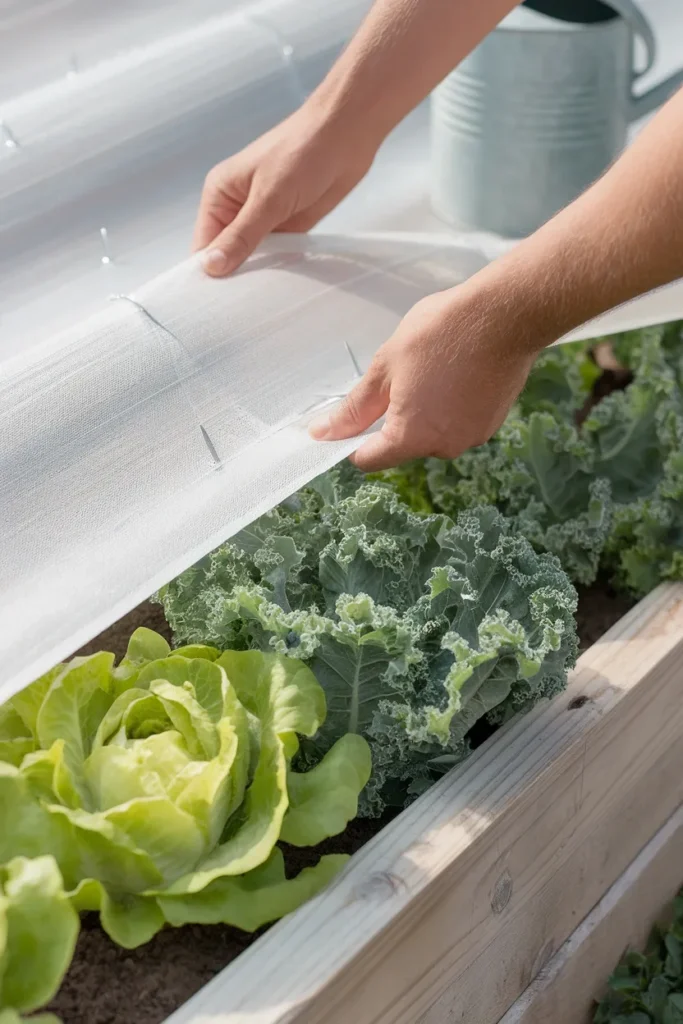
The Four Threat Filter: Match the Cover to the Problem
Most people buy the wrong raised garden bed cover because they shop by product name instead of by threat. Here is the framework I use, and it takes about two minutes.
The Four Threat Filter sorts every cover decision into one of four buckets: Cold, Critters, Bugs, and Burn. Name the threat you are losing plants to right now, pick the row, and stop shopping. If you have two threats in the same season, you build one frame and swap the skin.
| Threat | When it hits | Cover material | Frame you need | Ballpark cost per 4×8 bed |
|---|---|---|---|---|
| Cold | Late Mar to mid May, Oct to Dec | Spun-bonded row cover (Agribon AG-19) or 4 mil clear plastic | Low hoops, 24 to 36 in tall | $25 to $45 |
| Critters | All season, worst at seedling stage | 1/2 in galvanized hardware cloth or 2×4 welded wire | Hinged wood lid or rigid box frame | $70 to $140 |
| Bugs | May to Aug | Fine insect mesh, roughly 25 to 40 gauge | Same hoops as cold, taller if fruiting | $30 to $60 |
| Burn | Jun to Sep, Zones 7 and warmer | 30 to 40 percent shade cloth | Hoops or corner posts above the canopy | $25 to $50 |
Screenshot that table. It is the whole decision.
The reason this works is that the frame and the skin are separate purchases. One set of hoops carries frost fabric in April, insect mesh in June, and shade cloth in August. You buy the frame once and rotate three inexpensive skins through it. That single habit cuts the cost of covering a bed year-round by more than half.
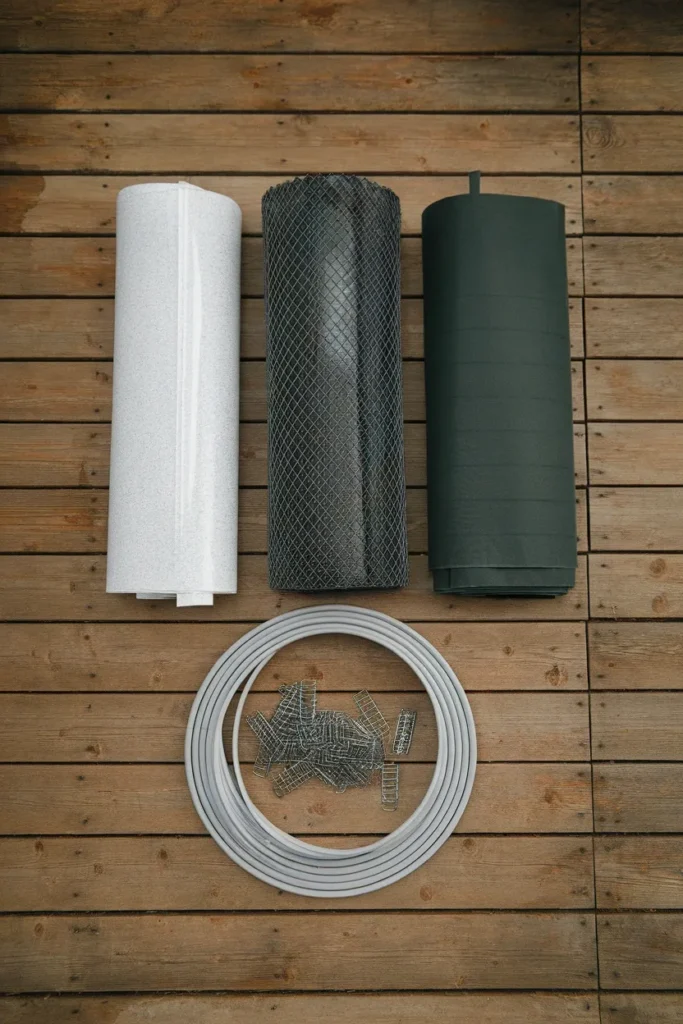
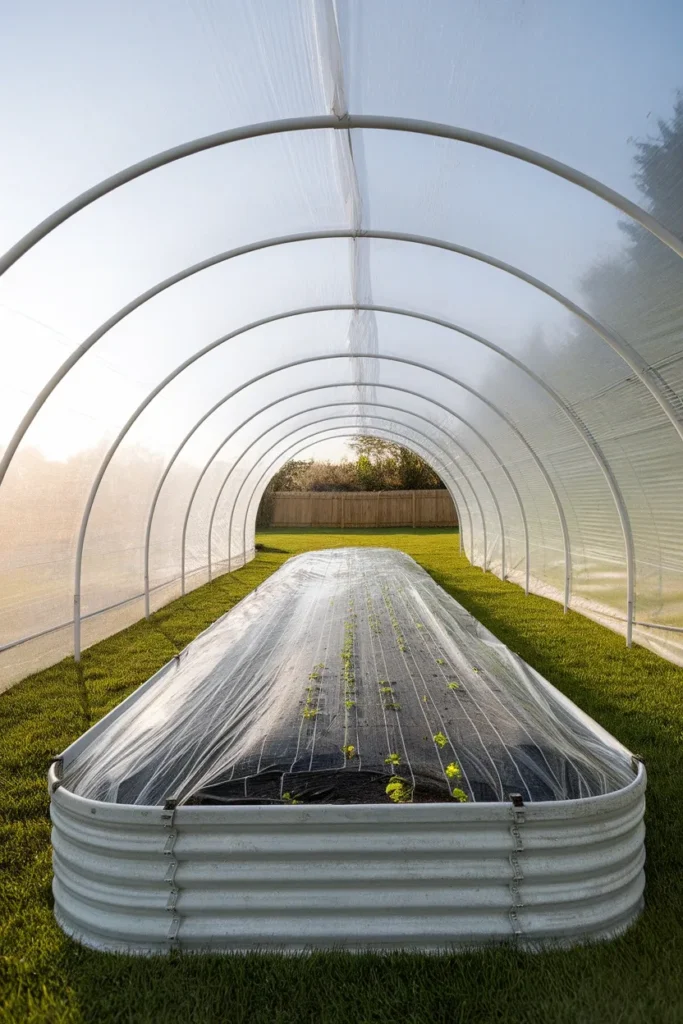
Idea 1: The Low Hoop Tunnel (Start Here)
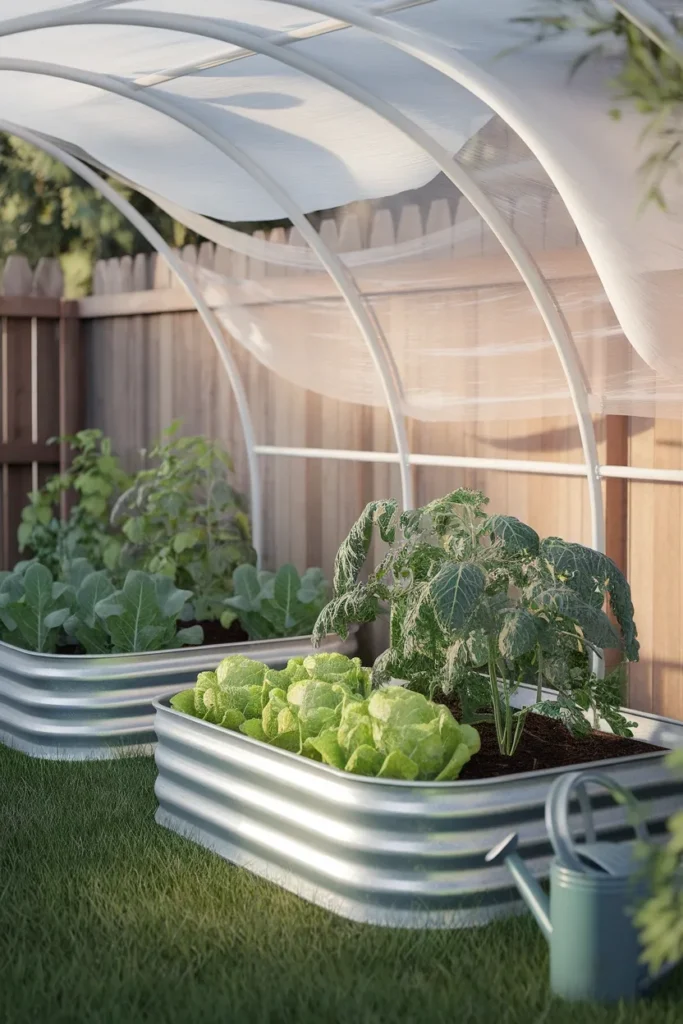
If you build one raised garden bed cover this year, build this one. A low tunnel is a row of arched hoops spanning the bed with fabric or plastic stretched over the top and pinned down at the edges. It handles frost, bugs, and shade depending on what you drape over it.
Three frame options, cheapest to best:
- 1/2 inch PVC conduit. Roughly $4 to $6 per ten-foot stick at Lowe’s or Home Depot. Bends into a nice arch, costs almost nothing, goes yellow and brittle after two or three summers of UV. Fine for a first season.
- Fiberglass rod hoops. Home Depot and Amazon both carry 36-piece kits for under $30. Thin, springy, nearly invisible from a distance, and they do not degrade the way PVC does. My favorite value pick.
- Powder-coated steel hoops. Gardener’s Supply Super Hoops come in sets of six and run around $30 a set. Heavier, hold shape in wind, last basically forever.
Build notes that matter. Space hoops every 24 to 36 inches. Any wider and the fabric sags into the plants and freezes to the leaves it is supposed to protect. Run a length of twine or a single PVC spine along the peak to stop the whole thing from folding sideways in wind. Pin the fabric edges with 6 inch galvanized garden staples, or lay a 2×4 along each side. Wind is what destroys these, never cold.
The NC Cooperative Extension’s PVC row cover frame build uses 1/2 inch PVC, 2 inch clamps, and 1.5 inch screws mounted to the bed sides, and their agent puts assembly at 20 to 30 minutes. That clamp trick is the part worth stealing. The hoops pop in and out of the clamps in seconds, so removing the cover to harvest does not become a chore you start avoiding.
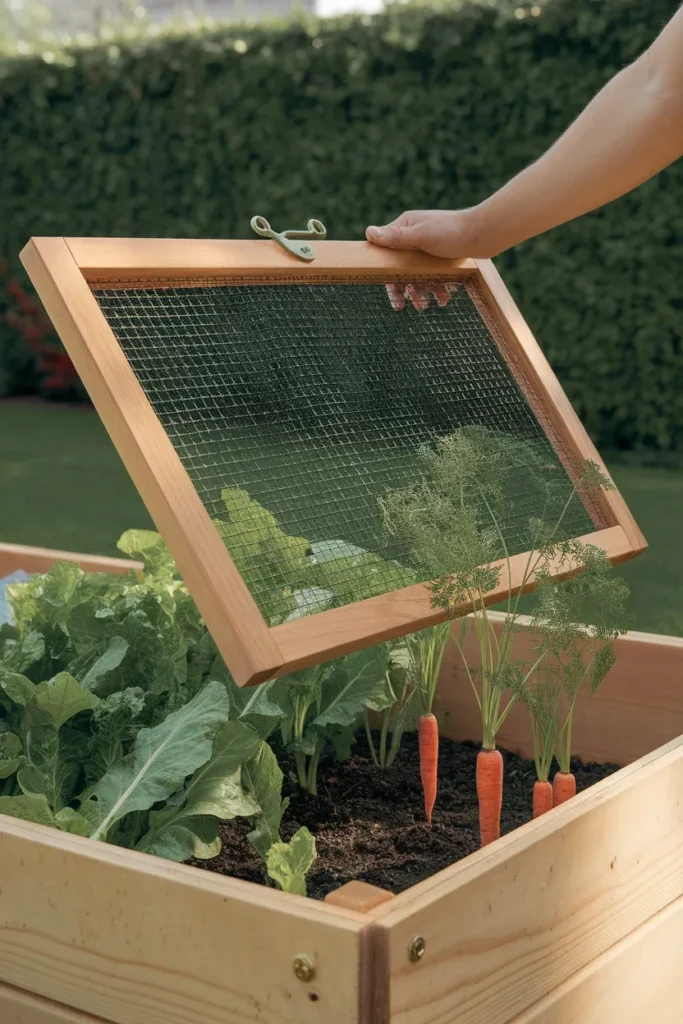
Idea 2: The Hinged Hardware Cloth Lid
This is the animal-proof answer, and it is the raised garden bed cover that looks the most deliberate. You build a shallow wood frame the exact footprint of your bed, staple 1/2 inch galvanized hardware cloth across it, mount it with two or three exterior hinges along the back rail, and add a barrel bolt at the front so wind cannot flip it open.
What it costs. Four 2x2x8 boards run about $4 each. A 2 ft x 25 ft roll of Everbilt 19 gauge, 1/2 inch hardware cloth from Home Depot lands in the $30 to $40 range and covers a 4×8 lid with some left over. Hinges, a barrel bolt, and exterior screws come in under $20. Call it $70 to $90 for a lid that will outlive the bed.
Why 1/2 inch mesh instead of chicken wire. Chicken wire keeps chickens in. It does not keep chipmunks, voles, or determined squirrels out, and a raccoon will peel it back like a soup can lid. Hardware cloth at 19 gauge is stiff enough to resist and tight enough to exclude the small stuff. Spend the extra fifteen dollars.
Two details people skip. Put the hinges on the north or back side so the lid opens away from where you stand to harvest. And build the frame about an inch narrower than the bed’s outside dimension so it drops in rather than perching on top, which stops wind from getting under it.
If you garden with deer, this lid alone is not enough. Deer will not chew through hardware cloth, but they will stand on it. Either build the frame with a center support or go with a taller box cage.
Idea 3: Floating Row Cover for Frost
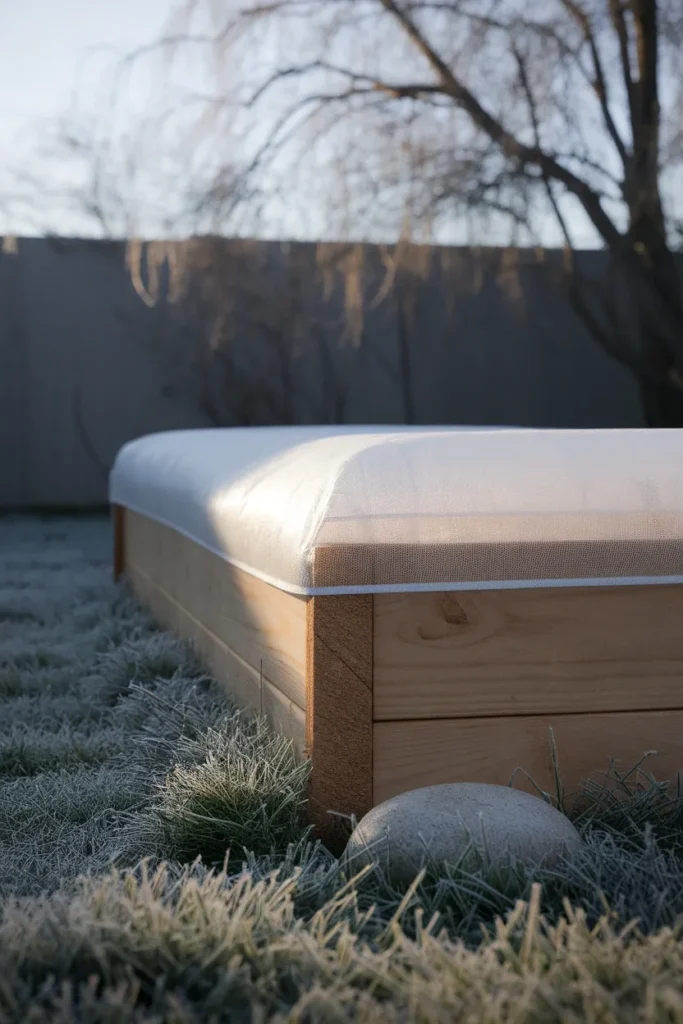
Floating row cover is spun-bonded polypropylene fabric, and it is the single most useful thing in my garden shed. Agribon AG-19 weighs 0.55 ounces per square yard, lets through about 85 percent of available light, and delivers roughly 4 degrees F of frost protection. That number sounds small until you remember that most spring losses happen when the forecast says 34 and the reality is 30.
You can lay it directly on the plants (that is the “floating” part) or drape it over hoops. Hoops are better. Fabric touching a leaf overnight transfers cold straight into it, and you get frost burn in exactly the pattern of your fabric contact points.
Weight matters more than brand. Lighter fabrics like AG-19 transmit more light and can stay on for weeks. Heavier frost blankets hold more warmth but block enough light that you should pull them off within a few days. For a Zone 5 or 6 spring bed I run the lighter weight and add a second layer on nights the forecast turns ugly. Two layers of light fabric beat one layer of heavy fabric almost every time, because you can strip one off in the morning.
Timing. Check the 2023 USDA Plant Hardiness Zone Map for your zone, then work from your local typical last frost date. In Zone 5 that is usually mid to late April. Zone 6 lands around mid April, Zone 7 around early April, Zone 8 mid March. Those are typical ranges rather than promises, and micro-location matters a lot, so confirm against your county extension office before you commit tender transplants to a date.
Idea 4: Insect Mesh That Stops Cabbage Moths
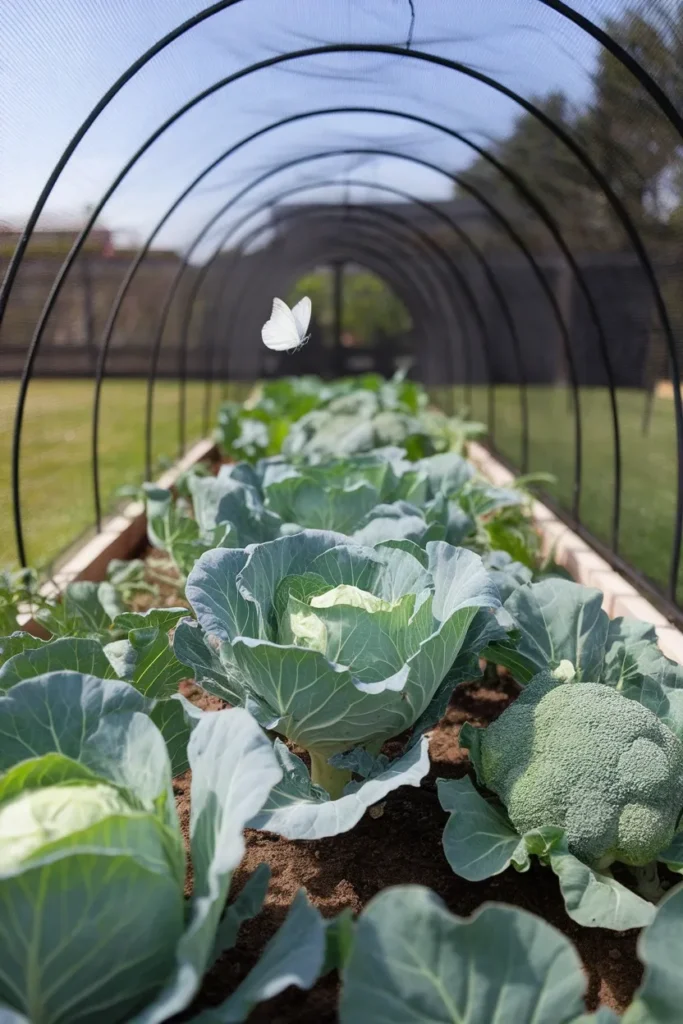
Frost fabric and insect mesh look similar and do different jobs. Mesh is woven, breathable, and does almost nothing for warmth, which is exactly what you want in June. It stops cabbage white butterflies, squash vine borer moths, flea beetles, and leaf miners from ever reaching the plant.
Install it the day you transplant, not the day you see damage. A cabbage moth needs about four seconds to lay eggs on a kale leaf. Once those eggs are under the mesh with your plants, you have built a very effective caterpillar nursery.
Crops where mesh pays for itself immediately: kale, cabbage, broccoli, Brussels sprouts, collards, arugula, turnips, radishes, and summer squash. Anything in the brassica family is a target from the moment it goes in the ground.
Crops where mesh will cost you fruit: tomatoes, peppers, cucumbers, melons, beans, and eventually squash. More on that timing problem below, because it is the mistake that ruins otherwise perfect gardens.
Fine mesh runs about $30 to $60 for enough to cover a 4×8 bed, and Vego Garden’s cover systems bundle a frame and mesh together at a 35 percent shading rate if you would rather buy than build. Their kits fall in the $80 to $130 range depending on bed size.
Idea 5: Shade Cloth for the Ugly Part of Summer
In Zones 7 through 10, the thing killing your lettuce in July is not neglect. It is sustained heat. Lettuce bolts, spinach turns bitter, cilantro flowers in a week, and tomatoes stop setting fruit above roughly 90 degrees at night.
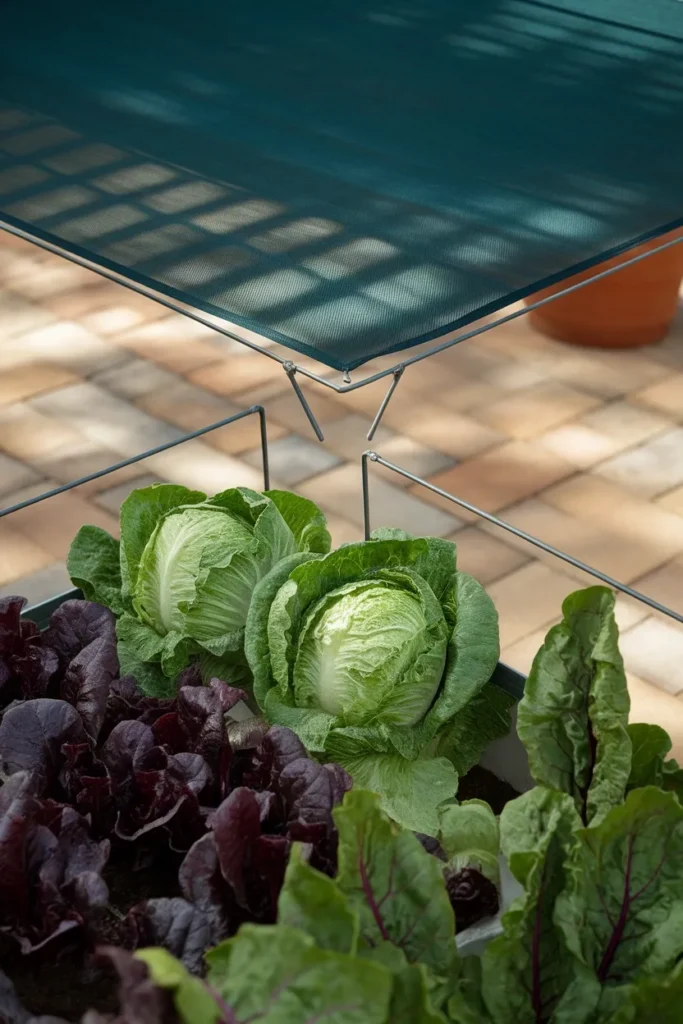
Shade cloth is rated by the percentage of light it blocks. For a vegetable bed, 30 to 40 percent is the sweet spot, and it is the easiest raised garden bed cover to install because nothing has to arch. Agfabric sells a 40 percent sunblock cloth with clips around $25 to $35 for a 10 by 20 foot piece at Walmart, which covers a standard bed with room to spare. Anything above 50 percent starts starving fruiting crops of the light they need.
Where to put it. Hang it 12 to 18 inches above the canopy rather than resting it on the plants, and prioritize the afternoon side. Morning sun is the good sun. It is the 2pm to 6pm west exposure that cooks a bed. Corner posts made from 1/2 inch conduit and a few zip ties handle this in about twenty minutes.
If half your yard is already dim and you are working out what will actually grow there, our shade garden ideas guide covers the plant side of that problem.
Idea 6: Cold Frames, Cloches, and Mini Greenhouses
These three are the winter end of the range, and they trade convenience for real season extension.
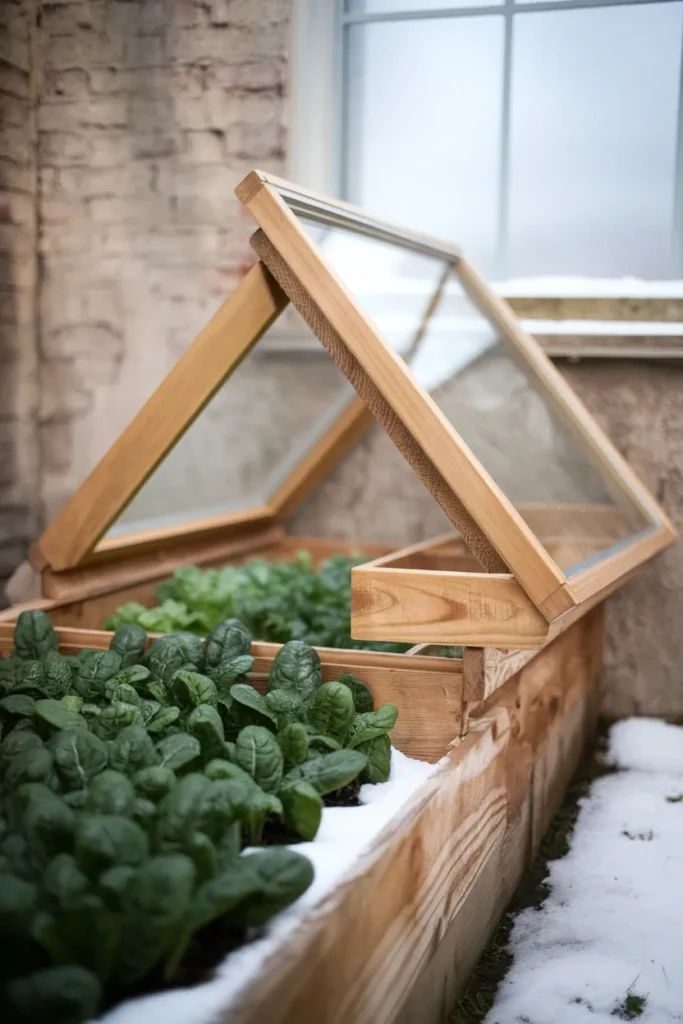
A cold frame is a shallow box with a clear lid, usually angled toward the south. Build one from scrap 2×8 lumber and an old storm window and you have spent nothing. A cold frame sitting on top of a raised bed will carry spinach, mache, and carrots through a Zone 6 winter with no supplemental heat. The rule that trips people up: vent it. A sealed cold frame on a sunny 45 degree February day will hit 90 inside and cook everything.
Cloches are individual covers, one per plant. A one-gallon milk jug with the bottom cut off costs nothing and protects a single tomato start through a surprise freeze. Glass bell cloches look beautiful and cost real money. Use them where you can see them.
Mini greenhouse covers are the pre-built kits, usually a zippered clear PVC shell over a steel frame. Quictent, Outdoor Living Today, and Gardener’s Supply all sell versions sized to standard beds. They work well and they are the least attractive option on this list, so think hard about where the bed sits before you commit.
Anything clear and sealed needs venting on sunny days from February onward. That is the single most common way people kill plants with a cover.
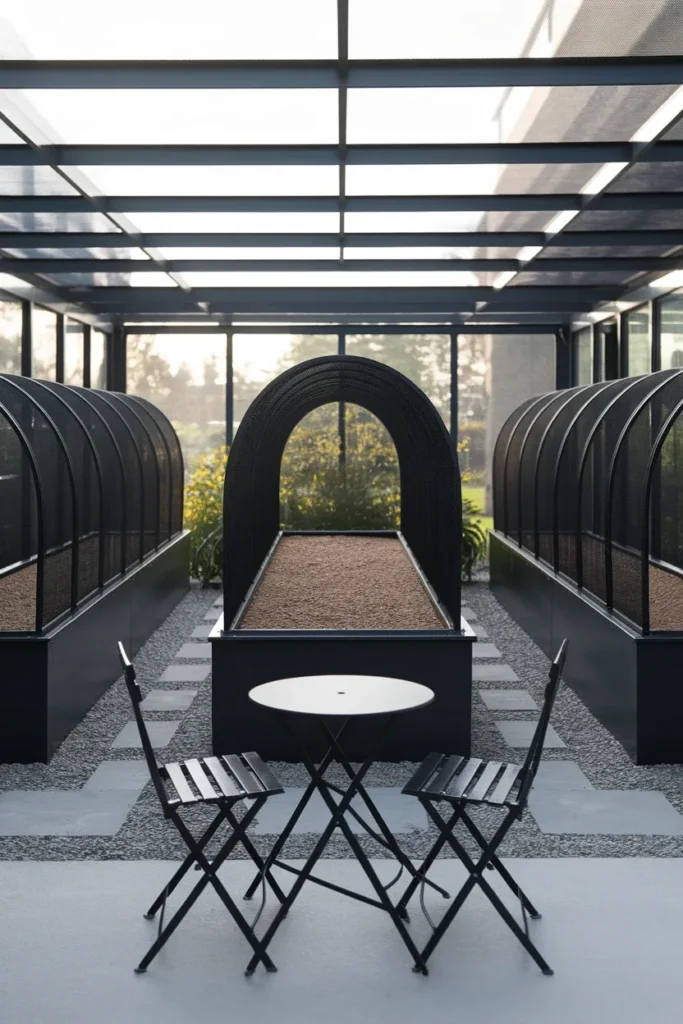
Idea 7: Covers That Do Not Wreck the View
Nobody else writing about this topic will tell you the truth, so here it is. A white PVC tunnel eight feet from your patio table looks like a job site. If your beds sit in a back corner behind a hedge, ignore this section entirely. If they sit where you eat dinner, keep reading.
Four moves that make a cover look intentional:
- Match the frame material to something already in the yard. Cedar lids next to a cedar fence. Black powder-coated hoops next to black metal beds. Matching one finish does more visual work than any amount of tidiness.
- Choose black mesh over white fabric where you can. Black insect mesh visually disappears at ten feet. White row cover reads as a bright object from anywhere in the yard. When you need white fabric for warmth, accept it for the eight weeks it is doing real work and pull it in May.
- Keep the height consistent across every bed. Three beds with covers at three different heights looks chaotic. The same low arch repeated across all three reads as a design decision.
- Finish the edges. A cover looks unfinished when the bed itself looks unfinished. Clean gravel or steel edging around the bed base does more for the whole picture than the cover itself, and our garden edging ideas walk through the options.
Honestly, the black mesh trick alone solved this for me. Same protection, and from the kitchen window you mostly see plants.
Idea 8: Knowing When to Take the Cover Off
This is the section that will save your harvest, and it is the one no competing article spells out.
A cover that excludes cabbage moths also excludes bees. For leafy crops that is free money, because you eat the leaves and pollination is irrelevant. Kale, lettuce, spinach, chard, arugula, and root crops can stay covered from transplant to harvest with no downside at all.
Fruiting crops are a different story. Squash, cucumbers, melons, and pumpkins need insect pollination to set fruit. Leave the mesh on and you get a gorgeous, healthy, completely fruitless plant. The rule is simple.
Pull the cover off fruiting crops the day the first flower opens. Not the day you see fruit. The day you see a flower.
Tomatoes, peppers, and beans self-pollinate and technically do not need bees, though airflow and vibration help. You can leave those covered longer, but they will set more fruit uncovered once they start flowering.
For squash specifically, this creates a real tension. Squash vine borers arrive right around the time squash starts flowering in most of the country. The workable compromise is to cover from transplant until first flower, then uncover and wrap the base of each stem in aluminum foil to block borers at the entry point. It is fussy and it works.
Two other removal rules:
- Pull frost fabric off by mid morning on any day forecast above 60. Trapped heat and humidity under fabric invites fungal problems fast.
- Vent any clear plastic cover once daytime temperatures pass 50, even in February. Especially in February.
Idea 9: Making Your Cover Survive a Second Season
A raised garden bed cover rarely fails from cold. It fails from UV, wind, and being shoved wet into a bin in October.
PVC goes yellow and snaps after two or three seasons of full sun. If you want more life out of it, store the hoops indoors during the months they are not in use.
Row cover fabric tears at the staple points first. Reinforce the corners with duct tape before the first install and you will double its life. Three seasons is realistic for AG-19 with careful handling. One season is what most people get.
Hardware cloth rusts at every cut edge. Hit the raw edges with a shot of Rust-Oleum before you staple, and fold the cut edge under the frame rail so nobody catches a hand on it.
Storage that actually works: fold fabric dry, never damp, and store it in a labeled bin with a note about which bed size it fits. Mildew is what ends most row cover, not tearing. Wind hoops into a loose coil and secure with a bungee rather than stacking them loose in a corner where they get stepped on.
One more thing worth doing every fall. Walk the beds with a marker and write the bed dimensions directly on the fabric edge. Next March you will not be measuring anything.
Frequently Asked Questions
Should a raised garden bed be covered in winter? Yes, though the goal changes. If you are growing through winter, use a cold frame or heavy plastic over hoops. If the bed is resting, cover the soil with shredded leaves, straw, or a cover crop instead of leaving it bare. Bare soil erodes, loses nitrogen, and grows weeds. A simple leaf mulch layer is enough for most Zone 5 through 8 gardens.
What is the best material to cover a raised garden bed? There is no single best material, which is why the Four Threat Filter above exists. For frost, use spun-bonded row cover like Agribon AG-19. For animals, use 1/2 inch galvanized hardware cloth. For insects, use fine woven mesh. For heat, use 30 to 40 percent shade cloth. Buy one frame and rotate the skins.
How do you keep animals out of raised garden beds? A hinged lid framed in 2×2 lumber and covered in 1/2 inch hardware cloth is the most reliable answer. Chicken wire will not stop chipmunks or squirrels. For deer, you need height, either a taller box cage or a frame strong enough that standing on it does nothing.
Do row covers protect plants from frost, and by how much? Lightweight row cover such as Agribon AG-19 provides roughly 4 degrees F of protection while transmitting about 85 percent of available light. Heavier frost blankets provide more warmth and less light. Two layers of lightweight fabric usually outperform one heavy layer, because you can remove one in the morning.
How long can plants stay under a row cover? Leafy greens and root crops can stay covered from transplant to harvest. Fruiting crops such as squash, cucumbers, and melons must be uncovered the day the first flower opens so bees can reach them. Heavy frost blankets should come off within a few days because of light loss.
How much does a raised garden bed cover cost? A basic hoop and fabric setup for a 4×8 bed runs $25 to $45. A hinged hardware cloth lid runs $70 to $90 in materials. Pre-built kit systems from brands like Vego Garden or Gardener’s Supply fall in the $80 to $130 range depending on size.
Can you leave a raised garden bed cover on all summer? Only for leafy and root crops, and only if you are venting heat. Fabric traps warmth, so anything opaque or clear should come off or be swapped for mesh once daytime temperatures pass 60. Mesh and shade cloth can stay on all summer without a problem.
Pick One Bed and Start There
You do not need a raised garden bed cover on every bed this weekend. Pick the bed you lose the most from, name the threat, and buy the one skin that solves it. A set of fiberglass hoops and a roll of AG-19 costs less than dinner out and will pay you back the first night the forecast is wrong.
If you build one this season, I would love to know which threat you were fighting and whether the black mesh trick worked as well in your yard as it did in mine. That is the detail that changes most people’s minds about covers.