Front Yard Landscaping Ideas With Rocks That Look Like You Hired Someone

Most rock front yards fail for one boring reason: somebody ordered a single size of stone and spread it flat. That’s it. The gravel goes down, the yard turns into a parking lot, and two seasons later it’s full of weeds nobody can pull.
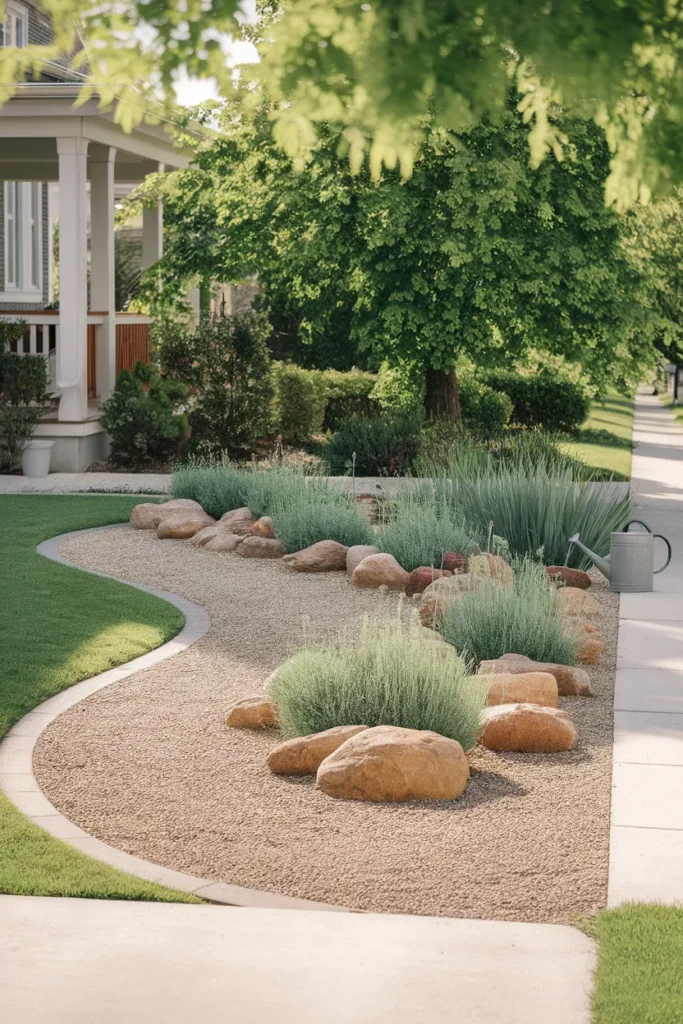
The good news is that fixing it costs almost nothing extra. The best front yard landscaping ideas with rocks all share the same skeleton, and once you see it you cannot unsee it. Three stone sizes. Real plants. A shape that goes somewhere.
Here’s what we’re covering: the layout rule that makes a $400 bed look like a $4,000 one, nine looks worth stealing, actual 2026 material costs, plant picks by zone, and the rebate check most homeowners have no idea they qualify for.
Start With the Three-Size Rock Rule
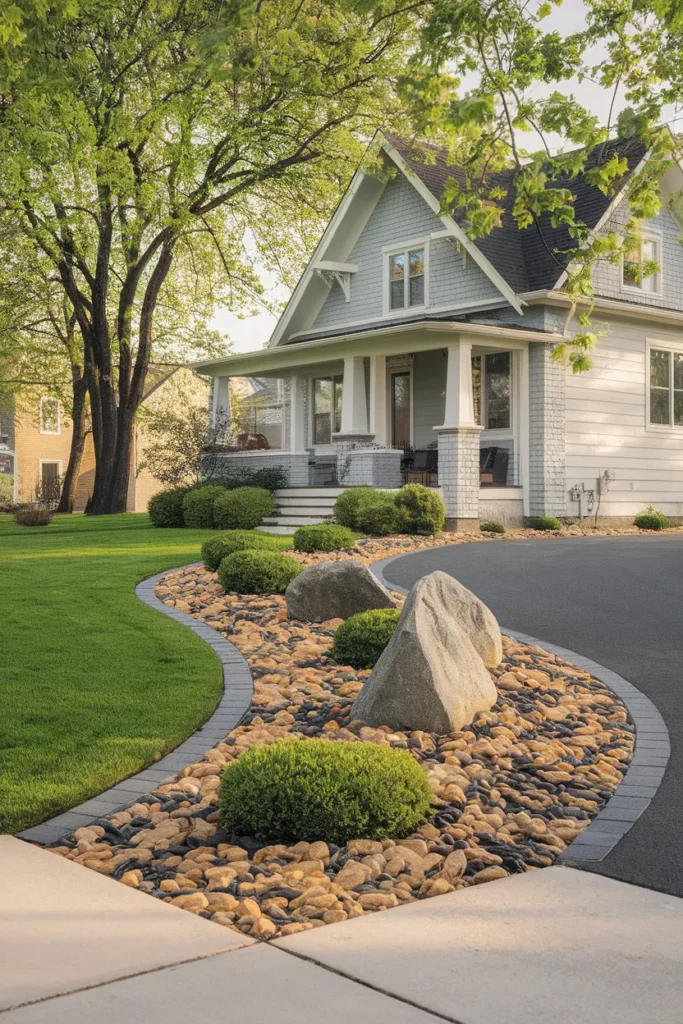
Every rock bed that photographs well uses exactly three stone sizes, and every rock bed that looks cheap uses one. Call it the Three-Size Rock Rule.
The idea is simple. You need an anchor, a mid-tone, and a filler. Skip any one of them and the eye has nothing to land on.
| Layer | Size | What it does | Rough coverage |
|---|---|---|---|
| Anchor | 12 to 36 inch boulders | Gives the bed a focal point and permanent structure | 1 boulder per 40 to 60 sq ft |
| Mid | 2 to 5 inch cobble or river rock | Creates movement and edges beds without hard lines | Ribbons and drifts, roughly 20% of the bed |
| Filler | 3/8 to 3/4 inch gravel or decomposed granite | The working ground cover that everything sits in | The remaining 75% or so |
Buy the anchors first. They’re the piece people skip because a single ton of boulders runs $100 to $350 at 2026 material prices, and it feels like a lot for three rocks. It isn’t. Those three rocks are the entire reason the bed reads as designed.
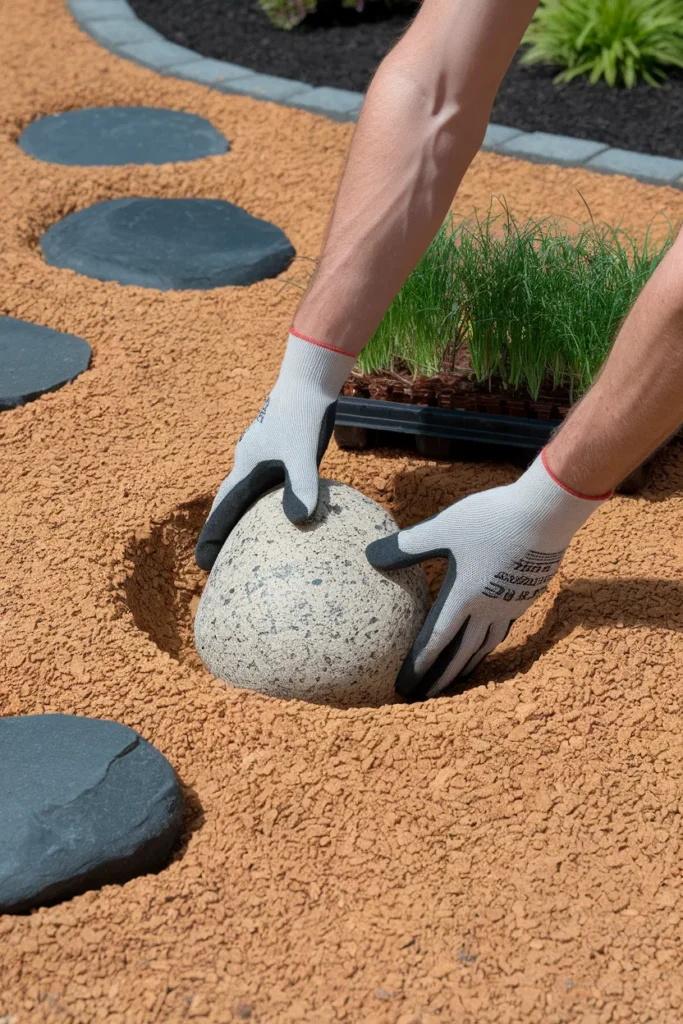
One placement trick: bury the bottom third of every boulder. Rocks that sit on top of gravel look dropped. Rocks that emerge from it look like they were always there.
Dry Creek Beds Solve Drainage and Look Expensive Doing It
A dry creek bed is the highest return per dollar in this whole article. It handles runoff, it gives the yard a spine, and it saves you from buying enough stone to cover a whole lawn.
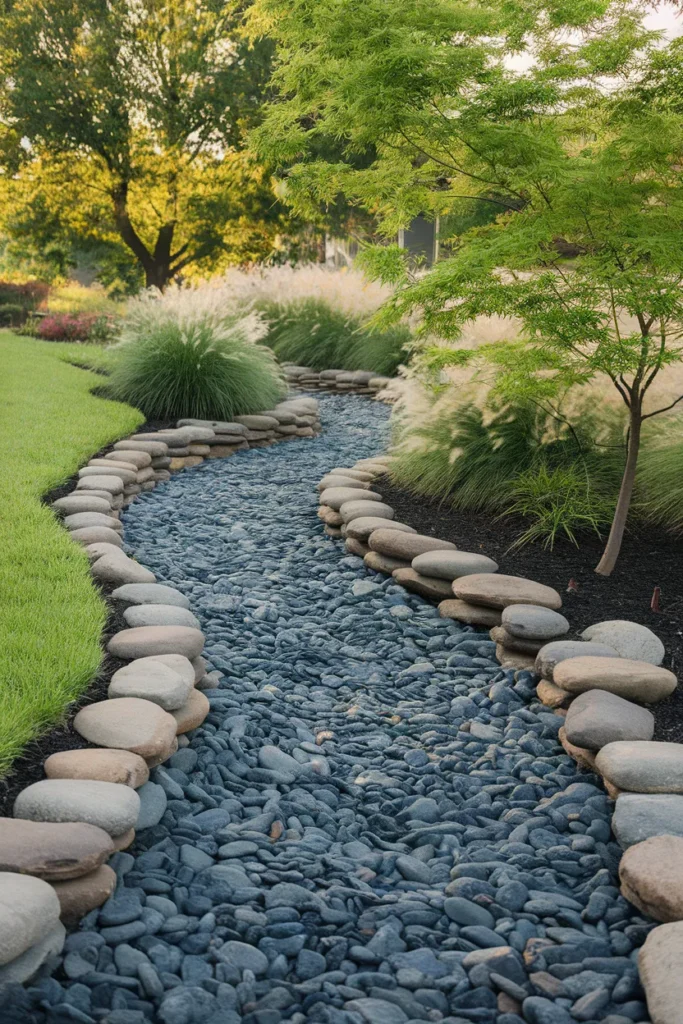
Start where water already goes after a storm. Follow that path, don’t fight it. Dig a shallow trench roughly 12 to 18 inches wide and 6 inches deep, wider at the bends.
Line the trench floor with your 2 to 5 inch cobble. Set larger stones along the outer edge of each curve, the way a real stream deposits them. Then let the bed spill into a wider pool of gravel near the downspout or the street.
Snaking curves photograph better than straight runs, and Pinterest agrees. Straight rock channels read like drainage infrastructure. Curves read like a garden.
If your yard sheds water toward the foundation, get that grade corrected before you decorate it. A creek bed is a channel, not a fix for bad slope.
Boulders Are the Cheapest Way to Fake a Designer Yard
Three boulders will do more for curb appeal than three hundred dollars of shrubs. That sounds backwards until you price shrubs.
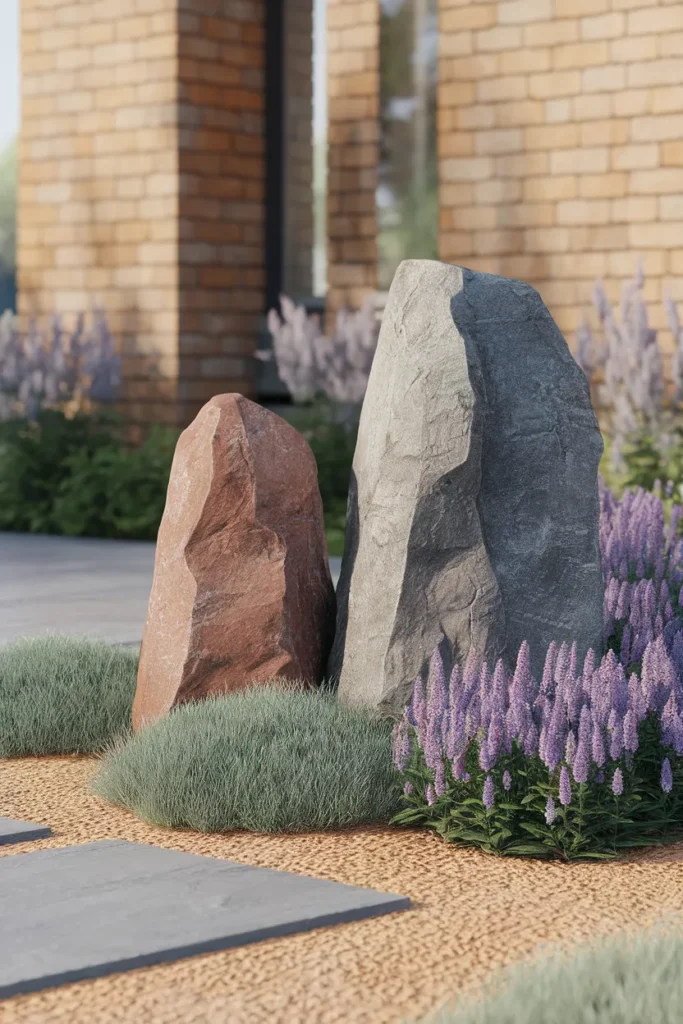
Group them in odd numbers. Two boulders look like a mistake, three look intentional, five look like a landscape architect showed up. Vary the heights so the tallest sits roughly a third off-center in the grouping.
Buy them locally. Stone is heavy, freight is the expensive part, and most regional yards will load them into a truck for you. Home Depot, Lowe’s, and Menards carry bagged decorative stone for small work, but for anything over a ton, a local quarry or landscape supply yard beats big-box pricing by a wide margin. Tractor Supply is worth checking in rural areas for bulk bagged gravel.
Sizing matters more than people expect. A boulder that looked enormous in a gravel yard will shrink dramatically once it’s sitting in your front bed with a two-story house behind it. Go one size up from whatever feels right.
For a fuller look at the style this pairs with, our desert front yard ideas guide covers the planting side in more depth.
Rock Borders That Hold Their Line
Loose stone migrates. Every single time. Without a hard edge, your gravel ends up in the lawn, the mower throws it at the siding, and by year two the bed has no shape left.
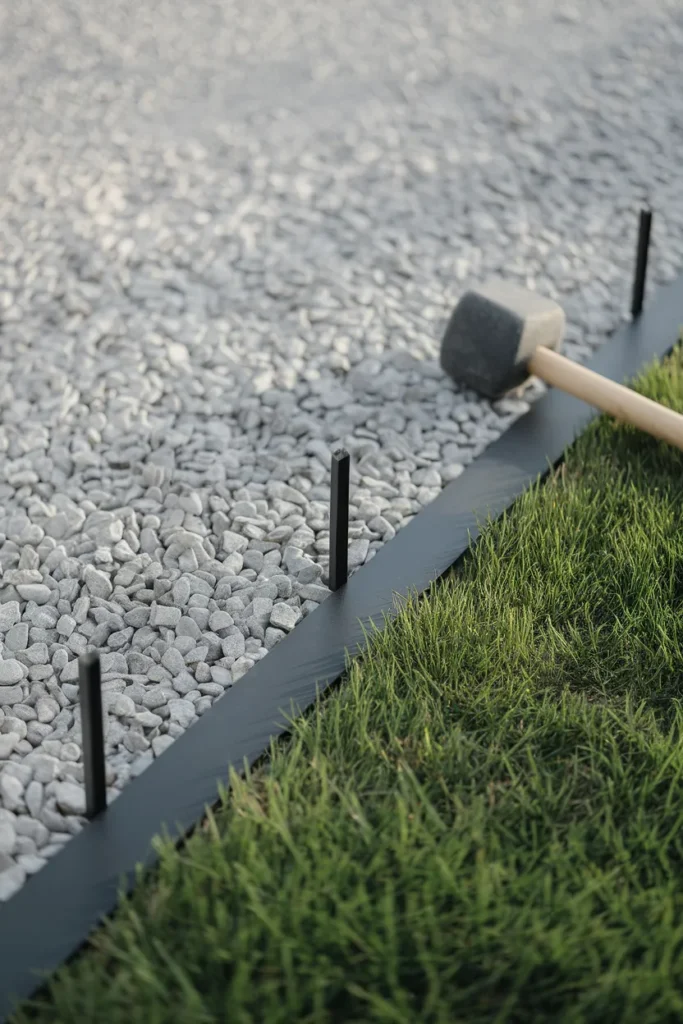
Steel edging is the fix. Powder-coated steel in 4 or 6 inch depth runs about $2 to $4 per linear foot at most home centers, and it disappears visually once the gravel settles against it. Aluminum works too and won’t rust in wet climates.
Plastic no-dig edging is cheaper and it heaves. Every freeze-thaw cycle in Zones 5 through 7 lifts it a little more until it’s waving out of the ground like a ribbon. Spend the extra dollar per foot.
For a softer edge, set a single row of your mid-size cobble half-buried along the bed line. It won’t contain gravel as well as steel, but it looks handmade in a good way, and it costs whatever a few hundred pounds of stone costs.
Curved beds need a relief cut every couple of feet on the inside of tight turns so the steel bends without kinking.
The Rock and Mulch Split That Keeps Your Plants Alive
Here’s the part most rock landscaping articles skip, and it’s the reason so many of these beds look dead by year three.
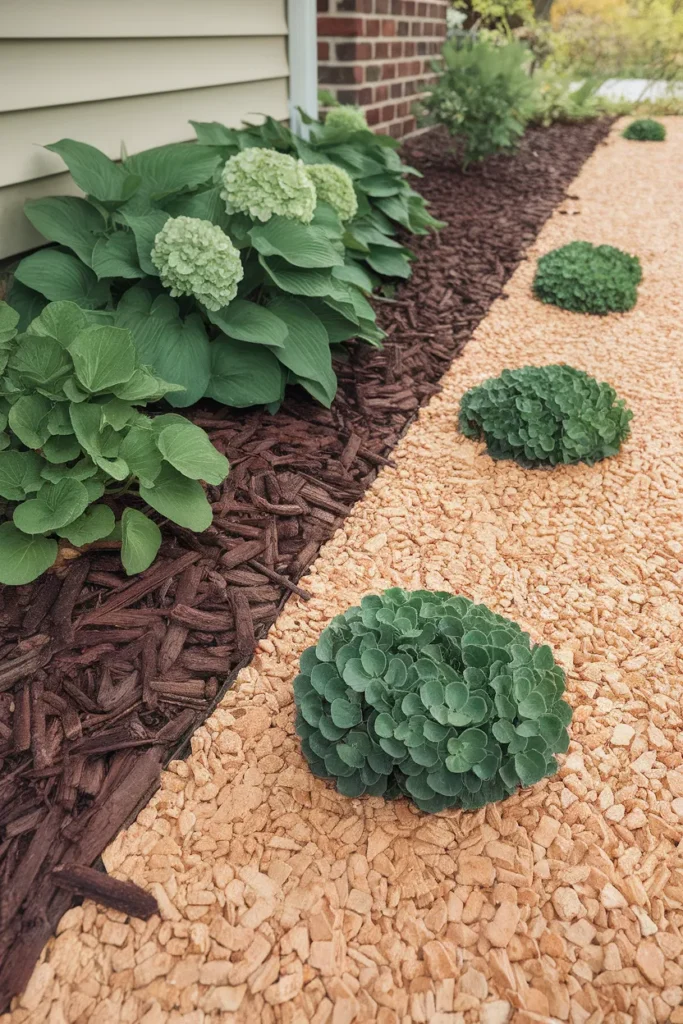
Rock is not a mulch substitute for living plants. K-State Research and Extension puts it plainly: rock mulch raises soil temperature because stone reflects and absorbs heat, and that heat hurts plants. Organic mulch does the opposite. It holds moisture and cools the root zone.
So split the yard. Rock goes where nothing needs to thrive: along the driveway, in the hell strip, around the mailbox, under downspouts, in the dry creek. Bark or shredded hardwood mulch goes in the actual planting beds against the house, where hydrangeas and hostas live.
That single decision is the difference between a rock yard that ages well and one that slowly cooks everything in it.
The other honest warning from the same extension source concerns landscape fabric. Fabric under stone restricts water and air movement, which reduces soil health, and over time it frays and looks bad. Wind blows fine soil into the gaps between rocks anyway, and that silt becomes a perfect seedbed. Weeds then root through the fabric and become far harder to pull than they would have been in bare gravel.
If you use a barrier at all, University of Maine Cooperative Extension recommends commercial-grade woven polypropylene stapled every 2 feet, not the thin garden-center rolls. My honest preference is to skip fabric in decorative beds, go 3 inches deep on gravel, and spot-treat the handful of weeds that show up. Fabric is worth it under pathways and driveways where nothing is meant to grow.
Slopes and Terraces Where Rock Earns Its Keep
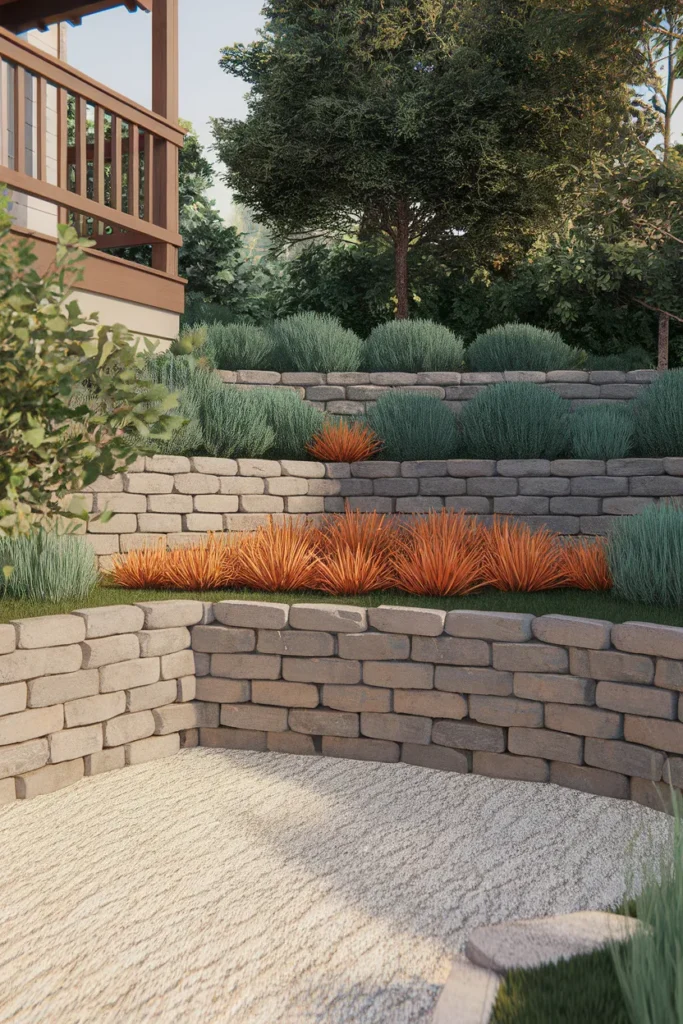
On a slope, rock stops being decoration and starts doing structural work. Mulch washes down a grade in one hard rain. Stone stays put.
Terracing is the standard move. Build two or three low retaining courses out of flat fieldstone or wall block, each no more than 18 to 24 inches tall, and backfill with soil for planting pockets. Short walls stacked in series handle grade far better than one tall wall, and they usually stay under the height that triggers a permit requirement in most US municipalities. Check your local code before you build anything over 3 to 4 feet.
Where a full terrace is overkill, a boulder scatter works. Set anchors into the slope face at irregular intervals, backfill around them with gravel, and tuck creeping juniper or sedum between. The rocks break the water’s run and hold the gravel in place.
Slopes also drink up more stone than you’d guess, since the surface area is bigger than the footprint. Add 20% to whatever your flat calculation says. Our gravel patio ideas post has the base-layer math if you’re building a flat sitting area at the bottom of a grade.
Plants That Actually Thrive in Rock Beds by Zone
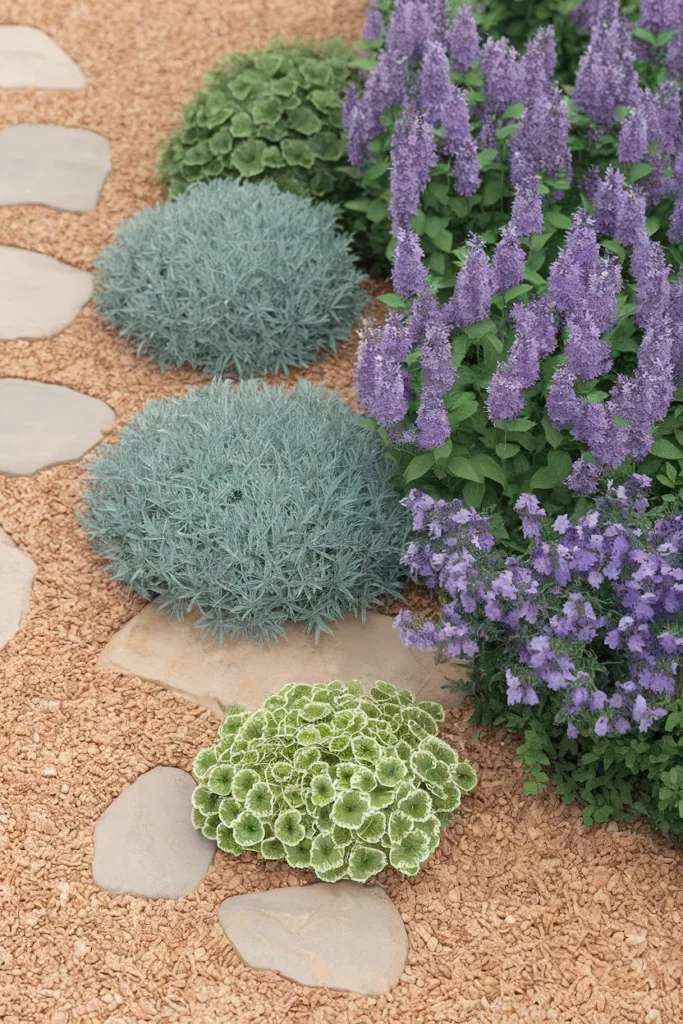
Gravel beds run hot and drain fast. Plants that love that combination look great with almost no help. Plants that don’t will sulk all season no matter how much you water.
Zones 5 to 6: creeping thyme, blue fescue, hens and chicks, dwarf mugo pine, catmint, coneflower, Russian sage.
Zones 7 to 8: rosemary, lavender, autumn sage, yucca, dwarf yaupon holly, muhly grass, agastache.
Zone 9: agave, red yucca, lantana, bougainvillea, desert marigold, damianita, dwarf oleander.
Plant in fall or early spring, not July. In Zones 5 through 7 the practical window is after last frost, which usually falls somewhere between mid-April and mid-May depending on where you sit in the band. Confirm your exact zone against the USDA Plant Hardiness Zone Map or your county extension office, since micro-location shifts frost dates by weeks.
Dig planting pockets wide, not deep. Pull the gravel back, amend the native soil with something like Espoma Bio-tone at planting, set the plant, then pull the gravel back to the edge of the crown rather than piling it against the stem. Stone packed against a woody stem holds heat and invites rot.
Water new plantings deeply once a week for the first full season. After that most of this list is on its own.
Light Your Rock Beds and Curb Appeal Doubles After Dark
Nobody talks about this and it’s the biggest miss in the entire category. Your neighbors see your front yard at 7pm far more often than at noon.
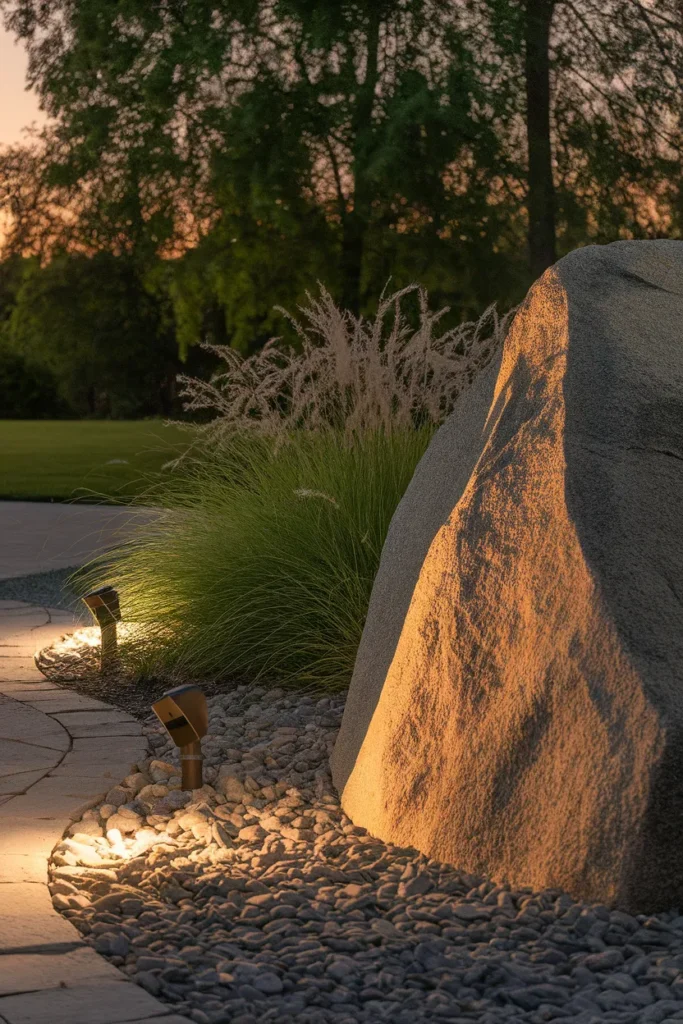
Rock is a texture material, which means it only shows up under raking light. Overhead lighting flattens it into gray mush. Side lighting makes every stone throw a small shadow and the whole bed suddenly reads three-dimensional.
Three fixtures do the job on a typical bed. Set one low uplight at the base of your largest boulder aimed up its face, one path light at the bed’s outer curve, and one wash light behind an ornamental grass so the blades glow. Warm color temperature only, somewhere around 2700K. Cool white makes tan gravel look like concrete.
Feit Electric and Brightech both make solar and low-voltage kits in the $30 to $80 range that hold up outdoors. Solar is fine for path lights. For boulder uplighting, low-voltage wired fixtures throw a much stronger beam and won’t quit in February.
Bury the cable under the gravel, not the fabric, so you can move fixtures later when the plants fill in and change the composition.
Get Paid to Pull Your Lawn (and Fix a Rock Bed Gone Wrong)
Here’s the part nobody in the top search results mentions. Many US water agencies will pay you to remove turf grass, and rock landscaping is exactly the qualifying project.
Southern California’s Metropolitan Water District runs a turf replacement rebate through SoCal Water$mart that starts at $2 per square foot, plus $100 per tree for up to five trees. Programs exist across Nevada, Colorado, Arizona, Texas, and California, and rates vary by agency. On a 500 square foot front bed, a $2 rate is $1,000 back, which can cover most of your stone.
Apply before you dig. Nearly every program requires pre-approval and a before photo, and tearing out the lawn first disqualifies you. Search your water utility’s name plus “turf rebate” and read the plant-coverage requirement, since most programs require living plants at a minimum percentage rather than bare gravel. The EPA’s guidance on water-smart landscape design is a useful primer on what these programs are trying to encourage.
Already have a tired rock bed? You don’t need to start over. Rake the existing stone into piles, pull whatever fabric is under it (it’s failing, that’s why you’re here), amend the exposed soil, set two or three boulders you never had, then spread the old gravel back and top with one fresh bag per 15 square feet to brighten the color. A faded bed usually just needs structure and a clean edge, not a full replacement.
Cost reality, using 2026 US material pricing: river rock runs roughly $45 to $130 per ton, decomposed granite $45 to $95, lava rock $80 to $240, and plain gravel as low as $10 to $50 per ton. One ton covers about 55 to 135 square feet at a 2 to 4 inch depth. Installed with delivery and labor, expect $75 to $240 per ton. Prices swing hard by region and by how far the truck drives, so call two local suppliers before you budget.
Frequently Asked Questions
Is rock landscaping cheaper than grass?
Upfront, no. Rock costs more to install than seeding or sodding a lawn. Over five to ten years it usually wins, because you stop paying for mowing, fertilizer, irrigation water, and reseeding. Add a turf rebate and the math tilts faster.
How deep should landscaping rock be?
Two inches for fine gravel and decomposed granite, 3 to 4 inches for larger river rock and cobble. Under 2 inches you’ll see the ground through it and weeds come straight up. Over 4 inches you’re just buying extra stone.
Do I need landscape fabric under rocks?
In decorative planted beds, usually not, and it often causes more problems than it solves. Fabric restricts water and air to the soil and frays over time. Under driveways, walkways, and areas where nothing will grow, a commercial-grade woven fabric is worth using.
How do you keep weeds out of rock landscaping?
Go deep enough (3 inches minimum), keep a hard edge so soil doesn’t wash in, blow debris off the surface a couple of times a year, and spot-treat early. Weeds in rock come from silt that lands on top, not from soil underneath, so surface cleanliness matters more than what’s below.
What is the cheapest rock for landscaping?
Crushed gravel and pea gravel, often $10 to $50 per ton at the yard. Decomposed granite is next at roughly $45 to $95. River rock and lava rock cost considerably more per ton.
Does rock landscaping attract bugs or snakes?
Rock itself doesn’t attract them, though loose stacked stone with gaps creates shelter. Keeping gravel beds level and free of deep voids, and pulling weeds that provide cover, reduces the issue. Rock beds hold fewer pests than heavy bark mulch in most climates.
Does rock landscaping increase home value?
Well-designed rock landscaping generally helps curb appeal, particularly in dry western markets where buyers see low water use as an asset. Bare gravel with no plants tends to hurt. Structure and living plants are what buyers respond to.
One Bed Is Enough to Start
You don’t have to redo the whole yard this weekend. Pick the ugliest 100 square feet, usually the strip along the driveway or that patch by the mailbox where nothing grows, and apply the Three-Size Rock Rule to just that. Anchor, mid, filler. One clean steel edge. Three plants.
It’ll take a Saturday and about two tons of stone, and it will change how the entire front reads from the street.
Once that section is done, the rest of the yard tells you what it wants next. If you want more layouts to work from, browse the full collection of front yard landscaping ideas and pick the one that matches your house.
Which section of your yard are you starting with?
General information only. For structural retaining walls, drainage that affects your foundation, or anything requiring a permit, consult a licensed contractor and your local building department.