Shade Garden Ideas for Low-Light Yards That Actually Look Good

Most shade garden ideas you find online assume you have that pretty, dappled woodland light. You probably don’t. You have a north-facing side yard, or a fence that blocks everything after 11 a.m., or one enormous silver maple that drinks every drop of water before your plants see it.
That’s a different problem. It’s also a solvable one.
Here’s what changed things for us: we stopped trying to make a shady yard behave like a sunny one. No more sun-loving plants shoved into four hours of weak morning light, hoping. Once the design worked with the shade, the space started looking better than the sunny half of the yard. Deeper, cooler, more interesting to walk through.
Below you’ll find shade garden ideas built for real low light, a three-reading test that tells you exactly what kind of shade you own, the mistake that quietly kills mature trees, and honest costs at three budget levels.
Start by Measuring the Shade You Actually Have
Every plant tag lies to you a little. “Part shade” on a tag from a greenhouse in Michigan does not mean the same thing as part shade against a west-facing brick wall in Zone 8.
So measure first.
The Old Farmer’s Almanac puts the standard definitions this way: full shade is two hours of direct sun per day or less. Part shade runs four to six hours, with most of those hours falling in the morning. Full sun is six hours or more.
Morning versus afternoon matters more than people expect. Four hours of gentle 9 a.m. light is kind. Four hours of 3 p.m. August sun against a light-colored wall will scorch a hosta to paper.
There’s a third category nobody labels properly: dappled shade, the shifting light under an open tree canopy. Plenty of light gets through, but it moves all day and changes completely once the leaves come in. A spot that reads as full sun in March can be near-dark by June.
Before you buy a single plant, check your USDA hardiness zone using the ZIP code lookup on the 2023 map. Zone tells you what survives winter. Light tells you what survives summer. You need both.
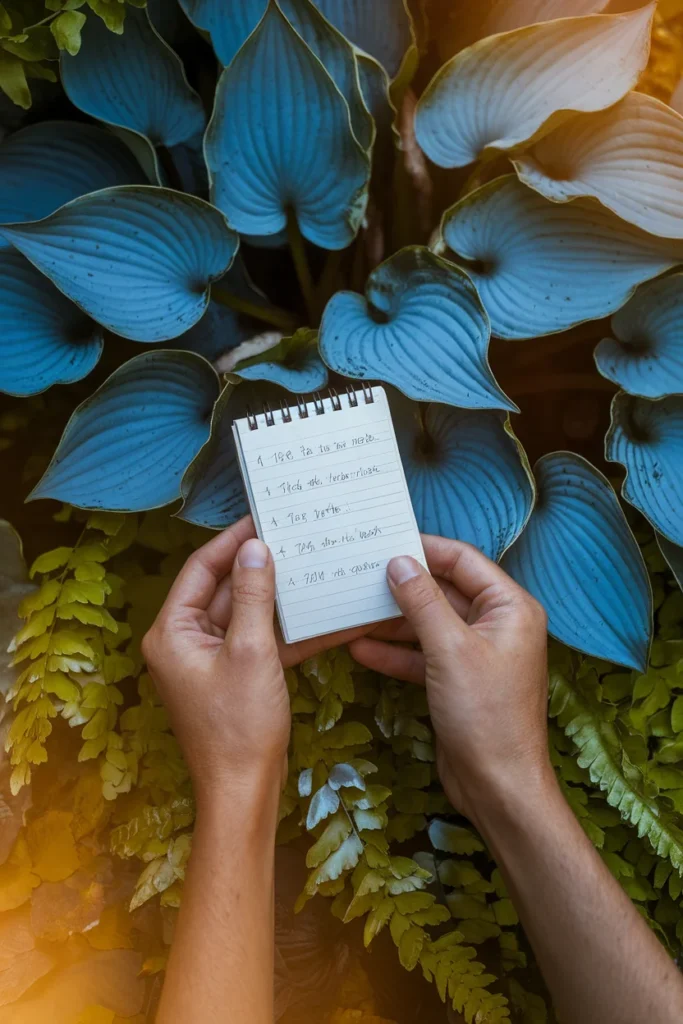
Grab a notebook before you grab a cart.
The 9-1-5 Shade Check: Our Three-Reading Light Test
This is the one thing we’d tell every beginner to do before spending money.
The 9-1-5 Shade Check is simple: on a clear day in late May or June, after the trees have fully leafed out, go stand in the spot at 9 a.m., 1 p.m., and 5 p.m. Write down whether the ground is in direct sun, dappled light, or full shadow at each reading. Three readings, one day, thirty seconds each.
Then match your result:
| 9 a.m. | 1 p.m. | 5 p.m. | What you have | Plant this |
|---|---|---|---|---|
| Sun | Shadow | Shadow | Morning part shade | Astilbe, hydrangea, heuchera |
| Shadow | Shadow | Sun | Afternoon part shade (hardest) | Hellebore, brunnera, tough ferns |
| Dappled | Dappled | Dappled | Dappled woodland shade | Hosta, Japanese forest grass, tiarella |
| Shadow | Shadow | Shadow | Full shade | Ferns, hosta, hellebore, wild ginger |
| Shadow | Dappled | Shadow | Filtered part shade | Almost any shade perennial |
Screenshot that. Take it to the garden center with you.
We ran this test on our own north side after losing an entire flat of impatiens two summers in a row. Turned out the strip got roughly forty minutes of direct light at 5 p.m. and nothing else. That’s full shade with a hot afternoon kicker, which is the single worst combination for anything delicate. Swapping to autumn ferns and ‘Sum and Substance’ hosta fixed it in one season.
Do the test in June. Not April. Bare branches lie.
The Best Shade Garden Ideas Start With Foliage
Here’s where most low-light yards go wrong. People shop for blooms, get four weeks of color, then stare at a green blob until October.
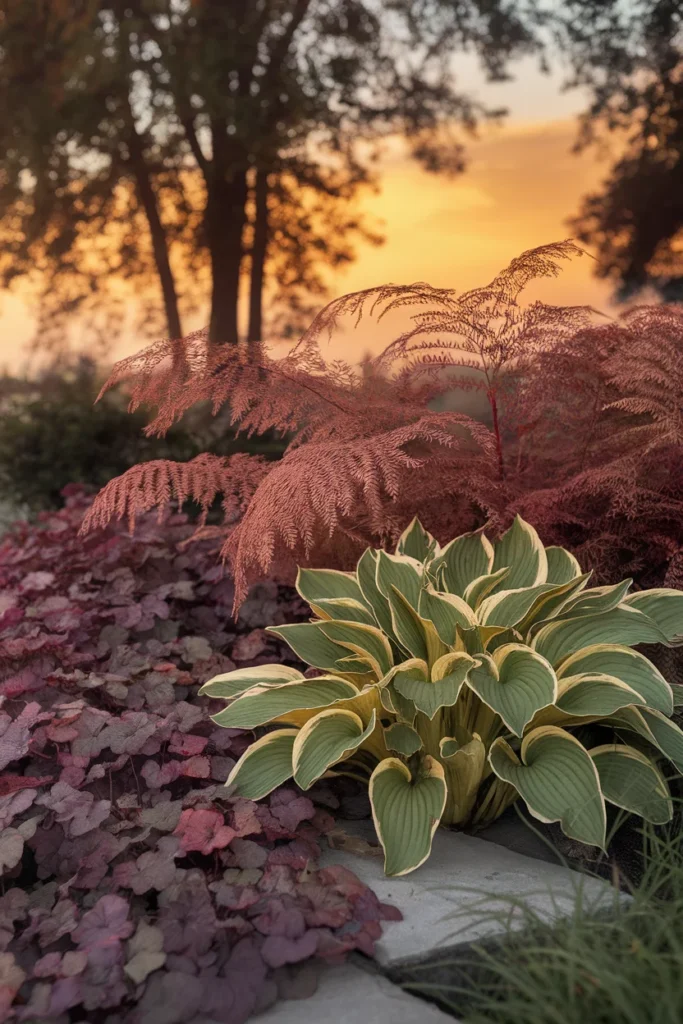
Shade gardens run on leaves. Contrast in texture, size, and color is doing ninety percent of the visual work, and it does that work from April through hard frost.
Build around three leaf shapes:
- Big and broad. Hosta is the obvious one and it earns the spot. ‘Sum and Substance’ throws chartreuse leaves the size of dinner plates, and chartreuse reads as light in a dark corner. A one-gallon hosta from Bell Nursery at Home Depot runs roughly $10 to $18 depending on the cultivar.
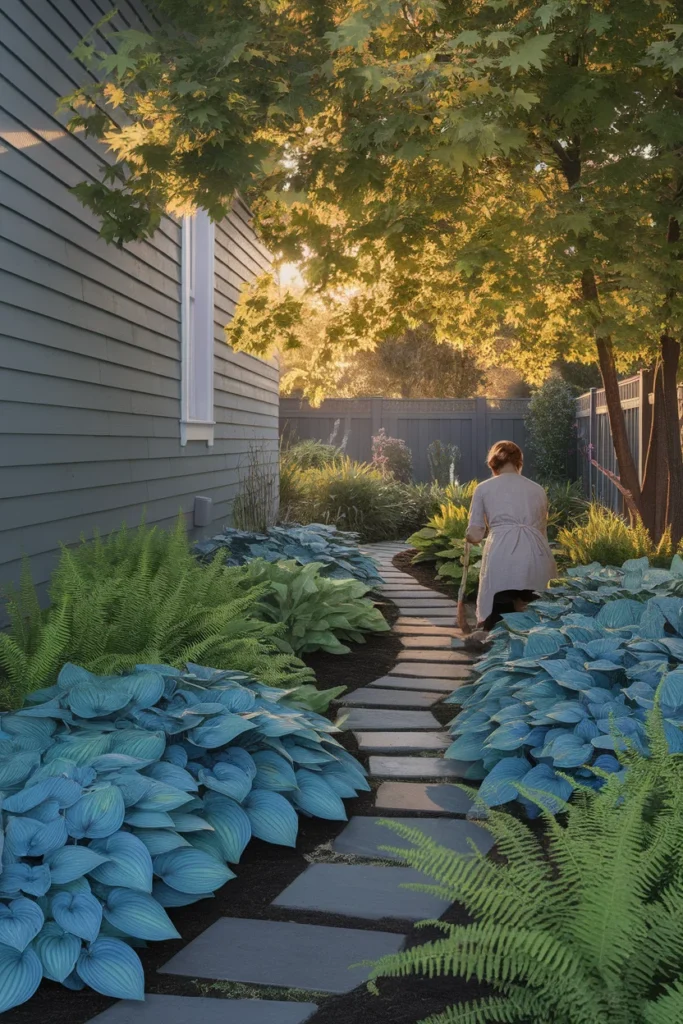
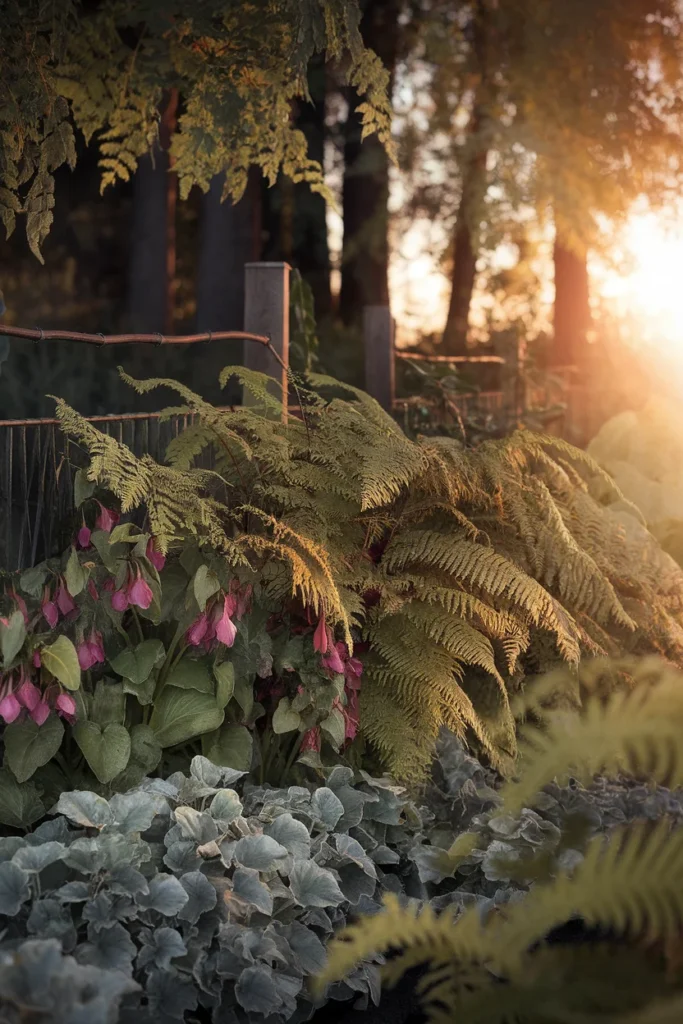
- Fine and feathery. Lady fern, autumn fern, Japanese painted fern. The autumn fern pushes coppery-bronze new growth every spring, which is the closest thing to a flower that isn’t one.
- Strappy and upright. Japanese forest grass (Hakonechloa) spills like a slow green waterfall. Carex and liriope do similar work for less money.
Then add color through leaves, not petals. Heuchera comes in caramel, plum, lime, and near-black, and it holds that color all season. Brunnera ‘Jack Frost’ has silver-webbed leaves that genuinely glow at dusk.
One rule we follow: anything chartreuse, silver, white-variegated, or cream goes near the back or the darkest edge. Pale foliage bounces the little light there is and makes the space feel deeper than it is. Dark burgundy heuchera in a dim corner just disappears.
Flowers still belong here. Astilbe plumes, hellebore in February, foamflower, bleeding heart, hydrangea. Treat them as punctuation.
Dry Shade Under Trees: The Part Everyone Gets Wrong
If your shade comes from a big established tree, you don’t have a light problem. You have a water problem.
A mature maple or oak pulls an enormous volume of water out of the top foot of soil every single day. Your hostas are competing with a hundred-foot straw. That’s dry shade, and it’s why plants under trees look fine in May and miserable by July.
Now the part that matters, and the part none of the big shade garden ideas roundups mention.
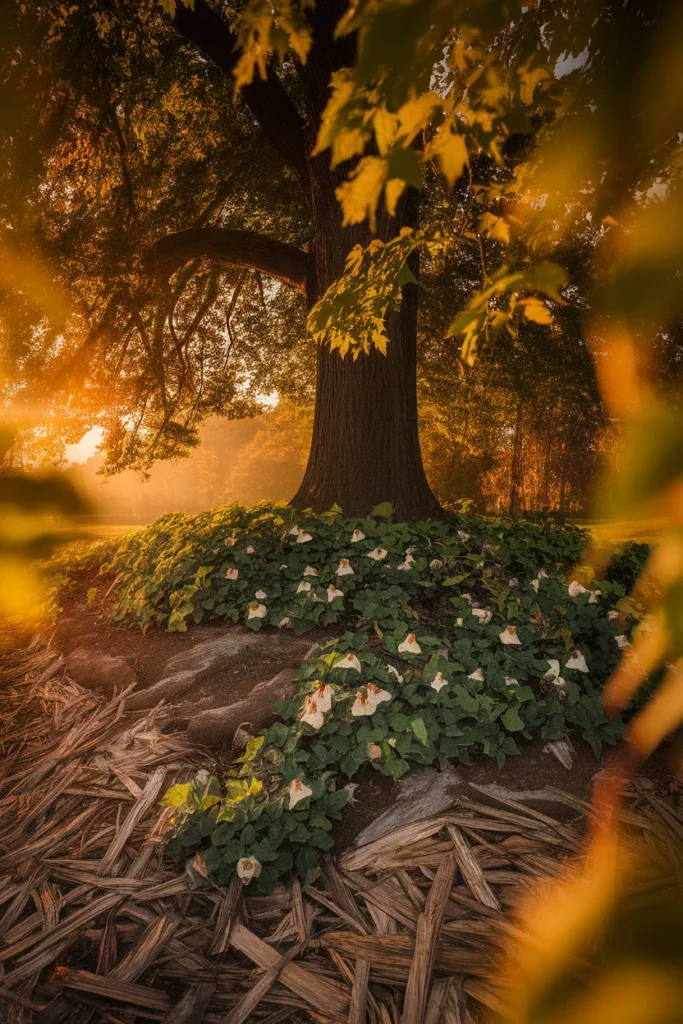
Do not build a raised bed under a mature tree. Do not mound six inches of topsoil over the root zone either. According to university extension guidance on planting under trees, most feeder roots live in the top 12 to 18 inches of soil, and burying them cuts off oxygen. The tree does not die dramatically. It declines slowly, and the symptoms “may not appear for 2-5 years,” by which point nobody connects the dots back to the pretty cedar bed they built.
Pinterest is full of raised beds ringing tree trunks. They photograph beautifully. They are also a slow-motion problem.
What to do instead:
- Spread a 2-inch layer of organic matter on the surface and work it in by hand to about 4 to 6 inches, only in the pockets where you’re planting.
- Plant small. One-quart perennials, not gallons, so you disturb fewer roots digging.
- Never cut a root thicker than your thumb. Move the plant, not the root.
- Water deeply once a week (about one inch) for the first season, then taper to every other week.
- Mulch 2 to 3 inches deep, and keep it pulled back a few inches from the trunk flare.
Best performers in genuinely dry shade: epimedium, wild ginger, hellebore, big root geranium, Solomon’s seal, and Japanese forest grass. Epimedium in particular is almost stubbornly indestructible once it settles in.
Brighten a Dark Corner Without Planting Anything
Some of the highest-impact shade garden ideas involve zero horticulture.
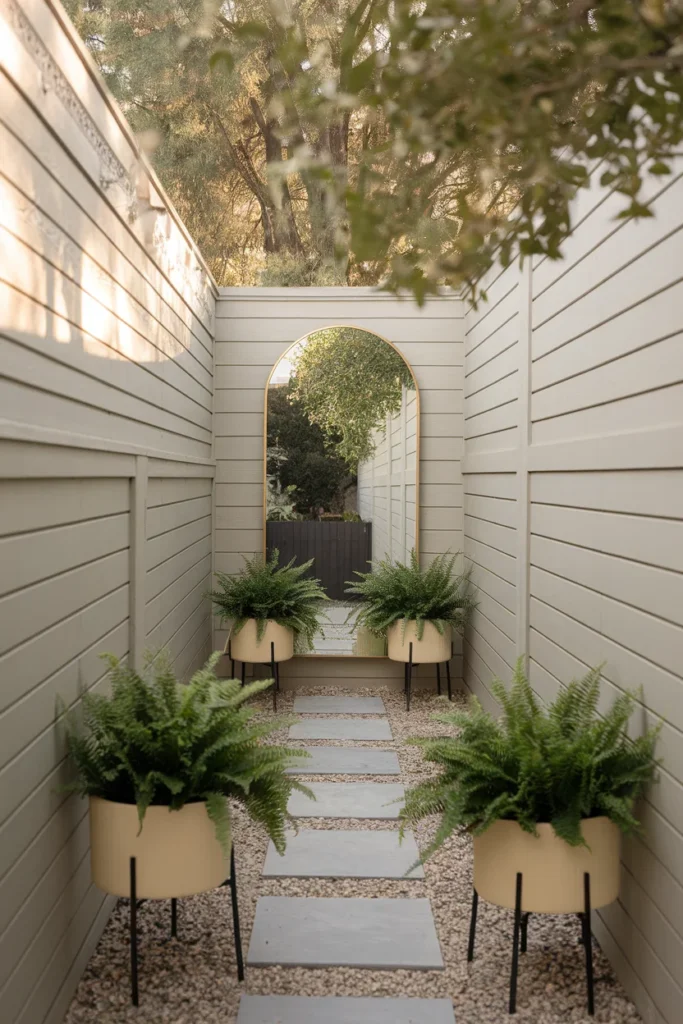
Paint the boundary. A dark brown fence absorbs light. The same fence in soft white, pale gray-green, or warm cream throws it back into the bed. We repainted a six-foot cedar fence in a light greige and the difference was more dramatic than the three hydrangeas we’d planted the year before. Two gallons of exterior paint, roughly $70 total, one Saturday.
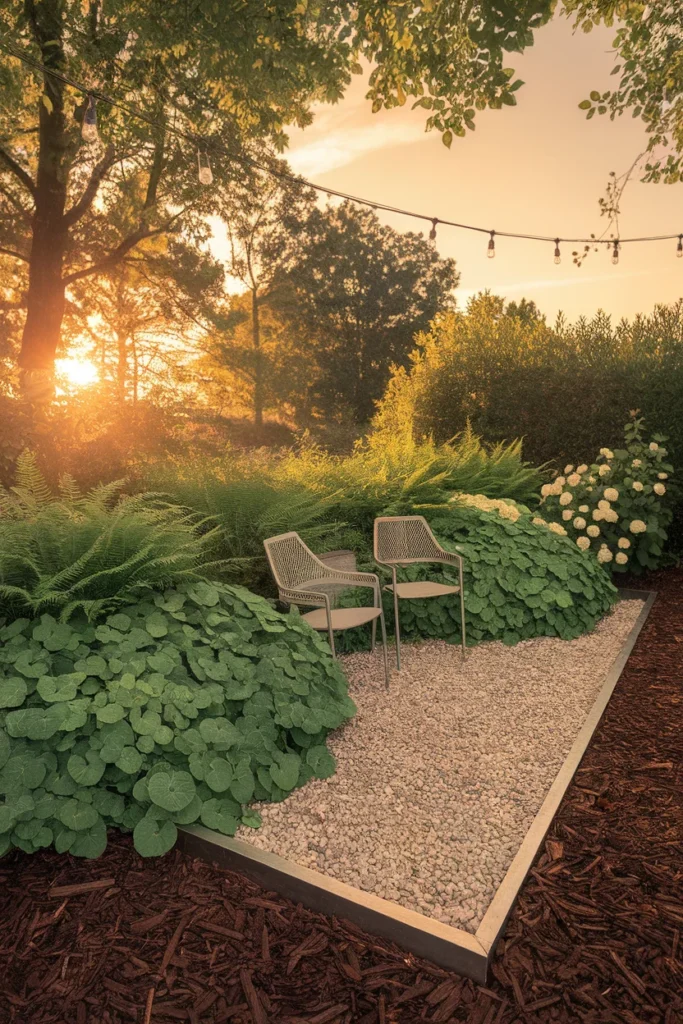
Switch your hardscape to something pale. Pea gravel, light flagstone, and cream-toned pavers read brighter than dark mulch or wet brick. Same square footage, twice the perceived light.
Hang a mirror, carefully. An outdoor-rated mirror on a shady wall doubles the visual depth of a narrow side yard. Two cautions: angle it so it reflects planting rather than reflecting direct sun onto siding or plants, and place it where birds are unlikely to fly into it (near dense foliage rather than across an open flight path).
Use pale containers as light points. A cluster of three cream or white Bloem planters, usually $15 to $30 each, pulls the eye into a dead corner far better than one more green shrub.
Add reflective water. Even a small dark-bottomed bowl of still water catches sky and flickers. It works because the sky above a shade garden is still bright, and you’re borrowing it.
If your darkest zone happens to be the shaded strip under your deck, most of the same moves apply, plus a few structural ones worth reading separately.
Container Shade Garden Ideas for Renters and Patios
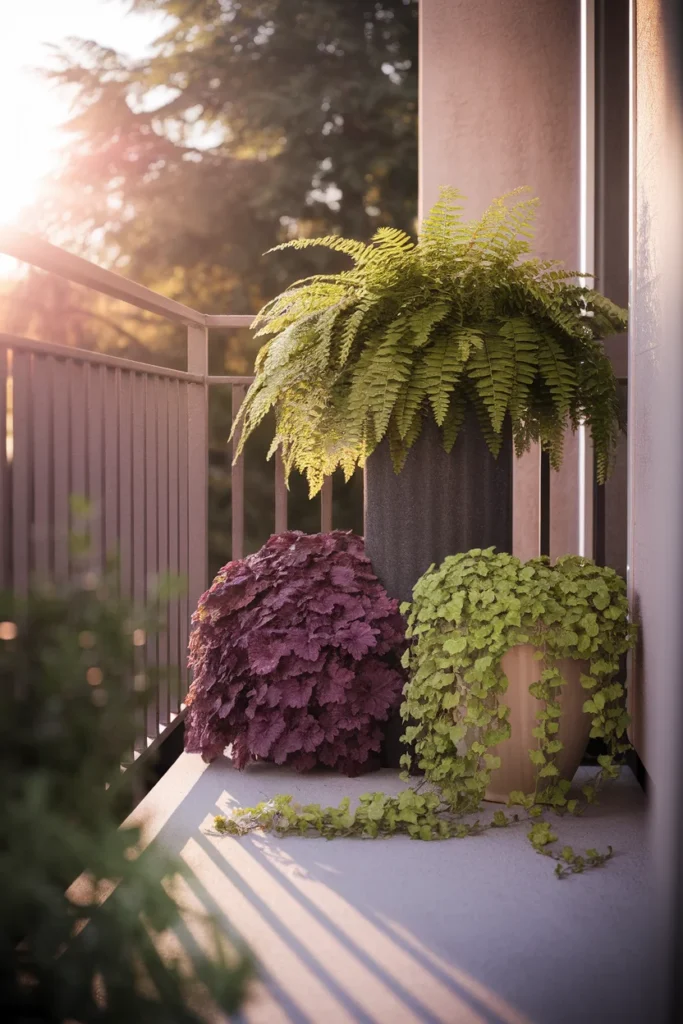
Renting? Working with a concrete patio or a balcony that faces a wall? Containers solve the whole thing, and they let you chase whatever light you do get by simply moving the pot.
The classic recipe still holds: one tall thriller, a few mounding fillers, something trailing over the edge.
For full shade, that looks like:
- Thriller: Japanese painted fern, a small hosta, or caladium for tropical color
- Filler: heuchera, torenia, begonia (wax or tuberous)
- Spiller: creeping Jenny in chartreuse, ivy, or trailing lobelia
Two things matter more in shade containers than sunny ones. First, drainage, because shaded soil stays wet far longer and root rot arrives fast. Use a light potting mix rather than heavy garden soil, and never skip the drainage holes. Second, fertilize less. Shade plants grow slower, so a half-strength feed every few weeks beats a full dose.
Impatiens and begonias remain the workhorses for actual flower color in deep shade. Nothing else blooms that hard with that little light.
For a fuller planting plan you can adapt to a shady patio, our guide to building a container garden on a patio walks through pot sizes and combinations.
Light the Space After Sunset
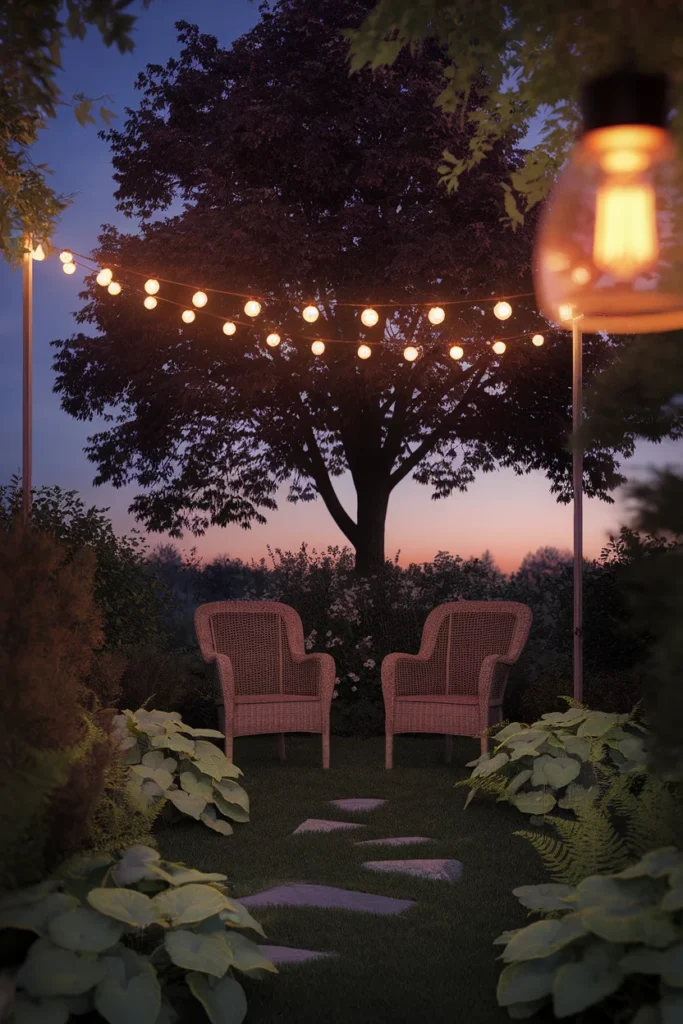
A shade garden is already dim at 6 p.m. Left unlit, it goes fully invisible by eight, which means you lose the whole space right when you’d actually be sitting outside.
Warm light (2700K, not the blue-white 5000K stuff) does something specific here: it makes cool green foliage look richer instead of gray.
Three layers, in order of impact:
- Overhead string lights. Brightech Ambience Pro in the 27-foot or 48-foot run is the standard for a reason, generally $40 to $70 depending on length. Zigzag them above a seating area, not around the perimeter.
- Uplights at the base of trunks. One small spotlight aimed up a maple trunk turns the tree into the feature after dark. Two or three of these do more than a dozen path lights.
- A few low path lights. Solar works poorly in real shade (no surprise), so plan on a low-voltage wired kit if the area gets under two hours of sun. Dollar Tree solar stakes at $1.25 each are fine for a decorative flicker along a walkway, but treat them as accent, not illumination.
Skip anything that changes color. It fights the foliage, and it undoes the calm most shade garden ideas are reaching for.
If Deer Walk Through Your Yard, Read This First
Shade gardens tend to sit along woodland edges, fence lines, and back property boundaries. That is exactly where deer travel. You can execute every idea on this page perfectly and wake up to bare hosta stems in one night.
Hostas are deer candy. So are daylilies and tulips. If you have browsing pressure, plant hosta only in containers close to the house, or accept that you’re feeding wildlife.
Reliably deer-resistant shade plants:
- Ferns. Nearly all of them. Deer skip the texture entirely.
- Hellebore. Toxic foliage, blooms in late winter, essentially untouched.
- Epimedium. Tough, dry-shade tolerant, and ignored.
- Brunnera. Fuzzy silver leaves that browsers dislike.
- Astilbe. Usually passed over, though not guaranteed in a hard winter.
- Wild ginger and Japanese forest grass. Both hold up well.
Nothing is deer-proof when the animals are hungry enough. But a bed built on ferns and hellebores survives a season that would strip a hosta collection bare.
What These Shade Garden Ideas Actually Cost
Nobody in the top search results will tell you this, so here it is. Prices below are approximate US ranges for 2026 and vary by region and retailer, so treat them as planning numbers.
Tier 1: Under $150 (one weekend, one corner)
Six to eight one-quart perennials at roughly $8 to $12 each, two bags of Miracle-Gro Garden Soil at about $6 to $10 per one-cubic-foot bag, and three bags of shredded hardwood mulch. Covers roughly a 6-by-8-foot bed. Buy small and let things fill in.
Tier 2: $300 to $600 (a real border)
Twelve to eighteen one-gallon perennials, a few shade shrubs (oakleaf hydrangea, Japanese kerria), stone or steel edging, six to eight bags of mulch, and a string light run. This is the tier where the bed starts photographing well.
Tier 3: $1,200 and up (the full corner)
Everything above plus a flagstone or pea gravel sitting area, low-voltage wired lighting, three to five large containers, and a small water feature. Add professional installation and this climbs quickly.
Two ways to spend less without it looking cheap: buy perennials in fall when garden centers discount them 40 to 60 percent, and buy fewer varieties in larger groups. Nine of one fern reads as intentional. One each of nine plants reads as a collection of leftovers.
If keeping the whole thing manageable matters more than maximum plant count, a low maintenance backyard plan is worth reading alongside this.
A Season-by-Season Order for Your Shade Garden Ideas
Do it in this sequence and you’ll waste less money.
- June: Run the 9-1-5 Shade Check. Write down what you find.
- Late June: Amend only the planting pockets, 2 inches of compost worked in shallowly.
- July: Plant the structural pieces first (shrubs, then the largest perennials). Water deeply once a week.
- August: Fill gaps with containers rather than committing to more in-ground plants. You’ll learn the space.
- September and October: Buy discounted perennials and plant the rest. Fall planting in shade beats spring planting in shade almost every time, since roots establish without heat stress.
- Before frost: Mulch 2 to 3 inches, keeping it off crowns and trunks.
One honest note about year one. It will look sparse. Shade perennials spend their first season building roots, and the visible payoff lands in year two. We nearly ripped out an entire epimedium planting after ten months of nothing much happening. Year three it was the best thing in the yard.
Frequently Asked Questions
What can I do with shaded areas in my garden?
Plant a foliage-driven bed (ferns, hostas, heuchera), or convert the space into a use rather than a planting: a seating nook, a gravel path, storage, or a shaded dining spot. Deep shade under a deck or against a north wall often works better as usable square footage than as a flower bed, so the best shade garden ideas there are structural.
How do you brighten a shady garden?
Three moves, in order of impact: paint boundaries and structures a light color, switch to pale hardscape (gravel, light flagstone, cream pavers), and plant chartreuse, silver, or white-variegated foliage at the darkest points. Mirrors and pale containers add depth after that.
What can I plant in a shady yard?
For full shade: ferns, hostas, hellebore, wild ginger, epimedium, brunnera, Japanese forest grass. For part shade add astilbe, hydrangea, heuchera, foamflower, bleeding heart, and tiarella. For annual color in deep shade, impatiens and begonias outperform everything else.
What is the difference between part shade and full shade?
Part shade means roughly four to six hours of direct sun, ideally in the morning. Full shade means two hours or less of direct sun per day. The distinction matters because afternoon sun is far harsher than morning sun at the same duration.
What flowers bloom in full shade?
Hellebore (late winter), impatiens and begonias (all season), astilbe, foamflower, bleeding heart, and hosta flower spikes in midsummer. Bloom is genuinely limited in full shade, which is exactly why foliage carries the design.
Do shade gardens need less water?
Usually yes, since less sun means slower evaporation. The exception is dry shade under mature trees, where root competition can make the soil drier than a sunny bed. Check two inches down with your finger rather than assuming.
Can you grow vegetables in a shade garden?
Leafy crops can manage with three to four hours of sun: lettuce, spinach, arugula, kale, chard, and most herbs except basil and rosemary. Anything that fruits (tomatoes, peppers, squash) needs six-plus hours and will not produce in real shade.
Where to Start This Weekend
Pick your darkest corner. Run the 9-1-5 Shade Check on the next clear day, then buy three plants, not thirty: one fern, one hosta or heuchera, and one thing with pale or variegated leaves. Put them in, mulch, and watch them for a month.
That corner will tell you more in four weeks than any plant list can, including this one.
And if you try any of these shade garden ideas, we’d love to know which spot you tackled first. The dark side yard is usually the one that surprises people most.