
Covered Patio String Lights: 9 Cozy Ideas and How to Hang Them
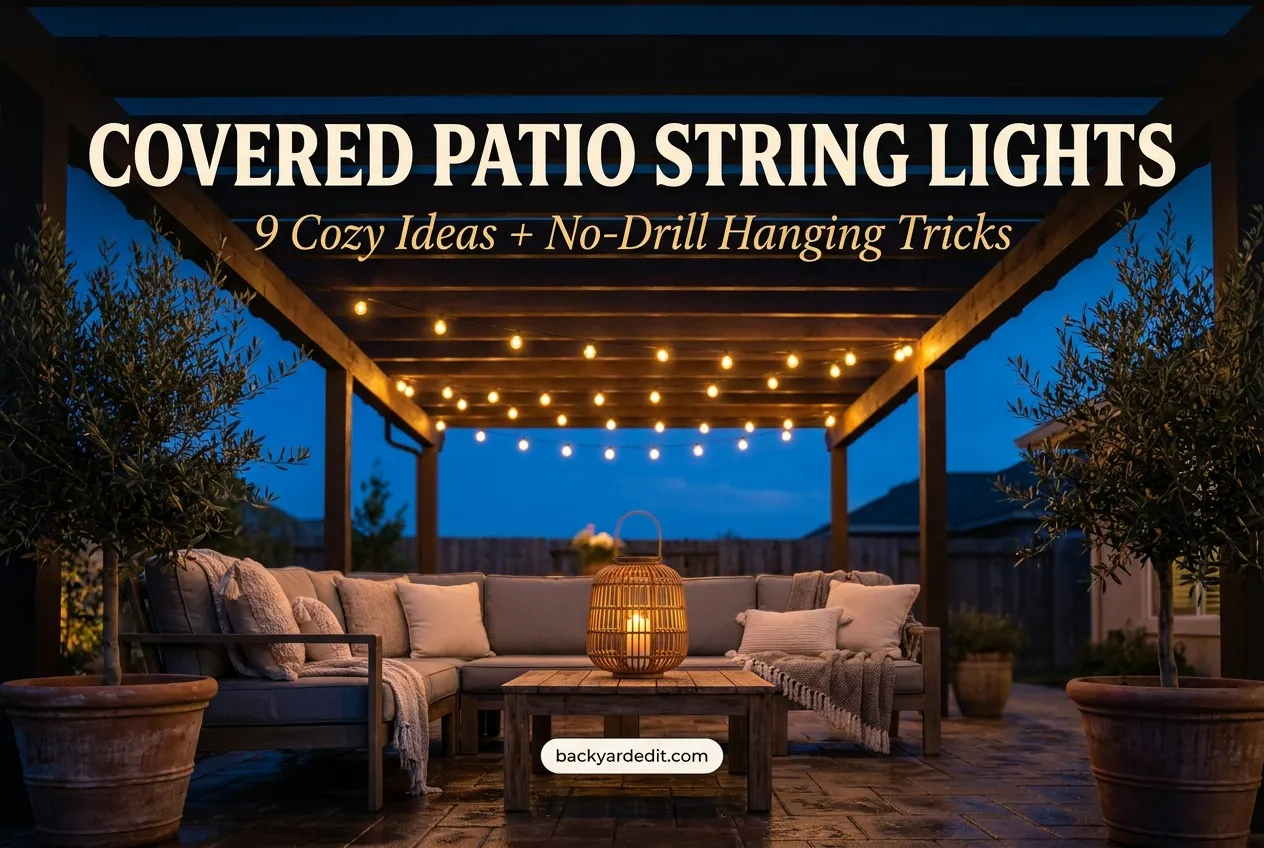
Your covered patio has one thing an open yard doesn’t: a ceiling. That roof, beam, or pergola frame is the easiest anchor you’ll ever get for covered patio string lights, and it means no leaning poles, no guy wires stretched across the lawn, no praying the wind behaves. String a few warm strands up there and a plain concrete slab turns into the spot everyone drifts toward after dark.
Below are nine looks worth copying, from a single lazy strand to a full glowing grid. You’ll also get the part the big magazines skip: how to hang them on a covered structure without wrecking your ceiling, including a renter-safe no-drill route.
Let’s get into it.
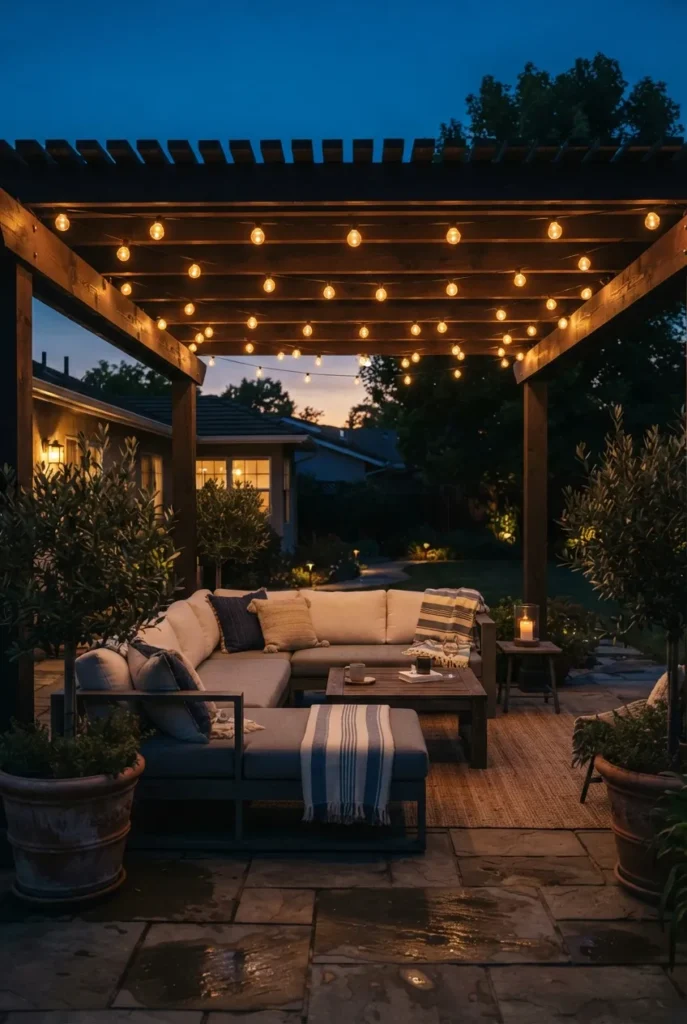
Start With the Right Bulb and Strand for a Covered Patio
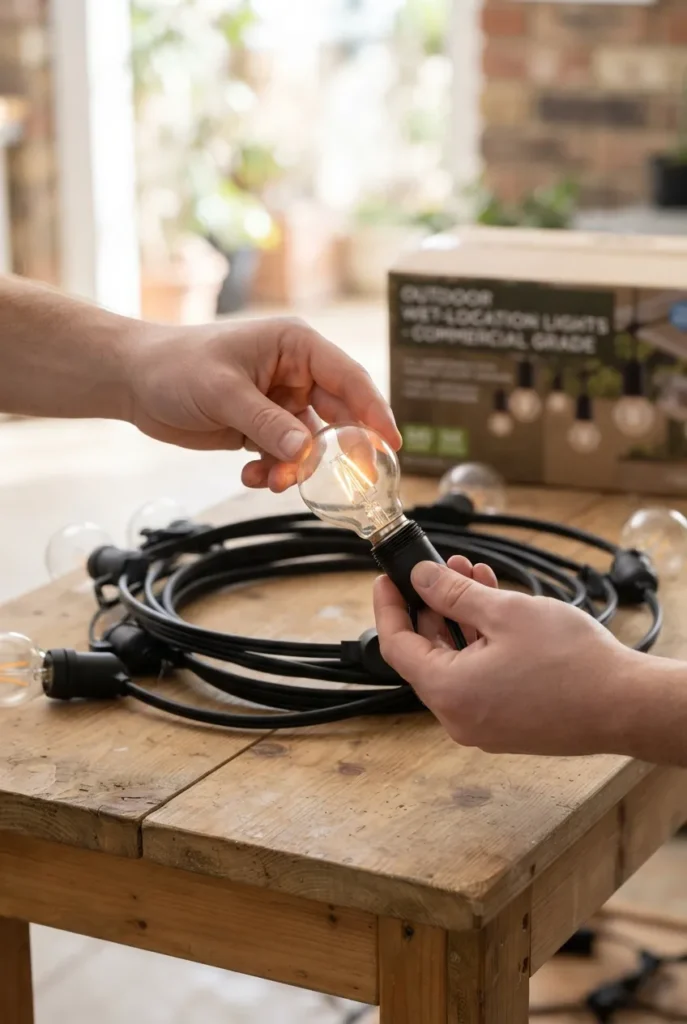
Before the pretty stuff, pick a strand that survives a roofed outdoor space. A covered patio traps a little less rain but plenty of humidity, pollen, and summer heat, so the strand still needs to be built for outside.
Look for a UL or ETL “wet location” or “outdoor” rating on the box, warm-white 2200K to 2700K bulbs (that honey glow the top Pinterest pins all share), and shatter-resistant shells if kids or dogs use the space. Shatterproof G40 globe or S14 café bulbs are the two shapes that read “cozy” instantly.
A few solid starting points: Brightech Ambience Pro (shatterproof, warm 2700K, commonly sold in the $30 range for a 26-foot solar strand), Feit Electric café strands from Home Depot or Costco, and the budget Hampton Bay 48-foot S14 set that hovers around $30 . Buy one strand longer than you think. You’ll always want the extra length.
Here’s a small truth from the trenches.Real experience here, e.g. “The first strand I hung on our covered patio was a cheap indoor-rated set from a big-box clearance bin, and by the second humid Zone 7 July the sockets had corroded and half the bulbs quit. I replaced it with a wet-rated Brightech run and haven’t touched it in two summers.”
Hang Them Safely on a Covered Structure
This is the section that actually matches your search, and it’s the one most idea posts gloss over. A covered patio gives you overhead anchor points, but how you attach to them depends entirely on the ceiling material.
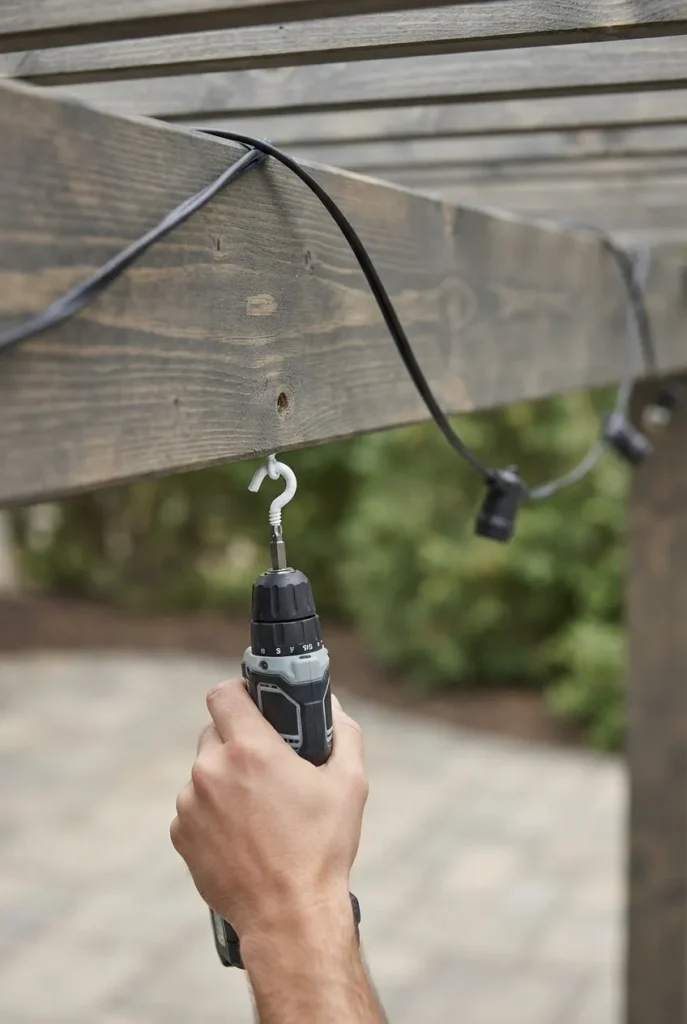
Wood beams, rafters, or a pergola get screw-in cup hooks or eye bolts spaced every 3 to 4 feet. Vinyl or aluminum patio covers can’t take a screw cleanly, so reach for adhesive-backed outdoor hooks or gutter clips instead. Stucco or masonry columns need a masonry bit and a plastic anchor. For a run longer than about 10 feet, string a thin stainless guide wire first, then hang the lights from the wire with S-hooks so the strand isn’t carrying its own sag.
Keep a gentle swoop between anchor points. A slight droop looks intentional and keeps steady tension, while a drum-tight line stresses the sockets and tends to pull hooks loose over time.
One safety note worth thirty seconds: outdoor lights belong on a ESFI, “plug everything into a GFCI outlet“, and any extension cord should be an USU Extension, “use outdoor-rated cords with three-prong plugs”]=. A roofed space hides cords overhead where you forget about them, so a weatherproof plug cover at the connection point is cheap insurance. If you want the full walkthrough with photos, our guide on how to hang string lights in a backyard covers spans, tools, and tension in more detail.
The Layered-Glow Method: My 3-Layer Covered Patio Lighting Formula
Here’s the original framework I use to plan any covered space, and it keeps a patio from looking either too dark or lit up like a parking lot. Call it the 3-Layer Covered Patio Glow.
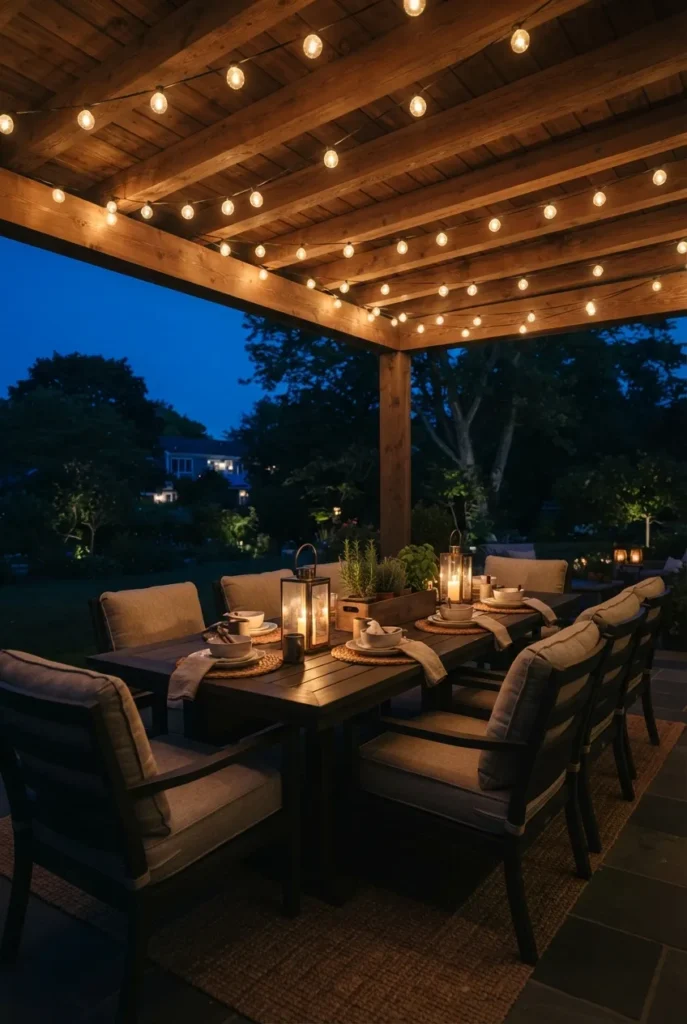
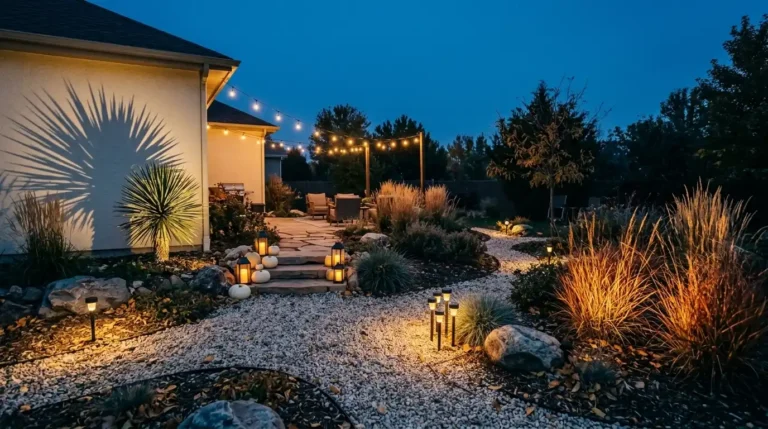
Layer one is the canopy: your main string light run overhead, the anchor of the whole scene. Layer two is the accent: a lantern, a table lamp, or a smaller secondary strand at eye level to fill shadows. Layer three is the ground glow: a couple of solar path lights or a fire feature down low so the light wraps around you instead of only pressing down from above.
Hit all three layers and a covered patio feels like a room. Skip to just the overhead strand and it can feel flat. This is the single change that separated the “meh” version of our space from the one people actually want to sit in.
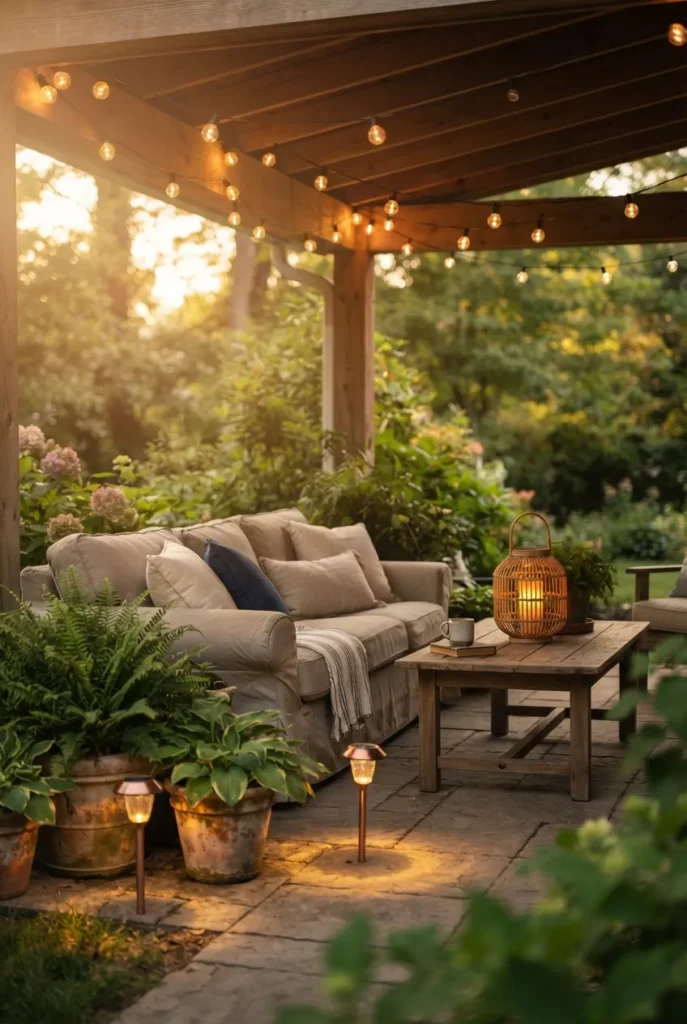
9 Covered Patio String Light Ideas to Copy
Now the fun part. Pick the pattern that matches your ceiling and your vibe.
1. Straight Rows Across the Beams
The cleanest look, and the easiest on a covered patio. Run parallel strands from one side beam to the other, spaced evenly. It reads modern and calm, and it’s the pattern that photographs best for that magazine-cover feel.
2. The Open-V Frame
Anchor three points and let the strands meet in a soft V over your seating zone. It frames the couch without boxing it in, and it uses less wire than a full grid.
3. Zig-Zag for Even Wash
Weave the strand back and forth in a zig-zag under the roof. Shorter individual spans mean less sag and a soft, even wash of light across the whole space. Great for wide covers.
4. Perimeter Outline
Run a single strand along the entire edge of the roofline. It outlines the patio like a picture frame and quietly boosts nighttime visibility. Simple, and hard to get wrong.
5. One Lazy Strand
Not every space needs a grid. A single draped strand over the dining table looks effortless and lets a pretty tablescape stay the star. Honestly, this is where I’d start if you’re nervous.
6. Curtain Drop From the Roof Edge
Hang a curtain-style strand so lights cascade straight down along one open side. It creates a glowing “wall” of light and a little privacy, which pairs beautifully with the tricks in our covered patio ideas roundup.
7. Wrapped Posts and Columns
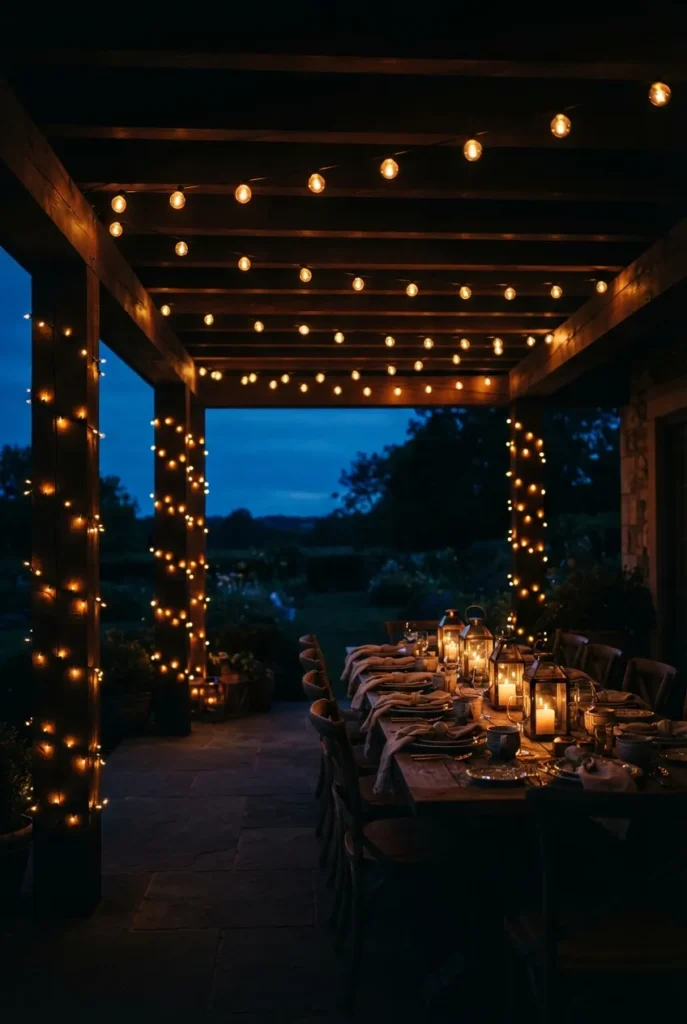
Spiral a warm strand up each support post. On a covered patio those posts are right there begging for it, and lit columns make the whole structure feel custom.
8. Mixed With Lanterns
Pair your overhead strand with a few hanging lanterns at different heights. The mix of point-source lanterns and diffuse string light adds the depth that layer two in the formula is all about.
9. Dimmable and Smart-Plug Controlled
Put the whole run on a smart plug (a Kasa outdoor smart plug sells for around $15 to $20) or pick dimmable strands. Bright for a cookout, low and moody for a nightcap, all from your phone.
No-Drill and Renter-Friendly Options
Two of the top Google questions ask how to hang string lights on a covered patio without nails or drilling, so this one’s for renters and anyone who wants zero holes.
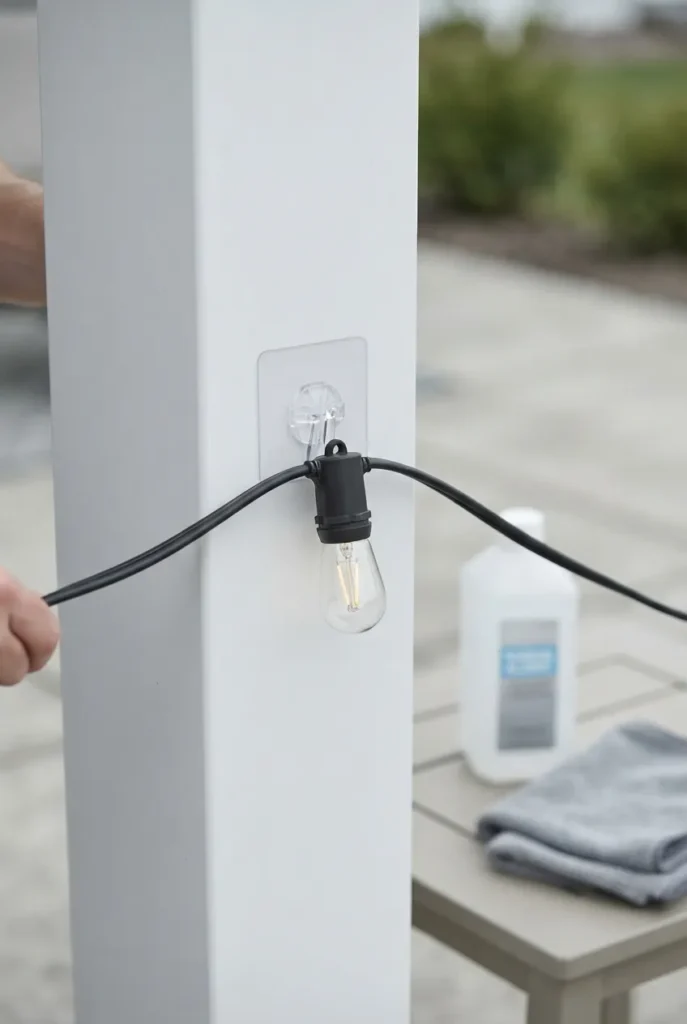
Adhesive outdoor hooks (Command makes an outdoor line rated to hold in heat and rain) stick to clean beam faces, siding, and columns, then peel off later without a mark. Gutter hooks slip over the edge of a roof gutter with no fasteners at all. Tension between two posts, a freestanding rack, or a couple of planter-anchored poles also skips the ceiling entirely. If you’d rather stand your lights up than hang them, you can build your own DIY string light poles in an afternoon with a few bags of concrete and some galvanized pipe.
Clean the surface with rubbing alcohol before any adhesive hook goes up. Skip that step and they drop in the first heat wave (learned that one the annoying way).
Match the Look to Your Patio Style
The same warm bulbs read completely differently depending on what’s around them.
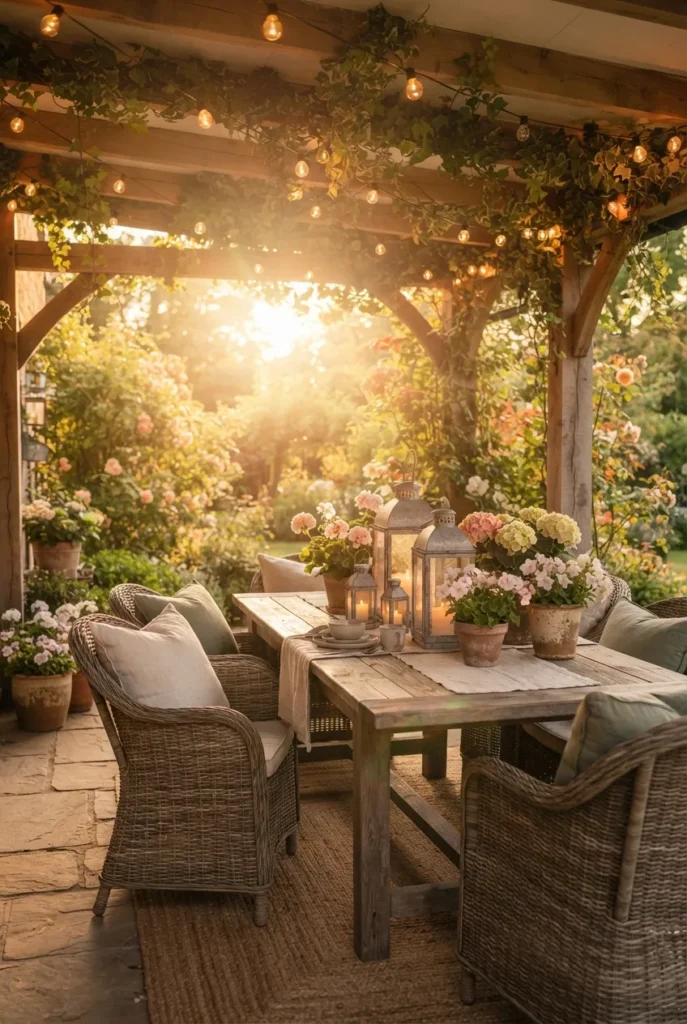
For a modern patio, straight rows of black-corded S14 lights over a concrete floor and low furniture keep it crisp. For cottage or farmhouse, warm globes woven with trailing greenery and a couple of galvanized lanterns lean charming. For a Mediterranean feel, spiral the strands up stucco columns and add terracotta pots. If you want the full spread of yard-wide inspiration beyond the covered zone, our outdoor string light ideas for the whole yard shows how to carry the glow past the patio roof.
Seasonal Care So They Last for Years
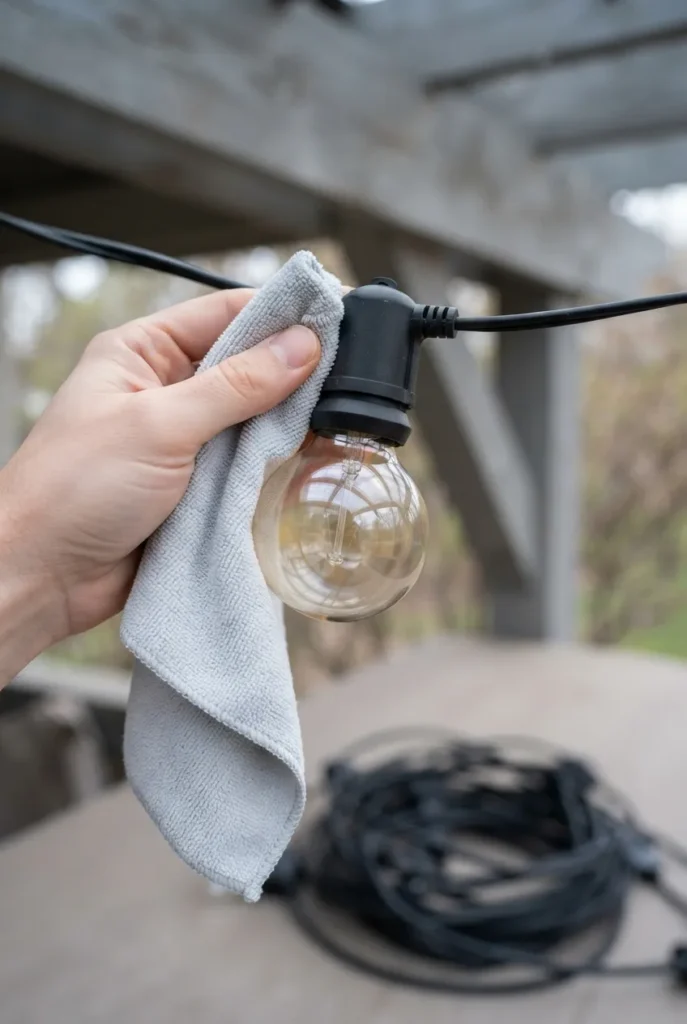
A covered patio protects your lights better than open sky, but they still take a beating from heat and humidity. In most of the country (roughly USDA Zones 5 to 9, where this site’s readers garden), leave outdoor-rated strands up year-round and just unplug during hard freezes or a big storm. Wipe the bulbs each spring, check sockets for corrosion, and store any non-rated strands indoors over winter.
Real zone and routine, e.g. “in our Zone 6b yard we leave the wet-rated café lights up all year and only pull them for the two or three ice storms we get between December and February”
What This Costs to Pull Off
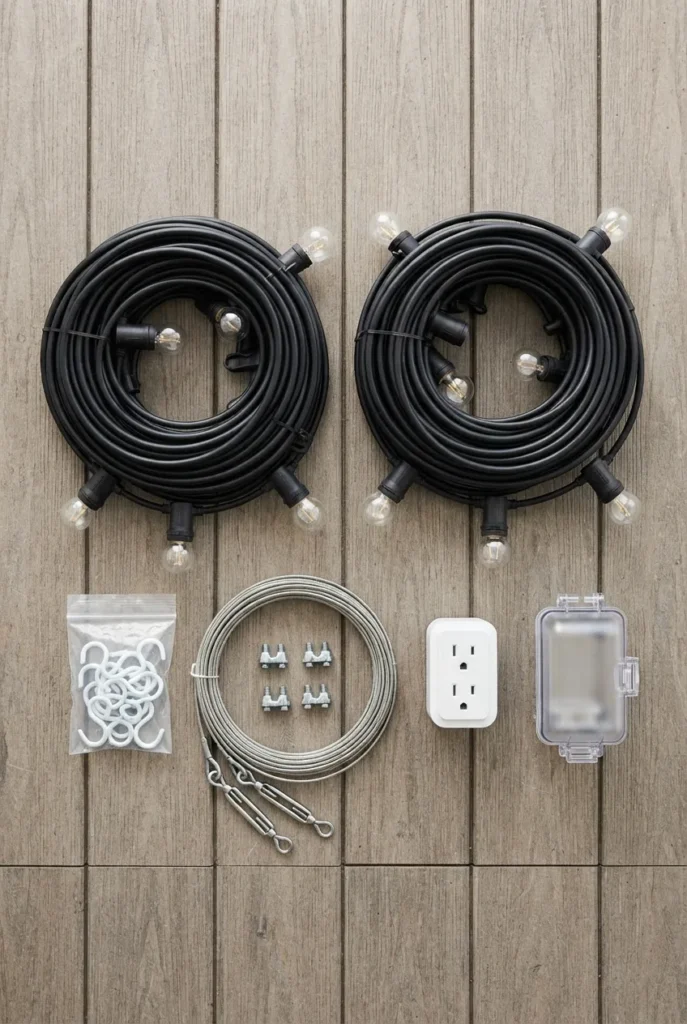
Good news: this is one of the cheapest backyard upgrades going. A solid mid-range setup runs about like this.
| Piece | Typical cost |
|---|---|
| Two outdoor-rated strands (48–52 ft) | around $60 total |
| Cup hooks or adhesive hooks | under $15 |
| Stainless guide wire + turnbuckles | around $20 |
| Outdoor smart plug (optional) | $15 to $20 |
| Weatherproof plug cover | under $10 |
Call it roughly $100 to $125 for a covered patio that glows every night, less if you already own the hooks or skip the smart plug. Compare that to a single piece of patio furniture and the value is obvious.
Bring It All Together
A covered patio hands you the anchor points, the shade, and the shelter. All it’s missing is that warm overhead glow, and now you’ve got nine ways to add it plus the hanging tricks to keep it up for years. Pick one pattern, grab a wet-rated strand, and give yourself a weekend.
Frequently Asked Questions
How do you hang string lights on a covered patio without nails?
Use adhesive-backed outdoor hooks (like Command’s outdoor line) on clean beam faces or columns, or slip gutter hooks over the roof edge. Both hold string lights with zero holes and peel off cleanly, which makes them ideal for renters. Wipe the surface with rubbing alcohol first so the adhesive grips.
How do you hang string lights on a patio without drilling holes?
Skip the ceiling entirely: tension the strand between two existing posts, use a freestanding light-pole rack, or anchor poles in weighted planters at each corner. Adhesive hooks and gutter clips are the other no-drill routes.
How do you light a covered patio?
Layer it. Start with an overhead string light run as your main source, add lanterns or a table lamp at eye level, and finish with low ground lighting like solar path lights or a fire feature. That three-layer mix keeps the space from feeling either dark or harshly flat.
What is the best way to hang string lights outdoors?
Anchor to sturdy points every 3 to 4 feet with cup hooks or eye bolts, allow a gentle swoop instead of a tight line, and add a stainless guide wire for any span over about 10 feet so the wire carries the weight, not the strand.
How high should covered patio string lights hang?
Aim for at least 6 feet of clearance, and ideally 8 to 12 feet, so nobody walks into them and the glow spreads evenly. On a covered patio your beam height usually sets this for you.
Can you leave string lights up on a covered patio year-round?
Yes, if they’re outdoor or wet-location rated. A patio roof shields them from the worst weather, so most people leave rated strands up all year and simply unplug during hard freezes or major storms. Store any indoor-only strands over winter.
How many string light strands can you connect end to end?
It depends on bulb wattage and the manufacturer’s max, printed on the box. LED strands draw far less power than incandescent, so you can usually link many more runs. Never exceed the stated limit, and plug the first strand into a GFCI outlet.
One Comment