Narrow Backyard Ideas: Smart Layouts for Long Yards
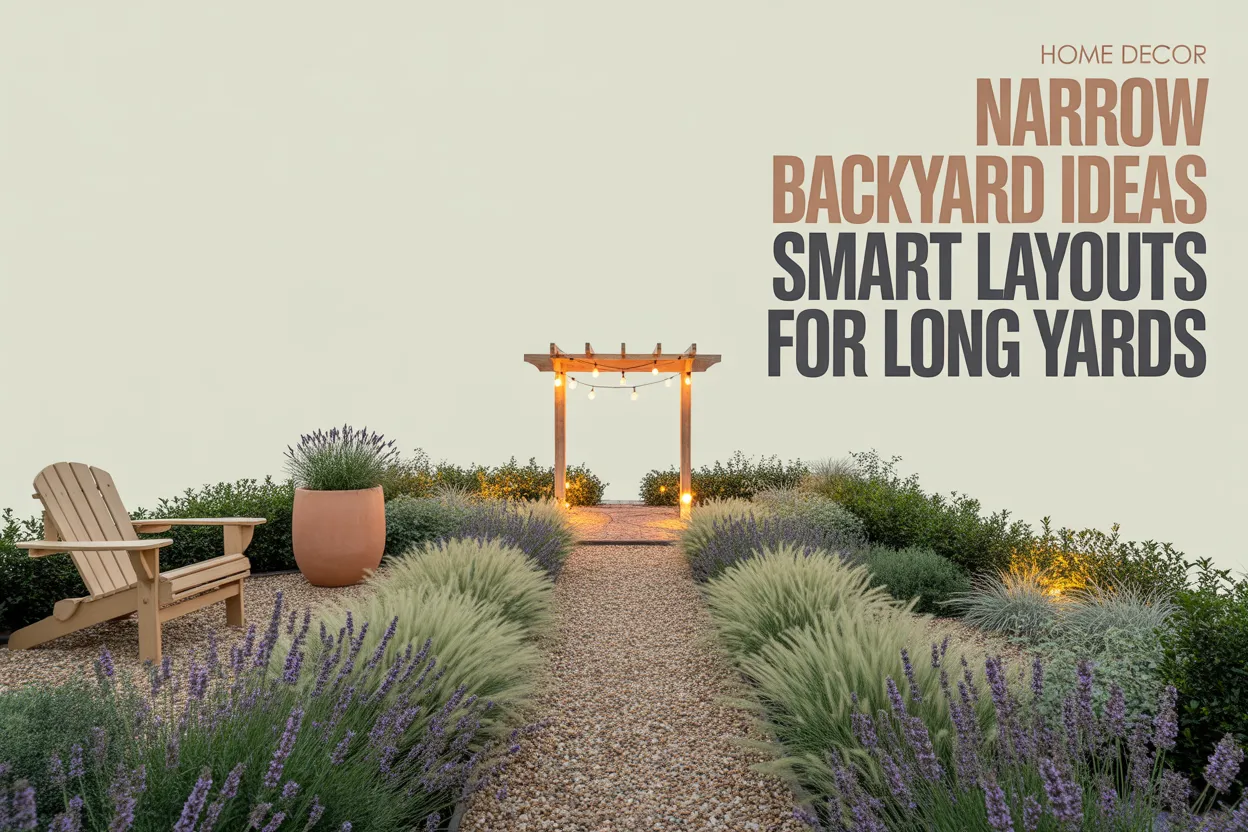
You walk out the back door, coffee in hand, and there it is again. A long, skinny rectangle of patchy grass, the neighbor’s fence pressing in from both sides, one sad plastic chair pushed against the gate. The yard isn’t broken. It just looks like a hallway nobody finished decorating.
Here’s the fix. The 18 narrow backyard ideas below are organized by yard zone (entry, middle, and back) so you can plan from the door outward instead of guessing. You’ll see budget picks under $25, mid-range buys from Target and IKEA, and a few splurges if you’re ready to go all in.
Who this is for: renters with a 10-foot strip of yard, new homeowners staring at a 60-foot rectangle, small-space dwellers who want zones instead of one boring lane, and anyone whose long narrow yard photographs better than it actually feels to sit in.
Bookmark this one. It’s the playbook I wish I’d had before I spent three weekends fighting a 12 by 45 foot lot with the wrong plants and a path that ran straight down the middle like an airport runway.
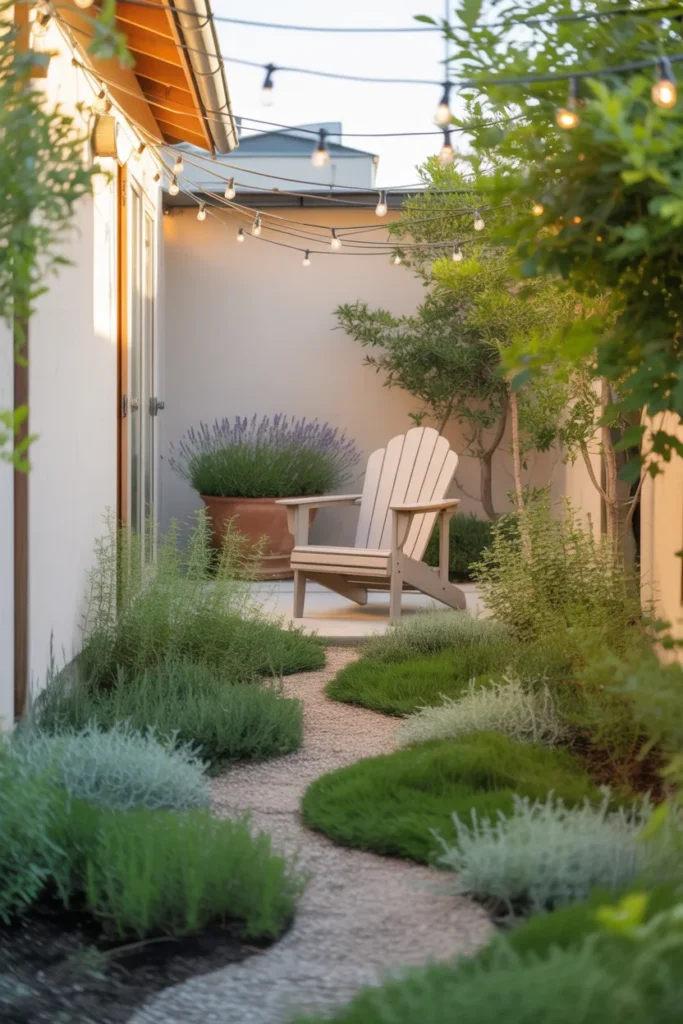
The One Rule That Changes Every Narrow Backyard
Before any of the ideas, this. A narrow yard fails for one reason: the eye runs straight from the back door to the fence at the end. There’s nothing to slow it down. The whole space reads as one tube.
Every fix below works because it does one of three things. It breaks the sight line. It pulls the eye sideways. Or it gives the yard a destination at the far end so the length feels intentional instead of accidental.
Keep that lens on every idea you scroll past.
Plan the Yard in Three Zones (Not One Long Strip)
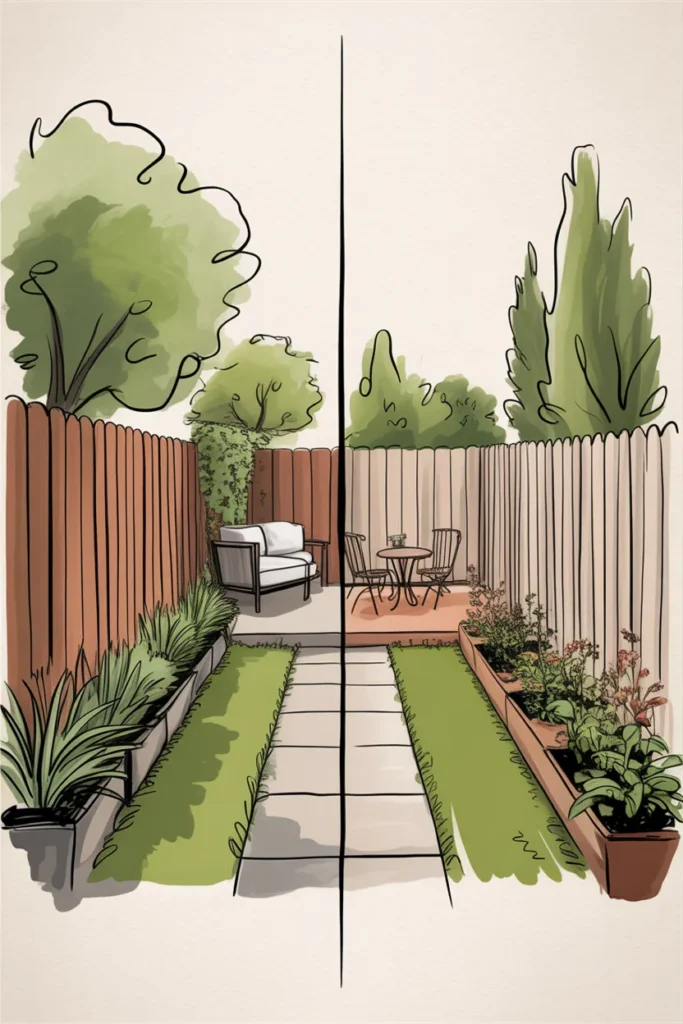
The fastest visual upgrade for a long narrow yard is dividing it into three zones, even if your total length is only 30 feet. Pros call this zoning. You can call it “stop making your yard look like a bowling lane.”
Here’s the framework I use on every long narrow lot:
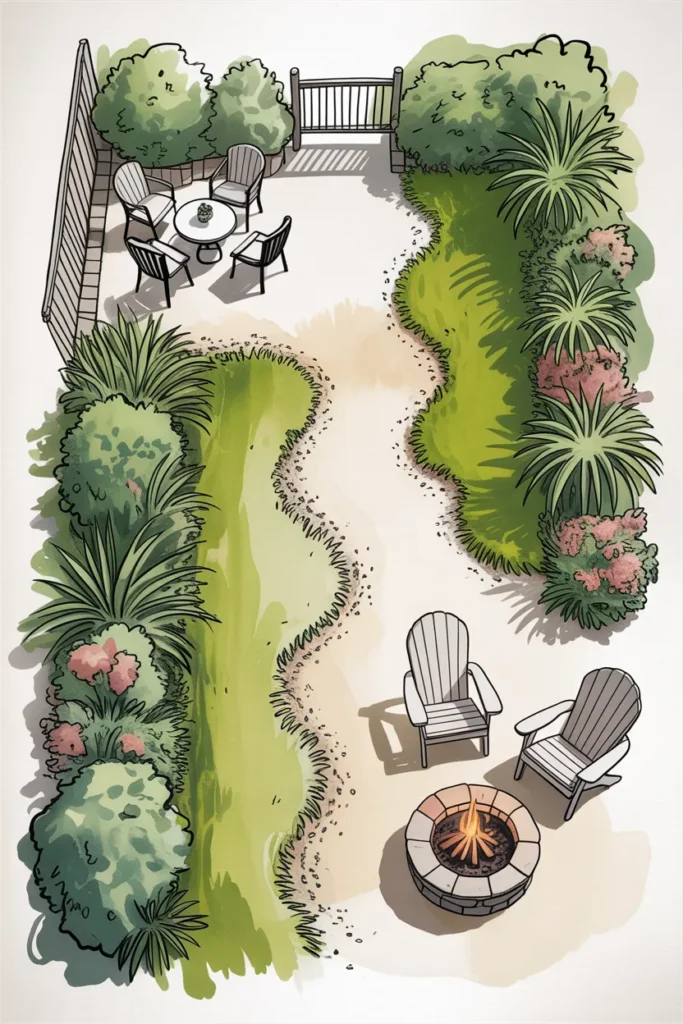
- Zone 1, the entry zone (first 30% of the yard): transition from the house. Patio, dining, the place you spill out of the back door with a glass of wine.
- Zone 2, the middle zone (middle 40%): the connector. Lawn, gravel, planted beds, a winding path. This is where most yards fall apart because people leave it blank.
- Zone 3, the back zone (final 30%): the destination. Fire pit, hammock, shed, raised garden, garden bench under a small tree. Give the eye somewhere to land.
Mark the transitions with material changes. Pavers become gravel. Gravel becomes lawn. Lawn becomes mulch. Your brain reads each shift as a new room, and a 40-foot yard suddenly feels like three small spaces instead of one long one. For deeper layout thinking on smaller lots, this guide on small backyard landscaping ideas walks through the same logic for tighter footprints.
The Rule of Three in Landscaping (And How It Saves Skinny Yards)
The rule of three says you should plant or place things in groups of three, not pairs and not singles. Threes look natural to the human eye. Pairs look staged. Singles look forgotten.
In a narrow yard this rule does double duty. Three matching planters along one fence creates visual rhythm. Three repeated shrubs at different points down the yard pulls the eye in a zigzag instead of a straight shot. Three identical lanterns on a fence break up the length without adding clutter.
A trick I tested last spring on my own 14-foot-wide strip: I bought three 16-inch fluted concrete planters from Target ($45 each), placed one near the patio, one halfway down on the opposite side, and one near the back fence. The yard instantly felt like it had structure. Total cost, $135. Total weekends, one.
18 Narrow Backyard Ideas, Zoned and Sorted
Entry Zone Ideas (Right Off the Back Door)
1. Lay a small paver patio wider than it is deep.
What it is: a 6 by 10 foot paver pad pushed against the house, oriented sideways.
Why it works: a horizontal patio cuts against the vertical pull of the yard. Your eye reads “room,” not “runway.” How to execute: gray concrete pavers from Home Depot run about $2-$4 each. For a 6 by 10 area you’ll need roughly 40 pavers, about $80-$160 total. Lay over compacted paver base and polymeric sand. Rental-friendly version: use 12-inch interlocking deck tiles from IKEA (RUNNEN series, around $35 for a 9-tile pack) directly over existing concrete or compacted gravel. No digging.
2. Hang a wall-mounted folding bistro table on the fence.
What it is: a 24 by 16 inch folding wooden table that mounts to a fence or exterior wall and drops down when you need it.
Why it works: keeps your tight footprint clear when not in use, but gives you a coffee spot for two. How to execute: search “wall mounted drop-leaf table” on Amazon, $40-$70. Mount into fence posts (not just slats) with 2.5-inch deck screws. Add two folding bistro chairs (around $30 each from Walmart) and you have a complete morning corner for under $130.
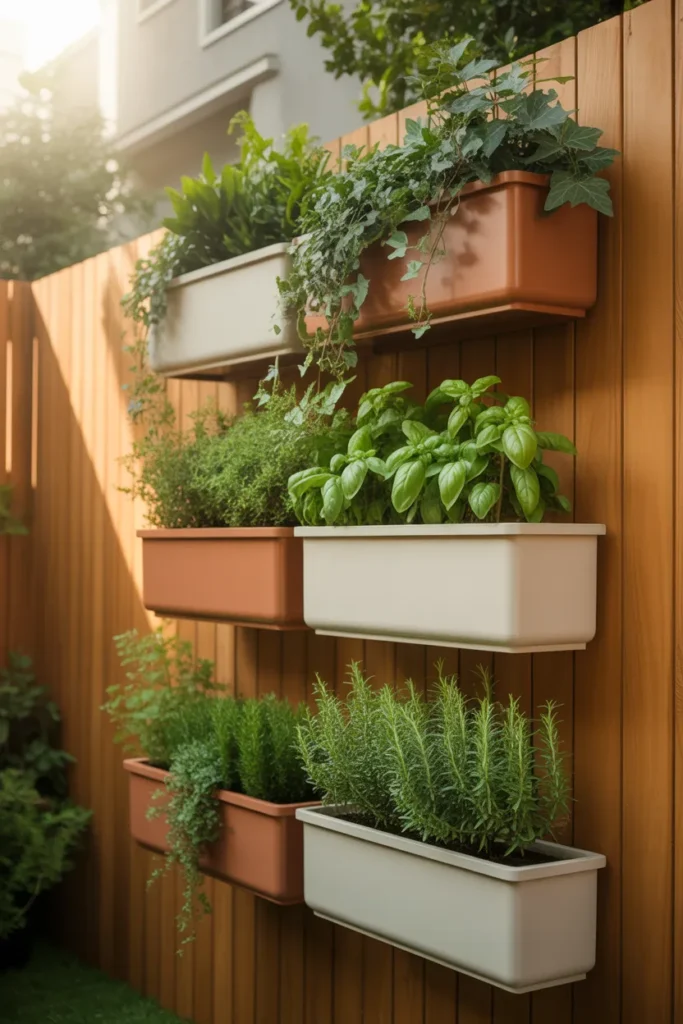
3. Use a vertical garden wall to plant up, not out.
What it is: a 3 by 6 foot wall-mounted planter system stocked with herbs, trailing greenery, or succulents.
Why it works: zero ground footprint, big visual payoff, and the height pulls the eye up off the narrow ground plane. How to execute: the IVAR shelving from IKEA can be repurposed into a vertical herb wall for under $90. Splurge version: a cedar living wall planter from West Elm runs $200-$300. For plant pairing in tight conditions, the University of Minnesota Extension’s landscape design and plant selection guide is a free, research-backed tool to filter by sun, soil, and mature size.
Middle Zone Ideas (The Connector)
4. Replace the straight path with a curved one.
What it is: a winding paver or gravel path that swings gently from one side of the yard to the other.
Why it works: a curve forces the eye to travel slower and the brain to register more space. A straight path tells the truth about how narrow you are. A curve hides it. How to execute: use 18-inch stepping stones from Lowe’s ($6-$10 each) set in pea gravel. Plan a soft S-curve, not a sharp zigzag. Budget for about 12 stones for a 30-foot run, total around $100 plus $50 for a half-yard of gravel.
5. Plant a sensory corridor along one fence.
What it is: a 24-inch deep planting bed running along just one long side of the yard, packed with herbs and grasses.
Why it works: scent and movement engage senses other than sight, which is the only sense that registers “narrow.” Brush past lavender and rosemary and you stop counting feet of width. How to execute: lavender, rosemary, catmint, ornamental sage, and feather reed grass all stay under 36 inches tall and tolerate Northern Hemisphere zones 5-9. Mid-range cost: 12 one-gallon plants from a local nursery at $10-$15 each, total $120-$180.
6. Use the “rule of three” with matching planters down one side.
What it is: three identical large planters spaced down one fence line.
Why it works: rhythm. The eye hops planter to planter and treats the yard as a sequence of moments instead of one empty stretch. How to execute: 18-inch fiberstone planters from Wayfair run about $60 each. Plant one with a small Japanese maple, one with mixed ornamental grasses, one with seasonal annuals. Total for trio: around $180 plus plants.
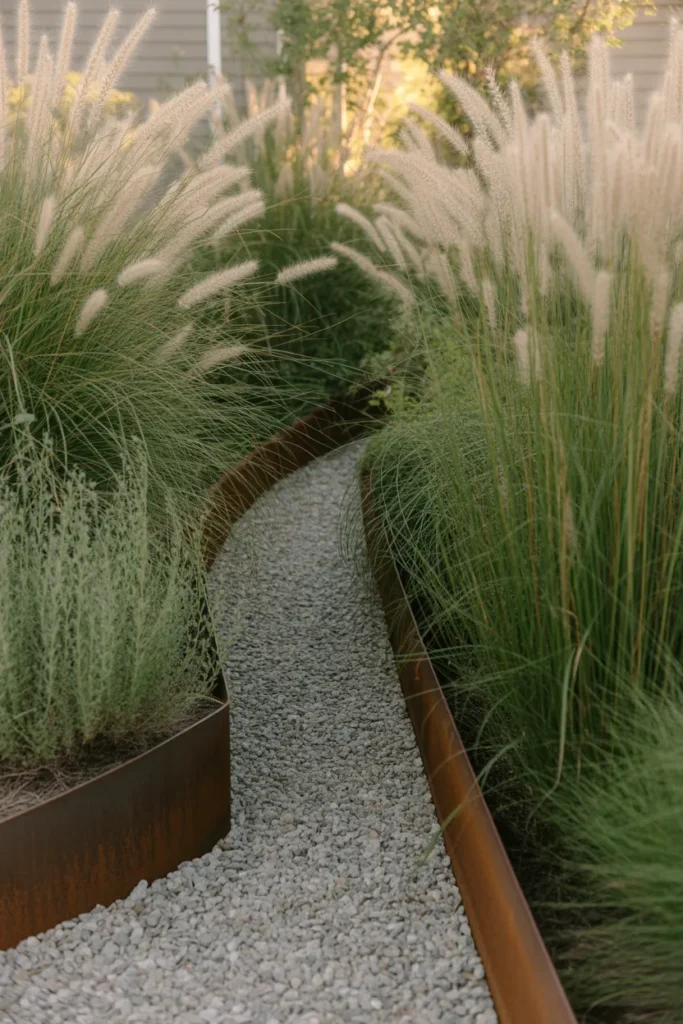
7. Add a narrow gravel runway with steel edging.
What it is: a 36-inch wide pea gravel strip down the middle of the yard, edged with corten steel.
Why it works: the dark steel edge creates a clean visual frame that makes the gravel read as a deliberate design element, not a shortage of grass. How to execute: corten steel landscape edging runs about $40 per 8-foot section at Home Depot. Pea gravel is $40-$60 per cubic yard. For a 30-foot runway, plan on $200-$300 total. Rental version: use galvanized steel edging from Lowe’s at half the price (around $20 per section).
8. Plant ornamental grasses for sway and screen.
What it is: a row of 4-6 ornamental grasses (Karl Foerster, Hameln fountain grass, little bluestem) placed at varied intervals.
Why it works: grasses move with the wind, which adds the one thing narrow yards usually lack: motion. They also screen the neighbor’s view without adding a wall. How to execute: one-gallon ornamental grasses run $12-$20 each at most US nurseries. Five plants will fill 15 linear feet for around $80. For more privacy-screen plant options matched to your region, the University of Maryland Extension keeps a free mixed privacy screen plant guide updated with research-based recommendations.
Back Zone Ideas (The Destination)
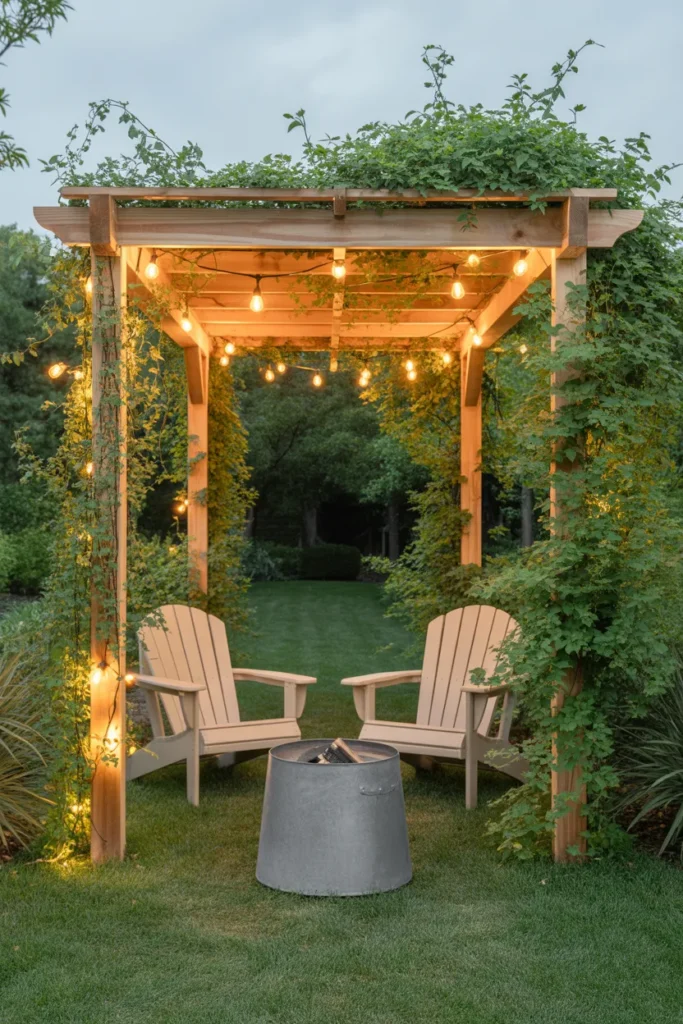
9. End the yard with a small pergola or arbor.
What it is: a 6 by 6 foot cedar pergola anchored at the back of the yard, optionally draped with climbing jasmine or string lights.
Why it works: this is the single best move for a long narrow yard. The pergola gives the eye a clear stopping point, which tells your brain the length is intentional. How to execute: a flat-pack cedar pergola kit from Home Depot runs $400-$800. Splurge version from Crate & Barrel or West Elm hits $1,200-$2,000. Add solar-powered Edison string lights ($25 from Target) and you have a finished destination for the cost of a long weekend.
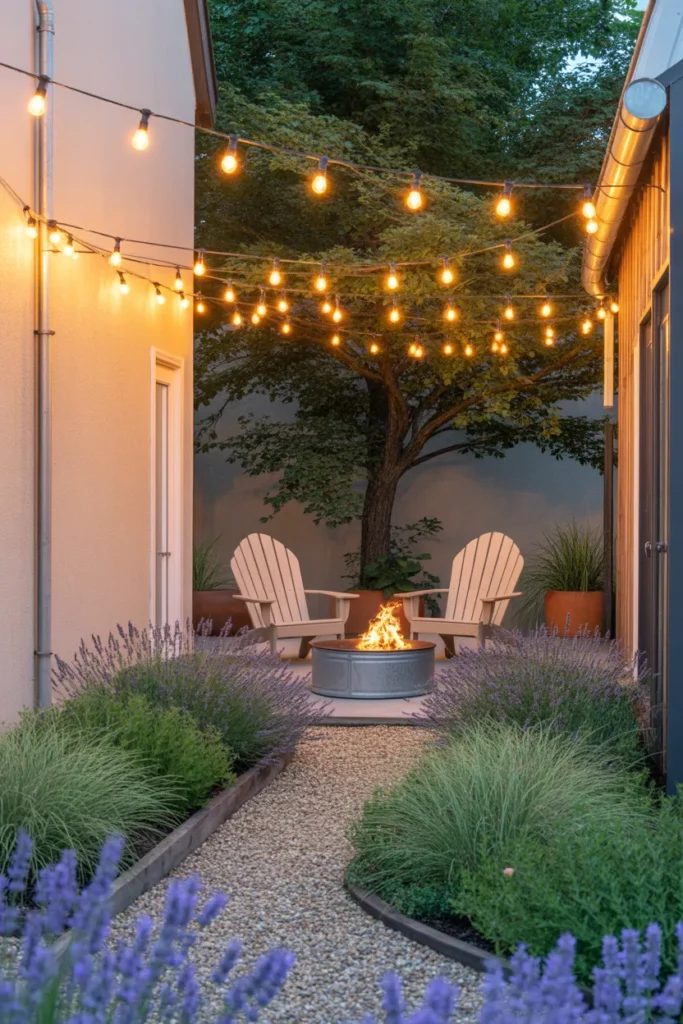
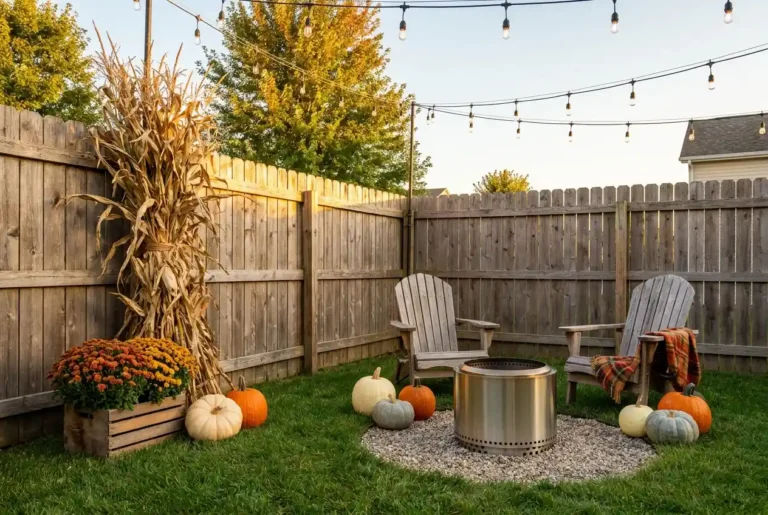
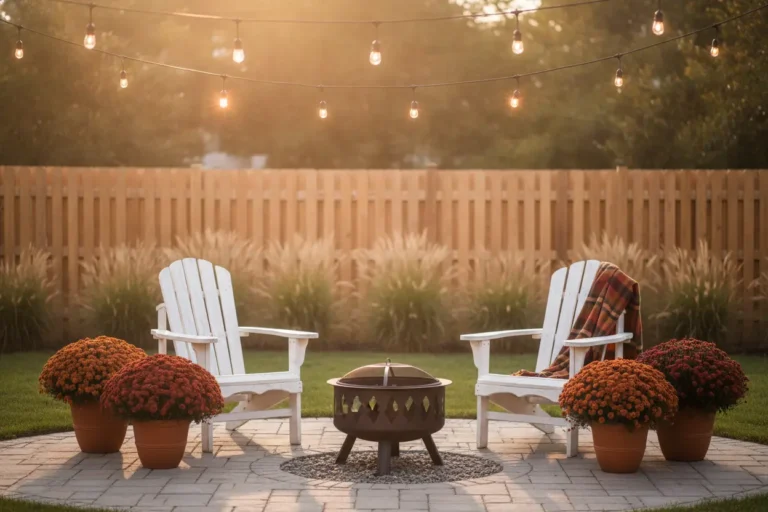
10. Install a small fire pit ring with three chairs.
What it is: a 24-inch galvanized steel or stone fire ring with three matching outdoor chairs arranged in a curve.
Why it works: a circular feature anywhere in a rectangular yard breaks the visual geometry. The eye reads it as a “room.” How to execute: a galvanized steel fire pit from Walmart runs $40-$80. Three folding Adirondack chairs from Target are about $80 each. Splurge: a cast concrete fire bowl from CB2 plus three resin Adirondacks from West Elm runs $700+.
11. Build a back-of-yard garden shed (storage + focal point).
What it is: an 8 by 6 foot wooden shed with a small front window, painted soft cream or sage.
Why it works: it gives the yard a “cottage at the end” effect, doubles your storage, and works in yards as narrow as 10 feet because it sits perpendicular to the long axis. How to execute: prefab kits from Home Depot run $1,200-$2,500. For more transformation inspiration with real numbers attached, the budget backyard ideas under $100 post covers smaller-scale focal point builds.
12. Hang a hammock or single swing at the back fence.
What it is: a freestanding hammock with a steel arc base, or a single rope swing from a sturdy fence post.
Why it works: introduces curves into a rectangular space, and a hammock at the far end pulls people physically toward the back of the yard. How to execute: freestanding hammock with steel frame from Amazon runs $80-$150. Cotton hammock with cream stripes adds the Pinterest-ready aesthetic.
Privacy and Screening Ideas
13. Stagger tall planters instead of building a wall.
What it is: three to five tall (36-48 inch) planters placed in a zigzag pattern, each holding a columnar evergreen or tall grass.
Why it works: it gives you privacy from the neighbor without the closed-in feeling of a solid fence or hedge wall, which is critical in a narrow yard. How to execute: 36-inch tall planters from IKEA (KRYDDPEPPAR series, around $60) plus skyrocket juniper or columnar boxwood ($40-$60 each from a local nursery). Total for five-planter setup: under $500.
14. Use a slatted horizontal wood screen at the back fence.
What it is: a 6 by 6 foot horizontal cedar slat screen mounted to the back fence, with 1-inch gaps between slats.
Why it works: horizontal lines widen a narrow space visually. The gaps let air and light through, so you don’t feel walled in. How to execute: a DIY cedar slat panel runs $80-$120 in materials from Lowe’s. Pre-built screens from Wayfair start at $180. Rental-friendly version: a freestanding cedar privacy screen on a weighted base ($150 from Amazon) needs no fence drilling.
Lighting and Atmosphere
15. Layer three light heights, not one.
What it is: string lights overhead, lanterns at eye level, and path lights at ground level.
Why it works: a single height of lighting flattens a yard. Three heights add depth and dimension after sunset, which is when most narrow yards either disappear or shine. How to execute: 48-foot Edison string lights from Target ($25), three solar lanterns at $20 each, and a 10-pack of solar path lights ($30 from Walmart). Total under $115 for a finished evening setup.
Budget vs Splurge: The Same Long Narrow Yard, Two Ways
| Element | Budget version (under $25 each) | Mid-range ($25-$100) | Splurge ($100+) |
|---|---|---|---|
| Planters (x3) | Plastic from Dollar Tree, spray-painted matte black, $5 each | 18-inch fluted concrete from Target, $45 each | 24-inch cast stone from West Elm, $180 each |
| Path | Mulch with stepping stones from Walmart, $15 total for 6 stones | Pea gravel with concrete steppers from Lowe’s, $150 | Bluestone slabs from a local stone yard, $600+ |
| Seating | Two folding bistro chairs from Walmart, $25 each | Two acacia bistro chairs from Target, $90 each | Teak bistro set from Crate & Barrel, $400+ |
| Lighting | Solar string lights from Amazon, $20 | Edison-bulb string lights from Target, $25 | Brass path lights from Pottery Barn, $400 |
| Focal point | DIY cedar privacy panel, $80 | Prefab arbor from Home Depot, $250 | Custom pergola installed, $2,500+ |
Total entry-level setup: about $250. Mid-range: about $1,100. Splurge: $4,500+.
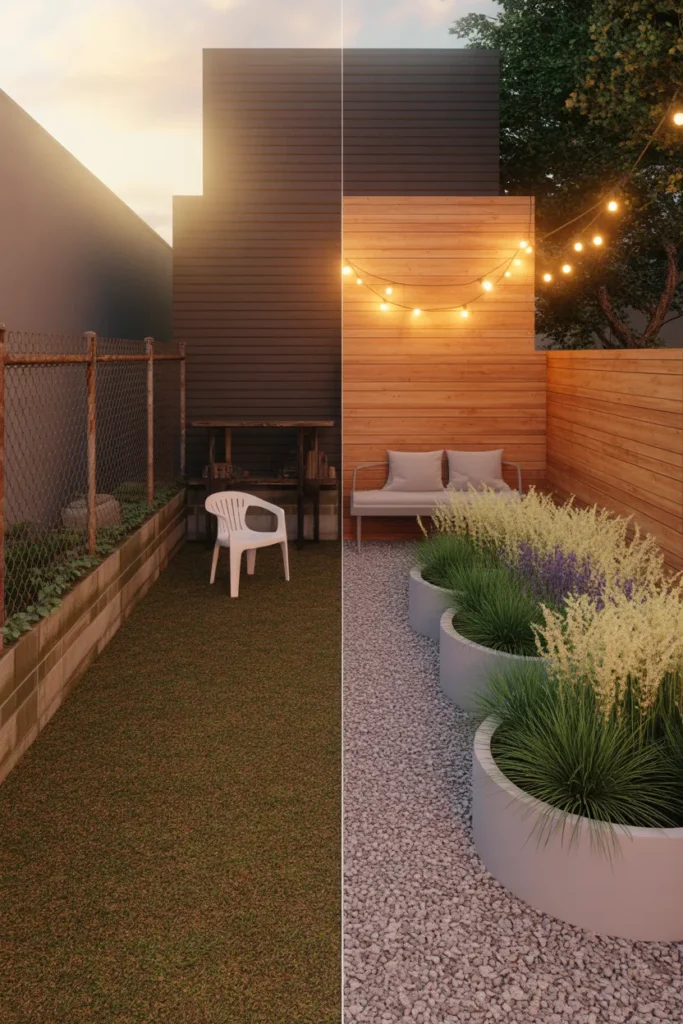
You can mix tiers. A splurge pergola plus dollar-store planters spray-painted matte black photographs almost identically to a head-to-toe splurge yard. The eye reads the silhouette, not the price tag.
Narrow Backyard Ideas for Kids and Pets
If kids or dogs share the yard, the three-zone framework still works. Just assign the middle zone as the play zone instead of pure landscape.
A 4 by 8 foot rubber mulch pad with a small swing set fits in yards as narrow as 12 feet. A sandbox (3 by 3 feet) tucks against one fence. For dogs, a 24-inch wide gravel “dog runway” along one side of the yard handles the back-and-forth path most dogs wear into the grass anyway, and saves the lawn.
Avoid these in a narrow kid yard: trampolines (they dominate the whole space visually), playhouses larger than 4 by 4 feet (block sight lines completely), and anything painted bright primary colors. Stick to natural wood and muted greens so the play gear blends in instead of taking over the entire visual field.
Narrow Backyard Ideas With a Pool
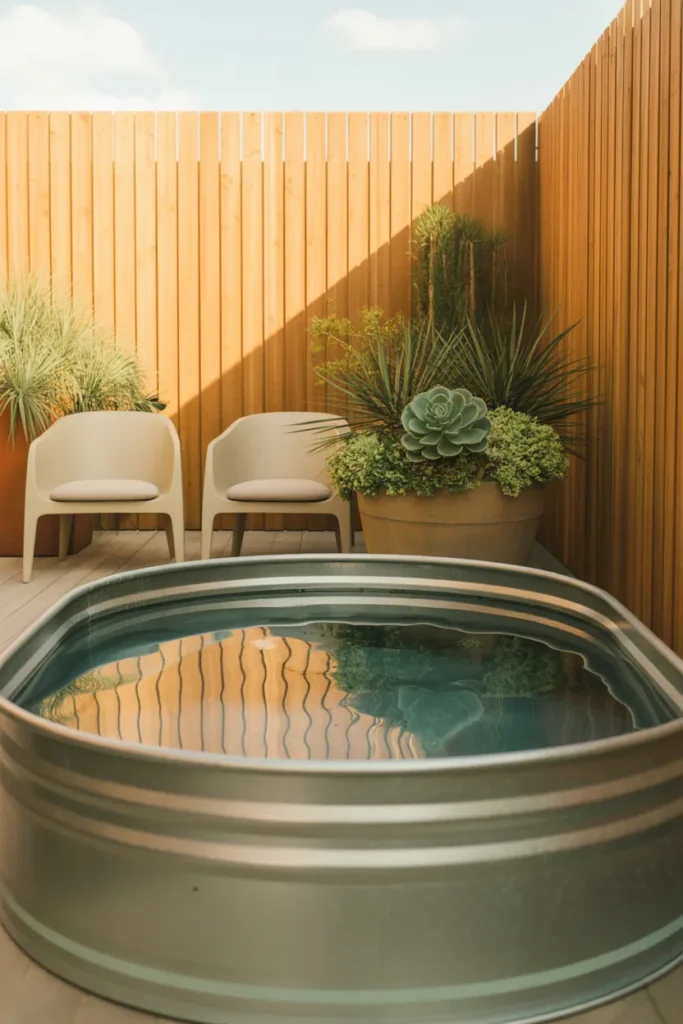
A 7 by 14 foot plunge pool or stock-tank pool fits in yards as narrow as 12 feet, oriented lengthwise. Push the pool against one long fence and use the other side as a 4-foot deck path with bistro seating at one end. The asymmetry actually helps: it tells the eye the yard isn’t symmetrical, which makes the width feel deliberate.
For pool-shape inspiration scaled to skinny lots, this small backyard ideas guide covers a few plunge-pool layouts that work under 15 feet wide.
A Dimension-Based Cheat Sheet
Pin this. It’s the only sizing guide you need for a long narrow yard.
| Yard width | Best path | Patio size | Privacy strategy | Back focal point |
|---|---|---|---|---|
| Under 10 ft | Single line of stepping stones, off-center | 5 by 7 ft against house | Vertical planters, slatted screen | Bistro set under string lights |
| 10-15 ft | 36-inch curved gravel path | 6 by 10 ft, oriented sideways | Staggered tall planters | Small fire pit with 3 chairs |
| 15-20 ft | Two parallel materials (gravel + lawn strip) | 8 by 12 ft, sideways | Mixed planting bed on one side | Pergola or arbor |
| 20-30 ft | Curved path with planted bed on both sides | 10 by 14 ft, sideways | Layered shrubs and grasses | Shed or garden room |
Common Mistakes to Avoid in a Narrow Backyard
After helping friends, family, and one very stubborn brother-in-law fix long skinny yards, these are the mistakes I see every single time:
- Painting the back fence a dark color. It pulls the back wall closer and shrinks the yard. Light cream, soft sage, or warm gray pushes the boundary back visually.
- Running a single path straight down the middle. Even Homes & Gardens calls this one out. Curve it or offset it.
- Buying patio furniture that’s too big. A full six-seat dining set in a narrow yard eats the entire patio zone. Stick to bistro sets, love seats, and bench seating for tight footprints.
- Planting symmetrical rows on both sides. Symmetry shrinks narrow yards. Asymmetry makes them feel found and intentional.
- Skipping a focal point at the back fence. The eye needs somewhere to land. Without a destination, the yard reads as unfinished.
- One height of plants only. A single hedge line at fence level flattens the yard. Layer ground covers, mid-height perennials, and one or two taller anchor pieces.
A Real Weekend Plan (If You Have Two Days and $300)
Saturday morning: measure the yard, mark three zones with painter’s tape on the lawn, buy materials. Three matching planters ($135), one bag of pea gravel ($6), 12 stepping stones ($72 if you go with 18-inch concrete from Lowe’s), one string of solar Edison lights ($25).
Saturday afternoon: lay the stepping stone path in a soft S-curve. Place planters at varied points down one fence. Hang string lights overhead from house to fence post.
Sunday: plant the planters (one tall grass, one trailing flowering plant, one shrub). Add a folding bistro set to your entry zone. Stand back. The yard already reads as three rooms instead of one tube.
Total spend: roughly $300. Total time: about 12 hours. The transformation feels like a $3,000 project.
Frequently Asked Questions
What can I do with a narrow backyard?
Split it into three zones (entry, middle, back), break the sight line with a curved path or a focal point at the far end, and pull the eye sideways with planters or screens on one side. Even a 10 by 30 foot yard can hold a patio, a winding path, and a back-fence destination if you zone it instead of treating it as one long lane.
What is the rule of three in landscaping?
Plant or place objects in groups of three rather than pairs or singles. Threes look organic and intentional to the human eye. In a narrow yard, three matching planters down one fence, three repeated shrubs at staggered points, or three layered plant heights (ground cover, mid-height, anchor) all create rhythm that makes the yard feel designed.
What is a small privacy idea for a backyard?
Stagger three tall planters with columnar evergreens (like skyrocket juniper or columnar boxwood) along the property line you want to screen. It gives 6 feet of privacy at strategic points without the closed-in feeling of a continuous hedge or fence, which matters more in narrow yards than wide ones.
How do I make a narrow backyard work for kids?
Use the middle zone as the play zone. A 4 by 8 foot rubber mulch pad fits a small swing set in yards as narrow as 12 feet. Tuck a 3 by 3 foot sandbox against one fence. Stick to natural wood tones and muted colors so the play gear blends in instead of dominating the sight line.
What is the budget version of these narrow backyard ideas?
You can pull off the full zoned-yard look for under $300. Dollar Tree planters spray-painted matte black, mulch with stepping stones from Walmart, folding bistro chairs at $25 each, and a single string of solar Edison lights from Amazon. The silhouette is what photographs, not the price tag.
How do I do this in a rental?
Stick to no-dig, removable solutions. Interlocking deck tiles over existing concrete, freestanding cedar privacy screens on weighted bases, large planters instead of in-ground beds, and command-strip-safe solar string lights with adhesive clips. A renter can build the entire three-zone framework and roll it out at move-out.
What if I don’t have a back fence to anchor my focal point?
Use a freestanding focal point instead. A 6 by 6 cedar pergola anchors itself, a metal arbor planted with climbing jasmine works without a fence, and a triangular grouping of three tall planters can serve as a “soft wall” focal moment. Anything that gives the eye somewhere to land works.
How long does a full narrow backyard makeover take?
A zoned narrow-yard refresh with paths, planters, lighting, and a small focal point takes one to two weekends for one or two people working at a normal pace. A full pergola build with planting beds and a paver patio stretches to three to four weekends. Plan for one weekend per zone if you’re working solo.
Save This for Your Next Yard Weekend
A long narrow yard isn’t a problem to fix. It’s a layout to read correctly. Zone it into three rooms, curve your path, layer your privacy, and anchor the back fence with a destination worth walking toward. Everything else is just shopping.
Pin the dimension cheat sheet above so you have it when you’re standing in the Home Depot aisle wondering whether 18-inch or 24-inch pavers are right for your width. And if you’re working with under $100 total, the budget backyard ideas under $100 guide has the cheap-but-photogenic combinations I keep coming back to.
Which zone are you starting with this weekend, the entry, the middle, or the back?